Affording a Ferrari means understanding the full financial picture: purchase price, financing structure, ongoing ownership costs, and the alternatives available when outright purchase is not yet viable.
This guide covers Ferrari pricing across every tier, the income and credit requirements lenders expect, financing and leasing options, total ownership costs, tax and investment considerations, and practical alternatives for experiencing a Ferrari without full ownership.
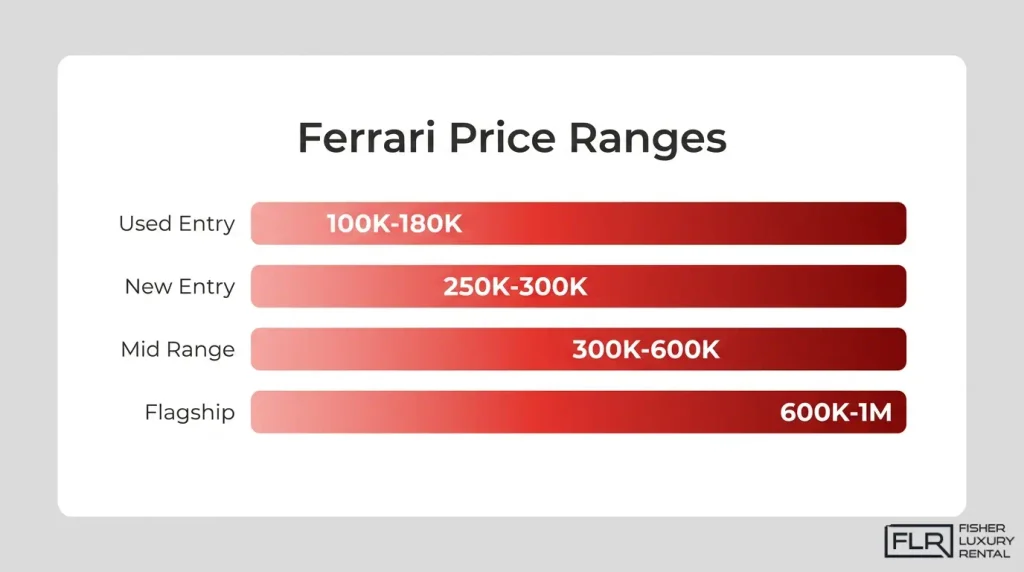
New Ferraris start around $250,000, with flagship models like the SF90 Stradale reaching nearly $1 million depending on configuration. Entry-level and mid-range models such as the Roma and Portofino occupy the lower end of that spectrum, while used examples can be found for less depending on mileage and model year.
Financing a Ferrari requires more than a strong credit score. Lenders typically expect a score of 740 or above, a down payment of 10% to 20%, and an income capable of keeping total transportation costs within responsible limits. Exotic car loan rates can reach as high as 10%, making financial preparation as important as the purchase decision itself.
Beyond the sticker price, Ferrari owners absorb annual insurance premiums, maintenance costs, depreciation, taxes, and registration fees that compound significantly over time. Leasing and business-use structures can reduce net cost, and certain collector models have shown dramatic long-term appreciation.
For those not yet ready for ownership, renting a Ferrari, attending a driving experience event, or starting with a more accessible exotic car each provide meaningful entry points into high-performance driving without the full financial commitment.
How Much Does a Ferrari Actually Cost?
Ferrari prices span a wide range depending on the model, trim, and configuration. The sections below break down costs by tier: entry-level, mid-range, flagship, and used.
How Much Does a New Entry-Level Ferrari Cost?
A new entry-level Ferrari costs approximately $250,000 at its starting price, with most current models ranging between $300,000 and $600,000 depending on configuration. The Portofino M sits at the accessible end of the lineup, making it the most common starting point for first-time Ferrari buyers. Even at the entry tier, personalization options through Ferrari’s Tailor Made program can push the final price well above the base MSRP. For most buyers, the sticker price is just the beginning of the financial commitment.
How Much Does a Mid-Range Ferrari Like the Roma or 296 GTB Cost?
A mid-range Ferrari like the Roma starts at $247,308, according to TrueCar pricing data. For comparison, the Ferrari Portofino starts at $218,750, placing the Roma at a modest premium for its more coupe-focused grand touring character. The 296 GTB, Ferrari’s hybrid mid-engine sports car, carries a higher starting price within this tier. Options, carbon fiber packages, and bespoke color choices routinely add $20,000 to $50,000 or more to any of these configurations.
How Much Does a Flagship Ferrari Like the SF90 or 812 Cost?
A flagship Ferrari like the SF90 Stradale starts at approximately $593,950 and can reach $995,000 depending on trim and options, according to Car and Driver. The 812 Superfast and 812 Competizione occupy a similar price altitude. At this tier, buyers are purchasing hybrid hypercars or limited-production V12 models with performance benchmarks that rival track machinery. These prices reflect Ferrari’s position at the absolute pinnacle of road car engineering, and allocation for flagship models is often invite-only.
How Much Does a Used Ferrari Cost?
A used Ferrari costs significantly less than new, though prices vary widely by model, mileage, service history, and collector demand. Entry-level models like older California or Portofino variants can be found in the $100,000 to $180,000 range, while certified pre-owned F8 Tributos and Roma models typically trade between $200,000 and $280,000. Collector-grade models tell a completely different story. Ferrari’s average depreciation over the first three years sits at just 15%, meaning even recent used examples retain most of their value compared to other luxury vehicles.
What Income Do You Need to Afford a Ferrari?
The income needed to afford a Ferrari depends on purchase price, financing terms, and how much of your gross income you dedicate to transportation costs. The sections below cover annual income thresholds, recommended net worth, and the payment-to-income ratio you should target.
What Annual Income Do You Need to Buy a Ferrari With Financing?
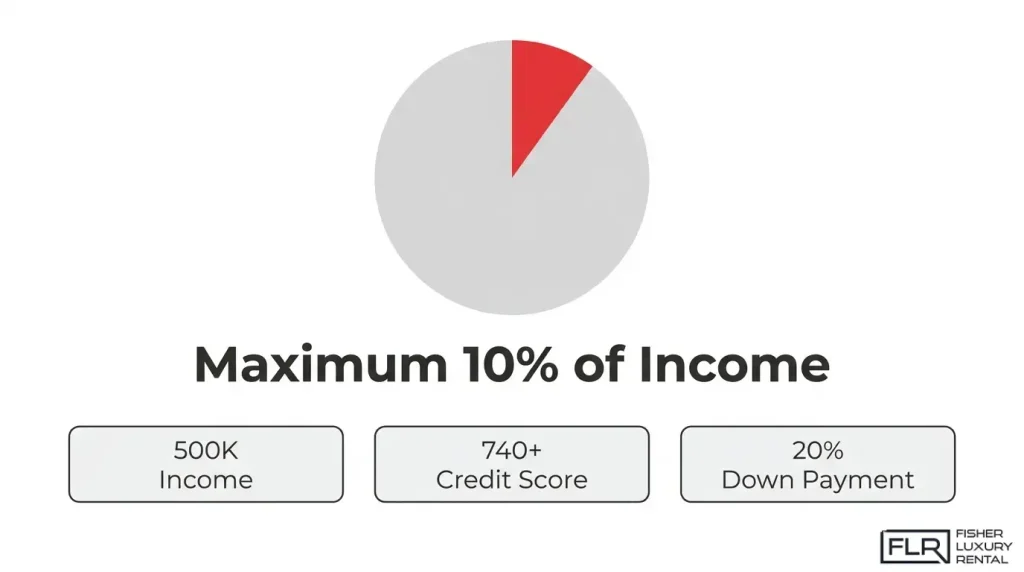
The annual income you need to buy a Ferrari with financing starts at roughly $500,000 for an entry-level model, though most financial advisors recommend significantly more. A new Ferrari starts around $250,000, with many models ranging between $300,000 and $600,000 or more. Using the 20/4/10 rule, which caps total transportation costs at 10% of gross income, financing a $300,000 Ferrari with 20% down over four years produces a monthly payment that requires an annual gross income well above $500,000 to stay within responsible limits. Exotic car interest rates can reach up to 10%, compressing affordability further for buyers near that threshold.
What Net Worth Should You Have Before Buying a Ferrari?
The net worth you should have before buying a Ferrari is generally at least 10 to 20 times the vehicle’s purchase price, meaning $2.5 million to $5 million minimum for most models. Ferrari vehicles depreciate an average of 15% in the first three years according to The Money Calculator, meaning a $300,000 car could lose $45,000 in value before your loan is paid off. Tying up a significant portion of liquid net worth in a depreciating asset creates real financial risk. Buyers with strong net worth can better absorb that loss without compromising their overall financial position.
What Percentage of Your Income Should a Ferrari Payment Represent?
Your Ferrari payment should represent no more than 10% of your gross monthly income, following the 20/4/10 rule. According to Capital One, that rule already demands $8,030 in monthly income to comfortably finance a $30,000 sedan. Scaling that ratio to a $300,000 Ferrari implies a required monthly income exceeding $80,000, or roughly $960,000 annually. Keeping your payment within this ceiling protects cash flow for insurance, maintenance, and other ownership costs that compound quickly with an exotic car.
How Can You Finance a Ferrari Purchase?
Ferrari financing options include traditional auto loans, manufacturer programs, leasing, balloon payment structures, and home equity loans. Each approach suits different financial profiles, ownership goals, and tax situations.
How Does a Traditional Auto Loan Work for a Ferrari?
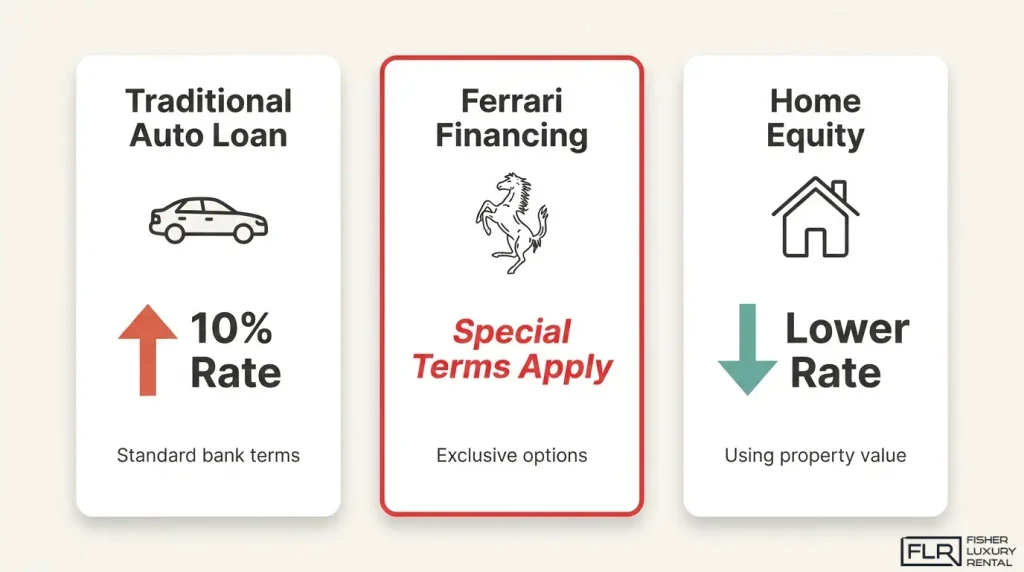
A traditional auto loan works by borrowing a fixed amount from a lender, then repaying principal plus interest in equal monthly installments over an agreed term. Most banks and credit unions treat Ferraris as exotic vehicles, which means stricter approval criteria and larger required down payments than standard car loans. Lenders typically want strong income documentation, low debt-to-income ratios, and substantial collateral. Notably, appreciating models can strengthen your application: according to Autobahn Alpha, the Ferrari F40’s value climbed from $308,000 in 2003 to over $3.5 million in 2026, demonstrating that certain Ferraris serve as genuine collateral assets.
How Does Ferrari Financial Services Financing Work?
Ferrari Financial Services financing works by offering manufacturer-backed loans and lease products exclusively for Ferrari buyers through authorized dealerships. Because it operates within Ferrari’s retail network, the program can accommodate custom configurations, extended warranties, and factory-aligned residual values. Rates and terms vary by model, credit profile, and region, but the program’s primary advantage is access to promotional rates and terms tailored to high-value Ferraris that general banks rarely match.
How Does Leasing a Ferrari Differ From Buying?
Leasing a Ferrari differs from buying in that you pay for depreciation during the lease term rather than the vehicle’s full value. Monthly lease payments are typically lower than loan payments on the same model, and you return the car at term’s end without managing resale. Buying, by contrast, builds equity and allows unlimited mileage but exposes you to full depreciation risk. Leasing suits drivers who want a current model every few years; buying suits those prioritizing long-term ownership or investment potential.
How Does a Balloon Payment Loan Work for Exotic Cars?
A balloon payment loan works by splitting the loan into lower monthly payments throughout the term, with a large lump-sum payment due at the end. This structure keeps near-term cash flow manageable on a high-value asset like a Ferrari. The trade-off is real: according to LendingTree, exotic car interest rates can reach as high as 10%, meaning the deferred balance accrues significant interest before the balloon comes due. Borrowers typically refinance, sell, or pay off the balloon at maturity. This approach is best suited to buyers expecting a liquidity event or asset sale near the loan’s end date.
Can You Use a Home Equity Loan to Finance a Ferrari?
Yes, you can use a home equity loan to finance a Ferrari by borrowing against the equity built in your primary residence. Home equity loans generally carry lower interest rates than exotic car loans because your home secures the debt. The risk, however, is substantial: defaulting puts your residence in jeopardy, not just the car. This path makes the most sense when the rate differential is significant and the borrower maintains strong emergency reserves alongside the new payment obligation.
What Credit Score and Financial Profile Do You Need for Ferrari Financing?
Ferrari financing requires a strong credit profile, a substantial down payment, and an understanding of available loan terms. The sections below cover the credit score threshold lenders expect, typical down payment requirements, and the loan term options you will encounter.
What Credit Score Do Ferrari Lenders Typically Require?
Ferrari lenders typically require a credit score of 740 or above to qualify for the most competitive rates. According to SoFi, borrowers with excellent credit in that range are more likely to secure lower interest rates, which can significantly reduce the total cost of purchasing an exotic vehicle. Lenders treat Ferraris as high-risk collateral given their price points, so scores below that threshold often result in higher rates or outright rejections. A score of 740+ is the practical floor, not just a nice-to-have.
What Down Payment Do You Need for a Ferrari Loan?
The down payment for a Ferrari loan typically ranges from 10% to 20% of the purchase price. On a $300,000 Ferrari, that means bringing $30,000 to $60,000 to the table upfront. Some specialty lenders serving the exotic car market may require higher down payments to offset depreciation risk and loan-to-value exposure on high-value vehicles. A larger down payment also reduces your monthly obligation and signals financial stability to lenders reviewing your full credit profile.
What Loan Terms Are Available for Ferrari Financing?
The loan terms available for Ferrari financing range from standard 72- to 84-month periods up to extended options. According to LendingTree, some exotic car financing lenders offer loans of up to 180 months, though 72- to 84-month terms are far more common. Longer terms lower monthly payments but increase total interest paid over the life of the loan, which is a meaningful cost difference on a $300,000+ purchase. For most buyers, a 72-month term balances payment manageability with total borrowing cost.
How Much Does It Cost to Own a Ferrari Beyond the Purchase Price?
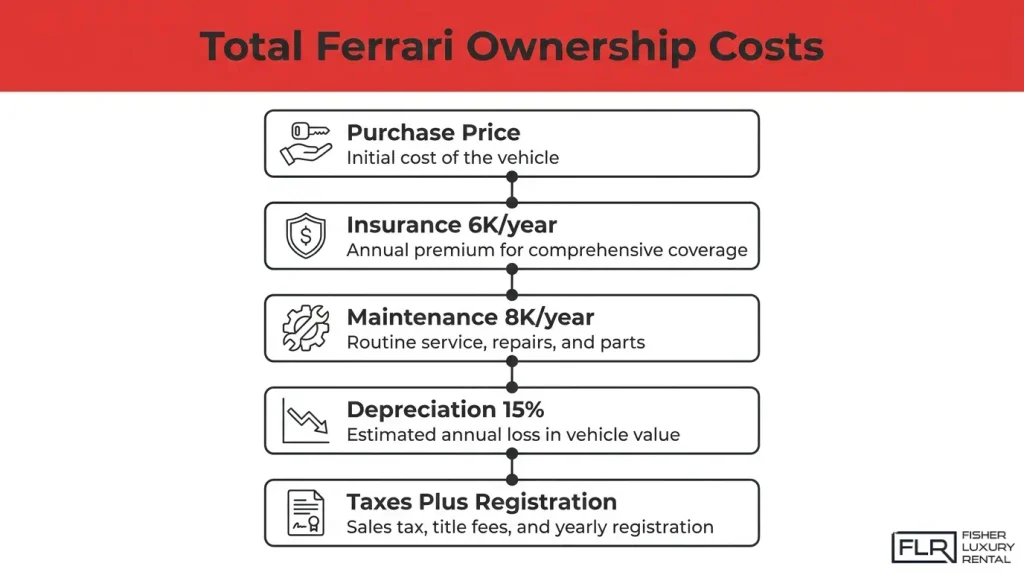
Owning a Ferrari costs significantly more than the sticker price. Beyond financing, owners budget for insurance, scheduled maintenance, parts, depreciation, and taxes, each of which adds thousands of dollars annually.
How Much Does Ferrari Insurance Cost Per Year?
Ferrari insurance costs considerably more than standard vehicle coverage. According to Policygenius, exotic and luxury car insurance averages $5,954 per year even for a BMW 740i, a benchmark vehicle far less expensive than most Ferraris. A Ferrari’s higher replacement value, performance capability, and specialized repair requirements push premiums well above that figure. The 20-4-10 rule from CNBC recommends keeping total transportation costs below 10% of gross income, and insurance alone can consume a meaningful share of that budget on a Ferrari.
How Much Does Scheduled Ferrari Maintenance Cost?
Scheduled Ferrari maintenance costs between $3,500 and $8,000 per year for models such as the 488 or F8, averaged across routine and major service intervals for owners driving 3,000 to 6,000 miles annually, according to Exotics Hunter. Major service milestones, including belt replacements and fluid overhauls, spike costs in specific years. Skipping authorized service schedules is a false economy: deferred maintenance reduces resale value and increases the risk of expensive mechanical failures.
How Much Do Ferrari Repairs and Parts Cost?
Ferrari repairs and parts cost substantially more than those for mainstream vehicles due to proprietary components, limited-availability parts, and factory-trained labor requirements. Brake systems, clutches, and suspension components routinely run into the thousands per replacement. Owners should budget a dedicated contingency reserve annually, separate from scheduled maintenance, because a single unplanned repair can equal or exceed the entire yearly maintenance budget.
How Much Does Ferrari Depreciation Affect Total Ownership Cost?
Ferrari depreciation affects total ownership cost meaningfully for modern production models, though far less severely than average vehicles. Ferrari vehicles depreciate an average of 15% over the first three years from new, according to The Money Calculator. On a $300,000 Ferrari, that represents roughly $45,000 in lost value. The IRS notes that business owners who use a vehicle exclusively for business may deduct its entire cost of ownership, which can partially offset this depreciation impact for qualifying buyers.
How Much Do Taxes and Registration Add to Ferrari Ownership?
Taxes and registration add a significant one-time and recurring cost to Ferrari ownership. Sales tax alone on a $300,000 vehicle can exceed $20,000 to $30,000 depending on the state. Annual registration fees for high-value vehicles vary by state but frequently run several hundred to over a thousand dollars per year. Luxury vehicle excise taxes in certain states further increase the first-year acquisition cost beyond the vehicle’s sticker price.
Is Leasing a Ferrari a Smarter Way to Afford One?
Leasing a Ferrari can be a smarter way to afford one for drivers who want lower monthly payments and flexibility without a long-term ownership commitment. The sections below cover monthly payment ranges, mileage restrictions, and business deduction eligibility.
What Are the Monthly Payments When Leasing a Ferrari?
Monthly payments when leasing a Ferrari typically range from $3,000 to $6,000 or more, depending on the model, lease term, residual value, and money factor set by the lessor. Entry-level models like the Roma carry lower payments than flagship models such as the SF90. Because lease payments are calculated on depreciation rather than the full vehicle price, they run meaningfully lower than loan payments on the same car. For high earners who want access to a current-model Ferrari without tying up capital in a depreciating asset, leasing often delivers better cash-flow efficiency than financing a purchase outright.
What Mileage Restrictions Apply to a Ferrari Lease?
Mileage restrictions on a Ferrari lease commonly cap annual driving at 5,000 to 10,000 miles per year, significantly lower than standard vehicle leases. Exceeding the cap triggers per-mile overage penalties that can add thousands of dollars to the final bill. Drivers who commute daily or plan extended road trips will find these limits restrictive. Leasing works best for owners who treat the Ferrari as a weekend or event car rather than a primary vehicle.
Can You Write Off a Ferrari Lease as a Business Expense?
Yes, you can write off a Ferrari lease as a business expense, but only for the portion of use that is documented as business-related. According to the IRS, if a car is used for both business and personal purposes, only the business-use percentage of the lease payment is deductible. Purely personal use generates no deduction. Meticulous mileage logs are essential, as the IRS requires documentation to substantiate any vehicle deduction. Business owners who can demonstrate genuine commercial use gain a meaningful tax advantage that makes leasing more cost-effective than personal ownership of the same car.
Can You Buy a Ferrari as a Business or Investment?
Yes, you can buy a Ferrari as a business or investment, and both strategies offer real financial upside when structured correctly. The sections below cover business tax benefits, appreciation potential, and which models hold value best.
How Can a Business Purchase or Lease a Ferrari for Tax Benefits?
A business can purchase or lease a Ferrari for tax benefits, but deductions depend entirely on how the vehicle is used. According to the IRS, if a vehicle is used exclusively for business purposes, its entire cost of ownership and operation may be deducted. Mixed personal and business use limits the deduction to the business-use percentage only.
For 2026, luxury auto limitations under Section 179 cap first-year depreciation at $20,200, according to Block Advisors. Given a Ferrari’s six-figure price tag, this cap makes leasing a more tax-efficient structure for many business owners, since lease payments are deductible in proportion to business use without the depreciation ceiling affecting the full vehicle cost.
Do Ferraris Appreciate in Value as Investments?
Ferraris do appreciate in value as investments, but only specific models, conditions, and ownership histories drive meaningful gains. The Ferrari F40’s value climbed from $308,000 in 2003 to over $3.5 million in 2026, according to Autobahn Alpha. Ferrari F50 values increased over 60% in a single year, reaching an average sale price of $5.3 million, per Curated.
Limited production runs, racing heritage, and factory originality are the primary appreciation drivers. Most daily-driven, high-mileage Ferraris do not replicate these returns.
Which Ferrari Models Hold Their Value Best?
The Ferrari models that hold their value best share three characteristics: limited production, iconic status, and documented provenance. Based on market performance, the strongest performers include:
- Ferrari F40: Climbed from $308,000 in 2003 to over $3.5 million by 2026.
- Ferrari F50: Average sale price reached $5.3 million after a 60%+ single-year increase.
- Ferrari Enzo: Consistently appreciates due to its flagship, limited-production status.
- Ferrari LaFerrari: Hybrid hypercars with restricted allocation have shown sustained value growth.
Modern volume models such as the Roma or Portofino follow more typical depreciation curves and are better suited to driving enjoyment than investment return.
What Are Common Mistakes People Make When Trying to Afford a Ferrari?
The common mistakes people make when trying to afford a Ferrari include underestimating total ownership costs, overextending financing, neglecting credit preparation, and treating every Ferrari as an appreciating investment. Understanding these pitfalls before committing prevents financial strain that can turn a dream purchase into a burden.
The most frequent errors fall into four categories:
- Ignoring total cost of ownership: Buyers focus on the purchase price while overlooking annual maintenance budgets of $3,500 to $8,000, insurance premiums, and registration fees that compound year over year.
- Overextending on financing: Exotic car loan rates can reach as high as 10%, according to LendingTree. Stretching into maximum loan terms to lower monthly payments dramatically inflates the total amount paid.
- Skipping credit preparation: Borrowers with scores below 740 typically face significantly higher interest rates on exotic car loans, increasing the true cost of ownership by thousands annually.
- Assuming all Ferraris appreciate: While collector models like the F40 have gained extraordinary value over decades, most modern production Ferraris depreciate an average of 15% within the first three years, making appreciation a poor primary justification for purchase.
- Underbudgeting the down payment: Entering a Ferrari purchase without a substantial down payment increases loan-to-value ratios and reduces lender options, often resulting in less favorable terms.
Experienced exotic car buyers treat the financing decision as seriously as the vehicle selection itself — the wrong financial structure on the right car can be just as damaging as buying the wrong car entirely.
What Are Alternatives if You Cannot Afford to Buy a Ferrari Yet?
Alternatives to buying a Ferrari include renting an exotic car, attending a Ferrari driving experience event, or starting with a more affordable exotic car. Each option lets you engage with high-performance vehicles at a fraction of full ownership costs.
Can Renting an Exotic Car Satisfy the Ferrari Experience Without Ownership?
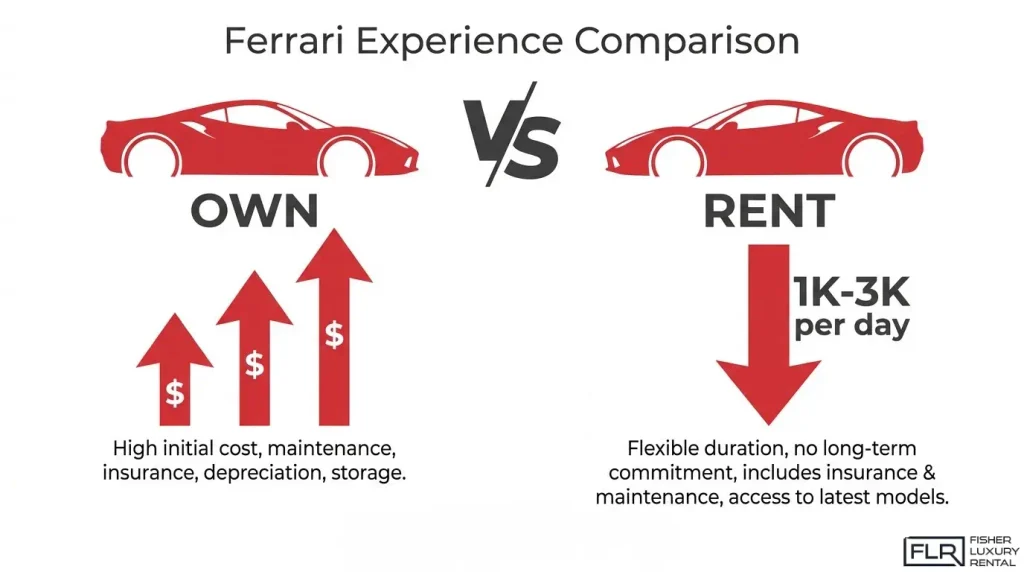
Yes, renting an exotic car can satisfy the Ferrari experience without the financial commitment of ownership. A 24-hour Ferrari rental typically ranges from $1,000 to $3,000 or more depending on the model, according to Luxo Exotics. For context, that is a fraction of the annual insurance, maintenance, and depreciation costs a full owner absorbs. Renting delivers the performance, styling, and prestige of driving a Ferrari without a six-figure purchase, ongoing service bills, or storage responsibilities. For enthusiasts who want occasional access rather than daily ownership, rental is arguably the most financially intelligent entry point. Fisher Luxury Rental offers exactly this kind of access in the Phoenix and Portland areas, with a fleet of top-trim exotic vehicles available for short-term rental with no ownership obligations.
Is a Ferrari Driving Experience Event Worth the Cost?
A Ferrari driving experience event is a structured program where participants drive factory or fleet Ferraris on a closed track under professional supervision. These events typically cost far less than a rental day and provide a controlled, high-performance environment optimized for first-time exotic car drivers. For first-time exotic car drivers who want a less structured introduction, renting through a company like Fisher Luxury Rental, which specializes in top-trim luxury and exotic vehicles, can offer a comparable first taste with more freedom in how and where you drive.The trade-off is limited freedom: routes, duration, and conditions are fixed. For someone building confidence with high-performance vehicles before committing to ownership or rental, these events offer genuine value with minimal financial risk.
Should You Start With a More Affordable Exotic Car First?
Yes, starting with a more affordable exotic car is a practical stepping stone toward eventual Ferrari ownership. The 2025 Porsche 911 Carrera starts at $120,100 and the 2026 Aston Martin Vantage starts at $194,500, both delivering supercar performance at meaningfully lower price points than a Ferrari’s entry-level cost. Ownership of either builds familiarity with exotic car insurance, maintenance schedules, and financing structures before stepping up. This staged approach reduces financial overreach and gives buyers a realistic preview of exotic ownership costs.
With these alternatives in mind, Fisher Luxury Rental offers one of the most direct paths to the Ferrari experience.
How Can You Experience a Ferrari Without Full Ownership Costs?
You can experience a Ferrari without full ownership costs by renting one through a luxury exotic car rental company. The sections below cover how Fisher Luxury Rental makes that possible and recap the key takeaways from this guide.
Can Fisher Luxury Rental Give You the Ferrari Experience at a Fraction of the Cost?
Yes, Fisher Luxury Rental can give you the Ferrari experience at a fraction of the cost of ownership. A Ferrari rental typically ranges from $1,000 to $3,000 per day, compared to the hundreds of thousands required to purchase, insure, and maintain one. Fisher Luxury Rental serves the Phoenix, AZ and Portland, OR areas, offering top-trim exotic vehicles with no long-term financial commitment. There are no financing approvals, no insurance premiums averaging thousands per year, and no depreciation exposure. For drivers who want the thrill without the balance sheet, renting is the most accessible path to the wheel of a Ferrari.
What Are the Key Takeaways About How to Afford a Ferrari?
The key takeaways about how to afford a Ferrari are centered on financial readiness, smart structuring, and realistic alternatives. Ownership involves far more than the sticker price: financing, insurance, maintenance, and depreciation all compound the true cost. The most important lessons from this guide are:
- Purchase price starts around $250,000 and easily exceeds $600,000 for flagship models.
- Financing typically requires a credit score of 740 or above to secure competitive rates.
- Loan terms of 72 to 84 months are most common for exotic car financing.
- Insurance and maintenance add thousands of dollars per year on top of loan payments.
- Leasing and business use can reduce net cost through structured deductions.
- Renting delivers the full Ferrari experience with zero ownership obligations.
For most people, renting remains the smartest first step toward the Ferrari experience.