Ferrari is an Italian high-performance automaker founded by Enzo Ferrari in Maranello, rooted in motorsport competition and built on a philosophy that treats racing as the foundation for every road car the company produces.
This guide covers Ferrari’s founding history and name, the origins of the Prancing Horse logo, the key eras that shaped the brand, its core values and design philosophy, its Formula 1 legacy, the most iconic models ever built, how Ferrari compares to rivals, why its cars hold value, what driving one actually feels like, and how to experience one through exotic car rental.
Enzo Ferrari’s path from Alfa Romeo racing driver to independent automaker established the competitive DNA that still governs Ferrari’s engineering approach today. The Ferrari name itself traces to an Italian occupational surname meaning blacksmith, a detail that anchors the brand in skilled Italian craft long before it became a global luxury identity.
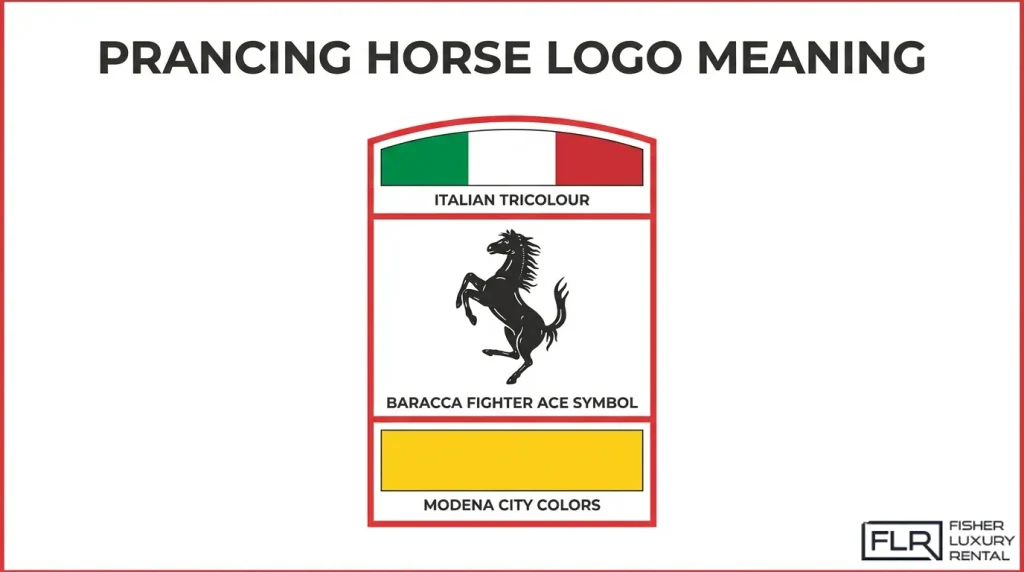
The Prancing Horse logo carries genuine historical weight: it originated on a World War I fighter pilot’s aircraft, was gifted to Enzo after a 1923 race victory, and was placed on Ferrari’s shield against the canary yellow of Modena with the Italian tricolour above it.
Ferrari’s history moves through distinct eras: 1950s–1960s motorsport dominance, the Ford rivalry at Le Mans, Fiat ownership, and the 2015 public listing. Each phase redefined the brand’s commercial structure while leaving its racing character intact.
Ferrari’s brand values, exclusivity sustained by deliberately limited production, Italian hand-finished craftsmanship, and the emotion engineered into every drive, are inseparable from the cars themselves. Iconic models like the 250 GTO, F40, and LaFerrari show how those values translate into automobiles that appreciate rather than depreciate.
Who Founded Ferrari and How Did the Company Begin?
Ferrari was founded by Enzo Ferrari, whose path from racing driver to automaker shaped one of the most recognizable automotive brands in history. The sections below cover his pre-founding career, the evolution of Scuderia Ferrari, and the first road car to carry the Ferrari name.
What Role Did Enzo Ferrari Play Before Starting the Company?
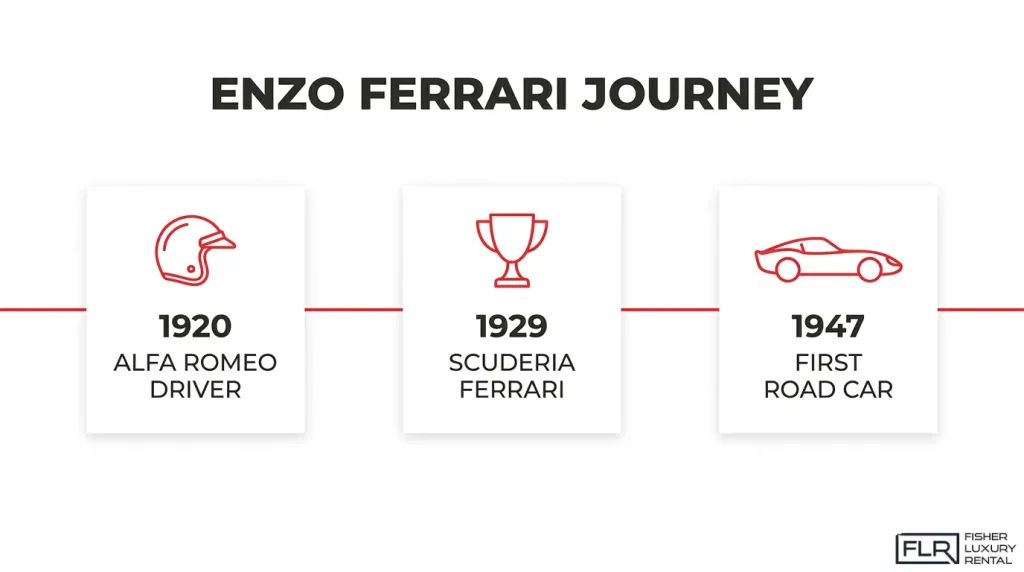
Enzo Ferrari played the role of racing driver and team organizer at Alfa Romeo before building his own company. Born on 18 February 1898 in Modena, Italy, he joined Alfa Romeo’s racing department in 1920 and won his first Grand Prix in 1923 on the Savio Circuit in Ravenna. That same year, the Baracca family met Ferrari following the race and suggested he adopt their son Francesco’s Prancing Horse symbol as a good luck charm. Francesco Baracca, an Italian flying ace, had originally displayed the horse on his aeroplane during World War I, and the family later permitted Enzo to use the design officially. By 1932, the Cavallino Rampante was adopted by Scuderia Ferrari.
In 1939, after disputes over Alfa Romeo’s policy changes, Enzo departed and established Auto Avio Costruzioni Ferrari, initially producing machine tools and racing cars. RM Sotheby’s 2026 auction estimates reflect how powerfully his legacy endures: the 1995 F50 is valued at $7,000,000–$9,000,000, underscoring the collector demand his vision created.
How Did Scuderia Ferrari Transition from Racing Team to Automaker?
Scuderia Ferrari transitioned from racing team to automaker by first proving itself as a dominant competition outfit before developing road cars funded by that motorsport success. Founded in 1929 as Alfa Romeo’s racing division, the team won 144 of its 225 races between 1929 and 1937. After Enzo’s 1939 departure, the organization evolved into an independent manufacturer.
Scuderia Ferrari has since accumulated 16 Constructors’ Championships, 15 Drivers’ Championships, 249 race victories, and 840 podium finishes in Formula One, according to Wikipedia’s Scuderia Ferrari records. Nine drivers claimed those titles, including Michael Schumacher, Niki Lauda, and Kimi Räikkönen. On the endurance side, Ferrari’s 499P ended Toyota Gazoo Racing’s five-year Le Mans winning streak in 2023, then repeated the victory in 2024 for the brand’s first consecutive Le Mans win since 1965. Automotive journalist Simon Ostler captured the road-car translation of this racing DNA well: “In every case, Ferraris give you the sense that something genuinely exceptional is occurring every time you get behind the wheel.
What Was the First Ferrari Road Car Ever Produced?
The first Ferrari road car ever produced was the Ferrari 125 S, which debuted on 11 May 1947 at the Piacenza racing circuit. It was powered by a 1.5-liter (1,497 cc) 60-degree V12 engine designed by Gioacchino Colombo, producing 118 bhp at 6,800 rpm. This was the first vehicle to officially carry the Ferrari name, marking the company’s formal shift from race preparation to road car manufacturing.
The lineage that began with the 125 S grew to produce some of the most valuable automobiles ever built. A 1962 Ferrari 250 GTO sold for $48,405,000 at RM Sotheby’s Monterey auction in August 2018, becoming the most valuable car ever sold at public auction. That outcome reflects how deeply the first-generation road car philosophy, built around racing performance above all else, continues to define Ferrari’s collector appeal.
What Does the Ferrari Name Mean and Where Does It Come From?
The Ferrari name means “blacksmith” in Italian. According to Wikipedia, Ferrari is an occupational surname, the plural form of Ferraro, a title historically given to those who worked iron and steel. The name Enzo Ferrari carried into automotive history carried that same sense of forging something essential from raw material.
Today, the brand that bears that name reported revenue of €6.677 billion in 2024, with net income of €1.526 billion, reflecting how thoroughly a craftsman’s surname has become one of the world’s most valuable automotive identities. As of May 2023, Ferrari’s market capitalisation stood at approximately US$85.5 billion, cementing its status among the largest car manufacturers by that measure.
Ferrari N.V. began trading on the New York Stock Exchange under the ticker symbol RACE on October 21, 2015, at USD 52 per common share. That ticker is no coincidence; it signals exactly what the company wants the market to understand about its identity.
The design dimension of the name was shaped significantly when Pininfarina’s partnership with Ferrari began in 1951, following a meeting between Enzo Ferrari and Battista “Pinin” Farina in Tortona. That agreement placed Pininfarina in charge of all aspects of Ferrari design, anchoring the brand’s visual language for decades.
For most people, Ferrari is more than a surname. It is a shorthand for the particular intersection of speed, craft, and Italian character that no other manufacturer has quite replicated.
What Is the Story Behind the Prancing Horse Logo?
The story behind the Prancing Horse logo connects a World War I fighter ace, an Italian racing victory, and the city of Modena into one of motorsport’s most recognisable symbols. The three H3s below cover the logo’s military origin, the yellow shield’s civic meaning, and the tricolour stripes.
How Did the Cavallino Rampante Originate?
The Cavallino Rampante originated with Francesco Baracca, an Italian flying ace who displayed a prancing horse emblem on his fighter aircraft during World War I. According to Wikipedia’s Prancing Horse entry, after Enzo Ferrari won the Circuito del Savio Grand Prix near Ravenna in 1923, the Baracca family approached him and suggested he adopt the horse as a good luck charm. Ferrari officially placed the symbol on his Scuderia’s cars in 1932. The emblem carried real emotional weight from the start: it transferred a fallen hero’s personal insignia directly onto the racing machines, giving Ferrari a mythology no marketing team could manufacture.
Why Does Ferrari Use a Yellow Background on Its Shield?
Ferrari uses a yellow background on its shield because yellow is the “colour of Modena,” Enzo Ferrari’s hometown. The canary yellow field on the Cavallino Rampante badge is a direct civic tribute, grounding the symbol in the specific Italian city where Ferrari’s identity was formed.
What Do the Green, White, and Red Stripes on the Badge Represent?
The green, white, and red stripes on the badge represent the Italian national flag, the tricolour. Positioned above the yellow shield, these three stripes reinforce that Ferrari is not merely a racing brand but an expression of Italian national pride, linking every car to its country of origin.
What Are the Key Eras in Ferrari’s History?
Ferrari’s history spans four defining eras: 1950s–1960s motorsport dominance, the Ford rivalry at Le Mans, the Fiat ownership period, and the public company era. Each phase shaped the brand’s identity, engineering priorities, and global standing.
How Did Ferrari Dominate Motorsport in the 1950s and 1960s?
Ferrari dominated motorsport in the 1950s and 1960s through a combination of engineering excellence and design partnership. The Ferrari 250 GT Berlinetta, presented in the late 1950s, was designed by Pininfarina and featured a 3-liter V12 engine producing 280 horsepower, reaching 100 km/h in seven seconds according to Ferrari Magazine. This era established the template Ferrari still follows: race-bred engineering translated directly into road car performance.
What Happened During the Ford vs Ferrari Rivalry at Le Mans?
The Ford vs Ferrari rivalry at Le Mans was a defining conflict between American industrial ambition and Italian racing pride. In 1966, the Ford GT40 claimed its first overall Le Mans victory, becoming the first American constructor to win a major European race since Duesenberg’s 1921 French Grand Prix triumph. Ford’s dominance continued in 1967, when Dan Gurney and A.J. Foyt drove a Ford Mk IV to victory with a one-two-three Ford finish, while no Ferrari prototype finished the race.
How Did Ferrari Evolve Under Fiat Ownership from 1969 Onward?
Ferrari evolved under Fiat ownership into a more commercially structured manufacturer while preserving its racing identity. On 21 June 1969, Fiat acquired 50% of Ferrari, according to the Ferrari official website. From 1963 to 2014, Ferrari operated as a Fiat S.p.A. subsidiary before being spun off from Fiat Chrysler Automobiles in 2016. Today, ownership is distributed across Exor (24.65% equity), Piero Ferrari (10.48% equity), and public shareholders (58.8% equity). Fiat’s backing provided the capital Ferrari needed to scale production without abandoning its hand-built ethos.
What Changed When Ferrari Became a Publicly Traded Company?
Ferrari became a publicly traded company when Ferrari N.V. listed on the New York Stock Exchange on October 21, 2015, at USD 52 per share under the ticker symbol RACE. As of May 2023, Ferrari’s market capitalization reached approximately US$85.5 billion, placing it among the largest car manufacturers by market value. Going public imposed financial transparency and shareholder accountability, yet Ferrari maintained strict production limits to protect exclusivity. The IPO transformed Ferrari from a family-influenced manufacturer into a global luxury investment asset without diluting its brand.
What Core Values Define Ferrari’s Brand Identity?
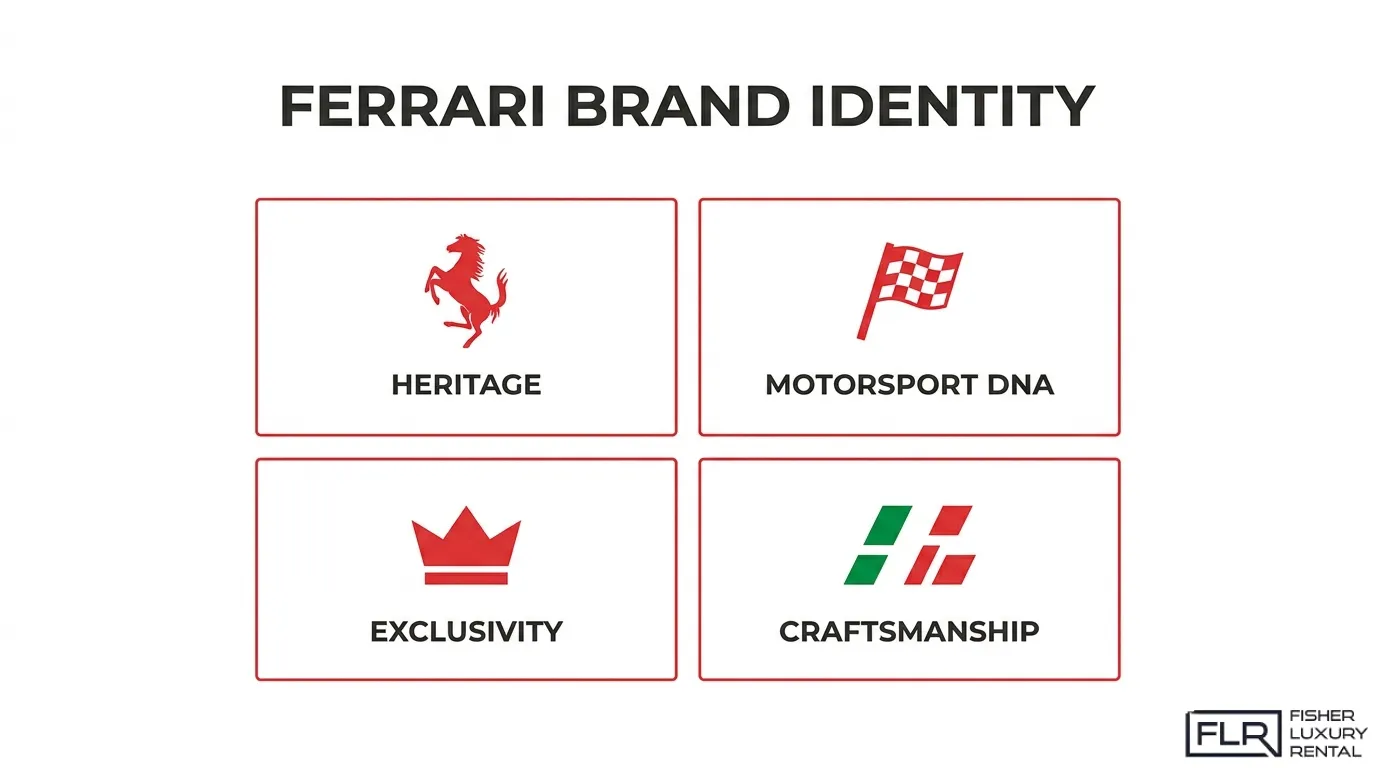
Ferrari’s core brand values are racing heritage, exclusivity, Italian craftsmanship, and emotional connection. The sections below examine how each value shapes the brand’s production decisions, design choices, and ownership experience.
How Does Racing Heritage Shape Every Ferrari Production Car?
Racing heritage shapes every Ferrari production car through a direct transfer of motorsport engineering priorities: aerodynamic efficiency, weight reduction, and high-revving powertrain performance. Scuderia Ferrari has competed in Formula One since 1952, accumulating more race victories, pole positions, and constructors’ titles than any other team in F1 history. That competitive DNA informs how Ferrari engineers approach throttle response, chassis stiffness, and braking systems on road cars. Models like the 296 GTB and SF90 Stradale carry hybrid powertrains developed in parallel with Ferrari’s F1 program. Racing heritage is not historical decoration; it is the functional engineering baseline every production car is built upon.
Why Is Exclusivity Central to Ferrari’s Brand Strategy?
Exclusivity is central to Ferrari’s brand strategy because deliberate scarcity protects the brand’s prestige and residual value. Ferrari produces approximately 13,752 units shipped in 2024, maintaining annual production between 10,000 and 14,000 units to ensure scarcity. Unlike volume manufacturers, Ferrari caps output regardless of demand. This constraint means customers wait months or years for allocations, reinforcing desirability. Exclusivity is not a side effect of limited capacity; it is a conscious strategic choice that separates Ferrari from every mainstream and near-luxury competitor.
How Does Italian Craftsmanship Influence Ferrari’s Identity?
Italian craftsmanship influences Ferrari’s identity by grounding its cars in hand-finished precision rooted in Modena’s artisan manufacturing traditions. Every Ferrari is assembled at the Maranello factory, where skilled technicians hand-stitch leather interiors, hand-finish bodywork, and custom-configure paint and trim to individual client specifications. This level of human involvement distinguishes Ferrari from mass production and connects each car to a centuries-old Italian tradition of making objects with both technical precision and aesthetic intention. The craftsmanship is inseparable from the product’s meaning.
What Role Does Emotion Play in the Ferrari Ownership Experience?
Emotion plays a central role in the Ferrari ownership experience, functioning as the primary purchase motivator rather than a secondary benefit. According to automotive journalist Simon Ostler at Goodwood Road and Racing, “In every case, Ferraris give you the sense that something genuinely exceptional is occurring every time you get behind the wheel.” Ferrari engineers the engine note, throttle response, and seat position specifically to amplify emotional intensity. Ownership rituals, including factory visits, personalization programs, and client events, extend that emotional connection beyond the drive itself. For most buyers, the feeling Ferrari delivers is the product.
What Makes Ferrari’s Design Philosophy Distinctive?
Ferrari’s design philosophy is distinctive because it treats aerodynamics and visual beauty as inseparable goals rather than competing priorities. The sections below cover how Ferrari balances form and function, why the mid-engine layout defines its sports car identity, and which signature design elements appear consistently across models.
How Does Ferrari Balance Aerodynamics and Beauty?
Ferrari balances aerodynamics and beauty by treating every body surface as both a functional airflow device and a sculptural statement. The 1968 Ferrari 365 GTB/4 Daytona demonstrated this commitment directly: presented at the Paris Auto Salon, it revolutionized Ferrari design by abandoning the famous oval grille and replacing it with aerodynamic rectangular headlight covers, according to Ferrari Magazine. Rather than choosing between drag reduction and striking aesthetics, Ferrari’s designers resolved both demands in a single form. This approach, refined over decades with Pininfarina, remains the standard against which every new Ferrari silhouette is judged.
Why Is the Mid-Engine Layout Iconic to Ferrari’s Sports Cars?
The mid-engine layout is iconic to Ferrari’s sports cars because it places the heaviest mechanical component, the engine, between the axles, optimizing weight distribution and cornering balance. This configuration lowers the center of gravity and gives the driver more direct, predictable feedback through corners. Ferrari adopted mid-engine architecture across its most celebrated sports car lineages precisely because track performance demanded it. For road cars, the layout translates racing-derived handling directly into the driving experience, making the connection between motorsport engineering and street driving tangible rather than cosmetic.
What Signature Design Elements Appear Across Ferrari Models?
The signature design elements that appear across Ferrari models include air intakes integrated into the bodywork, a low-slung fastback roofline, wide rear haunches over the rear wheels, and the Cavallino Rampante badge on the nose and steering wheel. Pininfarina’s long collaboration, beginning in 1951, established a visual language built on fluid surfaces, minimal ornamentation, and purposeful apertures that serve aerodynamic function. Rosso Corsa red, while not mandatory, remains the most recognized Ferrari color and reinforces the brand’s Italian racing identity at a glance.
How Does Ferrari’s Motorsport Legacy Influence Its Road Cars?
Ferrari’s motorsport legacy influences its road cars by driving direct technology transfer from the track to production models. The two headings below cover specific F1-derived innovations and the competitive record that makes Ferrari’s racing credentials uniquely authoritative.
What Technologies Have Transferred from Formula 1 to Street Ferraris?
The technologies that have transferred from Formula 1 to street Ferraris include carbon fiber construction, aerodynamic downforce management, hybrid powertrains, and paddle-shift transmission systems. Ferrari’s F1 program developed carbon fiber chassis techniques that now appear in flagship road cars, reducing weight while maximizing structural rigidity. Hybrid technology, refined under race conditions, reached production vehicles through models like the 296 GTB and LaFerrari. The paddle-shift gearbox, originally an F1 innovation, became standard across the road car range. Ferrari’s engineers treat every race season as a live laboratory, which means production buyers benefit directly from solutions validated at 200 mph before a single street car is built.
Why Is Ferrari the Most Successful Team in F1 History?
Ferrari is the most successful team in F1 history because it has accumulated more race victories, podium finishes, pole positions, and Constructors’ Championships than any other constructor since the championship began. According to Wikipedia’s Scuderia Ferrari entry, Michael Schumacher remains the team’s defining driver: he joined Ferrari in 1996 and won five consecutive Drivers’ Championships between 2000 and 2004, claiming 72 Grand Prix victories for the team. That dominance alone reshaped what was considered achievable in the sport. This unbroken competitive presence, spanning over seven decades, is what gives every Ferrari road car its motorsport credibility at the point of purchase.
What Are the Most Iconic Ferrari Models of All Time?
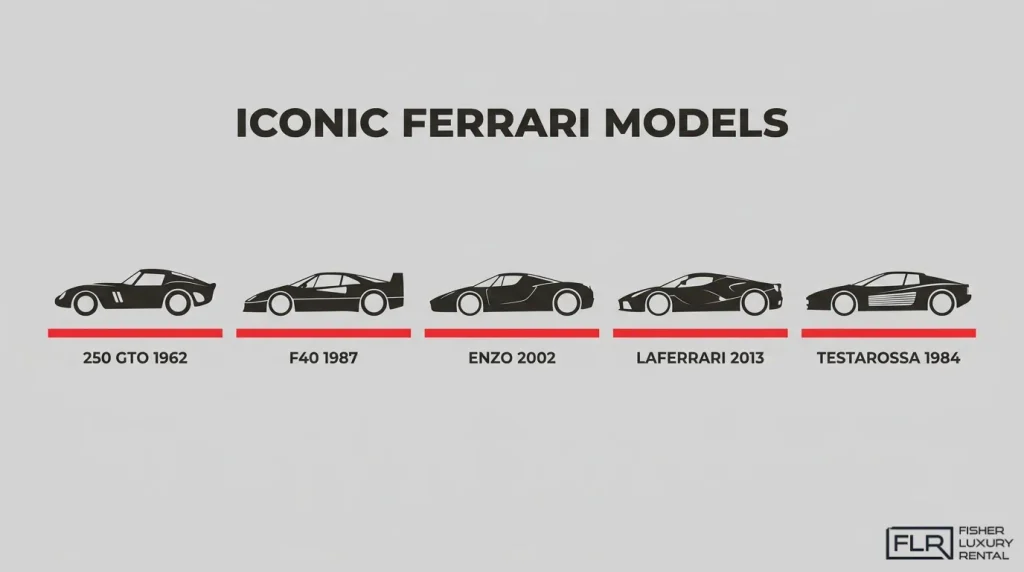
The most iconic Ferrari models of all time include the 250 GTO, F40, Enzo, LaFerrari, and Testarossa. Each represents a distinct era of Ferrari engineering, design, and motorsport philosophy.
Ferrari 250 GTO
The Ferrari 250 GTO is widely regarded as the most valuable road-racing car ever built. Produced from 1962 to 1964, it combined a 3.0-liter V12 engine with a lightweight body designed for GT racing homologation. A 1962 example sold for $48,405,000 at RM Sotheby’s Monterey auction in August 2018, making it the most valuable car ever sold at auction. Only 36 were built, and every surviving example remains in a class of its own among collectors.
Ferrari F40
The Ferrari F40 is the last road car personally approved by Enzo Ferrari before his death in 1988. Built to celebrate Ferrari’s 40th anniversary, it produced 478 horsepower from a twin-turbocharged 2.9-liter V8 and was the first production car to exceed 200 mph. Its stripped interior, raw driving feel, and direct racing DNA made it a landmark in supercar history. No other Ferrari of its era communicated motorsport heritage as uncompromisingly as the F40.
Ferrari Enzo
The Ferrari Enzo is a mid-engine supercar built between 2002 and 2004 using Formula 1 technology transferred directly to a road car. It produced 651 horsepower from a naturally aspirated 6.0-liter V12 and used carbon-fiber bodywork, a sequential gearbox, and carbon-ceramic brakes. RM Sotheby’s estimates a 2003 Enzo at $5,000,000–$6,000,000 USD at 2026 auction, reflecting its enduring collector status.
Ferrari LaFerrari
The Ferrari LaFerrari is the brand’s first hybrid hypercar, combining a 6.3-liter V12 with an electric motor for a combined output of 950 horsepower. Introduced in 2013, just 499 coupe examples were built and sold exclusively to invited Ferrari customers. RM Sotheby’s values a 2015 LaFerrari at $4,500,000–$5,000,000 USD for 2026 auction, confirming its status as a modern collectible and a technical milestone in Ferrari’s evolution.
Ferrari Testarossa
The Ferrari Testarossa is a flat-12, mid-engine grand tourer produced from 1984 to 1996 that defined the visual language of 1980s supercar culture. Its wide side strakes, silver alloy wheels, and 390-horsepower engine made it one of the most recognizable cars ever built. The Testarossa became a cultural icon beyond the automotive world, appearing in film and television and cementing Ferrari’s identity as a symbol of speed and glamour across an entire generation.
How Does Ferrari Compare to Other Supercar Brands?
Ferrari compares to other supercar brands by leading on profitability, brand prestige, and motorsport heritage rather than competing purely on raw performance specifications. According to Supercar Blondie, Ferrari’s operating profit margin reached 28.3 percent, surpassing Porsche and making Ferrari the most profitable luxury car brand in the world.
While rivals like Lamborghini and McLaren compete closely on horsepower and lap times, Ferrari’s advantage is structural. Its deliberate production ceiling of roughly 10,000 to 14,000 units annually creates scarcity that competitors manufacturing at higher volumes cannot replicate. That scarcity sustains resale values and auction records that no other supercar brand consistently matches.
From a brand identity standpoint, Ferrari is also unique in operating its own Formula 1 constructor, Scuderia Ferrari, with an unbroken presence since 1950. This direct motorsport-to-road-car pipeline gives Ferrari an engineering credibility and emotional resonance that brands without active racing programs struggle to claim.
Ferrari competes differently: not by chasing every spec benchmark, but by being irreplaceable.
Why Do Ferraris Hold Their Value Better Than Most Cars?
Ferraris hold their value better than most cars because of three compounding forces: controlled scarcity, unmatched motorsport heritage, and a collector market that rewards iconic models with appreciation rather than depreciation.
How Does Limited Production Protect Ferrari’s Resale Value?
Limited production protects Ferrari’s resale value by keeping supply deliberately below demand. Ferrari ships approximately 13,752 units annually, maintaining output between 10,000 and 14,000 cars per year to preserve exclusivity. When fewer cars exist than buyers willing to pay for them, prices hold firm on the secondary market. This is a deliberate brand strategy, not a manufacturing constraint, and it is one of the most effective value-preservation tools in the automotive industry.
What Auction Records Prove Ferrari’s Long-Term Value Appreciation?
Ferrari’s long-term value appreciation is proven most dramatically by the 1962 Ferrari 250 GTO, which sold for $48,405,000 at RM Sotheby’s Monterey auction in August 2018, becoming the most valuable car ever sold at auction. Even newer flagship models hold extraordinary values. According to RM Sotheby’s 2026 auction estimates, the 1995 Ferrari F50 is valued at $7,000,000–$9,000,000, the 2003 Ferrari Enzo at $5,000,000–$6,000,000, and the 2015 Ferrari LaFerrari at $4,500,000–$5,000,000.
Does Ferrari’s Financial Strength Reinforce Collector Confidence?
Ferrari’s financial strength reinforces collector confidence by signaling that the brand behind the asset is built to last. Ferrari reported revenue of €6.677 billion in 2024, with a net income of €1.526 billion and a market capitalization of approximately US$85.5 billion as of May 2023. A brand this commercially dominant is not going to dilute its product or compromise its exclusivity, which gives collectors long-term confidence that the cars they buy today will remain desirable tomorrow.
What Does It Feel Like to Drive a Ferrari?
Driving a Ferrari delivers a sensory experience unlike any other production car. The following sections cover how Ferrari’s engine sound and driving dynamics combine to create that feeling.
How Does Ferrari’s Engine Sound Contribute to the Experience?
Ferrari’s engine sound contributes to the experience by creating an auditory connection between driver and machine that few cars replicate. The high-revving V12 and V8 engines produce a layered, operatic exhaust note that rises sharply toward the redline, turning acceleration into a visceral event rather than a mechanical one. That sound is not incidental; it is engineered as part of the driving theater, signaling power, precision, and Italian craftsmanship with every throttle input. For many drivers, the sound alone justifies the entire experience.
What Sets Ferrari’s Driving Dynamics Apart from Competitors?
Ferrari’s driving dynamics set it apart through the combination of chassis precision, hybrid powertrain performance, and steering feedback that competitors rarely match at the same level. According to automotive journalist Simon Ostler at Goodwood Road and Racing, “the response from the throttle posits you as the conductor of an orchestra,” and in the Ferrari 296, “the grip feels limitless” while the chassis harnesses hybrid output into usable momentum. That balance between raw performance and driver control is what separates Ferrari from rivals who prioritize either comfort or outright speed but rarely both.
How Can You Experience a Ferrari Through Exotic Car Rental?
Exotic car rental gives enthusiasts direct access to Ferrari’s performance and heritage without ownership. The sections below cover Fisher Luxury Rental’s Ferrari offerings and key takeaways from Ferrari’s brand story.
Does Fisher Luxury Rental Offer Ferrari Models to Drive?
Fisher Luxury Rental offers Ferrari models to drive through its exotic car rental fleet, serving customers in Phoenix, AZ and Portland, OR. The company specializes in top-trim vehicles, prioritizing quality and an exhilarating driving experience over budget options. Demand for access like this is growing fast: according to Fortune Business Insights, the global luxury car rental market is projected to grow from $56.30 billion in 2026 to $125.98 billion by 2034, at a compound annual growth rate of 10.59%. For anyone who wants to understand what makes Ferrari exceptional, getting behind the wheel is the most direct answer available.
What Are the Key Takeaways About Ferrari’s History and Brand Identity?
The key takeaways about Ferrari’s history and brand identity center on racing heritage, deliberate exclusivity, and emotional design. Several conclusions stand out from everything covered in this article:
- Ferrari was built from motorsport, with Enzo’s racing career directly shaping the company’s engineering culture and performance standards.
- The Cavallino Rampante logo carries genuine historical meaning, rooted in a World War I flying ace’s insignia adopted after a 1923 race victory.
- Ferrari limits annual production to roughly 10,000–14,000 units, making scarcity a core brand strategy rather than a constraint.
- Pininfarina’s design collaboration, beginning in 1951, established the visual language that still defines Ferrari’s road cars today.
- F1 dominance, with 16 Constructors’ Championships, is not background history but the active source of technology transferred to every production model.
Understanding Ferrari’s identity makes the driving experience far richer. Fisher Luxury Rental offers that experience directly.