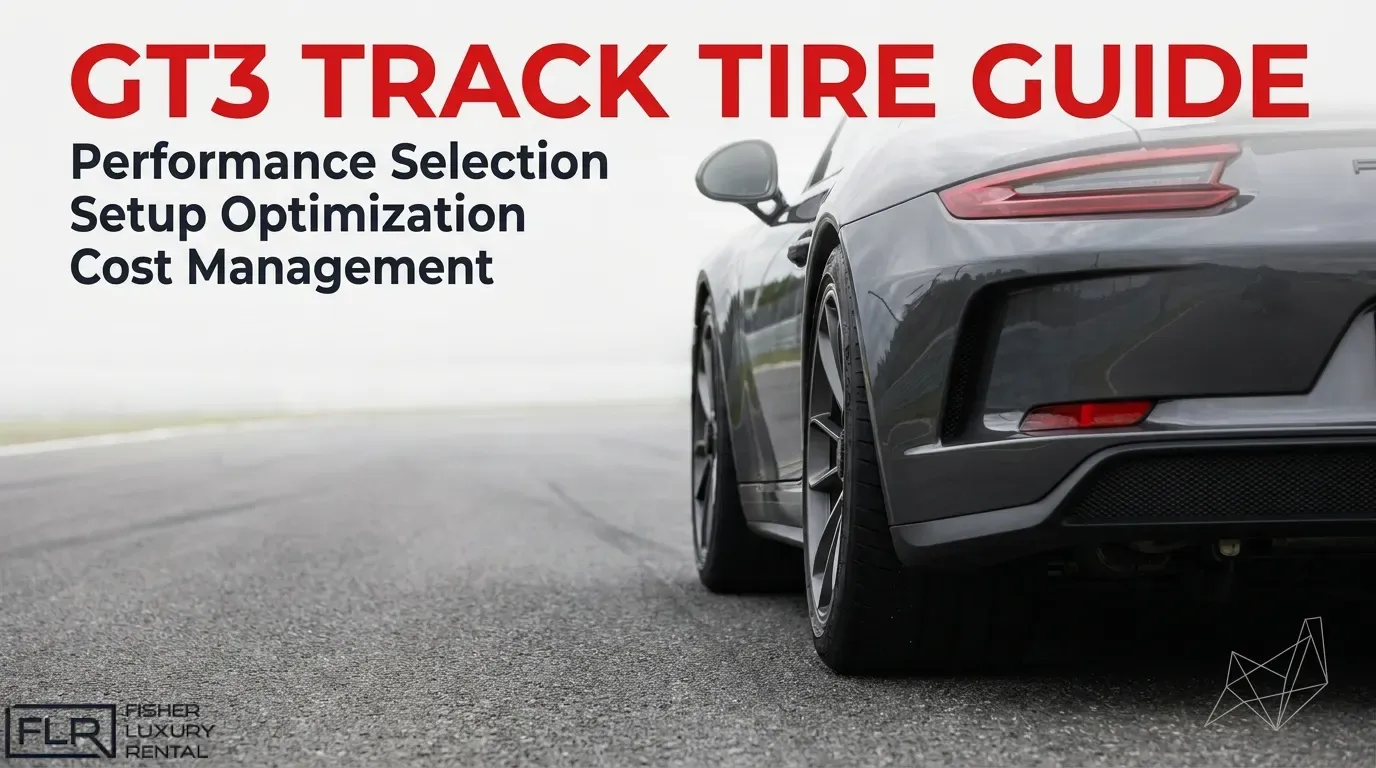
Track tires for a Porsche 911 GT3 are purpose-built compounds selected to match the car’s staggered fitment, rear-engine weight distribution, and the extreme thermal and lateral loads it generates on circuit. Choosing the wrong tire category, running incorrect pressures, or ignoring heat cycle limits translates directly into slower lap times and higher costs per session.
This guide covers GT3 tire sizing and setup, the four main tire categories available for track use, top compound recommendations across 200 treadwear and R-compound categories, and the practical management decisions that determine how much performance you actually extract on track.
The 911 GT3 runs staggered OEM fitments that vary by generation, and the choice between that stagger and a square setup can affect mid-corner speed in ways most drivers overlook.
The tire category you select, from street-legal 200 treadwear options through full racing slicks, determines your grip ceiling, your wet-weather options, and which track organizations will allow you to run.
Compound-specific performance, including how the Michelin Pilot Sport Cup 2, Pirelli P Zero Trofeo RS, Yokohama Advan A052, and their R-compound equivalents behave on the GT3, forms the core of this guide’s recommendations.
Pressure management, alignment setup, tire longevity by compound type, and the real cost of a full set round out the practical ownership side, giving you the information needed to plan a track day without expensive surprises.
What Tire Sizes Does the Porsche 911 GT3 Use on Track?
The Porsche 911 GT3 uses staggered OEM tire sizes that vary by generation, with the 992 running wider rubber than the 991. The sections below cover front sizes, rear sizes, and whether a square setup can outperform the factory stagger on circuit.
What Is the Factory Front Tire Size for the 911 GT3?
The factory front tire size for the 911 GT3 depends on the generation. According to TireSize.com, the 991.1 and 991.2 GT3 models use a 245/35R20 front tire, while the 2026 992 GT3 steps up to a 255/35ZR20 front, per Mavis Discount Tire. The 992 GT3 RS goes wider still, running a 275/35ZR20 up front.
| Generation | Front Tire Size |
| 991.1 / 991.2 GT3 | 245/35R20 |
| 992 GT3 | 255/35ZR20 |
| 992 GT3 RS | 275/35ZR20 |
Knowing the correct front size matters beyond fitment: running a wider-than-stock front tire on a lowered 992 can introduce bump-steer, where outer tires toe-out under compression.
What Is the Factory Rear Tire Size for the 911 GT3?
The factory rear tire size for the 911 GT3 also scales with generation. The 991.1 and 991.2 use a 305/30R20 rear, the 992 GT3 moves to a 315/30ZR21, and the 992 GT3 RS runs a 335/30ZR21. All three generations use a staggered fitment, with the rear tire significantly wider than the front to balance the rear-engine weight bias.
Should You Run a Staggered or Square Tire Setup on a GT3?
Staggered is the GT3’s factory configuration, but a square setup can deliver faster lap times in certain track conditions. According to ThreePiece.us, a properly sized 255 square setup often beats a 275/315 stagger because balanced front-to-rear grip lets drivers carry more speed through the middle of corners. Staggered setups protect the rear against snap oversteer, making them the safer choice for less experienced drivers, but experienced track drivers may find a matched square setup quicker and more adjustable under braking.
What Types of Tires Can You Run on a Porsche 911 GT3 at the Track?
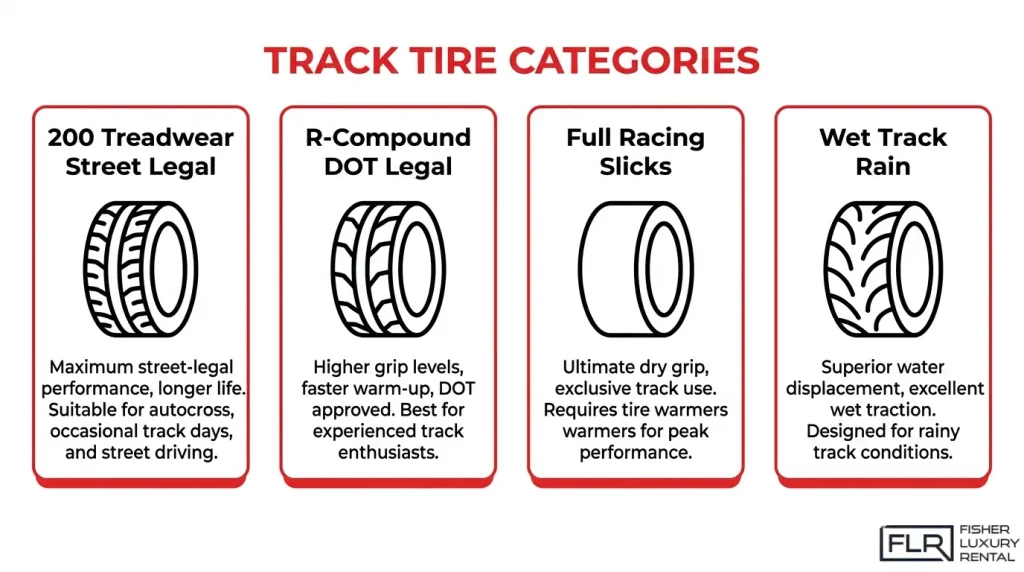
The types of tires you can run on a Porsche 911 GT3 at the track fall into four main categories: 200 treadwear street-legal performance tires, R-compound DOT-legal track tires, full racing slicks, and wet-condition rain tires. Each category suits a different level of track use, event ruleset, and performance goal.
200 Treadwear Street-Legal Performance Tires
200 treadwear street-legal performance tires are DOT-approved tires with a treadwear rating of 200, meaning they can be driven to and from the track on public roads. Options in this category include the Michelin Pilot Sport Cup 2, Pirelli P Zero Trofeo RS, Bridgestone Potenza RE-71RS, and Yokohama ADVAN A052. These tires balance road usability with serious track grip, making them the most practical choice for drivers who want one tire that handles both environments without trailering a dedicated track set.
R-Compound DOT-Legal Track Tires
R-compound DOT-legal track tires are competition tires that carry a DOT approval but are not intended for regular highway use. According to Grassroots Motorsports, the Super 200 category covers DOT-approved tires meeting 200tw ratings for autocross and time trials, while R-compounds sit in a separate, more aggressive competition class. R-compounds deliver maximum mechanical grip and are the standard choice for HPDE advanced groups, time attack, and club racing where treadwear minimums are not enforced.
Full Racing Slicks
Full racing slicks are non-grooved competition tires that maximize the contact patch for outright track performance. Under SVRA regulations, cars running tire sizes unavailable in the Hoosier R7 line may use racing slicks, provided the tires have two full-depth parallel grooves installed 3 inches apart. Slicks require proper heat cycling, warmup laps, and a well-tuned alignment to perform correctly; running them on a cold or misaligned GT3 will cost more time than they save.
Wet-Condition Track Rain Tires
Wet-condition track rain tires are purpose-built track tires with aggressive circumferential grooves designed to evacuate water at race speeds. Unlike all-season or performance street tires, dedicated rain tires maintain grip at the elevated speeds and cornering loads a GT3 generates on a wet circuit. They are typically required or strongly recommended by track organizations when a session is declared wet, and they are not suited for dry conditions where overheating and rapid wear become immediate concerns.
What Are the Best 200 Treadwear Tires for a Porsche 911 GT3?
The best 200 treadwear tires for a Porsche 911 GT3 are purpose-built compounds that balance street legality with genuine track performance. The following H3s cover four leading options: the Michelin Pilot Sport Cup 2, Pirelli P Zero Trofeo RS, Bridgestone Potenza RE-71RS, and Yokohama Advan A052.
How Does the Michelin Pilot Sport Cup 2 Perform on the GT3?
The Michelin Pilot Sport Cup 2 performs on the GT3 as the benchmark 200 treadwear option, delivering exceptional dry grip when properly heat-cycled. According to the Michelin Technical Bulletin, the Cup 2 R requires an operating temperature between 70°C and 100°C (90°C ideal), with hot pressures of 2.3 to 2.7 bar (33 to 40 psi) for optimum performance. A set of four in size 295/30ZR18 retails at approximately $2,035.96 (Tire Rack). Notably, the Michelin Pilot Sport S5, which carries Porsche’s N-homologation marking, puts the GT3 RS 10 seconds quicker around a 1.7-mile wet track than Cup 2s, according to race driver Jörg Bergmeister. In dry conditions, the Cup 2 remains the more track-focused choice for GT3 owners who prioritize outright grip over wet versatility.
How Does the Pirelli P Zero Trofeo RS Perform on the GT3?
The Pirelli P Zero Trofeo RS performs on the GT3 as a semi-slick tire purpose-engineered for circuit use. According to a Pirelli press release, it features a rigid shoulder similar to a competition slick tire, designed specifically to maximize lateral grip when cornering at very high speeds. This construction makes it one of the most aggressive street-legal options available for GT3 owners who push hard on track while retaining DOT compliance.
How Does the Bridgestone Potenza RE-71RS Perform on the GT3?
The Bridgestone Potenza RE-71RS performs on the GT3 as a dual-purpose Super 200 compound suited for both street driving and track days. According to Tire Reviews, it is a DOT-approved summer tire engineered to deliver massive grip and precise handling on the street while maintaining race-pace performance on track. For GT3 owners who drive to and from the circuit, the RE-71RS offers a practical grip-to-usability balance that more aggressive semi-slicks cannot match.
How Does the Yokohama Advan A052 Perform on the GT3?
The Yokohama Advan A052 performs on the GT3 as a high-grip 200 treadwear tire built on a motorsports MS compound. According to Discount Tire, it uses an asymmetrical tread pattern to deliver rapid steering response alongside extreme grip levels. The A052 consistently ranks among the fastest 200tw options in timed testing, making it a strong alternative to the Cup 2 for drivers who want maximum mechanical grip without crossing into R-compound territory. For GT3 owners comparing options, the A052’s steering response characteristics pair exceptionally well with the GT3’s precise, high-feedback chassis.
What Are the Best R-Compound Tires for a Porsche 911 GT3?
The best R-compound tires for a Porsche 911 GT3 are purpose-built competition tires that prioritize maximum dry grip over street usability. According to the Porsche Club of America, race tires perform best when first installed, degrading with each subsequent heat cycle. The H3s below cover the top four options: the Michelin Pilot Sport Cup 2 R, Pirelli P Zero Slick Pro, Yokohama A005, and Toyo Proxes RS1.
How Does the Michelin Pilot Sport Cup 2 R Perform on the GT3?
The Michelin Pilot Sport Cup 2 R performs on the GT3 as one of the most track-focused DOT-legal R-compound tires available. It sits above the standard Cup 2 in Michelin’s lineup, featuring a softer, more aggressive compound engineered specifically for circuit use. The Cup 2 R delivers outstanding lateral grip and consistent feedback through high-speed corners, making it a natural choice for GT3 owners who track frequently. Its thin tread depth extends less forgiving behavior in wet conditions, so it rewards drivers who plan sessions around dry track time.
How Does the Pirelli P Zero Slick Pro Perform on the GT3?
The Pirelli P Zero Slick Pro performs on the GT3 as a near-slick R-compound tire with a minimal tread pattern designed for maximum dry contact patch. It bridges the gap between DOT-legal track tires and full competition slicks, offering slick-like grip while remaining street-legal for paddock transit. The construction prioritizes rigid shoulder blocks that maximize lateral load during cornering, a design philosophy Pirelli carries across its GT3-specific tire range. For drivers running sprint sessions on dry circuits, the Slick Pro delivers grip levels that approach true racing slicks without requiring wet-weather tire swaps for occasional light rain.
How Does the Yokohama A005 Perform on the GT3?
The Yokohama A005 performs on the GT3 as a full-slick competition tire built for closed-circuit track days in dry conditions. Unlike DOT-legal options, the A005 is a true slick with zero tread pattern, maximizing contact patch area for peak mechanical grip. It suits GT3 drivers who run dedicated track wheels and have no need for street legality. The A005 is particularly popular in time attack and track day competition because it offers slick-tire performance at a price point accessible to amateur racers. Wet running is not possible without grooved slick variants, so weather-aware scheduling is essential.
How Does the Toyo Proxes RS1 Perform on the GT3?
The Toyo Proxes RS1 performs on the GT3 as a full-slick competition tire aimed specifically at amateur road racers. According to Toyo Tires Media, the Proxes RS1 features an advanced rayon casing with a high-modulus bead filler and steel-reinforced sidewall, construction choices that improve rigidity and load handling at race speeds. This sidewall stiffness translates to precise turn-in response on the GT3, where the car’s rear-engine weight distribution demands predictable tire behavior under lateral load. For club racers entering wheel-to-wheel events, the RS1 offers professional-grade construction at a competitive price point relative to premium European slick options.
How Do You Choose the Right Tire Compound for a GT3 Track Day?
Choosing the right tire compound for a GT3 track day depends on three variables: ambient temperature, track surface temperature, and session length. The sections below cover hot-condition compounds, cool-condition compounds, and longevity-focused choices.
What Compound Works Best in Hot Track Temperatures?
The compound that works best in hot track temperatures is a hard-compound 200 treadwear tire, such as the Michelin Pilot Sport Cup 2 or the Pirelli P Zero Trofeo RS. According to a Michelin Technical Bulletin, the Pilot Sport Cup 2 R reaches its optimum rubber running temperature between 70°C and 100°C, with 90°C being ideal. In sustained summer heat, these tires arrive at their operating window quickly and maintain consistent grip across long sessions. Softer R-compound options tend to overheat under those same conditions, generating greasy, inconsistent feedback. For high-ambient-temperature days, the Cup 2’s thermal stability is genuinely hard to match.
What Compound Works Best in Cool Track Temperatures?
The compound that works best in cool track temperatures is a softer-compound option, such as the Yokohama ADVAN A052 or the Bridgestone Potenza RE-71RS. The ADVAN A052 is built on a motorsports MS compound that provides extreme grip even before full thermal saturation, making it well-suited to cold-morning track sessions where harder compounds stay below their operating window for multiple laps. According to Motor Trend, Porsche GT3 RS test driver Jörg Bergmeister noted that the Michelin Pilot Sport S5 gets up to temperature very quickly, making it another strong cold-weather choice. Softer compounds reward patience on the out-lap but deliver peak lateral grip faster in cooler air.
What Compound Lasts Longest Over a Full Track Day?
The compound that lasts longest over a full track day is a 200 treadwear tire, such as the Michelin Pilot Sport Cup 2 or the Pirelli P Zero Trofeo RS, rather than an R-compound. The Porsche Club of America notes that race tires are always at their best when new and degrade with each heat cycle. R-compound tires typically sacrifice their peak grip window within a handful of sessions, whereas 200 treadwear compounds trade outright single-lap pace for broader usability across multiple stints. For a driver running two or three sessions per day, a 200 treadwear compound delivers more consistent performance from morning to afternoon than a softer R-compound that falls off sharply after its first few cycles.
How Do Tire Pressures Affect GT3 Lap Times on Track?
Tire pressures directly affect GT3 lap times by controlling how much of the tire’s contact patch actually works under load. The following sections cover starting pressures, session-by-session adjustment, and the tools needed to manage pressure accurately at the track.
What Cold Tire Pressures Should You Start With on a GT3?
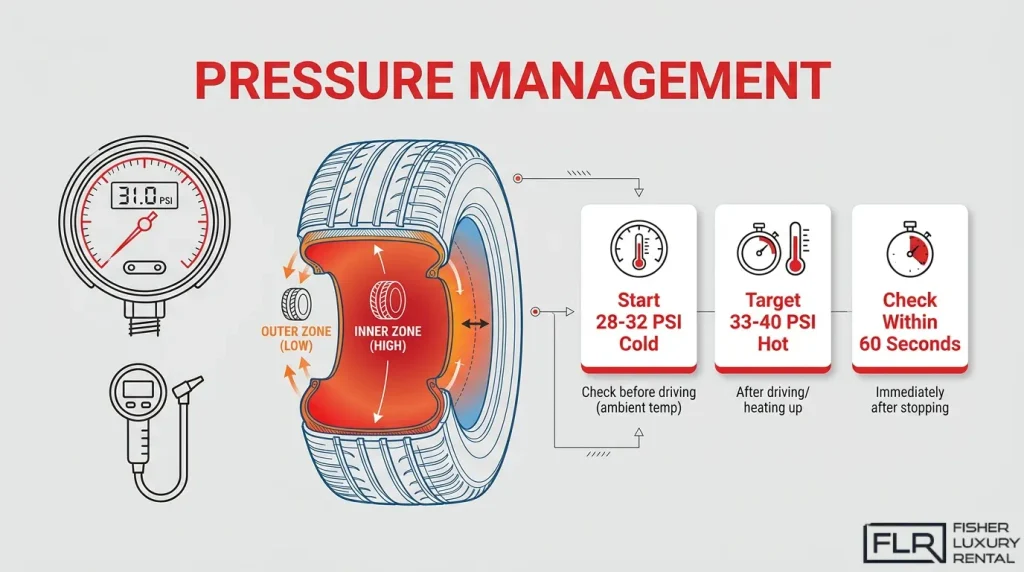
Cold tire pressures for a GT3 should start between 28 and 32 psi (1.93 to 2.2 bar) before heading out for a session. These figures are intentionally set low to account for the 6 to 10 psi rise that typically occurs as the tire heats up under track conditions. For the Michelin Pilot Sport Cup 2 R specifically, the Michelin Technical Bulletin targets a hot working pressure of 2.5 bar (36 psi) for optimum performance, with an acceptable range of 2.3 to 2.7 bar (33 to 40 psi). Setting cold pressures correctly gives you the best chance of landing inside that window after the first flying laps.
How Do You Adjust Pressures After Your First Sessions?
You adjust pressures after your first sessions by measuring hot pressures immediately after the out-lap, before the tires cool. Check each corner within 60 to 90 seconds of stopping. If pressures are above 2.7 bar (40 psi), bleed them down; if they are below 2.3 bar (33 psi), add air. Beyond the numbers, reading temperature distribution across the tire face tells you whether pressure is actually correct. According to Autosport Labs, the distribution of temperature across the tire face is a direct map of contact pressure distribution, and uneven temperatures indicate the full tire width is not being utilized. Edge-heavy heat means pressure is too low; center-heavy heat means pressure is too high.
What Tools Do You Need for Accurate Trackside Pressure Checks?
The tools you need for accurate trackside pressure checks are a quality digital tire pressure gauge, a portable compressor or nitrogen tank, and a pyrometer for reading tire surface temperatures. A digital gauge accurate to 0.1 bar is essential; analog gauges drift and introduce error at the worst possible moment. A pyrometer with three probes per tire (inner, middle, outer) lets you cross-reference temperature data against pressure readings, which is how professional setups are actually dialed in rather than relying on pressure numbers alone.
How Many Track Days Can You Get from a Set of GT3 Tires?
Track tire lifespan on a GT3 varies significantly by compound type and driving aggression. The sections below cover 200 treadwear longevity, R-compound heat cycle limits, and how driving style directly affects your cost per track day.
How Long Do 200 Treadwear Tires Last on a GT3 at the Track?
200 treadwear tires on a GT3 typically last 3 to 6 full track days before grip degrades noticeably. These tires trade longevity for accessibility: they warm up faster and survive street driving between events, but the GT3’s weight and power accelerate edge wear. Aggressive drivers on technical circuits will sit closer to 3 days; smoother drivers on flowing tracks can stretch a set to 6. Monitoring tread depth and shoulder wear after every event is the most reliable way to gauge remaining life.
How Long Do R-Compound Tires Last on a GT3 at the Track?
R-compound tires on a GT3 typically last 2 to 4 full track days, with heat cycle degradation being the primary limiter rather than raw tread wear. According to the Porsche Club of America, race tires are always at their best when new and degrade with each heat cycle or group of heat cycles. On a GT3, where tire loading is high and sessions are intense, each day can easily consume 4 to 6 heat cycles. Buying a fresh set per event season rather than storing half-used sets is often the smarter financial decision.
How Does Driving Style Impact GT3 Track Tire Longevity?
Driving style impacts GT3 track tire longevity more than any other single variable. Aggressive trail braking, hard acceleration exits, and sustained high-speed cornering multiply lateral and longitudinal stress on the contact patch, sharply accelerating wear. According to MPH.com, GT3 track consumable costs amortize to roughly $800 to $2,000 per track day depending on driving aggression. A smooth, disciplined driver who manages throttle application and avoids excessive wheelspin can realistically double the tire life of an aggressive driver on the same compound. Proper camber setup also plays a role: Suspension Secrets notes that the stock Porsche 992 GT3 delivers only -2.2 to -2.4 degrees of camber at maximum OEM adjustment, which distributes load unevenly across the tire face and accelerates shoulder wear at the track. Prioritizing setup alongside driving discipline is the most cost-effective way to extend tire life.
What Tire Maintenance Does a Porsche 911 GT3 Need Between Track Days?
Tire maintenance between track days covers inspection, pressure reset, heat cycle tracking, and alignment checks. The sections below address each task in sequence, from post-session inspection through pre-session preparation.
How Do You Inspect GT3 Tires After a Track Session?
GT3 tires need a thorough visual and tactile inspection after every track session. Look for the following conditions:
- Blistering or chunking: Surface bubbles or torn rubber indicate thermal overload or compound mismatch.
- Wear indicators: Uneven wear across the tread face signals a pressure or alignment issue.
- Embedded debris: Stones or track detritus lodged in grooves can damage casing structure under load.
- Sidewall scuffs or bulges: Any deformation near the sidewall suggests impact damage that warrants replacement.
According to Autosport Labs, uneven temperature distribution across the tire face directly maps to uneven contact pressure, meaning the full tread width is not being utilized. Inspect tire wear patterns as a diagnostic tool, not just a safety check.
How Should You Store GT3 Track Tires Between Events?
GT3 track tires should be stored in a cool, dark, and dry environment, away from ozone sources such as electric motors and fluorescent lighting. Key storage practices include:
- Mount tires horizontally or hang them on a tire rack to prevent flat-spotting.
- Keep temperatures stable: Avoid garages with extreme heat or freeze-thaw cycles.
- Seal in tire bags: UV exposure and ozone accelerate compound degradation between sessions.
- Record heat cycles: Per the Porsche Club of America, race tires are at their best when new and degrade with each heat cycle, so tracking cycles per set helps you retire tires before performance drops.
What Pressure and Alignment Checks Does a GT3 Need Before the Next Track Day?
Pre-event pressure and alignment checks are essential maintenance steps before every GT3 track day. Reset cold tire pressures to your established baseline, then verify alignment against your track-specific setup. A Suspension Secrets analysis notes that the Porsche 992 GT3 with OEM camber blocks at maximum negative reaches only -2.2 to -2.4 degrees of camber, which is insufficient for sustained track use. Recheck camber and toe after any kerb strikes or aggressive sessions, as geometry shifts silently and degrades both lap times and tire longevity before the next event.
How Does Wheel Alignment Affect GT3 Track Tire Performance?
Wheel alignment directly affects how evenly GT3 track tires load across their contact patch, which determines grip, wear rate, and lap time consistency. The two most critical alignment parameters for track use are camber and toe, covered in detail below.
How Does Camber Affect GT3 Tire Contact and Grip?
Camber affects GT3 tire contact by controlling how much of the tread face presses against the track surface during cornering. Negative camber tilts the top of the wheel inward, compensating for the tire’s tendency to roll onto its outer edge under lateral load. According to Suspension Secrets, the Porsche 992 GT3 with OEM camber blocks set to maximum negative only achieves approximately -2.2 to -2.4 degrees of camber depending on ride height, which is not sufficient for track driving. Most experienced GT3 track drivers run closer to -3.0 degrees or more at the front. Running insufficient negative camber causes the outer shoulder to overheat and wear prematurely, while the inner tread remains underused.
How Does Toe Setting Affect GT3 Tire Wear on Track?
Toe setting affects GT3 tire wear by scrubbing tread when wheels point inward or outward instead of straight ahead. Front toe-out improves turn-in response but accelerates inner edge wear. Rear toe-in adds stability under braking but must be carefully matched to the front setup. Suspension Secrets notes that excessively low front ride height changes the arc patterns of the front suspension arms and steering rack, producing bump-steer where outer tires toe-out under compression and inner tires toe-in when unloaded. This dynamic toe change effectively drags the tire sideways through every corner, compounding wear far beyond what a static toe reading would suggest. Getting alignment dialed in before a track day is one of the most overlooked performance investments a GT3 driver can make.
How Much Does a Full Set of GT3 Track Tires Cost?
GT3 track tire costs vary significantly by category, with 200 treadwear tires running cheaper than R-compounds. The sections below break down realistic set prices for both tire types.
What Do 200 Treadwear Track Tires Cost for a GT3?
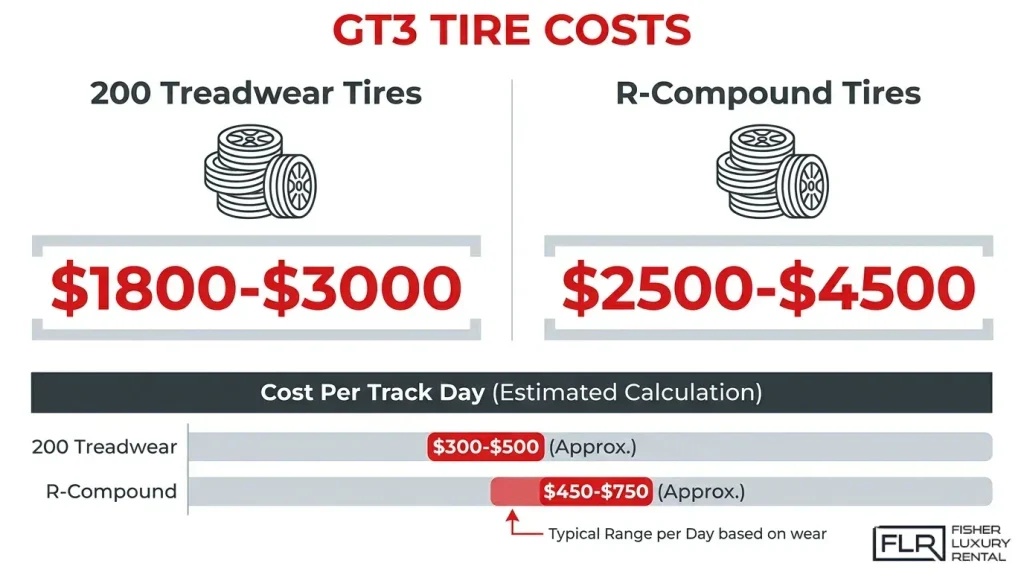
200 treadwear track tires for a GT3 cost roughly $1,800 to $3,000 per set, depending on brand and size. The GT3’s large staggered fitment (255/35ZR20 front, 315/30ZR21 rear on the 992) pushes prices toward the higher end of that range compared to smaller sizes. For reference, Tire Rack lists the Michelin Pilot Sport Cup 2 (240) in 295/30ZR18 at $2,035.96 for a set of four — and GT3-specific sizes cost more. Budget roughly $2,200 to $2,800 for a quality set in the correct GT3 fitment. Given that tires are the single largest consumable at a track day, buying a dedicated set for track use only is the most cost-effective approach for drivers who run more than two sessions per season.
What Do R-Compound Track Tires Cost for a GT3?
R-compound track tires for a GT3 cost between $2,500 and $4,500 per set, with pricing dependent on brand, compound, and GT3 size availability. The Porsche Club of America notes that R-compound tires degrade with each heat cycle, meaning they deliver peak grip on their first few sessions before performance drops measurably. That heat-cycle degradation should factor into your cost calculation: a $3,500 R-compound set that lasts three track days costs more per session than a 200tw set used strategically. For drivers competing in timed events or HPDE advanced groups, the lap-time advantage justifies the premium, but casual track day participants often find 200tw tires offer a better cost-to-performance ratio.
How Can You Experience Porsche 911 GT3 Performance Firsthand?
Experiencing GT3-level performance comes down to two paths: owning one or renting one. The sections below cover what Fisher Luxury Rental offers and the key takeaways from this GT3 track tire guide.
Can Renting an Exotic Car from Fisher Luxury Rental Deliver a GT3-Level Driving Thrill?
Yes, renting an exotic car from Fisher Luxury Rental can deliver a GT3-level driving thrill without the ownership costs or track-day tire commitments. Fisher Luxury Rental serves Phoenix, AZ, Scottsdale, AZ, Portland, OR, and Vancouver, WA, offering top-trim exotic and luxury vehicles curated for drivers who want a genuine performance experience. Fisher Luxury Rental emphasizes the cleanliness and maintenance of its vehicles, so the mechanical experience matches the visual impression. For car enthusiasts who want to feel high-performance dynamics on real roads before committing to a GT3 purchase, or who simply want the thrill without managing tire heat cycles and alignment setups, this is one of the most practical approaches available. Fisher Luxury Rental, established in 2022 and operating in Phoenix, AZ and Portland, OR, stocks only top-trim models of exotic and luxury vehicles, so drivers get the full performance experience rather than a diluted version of it.

What Are the Key Takeaways About Porsche 911 GT3 Track Tires?
The key takeaways about Porsche 911 GT3 track tires are that compound choice, pressure management, and heat cycling discipline determine how much performance you actually extract on track. The main lessons from this guide are:
- Tire category matters: 200 treadwear tires like the Michelin Pilot Sport Cup 2 balance street usability and track grip, while R-compounds and slicks prioritize outright lap time over longevity.
- Pressure precision is critical: Small deviations from optimal hot pressures reduce contact patch efficiency and uneven tire temperatures signal wasted grip.
- Heat cycles degrade R-compound tires progressively, so fresh tires perform best and each session compounds wear.
- Staggered vs. square setup affects balance: A square setup can deliver better mid-corner speed than wider staggered fitments depending on driver style and track layout.
- Ownership costs are real: Track consumables alone can reach $800 to $2,000 per track day, according to MPH.com analysis of GT3 ownership costs.
For drivers who want GT3-level performance without the commitment of ownership costs and consumables, exotic car rental services like Fisher Luxury Rental offer a practical alternative in the Phoenix and Portland areas. Understanding these variables before a track day separates drivers who manage their tires from drivers whose tires manage them.