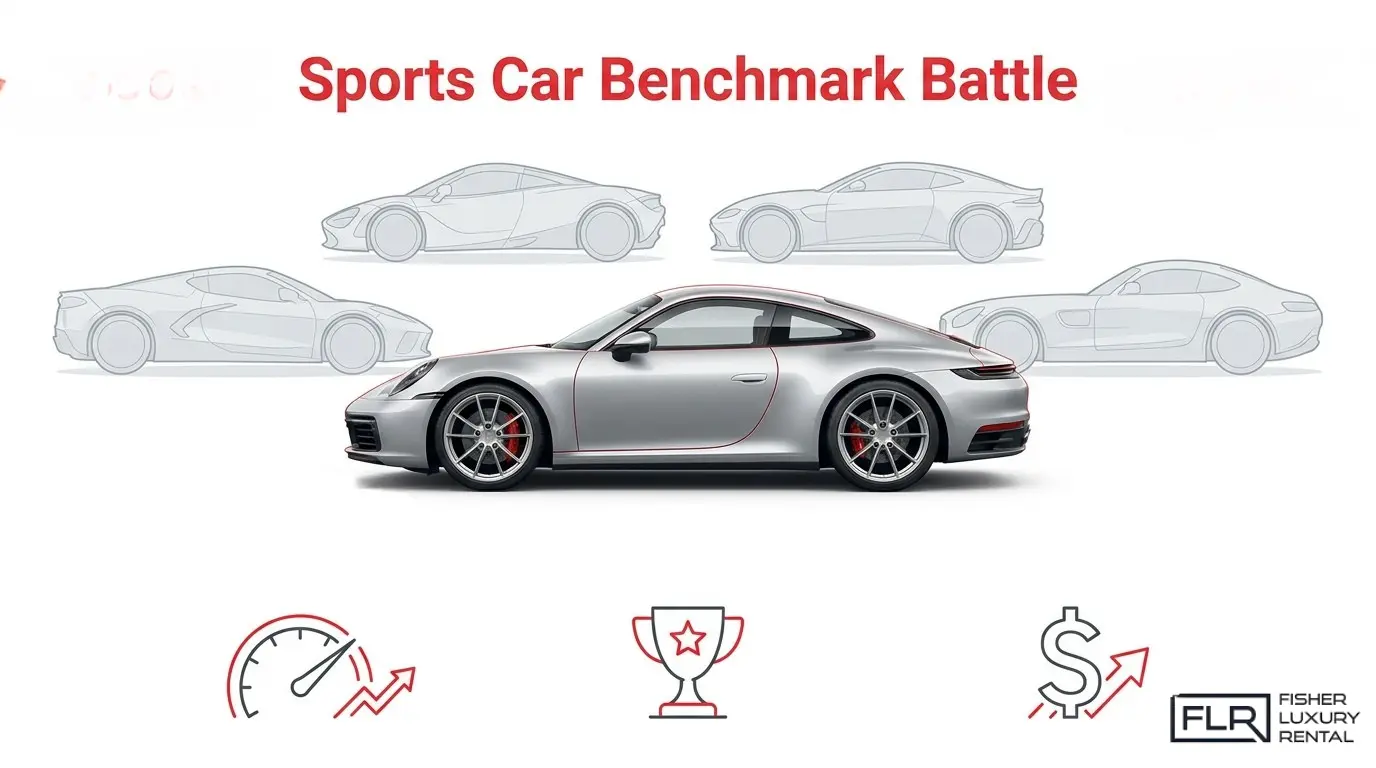
The Porsche 911 is a two-door, rear-engine sports car produced by Porsche of Stuttgart since 1964, and it remains the definitive benchmark against which every performance car in its class is measured.
This guide covers the 911’s standing as a sports car benchmark, the ten rivals that most directly challenge it, how those rivals compare on performance and price, their daily drivability and interior quality, and how electric and hybrid alternatives are reshaping the competitive landscape.
The 911’s six-decade legacy gives it a foundation no competitor has fully replicated. Its Nürburgring credentials, industry-leading resale value, and consistent sales growth set the standard this guide uses to evaluate each rival.
The competitors range from accessible American muscle to hand-built British grand tourers. Cars like the Chevrolet Corvette, Jaguar F-Type, Nissan GT-R, McLaren Artura, and Aston Martin Vantage each challenge the 911 in distinct ways, whether through raw power, emotional character, or price-to-performance ratio.
Performance and price comparisons reveal meaningful trade-offs across three tiers. From the Jaguar F-Type starting under $100,000 to the McLaren Artura Spider at $273,800, each rival occupies a specific value position relative to the 911’s trim range.
Electric and hybrid challengers including the McLaren Artura, Ferrari SF90 Stradale, and Porsche Taycan push power outputs and acceleration figures beyond what any combustion-only 911 can match, though they trade analogue driving character for electrified performance.
Resale value and interior quality round out the comparison, with the 911 holding a clear financial and cabin-refinement advantage over virtually every rival covered here.
What Makes the Porsche 911 the Benchmark for Sports Cars?
The Porsche 911 is the benchmark for sports cars because it combines race-derived performance, exceptional reliability, and outstanding resale value in a single platform that has been continuously refined since 1964. The sections below cover its origins, track credentials, and ownership economics.
The Porsche 911 is a family of two-door, high-performance rear-engine sports cars introduced in September 1964 by Porsche of Stuttgart, making it one of the longest-running sports car nameplates in automotive history. Over six decades, each successive generation has raised the performance bar while preserving the silhouette and driving philosophy that enthusiasts recognize instantly.
That continuity is not merely nostalgic — it is commercially validated. According to Porsche Sales Analytics, the 911 sold more than 50,600 units in 2024, with volume increasing 4 percent, making it one of the few remaining sports cars achieving consistent sales growth in a contracting segment.
On track, the 911 GT3 RS recorded a Nürburgring Nordschleife lap time of 6:49.328, placing it in the top ten fastest production cars ever timed at the circuit, according to Goodwood Road and Racing.
The ownership economics are equally compelling. According to iSeeCars, a new Porsche 911 depreciates just 7.8 percent after five years, retaining a resale value of $110,775, compared to the luxury sports car category average of 24 percent depreciation. Few competitors match that combination of daily usability and long-term financial resilience, which is precisely what cements the 911’s benchmark status rather than raw power alone.
Which Cars Directly Compete With the Porsche 911?
The cars that directly compete with the Porsche 911 span a wide price range and performance spectrum, from attainable American muscle to hand-built British grand tourers. The sections below cover ten of the most significant rivals: the Mercedes-AMG GT, Audi R8, Chevrolet Corvette, Jaguar F-Type, BMW M8, Aston Martin Vantage, Maserati GranTurismo, Nissan GT-R, McLaren Artura, and Lotus Emira.
Mercedes-AMG GT
The Mercedes-AMG GT is a front-engine grand tourer that competes with the 911 through a combination of raw power and interior refinement. The AMG GT 63 PRO 4MATIC+ Coupe produces 603 hp and 627 lb-ft of torque, reaching 60 mph in 3.1 seconds with a top speed of 197 mph. For buyers wanting more, the GT 63 S E PERFORMANCE hybrid variant combines a 4.0L biturbo V8 with an electric rear motor for 805 hp and 1,047 lb-ft of torque, hitting 60 mph in 2.7 seconds. Pricing starts at $136,050 and climbs to $177,050. Where the 911 wins is driving purity; the AMG GT answers with sheer muscle and Mercedes-Benz luxury.
Audi R8
The Audi R8 is a naturally aspirated mid-engine supercar that challenges the 911 on precision and engineering drama. Its 5.2-liter V10 produces 602 hp at 8,100 rpm and 413 lb-ft of torque, launching from 0-60 mph in 3.1 seconds with a top track speed of 206 mph. The R8 Coupe in V10 Performance RWD trim starts at $161,395. While the R8 matches the 911 in track capability, its naturally aspirated V10 soundtrack is one of the most compelling arguments for choosing it over the flat-six from Stuttgart.
Chevrolet Corvette
The Chevrolet Corvette is the most performance-per-dollar rival to the 911 in the American market. According to Car and Driver, the 2025 Corvette Stingray is powered by a 6.2-liter naturally aspirated V8 producing 490 hp and 470 lb-ft of torque, reaching 60 mph in 2.8–3.3 seconds. The range escalates dramatically: the Corvette ZR1 features a 5.5-liter twin-turbocharged V8 producing 1,064 hp, hitting 60 mph in 2.3 seconds and completing the quarter-mile in 9.6 seconds. The Z06 Z07 Package lapped the Nürburgring Nordschleife in 7:10.92. For buyers who want 911-rivaling track performance at a fraction of the price, the Corvette is genuinely hard to argue against. For those who want to experience the Corvette’s performance firsthand before comparing it to the 911, exotic car rental services like Fisher Luxury Rental offer access to high-performance vehicles in the Phoenix and Portland areas.
Jaguar F-Type
The Jaguar F-Type is a British two-seat sports car that competes with the 911 on style, sound, and V8 performance. The F-Type R produces 575 hp and reaches 60 mph in 3.5 seconds with a top speed of 186 mph, while the standard model delivers 444 hp and hits 60 mph in 4.4 seconds. Pricing is accessible relative to the 911: the 2024 F-Type 75 Coupe starts at $89,900, and the F-Type R75 Coupe starts at $113,000. The F-Type trades the 911’s everyday usability and resale strength for a more theatrical, emotionally charged driving experience.
BMW M8
The BMW M8 is a high-performance grand tourer that directly challenges the 911 with brutal straight-line speed and everyday practicality. The 2025 M8 Competition features a 4.4-liter twin-turbocharged V8 producing 617 hp and 553 lb-ft of torque, reaching 60 mph in 2.5 seconds in Car and Driver testing. The M8 Competition Coupe starts at $140,000. It offers more interior space and technology than the 911, making it a strong choice for drivers who want near-supercar performance with a usable back seat.
Aston Martin Vantage
The Aston Martin Vantage is a hand-built British sports car that rivals the 911 on emotion, exclusivity, and performance. Its 4.0-liter twin-turbo V8 produces 670 hp and 590 lb-ft of torque, with a top speed exceeding 200 mph. In Car and Driver testing, the 2025 Vantage reached 60 mph in 3.2 seconds, quicker than the previous F1 Edition model. The Vantage offers something the 911 cannot replicate: the visceral character of Aston Martin’s coachbuilt heritage, making it the most emotionally compelling rival in this segment.
Maserati GranTurismo
The Maserati GranTurismo is a long-wheelbase Italian grand tourer that competes with the 911 on luxury, sound, and cross-continental ability rather than outright lap times. The GranTurismo Trofeo uses a 3.0-liter V6 Nettuno twin-turbo engine producing 550 hp and 650 Nm of torque, reaching 100 km/h in 3.5 seconds with a maximum speed of 320 km/h. According to MotorTrend, the Trofeo in Modena specification delivers 483 hp with 0-60 mph in approximately 3.7 seconds. The 2026 GranTurismo starts at $160,695, with the Folgore electric variant at $200,295.
Nissan GT-R
The Nissan GT-R is a technology-driven Japanese supercar that competes with the 911 through engineering density and all-weather all-wheel-drive performance. The 2024 GT-R Premium produces 565 hp and 467 lb-ft of torque from a 3.8-liter twin-turbo V6, with 0-60 mph in 2.9–3.2 seconds. According to Car and Driver, the 2025 GT-R NISMO produces 600 hp. Pricing runs from $121,090 for the Premium to $221,090 for the NISMO. Despite its aging platform, the GT-R still delivers 911-level performance figures at prices that undercut most European rivals significantly.
McLaren Artura
The McLaren Artura is a hybrid mid-engine sports car that competes with the upper-tier 911 variants on outright performance and technological sophistication. According to Car and Driver, the Artura’s hybrid twin-turbo V6 powertrain produces a combined 690 hp, up 19 hp from the original Artura. The 2025 Artura Spider produces 531 lb-ft of torque, reaching 62 mph in 3.0 seconds with a top speed of 205 mph. The Spider base model starts at $273,800. The Artura positions itself above most of this list as a near-exotic, placing it closer to the 911 Turbo S in both price and ambition.
Lotus Emira
The Lotus Emira is a lightweight British sports car that competes with the 911 on driving purity and driver engagement rather than straight-line speed. The Emira uses a Toyota-sourced supercharged 3.5-liter V6 producing 400 hp and 310 lb-ft of torque, with a claimed 0-60 mph of 3.8 seconds and a top speed of 182 mph, though MotorTrend testing recorded 4.2 seconds to 60 mph and a quarter-mile in 12.6 seconds. The 2026 Emira starts at $109,400, with the range-topping V6 SE Racing Line at $118,400. For drivers who prioritize feel over outright power, the Emira makes a compelling case as the most driver-focused alternative in this group.
How Do Porsche 911 Competitors Compare on Performance?
Porsche 911 competitors compare on performance across several dimensions, including raw horsepower, 0-60 times, track capability, and drivetrain architecture. The H3s below examine the Corvette C8, Mercedes-AMG GT, Audi R8, Nissan GT-R, and Aston Martin Vantage against the 911’s benchmarks.
How Does the Corvette C8 Stack Up Against the 911 on Power?
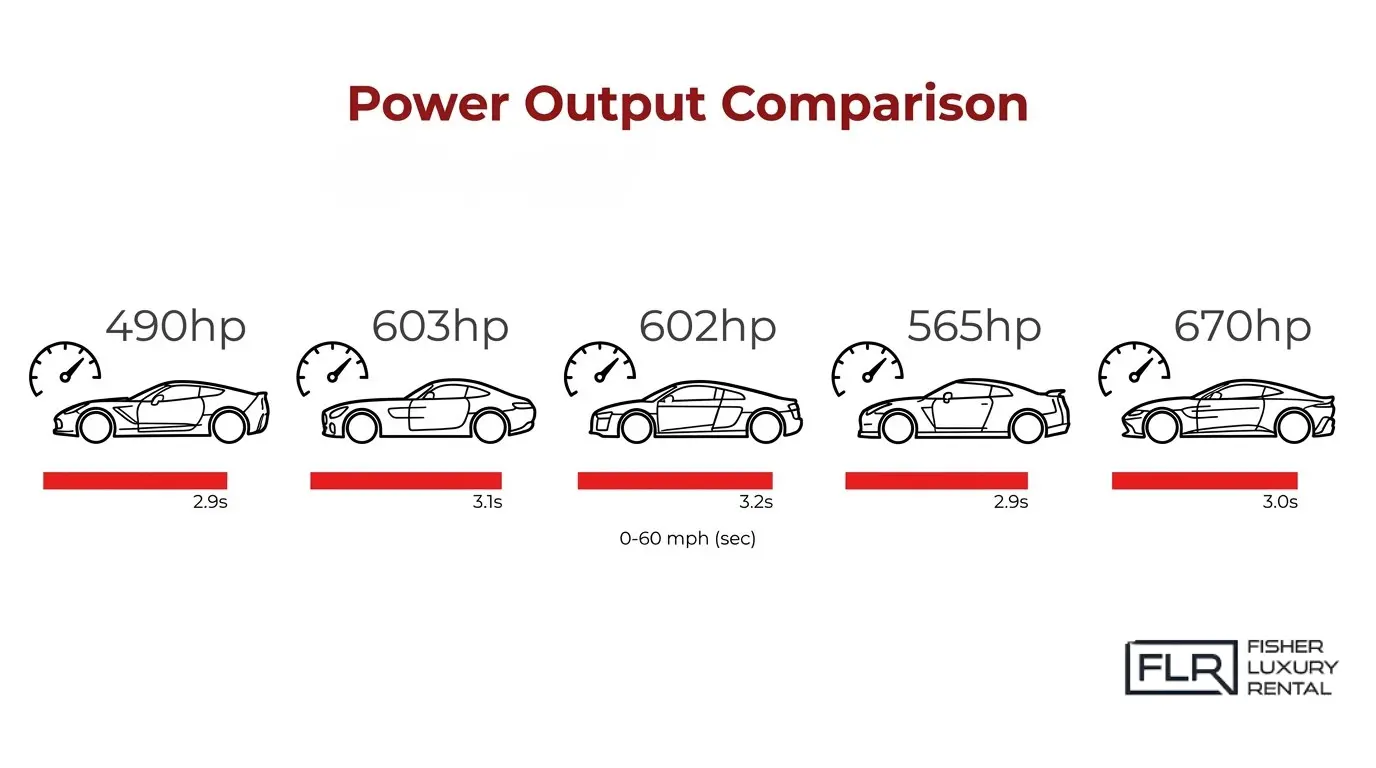
The Corvette C8 stacks up against the 911 on power with a compelling but different approach. The 2025 Corvette Stingray produces 490 hp from a 6.2-liter naturally aspirated V8, reaching 60 mph in as little as 2.8 seconds according to Car and Driver. At the top end, the 2025 Corvette ZR1 pushes 1,064 hp with a 0-60 time of 2.3 seconds, outgunning any production 911 on raw numbers. Where the 911 counters is balance and everyday refinement. The Corvette delivers brutal straight-line speed, but the 911’s rear-engine layout and chassis tuning give it a more cohesive, driver-focused experience across varied conditions.
How Does the Mercedes-AMG GT Compare to the 911 on Track?
The Mercedes-AMG GT compares to the 911 on track as a more powerful but heavier grand tourer. The AMG GT 63 PRO 4MATIC+ produces 603 hp and reaches 60 mph in 3.1 seconds, while the hybrid AMG GT 63 S E PERFORMANCE delivers 805 hp and 0-60 in 2.7 seconds. The Mercedes-AMG GT R posted a Nürburgring time of 7:10.92. Those figures are strong, but the 911 GT3 RS lapped the same circuit in 6:49.328 — over 21 seconds faster — underscoring how the 911’s purpose-built chassis outperforms the AMG GT’s heavier platform under sustained track use.
Can the Audi R8 Match the 911’s Driving Dynamics?
The Audi R8 can partially match the 911’s driving dynamics, but falls short in key areas. The R8 Coupe produces 602 hp, hits 60 mph in 3.1 seconds, and tops out at 206 mph, making it quicker than most 911 Carrera variants in isolation. However, the R8’s mid-engine layout and all-wheel drive prioritize stability over driver engagement. The 911’s rear-engine character, sharper steering feedback, and broader trim range — from the Carrera to the GT3 — give it greater depth as a driver’s car. The R8 is faster in a straight line at comparable trim levels, but the 911 is more rewarding to drive on a technical road.
How Does the Nissan GT-R’s AWD System Compare to the 911?
The Nissan GT-R’s AWD system compares to the 911 as a technically sophisticated but differently engineered solution. The 2024 GT-R Premium uses a 3.8-liter twin-turbo V6 producing 565 hp and 467 lb-ft of torque, with 0-60 in 2.9 to 3.2 seconds. Its ATTESA E-TS Pro all-wheel drive delivers exceptional traction and stability under hard acceleration. The 911 Carrera 4S and Turbo models also use AWD but with Porsche’s Traction Management system, which distributes torque with more precision and integrates tighter with rear-biased handling. The GT-R prioritizes brute grip; the 911 prioritizes dynamic balance.
Does the Aston Martin Vantage Rival the 911 Turbo S?
The Aston Martin Vantage rivals the 911 Turbo S on headline numbers but diverges in character. According to Aston Martin USA, the Vantage produces 670 hp and 590 lb-ft of torque from a handcrafted 4.0-liter twin-turbo V8, with 0-60 in 3.4 seconds and a top speed exceeding 200 mph. The 911 Turbo S outpaces it with 640 hp and 0-60 in 2.6 seconds in its 2025 form, while the 2027 model pushes 701 hp and 2.4 seconds. The Vantage compensates with dramatic styling and a more visceral exhaust note, making it a serious emotional competitor — though the 911 Turbo S holds the edge in outright performance precision.
How Do 911 Alternatives Compare on Price and Value?
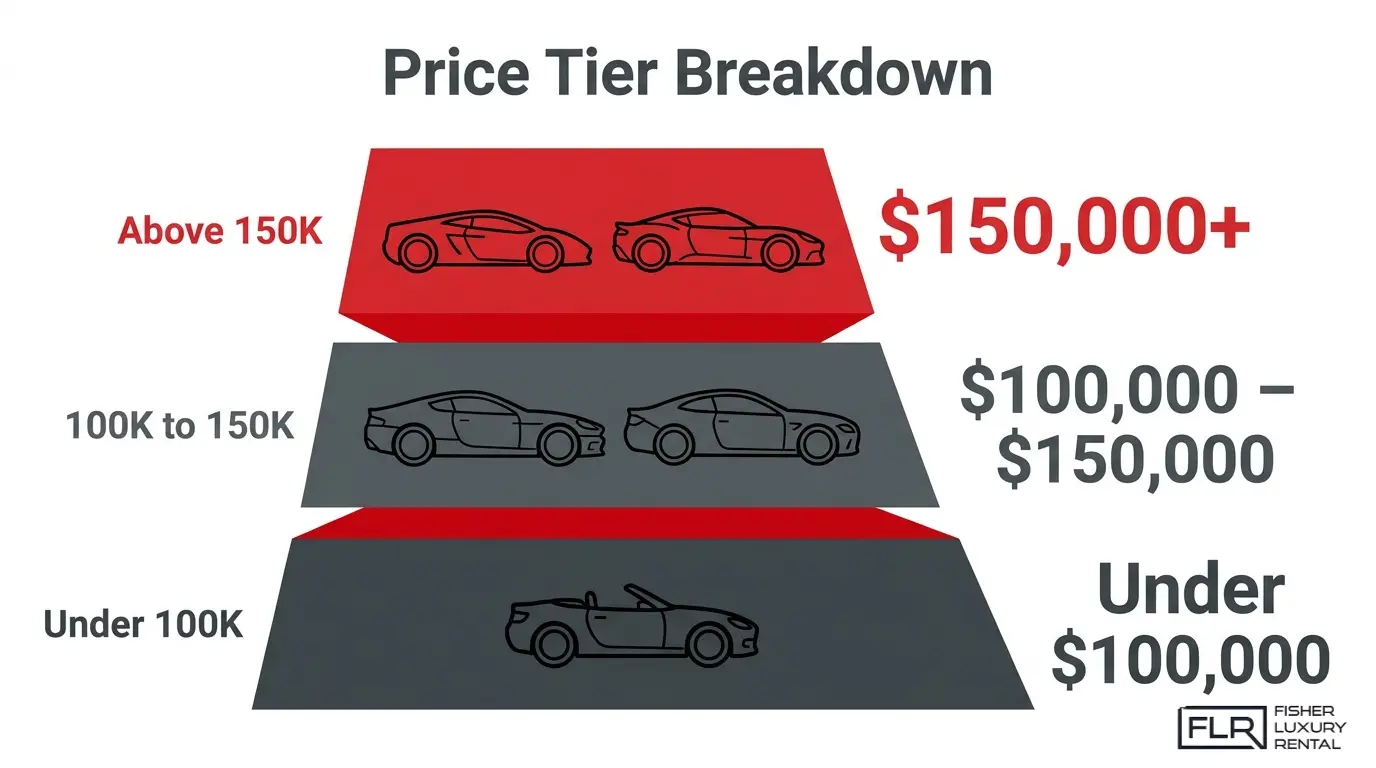
911 alternatives span three distinct price tiers, from under $100,000 to well above $150,000. The sections below break down which competitors fall into each range and what buyers get at each level.
Which 911 Competitors Cost Under $100,000?
The 911 competitors that cost under $100,000 are limited, with the Jaguar F-TYPE 75 Coupe being the clearest entry point. According to Jaguar North Dade, the 2024 F-TYPE 75 Coupe starts at $89,900 MSRP, making it the most accessible rival in this comparison. It delivers 444 horsepower and a 0-60 mph time of 4.4 seconds — respectable performance, though noticeably behind most mid-tier 911 alternatives. For buyers prioritizing British character and a lower buy-in, the F-TYPE represents strong value, though the performance gap relative to pricier rivals is real.
Which 911 Rivals Fall in the $100,000 to $150,000 Range?
The 911 rivals that fall in the $100,000 to $150,000 range include several well-matched competitors:
- Jaguar F-TYPE R75 Coupe: Starts at $113,000 MSRP, producing 575 hp with a 0-60 mph time of 3.5 seconds.
- Nissan GT-R Premium: Starts at $121,090 MSRP, delivering 565 hp and 0-60 mph in 2.9 to 3.2 seconds.
- BMW M8 Competition Coupe: Starts at $140,000 MSRP with 617 hp, 553 lb-ft torque, and 0-60 mph in 2.5 seconds.
- Nissan GT-R T-Spec: Starts at $141,090 MSRP with the same 565 hp output as the Premium.
- Lotus Emira: Starting at $109,400, the Emira tops out at $118,400 for the V6 SE Racing Line.
This bracket offers the strongest value density of the three tiers. The BMW M8 Competition, in particular, delivers near-Turbo S acceleration at a significantly lower price point.
Which Alternatives Exceed $150,000?
The 911 alternatives that exceed $150,000 include the segment’s most performance-focused and exclusive rivals:
- Audi R8 V10 Performance RWD: Starts at $161,395, producing 602 hp with a 0-60 mph time of 3.1 seconds and a top speed of 206 mph.
- Maserati GranTurismo: Starts at $160,695, rising to $200,295 for the Folgore variant.
- Mercedes-AMG GT Coupe: Ranges from $136,050 to $177,050 depending on trim.
- McLaren Artura Spider: Starts at $273,800, with 690 combined horsepower and 0-62 mph in 3.0 seconds.
- Nissan GT-R NISMO: Priced at $221,090, producing 600 horsepower.
Above $150,000, buyers trade broader value for exclusivity, raw performance, or brand prestige. The McLaren Artura Spider represents the upper ceiling in this comparison, commanding a price well above most 911 variants while delivering supercar-level performance that justifies the premium for the right buyer.
How Do Porsche 911 Rivals Compare on Daily Drivability?
Porsche 911 rivals compare on daily drivability across several key dimensions, including cargo space, fuel efficiency, ride comfort, and interior refinement. The sections below examine how the BMW M8, Maserati GranTurismo, and Jaguar F-Type each balance everyday usability with sports car performance.

How Practical Is the BMW M8 as a Daily Driver?
The BMW M8 Competition is one of the most practical daily drivers in the sports car segment. Its 4.4-liter twin-turbocharged V8 produces 617 horsepower, yet the M8 Gran Coupe adds genuine rear-seat space, making it a realistic four-seat option. According to Car and Driver, the 2025 M8 Competition reaches 60 mph in 2.5 seconds while starting at $140,000 MSRP. Adaptive suspension and xDrive AWD further soften the daily driving compromise. For buyers who need supercar performance without sacrificing passenger capacity, the M8 stands out as the most versatile choice in this competitive set.
Does the Maserati GranTurismo Offer Comfort for Everyday Use?
The Maserati GranTurismo offers a distinctive blend of Italian grand touring comfort and genuine performance. Its 2+2 cabin, hand-stitched leather, and long-wheelbase layout make highway cruising notably relaxed. The 2025 GranTurismo Trofeo produces 483 hp and 443 lb-ft of torque, reaching 60 mph in approximately 3.7 seconds per MotorTrend. The GranTurismo prioritizes sweeping, comfortable mile-eating over the sharpest possible lap times, which suits buyers who drive frequently on long routes.
Is the Jaguar F-Type Easy to Live With Daily?
The Jaguar F-Type is relatively easy to live with daily, though it makes notable compromises compared to broader-bodied GT cars. The standard F-Type produces 444 hp and reaches 60 mph in 4.4 seconds, while the R variant delivers 575 hp with a 3.5-second sprint, per Jaguar USA. Visibility is limited, trunk space is tight, and ride quality on sport settings can be firm on rough roads. However, its compact dimensions make urban parking straightforward, and the exhaust note remains one of the most rewarding in the segment for drivers who prioritize sensory engagement over pure practicality.
What Are the Best Alternatives to Each Porsche 911 Trim Level?
The best alternatives to each Porsche 911 trim level vary by performance tier, from daily-driver rivals for the base Carrera to hypercar-level competitors for the Turbo S and GT3. The sections below match top rivals to each trim.
What Rivals Match the Base Porsche 911 Carrera?
The rivals that best match the base Porsche 911 Carrera are the Lotus Emira, Jaguar F-TYPE, and Porsche Taycan. The 2025 Carrera produces 388 hp and 331 lb-ft torque, reaching 0-60 mph in 3.9 seconds with a 183 mph top speed, according to Porsche USA. The JD Power 2022 Vehicle Dependability Study awarded the 911 a score of 87 out of 100, a benchmark its rivals struggle to match.
- Lotus Emira: 400 hp, 0-60 in 3.8 seconds, starting around $109,400; closely mirrors Carrera pace and driver engagement.
- Jaguar F-TYPE: 444 hp in standard trim, 0-60 in 4.4 seconds; a compelling grand tourer at a lower price point.
- Porsche Taycan: 402 hp, 0-60 in 4.5 seconds, 274-mile EPA range; the electric alternative for Carrera buyers prioritizing efficiency.
For buyers who value the Carrera’s balance of daily usability and sports car performance, the Emira offers the closest driver-focused analog at a significantly lower price.
What Competes With the Porsche 911 Turbo S?
The cars that best compete with the Porsche 911 Turbo S are the Mercedes-AMG GT 63 S E PERFORMANCE, BMW M8 Competition, and Ferrari SF90 Stradale. The 2025 Turbo S starts at $230,400 MSRP, producing 640 hp, 590 lb-ft torque, and 0-60 mph in 2.6 seconds.
| Competitor | Power | 0-60 mph | Key Advantage |
| 911 Turbo S (2025) | 640 hp | 2.6 sec | Benchmark all-weather supercar |
| Mercedes-AMG GT 63 S E PERFORMANCE | 805 hp | 2.7 sec | Hybrid torque, grand touring |
| BMW M8 Competition | 617 hp | 2.5 sec | Everyday comfort at $140,000 |
| Ferrari SF90 Stradale | 986 hp combined | 2.1 sec | Hybrid hypercar performance |
The Mercedes-AMG GT 63 S E PERFORMANCE produces 805 hp and 1,047 lb-ft torque via its hybrid V8 system, per Mercedes-Benz USA. The Ferrari SF90 Stradale reaches 986 combined hp through a twin-turbo V-8 and three electric motors, per Car and Driver. The BMW M8 Competition delivers 617 hp with a 2.5-second 0-60 time at a notably lower entry price than the Turbo S.
What Are the Best Alternatives to the Porsche 911 GT3?
The best alternatives to the Porsche 911 GT3 are the Chevrolet Corvette Z06, McLaren Artura, and Audi R8. The 2025 GT3 features a naturally aspirated 4.0-liter flat-six producing 502 hp, with 0-60 in 3.2 seconds and a $224,495 MSRP, per MotorTrend.
- Chevrolet Corvette Z06: Naturally aspirated 5.5-liter flat-plane V8, track-focused engineering, substantially lower entry price than the GT3.
- McLaren Artura: 690 combined hp from a hybrid twin-turbo V-6, 0-62 mph in 3.0 seconds, starting at $273,800 for the Spider variant.
- Audi R8: 602 hp, 0-60 in 3.1 seconds, 206 mph top speed; the most street-friendly of the three for dual daily and track use.
The GT3’s Nürburgring-developed chassis and motorsport DNA remain genuinely difficult to replicate, but the Corvette Z06 comes closest for drivers prioritizing analog feel and track capability at a lower cost.
How Do Electric and Hybrid Sports Cars Challenge the 911?
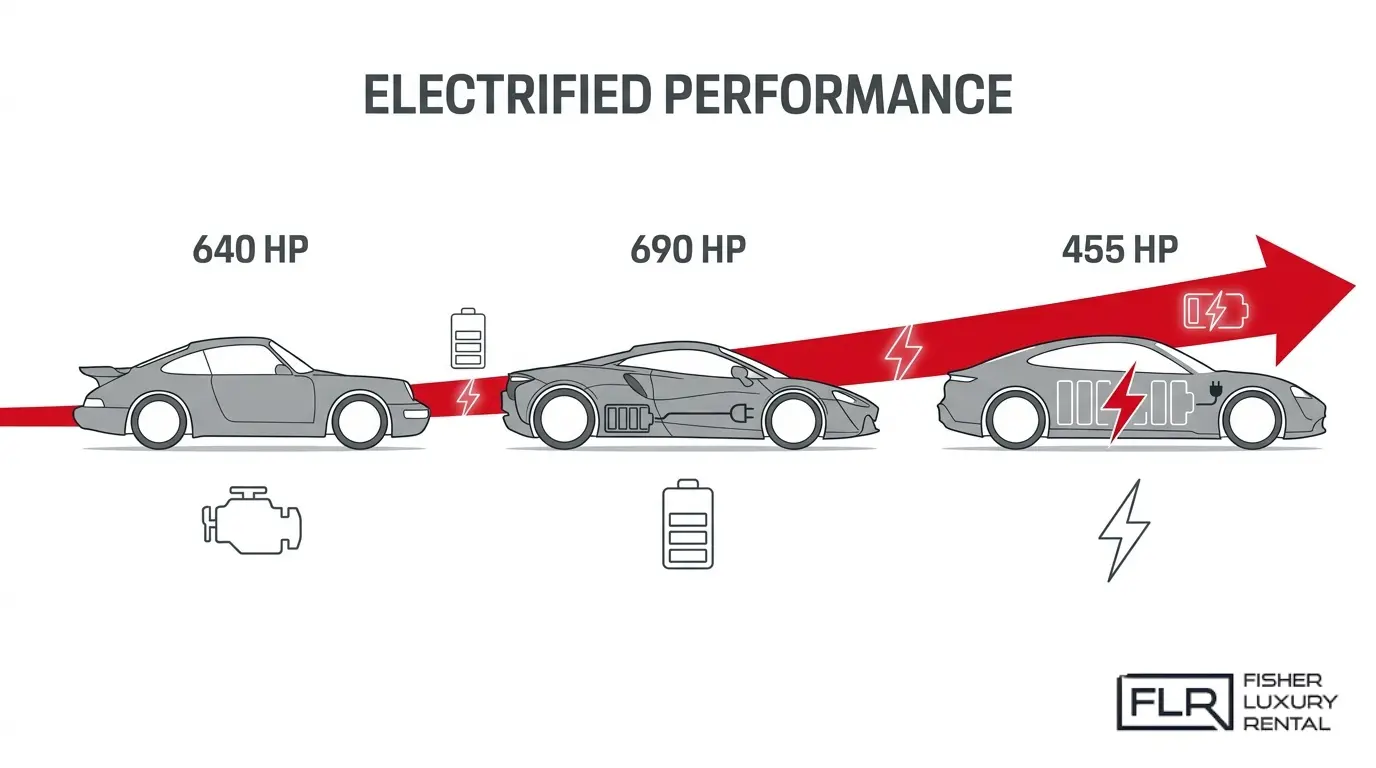
Electric and hybrid sports cars challenge the 911 by offering dramatically higher power outputs and faster acceleration, though they trade the 911’s analogue driving character and established reliability for cutting-edge electrification. The H3s below cover the McLaren Artura hybrid, the Ferrari SF90 Stradale, and the Porsche Taycan.
How Does the McLaren Artura Compare to the Porsche 911?
The McLaren Artura compares to the Porsche 911 as a hybrid supercar that significantly outguns most 911 variants in outright performance. The Artura’s hybrid twin-turbo V-6 powertrain produces a combined 690 horsepower, up 19 hp from its debut output, according to Car and Driver. The 2025 Artura Spider launches from 0-62 mph in 3.0 seconds and reaches a top speed of 205 mph. Starting at $273,800, it costs considerably more than any 911 Carrera, positioning it as a performance-first choice rather than an all-around daily driver.
How Does the Ferrari SF90 Stradale Stack Up Against the 911 Turbo S?
The Ferrari SF90 Stradale stacks up against the 911 Turbo S as a hypercars-tier rival that thoroughly outpaces it in raw numbers. According to Car and Driver, the SF90 Stradale combines a twin-turbocharged 4.0-liter V-8 producing 769 horsepower with three electric motors adding 217 horsepower, for a combined 986 hp and a 0-60 mph time of 2.1 seconds. Where the 911 Turbo S delivers usability and long-term ownership value, the SF90 prioritizes maximum hybrid performance at a significantly higher price.
Is the Porsche Taycan a True Competitor to the 911?
The Porsche Taycan is a true competitor to the 911 in terms of brand prestige and daily usability, but it targets a distinct type of driver. The Taycan 4S starts at $120,495 with 455 hp, an EPA range of 252 miles, and 0-60 mph in 3.5 seconds with Launch Control, per Car and Driver. It delivers a refined, near-silent performance experience rather than the 911’s signature flat-six soundtrack, making it the stronger choice for buyers who prioritize electric range and effortless everyday comfort over an engaging analogue connection.
Which 911 Competitor Holds Its Resale Value Best?
The 911 competitor that holds its resale value best is the Porsche 911 itself, which outperforms every rival in its segment on long-term value retention. According to iSeeCars, a new Porsche 911 depreciates just 7.8 percent after five years, producing a resale value of $110,775, compared to the luxury sports car category average of 24 percent depreciation. Robb Report also ranks the 911 No. 1 on its top 25 list of cars with the lowest depreciation rate, citing an average five-year depreciation of 19.5 percent.
Competitors such as the Mercedes-AMG GT, BMW M8, Audi R8, and Maserati GranTurismo all depreciate at significantly steeper rates, reflecting the 911’s unique combination of consistent demand, limited production variants, and decades-long brand loyalty. The Jaguar F-Type and Nissan GT-R, while compelling performers, face sharper value drops driven by model discontinuation uncertainty and lower resale demand.
From a financial perspective, the 911’s depreciation curve is remarkable. Its seven-year depreciation figure sits at just 8.3 percent, meaning ownership cost over time is substantially lower than any direct rival. For buyers weighing total cost of ownership rather than sticker price alone, no competitor in this class comes close. The 911 is not just the performance benchmark; it is the investment benchmark too.
How Does Interior Quality Compare Across 911 Rivals?
Interior quality across 911 rivals varies considerably, from driver-focused minimalism to grand touring luxury. The competitors covered below approach cabin design with distinct philosophies, each prioritizing different elements such as material richness, technology integration, and long-distance comfort.
How Does the Porsche 911 Interior Compare to the Mercedes-AMG GT?
The Porsche 911 interior compares to the Mercedes-AMG GT by offering a more driver-centric, analog-leaning cabin against AMG’s more opulent, technology-forward approach. The 911 uses hand-stitched leather, a driver-focused instrument cluster, and a relatively uncluttered layout built around feel and control. The AMG GT counters with a wide, sweeping dashboard dominated by a large infotainment display, richer ambient lighting, and a more overtly theatrical cabin presence. Buyers who prize cockpit precision over luxury theater consistently favor the 911’s approach, and that preference is well-founded. For pure driver immersion, the 911’s interior remains a more coherent expression of purpose.
How Does the Aston Martin Vantage Cabin Compare to the 911?
The Aston Martin Vantage cabin compares to the 911 by leaning heavily into hand-crafted British luxury, featuring extensive leather, aluminum trim, and artisan detailing throughout. Where the 911 prioritizes ergonomic efficiency, the Vantage prioritizes material prestige, with surfaces that feel more bespoke and tactile. Infotainment quality in the Vantage has historically lagged behind Porsche’s PCM system, a gap that makes the 911 the stronger daily driver for technology-dependent users. The Vantage wins on atmosphere; the 911 wins on usability.
How Does the Corvette C8 Interior Stack Up Against the 911?
The Corvette C8 interior stacks up against the 911 by offering a genuinely impressive cabin for its price point, with a driver-tilted central console, dual-screen display, and quality materials that surprised many early reviewers. However, the 911 maintains a clear advantage in perceived material quality, fit-and-finish consistency, and long-term tactile satisfaction. The C8 represents outstanding value-to-interior ratio in its class, but it does not match the 911’s refined assembly standards. For buyers cross-shopping primarily on cabin experience, the 911 sets the standard the Corvette aspires toward.
How Can You Experience Porsche 911 Rivals Before Choosing?
Experiencing Porsche 911 rivals before purchasing lets you compare real driving feel, not just specifications. The sections below cover how exotic car rentals enable side-by-side comparisons and summarize the key takeaways from this competitor analysis.
Can Renting Exotic Cars Help You Compare 911 Competitors?
Yes, renting exotic cars can help you compare 911 competitors in a way no test drive or spec sheet replicates. A single weekend rental puts you behind the wheel of a McLaren Artura, Aston Martin Vantage, or Chevrolet Corvette on your own roads and your own schedule. You experience the steering weight, exhaust note, cabin comfort, and daily usability firsthand. Buying a $150,000-plus sports car without driving it extensively is one of the most common and costly mistakes in this segment. Rental access removes that risk entirely, letting you evaluate each rival on the same routes before committing. Fisher Luxury Rental, serving Phoenix, Scottsdale, Portland, and Vancouver, specializes in top-trim exotic and luxury vehicles — giving serious buyers a practical way to put real seat time in high-performance cars before committing to a purchase.
What Are the Key Takeaways About Porsche 911 Competitors?
The key takeaways about Porsche 911 competitors are that no single rival dominates every category, and the best choice depends on your priorities. Here are the most actionable conclusions from this analysis:
- Performance value: The Chevrolet Corvette delivers supercar performance at a fraction of the price of European rivals.
- Emotional character: The Aston Martin Vantage and Maserati GranTurismo prioritize craftsmanship and theater over outright lap times.
- Technology leadership: The McLaren Artura’s hybrid powertrain and the Mercedes-AMG GT 63 S E PERFORMANCE push the segment toward electrification.
- Daily usability: The BMW M8 Competition and Nissan GT-R offer the most practical balance of performance and everyday comfort.
- Resale protection: The Porsche 911 remains the benchmark for holding value, making rivals a harder financial case to justify.
Fisher Luxury Rental offers an ideal way to experience exotic cars across Phoenix, Scottsdale, Portland, and Vancouver before making a six-figure decision.