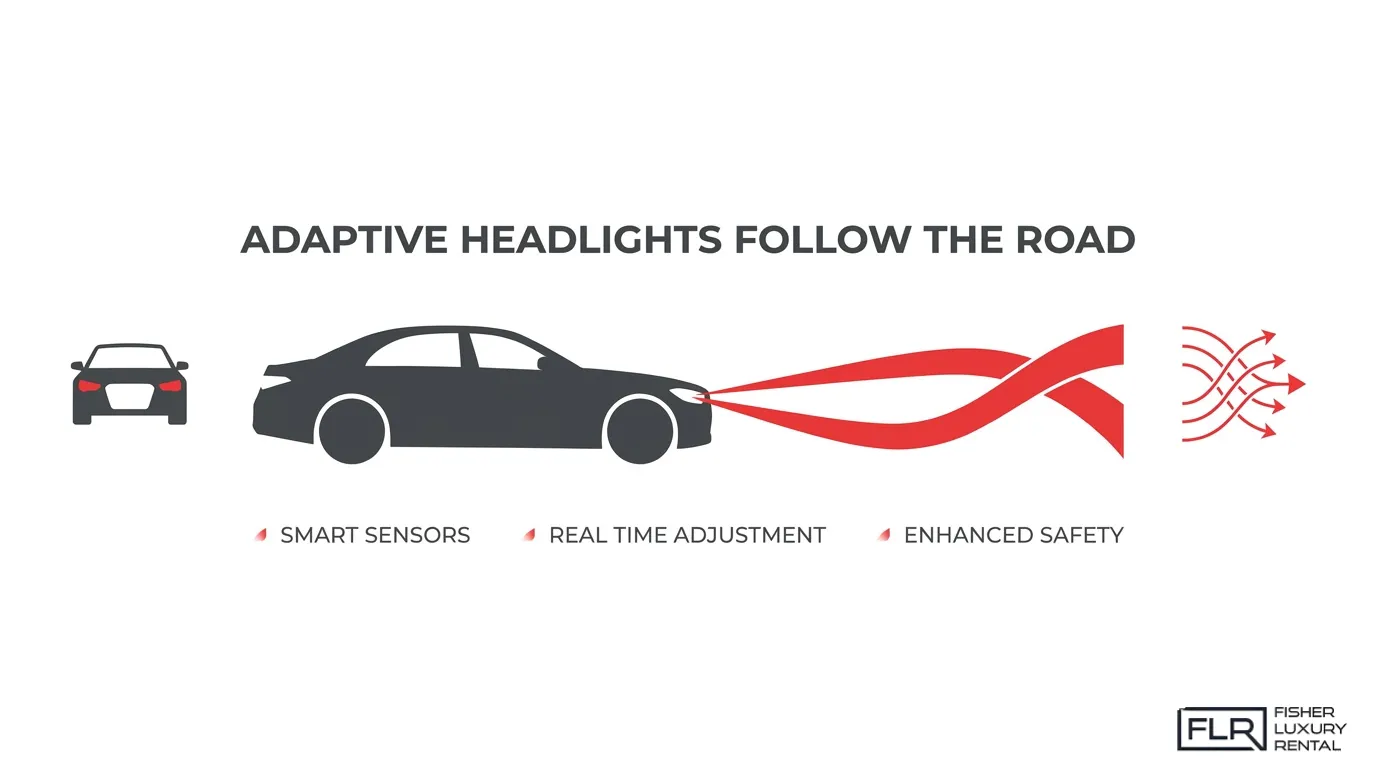
Adaptive headlights are advanced vehicle lighting systems that dynamically adjust the direction, range, and intensity of headlamp beams in response to real-time driving conditions such as steering angle, vehicle speed, and oncoming traffic. Unlike traditional fixed-beam headlights, adaptive systems follow the road rather than simply illuminate ahead of it.
This guide covers the core technology and components, how the system adjusts in real time, the distinct types of adaptive lighting, safety benefits, brand implementations, legal status, and what ownership and rental access actually look like.
Steering angle sensors, speed sensors, an ECU, and swivel actuators work together as a closed-loop system to pivot, reshape, and extend the beam continuously. More advanced variants, including Matrix LED and Adaptive Driving Beam (ADB), add forward-facing cameras to selectively shade portions of the high beam without moving parts.
Each real-time adjustment serves a specific purpose: cornering response keeps the beam on the road ahead rather than the roadside, speed-based scaling widens coverage in urban environments and narrows it at highway velocities, auto-leveling prevents blinding oncoming drivers on hills, and weather-adaptive modes reduce backscatter in rain or fog.
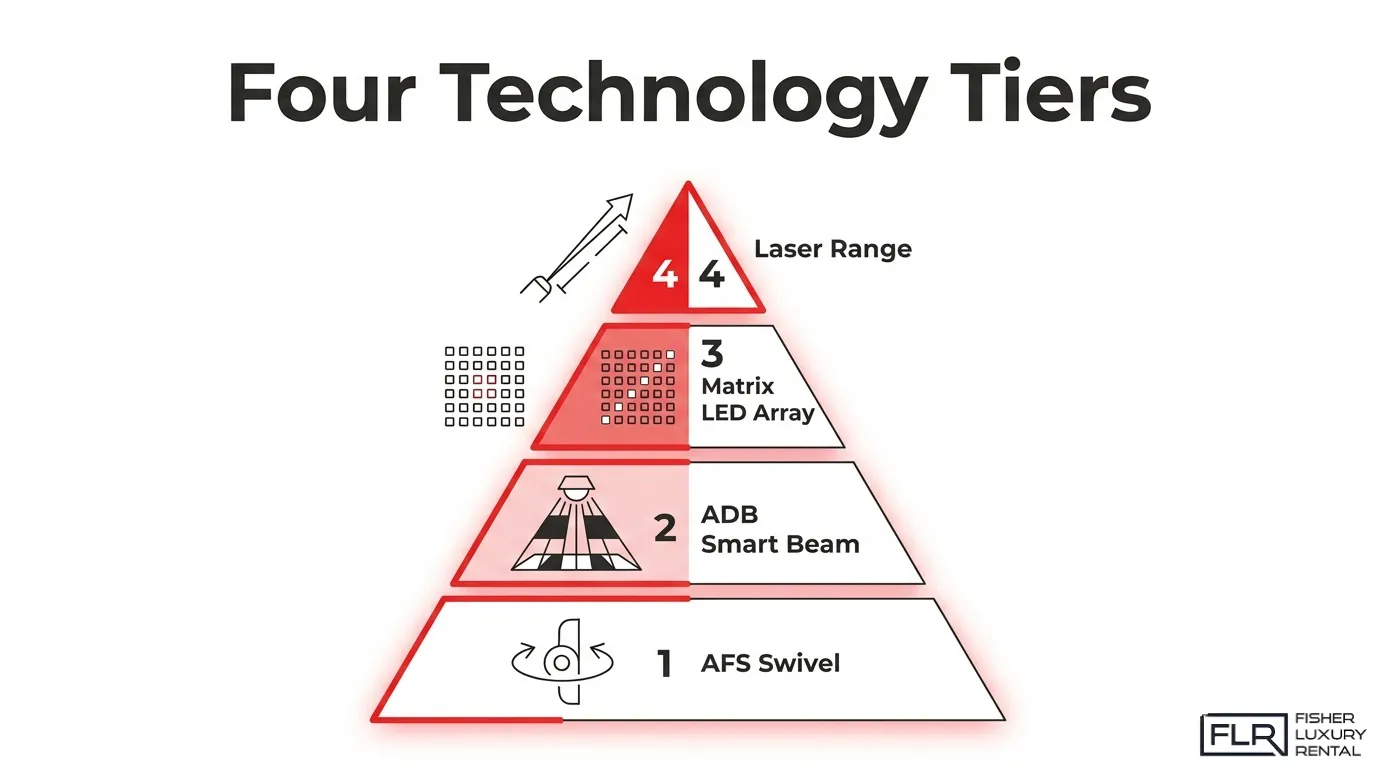
The four main technology tiers, Adaptive Front-Lighting Systems, Adaptive Driving Beam, Matrix LED, and laser headlights, each differ in how precisely they control beam direction and glare suppression. Automatic high beams operate on a fundamentally simpler, all-or-nothing principle and are not true adaptive systems.
Brands including Audi, BMW, Mercedes-Benz, Porsche, Lexus, Genesis, and Volvo offer proprietary implementations across their lineups. Replacement costs, windshield recalibration requirements, insurance implications, and how to identify and access the technology in a luxury rental round out the practical ownership picture.
What Are Adaptive Headlights?
Adaptive headlights are advanced vehicle lighting systems that dynamically adjust the direction, range, and intensity of headlamp beams in response to real-time driving conditions such as steering angle, vehicle speed, and oncoming traffic. Unlike traditional fixed-beam headlights, these systems optimize forward visibility while minimizing glare for other road users.
The following H3s cover the core definition, the key technology types, and how they are known across different systems and manufacturers.
Defining Adaptive Headlights as a Technology
Adaptive headlights are a category of intelligent automotive lighting that replaces static beam output with a continuously adjusting system. Where a conventional headlight points in one fixed direction regardless of road conditions, an adaptive system pivots, dims, or reshapes the beam based on live input from sensors and cameras. This makes adaptive headlights fundamentally different in purpose: they are designed to follow the road, not just illuminate ahead of it. In practice, these systems are also marketed under names such as dynamic headlights, cornering lights, swiveling headlights, and intelligent front-lighting, depending on the manufacturer.
What Technology Drives Adaptive Headlights?
The technology driving adaptive headlights combines steering angle sensors, speed sensors, an Electronic Control Unit (ECU), and swivel actuators working together as a closed-loop system. Steering angle sensors monitor wheel rotation and send directional data to the ECU. Speed sensors track vehicle velocity so beam length adjusts accordingly, shorter and wider at low speeds, longer and narrower at high speeds. The ECU processes all inputs and commands the swivel actuators, which are small motors inside the headlight assembly that physically pivot the light modules. More advanced variants, such as Matrix LED and Adaptive Driving Beam systems, add forward-facing cameras to detect other vehicles and reshape the beam without moving parts.
How Do Adaptive Headlights Differ from Standard Headlights?
Adaptive headlights differ from standard headlights in three core ways: beam direction, beam intensity, and glare control. Standard headlights use a fixed beam aimed straight ahead, while adaptive systems dynamically respond to steering input, speed, and oncoming traffic. The sections below examine those differences and their real-world cost implications.
Adaptive headlights use sensors, cameras, and an ECU to continuously reposition and reshape the beam. Standard headlights offer no such responsiveness, projecting a static pattern regardless of road conditions. According to IIHS, curve-adaptive headlights reduce insurance claims, though isolating how much benefit comes from the adaptive feature versus upgraded lamp technology like HID or LED remains difficult.
The performance gap is meaningful, but so is the cost gap. Replacing an adaptive headlight assembly runs between $1,000 and $5,000 or more due to complex sensors and LEDs. Windshield replacement on vehicles with ADB systems also requires recalibrating the forward-facing camera, adding unexpected repair costs. While adaptive headlights reduce crash frequency, their high replacement cost can offset premium discounts, sometimes resulting in higher insurance rates overall. For drivers who want to experience adaptive headlight technology without the ownership costs, Fisher Luxury Rental offers top-trim luxury vehicles in Phoenix and Portland that commonly include these advanced lighting systems as standard equipment on their trim level.
What Components Make Up an Adaptive Headlight System?
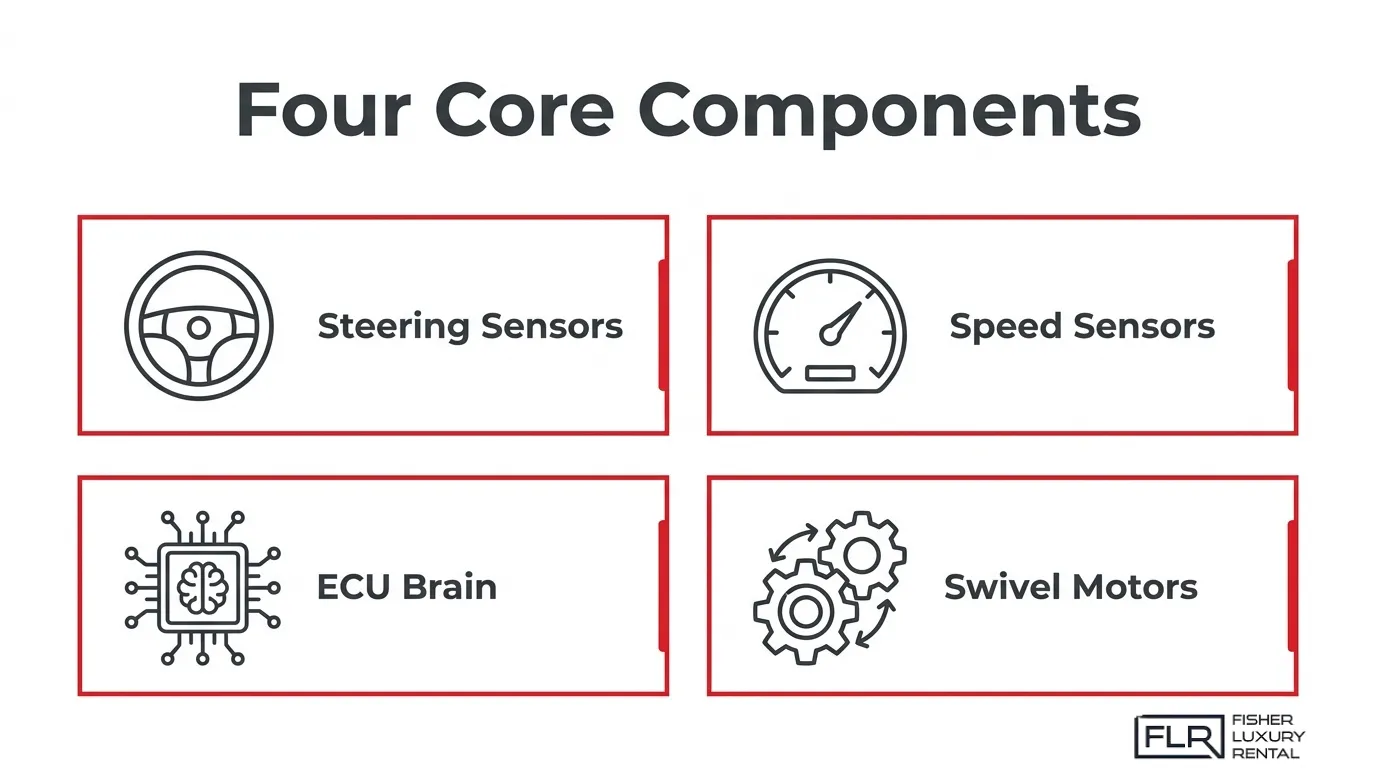
An adaptive headlight system consists of four core components: steering angle sensors, speed sensors, an electronic control unit (ECU), and swivel actuators. Each part handles a distinct task, and together they form the closed-loop system that keeps the beam where the road demands it.
What Role Do Steering Angle Sensors Play?
Steering angle sensors monitor the degree and direction of steering wheel rotation, then feed that data to the ECU in real time. Placed on the steering column, they detect how sharply and how quickly the driver is turning. The ECU uses this input to calculate exactly how far the headlight modules need to pivot to illuminate the curve ahead. Without accurate steering angle data, the system cannot distinguish a gradual lane change from a tight corner, making these sensors the primary directional input for the entire assembly.
How Do Speed Sensors Influence Beam Adjustment?
Speed sensors track vehicle velocity and allow the system to scale beam geometry to driving conditions. At low speeds, such as parking lot maneuvering or urban driving, the ECU uses speed data to produce a shorter, wider beam pattern that illuminates nearby pedestrians and cross-traffic. At highway speeds, the same data triggers a longer, narrower beam that extends visibility further down the road. This speed-responsive scaling is one of the more underappreciated aspects of adaptive lighting, as it directly addresses how differently a driver needs to see at 15 mph versus 75 mph.
What Does the Electronic Control Unit Do?
The electronic control unit (ECU) is the central processor that receives inputs from sensors and cameras, calculates the optimal beam pattern, and commands the actuators. It acts as the decision layer between raw sensor data and physical movement, running calculations continuously as driving conditions change. The ECU also integrates data from additional sources, such as forward-facing cameras used in Adaptive Driving Beam (ADB) systems, to detect oncoming vehicles and adjust beam intensity accordingly. Every pivot, every brightness shift, and every beam-width change originates from an ECU command.
How Do Swivel Actuators Move the Headlight Assembly?
Swivel actuators are small motors within the headlight assembly that physically pivot the light modules left or right, and up or down, based on ECU commands. When the ECU calculates that a 12-degree leftward pivot is needed on a curve, it signals the actuator, which mechanically rotates the entire light module to match. These motors must respond within milliseconds to keep pace with real-time steering inputs, making their precision and response speed critical to system performance. The actuator is the final mechanical link between digital calculation and actual illuminated road coverage.
How Does an Adaptive Headlight System Adjust in Real Time?
An adaptive headlight system adjusts in real time by processing continuous inputs from steering angle sensors, speed sensors, and forward-facing cameras, then commanding actuators and LED arrays to reposition or reshape the beam within milliseconds. The following H3s cover cornering response, speed-based beam scaling, elevation leveling, and adverse weather behavior.
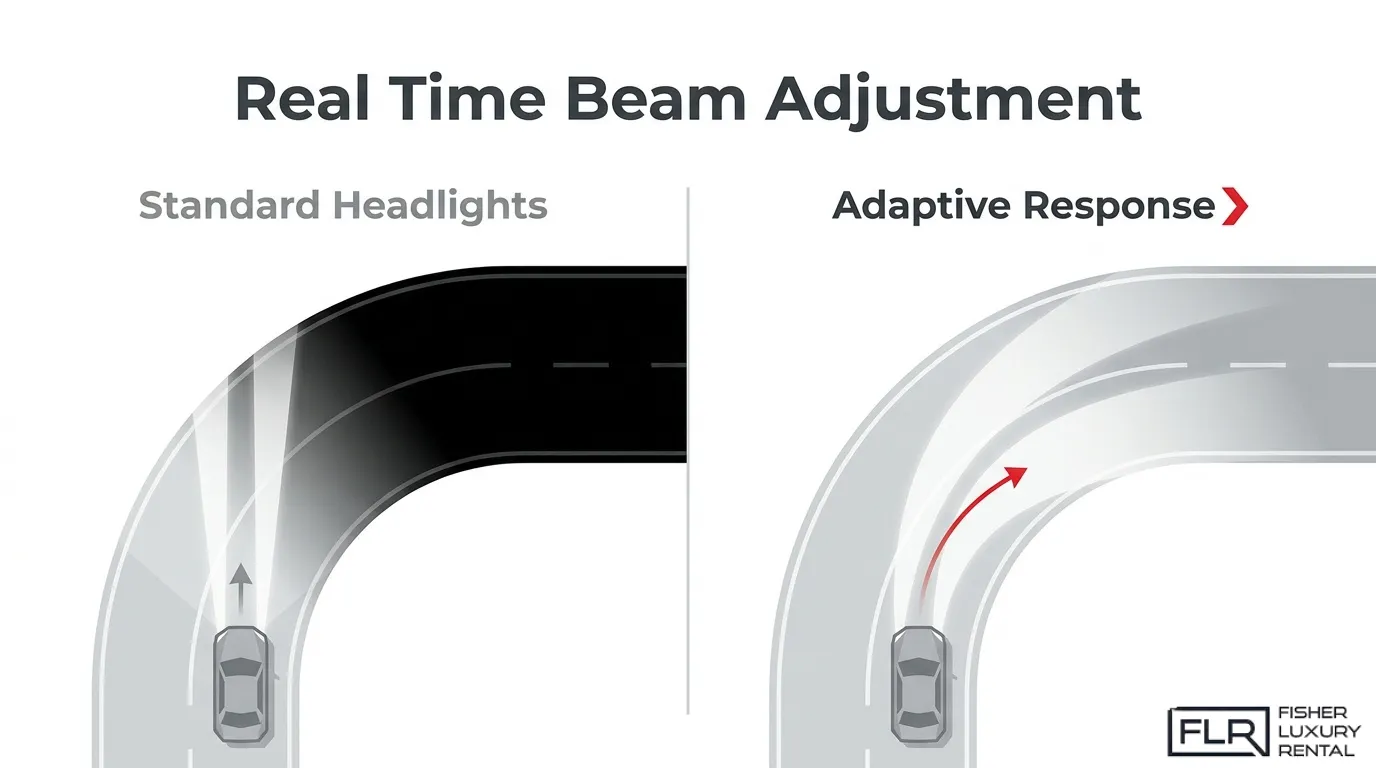
How Do Adaptive Headlights Respond When Cornering?
Adaptive headlights respond when cornering by reading the steering angle sensor and pivoting the headlight modules in the direction of the turn, illuminating the road ahead rather than the roadside. Brands such as Audi, BMW, Mercedes-Benz, and Porsche implement this via swivel actuators that physically rotate the light assembly. Matrix LED systems used by Genesis and Volvo achieve the same result by selectively activating individual LED segments on the inside of the curve. According to AAA, European vehicles equipped with adaptive driving beam headlights increase roadway lighting by as much as 86 percent compared to U.S. low beam headlights, underscoring how much cornering illumination standard fixed beams leave behind.
How Do Adaptive Headlights React to Changes in Speed?
Adaptive headlights react to changes in speed by narrowing and extending the beam at higher velocities and widening it at lower speeds. Speed sensors feed vehicle velocity data to the ECU continuously. At highway speeds, a longer, narrower beam gives the driver more forward warning distance. In urban or parking environments, a shorter, wider beam improves peripheral coverage at intersections and crosswalks. The beam geometry shifts automatically with no driver input required.
How Do Adaptive Headlights Adjust on Hills and Elevation Changes?
Adaptive headlights adjust on hills and elevation changes through an auto-leveling function that monitors vehicle pitch and repositions the beam vertically. When a vehicle crests a hill, the ECU detects the nose-up angle and tilts the beam downward to prevent blinding oncoming drivers. On a descent, the beam angles upward slightly to maintain road coverage ahead. Swivel actuators handle the vertical movement in the same way they manage lateral cornering adjustments. As Greg Brannon, Director of Automotive Engineering at AAA, noted: “Roads vary in so many ways, some have hills, others sharp turns, by not conducting track testing, a lot of valuable insight is missed into how headlight technology could be enhanced.”
How Do Adaptive Headlights Behave in Adverse Weather?
Adaptive headlights behave in adverse weather by modifying beam intensity and pattern to reduce backscatter from rain, fog, or snow. In wet conditions, a standard high beam reflects off the road surface and oncoming precipitation, creating glare that impairs the driver. Adaptive systems lower beam intensity or shift the cutoff angle to reduce this reflection. Some advanced systems, including those in top-trim Mercedes-Benz and BMW models, use forward-facing cameras to detect precipitation and adjust automatically. This keeps usable forward visibility as high as conditions allow without compounding glare for other road users.
What Are the Different Types of Adaptive Headlight Technology?
The different types of adaptive headlight technology are Adaptive Front-Lighting Systems (AFS), Adaptive Driving Beam (ADB), Matrix LED headlights, and laser adaptive headlights. Each type varies in how it controls beam direction, intensity, and glare management.
Adaptive Front-Lighting Systems
Adaptive Front-Lighting Systems (AFS) are curve-adaptive headlights that physically pivot the low-beam modules left or right based on steering input. Sometimes called swiveling headlights or cornering lights, AFS represents the foundational tier of adaptive lighting. Regulatory acceptance has expanded significantly: in February 2022, NHTSA amended FMVSS 108 to permit ADB systems in the United States, while Europe has permitted AFS under ECE R123 for years. Canada legalized ADB in March 2018. Luxury brands have developed proprietary AFS variants across their lineups, including Lexus BladeScan AHS on the RX, NX, LS, and LX, and Genesis Micro-Lens Array Intelligent Front-Lighting on the G80, G90, and GV80.
Adaptive Driving Beam Systems
Adaptive Driving Beam (ADB) systems allow high beams to remain on continuously while a forward-facing camera dynamically shades specific beam segments to prevent glare for oncoming drivers. Unlike Automatic High Beams, ADB never switches fully off; it selectively dims only the zones occupied by other vehicles. According to Greg Brannon, Director of Automotive Engineering at AAA, “Driving at night doesn’t have to be such a risky undertaking for Americans. The technology not only exists but is being used in other parts of the world to effectively provide the amount of light needed to keep drivers and pedestrians safer.”
Matrix LED Headlights
Matrix LED headlights are a type of ADB system that uses an array of individually addressable LEDs, allowing the ECU to turn off or dim specific LEDs to cast precise shadows around oncoming traffic without any moving parts. Premium implementations include Mercedes-Benz Digital Light and MULTIBEAM LED on the C, E, and S-Class, Audi HD and Digital Matrix LED on the A4, A6, A8, Q7, Q8, and e-tron, Porsche PDLS and PDLS+ Matrix on the 911, Cayenne, Macan, and Taycan, and Volvo Pixel LEDs on the EX90 and XC90. The pixel-level control Matrix LED provides is, in practice, the most precise glare-suppression available in production vehicles today. Several vehicles in the Fisher Luxury Rental fleet, including top-trim models from Audi, BMW, Mercedes-Benz, and Porsche, are equipped with Matrix LED or equivalent systems, making a rental a practical way to experience this technology firsthand.
Laser Adaptive Headlights
Laser adaptive headlights are systems that use blue laser diodes focused onto a yellow phosphor lens to produce intense white light, offering a range of up to 800 meters. More energy-efficient than conventional LEDs, they are currently more expensive and typically supplement LED high beams rather than replace them entirely. BMW offers Laserlight on the 3, 5, and 7 Series and the X5 and X7. Understanding these four technology tiers helps drivers and renters identify which level of adaptive lighting a specific vehicle delivers.
What Is the Difference Between Adaptive Headlights and Automatic High Beams?
The difference between adaptive headlights and automatic high beams is the degree of intelligence each system applies to managing light distribution. Adaptive systems actively shape and direct the beam; automatic high beams simply switch it on or off.
Adaptive Front-Lighting Systems vs. Automatic High Beams
Adaptive Front-Lighting Systems (AFS) physically pivot the low beam modules side-to-side based on steering input, directing light into curves before the vehicle enters them. Automatic High Beams (AHB) offer no such directional control; they detect oncoming traffic and toggle the entire beam between fully high and fully low. The core limitation of AHB is binary output: it cannot illuminate a curve ahead or selectively shade one lane while lighting another.
How Adaptive Driving Beam Differs from Automatic High Beams
Adaptive Driving Beam (ADB) represents the widest functional gap from automatic high beams. ADB keeps the high beam on continuously, using a forward-facing camera to detect other vehicles and dynamically shade or dim specific portions of the beam, preventing glare while keeping the rest of the road brightly lit. AHB cannot selectively shade areas; it is either fully high or fully low beam. In practice, this means ADB delivers far more usable light in traffic than AHB ever can.
Where Matrix LED and Laser Headlights Fit
Matrix LED is a type of ADB that uses an array of individually addressable LEDs, allowing the ECU to turn off or dim specific LEDs and create precise shadows around oncoming traffic without moving parts. Laser headlights use blue laser diodes focused onto a yellow phosphor lens, producing an intense white light with range up to 800 meters, often supplementing LED high beams rather than replacing them. Both technologies operate on a fundamentally different principle than AHB, which remains a simpler, all-or-nothing system best understood as a convenience feature rather than a true visibility upgrade.
What Safety Benefits Do Adaptive Headlights Provide?
Adaptive headlights provide safety benefits across three core areas: improved nighttime visibility, reduced glare for oncoming drivers, and a lower overall risk of nighttime accidents. The sections below examine each benefit with supporting evidence.
How Do Adaptive Headlights Improve Nighttime Visibility?
Adaptive headlights improve nighttime visibility by dynamically directing the beam where the road actually goes, rather than projecting light straight ahead. Curve-adaptive systems pivot the headlight modules into bends, illuminating the road ahead of the turn instead of the roadside shoulder. Speed-responsive adjustment further extends beam range at highway speeds, giving drivers more reaction time to hazards. According to a 2019 AAA study, European vehicles equipped with Adaptive Driving Beam headlights increase roadway lighting by as much as 86 percent compared to U.S. low-beam headlights. That gap is significant: better illumination directly expands a driver’s detection window for pedestrians, debris, and animals.
How Do Adaptive Headlights Reduce Glare for Oncoming Drivers?
Adaptive headlights reduce glare for oncoming drivers by using Adaptive Driving Beam technology to selectively dim or shade only the portions of the high beam that fall on other vehicles. Matrix LED systems accomplish this by turning off individual LEDs to cast a precise shadow over detected vehicles while keeping the surrounding road fully lit. Unlike Automatic High Beams, which cut the entire beam, ADB maintains maximum illumination everywhere except around the oncoming driver’s eyes. This targeted approach keeps visibility high for both parties simultaneously, rather than trading one driver’s safety for another’s comfort.
How Do Adaptive Headlights Lower the Risk of Nighttime Accidents?
Adaptive headlights lower the risk of nighttime accidents primarily by closing the visibility gap that makes night driving disproportionately dangerous. The IIHS confirms that curve-adaptive headlights reduce insurance claims, though isolating the adaptive feature’s contribution from the benefit of upgraded LED or HID lamps remains difficult. Earlier detection of road hazards, better cornering illumination, and sustained high-beam coverage without blinding other drivers all compound to reduce crash probability. The technology’s strongest case is in accident prevention through sustained, optimized illumination rather than any single mechanism acting alone.
Which Luxury Vehicle Brands Offer Advanced Adaptive Headlights?
The luxury vehicle brands that offer advanced adaptive headlights include Audi, BMW, Mercedes-Benz, Porsche, Lexus, Genesis, and Volvo. Each brand deploys a distinct proprietary system, ranging from Matrix LED arrays to laser-assisted high beams, across their flagship and mid-tier models.
| Brand | System Name | Models |
| Audi | HD/Digital Matrix LED | A4, A6, A8, Q7, Q8, e-tron |
| BMW | Adaptive LED, Laserlight | 3, 5, 7 Series, X5, X7 |
| Mercedes-Benz | Digital Light, MULTIBEAM LED | C, E, S-Class, GLE, GLS |
| Porsche | PDLS/PDLS+/Matrix | 911, Cayenne, Macan, Taycan |
| Lexus | BladeScan AHS | RX, NX, LS, LX |
| Genesis | Micro-Lens Array, Intelligent Front-Lighting | G80, G90, GV80 |
| Volvo | Pixel LEDs | EX90, XC90 |
From a practical standpoint, Matrix LED and Digital Light systems represent the most capable implementations currently available, offering individually addressable LED segments that carve precise shadow zones around oncoming traffic without dimming the surrounding road. For drivers prioritizing night-drive confidence, models like the Audi A8 or Mercedes S-Class represent the clearest path to experiencing this technology at its most refined.

Are Adaptive Headlights Legal in Every Country?
Adaptive headlights are not legal in every country under the same rules. Regulations vary significantly across the United States, Europe, Canada, and other regions, each governed by different standards bodies and testing requirements.
Are Adaptive Headlights Legal in the United States?
Adaptive headlights were historically not fully legal in the United States due to FMVSS 108, the federal motor vehicle safety standard that required vehicles to maintain distinct, fixed high and low beam settings. This made Adaptive Driving Beam systems non-compliant for decades, even as other countries embraced the technology. In February 2022, NHTSA amended FMVSS 108 to formally permit ADB systems, establishing specific testing and performance requirements that manufacturers must meet before equipping U.S.-market vehicles.
Are Adaptive Headlights Legal in Europe?
Adaptive headlights are legal in Europe and have been permitted for years under two key regulations: ECE R123, which governs Adaptive Front-lighting Systems, and ECE R149, which covers Adaptive Driving Beam systems. European automakers have offered ADB-equipped vehicles far longer than their American counterparts, which explains why brands like Audi, BMW, and Mercedes-Benz delivered more advanced headlight technology in European markets first.
Are Adaptive Headlights Legal in Canada and Other Regions?
Adaptive headlights are legal in Canada, where Transport Canada legalized ADB in March 2018, predating the U.S. amendment by nearly four years. Beyond North America, ADB systems are widely legal in Japan, Australia, and many other countries that follow UNECE regulations. The global picture is clear: the United States was the primary outlier, and its 2022 rule change finally aligned it with international standards.
How Can You Tell If a Vehicle Has Adaptive Headlights?
You can tell if a vehicle has adaptive headlights by examining several visual and specification-based indicators. Key clues include the headlight housing design, vehicle trim documentation, and instrument cluster behavior while driving.
- Check the headlight housing: Look for segmented or pixelated LED arrays inside the housing rather than a single continuous bulb or reflector. Matrix LED systems have a visibly distinct honeycomb or grid-like arrangement.
- Read the vehicle description: Terms such as “Matrix LED,” “Adaptive,” “MULTIBEAM LED,” “Digital Light,” or “PDLS+” in the manufacturer’s spec sheet or rental listing confirm adaptive technology.
- Test the headlights on a curve: Adaptive headlights physically pivot or adjust their beam pattern when you turn the steering wheel, illuminating the road ahead rather than straight forward.
- Review the owner’s manual or instrument cluster: Many vehicles display an adaptive headlight indicator or allow the driver to toggle the system through the infotainment menu.
- Confirm trim level: Adaptive headlights typically appear on top-trim or optional packages. According to rental industry guidance, renters can identify adaptive systems on luxury rental vehicles by searching for “Matrix LED” or “Adaptive” in the vehicle description.
Fisher Luxury Rental, which serves Phoenix and Portland, lists vehicle trim details in its rental descriptions, allowing prospective renters to confirm which lighting technology a specific vehicle includes before booking.
What Should You Know About Maintaining Adaptive Headlights?
Maintaining adaptive headlights requires more than a standard bulb check. The sections below cover replacement costs, windshield calibration requirements, and insurance effects.
What Do Adaptive Headlight Repairs and Replacements Cost?
Adaptive headlight repairs and replacements cost significantly more than standard headlight repairs. Replacing an entire adaptive headlight assembly runs between $1,000 and $5,000 or more, driven by the integrated sensors, swivel actuators, and LED arrays inside each unit. These aren’t components a technician can swap out piecemeal in most cases; the entire housing often requires replacement as a unit. For owners of luxury vehicles, this cost is worth anticipating before any incident occurs.
Why Does Windshield Replacement Affect Adaptive Headlight Calibration?
Windshield replacement affects adaptive headlight calibration because the forward-facing cameras that control Adaptive Driving Beam systems are typically mounted directly behind the windshield glass. Replacing the windshield disturbs the camera’s alignment, requiring a full recalibration to restore accurate beam targeting. This adds meaningful labor and equipment cost beyond the windshield itself, making what seems like a straightforward repair considerably more expensive.
How Do Adaptive Headlights Affect Insurance Premiums?
Adaptive headlights affect insurance premiums in two competing directions. While these systems reduce crash frequency, their high replacement cost can offset the discount that safer performance would otherwise generate, sometimes resulting in higher overall premiums for vehicles equipped with them. According to the IIHS, curve-adaptive headlights do reduce insurance claims, though separating the contribution of the adaptive feature from the underlying HID or LED lamp technology remains difficult. Owners should review their policy terms with this trade-off in mind.
How Can You Experience Adaptive Headlights in a Luxury Rental?
Renting a top-trim luxury vehicle gives you direct, hands-on access to adaptive headlight technology. The two H3s below cover what to look for when booking and the key takeaways from this article.
Does Renting a Top-Trim Luxury Car Let You Test Adaptive Headlights?
Yes, renting a top-trim luxury car lets you test adaptive headlights in real driving conditions. Luxury rental fleets sourced from top-trim models commonly include systems such as Matrix LED, MULTIBEAM LED, and PDLS+, all of which activate automatically during night driving.
To confirm a rental vehicle has adaptive headlights, look for terms like “Matrix LED” or “Adaptive” in the vehicle description, or check the headlight housing for segmented LED arrays. Fisher Luxury Rental stocks top-trim models of every luxury car in its fleet, meaning the vehicles they offer are more likely to include the advanced lighting packages that come standard or optional on flagship trims.
What Are the Key Takeaways About How Adaptive Headlights Work?
The key takeaways about how adaptive headlights work center on one core principle: the system continuously reads driving conditions and adjusts the beam in real time. The most important points to remember are:
- Adaptive headlights use steering angle sensors, speed sensors, and an ECU to pivot and reshape the beam dynamically.
- Adaptive Driving Beam (ADB) keeps high beams active while selectively shading around detected vehicles to eliminate glare.
- Matrix LED systems use individually addressable LEDs to create precision shadows without moving parts.
- Laser headlights extend range significantly and supplement LED high beams on flagship models.
- Automatic high beams switch the entire beam on or off and are simpler than true adaptive systems.
- NHTSA amended FMVSS 108 in February 2022, finally permitting ADB systems in the United States.
The most practical way to understand this technology is to drive it, and a luxury rental puts that experience within reach.