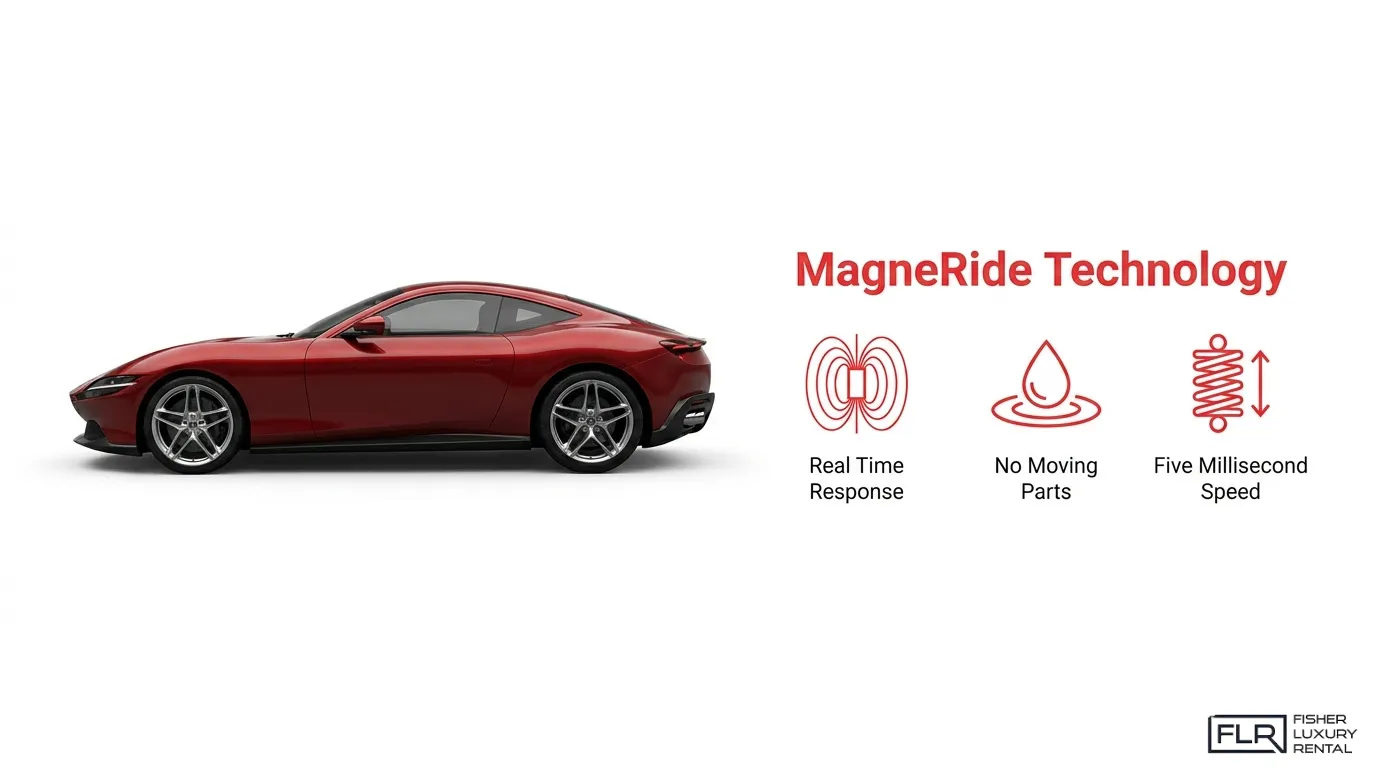
The Ferrari Roma’s adaptive damping system is a magnetorheological suspension setup, branded as MagneRide, that continuously adjusts damper stiffness in real time by altering the viscosity of a specialized fluid using a magnetic field rather than mechanical valves.
This review covers how MagneRide works at a technical level, how it performs across drive modes and real-world road conditions, how it compares to rivals, and what owners and journalists actually say about living with it.
The MagneRide system uses ferromagnetic fluid and electromagnetic coils to achieve response times as fast as 5 to 15 milliseconds, with no moving mechanical components inside the dampers. We examine what that architecture means in practice and why Ferrari paired it with softer-than-average spring rates.
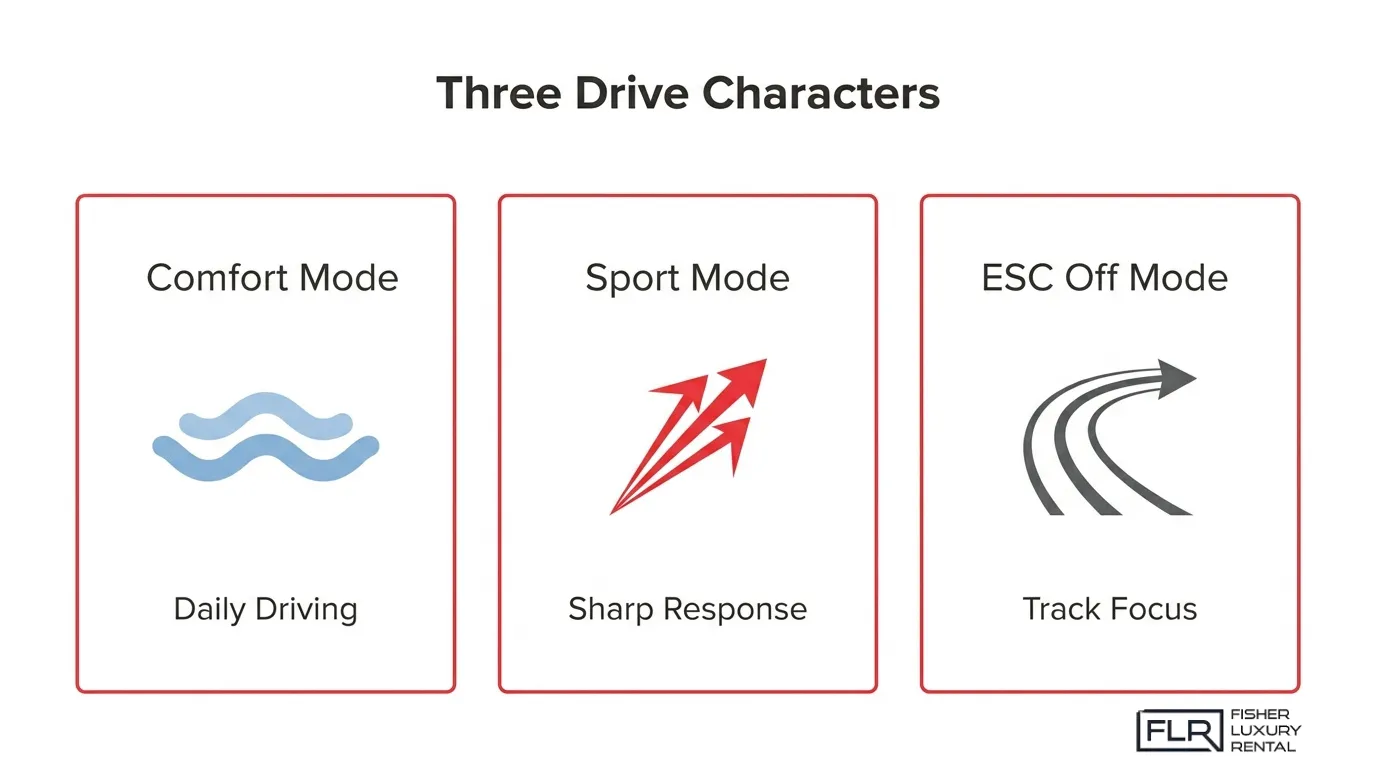
Drive mode behavior shapes the Roma’s character entirely. Comfort, Sport, and ESC-Off each recalibrate the dampers for a distinct purpose, from relaxed grand touring on rough urban streets to track-focused chassis control with stability systems off.
On real roads, the Roma manages potholes, highway expansion joints, and broken surfaces with composure that surprises drivers expecting a harsher exotic. We also cover how damping interacts with the electronic differential to sharpen cornering, how tire and wheel size affect system performance, and how MagneRide degrades over time.
Finally, we compare the Roma’s ride quality against the Porsche 911, Aston Martin Vantage, and McLaren GT, and explain why renting one is the only way to truly verify these conclusions on the road.
What Is the Ferrari Roma’s Adaptive Damping System?
The Ferrari Roma’s adaptive damping system is a magnetorheological suspension setup branded as MagneRide, which continuously adjusts damper stiffness in real time to balance ride comfort and handling precision. The following H3 sections cover how MagneRide works mechanically, what makes its fluid-based technology unique, and why Ferrari chose this system for the Roma.
How Does MagneRide Work on the Ferrari Roma?
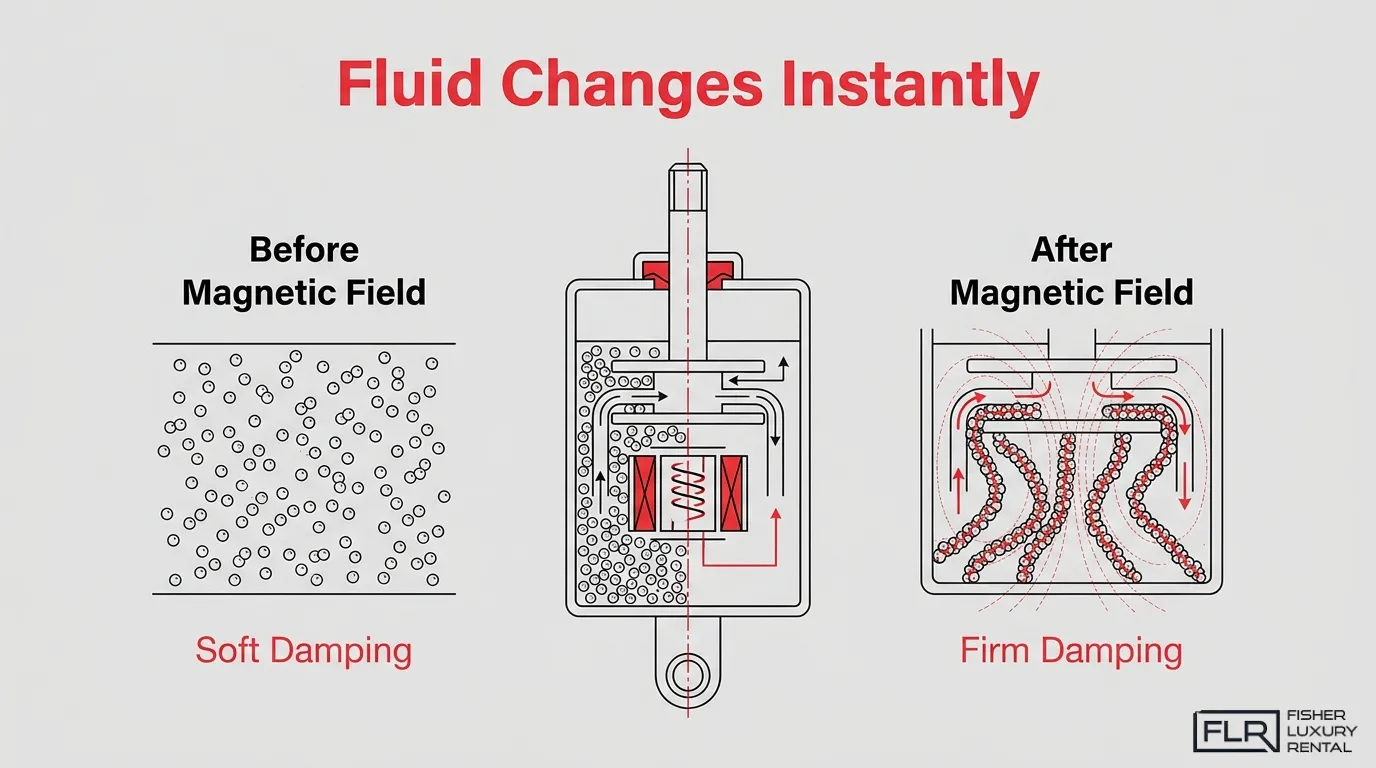
MagneRide works by using magnetorheological fluid, a suspension medium containing ferromagnetic particles, that changes viscosity instantly when exposed to a magnetic field. According to Ferrari, the MagneRide system exploits the capability of magnetorheological fluids to react to a magnetic field and offer variable damping action. Because there are no internal valves or complex mechanical flow channels, the system adjusts damping force by altering fluid characteristics alone, eliminating moving parts that could wear or fail over time.
Why Did Ferrari Choose Magnetorheological Dampers for the Roma?
Ferrari chose magnetorheological dampers for the Roma because the system delivers millisecond response times that purely mechanical alternatives cannot match. The Roma runs softer spring rates than many competitors, relying on MagneRide to manage body roll and pitch control without sacrificing everyday comfort. This approach allows a single chassis to feel composed on rough urban streets and sharp on a winding mountain road, making it ideally suited to the Roma’s identity as a refined grand tourer with genuine performance capability.
How Does the Ferrari Roma’s Magnetorheological Suspension Work?
The Ferrari Roma’s magnetorheological suspension works by using a magnetic field to instantly alter the viscosity of a special fluid inside each damper. The three H3s below cover the fluid’s mechanical role, how sensors and the ECU direct those changes, and how fast the system reacts.
What Role Does Magnetorheological Fluid Play in the Dampers?
Magnetorheological fluid plays the role of a continuously variable damping medium, changing stiffness in response to an applied magnetic field rather than through moving valves or mechanical components. According to BWI Group, MagneRide contains no internal valves or complex flow channels; damping force increases solely by altering the fluid’s characteristics with a magnetic field, eliminating mechanical wear points entirely. Because there are no moving parts to actuate, the system achieves response times measured in milliseconds. This is a fundamentally different architecture from conventional adaptive dampers, and it is precisely why the Roma can feel both supple and controlled without the lag or compromise that valve-based systems inevitably introduce.
How Do Sensors and ECU Adjust Damping in Real Time?
The sensors and ECU adjust damping in real time by continuously measuring wheel position, body acceleration, steering angle, and vehicle speed, then sending current to each damper’s electromagnetic coil to vary fluid viscosity at every corner independently. When the ECU detects an approaching bump or a lateral load change mid-corner, it modulates coil current to harden or soften the fluid before the disturbance fully transfers to the body. This closed-loop process runs constantly, meaning each of the four dampers can be in a different state simultaneously to suit the precise dynamic condition of that wheel.
How Quickly Does the System Respond to Road Inputs?
The system responds to road inputs in 5 to 15 milliseconds. Because response time is governed by coil inductance and fluid rheology rather than mechanical inertia, the dampers react orders of magnitude faster than any conventional hydraulic valve. At highway speeds, that speed advantage means the damper is already adjusted before the wheel has fully compressed over a bump, keeping body motion nearly imperceptible to the driver.
How Does Adaptive Damping Perform Across Ferrari Roma Drive Modes?
Adaptive damping performance varies meaningfully across the Roma’s drive modes, with each setting recalibrating the MagneRide system for a distinct character. The sections below cover Comfort, Sport, and ESC-Off behavior.
How Does Comfort Mode Tune the Dampers for Daily Driving?
Comfort mode tunes the dampers to prioritize suppleness, allowing the MagneRide system to run at lower magnetic field strengths and deliver softer damping forces throughout. This produces the most compliant ride the Roma offers, absorbing surface imperfections with minimal intrusion into the cabin. According to FerrariChat owners, MagneRide noticeably lessens bumps and reduces harshness on poorly maintained roads, making Comfort mode genuinely usable as a daily setting. Steering weight lightens slightly, and the car settles into a relaxed, long-distance character that belies its performance capability. For a grand tourer covering mixed road surfaces, Comfort mode is where the Roma’s dual-purpose engineering is most evident. Fisher Luxury Rental, which operates in Phoenix, AZ and Portland, OR, specializes in exotic and luxury car rentals for drivers who want to explore exactly this kind of real-world performance firsthand.
How Does Sport Mode Sharpen Damping Response?
Sport mode sharpens damping response by increasing the magnetic field applied to the magnetorheological fluid, raising damper stiffness and reducing suspension travel speed. Body motion becomes more controlled, with tighter roll resistance and faster load transfer during cornering. According to Car Magazine’s comparison testing, the Roma in Sport still absorbs bumps better than the Porsche 911 Turbo S, though occupants feel every road movement more directly. Throttle response and steering weight both increase in parallel, creating a cohesive, alert driving character. Sport mode represents the clearest expression of the Roma’s ability to serve two masters: it remains livable while becoming measurably more dynamic.
How Does ESC-Off Mode Alter Damper Behavior on Track?
ESC-Off mode alters damper behavior by disabling most electronic stability interventions, placing full chassis management responsibility on the driver while allowing the MagneRide system to operate in its firmest calibration. Side-slip control thresholds widen significantly, enabling controlled oversteer. The dampers stiffen further to resist the aggressive weight transfers generated under track-level braking, hard cornering, and acceleration. Ferrari’s electronic differential continues to distribute torque between the rear wheels based on steering angle, throttle input, and yaw rate, keeping the chassis balanced even when stability control is removed. ESC-Off mode is where the Roma’s suspension engineering is most exposed, rewarding precise driver inputs with a genuinely communicative, driver-focused ride.
How Does the Ferrari Roma Ride on Rough and Uneven Roads?
The Ferrari Roma rides on rough and uneven roads with notable composure, thanks largely to its MagneRide adaptive damping system. The H3s below cover pothole absorption, highway expansion joints, and broken or unpaved surfaces.
How Do the Adaptive Dampers Handle Potholes and Bumps?
The adaptive dampers handle potholes and bumps by adjusting magnetorheological fluid stiffness within milliseconds, softening impact before the occupants feel it. According to Ferrari Roma owners on FerrariChat, MagneRide lessens bumps noticeably, making the ride far less harsh on poorly maintained roads. The system reacts to each wheel independently, so a single pothole disturbs one corner without unsettling the rest of the car. For a grand tourer, that level of isolation without sacrificing road feel is genuinely impressive.
How Does the Roma Absorb Highway Expansion Joints?
The Roma absorbs highway expansion joints with a composed, well-controlled thud rather than a jarring crash. According to Car Magazine’s three-way comparison, even in Sport mode the Roma’s suspension absorbs bumps better than the Porsche 911 Turbo S, though every movement remains perceptible to the driver. The MagneRide system’s rapid response smooths the sharp leading edge of each joint before secondary oscillations can build.
How Does the System Manage Broken or Unpaved Surfaces?
The system manages broken or unpaved surfaces by using softer spring rates paired with active damper stiffening to balance compliance with control. On straight, damaged stretches, the Roma’s primary ride stays composed, with surface irregularities absorbed without disrupting cabin stability. The MagneRide unit continuously modulates damping force, preventing the wheel from bouncing off broken tarmac and maintaining tire contact. This makes the Roma a genuinely usable daily driver, not just a weekend machine.
How Does Adaptive Damping Improve Ferrari Roma Cornering?
Adaptive damping improves Ferrari Roma cornering by optimising the amount of grip available at high speed while reducing traction loss, according to Ferrari Official. The MagneRide system, electronic differential, and chassis geometry work together across three key areas: body roll control, mid-corner weight transfer management, and torque distribution.
How Does Body Roll Control Change with Damper Firmness?
Body roll control changes with damper firmness because stiffer damping generates greater lateral resistance as cornering forces build. According to Car Magazine, the Roma runs softer spring rates than its competitors, relying on the MagneRide system to control body roll and pitch rather than rigid springs alone. This approach is genuinely clever: softer springs absorb road imperfections between corners, while the magnetorheological dampers firm up instantly when cornering loads demand it, delivering roll stiffness without sacrificing ride compliance between bends.
How Does the System Manage Weight Transfer Mid-Corner?
The system manages weight transfer mid-corner by continuously adjusting damping force at each corner of the car as lateral loads shift between the inner and outer wheels. Faster damper stiffening at loaded corners resists body lurch, keeping the chassis balanced and the contact patches loaded evenly throughout the arc. This precise load management prevents the car from feeling unsettled during direction changes or mid-corner throttle adjustments.
How Does Damping Interact with the Electronic Differential?
Damping interacts with the electronic differential by sharing real-time data on steering angle, throttle input, and yaw rate to coordinate chassis control. Ferrari Official confirms the E-Diff distributes torque between rear wheels using friction discs controlled by a hydraulic actuator, with torque amounts dependent on those same variables the dampers monitor. The result is a unified system where grip is maximised at each wheel simultaneously, preventing traction loss precisely where adaptive damping has already stabilised the chassis.
How Does the Ferrari Roma Compare to Rivals in Ride Quality?
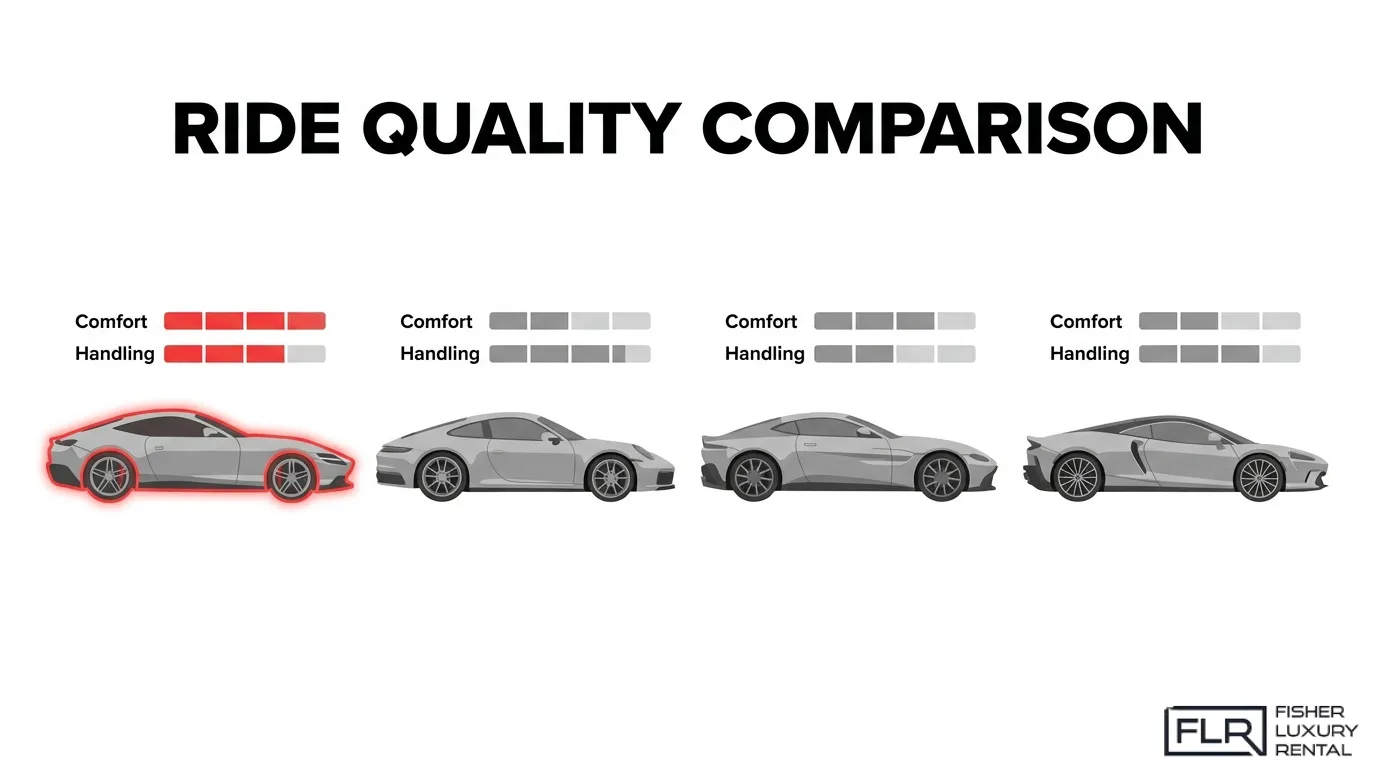
The Ferrari Roma competes against the Porsche 911, Aston Martin Vantage, and McLaren GT in the grand tourer segment. Each rival takes a different approach to adaptive damping, and the Roma’s MagneRide system sets it apart in meaningful ways.
How Does the Roma’s Ride Compare to the Porsche 911?
The Roma’s ride compares to the Porsche 911 favorably, particularly in everyday comfort. According to Car Magazine’s 2021 three-way comparison, the Roma runs softer spring rates than the 911 Turbo S, relying on MagneRide to manage body control rather than stiff passive springs. Even in Sport mode, the Roma absorbs bumps better than the 911, though road texture becomes more noticeable. The 911 prioritizes mechanical precision; the Roma offers that precision with a more livable compliance underneath.
How Does the Roma’s Ride Compare to the Aston Martin Vantage?
The Roma’s ride compares to the Aston Martin Vantage with a clear advantage in day-to-day suppleness. According to Yahoo Autos, the Vantage struggles to settle because its adaptive dampers remain fairly uncompromising across all modes, producing a fidgety firmness that never fully relaxes. The Roma’s MagneRide system, by contrast, genuinely transitions between Comfort and Sport characters. For drivers who split time between city streets and open roads, the Roma’s damping range is the more versatile solution.
How Does the Roma’s Ride Compare to the McLaren GT?
The Roma’s ride compares to the McLaren GT as a softer, more grand-tourer-oriented alternative. The GT uses hydraulically interconnected suspension to balance ride and handling, delivering impressive compliance, but its low-slung body and stiff chassis tune keep it firmly in sports car territory. The Roma prioritizes long-distance comfort without sacrificing cornering composure, making it the more relaxed choice for extended touring while still delivering genuine driver engagement when the road demands it. For drivers in the Phoenix or Portland areas looking to experience that touring balance personally, Fisher Luxury Rental offers access to exotic vehicles across both markets.
What Are Common Driver Impressions of Ferrari Roma Damping?
Common driver impressions of Ferrari Roma damping center on three consistent themes: urban comfort, high-speed composure, and steering feel. Owners and journalists alike describe the MagneRide system as a genuine dual-purpose achievement.
How Do Drivers Rate Low-Speed Urban Comfort?
Drivers rate low-speed urban comfort in the Ferrari Roma as genuinely impressive for a performance GT. According to FerrariChat owners, MagneRide lessens bumps noticeably, making the ride far less harsh on poorly maintained urban roads. Damaged surfaces and occasional speed bumps leave the ride quality largely unaffected, which surprises most first-time drivers expecting a firmer, more punishing character.
How Do Drivers Rate High-Speed Stability and Composure?
Drivers rate high-speed stability and composure in the Ferrari Roma as confident and well-controlled. On straight roads at speed, the primary ride remains surprisingly composed, with the MagneRide system managing body movement without feeling nervous or unsettled. Road & Track describes the Roma as offering direct, engaging handling alongside superb ride quality, a combination that reinforces the car’s grand tourer identity even during spirited driving.
How Do Drivers Rate Steering Feel and Road Feedback?
Drivers rate steering feel and road feedback in the Ferrari Roma as linear, precise, and more accessible than other Ferraris. One FerrariChat owner noted the steering surpassed the Porsche Carrera 4 GTS in responsiveness and character. Top Gear describes it as less frenetic than typical Ferrari fare, which makes the car feel approachable without sacrificing the agility that defines the Roma’s overall driving character.
Does Tire and Wheel Size Affect Ferrari Roma Damping Performance?
Yes, tire and wheel size affect Ferrari Roma damping performance by influencing how much sidewall flex is available to absorb road inputs before the MagneRide dampers must respond. The Roma’s 20-inch wheels are fitted with 245/35 front and 305/30 rear tires, according to Exotic Car Hacks. These low-profile tire sizes reduce sidewall height significantly, meaning less rubber cushioning exists between the wheel and road surface. As a result, the MagneRide system carries a greater share of ride compliance, making its millisecond-level response times especially important. Staggered sizing, with wider 305/30 rubber at the rear, also affects lateral load transfer, requiring the dampers to manage asymmetric grip dynamics during cornering. Upsizing wheels beyond the factory 20-inch specification would reduce sidewall further, compressing the damper’s effective operating window and potentially degrading ride quality in Comfort mode while adding unsprung mass that slows suspension response.
How Does Adaptive Damping Degrade or Require Maintenance?
Adaptive damping on the Ferrari Roma degrades primarily through magnetorheological fluid leaks and seal wear, rather than mechanical valve failure. The sub-sections below cover the most common failure mode, expected component lifespan, and typical replacement costs.
How Does MagneRide Fluid Leakage Cause Damper Failure?
MagneRide fluid leakage causes damper failure by depleting the magnetorheological fluid that the system needs to generate variable damping force. Worn-out seals or hairline cracks allow this specialized fluid to escape, and even a small leak disrupts the magnetic suspension’s ability to respond accurately. According to Strutmasters, once fluid loss reaches a critical threshold, the entire damper assembly can no longer modulate firmness, leading to progressively inconsistent ride quality across all drive modes.
How Long Do MagneRide Dampers Last on the Ferrari Roma?
MagneRide dampers last between 50,000 and 75,000 miles under normal operating conditions, though some units exceed 100,000 miles. Because MagneRide contains no internal valves or moving mechanical components, wear concentrates almost entirely on the fluid seals rather than internal hardware. In practice, well-maintained units on low-mileage exotic vehicles like the Roma tend toward the higher end of that range.
How Much Does MagneRide Damper Replacement Cost?
MagneRide damper replacement costs up to $1,000 per OEM shock and strut assembly, according to Strutmasters. On a Ferrari Roma, which requires four dampers, total parts costs alone can reach $4,000 before labor, specialized alignment, and calibration. Given those figures, catching a slow fluid leak early is almost always the more economical path than allowing progressive seal failure to accelerate across multiple corners simultaneously.
How Can You Experience Ferrari Roma Adaptive Damping Firsthand?
You can experience Ferrari Roma adaptive damping firsthand by renting one and driving it across real roads. The sections below cover what a rental reveals about ride quality and the key takeaways this article’s review delivers.
Can Renting a Ferrari Roma from Fisher Luxury Rental Show You Its True Ride Quality?
Yes, renting a Ferrari Roma can show you its true ride quality in ways no review alone can convey. Top Gear describes the steering as linear and less frenetic than other Ferraris, with ride quality that is supple and compliant. Chasing Cars notes the Roma’s primary ride remains surprisingly composed on damaged roads, with speed bumps leaving excellent ride quality totally unaffected. Autocar confirms the Roma Spider carries over all suspension hardware from the coupe, with only the magnetorheological damper settings adjusted. Road & Track calls the combination of direct, engaging handling and superb ride quality simply perfect. Reading those assessments is one thing; feeling the MagneRide system absorb a broken surface at speed is another entirely.
What Are the Key Takeaways About Ferrari Roma Adaptive Damping Ride and Handling?
The key takeaways about Ferrari Roma adaptive damping ride and handling are that the MagneRide system delivers a genuinely rare combination of comfort and precision. Ferrari confirms the system uses magnetorheological fluids containing ferromagnetic particles that react to a magnetic field to offer variable damping action. Evo Magazine reports that even the open-top Roma Spider absorbs motorway expansion joints better than nearly any car of any kind. Owners on FerrariChat describe the responsiveness, steering, and overall agility as astounding. In practice, the Roma proves that softer spring rates paired with intelligent damping can outperform rigidly sprung rivals without sacrificing dynamic engagement. Fisher Luxury Rental offers the only way to confirm that conclusion yourself.