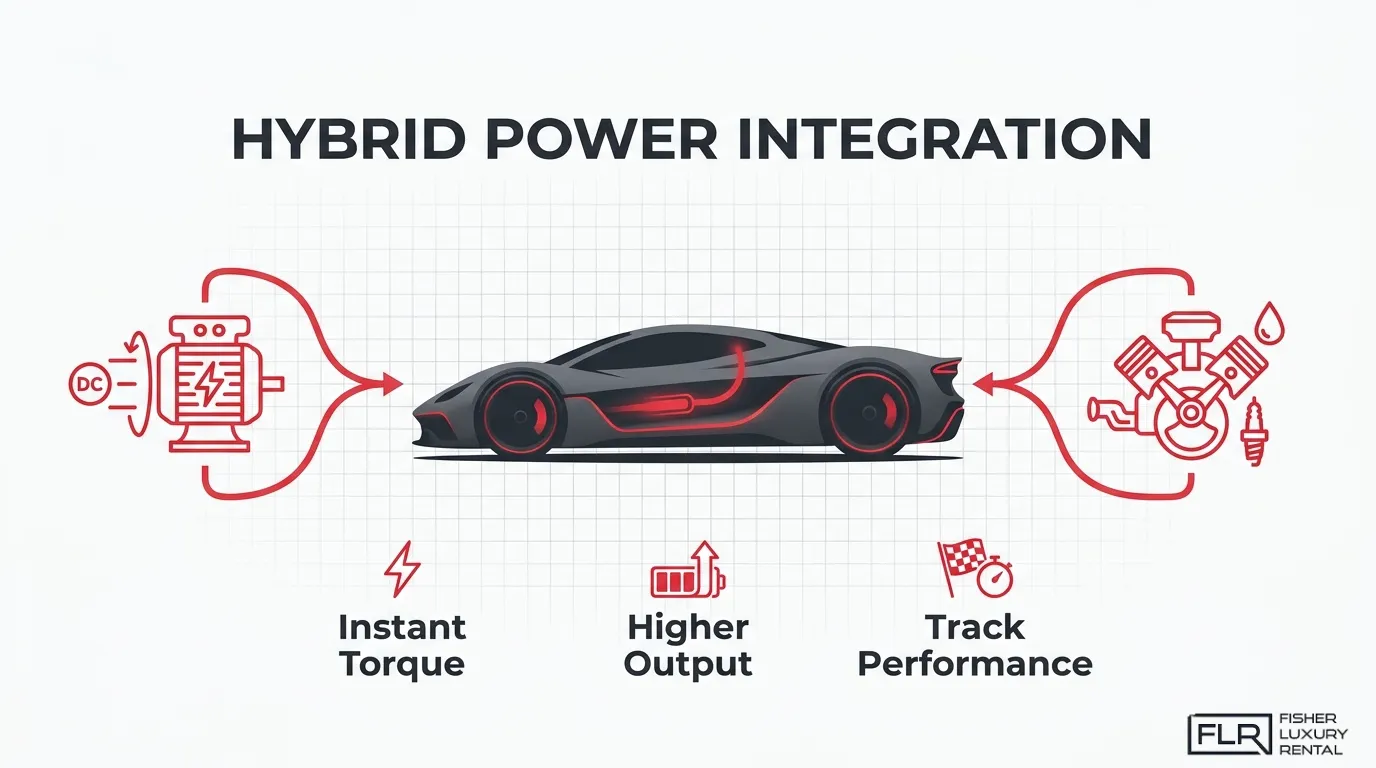
Best hybrid supercar performance is defined by the integration of instant electric torque with high-revving combustion engines, producing combined outputs, acceleration figures, and track capabilities that neither powertrain achieves alone.
This guide covers the engineering behind why hybrids outperform traditional supercars, how the leading models compare on raw numbers, what these machines feel like to drive, how they hold up in reliability and ownership, and where hybrid supercar technology is heading next.
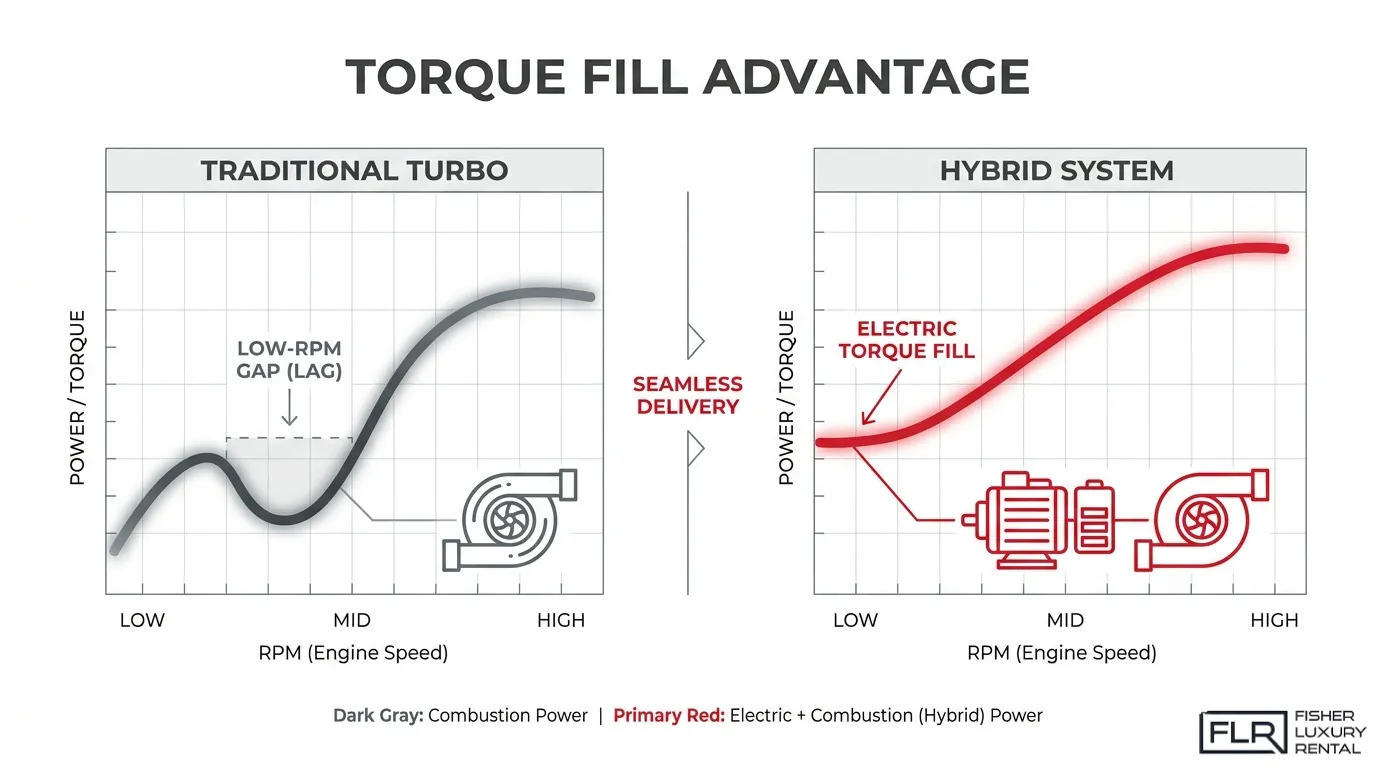
Electric torque fill and regenerative braking are the two core mechanical advantages that separate hybrid supercars from combustion-only rivals. By eliminating the lag turbocharged engines produce at low RPM and recovering energy through every braking zone, modern hybrid systems create a self-sustaining performance loop that compounds across laps and acceleration runs.
Models like the Ferrari SF90 Stradale, Lamborghini Revuelto, Mercedes-AMG One, Porsche 918 Spyder, McLaren Artura, and Koenigsegg Gemera each demonstrate a distinct approach to combining electric and combustion power, with outputs ranging from 690 hp to over 1,700 hp and 0-60 times clustering between 2.5 and 3.0 seconds.
Driving modes, acoustic character, and weight distribution all shift meaningfully when electric motors enter the equation, and we examine how those changes affect real-world feel alongside track performance benchmarks including the Porsche 918 Spyder’s landmark 6:57 Nürburgring lap.
Reliability data, battery longevity estimates, and comparisons against fully electric hypercars round out the picture, alongside manufacturer roadmaps from Ferrari and Lamborghini targeting full electrification by 2030.
What Makes Hybrid Supercars Faster Than Traditional Supercars?
Hybrid supercars are faster than traditional supercars because they combine instant electric torque with high-revving combustion engines, eliminating the power gaps that limit purely petrol-driven cars. The sections below cover electric torque fill, regenerative braking, and weight distribution.
How Does Electric Torque Fill Improve Acceleration?
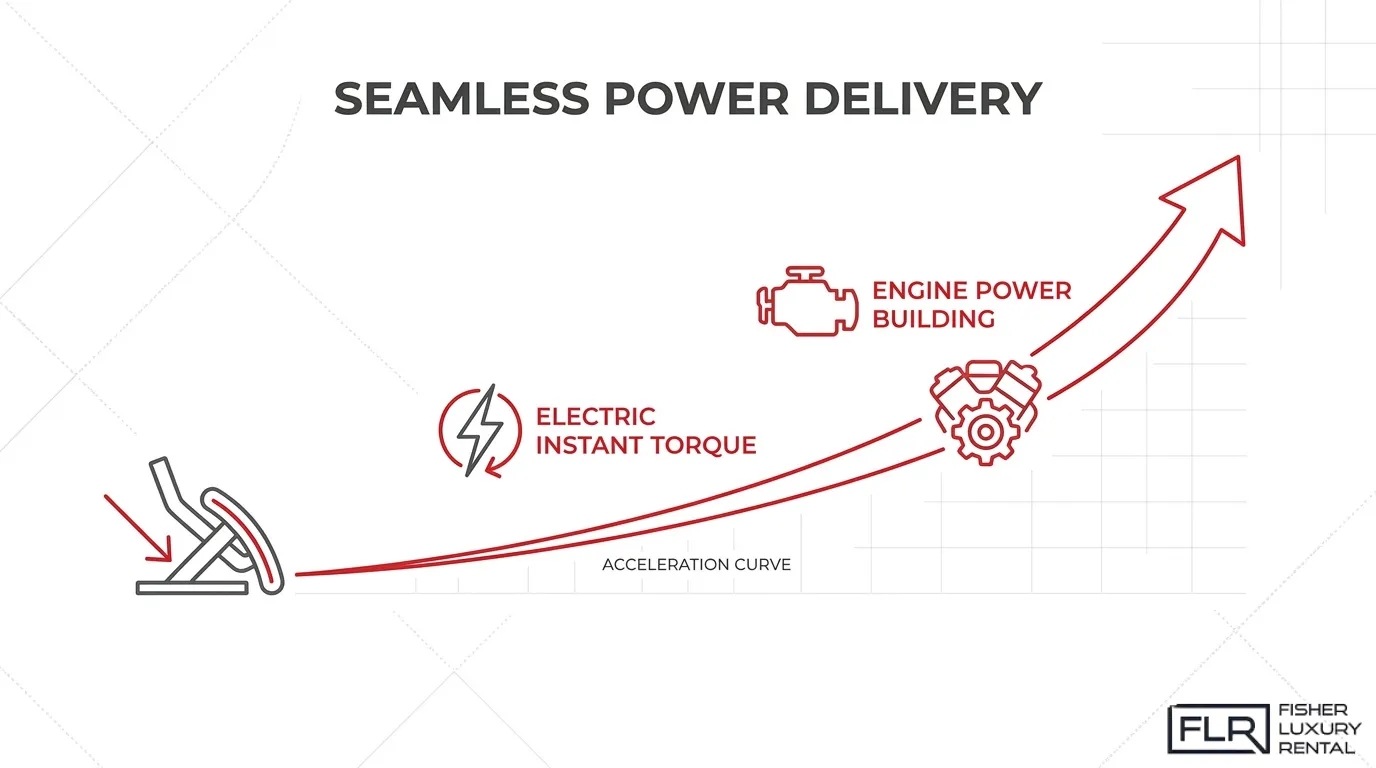
Electric torque fill improves acceleration by delivering instant motor torque during the moment a combustion engine needs time to build RPM. McLaren calibrated the P1’s hybrid system with exactly this principle, using electric motors to fill the power gap while the turbos spooled up, according to Goodwood Racing and Rallying. The result is a seamless, uninterrupted surge of power across the entire rev range.
The effect scales dramatically in modern hypercars:
- The Lamborghini Revuelto pairs a 814 hp V12 at 9,250 rpm with electric motors adding 187 hp and 248 lb-ft of immediate torque.
- The Mercedes-AMG One combines a 1.6-litre V6 and four electric motors for 1,063 hp total, reaching 0-200 km/h in just 7.0 seconds.
- The Koenigsegg Gemera pairs a 1,500 hp twin-turbo V8 with three electric motors, producing 1,500 Nm of torque at 5,000 rpm.
Torque fill is arguably the single most impactful hybrid performance advantage: it transforms a turbocharged engine’s weakness into a strength.
How Does Regenerative Braking Enhance Track Performance?
Regenerative braking enhances track performance by converting kinetic energy during deceleration back into stored electrical energy, keeping the battery charged for the next acceleration event. According to ScienceDirect, regenerative braking improves overall vehicle efficiency by minimizing energy consumption and extends the life of the braking system.
On track, this creates a self-sustaining performance loop: every braking zone recharges the hybrid battery, ensuring electric boost remains available lap after lap. Brake pad wear also decreases, reducing unplanned pit stops during extended sessions. The system rewards precise braking technique, making it especially valuable on technical circuits with frequent direction changes.
How Does Weight Distribution Differ in Hybrid Powertrains?
Weight distribution in hybrid powertrains differs from traditional layouts because engineers position electric motors, battery packs, and power electronics as structural ballast, deliberately tuning the front-to-rear weight balance. The McLaren Artura’s complete hybrid system, including a 194 lb battery pack and 34 lb electric motor, totals just 287 lbs, helping achieve a DIN curb weight of 3,303 lbs without compromising the mid-engine balance McLaren requires.
Battery packs are typically mounted low in the chassis, lowering the center of gravity compared to adding equivalent combustion components higher in the car. This placement improves cornering stability and turn-in response. Placing motors at individual axles also allows torque vectoring, actively shifting power between wheels to sharpen handling rather than simply adding straight-line speed.
Which Hybrid Supercars Deliver the Best Performance Numbers?
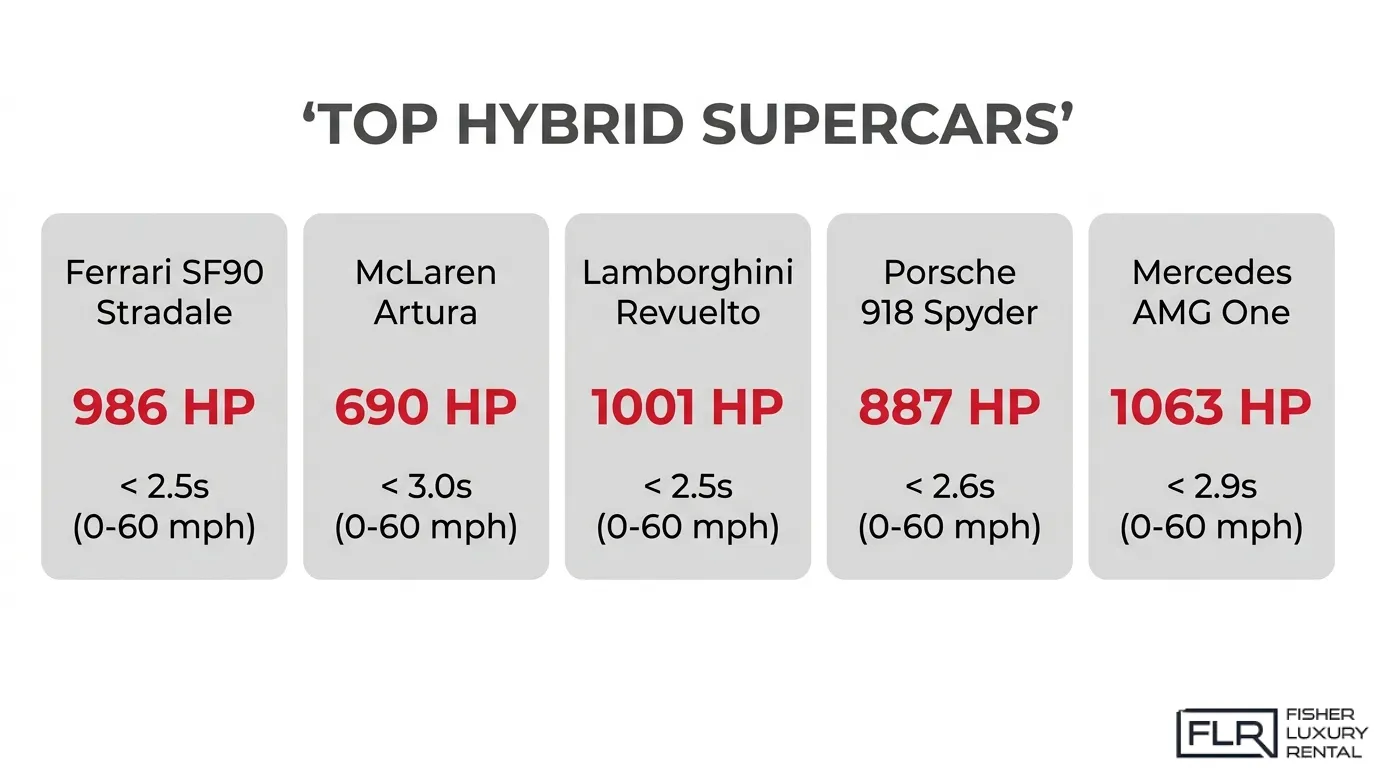
The hybrid supercars delivering the best performance numbers include the Ferrari SF90 Stradale, McLaren Artura, Lamborghini Revuelto, Porsche 918 Spyder, Mercedes-AMG One, and Koenigsegg Gemera. Each model demonstrates a distinct approach to combining combustion and electric power.
Ferrari SF90 Stradale
The Ferrari SF90 Stradale achieves 0-100 km/h in 2.5 seconds with a maximum torque of 800 N⋅m (590 lb-ft) at 6,000 rpm. Its top speed reaches 340 km/h (211 mph) from a dry weight of just 1,570 kg (3,461 lb). A 7.9 kWh lithium-ion battery provides 26 km (16 miles) of electric range in eDrive mode. For a car producing close to 1,000 PS, that power-to-weight ratio makes the SF90 Stradale one of the most complete hybrid performance packages available today.
McLaren Artura
The McLaren Artura achieves 0-60 mph in 3.0 seconds with a top speed of 205 mph (330 km/h), according to Kelley Blue Book specifications. Its twin-turbocharged V6 hybrid powertrain delivers 720 Nm of torque at a dry weight of just 1,457 kg (3,209 lb), making it the lightest car in this group. That weight discipline is what separates the Artura from heavier rivals.
Lamborghini Revuelto
The Lamborghini Revuelto has a maximum speed exceeding 350 km/h (217 mph) from a 6,498.5 cm³ V12 displacement. Its 0-100 km/h sprint of 2.5 seconds matches the Ferrari SF90 Stradale, but the Revuelto achieves this with a naturally aspirated V12 screaming to 9,250 rpm rather than a turbocharged unit. For drivers who value combustion character alongside hybrid performance, this distinction matters considerably.
Porsche 918 Spyder
The Porsche 918 Spyder set a Nürburgring Nordschleife lap time of 6:57 minutes, establishing a record for globally road-homologated vehicles, according to the Porsche Newsroom. It also achieves pure electric driving over 30 kilometres with a combined fuel consumption of 3.1-3.0 l/100 km. Among the Holy Trinity, the 918 Spyder remains the benchmark for balancing outright track performance with genuine efficiency.
Mercedes-AMG One
The Mercedes-AMG One produces 1,063 hp from a Formula 1-derived 1.6-litre V6 turbo engine combined with four electric motors. It reaches 0-100 km/h in 2.9 seconds and hits an electronically regulated maximum speed of 352 km/h (219 mph). The 0-200 km/h sprint takes just 7.0 seconds, and 0-300 km/h falls in 15.6 seconds, figures that no road car with a combustion engine had previously approached.
Koenigsegg Gemera
The Koenigsegg Gemera produces 1,700 hp with 3,500 Nm (2,583 lb-ft) of torque, including Hydracoup, and a maximum wheel torque of 11,000 Nm at ICE 4,000 rpm. Its 800V 15 kWh liquid-cooled battery supports up to 50 km (31 miles) of electric range, while total range extends to 1,000 km (621 miles). No other four-seat hybrid hypercar combines this level of output with that range capability, making the Gemera a category of one.
How Much Horsepower Do the Best Hybrid Supercars Produce?
The best hybrid supercars produce between 690 hp and over 1,000 hp by combining internal combustion engines with one or more electric motors. The following H3s cover output figures for the Ferrari SF90 Stradale, Lamborghini Revuelto, Mercedes-AMG One, Porsche 918 Spyder, and McLaren Artura.
How Much Power Does the Ferrari SF90 Stradale Make?
The Ferrari SF90 Stradale makes 986 hp (1,000 PS) combined. According to Ferrari, a 4.0L twin-turbocharged V8 rated at 769 hp integrates with three electric motors delivering 217 hp to reach that total. The eManettino knob selects four driving modes: eDrive (electric only), Hybrid (default), Performance (engine charges batteries), and Qualify (full powertrain output). In eDrive mode, two front-mounted motors power the car as a front-wheel-drive vehicle for up to 25 kilometers of all-electric range. At nearly 1,000 hp, the SF90 Stradale represents one of the most complete hybrid performance packages Ferrari has ever produced.
How Much Power Does the Lamborghini Revuelto Make?
The Lamborghini Revuelto makes 1,001 hp (1,015 CV) combined. According to Lamborghini, a naturally aspirated V12 producing 814 hp at 9,250 rpm pairs with three electric motors delivering a combined 187 hp, reaching that total output with a 0-100 km/h time of 2.5 seconds.
How Much Power Does the Mercedes-AMG One Make?
The Mercedes-AMG One makes 1,063 hp total. According to Mercedes-AMG, a 1.6-liter turbocharged V6 sourced directly from Formula 1 combines with four electric motors to produce that figure, with 0-100 km/h achieved in 2.9 seconds and a top speed of 352 km/h. For a road-legal car, 1,063 hp from a 1.6-liter engine is arguably the most striking engineering achievement in this comparison.
How Much Power Does the Porsche 918 Spyder Make?
The Porsche 918 Spyder makes 887 hp (652 kW) total. According to the Porsche Newsroom, a 4.6-liter V8 producing 608 hp combines with two electric motors delivering a combined 286 hp to reach that system output, while still offering pure electric driving over 30 kilometers.
How Much Power Does the McLaren Artura Make?
The McLaren Artura makes 690 hp combined. According to Car and Driver, its twin-turbo 3.0L V6 plug-in-hybrid powertrain also produces 531 lb-ft of torque, with a dry weight of just 1,457 kg (3,209 lb) keeping the power-to-weight ratio competitive against heavier rivals.
With outputs ranging from 690 hp to over 1,000 hp, each of these hybrid supercars demonstrates how electrification raises the performance ceiling without sacrificing driver engagement.
What Are the Fastest 0-60 Times for Hybrid Supercars?
The fastest 0-60 times for hybrid supercars range from 2.5 seconds to under 3.0 seconds, with the Ferrari SF90 Stradale, Lamborghini Revuelto, Porsche 918 Spyder, and Mercedes-AMG One leading the segment.
How Fast Is the Ferrari SF90 Stradale From 0 to 60?
The Ferrari SF90 Stradale reaches 0-60 mph in 2.5 seconds, making it one of the quickest road-legal production cars available. According to Wikipedia, the SF90 Stradale achieves 0-100 km/h in 2.5 seconds, backed by a combined 986 hp and 800 Nm of torque. At this level, the SF90 Stradale is not just fast by hybrid standards — it competes directly with purpose-built track machinery.
How Fast Is the Lamborghini Revuelto From 0 to 60?
The Lamborghini Revuelto reaches 0-62 mph in 2.5 seconds. According to Lamborghini, the Revuelto produces a combined 1,001 hp from a new V12 engine and three electric motors, matching the SF90 Stradale’s sprint time while delivering a top speed exceeding 350 km/h.
How Fast Is the Porsche 918 Spyder From 0 to 60?
The Porsche 918 Spyder reaches 0-60 mph in approximately 2.5 seconds. According to Porsche Newsroom, the 918 Spyder delivers 887 hp total from a 4.6-litre V8 producing 608 hp and two electric motors contributing a combined 286 hp. For a car launched in 2013, that acceleration figure remains genuinely remarkable by any era’s standards.
How Fast Is the Mercedes-AMG One From 0 to 60?
The Mercedes-AMG One reaches 0-60 mph in approximately 2.9 seconds. According to Mercedes-AMG, the AMG One produces 1,063 hp from a 1.6-litre V6 turbo engine and four electric motors, reaching 0-100 km/h in 2.9 seconds and 0-200 km/h in just 7.0 seconds. Its F1-derived powertrain prioritizes upper-speed performance over the sub-2.5-second launches achieved by rivals.
How Do Hybrid Supercars Perform on the Track?
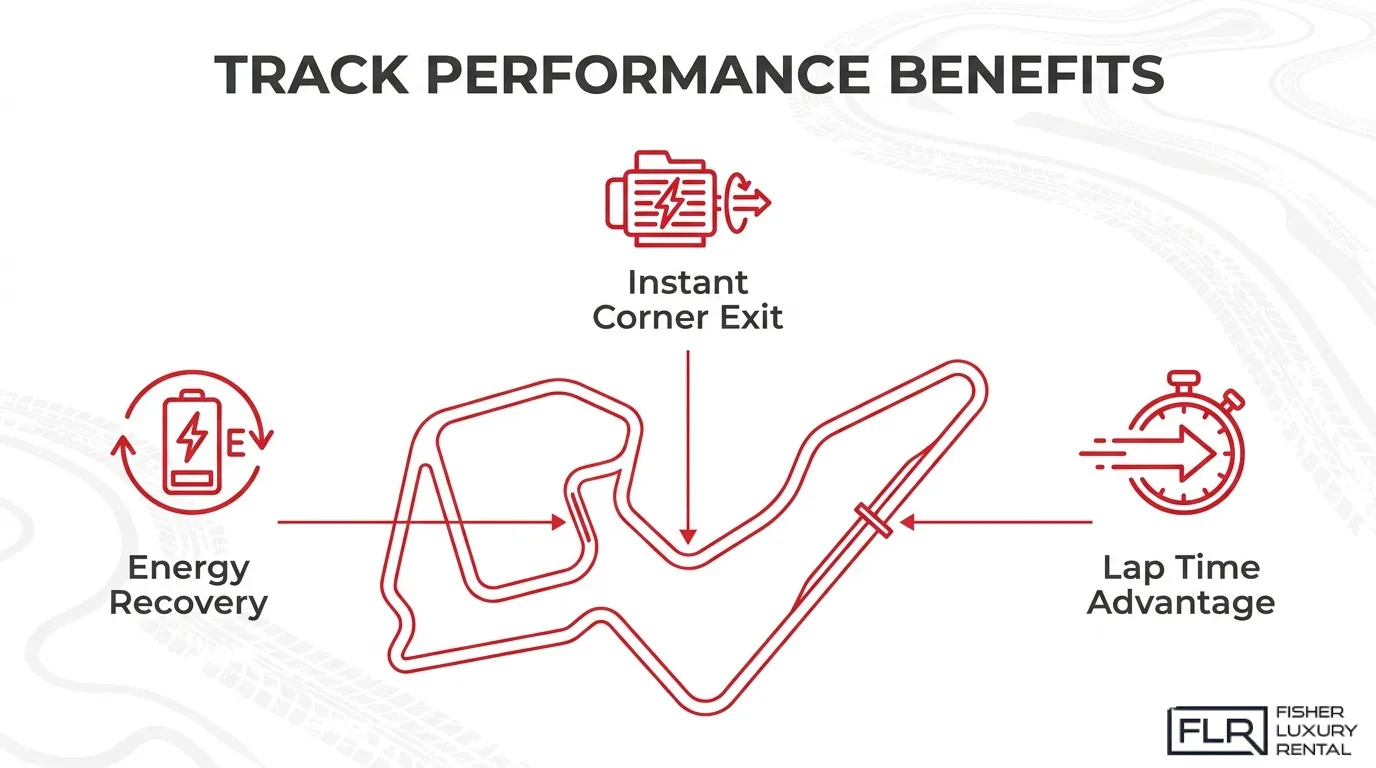
Hybrid supercars perform on the track by combining instant electric torque with sustained combustion power, giving them measurable advantages in lap times, corner exits, and energy recovery under braking. The sections below cover Nürburgring benchmarks, short-circuit dynamics, and battery depletion effects.
How Do Hybrid Supercars Perform at the Nürburgring?
Hybrid supercars perform at the Nürburgring by leveraging combined powertrain output across the circuit’s long straights and demanding corners. The Porsche 918 Spyder set a landmark 6:57 lap time at the Nürburgring Nordschleife, establishing a record for globally road-homologated vehicles. That achievement helped cement the McLaren P1, Ferrari LaFerrari, and Porsche 918 Spyder as the “Holy Trinity,” the first three supercars to deploy cutting-edge hybrid technology for outright performance. The 918’s result proved that hybrid architecture was not a compromise but a genuine competitive tool at the highest level. Few benchmarks since have better demonstrated what coordinated electric and combustion systems can achieve on a single demanding lap.
How Do Hybrid Supercars Perform on Short Technical Circuits?
Hybrid supercars perform on short technical circuits by exploiting instant electric torque at low speeds, where turbo lag in combustion engines is most damaging. Tight corners, chicanes, and slow-speed hairpins all demand power precisely when a traditional engine struggles to deliver it. The electric motor fills that gap immediately, pushing the car out of corners with no hesitation. Regenerative braking also works continuously, recovering energy through every braking zone and keeping the battery charged for the next acceleration phase. On circuits with many direction changes and short straights, this cycle of recover-and-deploy runs almost constantly, meaning the hybrid advantage compounds rather than fades across the lap.
How Does Hybrid Battery Depletion Affect Lap Times?
Hybrid battery depletion affects lap times by reducing the electric motor’s contribution as charge falls, forcing the combustion engine to carry more of the performance load. When the battery is depleted, torque fill disappears and the car effectively becomes a conventional combustion supercar mid-session. According to Car and Driver, most estimates for hybrid-battery longevity range between 100,000 and 200,000 miles overall, though no comprehensive studies on sustained track discharge exist. On repeated hot laps, the relevant concern is short-term charge depletion rather than long-term battery life. Engineers address this through performance driving modes that prioritize battery replenishment, but sustained track use without recovery time will narrow the gap between a hybrid and its non-electrified counterparts.
What Driving Modes Do Hybrid Supercars Offer?
Hybrid supercars offer multiple selectable driving modes that balance electric-only operation, combined efficiency, and full-performance output. The H3s below cover all-electric mode, hybrid mode, and performance mode in detail.
How Does All-Electric Mode Work in a Hybrid Supercar?
All-electric mode works by disabling the combustion engine entirely and running the vehicle solely on battery-stored energy through the electric motors. The Ferrari SF90 Stradale demonstrates this clearly: in eDrive mode, two front electric motors power the car as a front-wheel-drive vehicle for up to 25 kilometers of all-electric range. This mode suits low-speed urban driving, parking, and noise-restricted zones where combustion is unnecessary.
How Does Hybrid Mode Balance Power and Efficiency?
Hybrid mode balances power and efficiency by letting the vehicle’s control system automatically switch between the combustion engine and electric motors depending on throttle demand, speed, and battery state. The engine shuts off during light loads and restarts instantly when additional power is needed. As manufacturers deepen their hybrid commitment, Lamborghini’s 2027 Urus SE Performante targets 800 horsepower from a plug-in hybrid system, illustrating how efficiency and output are no longer competing priorities in this segment.
How Does Performance Mode Maximize Combined Output?
Performance mode maximizes combined output by keeping the combustion engine running continuously, using surplus capacity to actively recharge the battery while simultaneously delivering full electric motor assistance. The Ferrari SF90 Stradale’s Performance mode exemplifies this: the engine charges the battery pack while all three electric motors remain available, ensuring peak torque and horsepower are accessible on demand without depleting stored energy. This mode is the preferred setting for spirited road driving and track preparation, where consistent high-output availability matters more than fuel economy.
How Does Hybrid Technology Affect the Driving Experience?
Hybrid technology affects the driving experience by transforming how power is delivered, how engine sound is tuned, and how weight is managed through the chassis. The following sections cover throttle feel, acoustic character, and handling dynamics in hybrid supercars.
What Does Hybrid Power Delivery Feel Like at Full Throttle?
Hybrid power delivery at full throttle feels like an immediate, seamless surge that traditional combustion engines cannot replicate alone. According to the Alternative Fuels Data Center, electric motors deliver maximum torque instantly while petrol engines require RPM to build power, so hybrid systems combine both: instant electric thrust followed by rising combustion output. EV motors reach peak torque within milliseconds of throttle input, eliminating the brief hesitation drivers feel in purely turbocharged cars. The result is an unbroken acceleration arc with no perceptible gap between intent and response. For supercar drivers, this means launch feel is noticeably more linear and confidence-inspiring than a combustion-only equivalent, regardless of whether the turbochargers have fully spooled.
How Does Engine Sound Change in a Hybrid Supercar?
Engine sound in a hybrid supercar changes because electric motors contribute silent torque at low RPM, shifting more acoustic load toward the combustion engine at higher revs. Engineers can tune the combustion unit to operate in its most sonically dramatic range more consistently, since the electric system handles low-speed duties. The Ferrari LaFerrari demonstrated this clearly: its electric boost allowed the V12 to rev higher, past 9,250 rpm, producing a more aggressive character than the engine could sustain without electrical assistance. Hybrid architecture, counterintuitively, can make a supercar sound more dramatic, not less, by freeing the combustion engine from the mundane work of low-speed torque generation.
How Does Hybrid Weight Impact Handling and Agility?
Hybrid weight impacts handling through battery and motor mass, but engineers actively offset this by optimizing placement and minimizing component size. McLaren’s approach with the Artura illustrates the strategy well: the total hybrid component weight, including the 194 lb battery pack and 34 lb electric motor, is just 287 lbs, contributing to a DIN curb weight of 3,303 lbs. Low placement of the battery pack lowers the center of gravity, which can actually improve cornering response compared to a higher-mounted combustion component. The weight penalty is real but manageable when hybrid architecture is treated as a structural design variable rather than an add-on. For drivers curious about how these engineering trade-offs translate into a real driving experience, exotic car rental services like Fisher Luxury Rental offer a practical way to feel the difference before making any ownership decisions.
Are Hybrid Supercars More Reliable Than Pure Combustion Models?
Hybrid supercars are generally more reliable than pure combustion models, with fewer reported problems across key ownership metrics. The sections below cover brake system durability, battery longevity, and maintenance frequency.
Do Hybrids Have Fewer Mechanical Problems Than Gas Supercars?
Hybrid supercars have fewer mechanical problems than gas-only supercars, according to Consumer Reports’ annual reliability survey. Regenerative braking reduces wear on brake pads, while electric motor assistance lowers thermal and mechanical stress on the combustion engine during hard acceleration. For high-performance vehicles driven repeatedly at their limits, this reduced component strain translates into fewer unplanned service visits. From a long-term ownership standpoint, hybrid architecture is arguably better engineered for durability than traditional high-strung combustion-only supercar drivetrains.
How Long Do Hybrid Supercar Batteries Last?
Hybrid supercar batteries last an estimated 100,000 to 200,000 miles, according to Car and Driver, though no comprehensive long-term studies yet exist for exotic-grade applications. Battery degradation is gradual rather than sudden, meaning performance loss accumulates slowly over years of use. Replacement costs for supercar-spec battery packs remain high, reflecting their bespoke engineering and limited production volumes.
Do Hybrid Supercars Require Less Maintenance Than Traditional Supercars?
Hybrid supercars require less frequent maintenance than traditional supercars in several key areas, such as brake pad replacement, oil change intervals, and combustion system servicing. Regenerative braking extends brake pad life significantly, and electric motor assistance reduces engine workload, which lowers oil degradation rates. The Porsche 918 Spyder is widely regarded as the most reliable and easiest to maintain among its Holy Trinity peers, though ownership costs remain substantial due to its limited production and specialized hybrid technology.
How Do Hybrid Supercars Compare to Fully Electric Hypercars?
Hybrid supercars and fully electric hypercars each represent a distinct performance philosophy. The sections below examine how they differ across acceleration, range, driving character, and market trajectory.
Acceleration: Instant EV Torque vs. Hybrid Power Curves
Hybrid supercars compare to fully electric hypercars most dramatically in how each delivers power. Fully electric hypercars like the Rimac Nevera achieve 0-62 mph in 1.9 seconds and a top speed of 258 mph, enabled by four motors with zero mechanical lag. Hybrid supercars match this with a layered experience: electric torque fills low-RPM gaps while the combustion engine builds to its power band, producing a surge that builds rather than arrives all at once. For drivers who value the crescendo of acceleration over a single flat wall of torque, hybrids offer a more engaging sensation.
Range and Practicality
Hybrid supercars hold a decisive advantage in real-world range. The Koenigsegg Gemera, for example, offers a total range of up to 1,000 km (621 miles), combining 50 km of electric range with up to 950 km on its internal combustion engine. Fully electric hypercars are constrained by battery capacity and charging infrastructure, making long-distance drives more logistically demanding. Hybrids also provide an all-electric low-speed mode for urban use, adding daily versatility that most electric hypercars cannot match outside their core performance envelope.
Market Growth and Industry Direction
The hybrid electric car market is set to grow from USD 287.0 billion in 2025 to USD 507.1 billion by 2032, representing an 8.5 percent CAGR, according to PS Market Research. This trajectory reflects manufacturer confidence that hybrid powertrains will remain dominant in the performance segment before full electrification matures. Fully electric hypercars push the absolute limits of acceleration, but hybrid supercars currently offer the broader combination of engagement, range, and technology that the market rewards most.
What Is the Future of Hybrid Supercar Performance?
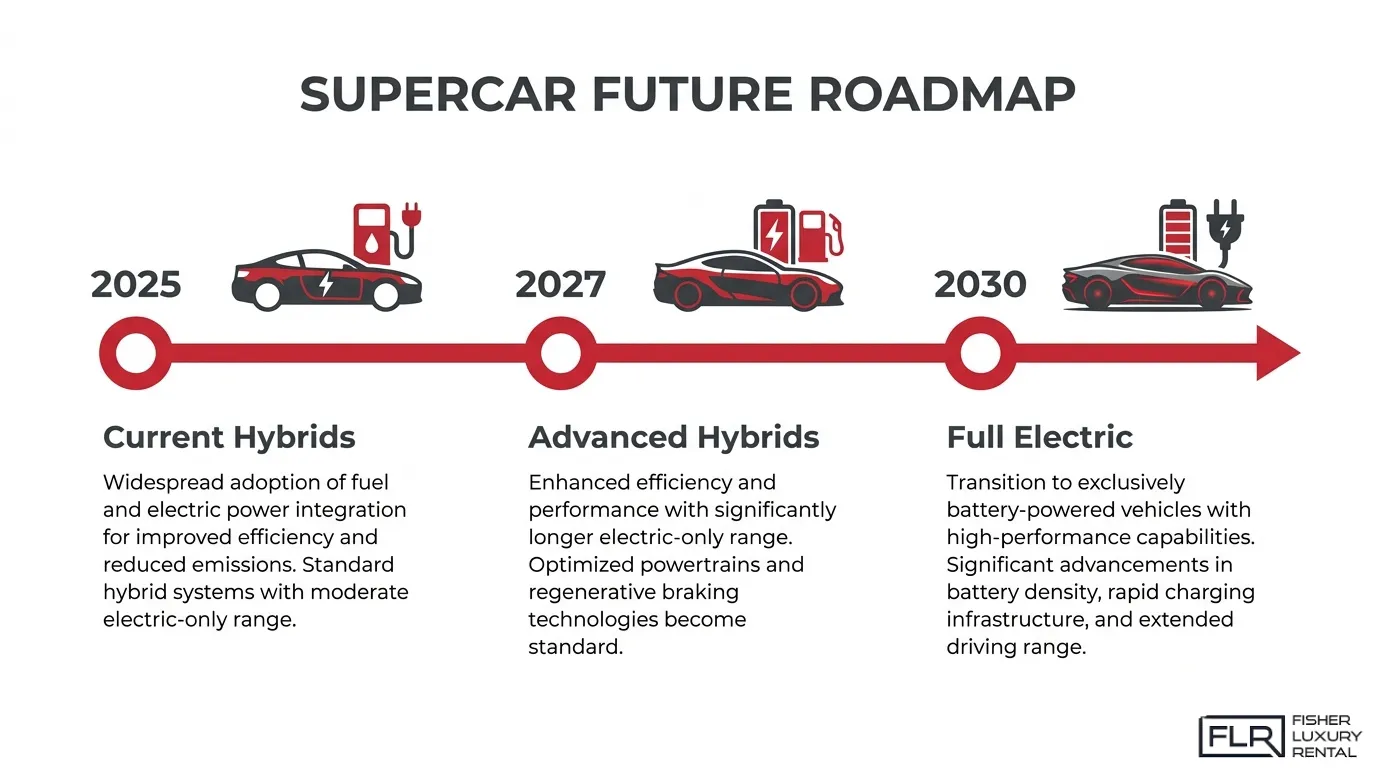
The future of hybrid supercar performance is defined by escalating power outputs, deeper electrification, and manufacturer commitments to fully electric transitions by 2030. The H3s below cover market growth, manufacturer roadmaps, and how pure electric hypercars are beginning to compete directly with hybrid platforms.
How Large Will the Hybrid Supercar Market Become?
The hybrid supercar market is part of a broader hybrid electric vehicle segment projected to grow from USD 287.0 billion in 2025 to USD 507.1 billion by 2032, according to PS Market Research, reflecting an 8.5 percent CAGR. This sustained growth signals that consumer appetite for high-performance hybrid vehicles is not a transitional phase. It represents a permanent shift in how performance car buyers evaluate powertrain technology.
What Are Ferrari and Lamborghini Planning for 2030?
Ferrari and Lamborghini have both announced electrification roadmaps targeting 2030. Ferrari plans to roll out 20 models by 2030, including fully electric vehicles. Lamborghini is taking a staged approach, with the 2027 Urus SE Performante, an 800-horsepower plug-in hybrid, preceding a fully electric model by 2030. Both strategies confirm that hybrid powertrains are the bridge technology carrying these brands from combustion to full electrification.
Can Fully Electric Hypercars Outperform Hybrid Supercars?
Fully electric hypercars can already outperform hybrid supercars in outright acceleration benchmarks. The Rimac Nevera R achieved 24 world records, including a 0-400-0 km/h time of 25.79 seconds and a top speed of 431.45 km/h (268.2 mph). The Lotus Evija delivers 1,877 horsepower and reaches 0-60 mph in 1.85 seconds. However, hybrid supercars retain an advantage in driving character, range flexibility, and the sensory engagement of a high-revving combustion engine alongside electric performance.
How Can You Experience Hybrid Supercar Performance Firsthand?
You can experience hybrid supercar performance firsthand by renting an exotic car or reviewing the key lessons these machines teach about powertrain engineering. The sections below cover rental access and the most important performance takeaways.
Can Renting an Exotic Car Let You Feel Hybrid Power?
Yes, renting an exotic car can let you feel hybrid power without the seven-figure purchase price. Fisher Luxury Rental offers access to luxury and exotic vehicles in Phoenix, AZ and Portland, OR, placing a premium driving experience within reach for enthusiasts and first-time drivers alike.
Reading specifications only goes so far. The instant torque delivery, seamless power transitions, and layered throttle response of a hybrid powertrain are sensations that only reveal themselves behind the wheel. Fisher Luxury Rental, serving Phoenix, AZ and Portland, OR, provides access to top-trim luxury and exotic vehicles for drivers who want to experience high-performance engineering firsthand, without the commitment of ownership.
What Are the Key Takeaways About Hybrid Supercar Performance?
The key takeaways about hybrid supercar performance center on how electric integration transforms every performance metric without sacrificing the character that makes supercars compelling. According to McLaren Press, the Artura’s complete hybrid system, including a 194 lb battery pack and 34 lb E-motor, weighs just 287 lbs total while contributing to a DIN curb weight of 3,303 lbs, proving that hybrid hardware no longer carries the weight penalty it once did.
The most important lessons from this category are:
- Instant torque delivery closes the gap between throttle input and acceleration, eliminating the lag traditional turbocharged engines produce at low RPM.
- Driving modes give the driver genuine control over power character, from silent electric cruising to maximum combined output.
- Weight engineering has matured to the point where hybrid components add performance capability without meaningfully compromising handling dynamics.
- Track credentials are real, with hybrid supercars holding outright lap records at the world’s most demanding circuits.
Renting before buying remains the single smartest way to validate whether a hybrid supercar’s real-world feel matches its numbers on paper.