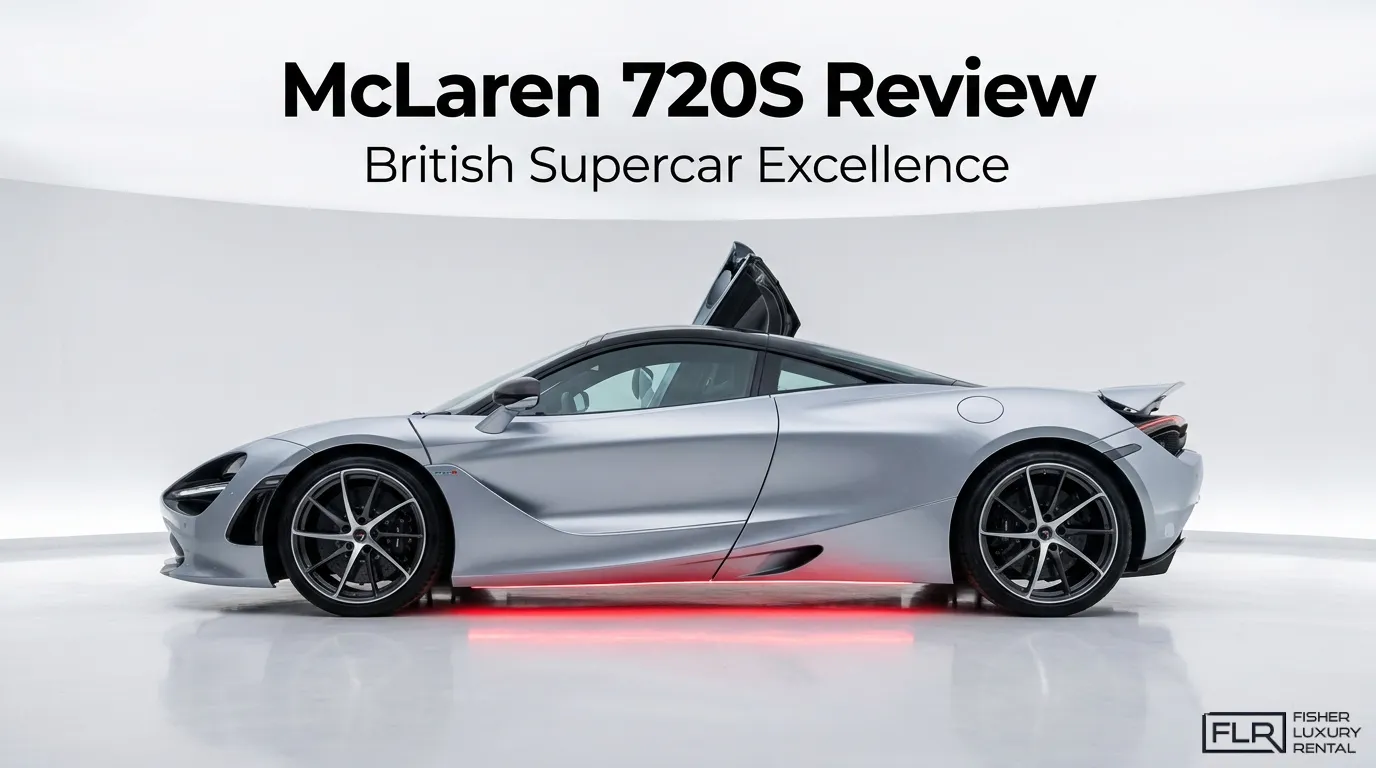
The McLaren 720S is a British mid-engine supercar from McLaren’s Super Series lineup, powered by a 4.0-liter twin-turbocharged V8 producing 710 hp, 568 lb-ft of torque, a 2.9-second 0-60 time, and a 212 mph top speed.
This review covers what the 720S is and how it performs on paper, what it actually feels like to drive, how its engineering and design work together, how it stacks up against key rivals, what ownership costs, and how to experience one through a luxury rental.
The 720S debuted at the 2017 Geneva Motor Show as a near-complete redesign of the 650S, sharing only 9% of its predecessor’s components. Its MonoCage II carbon fiber chassis sits 18 kg lighter than the outgoing structure, and it generates 50% more aerodynamic downforce than the car it replaced.
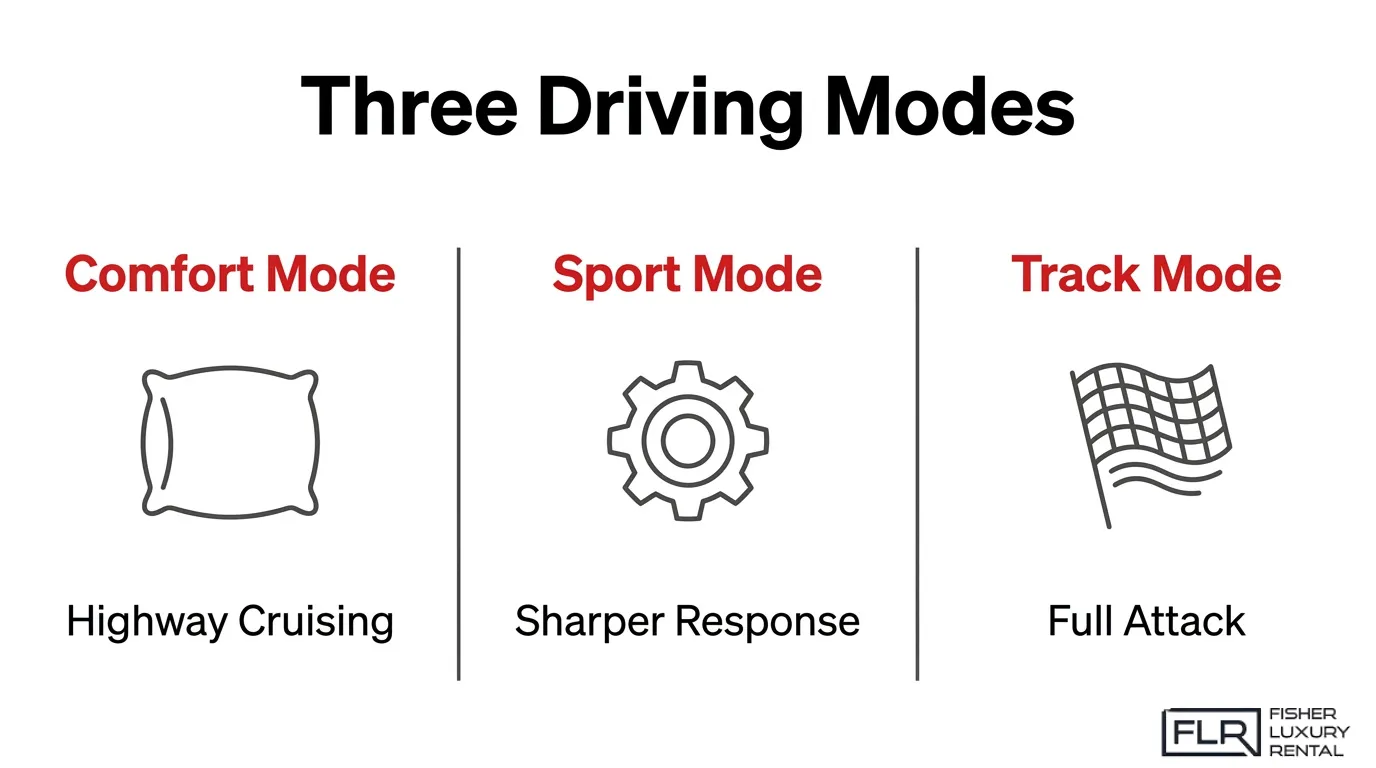
Behind the wheel, three suspension modes (Comfort, Sport, and Track) transform the car’s character from a composed highway cruiser to a full-attack track weapon. Owners consistently praise its surprising daily usability alongside its supercar performance ceiling.
The 720S exterior channels every surface toward aerodynamic purpose, while the cockpit wraps the driver in a focused, visibility-forward environment anchored by a Folding Driver Display and the IRIS infotainment system.
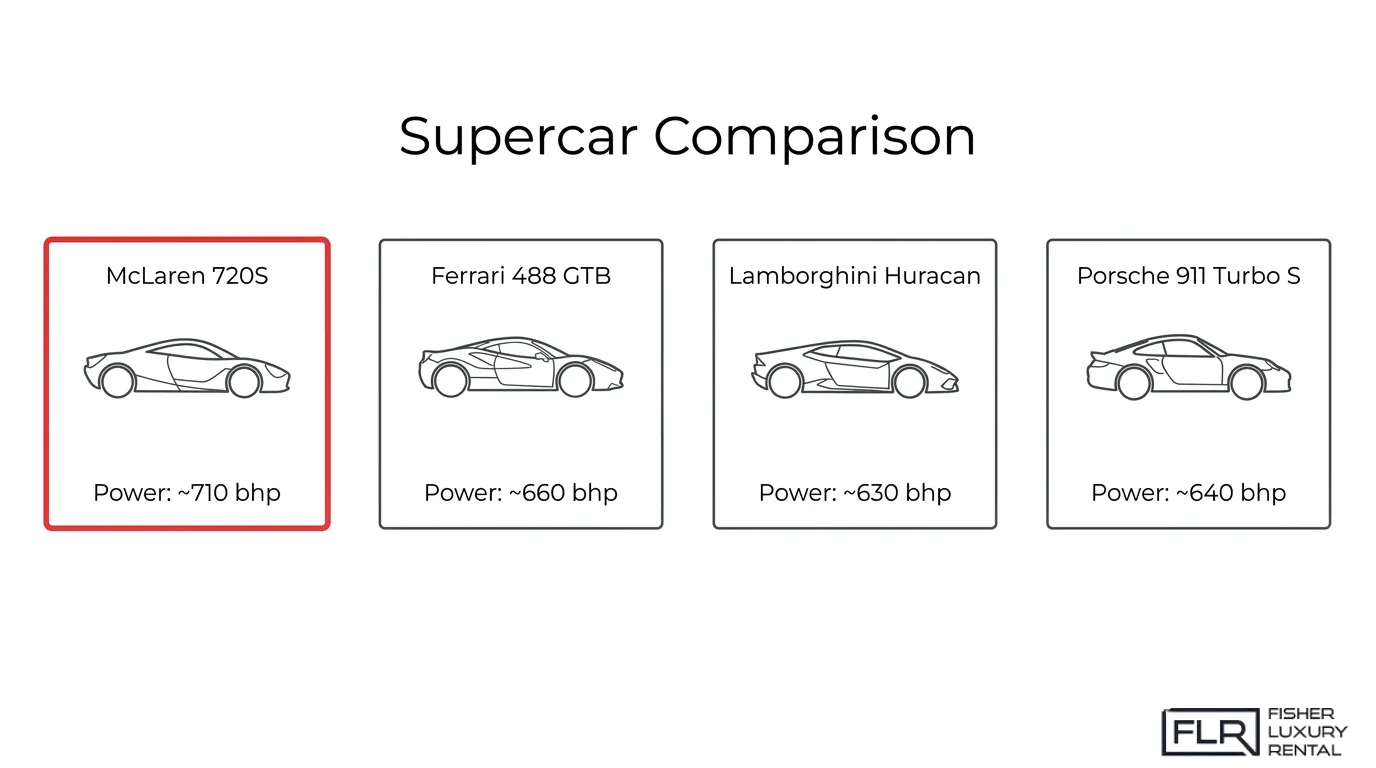
Against the Ferrari 488 GTB, Lamborghini Huracán, and Porsche 911 Turbo S, the 720S brings superior power output and carbon fiber construction to each matchup, though ownership costs, with major services reaching $5,000 to $10,000 and annual insurance averaging up to $7,000, demand serious consideration.
What Is the McLaren 720S?
The McLaren 720S is a British mid-engine supercar produced by McLaren Automotive, introduced as the second-generation model in the Super Series lineup. It debuted at the Geneva Motor Show on March 7, 2017, with a base MSRP of approximately $284,475, according to Forbes. The sections below cover its origins, core identity, and what separates it from its predecessor.
What Generation and Lineup Does the 720S Belong To?
The McLaren 720S belongs to the second generation of McLaren’s Super Series lineup, replacing the 650S after its debut at the 2017 Geneva Motor Show. Autocar described the 720S as being 91% new compared to the 650S it replaced, making it a near-complete redesign rather than a simple refresh. That level of engineering commitment is rare in the supercar segment and signals McLaren’s intent to set a new benchmark, not just iterate on one.
How Does the 720S Differ From the 650S It Replaced?
The 720S differs from the 650S through a lighter, stiffer chassis and 79 additional horsepower, producing significant gains in both performance and structural rigidity. The MonoCage II carbon fiber monocoque chassis replaced the outgoing platform, shedding 18 kg compared to its predecessor. Beyond raw numbers, the 720S also generates 50% more aerodynamic downforce than the 650S, a leap that transforms its behavior at speed rather than just on paper.
What Are the Key Specs and Performance Numbers of the 720S?
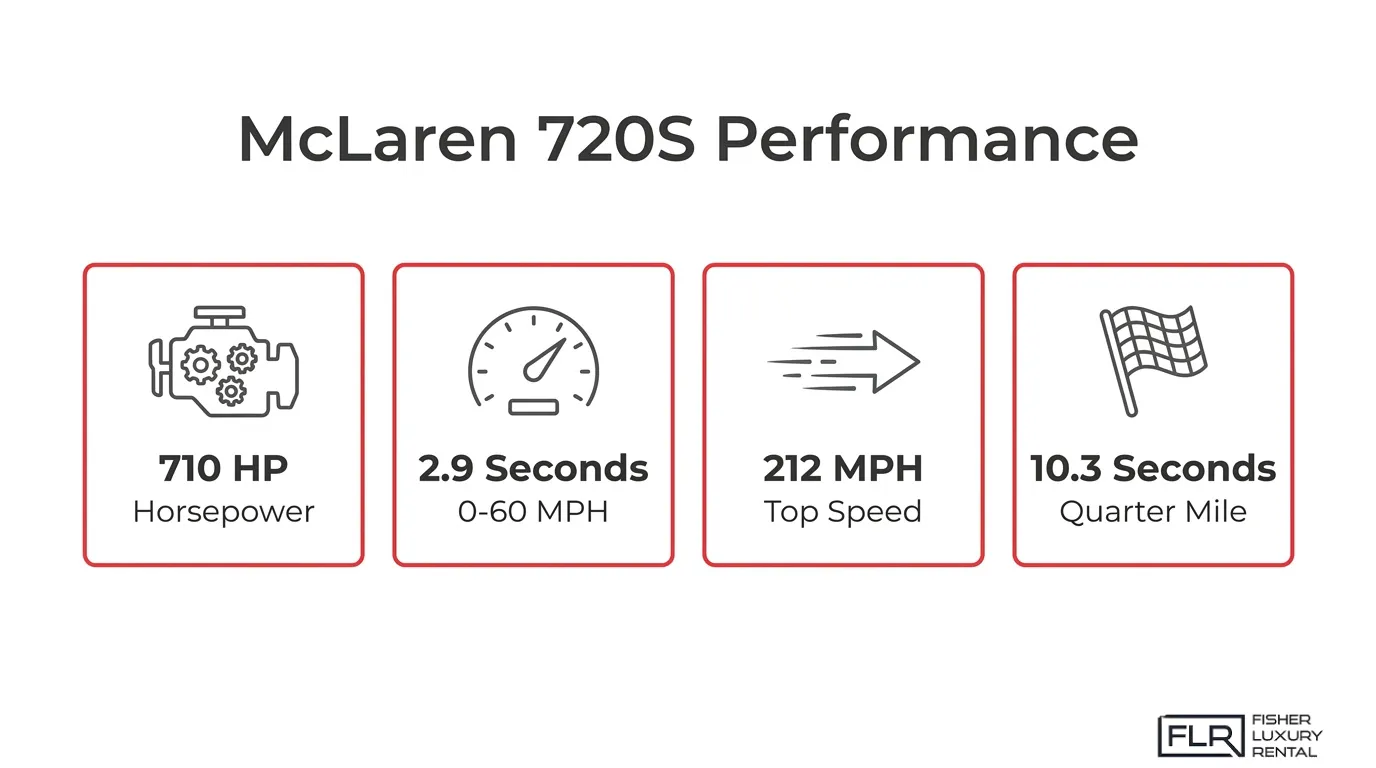
The key specs of the McLaren 720S center on a 4.0-liter twin-turbo V8, 710 hp, 568 lb-ft of torque, a 2.9-second 0-60 time, and a 212 mph top speed. The H3 sections below cover horsepower, acceleration, top speed, torque, and quarter-mile performance in detail.
How Much Horsepower Does the McLaren 720S Produce?
The McLaren 720S produces 710 hp (720 PS) at 7,500 rpm from its 3,994 cc M840T twin-turbocharged V8 engine. When it debuted at the Geneva Motor Show on March 7, 2017, according to Wikipedia, the 720S delivered 79 more horsepower than the 650S it replaced. That jump is not just a number on paper; it represents a fundamentally different performance category.
How Fast Is the McLaren 720S From 0 to 60 MPH?
The McLaren 720S accelerates from 0 to 60 mph in 2.9 seconds. At that pace, most drivers will have processed very little before triple digits appear on the speedometer. This figure places it among the fastest production supercars available.
What Is the Top Speed of the McLaren 720S?
The top speed of the McLaren 720S is 212 mph (341 km/h). Achieving that velocity is made possible by the 7-speed Graziano dual-clutch transmission, which delivers power to the rear wheels with precise, rapid gear changes.
How Much Torque Does the 720S Twin-Turbo V8 Deliver?
The 720S twin-turbo V8 delivers 568 lb-ft (770 N-m) of torque at 5,500 rpm. According to Wikipedia, the M840T engine produces this output from a 3,994 cc displacement, giving the car immediate, sustained thrust across a wide rpm range.
What Is the Quarter-Mile Time of the McLaren 720S?
The quarter-mile time of the McLaren 720S is 10.3 seconds. That result, combined with the 2.9-second 0-60 sprint and 212 mph ceiling, makes the 720S one of the most comprehensively fast production supercars on record.
What Does It Feel Like to Drive the McLaren 720S?
Driving the McLaren 720S feels like operating a machine built around a single purpose: maximum sensory engagement. The sections below cover how the 720S handles corners, motorway cruising, long-distance comfort, and what its three drive modes actually change.
How Does the 720S Handle on Twisty Roads?
The 720S handles on twisty roads with a level of precision that feels almost surgical. Steering is described as semi-light with a wide footprint, allowing drivers to dive and rip through corners with little fuss, according to Motor Trend. Point-to-point acceleration through and out of bends is explosive, with Car and Driver noting no dead spots under 100 mph. For a car with this kind of power, the composed, communicative cornering behavior is genuinely impressive, and arguably its single greatest talent.
How Does the 720S Feel at Highway Speeds?
The 720S feels remarkably composed and refined at highway speeds. Owners on Reddit praise it as a comfortable daily driver, noting it cruises well on the highway but is less ideal for bumper-to-bumper traffic. Wind noise stays well-managed, the cabin insulates effectively at speed, and the powertrain never feels strained. It is one of those rare supercars that can genuinely relax around you once the pace settles.
How Comfortable Is the 720S on Longer Drives?
The 720S is comfortable on longer drives when the suspension is set to Comfort mode. The Proactive Chassis Control II system absorbs road imperfections well enough that fatigue does not build at the same rate as in most supercars. Seat support is solid, and the cockpit ergonomics are purposeful rather than punishing. The main limitation remains the low ride height on rough urban roads, not sustained motorway miles.
What Do the Three Drive Modes Change About the Experience?
The three drive modes of the 720S are Comfort, Sport, and Track, and each meaningfully reshapes the car’s character. According to Car Throttle, these suspension settings provide a smooth and compliant ride in Comfort, sharper throttle response and firmer damping in Sport, and full-attack chassis behavior in Track. The transformation between Comfort and Track feels like driving two entirely different vehicles, which makes the 720S genuinely versatile across a wide range of driving scenarios.
How Does the McLaren 720S Engine and Powertrain Perform?
The McLaren 720S engine and powertrain perform at a level that few production cars can match, combining explosive power with surprisingly refined delivery. The following sections cover the M840T V8’s responsiveness and the Graziano dual-clutch transmission’s shift behavior.
How Responsive Is the 4.0-Liter Twin-Turbo V8?
The 4.0-liter twin-turbo V8 is exceptionally responsive, delivering 710 hp at 7,500 rpm and 568 lb-ft of torque at 5,500 rpm through the M840T engine. According to Car and Driver, point-to-point acceleration is explosive on straight sections, with no dead spots found under 100 mph. That last detail is what separates this engine from turbocharged rivals: the power curve feels linear rather than peaked, which makes the 720S far more predictable at the limit than its output numbers suggest.
How Smooth Is the Seven-Speed Dual-Clutch Transmission?
The seven-speed dual-clutch transmission is a Graziano unit that delivers power exclusively to the rear wheels. Top Gear confirms this setup and notes its role in the car’s seamless power delivery. Shifts are near-instantaneous in Sport and Track modes, while Comfort mode softens the gearbox behavior enough for relaxed driving. For a car producing this much power, the transmission’s ability to stay composed across all three modes is genuinely impressive and contributes directly to the 720S’s usability beyond the track.
How Good Is the McLaren 720S Suspension and Chassis?
The McLaren 720S suspension and chassis are exceptionally good, offering three settings (Comfort, Sport, and Track) that deliver a compliant ride for daily use while remaining track-capable. The sections below cover the Proactive Chassis Control II system and the MonoCage II carbon fiber structure.
What Makes the Proactive Chassis Control II System Special?
The Proactive Chassis Control II system is special because it uses a hydraulically interconnected suspension architecture that continuously adapts to road conditions across all three settings. According to Road & Track, the PCC II weighs 16 kg (35 lb) less than its predecessor, reducing unsprung mass without sacrificing compliance. That weight reduction directly improves both steering precision and body control through corners. Few hydraulic suspension systems in this class combine this level of adaptability with such meaningful weight savings, making PCC II one of the 720S’s most underappreciated engineering achievements.
How Does the Carbon Fiber Monocage II Affect Rigidity?
The MonoCage II carbon fiber monocoque chassis affects rigidity by providing an extremely stiff yet lightweight structural foundation for the entire vehicle. The McLaren 720S features this chassis at 18 kg (40 lb) lighter than its predecessor, according to ScienceDirect research on composite automotive structures. Reduced mass at the core lowers the center of gravity and sharpens the car’s response to steering inputs. Carbon fiber’s inherently high stiffness-to-weight ratio means the 720S gains structural integrity without the penalties that heavier steel alternatives would impose on handling dynamics.
What Does the McLaren 720S Look Like Inside and Out?
The McLaren 720S looks like a car designed entirely around airflow and driver focus, where every surface has an aerodynamic purpose. The sections below cover the exterior design, dihedral door mechanics, interior layout, and cockpit visibility.
How Striking Is the 720S Exterior Design?
The 720S exterior design is immediately distinguished by deeply sculpted body panels, a low-slung silhouette, and integrated aerodynamic elements that serve function as much as form. The full-width active rear spoiler acts as an airbrake, tilting to a near-vertical position to increase downforce and stability during heavy braking. Every surface flows with intent, from the tapered nose to the rear diffuser, creating a visual identity that is aggressive without excess.
How Does the Dihedral Door System Work?
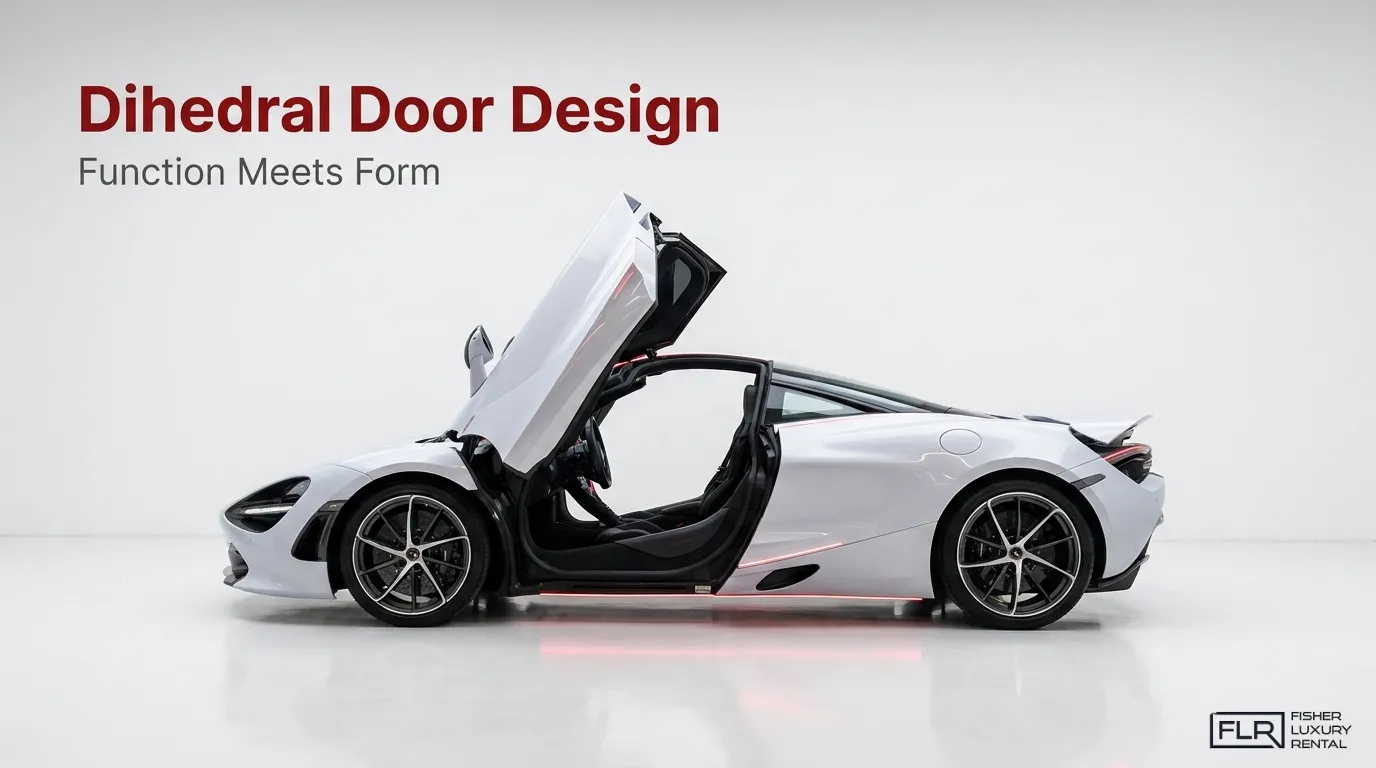
The dihedral door system works by swinging outward and upward simultaneously, rotating on a single hinge point mounted at the front of the door. According to Designboom, the doors feature a pioneering double-skin aerodynamic form that channels air directly to the high-temperature radiators, making them a functional aerodynamic component rather than a styling gesture. This dual-purpose engineering is one of the most distinctive expressions of McLaren’s form-follows-function philosophy.
How Driver-Focused Is the 720S Interior Layout?
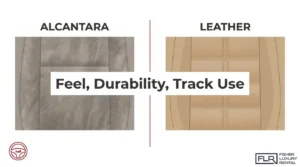
The 720S interior layout is highly driver-focused, placing all primary controls within immediate reach of the seated driver. The cockpit wraps around the driver with an angled center console, slim A-pillars, and a folding TFT driver display that adjusts based on the selected drive mode. Material quality is premium throughout, with carbon fiber trim, Alcantara, and leather finishes available, though the cabin prioritizes ergonomics over rear-seat accommodation, since the 720S is a strict two-seater.
How Is the Visibility From the 720S Cockpit?
Visibility from the 720S cockpit is exceptional for a mid-engine supercar, largely due to the MonoCage II carbon fiber structure. According to Car Throttle, the MonoCage II allows for thinner roof pillars and glass C-pillars, providing strong all-round visibility that makes the car surprisingly easy to place on the road. This is a genuine differentiator compared to rivals, where thick pillars and low rooflines often compromise sightlines significantly.
What Technology and Infotainment Does the 720S Offer?
The 720S offers a suite of proprietary technology features centered on driver focus, situational awareness, and in-cabin connectivity. The key systems include the Folding Driver Display, the IRIS infotainment platform, and an optional advanced driver assistance package.
What Is the Folding Driver Display on the 720S?
The Folding Driver Display is an upright TFT screen that folds down automatically in Track mode, showing only the most essential data so the driver stays focused. According to GT Spirit, the display retracts to declutter the cockpit when maximum driver engagement is required. This approach reflects McLaren’s philosophy of removing distractions at the moments that matter most.
What Does the IRIS Infotainment System Include?
The IRIS infotainment system handles audio, navigation, climate control, and vehicle diagnostics as a standalone proprietary platform. It is not Android Auto or Apple CarPlay compatible, which is a genuine limitation for drivers accustomed to smartphone integration. For a car at this price level, that absence is a notable trade-off worth considering before committing.
Does the 720S Have Advanced Driver Assistance Features?
The 720S can be equipped with advanced safety features including Adaptive Cruise Control, Lane Departure Warning, and Emergency Braking. These options make the 720S more viable as a daily-use supercar without compromising its core performance identity.
How Does the McLaren 720S Compare to Its Rivals?
The McLaren 720S competes directly against the Ferrari 488 GTB, Lamborghini Huracán, and Porsche 911 Turbo S. Across each matchup, the 720S brings a distinct combination of power, aerodynamic engineering, and track-focused construction that sets it apart from the field.
How Does the 720S Compare to the Ferrari 488 GTB?
The 720S compares to the Ferrari 488 GTB by outpacing it in both power and structural novelty. The Ferrari 488 GTB produces 661 hp and 561 lb-ft of torque, accelerating from 0-60 mph in 2.7 seconds, according to Wikipedia. The 720S edges it out with 710 hp and a 0-60 time of 2.9 seconds on paper, though the Ferrari carries a slight edge in raw acceleration figures. Where the 720S truly differentiates itself is engineering depth: according to Autocar, the 720S is 91% new compared to the 650S it replaced, signaling a ground-up rethink rather than an incremental update. For drivers prioritizing structural innovation and aerodynamic performance over Italian heritage, the 720S makes a compelling case.
How Does the 720S Compare to the Lamborghini Huracán?
The 720S compares to the Lamborghini Huracán LP610-4 by offering forced-induction power against a naturally aspirated V10. According to Wikipedia, the Huracán LP610-4 generates 602 hp from a 5.2L naturally aspirated V10 and hits 0-60 mph in 2.5 seconds, with a kerb weight of 3,424 lbs. The Huracán’s V10 soundtrack and all-wheel drive give it a different character entirely. The 720S counters with superior power output and aerodynamic downforce, making it the stronger choice for track-focused drivers who favor precision over drama.
How Does the 720S Compare to the Porsche 911 Turbo S?
The 720S compares to the Porsche 911 Turbo S by prioritizing supercar purity over daily versatility. According to Wikipedia, the 911 Turbo S (992) produces 641 hp and 590 lb-ft of torque, reaching 0-60 mph in 2.6 seconds, making it one of the most capable all-round performance cars available. The Porsche wins on practicality and all-weather usability. The 720S answers with a purpose-built mid-engine layout, a lighter carbon fiber chassis, and a more visceral driving experience that the Porsche, for all its engineering excellence, simply cannot replicate.
What Are the Common Pros and Cons of the McLaren 720S?
The common pros and cons of the McLaren 720S span breathtaking performance and daily usability on one side, and high ownership costs alongside notable depreciation on the other. The sections below cover what owners love most and the complaints that appear most frequently.
What Do Owners Love Most About the 720S?
What owners love most about the 720S centers on its reliability when properly maintained and its surprising everyday usability. According to McLaren owner community feedback, most owners report few issues with their 720S, citing proper driving and maintenance as key to reliability, though turbo inlets are a recognized concern worth monitoring. Beyond mechanical confidence, owners consistently highlight the car’s adaptability: it handles highway cruising comfortably while delivering supercar thrills on demand. For a vehicle at this performance level, that balance is genuinely rare and makes the 720S a standout among its peers.
What Are the Most Common Complaints About the 720S?
The most common complaints about the 720S include depreciation, high maintenance costs, and limited practicality in stop-and-go traffic. The key owner-reported drawbacks are:
- Depreciation: The 720S originally priced near $326,000 dropped to around $260,000 within a few years, retaining roughly 66% of its value.
- Maintenance costs: Minor services run $2,000 to $3,000; major services reach $5,000 to $10,000.
- Traffic usability: Owners note it is less suited to bumper-to-bumper conditions despite highway comfort.
- Known mechanical issue: Turbo inlets are a recurring concern flagged across owner communities.
For prospective buyers, depreciation deserves serious weight in the ownership calculus, particularly given how steeply the first few years affect resale value.
How Much Does a McLaren 720S Cost to Buy and Maintain?
The McLaren 720S costs a significant amount to buy and maintain, covering a purchase price well above $280,000 and ongoing service bills that rival luxury car lease payments. The sections below break down purchase price, maintenance costs, and insurance expenses.
What Is the Purchase Price of a McLaren 720S?
The purchase price of a McLaren 720S started at approximately $284,475 upon its debut, according to Forbes. Fully optioned examples pushed considerably higher, and with McLaren’s extensive personalization program, six-figure configurations were common. For buyers considering the used market, the 720S has experienced notable depreciation, with the original MSRP near $326,000 dropping to around $260,000 within a few years, retaining roughly 66% of its original value. From a purely financial perspective, that depreciation curve actually makes the used 720S one of the more accessible entry points into this level of supercar performance.
How Much Does McLaren 720S Maintenance Cost?
McLaren 720S maintenance costs are premium by any measure. According to McLaren Life, minor services run approximately $2,000 to $3,000, while major services reach $5,000 to $10,000. Routine items such as tires, brake components, and fluid changes add further to annual expenses. Owners who follow a strict maintenance schedule and avoid aggressive track use report better long-term reliability, though turbo inlet issues remain a known concern across the ownership community.
How Much Does McLaren 720S Insurance Cost?
Annual insurance costs for a McLaren 720S average between $4,000 and $7,000, depending on the driver profile and policy selected. Age, driving history, location, and chosen coverage levels all influence the final premium significantly. Total cost of ownership, combining maintenance and insurance alone, can easily exceed $15,000 per year before fuel and tire expenses are factored in. For drivers drawn to the 720S experience but wary of these ongoing costs, exotic car rental services like Fisher Luxury Rental provide an accessible alternative — delivering the performance without the annual financial commitment.
Who Is the McLaren 720S Best Suited For?
The McLaren 720S is best suited for drivers who prioritize raw performance, precision handling, and an emotionally engaging driving experience over practicality. The following profiles describe who gets the most from this supercar.
- The performance purist: Drivers who want a car that delivers 710 hp, a 2.9-second 0-60 time, and genuine track capability will find the 720S purpose-built for their priorities.
- The occasional daily driver: Owners who report using it as a highway cruiser benefit from the Comfort suspension mode, though bumper-to-bumper commuting dulls the experience considerably.
- The weekend and track-day enthusiast: The three-mode suspension system, Sport and Track settings, and Proactive Chassis Control II make the 720S exceptionally rewarding on open roads and circuits.
- The exotic car renter: Someone who wants the full supercar experience without ownership costs suits the rental model well. At $1,100 to $1,799 per day, renting offers access without the $284,475 base purchase price or premium maintenance bills of $5,000 to $10,000 per major service.
The 720S is not the right choice for those prioritizing cargo space, infotainment depth, or low running costs. It rewards drivers who treat every drive as an event. For those who want to treat a single drive as an event without committing to ownership, Fisher Luxury Rental offers top-trim exotic and luxury vehicles across Phoenix, AZ and Portland, OR — a practical way to experience this category of car on your own terms.
How Can You Experience a McLaren 720S Through a Luxury Rental?
Experiencing a McLaren 720S through a luxury rental lets you access 710 hp of supercar performance without ownership costs. The sections below cover how Fisher Luxury Rental delivers that experience and the key takeaways from this full 720S review.
Can Renting an Exotic Car at Fisher Luxury Rental Deliver the 720S Thrill?
Yes, renting an exotic car at Fisher Luxury Rental can deliver the full 720S thrill. Fisher Luxury Rental specializes in top-trim luxury and exotic vehicles, giving drivers direct access to the 720S’s twin-turbo V8, dihedral doors, and three-mode suspension without the six-figure purchase price.
The luxury rental market reflects strong demand for exactly this kind of experiential access. According to a Market Research Future report, the global luxury car rental market was valued at $30.3 billion in 2022 and is projected to reach $125.98 billion by 2034. Exotic car rental services target customers seeking experiential value for occasions such as weddings, corporate events, and weekend getaways. For those wanting the 720S experience on their terms, a rental is the most practical and immediate path.
What Are the Key Takeaways From This McLaren 720S Review?
The key takeaways from this McLaren 720S review confirm it as one of the most complete supercars available. Its strengths span every category: raw performance, chassis engineering, aerodynamic design, and driver-focused technology.
The most important conclusions are:
- Performance: 710 hp, 0-60 mph in 2.9 seconds, and a 212 mph top speed place it at the top of its class.
- Driving dynamics: Three suspension modes and Proactive Chassis Control II make it capable on both road and track.
- Design: Dihedral doors, active rear spoiler, and MonoCage II structure combine function with visual drama.
- Technology: The Folding Driver Display and IRIS infotainment system keep the cockpit purposeful and modern.
- Expert consensus: Top Gear called it “probably the single most accomplished supercar we’ve ever driven.”
For drivers who want this experience without ownership complexity, Fisher Luxury Rental offers access to luxury and exotic vehicles designed to create exactly these kinds of memories.