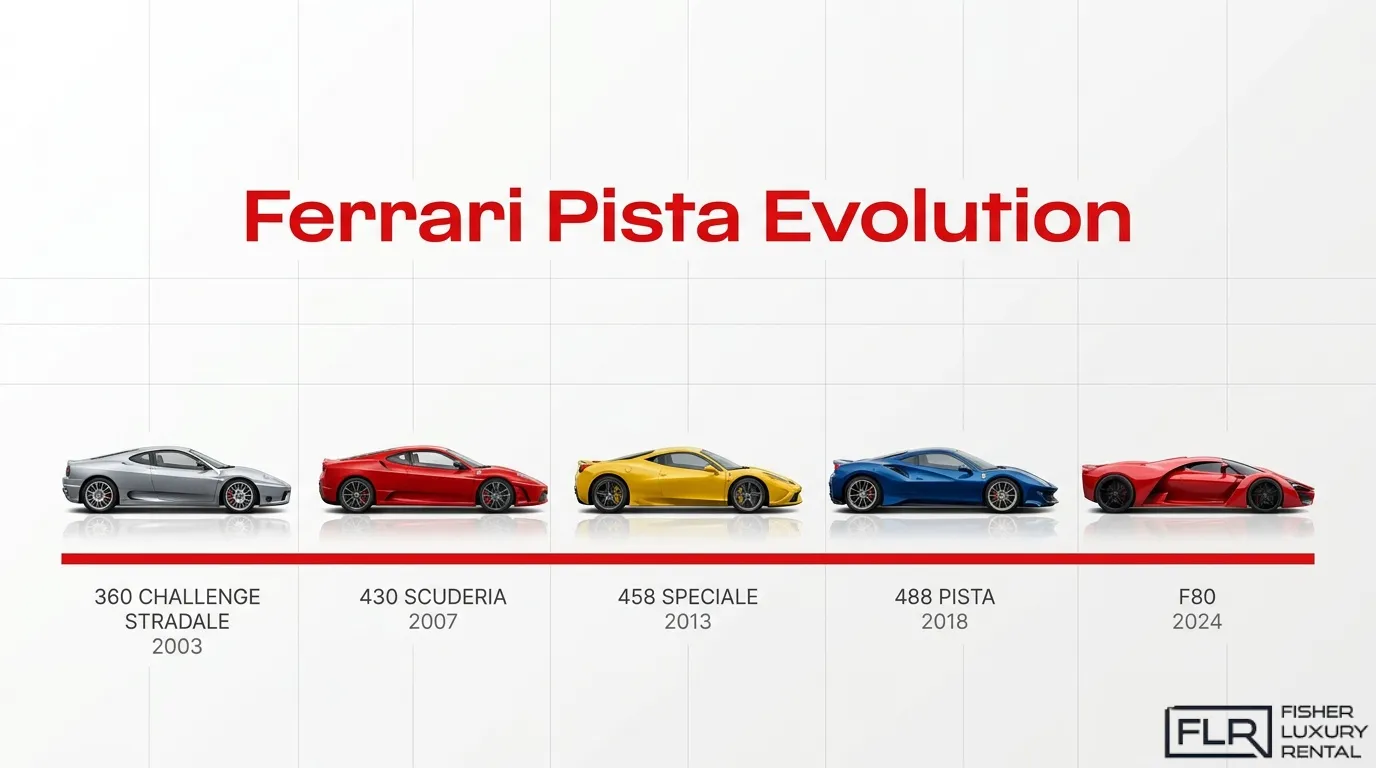
Ferrari Pista models are a lineage of track-focused, road-legal supercars built around a single philosophy: take racing technology directly from Ferrari’s competition program and engineer it into a street-registered machine. “Pista” means “track” in Italian, and every model bearing that designation treats the name as a performance contract.
This guide covers the Pista naming heritage, the full model lineage from the 360 Challenge Stradale through the F80, how each generation evolved in specs and technology, the Spider variants, collectibility and market values, and how to experience this lineage through an exotic car rental.
“Pista” as a brand promise started with the 2003 Ferrari 360 Challenge Stradale, which set the template: aggressive weight reduction, race-borrowed components like Brembo carbon ceramic brakes from the Enzo, and a Fiorano-benchmarked lap time. Every generation refined that formula.
Each successive model pushed the spec sheet further. From 419 hp naturally aspirated in the Challenge Stradale, output climbed to 503 hp in the 430 Scuderia, 597 hp in the 458 Speciale, and 710 hp in the 488 Pista, with Fiorano lap times falling from 1:28 to 1:21.5 across those four generations. Each car introduced a meaningful technology leap: F1-derived electronics, active aerodynamics, turbocharged V8s, and in the F80, a hybrid powertrain producing 1,200 hp.
Spider variants accompanied most generations in strictly limited numbers, adding open-top rarity to an already scarce lineage. Production caps as tight as 499 units have made models like the 458 Speciale Aperta and the 430 Scuderia Spider 16M among the most sought-after collector Ferraris on the market.
What Does “Pista” Mean in Ferrari’s Naming Heritage?
“Pista” means “track” in Italian, directly signaling that every Ferrari bearing this designation is engineered around racing performance. According to Road and Track, the name reflects the car’s racing heritage and track-focused performance characteristics. Ferrari further chose the term to emphasize performance derived from tried and tested racing technologies, making the word both a literal description and a brand promise.
The name functions as a lineage marker: each Pista-generation model carries forward racing DNA distilled from Ferrari’s competition program into a road-legal machine.
Which Ferrari Models Belong to the Pista Lineage?
The Ferrari models belonging to the Pista lineage are the 360 Challenge Stradale, 430 Scuderia, 458 Speciale, 488 Pista, and F80. Each generation raised the performance benchmark through lighter construction, more power, and deeper racing technology transfer.
Ferrari 360 Challenge Stradale
The Ferrari 360 Challenge Stradale is the founding model of the Pista lineage, produced between 2003 and 2005 in just 1,288 units worldwide. Its 3.6-liter naturally aspirated V8 produces 419 hp at 8,500 rpm, accelerating from 0 to 62 mph in 4.1 seconds with a 186 mph top speed. Brembo carbon ceramic brakes borrowed from the Enzo shaved 16 kg off curb weight while reducing unsprung mass for sharper handling. Compared to the Porsche 911 GT2, it was lighter and more agile, though the Porsche held the top-speed advantage. Values have appreciated dramatically: a 2004 example originally stickered at $202,028 sold at auction for $610,500 according to Hagerty, with current examples ranging from $300,000 to $400,000.
Ferrari 430 Scuderia
The Ferrari 430 Scuderia is the second-generation Pista model, built between 2007 and 2009 with approximately 2,000 to 3,500 units produced. Its 4.3-liter V8 generates 503 hp at 8,500 rpm, with a 0-60 mph time of 3.6 seconds and a 198 mph top speed. Carbon fiber, Lexan windows, titanium springs, and deleted sound-deadening materials collectively shed 220 lb versus the standard F430. The F1-SuperFast2 paddle-shift gearbox executes shifts in just 60 milliseconds, roughly a quarter of manual shift time, according to Motor Trend. Motor Trend called it “Ferrari’s best-performing GT car ever,” noting that Michael Schumacher matched the Enzo’s Fiorano lap time of 1:25.0 at the wheel. Current market values sit between $350,000 and $450,000.
Ferrari 458 Speciale
The Ferrari 458 Speciale is equipped with a 4.5-liter naturally aspirated V8 producing 597 hp at 9,000 rpm and 398 lb-ft of torque at 6,000 rpm. It completes 0-62 mph in 3.0 seconds with a 202 mph top speed, according to Evo Magazine. Ferrari-patented mobile aerodynamic flaps at the front adjust actively to optimize downforce and reduce drag, representing the lineage’s first production active aero system. Approximately 1,309 coupes were built, alongside 499 open-top Speciale Aperta units. For naturally aspirated purists, the 458 Speciale arguably represents the highest expression of that engine philosophy in the Pista family.
Ferrari 488 Pista
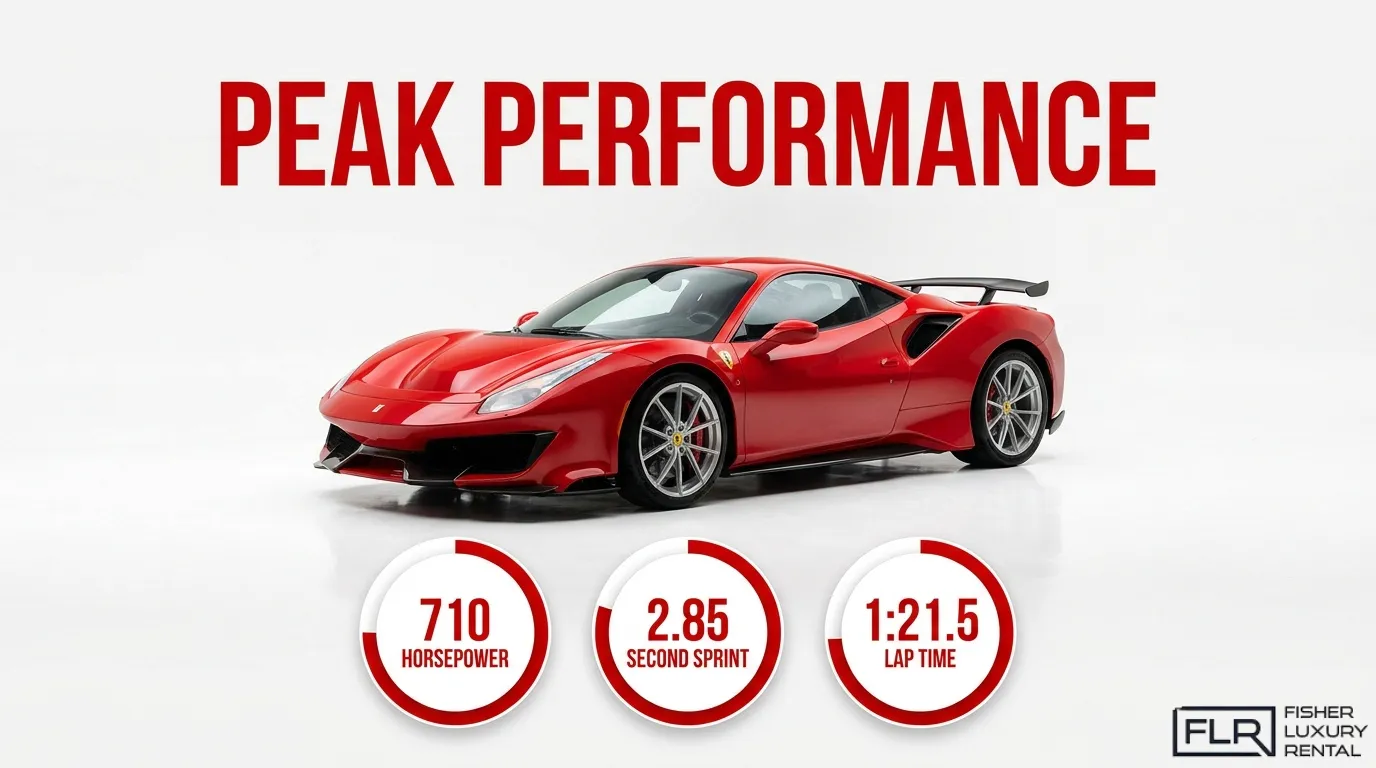
The Ferrari 488 Pista is powered by a 3.9-liter twin-turbocharged V8 producing 710 hp at 8,000 rpm and 568 lb-ft of torque at 3,000 rpm. It accelerates from 0-60 mph in 2.85 seconds and exceeds 211 mph, with a Fiorano lap time of 1 minute 21.5 seconds according to Motor1. Weighing approximately 1,385 kg dry, it is roughly 90 kg lighter than the 488 GTB. An aerodynamic S-Duct generates 20% more downforce than the 488 GTB, as confirmed by Ferrari. Top Gear named it Supercar of the Year 2018, describing it as “rampant but well groomed, angry but always in control.” Clean examples currently trade between $580,000 and $650,000.
Ferrari F80
The Ferrari F80 represents the most advanced model in the Pista lineage, combining a 3.0-liter twin-turbocharged V6 producing 900 hp with electric motors contributing 300 hp for a total system output of 1,200 hp. It reaches 0-62 mph in 2.15 seconds and 217 mph top speed, and set the fastest road car lap at Pista di Fiorano at 1 minute 15.3 seconds. Production is limited to 799 units, all already allocated, with pricing from $3,735,000 before options according to Car and Driver. The MGU-K electric motor is Ferrari’s first entirely developed and manufactured in-house at Maranello, with architecture derived directly from Formula 1.
How Did the Ferrari 360 Challenge Stradale Start the Pista Era?
The Ferrari 360 Challenge Stradale started the Pista era by establishing Ferrari’s template for road-legal, track-focused derivatives: aggressive weight reduction, race-borrowed components, and Fiorano-benchmarked performance. The H3s below cover its engine specs, weight reduction methods, and key differentiators from the standard 360 Modena.
What Engine and Performance Specs Define the 360 Challenge Stradale?
The engine specs defining the 360 Challenge Stradale are a 3.6-liter naturally aspirated V8 producing 425 PS (419 hp) at 8,500 rpm and 373 N⋅m (275 lb-ft) of torque at 4,750 rpm. Acceleration runs from 0 to 100 km/h in 4.1 seconds, with a top speed of 300 km/h (186 mph). To remain street legal, the car retained required elements such as ground clearance compliance, emission controls, proper lighting, and road-legal tires and brakes. That combination of high-revving performance and full road compliance made the Challenge Stradale the direct blueprint for every Pista-generation model that followed.
What Weight Reduction Techniques Did the Challenge Stradale Use?
The weight reduction techniques the Challenge Stradale used centered on extensive carbon fiber application and interior stripping. According to Wikipedia, Ferrari cut approximately 110 kg compared to the standard 360 Modena, bringing curb weight to 1,430 kg (3,153 lb), through measures including:
- Carbon fiber door panels
- Lexan door windows replacing standard glass
- Deleted radio and sound-deadening materials
- Alcantara fabric replacing leather throughout
- Brembo carbon ceramic brakes borrowed from the Enzo, shaving an additional 16 kg by reducing unsprung weight
This systematic approach to mass reduction remains the defining characteristic of every subsequent Pista-lineage model.
What Made the 360 Challenge Stradale Different From the Standard 360?
The 360 Challenge Stradale differed from the standard 360 Modena through a combination of race-derived hardware, significant weight reduction, and track-benchmarked performance credentials. Where the Modena prioritized everyday comfort, the Challenge Stradale stripped the interior, fitted Brembo carbon ceramic brakes from the Enzo, and posted a Fiorano lap time of 1 minute 28 seconds, according to Top Gear. That lap time established a measurable, repeatable standard for every Ferrari track-focused road car that followed, setting the benchmark the F80 would eventually reduce to 1 minute 15.3 seconds.
What Innovations Did the Ferrari 430 Scuderia Introduce?
The Ferrari 430 Scuderia introduced a combination of engine upgrades, aerodynamic refinements, and Formula 1-derived electronics that set a new benchmark for road-legal performance cars. The following H3 sections cover its engine specs, aerodynamic improvements, and racing technology transfers.
What Engine and Performance Specs Define the 430 Scuderia?
The engine and performance specs that define the 430 Scuderia are centered on a 4.3-liter V8 producing 510 PS (503 hp) at 8,500 rpm and 471 N·m (347 lb-ft) of torque at 5,250 rpm. It achieves 0-60 mph in 3.6 seconds with a top speed of 198 mph. Weighing just 1,250 kg dry, it sits approximately 100 kg lighter than the standard F430, thanks to carbon fiber throughout the interior, titanium springs and lug bolts, a Lexan rear window, and deleted sound-deadening materials. That power-to-weight combination produced a Fiorano lap time of 1 minute 25 seconds, equaling the Ferrari Enzo’s best recorded time at the circuit.
How Did Ferrari Improve Aerodynamics on the 430 Scuderia?
Ferrari improved aerodynamics on the 430 Scuderia through a more pronounced front splitter and a redesigned center inlet that more precisely manages airflow. According to Motor Trend, the revised fascia produced front and rear lift coefficients of -0.145 and -0.211, a downforce distribution that mirrors the car’s static weight balance. This level of aerodynamic intentionality was uncommon for a production GT car of its era, making the Scuderia’s aero package genuinely track-calibrated rather than cosmetic.
What Racing Technology Carried Over to the 430 Scuderia?
The racing technologies carried over to the 430 Scuderia include the F1-Trac traction and stability control system, the E-Diff2 electronic limited-slip differential, and the F1-SuperFast2 paddle-shift gearbox. The F1-Trac and E-Diff2 combination delivers 40% more acceleration out of corners than traditional systems. The F1-SuperFast2 gearbox executes shifts in as little as 60 milliseconds, roughly one-quarter the time of a manual gearshift. Together, these systems gave everyday drivers access to performance previously reserved for factory test drivers. For enthusiasts who want to experience this level of exotic performance without ownership, Fisher Luxury Rental offers top-trim luxury and exotic vehicles in Phoenix, AZ and Portland, OR.
How Did the Ferrari 458 Speciale Advance the Pista Formula?
The Ferrari 458 Speciale advanced the Pista formula through a more powerful naturally aspirated V8, active aerodynamics, and a sharper chassis setup. The sections below cover its engine specs, handling improvements over the 430 Scuderia, and its aerodynamic innovations.
What Engine and Performance Specs Define the 458 Speciale?
The engine and performance specs that define the 458 Speciale are a 4.5-liter naturally aspirated V8 producing 605 PS (597 hp) at 9,000 rpm and 540 Nm (398 lb-ft) of torque at 6,000 rpm. According to Ferrari Official, the 458 Speciale completes 0-62 mph in 3.0 seconds and reaches a top speed of 202 mph (325 km/h). Curb weight sits between 1,451 and 1,455 kg, and the Speciale posted a Fiorano lap time of 1 minute 23.5 seconds, shaving two full seconds off the 430 Scuderia’s benchmark. For a naturally aspirated road car, that figure remains extraordinary.
How Did the 458 Speciale Improve Handling Over the 430 Scuderia?
The 458 Speciale improved handling over the 430 Scuderia through a revised Side Slip Control (SSC) system and a stiffer, more responsive chassis tune. SSC integrates the E-Diff3 electronic differential, F1-Trac traction control, and magnetorheological dampers into a unified control network, allowing more precise torque vectoring at higher cornering speeds than the 430 Scuderia’s earlier E-Diff2 setup permitted. The higher redline of 9,000 rpm also gives drivers a broader power band to exploit through corners. That combination of electronic integration and engine character makes the 458 Speciale more rewarding to drive at the limit than its predecessor.
What Role Did Active Aerodynamics Play in the 458 Speciale?
Active aerodynamics played a central role in the 458 Speciale’s performance by using Ferrari-patented mobile flaps at the front that adjust in real time to optimize downforce and reduce drag. These flaps represent the first application of active front aerodynamics in a road-going Pista-series Ferrari, a clear step beyond the 430 Scuderia’s fixed passive splitter. By balancing downforce against drag depending on speed and driving conditions, the system improves both straight-line efficiency and cornering stability without requiring driver input.
Why Is the Ferrari 488 Pista Considered the Peak of the Series?
The Ferrari 488 Pista is considered the peak of the series because it combines the highest output engine, the most advanced track-derived technology, and the greatest aerodynamic development of any naturally road-registered 488-generation model. The following sections cover its engine specs, turbocharging dynamics, track technologies, and how it compares to the 458 Speciale.
What Engine and Performance Specs Define the 488 Pista?
The engine and performance specs that define the 488 Pista are a 3.9-liter twin-turbocharged V8 producing 720 PS (710 hp) at 8,000 rpm and 770 Nm (568 lb-ft) of torque at just 3,000 rpm, according to Ferrari Official. The car accelerates from 0-60 mph in 2.85 seconds and reaches a top speed exceeding 211 mph. It weighs approximately 1,385 kg dry, roughly 90 kg less than the standard 488 GTB. A Fiorano lap time of 1 minute 21.5 seconds further confirms its status as the most capable road-registered Ferrari of its generation.
How Did Turbocharging Change the Pista Driving Experience?
Turbocharging changed the 488 Pista driving experience by delivering massive torque earlier in the rev range while preserving the high-revving engagement expected of a track-focused Ferrari. The Pista’s twin-turbo V8 is derived directly from the 488 Challenge race car, featuring a flywheel with fewer counterweights and lighter construction for sharper responsiveness, according to Top Gear. With peak torque arriving at 3,000 rpm, power delivery is broader and more accessible than in naturally aspirated predecessors, yet the engine still pulls strongly to 8,000 rpm. This combination makes the Pista feel both brutally fast on straights and rewarding through corners.
What Track-Derived Technologies Appear in the 488 Pista?
The track-derived technologies in the 488 Pista include a front aerodynamic S-Duct generating 20% more downforce than the 488 GTB, a 7-speed dual-clutch F1-style transmission, and extensive carbon fiber construction across the engine cover, bumpers, and spoiler. The S-Duct routes air from the front underbody through the hood, a solution borrowed directly from Formula 1 and GT racing programs. Together, these systems deliver aerodynamic grip, mechanical efficiency, and chassis responsiveness that are rare in any street-legal vehicle.
How Does the 488 Pista Compare to the 458 Speciale?
The 488 Pista outperforms the 458 Speciale across every measurable metric. The key differences are:
- Engine output: 720 PS (488 Pista) vs. 605 PS (458 Speciale)
- 0-62 mph: 2.85 seconds vs. 3.0 seconds
- Top speed: 211+ mph vs. 202 mph
- Fiorano lap time: 1:21.5 vs. 1:23.5
- Torque delivery: 770 Nm at 3,000 rpm (turbocharged) vs. 540 Nm at 6,000 rpm (naturally aspirated)
The 458 Speciale holds a strong case for emotional purity given its naturally aspirated character and higher-revving soundtrack. However, in outright performance, the 488 Pista represents a definitive step forward that no tuning of the naturally aspirated formula could have matched.
What Are the Spider Variants in the Pista Lineage?
The Spider variants in the Pista lineage are open-top interpretations of each generation’s track-focused coupe, combining roof-down driving with the same performance hardware. Each variant maintained strict production limits, making them among the rarest configurations in the lineage.
Ferrari 360 Challenge Stradale Spider
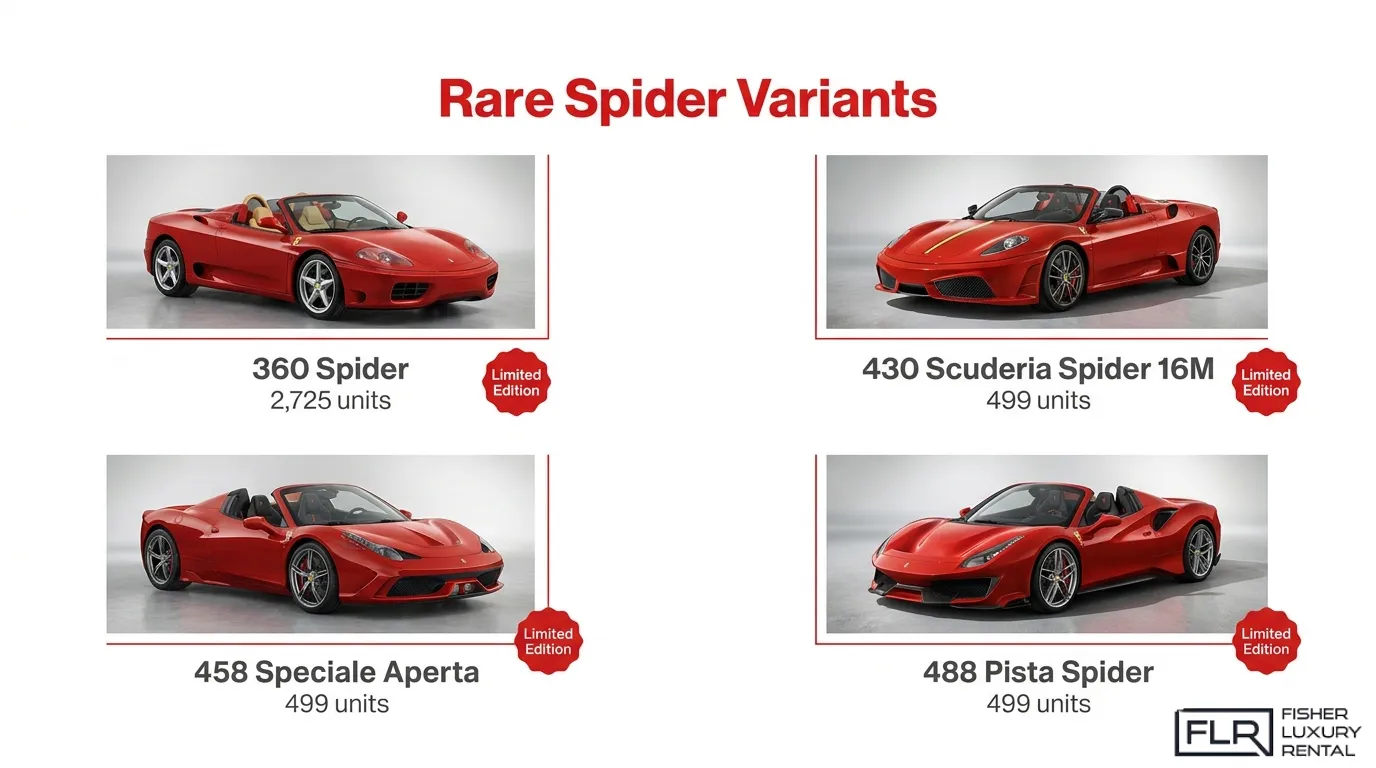
The Ferrari 360 Spider is the open-top counterpart to the 360-generation track car. Unveiled at the 2000 Geneva Motor Show, it weighed only 60 kg (130 lb) more than the coupe, a remarkable achievement made possible by aluminum construction used throughout the chassis and body structure.
Ferrari 16M Scuderia Spider
The Ferrari 430 Scuderia Spider 16M is a limited-edition open-top variant built in a run of exactly 499 units to commemorate Ferrari’s 16 Formula 1 Constructors’ Championships, according to RM Sotheby’s. Despite losing the coupe’s fixed roof, it achieved a curb weight of 1,440 kg, some 80 kg less than the base F430 Spider at 1,520 kg. That weight discipline in a convertible is genuinely impressive engineering.
Ferrari 458 Speciale Aperta
The Ferrari 458 Speciale Aperta is a limited-production open-top version of the track-focused 458 Speciale. According to RM Sotheby’s, only 499 Aperta units were built worldwide between 2013 and 2015, compared to approximately 1,309 Speciale coupes produced over the same period, making the convertible significantly rarer than its closed sibling.
Ferrari 488 Pista Spider
The Ferrari 488 Pista Spider is the open-top variant of the 488 Pista, with an estimated 1,100 to 1,500 units produced out of approximately 2,400 total 488 Pista units built between 2018 and 2020. Across the lineage, Spider variants consistently represent fewer units than their coupe counterparts, reinforcing their long-term collectibility.
How Have Pista Model Specs Evolved Across Generations?
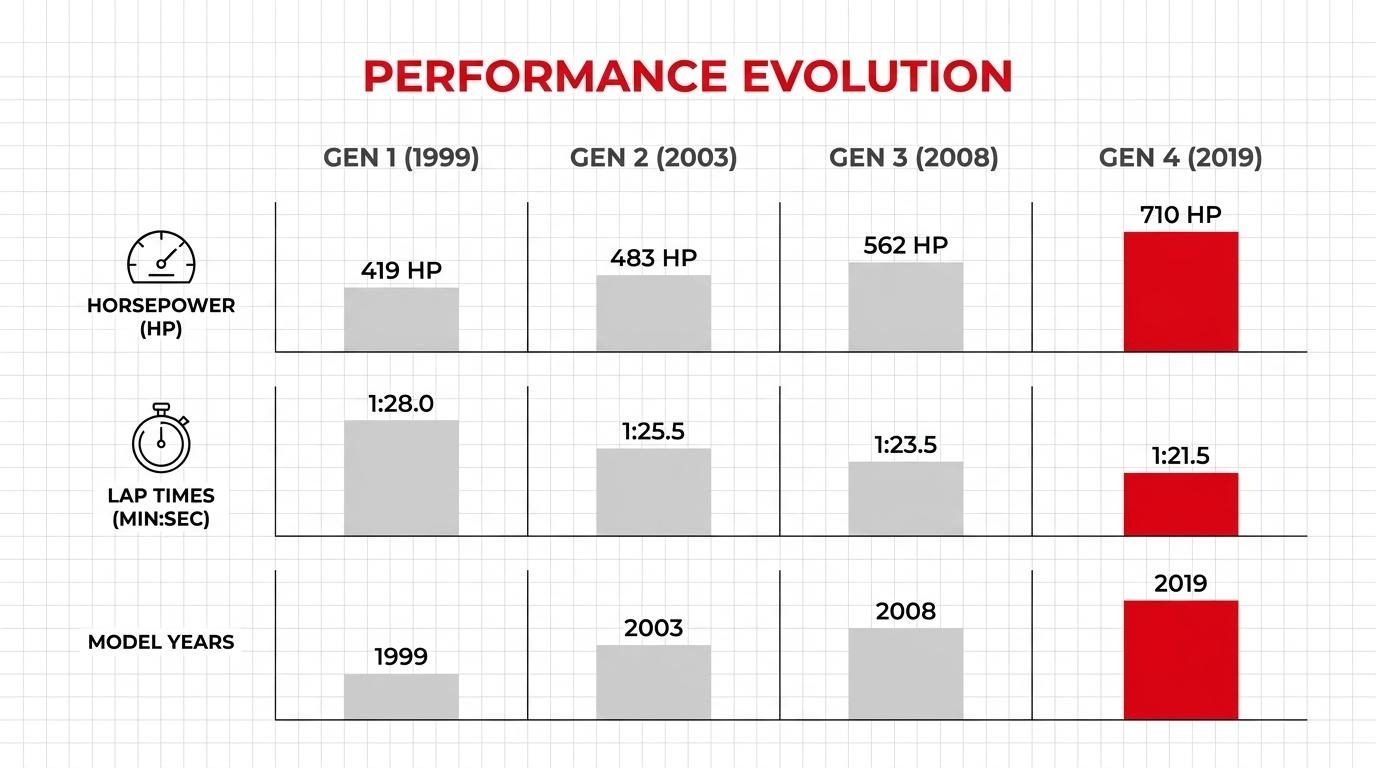
Pista model specs have evolved from 419 hp naturally aspirated engines to 710 hp twin-turbo units, with Fiorano lap times dropping from 1:28 to 1:21.5 and curb weights shifting through each redesign. The H3s below compare horsepower, lap times, and curb weight across generations.
How Has Horsepower Progressed From the Challenge Stradale to the 488 Pista?
Horsepower has progressed from 419 hp in the 360 Challenge Stradale to 503 hp in the 430 Scuderia, 597 hp in the 458 Speciale, and 710 hp in the 488 Pista. The jump to the 488 Pista represents the most dramatic single-generation leap, driven largely by forced induction. According to Top Gear, the 488 Pista’s twin-turbo V8 is derived directly from the 488 Challenge race car, featuring a lighter flywheel with fewer counterweights for sharper throttle response. Each generation extracted more output through a combination of displacement changes, revised induction strategies, and race-program knowledge transferred to road cars.
How Have Lap Times Improved Across Pista Generations?
Lap times at the Pista di Fiorano have improved consistently across every generation. The progression is:
- 360 Challenge Stradale: 1 minute 28 seconds
- 430 Scuderia: 1 minute 25 seconds
- 458 Speciale: 1 minute 23.5 seconds
- 488 Pista: 1 minute 21.5 seconds
Each model trimmed between 1.5 and 3 seconds from its predecessor, reflecting genuine performance gains in power, aerodynamics, and chassis technology rather than incremental tuning. Experiencing this level of engineering progression firsthand is something Fisher Luxury Rental makes accessible, offering exotic car rentals by the day across its Phoenix and Portland locations.
How Has Curb Weight Changed Across Each Pista Generation?
Curb weight across Pista generations has not followed a simple downward trend. The 430 Scuderia achieved its lightest dry weight at 1,250 kg, while the 488 Pista sits at approximately 1,385 kg dry. Ferrari Official confirms the F80 carries a curb weight of 1,681 kg, the heaviest of the lineage, reflecting the added mass of its hybrid powertrain. Weight reduction remained a priority in naturally aspirated generations, but hybrid and turbocharged architectures introduced unavoidable mass trade-offs that raw power figures more than compensate for on track.
What Makes Ferrari Pista Models Valuable as Collectibles?
Ferrari Pista models are valuable as collectibles because they combine race-derived engineering, strict production limits, and documented performance heritage. The sections below cover which specific models have appreciated most and how production numbers shape each car’s collectibility.
Which Pista Models Have Appreciated the Most in Value?
The Pista models that have appreciated the most in value are the 360 Challenge Stradale and the 488 Pista, both commanding multiples above their original MSRPs. A 2004 360 Challenge Stradale with a $202,028 window sticker sold at Hagerty auction for $610,500 after 21 years and just 4,500 miles. Current market values for clean 488 Pista examples sit around $580,000–$650,000, with select auction results reaching $819,500. The 430 Scuderia trades in the $350,000–$450,000 range, reflecting strong but slightly softer demand. Racing-derived technology, such as the 488 Pista’s 7-speed dual-clutch F1-style transmission, reinforces buyer confidence in the car’s performance pedigree and long-term investment case.
How Do Production Numbers Affect Pista Model Collectibility?
Production numbers directly affect Pista model collectibility by limiting supply against growing global collector demand. The rarest units command the strongest premiums:
- 360 Challenge Stradale: 1,288 units produced (2003–2005)
- 430 Scuderia: approximately 2,000–3,500 units (2007–2009); Spider 16M limited to 499 units
- 458 Speciale: approximately 1,309 coupes; Speciale Aperta capped at 499 units
- 488 Pista: approximately 2,400 coupes; Spider variants estimated at 1,100–1,500 units
Lower-volume variants, particularly the Spider 16M and Speciale Aperta, consistently attract the highest collector premiums. Models with sub-500 unit counts represent the strongest long-term investment tier within the Pista lineage.
How Can You Experience a Ferrari Pista Through an Exotic Car Rental?
You can experience a Ferrari Pista through an exotic car rental by booking with a specialist provider that maintains high-performance Ferrari models in its fleet. The sections below cover Fisher Luxury Rental’s Ferrari offerings and key takeaways from the full Pista lineage.
Does Fisher Luxury Rental Offer Ferrari Models for High-Performance Driving?
Fisher Luxury Rental offers exotic and luxury car rentals, giving enthusiasts direct access to high-performance vehicles without ownership. Ferrari ranks among the top-most costly and sought-after rental brands globally, alongside Rolls-Royce and Lamborghini, valued for quality, rarity, and international status. According to Grand View Research, demand for luxury car rental is expected to grow at a CAGR of 8.6% from 2025 to 2030, driven by rising disposable income and a growing preference for premium experiences. Fisher Luxury Rental serves Phoenix, AZ and Portland, OR, specializing in top-trim exotic vehicles that deliver high-performance driving experiences.
What Are the Key Takeaways About Ferrari Pista Models History and Evolution?
The key takeaways about Ferrari Pista models history and evolution center on a consistent philosophy: strip weight, sharpen aerodynamics, and transfer racing technology directly to road-legal cars. Each generation raised the performance ceiling while refining driver connection. The 488 Pista, for instance, achieved approximately 90 kg of weight reduction over the 488 GTB through carbon fiber applications across the engine cover, bumpers, and spoiler. For drivers who want to feel this performance lineage firsthand, renting an exotic car through Fisher Luxury Rental translates high-performance engineering into an experience available by the day.