Car chassis material is the structural foundation that determines a vehicle’s weight, rigidity, crash protection, and driving dynamics. Steel, aluminum, carbon fiber, and composite blends each deliver distinct trade-offs between strength, mass, cost, and manufacturability.
This guide covers the performance and safety role of chassis materials, the strengths and limits of steel versus aluminum, carbon fiber and composite applications, chassis design types, sustainability in chassis manufacturing, and what these materials mean for the luxury rental experience.
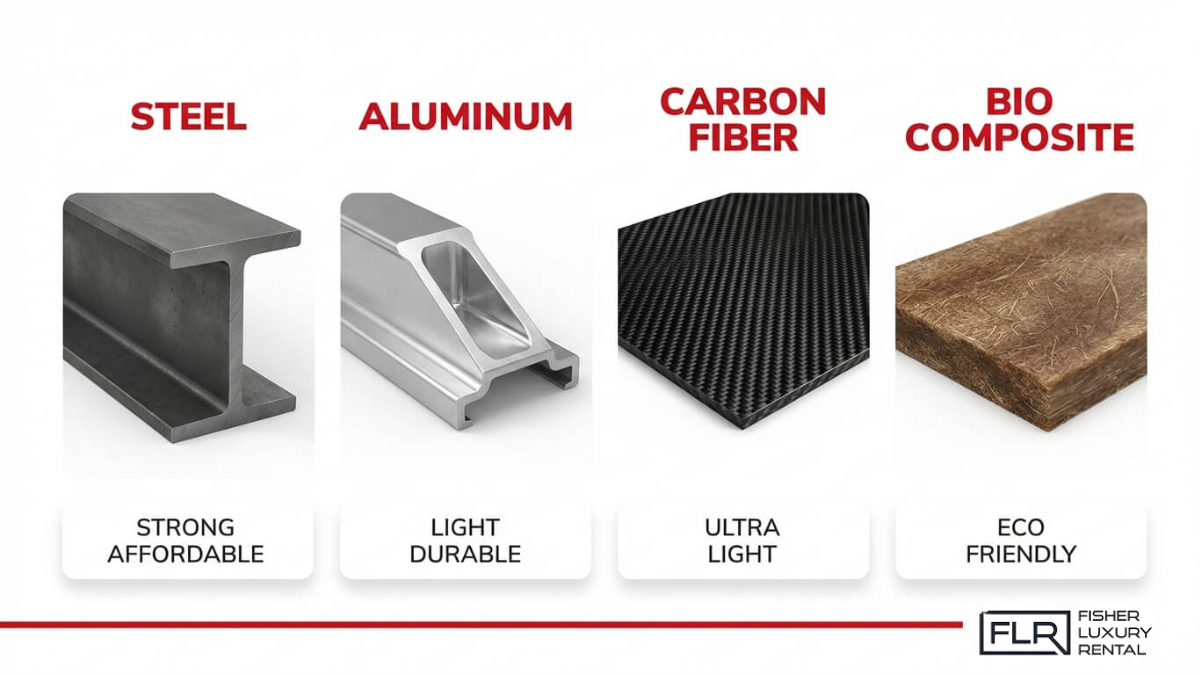
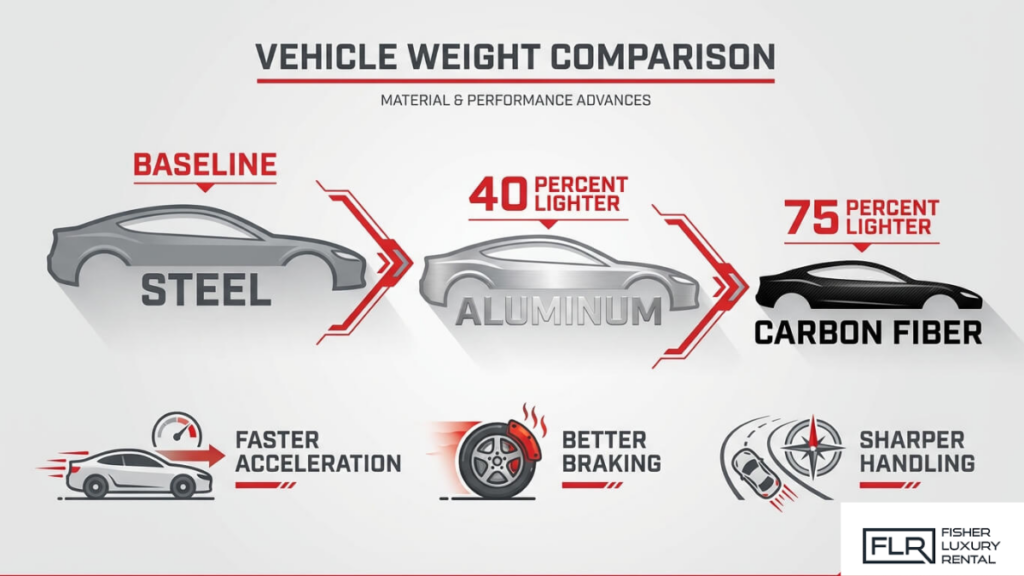
Steel remains the dominant chassis material, valued for its high tensile strength, weldability, and low production cost. Its main drawback is weight; aluminum alloys can cut chassis mass by up to 40 percent while preserving structural integrity.
Carbon fiber reinforced plastic (CFRP) pushes lightweighting further, producing components roughly 75 percent lighter than steel equivalents with superior specific strength and stiffness. The trade-off is cost, as carbon fiber parts run three to five times the price of aluminum, which limits widespread adoption to supercars and motorsport.
Ladder frames, monocoque shells, and space frames each shape the driving experience differently. Monocoque construction delivers the highest torsional stiffness, which is why manufacturers like McLaren and Ferrari rely on carbon fiber monocoque cells for their flagship road cars.
Bio-composites, graphene-enhanced plastics, and recycled materials are entering chassis production as automakers work to lower lifecycle emissions without sacrificing structural performance.
Renting exotic vehicles built on these advanced platforms offers a direct way to feel how chassis material translates into acceleration response, cornering precision, and overall ride quality.
Why Is the Choice of Car Chassis Material Important for Performance and Safety?
The choice of car chassis material is important for performance and safety because it directly determines a vehicle’s weight, structural rigidity, handling precision, and crash protection. The following sections explore how materials influence weight and handling, then durability and crash performance.
How Does Chassis Material Influence Vehicle Weight and Handling?
Chassis material influences vehicle weight and handling by dictating the mass a powertrain must accelerate, brake, and corner with. Lighter materials lower the center of gravity and reduce rotational inertia, producing sharper turn-in response and shorter stopping distances.
According to a study published by Longdom Publishing SL, aluminum alloys in vehicle chassis can reduce structural weight by up to 40% compared to traditional steel frames without compromising safety. Carbon fiber reinforced plastic pushes this further, offering superior specific strength and stiffness that allows engineers to design complex, weight-optimized profiles.
These weight savings translate directly to improved throttle response, better tire contact management, and more predictable cornering behavior. For high-performance vehicles, even a 10% reduction in chassis mass can meaningfully transform the driving experience.
What Are the Impacts of Chassis Materials on Durability and Crash Protection?
The impacts of chassis materials on durability and crash protection vary significantly across steel, aluminum, and composites:
- Steel provides high energy absorption through controlled deformation, making it effective for crumple zones in frontal and side impacts.
- Aluminum offers strong crash resistance at lower weight, though it requires careful engineering to match steel’s energy-absorbing behavior.
- Carbon fiber composites deliver exceptional rigidity but absorb impact energy through fracturing rather than bending, which demands specialized structural design.
Regulatory frameworks shape how these materials are applied. According to the Federal Register, FMVSS No. 305a establishes crash safety requirements for electric-powered vehicles that directly affect chassis material selection and structural design.
Euro NCAP frontal overlap test protocols also influence how engineers design energy-absorbing chassis structures. Material choice is ultimately a balancing act between weight, repairability, and occupant protection, and the best modern chassis often combine multiple materials to optimize all three.
Understanding these material trade-offs reveals why specific chassis types, starting with steel, remain foundational in automotive design.
What Are the Advantages and Disadvantages of Steel Car Chassis?
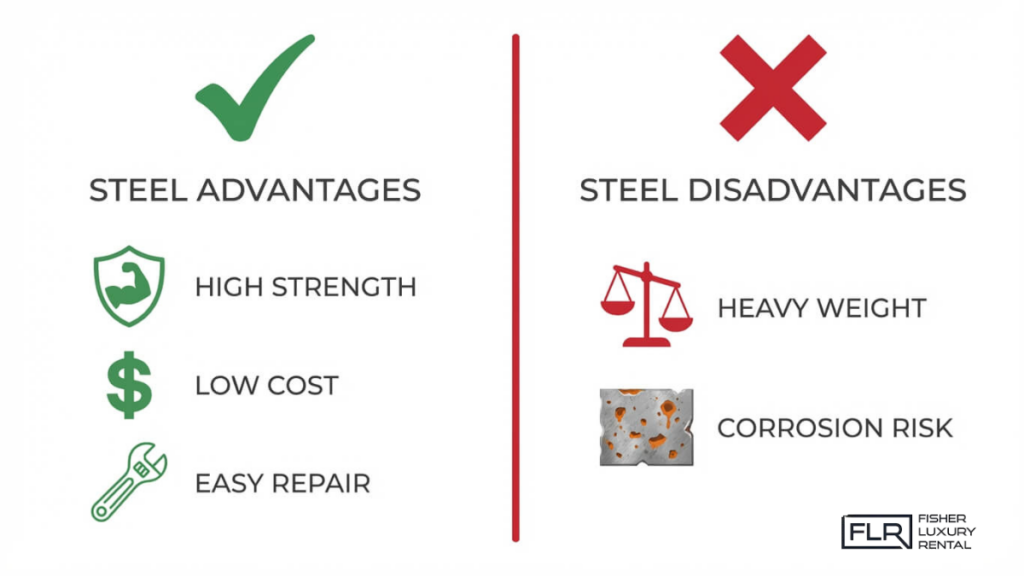
The advantages and disadvantages of steel car chassis center on a trade-off between proven reliability and weight penalty. Steel offers strength, affordability, and easy repair, but it falls short of newer materials in weight savings and corrosion resistance.
Why Has Steel Been the Traditional Choice for Car Chassis Construction?
Steel has been the traditional choice for car chassis construction because it combines high tensile strength, low cost, and well-established manufacturing processes. According to Elsevier’s Automotive Body: Volume I, the first motor car chassis frames built between 1896 and 1910 were primarily constructed of wood and steel, establishing steel’s dominance from the earliest days of the automobile.
Steel’s advantages for chassis construction include:
- High crash energy absorption, which makes it effective for occupant protection in collisions.
- Widespread weldability, allowing quick repairs at virtually any body shop worldwide.
- Lower raw material and fabrication costs compared to aluminum or carbon fiber.
- Mature supply chains that support mass production at scale.
These properties explain why steel still holds a commanding position in vehicle manufacturing. For everyday cars where cost and repairability matter most, steel remains difficult to beat.
What Are the Limitations of Steel Compared to Newer Materials?
The limitations of steel compared to newer materials are primarily weight, corrosion susceptibility, and reduced design flexibility. According to a study published by Longdom Publishing SL, aluminum alloys alone can reduce chassis weight by up to 40% compared to traditional steel frames without compromising safety.
Steel’s key drawbacks include:
- Significantly higher density than aluminum or carbon fiber, which increases fuel consumption and reduces acceleration response.
- Vulnerability to rust and oxidation, requiring protective coatings that add cost and maintenance over time.
- Less formability for complex aerodynamic shapes that lighter composites can achieve.
- Greater overall vehicle mass, which demands larger brakes and heavier suspension components.
For performance-focused and luxury vehicles, these limitations push manufacturers toward aluminum, carbon fiber, and hybrid material strategies. Understanding where steel falls short helps explain the material choices behind today’s most advanced chassis designs.
How Do Aluminum Car Chassis Compare to Steel in Modern Vehicles?
Aluminum car chassis compare to steel by offering significant weight savings and improved performance, though with trade-offs in cost and repairability. The following subsections cover aluminum’s performance benefits and its structural drawbacks.
What Performance Benefits Does Aluminum Offer in Chassis Design?
Aluminum offers several performance benefits in chassis design, primarily centered on weight reduction and improved dynamic response. According to a study published by Longdom Publishing SL, aluminum alloys in vehicle chassis can reduce structural weight by up to 40% compared to traditional steel frames without compromising safety.
This substantial weight savings translates directly into measurable advantages:
- Faster acceleration due to lower curb weight.
- Improved braking distances from reduced momentum.
- Better fuel efficiency across all driving conditions.
- Enhanced handling precision through a lower center of gravity.
Aluminum’s natural corrosion resistance also extends chassis lifespan in harsh climates. For performance-focused vehicles like the Lamborghini Temerario, whose all-aluminum spaceframe chassis achieves a 20% increase in torsional rigidity over its predecessor, the material strikes an effective balance between structural stiffness and lightweight agility. In most modern sports cars, aluminum represents the sweet spot between affordability and measurable performance gains.
Are There Drawbacks to Using Aluminum for Car Structures?
There are notable drawbacks to using aluminum for car structures, especially in cost, manufacturing complexity, and crash energy management. Aluminum is more expensive to source and fabricate than steel, requiring specialized welding techniques and adhesive bonding that increase production costs.
Key limitations include:
- Higher raw material cost compared to steel.
- Greater difficulty in stamping complex body panels.
- Lower energy absorption in frontal collisions without additional reinforcement.
- More expensive collision repairs requiring certified technicians and dedicated facilities.
Although aluminum chassis components are generally easier to repair through bending, welding, and machining compared to carbon fiber, according to Supreem Carbon’s industrial comparison, they still demand more expertise than equivalent steel repairs. Steel held a 65.28% share of the automotive chassis market in 2024, partly because its repairability infrastructure remains far more accessible. For buyers weighing chassis materials, aluminum’s performance advantages must be balanced against these real-world ownership considerations.
With aluminum’s strengths and limitations clarified, the next section explores how carbon fiber and composites push lightweight construction even further.
What Role Do Carbon Fiber and Composite Materials Play in High-End Car Chassis?
Carbon fiber and composite materials deliver extreme weight reduction and superior structural rigidity in high-end car chassis. Below, we explore how composites transformed performance cars and whether their use extends beyond supercars.
How Has Composite Technology Revolutionized Performance Cars?
Composite technology revolutionized performance cars by enabling dramatic weight savings without sacrificing strength or safety. Carbon fiber reinforced plastic (CFRP) exhibits superior specific strength and stiffness compared to both aluminum and steel, allowing engineers to create complex structural profiles with optimized weight-to-strength ratios, according to a 2025 study published in MDPI Materials.
McLaren’s John Barnard designed the first carbon fiber monocoque for Formula 1 in 1981, a milestone that triggered widespread adoption across motorsport and eventually high-performance road cars. That racing DNA now defines vehicles like the McLaren W1, which features the Aerocell, an ultra-light carbon fiber monocoque integrating front suspension directly into the carbon cell. Carbon fiber parts do cost 3 to 5 times more than equivalent aluminum components due to specialized hand-laying processes, yet for performance cars, the handling precision and acceleration gains justify every dollar.
Are Composites Used Only in Supercars, or in Other Vehicles Too?
No, composites are not used only in supercars. While carbon fiber monocoques remain most prominent in vehicles like the McLaren 720S and Lamborghini Huracan Spyder, composite adoption is expanding rapidly across the broader automotive market. According to a 2025 CompositesWorld report, the automotive composites market is estimated at $10.06 billion in 2025 and projected to reach $17.72 billion by 2030, driven by demand for lightweight materials across vehicle segments.
Mainstream applications now include:
- Structural reinforcement panels in luxury sedans
- Hybrid aluminum-carbon fiber subframes in sports cars
- Interior trim and body panels in premium electric vehicles
Steel still dominated the chassis market with a 65.28% share in 2024, but carbon fiber composites are projected to grow significantly as manufacturing costs decrease. Understanding how these materials shape real-world driving dynamics becomes clearer when comparing specific chassis designs side by side.
What Are the Key Differences Between Ladder, Monocoque, and Space Frame Chassis Designs?
The key differences between ladder, monocoque, and space frame chassis designs involve structural rigidity, weight, and intended application. Each type shapes how a vehicle performs, handles, and serves its purpose.
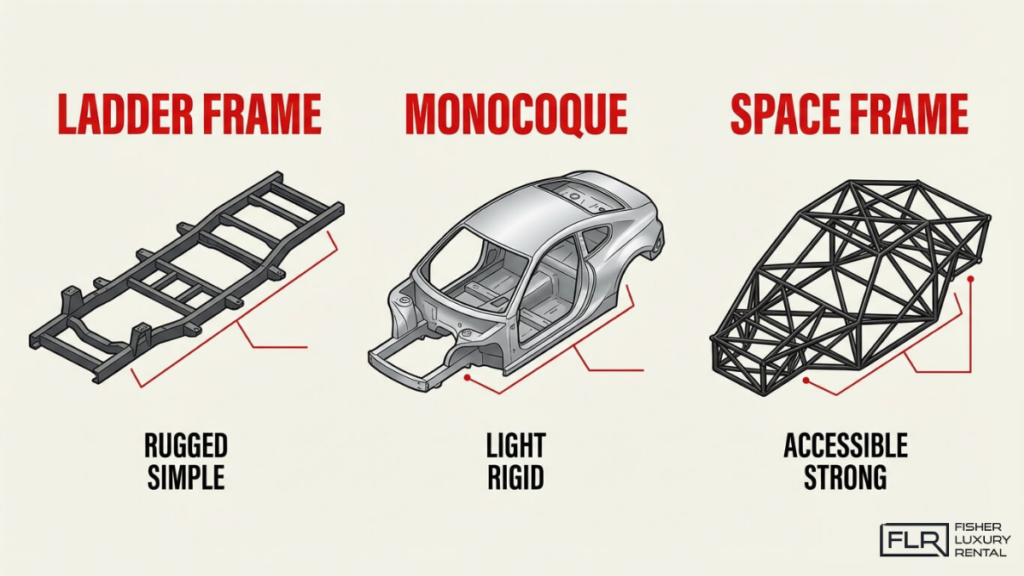
How Do Different Chassis Types Affect Driving Experience and Vehicle Application?
Different chassis types affect driving experience and vehicle application by determining structural stiffness, overall weight, and mechanical accessibility. Ladder frame chassis provide good torsional stiffness when cross-member placement is optimized, though they remain generally heavier than unibody structures. This weight makes them best suited to trucks and heavy-duty vehicles where ruggedness matters more than agility.
Monocoque chassis integrate the body and frame into a single shell, producing low weight and high torsional stiffness. According to a 2024 study published in MDPI (Vehicles), the monocoque frame delivers 350% greater torsional stiffness than the space frame for a single-seater racing vehicle. That rigidity translates directly into sharper steering response and more predictable cornering for the driver.
Space frame chassis use a network of triangulated tubes to distribute loads efficiently. While they typically sacrifice some torsional rigidity compared to monocoques, space frames offer easier rear-section construction and better accessibility for mechanical components. This trade-off makes them popular in mid-engine sports cars where frequent powertrain servicing is a practical consideration.
Which Chassis Designs Are Most Common in Luxury and Exotic Cars?
The most common chassis designs in luxury and exotic cars are carbon fiber monocoques and aluminum space frames. McLaren builds the W1 around the Aerocell, an ultra-light carbon fiber monocoque that integrates front suspension directly into the carbon cell. Lamborghini takes a different approach; the Temerario’s all-aluminum spaceframe chassis achieves a 20% increase in torsional rigidity compared to its predecessor, the Huracán, according to Hindustan Times.
Some manufacturers blend both philosophies. Hybrid chassis combining aluminum and carbon fiber balance weight savings with structural rigidity, a strategy seen across several mid-engine exotic platforms. Ferrari continues pushing boundaries as well, unveiling a production-ready chassis for its new electric car at Capital Markets Day 2025 that emphasizes tradition alongside technological innovation.
For most buyers and enthusiasts, the chassis choice reveals the manufacturer’s engineering priorities: monocoques favor ultimate lightness and stiffness, while space frames prioritize manufacturability and component access. Understanding these designs deepens appreciation for how each exotic car delivers its unique driving character.
How Is Sustainability Affecting the Evolution of Car Chassis Materials?
Sustainability is driving automakers to adopt bio-composites, graphene-enhanced materials, and waste-derived additives that reduce chassis carbon footprints. The following sections cover emerging eco-friendly manufacturing innovations and the growing role of recycled or renewable materials in chassis construction.
What Innovations Are Emerging in Eco-Friendly Chassis Manufacturing?
The innovations emerging in eco-friendly chassis manufacturing include graphene-reinforced composites, carbon-negative waste additives, and bio-composite structural panels. Graphene composites enhance fuel efficiency while meeting tightening environmental standards; according to a 2025 Business Wire report, the graphene composites market is projected to reach $317.3 million by 2030, driven by expanding R&D in multifunctional automotive applications. Adding just 1 to 5 wt% of reduced graphene oxide to bio-composites significantly improves mechanical properties and energy absorption. Meanwhile, household waste-based carbon-negative materials used as a 5% additive in automotive plastics can lower a component’s carbon footprint by 30%. These breakthroughs suggest that the next generation of chassis materials will prioritize environmental performance alongside structural integrity.
Are Recycled or Renewable Materials Used for Chassis Construction?
Yes, recycled and renewable materials are increasingly used for chassis construction. Bio-composites made from natural fibers now appear in dashboards, floor panels, and roof frames. According to a 2024 Taylor & Francis review of green composite materials, some manufacturers aim for at least 25% of new cars launched after 2025 to feature bio-composite components. Aluminum also contributes to chassis sustainability because it is widely recycled through established industrial streams, making end-of-life recovery straightforward. While structural chassis rails still rely primarily on steel and aluminum for crash safety, renewable materials are steadily expanding from interior panels into semi-structural roles. For most automakers, blending recycled metals with bio-based composites represents the most practical path toward lower-emission vehicle production.
With sustainable materials reshaping chassis engineering, understanding these advances adds context when choosing which vehicles to experience firsthand.
How Should You Approach Car Chassis Materials When Renting a Luxury or Exotic Vehicle?
You should approach car chassis materials when renting a luxury or exotic vehicle by understanding how each material shapes the driving experience. The following sections cover how Fisher Luxury Rental connects you to advanced chassis engineering and the key takeaways from this guide.
Can Renting Exotic and Luxury Cars from Fisher Luxury Rental Let You Experience Advanced Chassis Materials Firsthand?
Yes, renting exotic and luxury cars from Fisher Luxury Rental can let you experience advanced chassis materials firsthand. The Fisher Luxury Rental fleet includes vehicles built on distinctly different structural platforms, giving renters direct access to the engineering covered throughout this guide.
The McLaren 720S in the Fisher Luxury Rental fleet features a carbon fiber Monocage II chassis that delivers extreme lightweighting and structural integrity. Carbon fiber is approximately 75% lighter than steel while maintaining a high strength-to-weight ratio, according to data published by Calian Group. Behind the wheel, that difference translates into sharper throttle response and more precise cornering.
The Lamborghini Huracan Spyder available from Fisher Luxury Rental uses a hybrid chassis of aluminum and carbon fiber to balance weight and rigidity. Driving these two vehicles back to back reveals how material selection directly influences acceleration feel, steering feedback, and overall composure at speed. For anyone curious about chassis engineering beyond the textbook, a rental provides the most immediate and visceral education available.
What Are the Key Takeaways About Car Chassis Materials and Types Covered in This Guide?
The key takeaways about car chassis materials and types covered in this guide center on how material choice defines every aspect of vehicle performance, safety, and sustainability.
- Steel remains the most widely used chassis material, valued for its affordability and crash energy absorption, though it carries a significant weight penalty.
- Aluminum reduces chassis weight by up to 40% compared to steel without compromising structural safety, making it a common choice in modern luxury vehicles.
- Carbon fiber and CFRP deliver the highest strength-to-weight ratios available, which is why supercars and hypercars rely on monocoque and hybrid carbon structures.
- Chassis design type matters as much as material; monocoque, space frame, and ladder frame architectures each serve different performance goals.
- Sustainability is reshaping the industry through bio-composites, graphene additives, and recycled materials that reduce environmental impact without sacrificing structural integrity.
Understanding these principles helps you appreciate what separates a daily commuter from a purpose-built exotic, and Fisher Luxury Rental offers the opportunity to feel that difference from the driver’s seat.