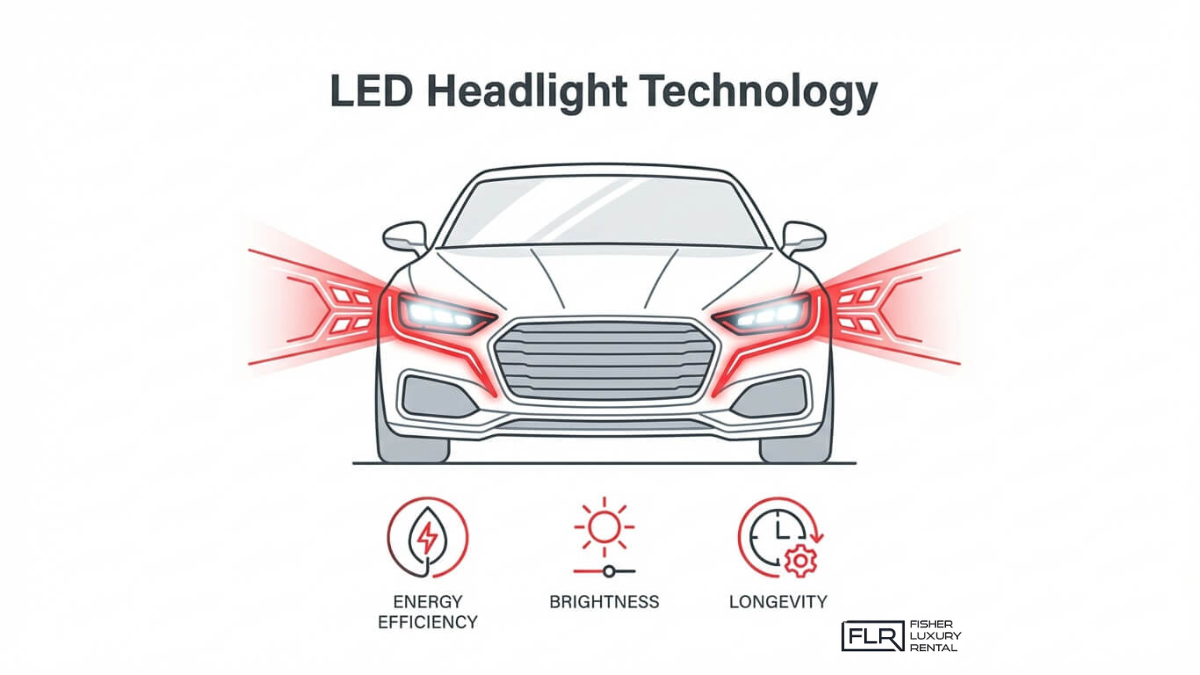
LED headlights are automotive lighting systems that use light-emitting diodes (compound semiconductors) to convert electrical current into bright, focused light through electron-hole recombination at the pn junction. They represent a fundamental shift from filament and gas-discharge technologies, offering superior luminous output at a fraction of the energy draw.
This guide covers LED semiconductor technology and how it compares to legacy bulbs, the measurable benefits of LED headlights, their lifespan and maintenance needs, the design freedom they give automakers, legal regulations and potential drawbacks, and what LED-equipped vehicles mean for the luxury rental experience.
LED headlights rely on III-V compound semiconductors that can theoretically convert 100% of electrical power into optical energy. Compared to halogen and HID alternatives, this architecture produces dramatically more lumens per watt while reaching full brightness instantaneously.
The performance advantages are concrete: longer road illumination range, improved object recognition across weather conditions, and energy savings that reduce strain on a vehicle’s electrical system. These gains translate directly into safer, more comfortable nighttime driving.
LED longevity far exceeds older technologies, with rated lifespans stretching tens of thousands of hours. Solid-state construction eliminates fragile filaments and pressurized gas capsules, reducing maintenance demands considerably.
Compact LED modules give designers unprecedented freedom to sculpt signature lighting shapes, animated elements, and brand-defining aesthetics; a feature especially visible in luxury and exotic vehicles.
Potential drawbacks include higher upfront cost, strict legal chromaticity boundaries for street-legal color temperatures, and glare concerns tied to elevated luminance levels. Adaptive Driving Beam systems address some of these challenges by dynamically shaping output to protect oncoming drivers.
For renters exploring high-performance vehicles, LED headlight systems (including laser-LED hybrids found in top-tier exotics) elevate both safety and the overall driving experience.
What Technology Powers LED Headlights?
LED headlights are powered by semiconductor technology that converts electrical current directly into light. The subsections below explain how LEDs compare to older bulb types and what components make up a modern LED headlight assembly.
How Do LEDs Differ from Halogen and HID Bulbs?
LEDs differ from halogen and HID bulbs in three critical areas: light output, energy consumption, and lifespan. According to a 2024 Partsmax performance comparison, LED headlights produce 8,000 to 12,000 lumens at just 15 to 25 watts, while HID bulbs generate 3,000 to 5,000 lumens at 35 to 55 watts, and halogen bulbs output only 1,000 to 2,000 lumens at 55 to 65+ watts.
Key differences include:
- LED headlights reach full brightness instantaneously, giving following drivers earlier warning of braking or turning.
- Halogen bulbs require a brief warm-up period before reaching peak output.
- LED headlights last 25,000 to 50,000+ hours, compared to 2,000 to 3,000 hours for HID and 400 to 1,000 hours for halogen.
This combination of higher efficiency, instant response, and dramatically longer service life makes LEDs the most practical headlight technology available today.
What Is the Basic Structure of an LED Headlight?
The basic structure of an LED headlight consists of several integrated components working together. A semiconductor chip, typically made from III-V compound materials, serves as the light source. When forward current passes through the chip’s pn junction, electrons and holes recombine, releasing energy as visible light.
Surrounding the chip, a heat sink draws thermal energy away from the semiconductor, since LEDs generate heat at the junction rather than through radiated infrared light. A driver circuit regulates voltage and current to protect the chip from electrical fluctuations. Reflectors or projector lenses then shape the raw LED output into a controlled beam pattern that meets road illumination standards. Understanding these core components helps explain why LED headlights deliver such consistent, reliable performance.
What Are the Main Benefits of LED Headlights?
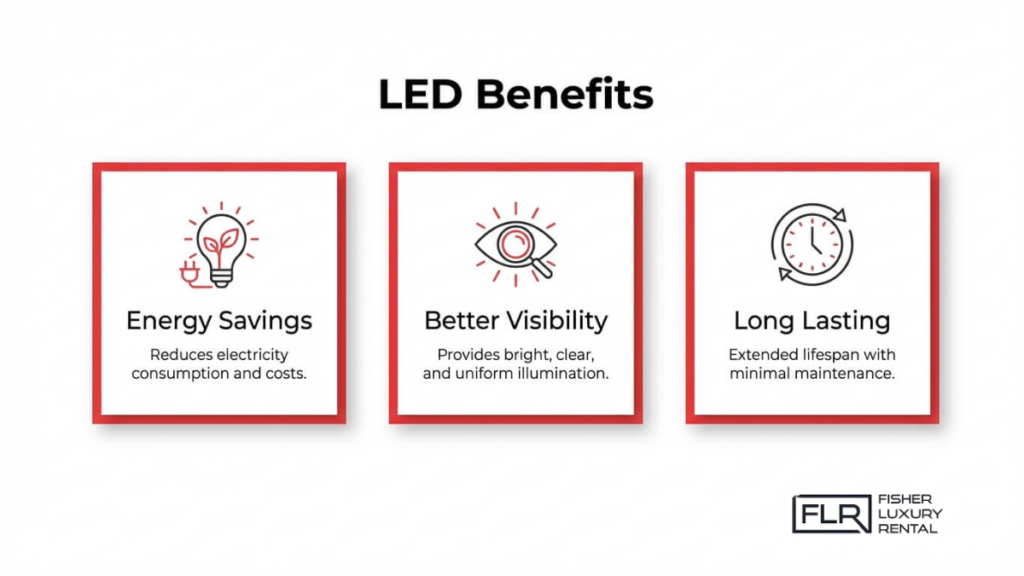
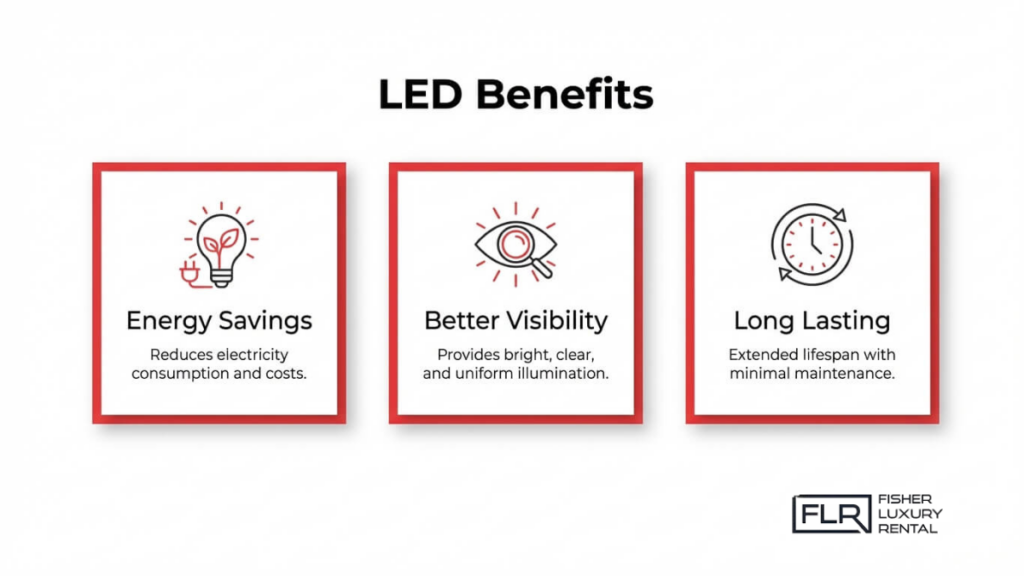
The main benefits of LED headlights are superior energy efficiency, enhanced visibility and safety, and exceptional durability. Each advantage contributes to a better driving experience compared to halogen or HID alternatives.
Why Are LED Headlights More Energy Efficient?
LED headlights are more energy efficient because they convert a greater percentage of electrical energy into light while consuming far less power. A typical LED headlight produces thousands of lumens at only 15 to 25 watts, whereas halogen bulbs require 55 to 65 watts for significantly less output.
According to the International Energy Agency, average LED efficacy has roughly doubled since 2015, with best-available products now reaching up to 230 lm/W, nearly twelve times the efficiency of halogen lamps. This reduced electrical draw places less strain on the vehicle’s alternator and battery, which is particularly valuable in performance vehicles where every watt matters.
How Do LED Headlights Enhance Visibility and Safety?
LED headlights enhance visibility and safety by producing bright, focused beams that illuminate the road more effectively than traditional bulbs. They reach full brightness instantaneously, giving following drivers earlier warning of braking or turning intentions. This instant response eliminates the warm-up delay associated with halogen and HID technologies.
Color temperature also plays a role in real-world performance. Low-color-temperature LEDs offer higher object recognition rates, especially in fog, where high-CCT light scatters more readily. For drivers navigating unfamiliar roads at night, that improved recognition can be the difference between spotting a hazard in time and reacting too late.
Are LED Headlights More Durable Than Traditional Options?
LED headlights are more durable than traditional options, with verified lifespans of 25,000 to 50,000 hours or more. By comparison, halogen bulbs last 400 to 1,000 hours, and HID bulbs last 2,000 to 3,000 hours. Because LEDs lack a fragile filament or pressurized gas capsule, they resist vibration and shock far better on rough roads.
The trade-off is the upfront cost. According to a 2023 ResearchAndMarkets.com report, LED lighting systems can cost several times more than basic halogen models, though significant lifetime savings offset that premium over time. For high-performance vehicles, the durability alone justifies the investment, since fewer replacements mean less downtime.
With these core benefits established, LED headlights also shape how modern vehicles look and feel on the road.
What Is the Lifespan of LED Headlights Compared to Other Types?
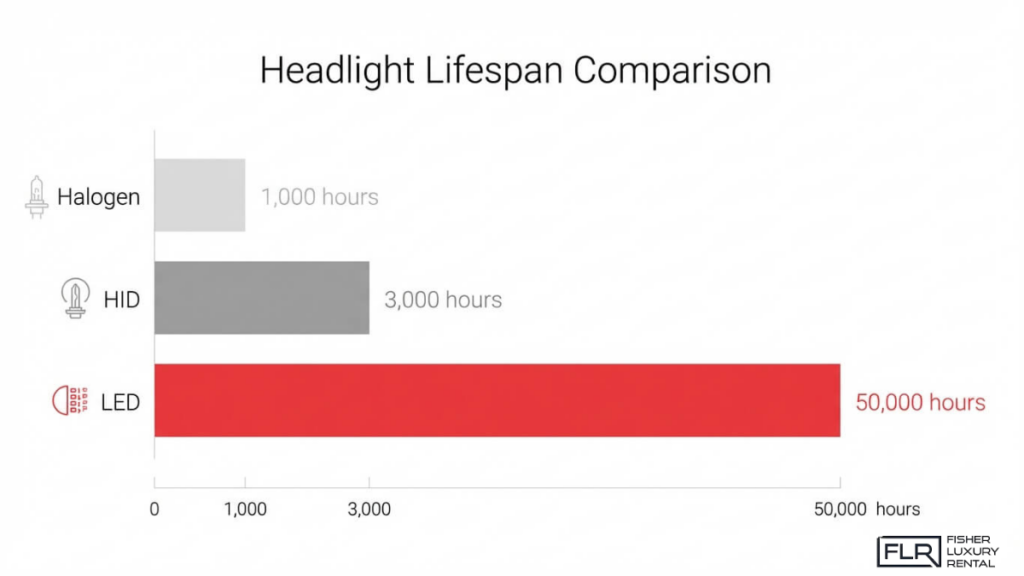
The lifespan of LED headlights ranges from 25,000 to 50,000+ hours, far exceeding HID bulbs at 2,000 to 3,000 hours and halogen bulbs at 400 to 1,000 hours. Several factors and maintenance practices affect that longevity.
What Factors Influence the Longevity of LED Headlights?
The factors that influence the longevity of LED headlights include heat management, electrical quality, and operating conditions. LEDs produce less waste heat than halogen or HID bulbs, yet the semiconductor junction remains sensitive to thermal stress. Poorly designed heat sinks or blocked ventilation around the headlight housing accelerate lumen depreciation over time. According to Lasfit, LED headlights carry a verified lifespan of 25,000 to 50,000+ hours, while HID bulbs last 2,000 to 3,000 hours and halogen bulbs only 400 to 1,000 hours. Voltage fluctuations and frequent power cycling can also shorten LED life, though their solid-state construction, with no filament or gas capsule, eliminates the fragility that limits traditional bulb types. Consistent electrical supply and adequate airflow around the housing are the two most controllable variables for maximizing LED headlight longevity.
Do LED Headlights Require Special Maintenance?
LED headlights do not require special maintenance in the way halogen or HID systems do. Because LEDs lack filaments that burn out or gas capsules that degrade, there are no scheduled bulb replacements during normal use. Routine care involves keeping the lens clean and ensuring the housing remains free of moisture intrusion, which can damage internal electronics. Periodic inspection of wiring connections helps prevent voltage drops that stress the diodes. One practical advantage worth noting: since LED headlights can outlast the vehicle itself, owners rarely face the recurring replacement costs associated with halogen bulbs that fail every 1 to 2 years. For drivers of high-performance vehicles, this reliability means consistent nighttime visibility without unexpected outages.
With lifespan and maintenance covered, the next consideration is how LED headlights influence vehicle design and aesthetics.
How Do LED Headlights Affect Vehicle Design and Aesthetics?
LED headlights affect vehicle design and aesthetics by giving automakers compact, directional light sources that enable slimmer headlamp profiles and signature lighting elements. The sections below cover custom shaping possibilities and luxury vehicle advantages.
Can Automakers Shape LED Headlights for Custom Looks?
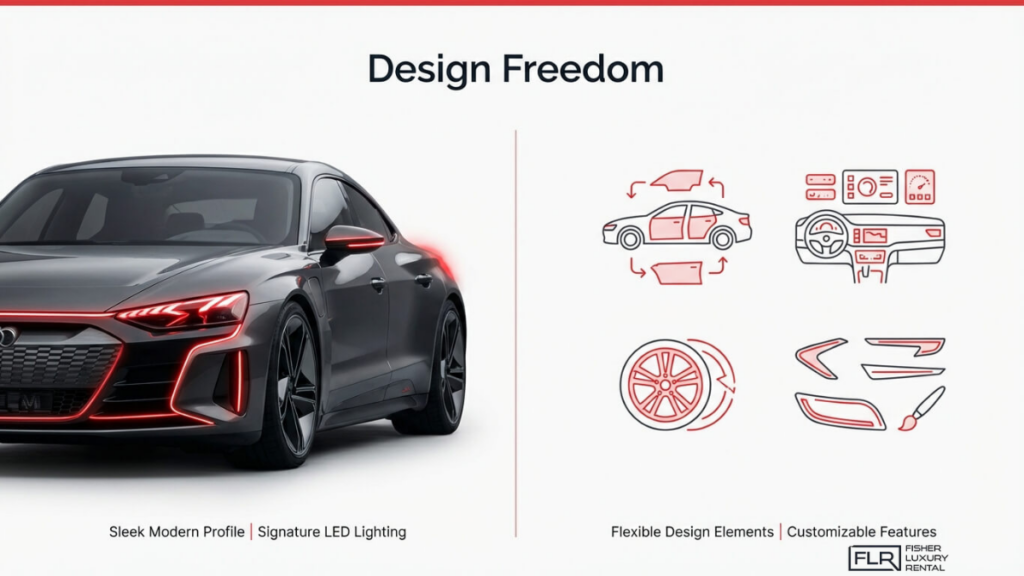
Yes, automakers can shape LED headlights for custom looks thanks to the technology’s compact form factor and directional light output. Unlike bulky halogen or HID assemblies, individual LED elements can be arranged in thin strips, clusters, or geometric patterns that define a vehicle’s front-end identity.
According to Infineon Technologies, LED technology provides automotive designers with unprecedented creative freedom due to compact size and directional nature, allowing integration of animated lighting elements that reinforce brand identity. This flexibility explains why modern vehicles feature distinctive daytime running light signatures, sequential turn indicators, and illuminated brand logos that would be impossible with traditional bulb housings.
For anyone who appreciates automotive design, LED headlights have become as much a styling statement as a functional component.
Do LED Headlights Provide Advantages for Luxury and Exotic Cars?
LED headlights provide significant advantages for luxury and exotic cars, where design precision and advanced technology are defining characteristics. High-end manufacturers use LED arrays to create razor-thin light signatures that communicate performance and exclusivity before the engine even starts.
Key advantages for luxury and exotic vehicles include:
- Precision styling allows designers to sculpt aggressive or elegant headlamp shapes that match each model’s character.
- Adaptive beam systems adjust light distribution in real time, complementing the advanced driver-assistance suites found in premium vehicles.
- Laser-LED hybrid configurations extend illumination range at high speeds, a feature increasingly adopted by top-tier manufacturers.
- Instant full-brightness activation enhances the dynamic appearance during startup sequences and welcome lighting animations.
These capabilities make LED headlights a core element of the premium driving experience, not merely a practical upgrade. Understanding what sets these lighting systems apart adds context to the broader conversation around LED headlight limitations and legal considerations.
Are There Any Drawbacks or Limitations to Using LED Headlights?
The drawbacks and limitations of using LED headlights include legal restrictions on color temperature, potential glare for oncoming drivers, and higher upfront costs. The following sections cover regulatory requirements and road safety concerns.
What Legal Regulations Govern LED Headlight Usage?
Legal regulations governing LED headlight usage focus on color temperature compliance and housing compatibility. Legal LED headlights must maintain a color temperature within specified chromaticity boundaries for “white” light; temperatures above 6000K often appear blue and can violate street legality. Aftermarket LED retrofits installed in halogen housings are not federally compliant under FMVSS 108 in the United States, making many popular bulb swaps technically illegal regardless of brightness.
For anyone considering modifications, verifying that LED headlights are DOT-compliant and designed for the specific headlamp assembly is essential before installation. Overlooking this step is one of the most common and costly mistakes drivers make.
Can LED Headlights Cause Glare or Other Road Issues?
Yes, LED headlights can cause glare and other road issues. According to an analysis presented at the ADAC Symposium, glare from LED headlights is often caused by significantly higher luminance levels compared to traditional sources, which can reduce the ability of other drivers to see and cause discomfort. Improper alignment or poorly designed reflector housings amplify this problem.
However, newer technology is addressing these concerns directly. Adaptive Driving Beam (ADB) systems actively modify headlamp beams to provide more illumination while preventing glare for other vehicles. For drivers who prioritize both performance and courtesy on the road, ADB-equipped LED headlights represent the most practical solution available today.
With these limitations understood, the next section explores how LEDs perform in high-end rental vehicles.
How Do LED Headlights Impact Driving Experience in High-End Rental Cars?
LED headlights impact driving experience in high-end rental cars by delivering superior nighttime visibility, instant response times, and a distinctive visual presence. The sections below cover nighttime driving improvements and why LEDs define exotic and luxury rentals.
Do LED Headlights Improve Nighttime Driving for Renters?
LED headlights improve nighttime driving for renters by producing bright, focused illumination that reveals road hazards, signage, and lane markings earlier than traditional lighting. The instant activation of LEDs means brake lights and turn signals communicate immediately to surrounding drivers, reducing reaction gaps in fast-moving traffic.
For renters unfamiliar with a vehicle’s handling characteristics, this clarity builds confidence on unfamiliar roads. High-output LED beams paired with adaptive systems in luxury vehicles actively reshape light distribution through curves, keeping the driver’s sightline aligned with the road ahead. This combination of responsiveness and precision makes nighttime rentals feel safer and more controlled from the first mile.
Are LED Headlights a Key Feature in Exotic and Luxury Rentals?
LED headlights are a key feature in exotic and luxury rentals because they serve both performance and design functions that define premium vehicles. According to a MarketIntelo industry report, a significant content gap exists in technical documentation for high-end vehicle LED applications, such as laser-LED hybrid systems used in luxury and exotic rentals to enhance visibility at extreme speeds.
Exotic cars from manufacturers like Lamborghini, Ferrari, and McLaren integrate LEDs not as an upgrade but as standard equipment, with animated lighting signatures that reinforce each brand’s identity. Renters expect this technology as part of the premium experience. The combination of cutting-edge illumination and sculpted light design is one of the first details clients notice when they approach a high-end rental.
With LED technology setting the standard across luxury fleets, choosing the right rental ensures you experience these advancements firsthand.
How Can Fisher Luxury Rental Enhance Your Experience With LED-Equipped High-Performance Vehicles?
Fisher Luxury Rental enhances your experience with LED-equipped high-performance vehicles by pairing advanced lighting technology with an elite fleet of exotic and luxury cars. The following sections cover how renting elevates your drive and summarize the key takeaways from this guide.
Can Renting an Exotic or Luxury Car with LED Headlights Elevate Your Driving Experience?
Yes, renting an exotic or luxury car with LED headlights can elevate your driving experience significantly. Fisher Luxury Rental maintains a fleet of top-trim vehicles, including the Lamborghini Huracan Spyder, Ferrari 488 Spider, and McLaren 720S.
These LED systems do more than illuminate the road. According to a 2023 study published in Nature (Scientific Reports), the recognition rate for objects is higher with low-color-temperature LEDs compared to high-color-temperature LEDs, particularly in foggy conditions where high-CCT light experiences greater scattering.
Exotic cars from manufacturers like Lamborghini, Ferrari, and McLaren integrate LEDs not as an upgrade but as standard equipment, with animated lighting signatures that reinforce each brand’s identity. Renters expect this technology as part of the premium experience.
For drivers exploring the Pacific Northwest’s varied weather conditions through Portland and Vancouver, or the clear desert nights around Phoenix and Scottsdale, premium vehicles with advanced lighting systems deliver both safety advantages and an elevated driving experience that matches the quality Fisher Luxury Rental has provided since 2022. The Fisher Luxury Rental fleet offers vehicles suited for real-world driving conditions, whether you are navigating desert highways outside Phoenix or winding roads near Portland.
What Are the Key Takeaways About What Are LED Headlights? Benefits, Function & Explained We Covered?
The key takeaways about what are LED headlights covered in this guide are:
- LED headlights use semiconductor technology to convert electrical energy into light with exceptional efficiency.
- LEDs outperform halogen and HID bulbs in brightness, lifespan, and energy consumption.
- LED systems enhance nighttime visibility and safety through instant-on response and superior illumination.
- Compact LED designs give automakers creative freedom for distinctive vehicle aesthetics.
- Legal regulations govern color temperature and retrofit compliance, making factory-installed systems the safest choice.
- High-performance and luxury vehicles benefit most from advanced LED configurations, including adaptive beam technology.
Fisher Luxury Rental offers a curated fleet of exotic and luxury vehicles available in Phoenix, Scottsdale, Portland, and Vancouver.