
Supercar and hypercar classifications are informal, marketing-driven categories that rank high-performance vehicles by power output, production scarcity, price, and engineering innovation. Neither term follows a universal technical standard, yet the automotive industry applies them consistently enough to draw clear lines between tiers.
This guide covers the core criteria separating supercars from hypercars, the historical evolution of both categories, the specific brands and models defining each tier in 2026, ownership and daily-usability realities, common classification myths, the role of emerging technology, and how premium rentals offer direct access to these machines.
Supercars in 2026 typically occupy a 700 to 900 horsepower corridor with hybrid V6 or V8 powertrains, while hypercars exceed 1,000 hp and limit production to double- or triple-digit runs. Price reflects that gap; a flagship hypercar like the Ferrari F80 carries a base cost above $3 million.
The category structure traces back decades, with the 1966 Lamborghini Miura credited as the car that popularized “supercar” in common language. “Hypercar” emerged later to isolate a new ceiling of performance and exclusivity that traditional supercars could no longer represent.
Electrification is reshaping both tiers rapidly. Hybrid energy management, torque-vectoring algorithms, and active suspension systems debut in hypercars first, then migrate to supercars within a few years. This technology cascade keeps pushing the baseline upward, making yesterday’s hypercar spec tomorrow’s supercar standard.
Ownership costs, insurance requirements, and practicality differ sharply between the two classes. Renting removes those barriers entirely, letting drivers experience authentic performance across both tiers without long-term commitment.
What Key Criteria Distinguish Supercars from Hypercars Today?
The key criteria that distinguish supercars from hypercars today span three core dimensions: performance output, price and production exclusivity, and the design philosophy behind materials and engineering.
How Do Performance Metrics Like Horsepower and Top Speed Factor In?
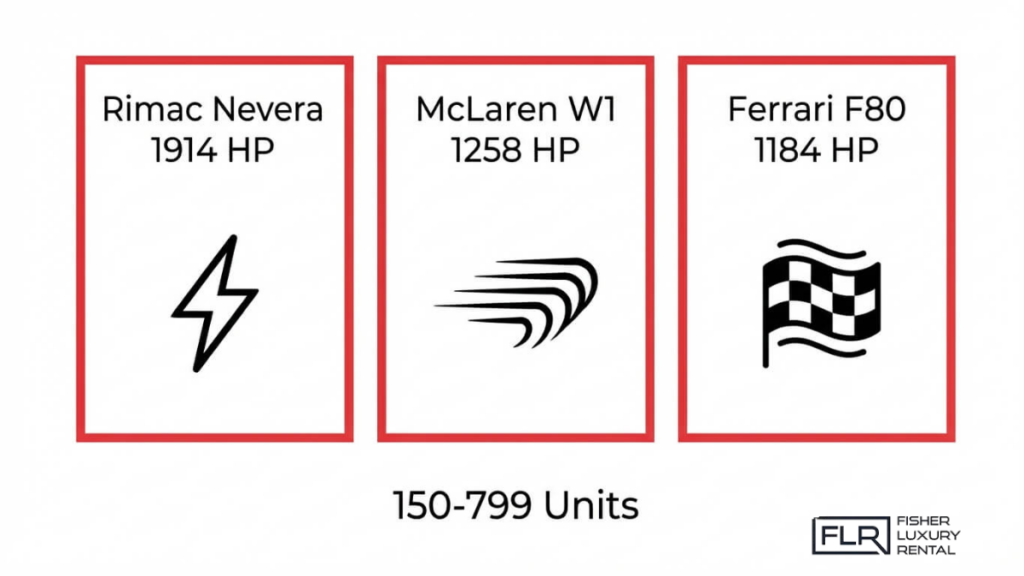
Performance metrics like horsepower and top speed factor in as the most measurable dividing line between supercars and hypercars. A 2026 supercar operates in the 700–900 horsepower corridor, while a hypercar lives above 1,000 hp. According to SBX Cars, models like the Lamborghini Temerario at 907 hp represent the supercar ceiling, whereas the Rimac Nevera at 1,914 hp, the Ferrari F80 at 1,184 hp, and the McLaren W1 at 1,258 hp define the hypercar tier.
Top speed reinforces this gap. The McLaren W1 achieves 217 mph, and acceleration benchmarks reach extremes previously unimaginable; the Rimac Nevera hits 0–60 mph in 1.85 seconds. These figures place hypercars in a category where raw output alone excludes most production vehicles.

What Role Do Price and Exclusivity Play in Classification?
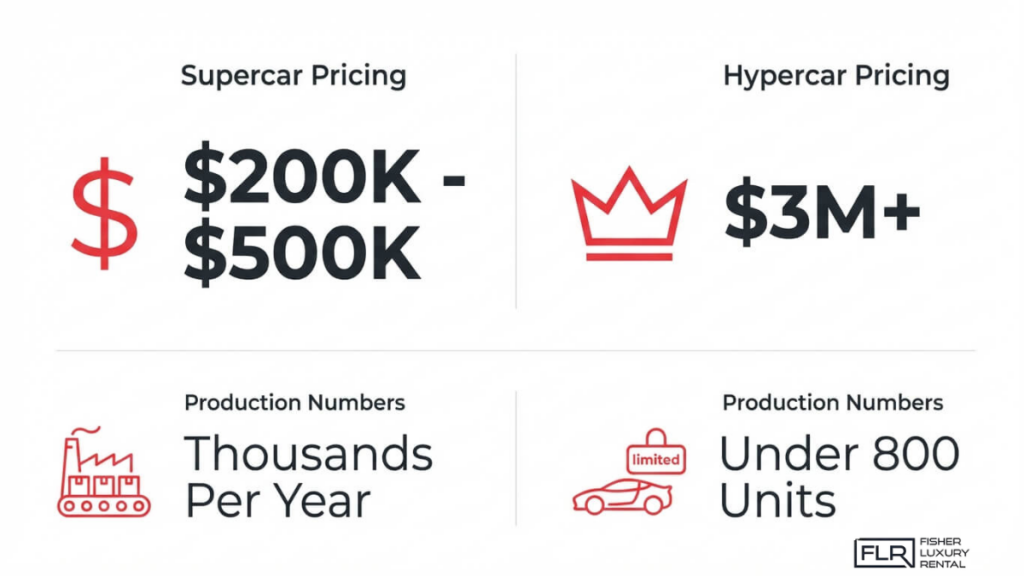
Price and exclusivity play a defining role in classification because hypercars occupy a financial and production tier that supercars rarely approach. The 2026 Ferrari F80 carries an estimated base price of $3,230,000, according to CarBuzz. That figure dwarfs typical supercar pricing, which generally falls between $200,000 and $500,000.
Production scarcity compounds this separation. True hypercars are measured in double- or triple-digit runs:
- The Rimac Nevera is capped at 150 units.
- The McLaren W1 is limited to 399 units.
- The Ferrari F80 is restricted to 799 examples.
Supercars, while not mass-produced, ship in volumes of several thousand per year. This combination of extreme pricing and deliberate scarcity makes hypercars fundamentally less accessible.
How Do Design and Materials Influence Whether a Car Is a Supercar or Hypercar?
Design and materials influence whether a car is a supercar or hypercar by reflecting the level of engineering ambition invested in each platform. Hypercars prioritize bespoke carbon fiber monocoques, active aerodynamic systems, and proprietary powertrain architectures developed specifically for a single model. Supercars, though advanced, typically share platforms and component families across a manufacturer’s lineup.
Electrification is accelerating this divide. According to Accio, the electric supercar market is projected to grow at a CAGR of 13.4% from 2026 to 2033, with advancements in powertrain electrification and advanced materials enhancing both performance and safety. Hypercars adopt these technologies first; supercars inherit them as the engineering matures.
The real distinction often comes down to intent. Hypercars exist to push absolute limits, while supercars balance peak performance with broader usability, making the engineering philosophy behind the materials just as important as the materials themselves. Understanding these criteria helps clarify how each category has evolved over time.
How Have Supercar and Hypercar Categories Evolved Over Time?
Supercar and hypercar categories have evolved over time through decades of engineering breakthroughs, shifting terminology, and escalating performance benchmarks. The milestones below trace how supercars emerged and why the hypercar label became necessary.
What Are the Major Historical Milestones in Supercar Development?
The major historical milestones in supercar development begin with a single revolutionary model from the 1960s. According to JBR Capital, the Lamborghini Miura, launched in 1966 with a transversely-mounted V12 engine, is widely credited with establishing Lamborghini as the world’s premier supercar maker and popularizing the term “supercar” in common parlance. Before the Miura, high-performance grand tourers existed, but none packaged a mid-mounted engine in a road car with such dramatic intent.
That milestone set the template every successor would follow: mid-engine layout, extreme power, and unmistakable visual presence. Each subsequent decade pushed boundaries further, from the Porsche 959 and Ferrari F40 in the 1980s to the McLaren F1 in the 1990s. For anyone passionate about automotive history, this progression is what makes the supercar category so compelling to experience firsthand.
When Did the Term “Hypercar” Emerge and Why?
The term “hypercar” emerged in the early 2010s because supercars alone could no longer describe the most extreme production vehicles. As manufacturers began exceeding 1,000 horsepower and limiting builds to a few hundred units, journalists and marketers needed a new tier to separate these machines from conventional supercars.
Models like the McLaren P1, Porsche 918 Spyder, and LaFerrari, collectively known as the “Holy Trinity,” catalyzed this linguistic shift around 2013. These hybrid-powered flagships redefined what road cars could achieve, making the existing “supercar” label feel insufficient for their level of engineering. The distinction was never formalized by a standards body; it grew organically from an industry need to communicate a new threshold of performance and exclusivity.
With historical context established, the next section identifies which specific brands and models exemplify each category in 2026.
Which Brands and Models Exemplify Each Category in 2026?
The brands and models that exemplify each category in 2026 span hybrid-powered supercars from Lamborghini and Ferrari to limited-production hypercars from Rimac and McLaren. The following examples clarify where each model sits.
What Are Notable 2026 Supercar Examples?
Notable 2026 supercar examples are models operating in the 700 to 900 horsepower corridor, combining hybrid powertrains with mid-engine layouts. According to Stratstone, the Lamborghini Temerario pairs a 4.0-litre flat-plane V8 hybrid producing 907 bhp, while the Ferrari 296 Speciale features a V6 hybrid boosted to 868 bhp after shedding 60 kg of weight.
The McLaren 750S rounds out the category at approximately 740 horsepower. What makes the 2026 supercar class particularly compelling is the universal shift to hybridization; every major contender now relies on electric assistance to push output beyond what combustion alone could achieve even two years ago.
Which Cars Are Considered Hypercars in 2026?
The cars considered hypercars in 2026 exceed 1,000 horsepower and are restricted to extremely limited production runs:
- The Rimac Nevera produces 1,914 hp, hits 0 to 60 mph in 1.85 seconds, and is capped at 150 units.
- The McLaren W1 delivers 1,258 hp and is limited to 399 units.
- The Ferrari F80 generates 1,184 hp with production restricted to 799 examples.
According to Auto Express, the Aspark Owl claims an even faster 0 to 60 mph time of 1.72 seconds, pushing the acceleration benchmark further. Production scarcity alone separates these machines from supercars; owning one often requires an existing purchase history with the manufacturer.
With specific models mapped to each tier, understanding ownership realities adds essential context to the classification debate.
How Do Ownership, Licensing, and Daily Usability Compare Between Supercars and Hypercars?
Ownership, licensing, and daily usability differ significantly between supercars and hypercars due to cost, insurance complexity, and practicality constraints. The sections below cover common insurance and legal requirements, then address whether regular driving is realistic for either class.
What Insurance and Legal Requirements Are Common?
Insurance and legal requirements common to supercars and hypercars include high-value specialty coverage, agreed-value policies, and standard state licensing. According to Ferrari of Fort Lauderdale, most Ferrari owners budget between $15,000 and $30,000 per year for moderate use, with insurance alone running $5,000 to $12,000 annually. Hypercar policies often exceed these figures because replacement costs can surpass $3 million. Most insurers require agreed-value coverage rather than standard actual-cash-value plans, since depreciation models do not apply to limited-production vehicles. A standard driver’s license is legally sufficient for both classes, though some insurers mandate clean driving records and may require proof of secure enclosed storage before binding a policy.
Is It Practical to Drive These Cars Regularly?
Driving these cars regularly is practical for most supercars but far less so for hypercars. Key factors that limit daily usability include:
- Maintenance costs: Wear components like tires and brakes cost $2,000 to $5,000 annually on supercars, with hypercar consumables often running several times higher due to proprietary parts.
- Ground clearance: Low ride heights on both classes make speed bumps, parking ramps, and uneven roads a constant concern, though supercars with adjustable lift systems handle daily terrain more easily.
- Storage and cargo space: Most supercars offer a small front trunk adequate for errands, while hypercars typically sacrifice all cargo room for aerodynamic and powertrain packaging.
- Production scarcity: Hypercar owners frequently avoid daily driving to preserve resale value on vehicles limited to a few hundred units.
Supercars like the Lamborghini Huracán or McLaren 750S strike a more livable balance, making them the realistic choice for owners who want regular seat time. For most enthusiasts, renting removes the ownership burden entirely while preserving the full driving experience. Fisher Luxury Rental addresses this access challenge by offering top-trim supercars including the Lamborghini Huracan Spyder and McLaren 720S across Phoenix, Scottsdale, and Portland, allowing drivers to experience genuine performance without the long-term ownership costs that can exceed $30,000 annually.
What Are the Common Misconceptions and Myths About Supercars and Hypercars?
The common misconceptions about supercars and hypercars center on price equaling classification and hypercars dominating every performance category. The following subsections address the biggest myths.
Are All Expensive Cars Automatically Supercars or Hypercars?
No, not all expensive cars are automatically supercars or hypercars. A high price tag alone does not determine classification. Ultra-luxury grand tourers, armored sedans, and bespoke limousines can exceed seven figures without meeting the performance, engineering, or design thresholds that define either category.
Supercar and hypercar status requires a combination of extreme power output, lightweight construction, aerodynamic innovation, and limited production. According to Stratstone’s 2026 supercar rankings, models like the Lamborghini Temerario earn their classification through a 4.0-litre flat-plane V8 hybrid producing 907 bhp, not simply through their sticker price.
Many buyers confuse exclusivity with classification. A Rolls-Royce Phantom commands a premium yet prioritizes comfort over lap times, placing it firmly outside supercar territory.
Do Hypercars Always Outperform Supercars in Every Metric?
No, hypercars do not always outperform supercars in every metric. While hypercars typically lead in peak horsepower and straight-line acceleration, supercars can match or exceed them in areas such as:
- Driver engagement and steering feedback on winding roads.
- Throttle response and mid-corner agility at lower speeds.
- Ride comfort and daily usability on public roads.
- Lap times on tight, technical circuits where lightweight balance matters more than raw power.
Technologies pioneered in hypercars, including active suspension systems, torque-vectoring algorithms, and hybrid energy management, are expected to trickle down to supercars within five years of initial implementation, according to SBX Cars. This technology transfer steadily narrows the measurable gap between the two categories.
Treating hypercars as universally superior oversimplifies the comparison; the best choice depends entirely on the driving context and what metrics matter most to the driver.
How Does Technology Impact the Modern Classification of Supercars and Hypercars?
Technology impacts the modern classification of supercars and hypercars by redefining performance baselines through electrification, advanced materials, and intelligent driver systems. Below, we examine how hybrid and electric powertrains reshape category boundaries and how driver assistance systems influence where a car falls in the hierarchy.

What Role Does Hybrid and Electric Powertrain Play?
Hybrid and electric powertrains play a central role in blurring and reshaping the line between supercars and hypercars. Electrified drivetrains now deliver instant torque figures that were unattainable with combustion engines alone, pushing traditional supercar output into what was once hypercar territory. According to an Accio market analysis, the electric supercar market is projected to grow at a CAGR of 13.4% from 2026 to 2033, with advancements in powertrain electrification and advanced materials enhancing both performance and safety.
This rapid adoption means hybrid energy management systems pioneered in limited-production hypercars increasingly appear in broader supercar lineups. As electrification raises the performance floor, the benchmarks that once separated these two categories continue shifting upward.
How Do Advanced Driver Assistance Systems Influence Classification?
Advanced driver assistance systems influence classification by adding a layer of technological sophistication that separates hypercars from supercars beyond raw power alone. Active suspension systems, torque-vectoring algorithms, and hybrid energy management pioneered in hypercars are expected to trickle down to supercars within five years of initial implementation, according to SBX Cars.
This trickle-down cycle creates a moving target. Once a hypercar-exclusive technology becomes standard in supercars, manufacturers must innovate further to justify the hypercar label. The result is a classification system driven as much by software intelligence and systems integration as by horsepower or top speed. For enthusiasts wanting to feel this technological evolution firsthand, experiencing these vehicles on the road reveals what specifications alone cannot convey.
How Can You Experience Authentic Supercar and Hypercar Performance Through Premium Car Rentals?
You can experience authentic supercar and hypercar performance through premium car rentals by accessing top-trim models without the financial commitment of ownership. The sections below cover how renting enhances the driving experience and summarize the key classification takeaways from this guide.
How Does Renting a Top-Trim Supercar or Hypercar Enhance the Driving Experience?
Renting a top-trim supercar or hypercar enhances the driving experience by placing genuine performance, crafted engineering, and visceral sensation directly in your hands, without the long-term costs of ownership. According to Ferrari of Fort Lauderdale, most Ferrari owners budget between $15,000 and $30,000 per year for moderate use, covering insurance, tires, and brakes alone. Renting eliminates those recurring expenses while preserving the full sensory impact of piloting a high-performance machine. For example, Fisher Luxury Rental’s fleet includes Ferrari models like the 488 Spider and California T Convertible, as well as the Porsche 911 Carrera S—all maintained to the highest specifications so renters experience authentic supercar performance without the long-term financial commitment.
Premium rental services specialize in top-trim models, including vehicles like the McLaren 720S and Ferrari 488 Spider. Leading rental companies focus on high-specification vehicles, so renters experience the same caliber of performance that defines authentic supercar driving. For most enthusiasts, a well-chosen rental delivers a more concentrated thrill than casual ownership ever could.
What Are the Key Takeaways About Supercar & Hypercar Classifications Explained We Covered?
The key takeaways about supercar and hypercar classifications explained in this 2026 guide are:
- Supercars operate in the 700 to 900 horsepower corridor, while hypercars exceed 1,000 horsepower.
- Price, production scarcity, and advanced materials separate hypercars from supercars as much as raw speed does.
- Classification boundaries are shaped by marketing heritage as much as by engineering thresholds.
- Hybrid and electric powertrains are redefining both categories, with electrification making traditional supercar metrics the new baseline.
- Hypercar technology, including active suspension and torque vectoring, trickles down to supercars within roughly five years.
- Ownership costs and daily usability remain practical factors that influence which category suits a given driver.
For readers who want to feel the difference firsthand rather than simply read about it, premium rental services offer supercars like the Lamborghini Huracan Spyder and the Porsche 911 Carrera S in major metropolitan areas.