Exotic car speed is the product of engineering disciplines working in concert: aerodynamics, materials science, powertrain design, electronic control systems, and purposeful vehicle architecture. Each discipline targets a specific performance bottleneck, and the fastest cars in 2026 integrate all of them into a unified platform.
This guide covers core engineering fundamentals, performance technology and software, design philosophy for speed, the balance between power and everyday usability, and how luxury rentals bring these machines within reach.
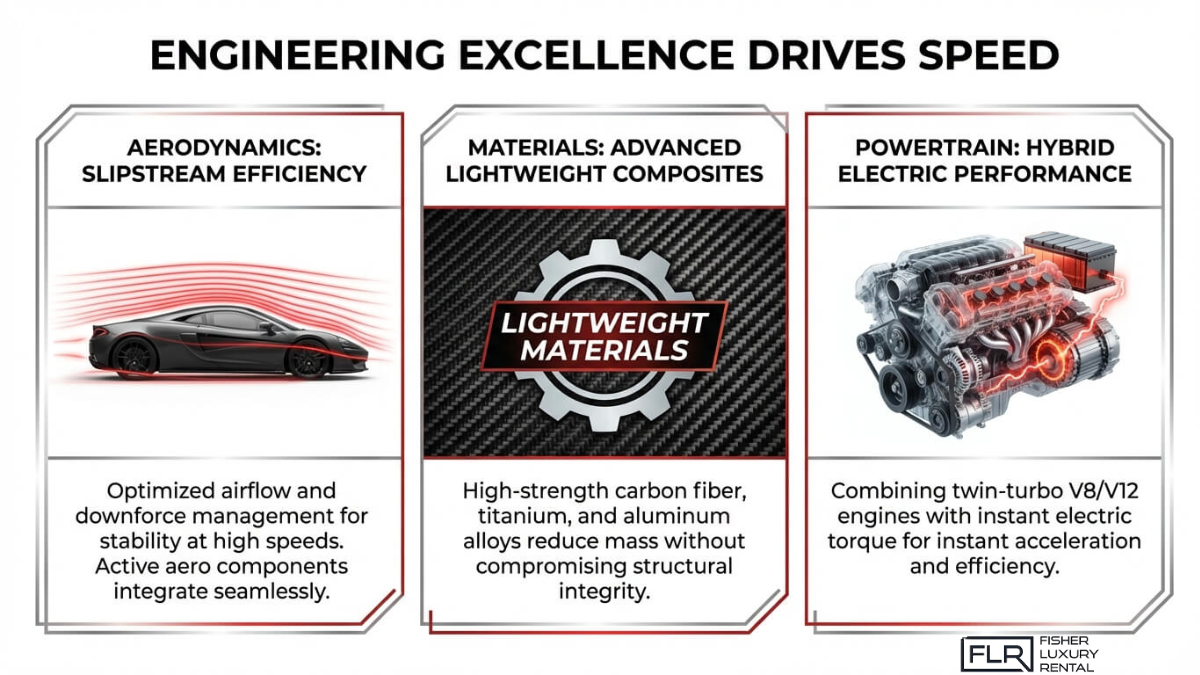
Aerodynamics, lightweight construction, and advanced powertrains form the mechanical foundation of every high-performance exotic. Active aero surfaces now adjust in real time for cornering grip or straight-line efficiency, while carbon fiber and aluminum keep curb weight low enough for sub-three-second sprints to 60 mph. Turbocharged engines paired with energy recovery systems extract more usable power from every combustion cycle.
Technology layers build on that foundation. Hybrid and electric drive systems deliver instant torque at any speed, AI-driven suspension adapts damping to road conditions continuously, and software calibrates throttle mapping, traction control, and differential behavior on every corner.
Design choices serve function directly. Exterior sculpting channels airflow to reduce drag and increase downforce, while cockpit ergonomics position the driver for precise inputs during high-speed maneuvers.
Manufacturers also engineer these cars for daily use, blending track capability with road comfort, adjustable drive modes, and modern safety systems.
For those who want to feel this performance firsthand, renting a top-trim exotic offers direct access without ownership commitment.
What Are the Main Engineering Elements That Make Exotic Cars So Fast?
The main engineering elements that make exotic cars so fast are aerodynamic design, lightweight materials, and advanced powertrains. Each element works together to maximize speed, handling, and acceleration.
How Do Aerodynamics Affect the Speed and Handling of Exotic Cars?
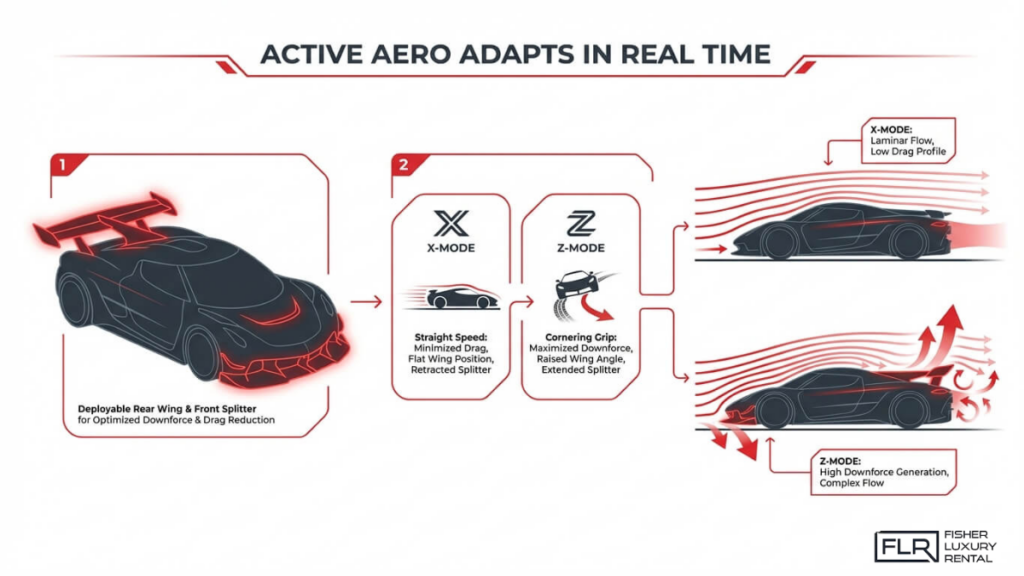
Aerodynamics affect the speed and handling of exotic cars by managing airflow to reduce drag and increase downforce. Active aerodynamic systems, now standard on many high-performance vehicles, adjust elements like rear spoilers and front splitters in real time based on driving conditions. For the 2026 Formula 1 regulations, the FIA mandated a 55% reduction in drag and introduced active aero modes, including “X-mode” for straight-line speed and “Z-mode” for cornering grip. These motorsport innovations filter directly into road-going exotic cars from manufacturers like Ferrari, McLaren, and Lamborghini. Every aerodynamic surface on an exotic car serves a calculated purpose, making airflow management one of the most impactful performance variables available to engineers.
Why Are Lightweight Materials Essential for Exotic Car Performance?
Lightweight materials are essential for exotic car performance because reducing mass improves acceleration, braking, and cornering simultaneously. Carbon fiber, aluminum alloys, and titanium allow manufacturers to build rigid chassis structures without the weight penalty of conventional steel. According to a 2024 study published in MDPI Materials, the share of aluminum alloys in an average car’s overall weight is expected to reach 250 kg by 2025, up from 152 kg in 2023. Exotic cars push further by incorporating carbon fiber monocoques and composite body panels that cut hundreds of additional kilograms. Weight reduction remains the most cost-effective way to gain performance across every measurable metric; no amount of added horsepower compensates for unnecessary mass.

How Do Advanced Engines and Powertrains Contribute to High Speeds?
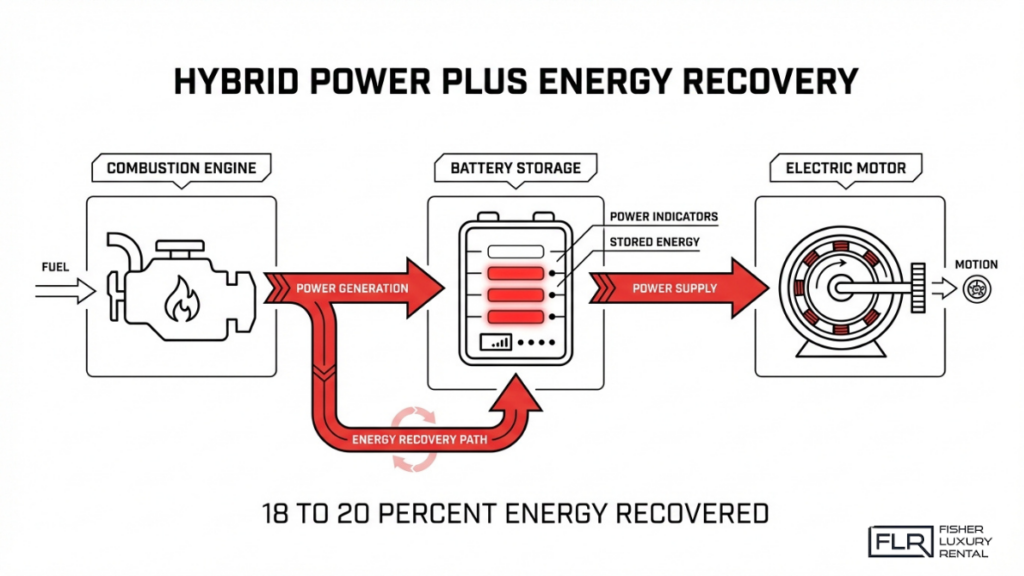
Advanced engines and powertrains contribute to high speeds by delivering extreme power output while recovering energy that traditional engines waste. Modern exotic cars pair twin-turbocharged engines with hybrid electric motors for instantaneous torque delivery. A study published in MDPI Energies found that turbocompounding and waste heat recovery systems can recover 18 to 20% of an engine’s brake power, energy that would otherwise be lost as exhaust heat. The Ferrari 296 GTB, for example, produces 819 bhp and reaches 60 mph in 2.3 seconds by combining a V6 combustion engine with an electric motor. Powertrain engineering has evolved beyond raw displacement; efficiency and energy recovery now define the fastest cars on the road.
With these core engineering foundations in place, cutting-edge technology further amplifies exotic car performance.
How Does Cutting-Edge Technology Enhance Exotic Car Performance?
Cutting-edge technology enhances exotic car performance through hybrid powertrains, advanced suspension and braking systems, and intelligent software that optimizes every aspect of driving dynamics.
What Role Do Hybrid and Electric Systems Play in Modern Exotic Cars?
Hybrid and electric systems play a central role in modern exotic cars by combining combustion engines with electric motors to deliver instant torque and recover otherwise wasted energy. According to a study published in MDPI Energies, the implementation of turbocompounding and waste heat recovery systems in internal combustion engines can recover a total of 18–20% of the engine’s brake power. This recovered energy feeds directly back into the powertrain, boosting acceleration without increasing fuel consumption.
Cars like the Ferrari 296 GTB exemplify this approach, pairing a twin-turbo V6 with an electric motor to produce 819 bhp. For most performance-focused buyers, hybrid technology is no longer a compromise; it is the fastest path to peak output.
How Do Modern Suspension and Braking Systems Impact Performance?
Modern suspension and braking systems impact performance by allowing exotic cars to handle higher cornering loads and stop from extreme speeds with greater consistency. Carbon-ceramic composite brake discs represent a significant advancement over traditional steel rotors. A 2026 study published in ScienceDirect Next Materials found that carbon-ceramic (C/SiC) brake discs reach peak temperatures of only 114°C under moderate braking, while maintaining a thermal stress safety factor of approximately 1.6.
On the suspension side, adaptive dampers now adjust in milliseconds to shifting weight loads during hard cornering or braking. This combination of thermal resilience in braking and real-time suspension response gives drivers confidence to push closer to a car’s true limits.
How Does Smart Software Optimize Driving Dynamics in Exotic Cars?
Smart software optimizes driving dynamics in exotic cars by processing sensor data in real time to adjust throttle maps, traction control, and suspension behavior. According to a 2026 SAE International paper, AI models including machine learning and computer vision are being integrated into active suspension systems to continuously monitor road inputs and passenger preferences, enabling real-time damping adjustments.
These systems go well beyond simple drive mode selectors. They learn from road conditions and driver behavior simultaneously, creating a feedback loop that refines handling characteristics with each passing mile. For high-performance vehicles, this level of software intelligence bridges the gap between raw mechanical capability and accessible, predictable control at speed.
Why Does Design Matter in Achieving Exotic Car Speed and Performance?
Design matters in achieving exotic car speed and performance because every exterior surface and interior element directly influences how a vehicle manages airflow, weight, and driver control. The following sections cover how exterior shaping increases speed and how interior ergonomics enhance high-performance driving.
How Do Exterior Design Choices Increase Speed Capabilities?
Exterior design choices increase speed capabilities by shaping airflow to reduce drag and generate controlled downforce. Every curve, vent, and spoiler on an exotic car serves an aerodynamic function that translates directly into faster acceleration and more stable cornering at high speeds.
Active aerodynamic elements represent the cutting edge of this discipline. For the 2026 Formula 1 regulations, the FIA has mandated a 55% reduction in drag and a 30% reduction in downforce while introducing active aerodynamics with “Z-mode” for cornering and “X-mode” for straight-line speed, according to Formula 1. Road-going exotics increasingly adopt similar principles through deployable rear wings, adaptive front splitters, and underbody diffusers that adjust based on driving conditions.
The best exterior designs balance visual presence with functional precision; form that does not serve performance is simply excess weight.
What Makes the Interior Design Relevant for High-Performance Driving?
The interior design is relevant for high-performance driving because it determines how effectively a driver can control the vehicle under extreme conditions. Seat position, steering wheel placement, and pedal reach all influence reaction time and sustained focus during spirited driving.
According to a study published in IEEE Access by the University of Bologna, the optimal driving position is significantly influenced by SAE-standardized variables, including the H-point coordinates, seatback angle, and steering wheel position, which must be balanced to optimize both vehicle acceleration performance and driver comfort. Exotic car manufacturers engineer cockpits around these principles, using fixed-back racing seats, flat-bottom steering wheels, and minimalist controls to keep the driver connected to the car’s dynamics.
A well-designed interior is not a luxury afterthought; it is the interface between human input and mechanical output. With design shaping both the air around the car and the driver within it, the next question is whether these machines can handle daily life, too.

Are Exotic Cars Built for Both Speed and Everyday Usability?
Exotic cars are built for both speed and everyday usability, though achieving this dual purpose requires deliberate engineering compromises. The sections below explain how manufacturers balance raw power with daily comfort and which features enable seamless transitions between road and track.
How Do Manufacturers Balance Power with Road Comfort and Safety?
Manufacturers balance power with road comfort and safety by engineering adaptive systems that adjust vehicle behavior based on driving conditions. Selectable drive modes allow the same car to deliver aggressive throttle response on a track and compliant, quiet cruising on city streets.
According to a 2026 SAE International paper, AI models including machine learning and computer vision are now integrated into active suspension systems, continuously monitoring road inputs and passenger preferences to adjust damping characteristics in real time. This technology lets high-powered platforms absorb potholes and uneven pavement without sacrificing cornering precision at speed. Regulatory pressure also shapes this balance; the NHTSA has proposed a fleet average target of approximately 49 mpg for model year 2026, pushing manufacturers to pair performance with fuel efficiency through hybrid architectures rather than brute displacement alone.
What Features Allow Exotic Cars to Be Driven Both on Road and Track?
The features that allow exotic cars to be driven both on road and track include adjustable suspension, switchable stability control, and multi-mode powertrains. These systems let a single vehicle shift character depending on context:
- Adaptive suspension firms damping for flat cornering on circuits, then softens for highway comfort.
- Selectable drive modes recalibrate throttle mapping, transmission shift points, and exhaust sound between street and sport settings.
- Carbon-ceramic brakes resist heat fade during repeated hard stops on track while remaining smooth under light street braking.
- Lift-system front axles raise the nose to clear speed bumps and driveways, then lower for aerodynamic efficiency at speed.
- Hybrid energy recovery provides electric-only low-speed cruising for errands and instant torque boost for spirited driving.
For most drivers, these dual-purpose features eliminate the old trade-off between livability and lap times. Understanding this versatility makes the leap from reading about performance to experiencing it firsthand all the more compelling.
How Do Luxury Car Rentals Let You Experience Exotic Car Performance?
Luxury car rentals let you experience exotic car performance by placing you behind the wheel of top-trim supercars without the commitment of ownership. The following sections cover how Fisher Luxury Rental delivers that firsthand experience and the key performance takeaways for 2026.
Can Renting an Exotic Car from Fisher Luxury Rental Let You Feel High Performance Firsthand?
Yes, renting an exotic car from Fisher Luxury Rental can let you feel high performance firsthand. Fisher Luxury Rental specializes in top-trim exotic and luxury vehicles in the Phoenix Metropolitan Area and Northwest Oregon, maintaining a fleet that excludes base models to ensure every rental delivers a high-grade performance offering. That distinction matters because the engineering covered throughout this article, from carbon-fiber construction to adaptive suspension systems, only reveals itself at full specification. When you rent a McLaren 720S or a Ferrari 488 Spider from Fisher Luxury Rental, you experience the same active aerodynamics, carbon-ceramic braking, and hybrid powertrain responsiveness that define the supercar segment. Reading about 819 bhp is one thing; feeling it press you into an ergonomically optimized cockpit seat is something else entirely.
What Are the Key Takeaways About What Makes Exotic Cars Fast and High Performance in 2026?
The key takeaways about what makes exotic cars fast and high performance in 2026 center on five converging engineering disciplines:
- Active aerodynamics now toggle between low-drag and high-downforce configurations in real time, a concept validated by the FIA’s 2026 regulations introducing X-mode for straight-line speed and Z-mode for cornering.
- Lightweight materials, especially aluminum alloys and carbon composites, continue reducing curb weight while preserving structural rigidity.
- Hybrid powertrains recover wasted energy; according to a study published in MDPI Energies, turbocompounding and waste heat recovery systems can recapture 18 to 20 percent of an engine’s brake power.
- AI-driven suspension and software systems adjust damping in milliseconds based on road conditions and driver input.
- Carbon-ceramic brakes deliver repeatable stopping power under extreme thermal loads.
These systems no longer operate in isolation. The most capable exotic cars in 2026 integrate all five elements into a unified performance platform, and renting one remains the most accessible way to feel that integration firsthand.