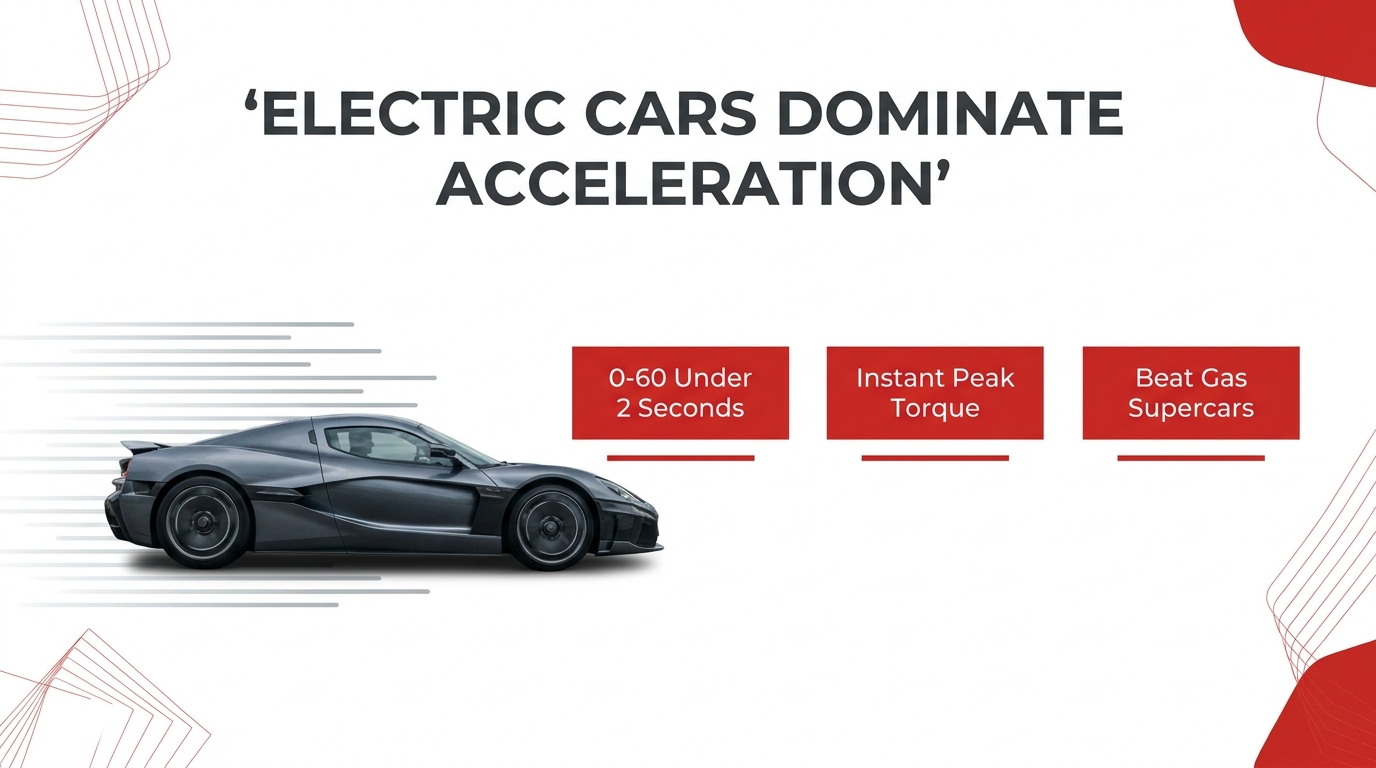
Electric cars are among the fastest accelerating vehicles ever built, with the quickest production models reaching 60 mph in under 2 seconds. This speed comes from fundamental engineering advantages that internal combustion engines cannot replicate.
This guide covers the physics behind EV acceleration, the fastest electric cars in production, how top speeds and 0–60 times compare across models, the technical limits that cap EV performance, and how electric cars hold up on the track.
Electric motors deliver peak torque within milliseconds of throttle input, while gas engines must climb through their power band first. A single-speed transmission removes the interruptions of gear changes, and flat torque curves sustain power across a wider speed range than any combustion engine can match.
The fastest EVs available today include the Rimac Nevera, which recorded a 0–60 time of 1.74 seconds, the Lucid Air Sapphire with a 9.3-second quarter-mile, the Porsche Taycan Turbo GT with a verified 190 mph top speed, and Tesla’s Plaid lineup, which brings sub-3-second launches to both sedans and SUVs.
Top speed in electric cars is shaped by motor RPM ceilings tied to single-speed gearboxes, battery weight, and thermal management systems that throttle output under sustained high-speed loads.
On track, EVs have earned outright lap records at the Nürburgring, though thermal constraints affect lap consistency across full sessions. Regenerative braking adds a distinctly different driving feel, and for those who want to experience exotic performance firsthand, renting remains the most direct path to understanding what these figures actually feel like.
Why Are Electric Cars Faster Than Gas Cars Off the Line?
Electric cars are faster than gas cars off the line because electric motors deliver maximum torque instantly, while internal combustion engines must build RPM before producing usable power. The sections below cover instant torque, single-speed transmissions, and power delivery differences.
How Does Instant Torque Make EVs Accelerate Faster?
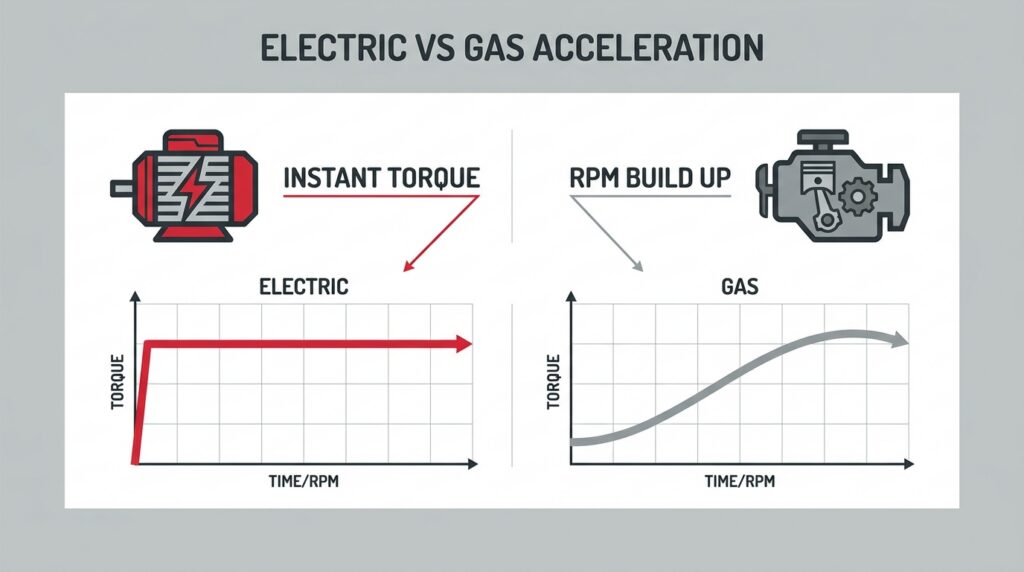
Instant torque makes EVs accelerate faster because electric motors reach peak torque within milliseconds after the throttle is applied. Gas engines, by contrast, require time to climb through their power band before torque peaks, creating a measurable delay between input and response. That gap is exactly where EVs win every standing-start contest, regardless of horsepower ratings. For drivers who want to feel that difference firsthand, it is one of the most visceral sensations modern performance vehicles offer.
Why Does a Single-Speed Transmission Help EV Speed?
A single-speed transmission helps EV speed by eliminating the gear-change interruptions that momentarily cut power delivery in conventional vehicles. According to Patsnap Eureka, single-speed gearboxes reduce mechanical losses and enhance overall efficiency through fewer moving parts compared to multi-gear transmissions. The tradeoff is that motor RPM constraints set a ceiling on top speed, since there are no higher gears to extend the speed range. For off-the-line acceleration, though, the seamless power band is a decisive advantage.
How Does Electric Motor Power Delivery Differ From ICE?
Electric motor power delivery differs from ICE because it operates across two distinct regions: a constant torque region at low speeds limited by current, and a constant power region at high speeds limited by battery voltage. According to Hypercraft, electric motors can provide up to 75% more effective power than internal combustion engines at the same horsepower rating, thanks to a flat torque plateau maintained from low RPM. Gas engines produce usable torque only within a narrow RPM window, forcing drivers to work through gears to stay in the powerband. That fundamental difference in torque curve shape is the core engineering reason EVs dominate off-the-line acceleration.
What Are the Fastest Electric Cars Available Right Now?
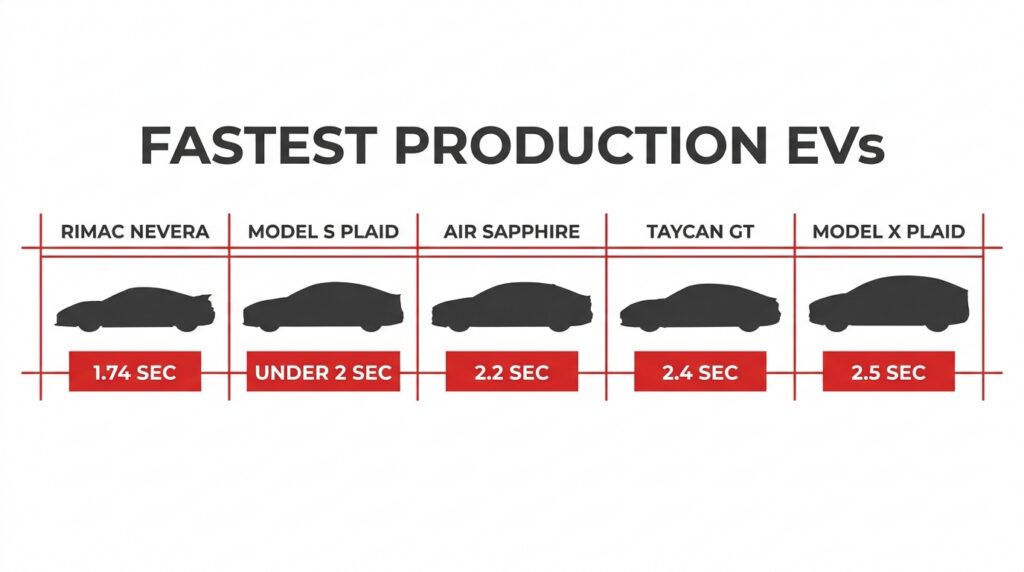
The fastest electric cars available right now include the Rimac Nevera, Lucid Air Sapphire, Pininfarina Battista, Porsche Taycan Turbo GT, and Tesla’s Plaid lineup. Each model represents a different balance of outright acceleration, top speed, and real-world track capability.
Tesla Model S Plaid
The Tesla Model X Plaid is a tri-motor electric SUV that delivers a 0-60 mph time of 2.5 seconds and a top speed of 163 mph, according to Tesla. For a full-size family hauler, that level of straight-line performance is genuinely remarkable and speaks to how effectively Tesla has packaged high-output motors into a practical vehicle.
Rimac Nevera
The Rimac Nevera is a Croatian electric hypercar that recorded a 0-60 mph time of 1.74 seconds during a record-breaking session in 2023. Beyond the launch numbers, it set a 0-400-0 km/h time of 29.93 seconds, over a second quicker than the previous record holder, according to the Rimac Newsroom. No other production EV currently matches its combination of acceleration and high-speed capability.
Porsche Taycan Turbo GT
The Porsche Taycan Turbo GT is a performance-focused electric sedan that reaches a top speed of 190 mph (305 km/h) with the Weissach package. Driven by Lars Kern, it achieved a Nürburgring Nordschleife lap time of 7:07.55, according to Auto Express. That result positions it as the benchmark for EV track credibility over sustained, mixed-speed conditions.
Lucid Air Sapphire
The Lucid Air Sapphire is a tri-motor electric sedan producing 1,234 horsepower and 1,430 lb-ft of torque. A 2024 Motor Trend test confirmed a 0-60 mph time of 2.2 seconds and a quarter-mile at 9.3 seconds at 156.0 mph, matching the record for the quickest production car Motor Trend has ever tested. It proves that a luxury sedan can deliver hypercar-level drag strip performance.
Pininfarina Battista
The Pininfarina Battista is an Italian electric hypercar capable of 0-60 mph acceleration in approximately 1.8 seconds. It sits alongside the Rimac Nevera at the extreme end of EV performance, offering a handcrafted, coachbuilt experience that blends Italian design heritage with all-electric propulsion.
Tesla Model X Plaid
The Tesla Model X Plaid delivers a 0-60 mph time of 2.5 seconds and a top speed of 163 mph, making it one of the quickest electric SUVs currently in production. It demonstrates that EV performance is no longer reserved for low-slung sports cars, with a three-row SUV now capable of matching dedicated performance machines off the line.
How Fast Can Electric Cars Go in 0–60 MPH?
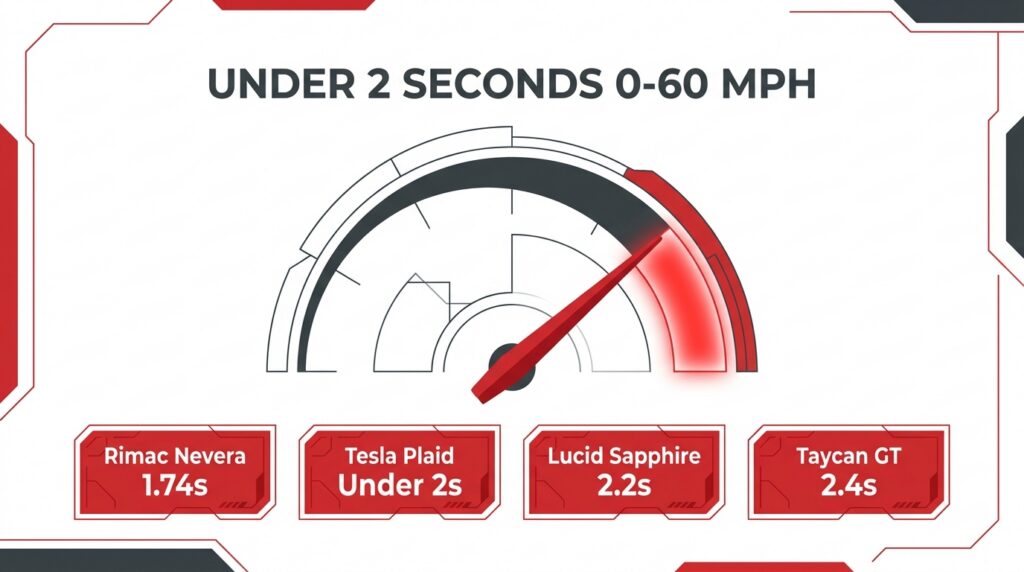
The fastest electric cars can complete 0–60 mph in under 2 seconds, with production hypercars and performance sedans leading the class. The H3s below cover the four quickest EVs by 0–60 time: the Rimac Nevera, Tesla Model S Plaid, Lucid Air Sapphire, and Porsche Taycan Turbo GT.
How Fast Is the Rimac Nevera From 0–60?
The Rimac Nevera reaches 0–60 mph in 1.74 seconds, making it the quickest production electric car ever tested. That figure came from a record-breaking session in 2023, during which the Nevera set 23 performance records in a single day, including a 0-400-0 km/h run of 29.93 seconds. According to the Rimac Newsroom, that 0-400-0 time beat the previous record holder by more than a second. No other road-legal production vehicle has matched it.
How Fast Is the Tesla Model S Plaid From 0–60?
The Tesla Model S Plaid reaches 0–60 mph in under 2 seconds in its highest-performance configuration, placing it among the quickest production sedans available. The tri-motor architecture delivers immediate, full torque across all three motors simultaneously, eliminating the hesitation common in internal combustion vehicles. For a car at its price point, the Model S Plaid represents one of the most accessible entry points into sub-2-second acceleration.
How Fast Is the Lucid Air Sapphire From 0–60?
The Lucid Air Sapphire reaches 0–60 mph in 2.2 seconds. A 2024 Motor Trend first test confirmed that the Sapphire’s 1,234 horsepower and 1,430 lb-ft of torque also deliver a quarter-mile time of 9.3 seconds at 156.0 mph, matching Motor Trend’s record for the quickest production car ever tested. That combination of sedan practicality and hypercar-level acceleration makes the Air Sapphire arguably the most well-rounded performance EV in production.
How Fast Is the Porsche Taycan Turbo GT From 0–60?
The Porsche Taycan Turbo GT reaches 0–60 mph in under 2.4 seconds and tops out at 190 mph (305 km/h) with the Weissach package. Beyond straight-line performance, it recorded a Nürburgring Nordschleife lap time of 7:07.55 minutes, driven by Lars Kern, confirming its credentials as a track-capable EV rather than just a drag race performer.
What Is the Top Speed of the Fastest Electric Cars?
The top speed of the fastest electric cars ranges from 163 mph in performance sedans to over 190 mph in purpose-built hypercars. The following covers verified top-speed figures across the leading production EVs available today.
| Electric Car | Top Speed |
| Rimac Nevera | 258 mph (claimed) |
| Porsche Taycan Turbo GT (Weissach) | 190 mph |
| Lucid Air Sapphire | 205 mph |
| Tesla Model X Plaid | 163 mph |
The Porsche Taycan Turbo GT with the Weissach package reaches a verified top speed of 190 mph (305 km/h), according to EV Specs. Meanwhile, BYD claimed the electric top-speed record in 2025 with the Yangwang U9 Track Edition, reaching approximately 293.5 mph, though that figure applies to a specialized track variant rather than a standard production model.
Top speed in EVs is often constrained by motor RPM limits inherent to single-speed gearboxes, not raw power output. In practical terms, most buyers will never approach these ceilings, making 0-60 acceleration the more meaningful performance benchmark for everyday driving.
Do Electric Cars Lose Speed at High RPMs Like Gas Cars?
Electric cars do not lose speed at high RPMs the way gas cars do. The sections below explain how EV power delivery differs at high rotational speeds and what actually limits an electric car’s top-end performance.
How Do EVs Maintain Power at High Motor Speeds?
Electric motors maintain power at high speeds through a constant power region, where output is limited by battery voltage rather than a mechanical ceiling. Unlike internal combustion engines, which lose torque as RPMs climb beyond a narrow power band, an electric motor’s torque-speed curve transitions smoothly from a constant torque region at low speeds into this sustained power region. The result is consistent thrust across a much wider speed range, without the RPM-related power drop-off gas engines experience.
What Actually Limits EV Top Speed Instead of RPM Drop-Off?
EV top speed is limited primarily by motor RPM constraints tied to single-speed gearboxes with fixed maximum rotational speeds, not by power fade the way a gasoline engine experiences. Because most EVs use a single fixed gear ratio, the motor simply reaches its ceiling RPM and cannot spin faster, capping vehicle speed mechanically. Battery voltage and thermal output also set boundaries on sustained high-speed performance. In practice, this means top speed is an engineered limit, not a consequence of power loss.
According to a 2025 J.D. Power U.S. Electric Vehicle Consideration Study, 24% of vehicle shoppers say they are “very likely” to consider purchasing an EV, suggesting growing consumer awareness of how differently these vehicles perform compared to gasoline alternatives.
Are Electric SUVs Fast Compared to Performance Sedans?
Electric SUVs are fast compared to many performance sedans, though top electric sedans still hold the acceleration edge. The comparison below covers key models across both categories.
Tesla Model X Plaid vs. Performance Sedans
The Tesla Model X Plaid is fast for an SUV, reaching 0–60 mph in 2.5 seconds with a top speed of 163 mph, according to Tesla. That figure rivals many dedicated performance sedans despite the Model X carrying a heavier, taller body. For a three-row SUV to hit sub-3-second acceleration is genuinely remarkable, and it reshapes what buyers should expect from the segment.
Lucid Air Sapphire as a Sedan Benchmark
The Lucid Air Sapphire sets the sedan benchmark, producing 1,234 horsepower and 1,430 lb-ft of torque. According to Motor Trend, it achieves a 0–60 mph time of 2.2 seconds and a quarter-mile in 9.3 seconds at 156.0 mph, matching the record for the quickest production car Motor Trend has ever tested. No current electric SUV matches those figures.
How the Two Categories Compare
The performance gap between electric SUVs and electric sedans is real but narrowing, driven by multi-motor layouts and low-mounted battery packs. Key differences include:
- 0–60 advantage: Top electric sedans such as the Lucid Air Sapphire edge out electric SUVs by 0.3 seconds or more.
- Top speed: The Porsche Taycan Turbo GT with the Weissach package reaches 190 mph, surpassing any current electric SUV.
- Body weight: SUV platforms carry more mass, which limits both peak acceleration and sustained high-speed performance.
- Everyday usability: Electric SUVs offer comparable launch feel to most gas-powered performance sedans in daily driving.
Can Electric Cars Beat Supercars in a Drag Race?
Yes, electric cars can beat supercars in a drag race, and several already hold verified production car records. The Rimac Nevera, Lucid Air Sapphire, and Pininfarina Battista regularly outpace traditional petrol-powered supercars from a standing start.
How Does the Rimac Nevera Compare to Petrol Supercars?
The Rimac Nevera beats petrol supercars comprehensively in straight-line acceleration. In 2023, it recorded a 0-60 mph time of 1.74 seconds during a record-breaking test session, setting 23 performance records in a single day. Most impressively, it completed the 0-400-0 km/h (0-249-0 mph) challenge in 29.93 seconds, over a second quicker than the previous record holder. No comparable petrol supercar has matched that combined acceleration and braking benchmark. For pure drag race dominance, the Nevera is simply in a category of its own.
How Does the Lucid Air Sapphire Perform Against Gas-Powered Sports Cars?
The Lucid Air Sapphire outperforms nearly every gas-powered sports car in quarter-mile testing. According to Motor Trend, the 2024 Air Sapphire produces 1,234 horsepower and 1,430 lb-ft of torque, achieving a quarter-mile time of 9.3 seconds at 156.0 mph, matching the record for the quickest production car Motor Trend has ever tested. That figure beats legendary petrol machines across the same standardized test. What makes this remarkable is that the Sapphire achieves it in a four-door sedan body, redefining what drag race performance looks like.
Where Do EVs Still Fall Short Against Supercars?
Electric cars still fall short against supercars in sustained high-speed performance and multi-lap track endurance. EV top speeds are often limited by motor RPM constraints, since most use single-speed gearboxes with fixed maximum rotational speeds. Battery thermal management also becomes a factor during repeated hard acceleration runs, as heat buildup can reduce peak output over consecutive passes. Traditional supercars, built with multi-speed transmissions and combustion powertrains optimized for sustained heat rejection, maintain consistent output across longer performance windows where EVs can fade.
What Limits How Fast an Electric Car Can Go?
Several engineering factors cap EV top speed, including battery weight, thermal management, and single-speed gearbox RPM ceilings. The following sections break down each constraint.
Why Does Battery Weight Affect EV Top Speed?
Battery weight affects EV top speed because heavier vehicles require more energy to overcome aerodynamic drag at high speeds, reducing the power available to sustain velocity. Large battery packs, while essential for range, add hundreds of pounds to a vehicle’s total mass. At extreme speeds, this mass penalty becomes increasingly costly, as aerodynamic drag grows exponentially with velocity. Engineers must balance energy density against weight to optimize both range and top-speed capability. Lighter, more energy-dense battery chemistry directly enables higher sustained speeds without sacrificing structural safety.
How Does Battery Thermal Management Limit Sustained Speed?
Battery thermal management limits sustained speed by preventing the continuous high-power output required for extended high-speed driving. According to Sage Journals research, battery thermal management systems are critical for regulating heat during rapid charge and discharge cycles to prevent overheating and thermal runaway. When sustained maximum speed pushes discharge rates near thermal limits, the battery management system throttles output to protect cells. Manufacturers validate sustained speed performance at dedicated facilities; the Ehra-Lessien testing facility in Germany features a 5.6-mile straight built specifically for this purpose. Thermal constraints are, in practice, a more restrictive ceiling than motor RPM limits for most production EVs.
Why Do Most EVs Have a Lower Top Speed Than Supercars?
Most EVs have a lower top speed than supercars because single-speed gearboxes impose a fixed maximum motor RPM that directly caps the vehicle’s terminal velocity. Unlike multi-gear transmissions, which allow combustion supercars to multiply torque across speed ranges, a single-speed EV drivetrain cannot extend its speed ceiling beyond what its gear ratio and peak RPM allow. Additionally, software-imposed speed limiters protect tires, motors, and battery systems from damage at extreme velocity. Manufacturers typically prioritize acceleration performance over outright top speed because instant torque delivers a more compelling real-world driving advantage than a higher but rarely usable top speed.
Are Electric Cars Fast Enough for Track Performance?
Electric cars are fast enough for track performance, with purpose-built EVs now setting outright lap records at legendary circuits. The sections below cover Nürburgring benchmarks and the thermal challenges that shape sustained track capability.
Nürburgring Lap Times Set by EVs
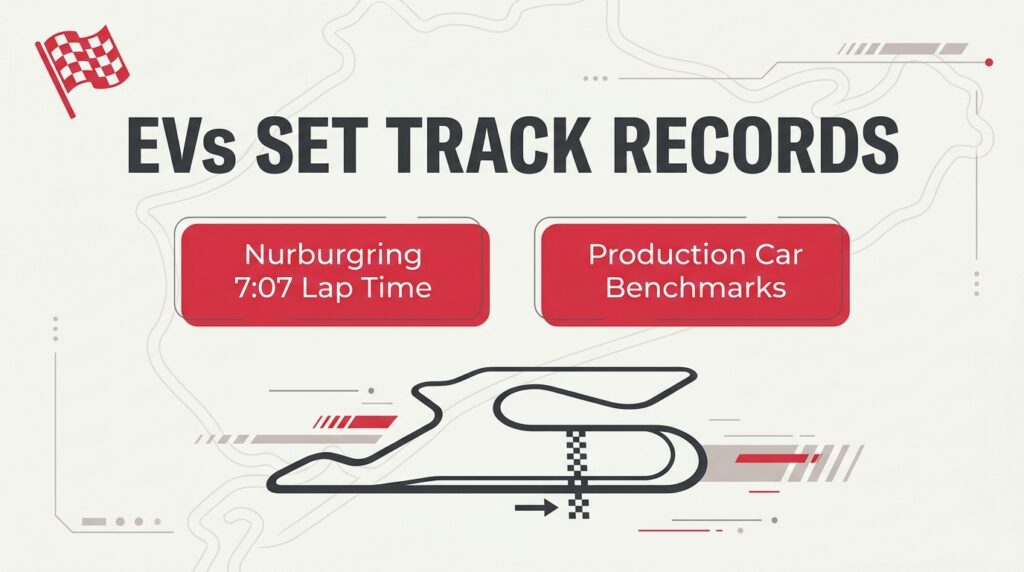
The Nürburgring Nordschleife is the definitive benchmark for production car performance, and electric vehicles have proven fully competitive there. The Porsche Taycan Turbo GT achieved a lap time of 7:07.55 minutes at the Nürburgring, driven by Lars Kern, according to Auto Express. That time places it among the fastest production cars ever to complete the circuit, regardless of powertrain.
For any serious performance car, earning a strong Nürburgring result is the clearest proof of real-world track capability, not just straight-line speed.
Battery Thermal Limits During Sustained Track Use
Battery thermal management limits EVs during sustained track sessions by regulating heat generated through rapid charge and discharge cycles. Without effective thermal control, overheating risks thermal runaway, which forces power reduction. This constraint affects lap consistency more than outright speed: an EV may post a blistering first lap but struggle to replicate it across a full session without active cooling systems managing battery temperature continuously.
The Ehra-Lessien facility in Germany, featuring a 5.6-mile straight, is one venue manufacturers use to validate sustained maximum speed under these thermal conditions.
How Does Regenerative Braking Affect EV Driving Feel?
Regenerative braking affects EV driving feel by converting kinetic energy into electrical energy during deceleration, creating a distinctive one-pedal driving sensation that differs noticeably from traditional friction braking. Most EV drivers experience a stronger, more immediate slowdown the moment they lift off the accelerator. According to research published by arXiv (Cornell University), this mechanism significantly influences car-following dynamics, altering how EVs interact with traffic flow compared to gas-powered vehicles. In practice, drivers can modulate regenerative braking intensity through settings ranging from light coasting to aggressive deceleration. This level of control adds a layer of engagement that conventional braking simply cannot replicate, making spirited driving feel more intuitive and connected once you adapt to the system.
How Can You Experience Supercar-Level Speed Firsthand?
You can experience supercar-level speed firsthand by renting an exotic car. Fisher Luxury Rental offers a curated fleet of high-performance vehicles in Phoenix, AZ, and Portland, OR, covering both the rental opportunity and key EV speed takeaways.
Can Renting an Exotic Car From Fisher Luxury Rental Satisfy Your Need for Speed?
Yes, renting an exotic car from Fisher Luxury Rental can satisfy your need for speed. Fisher Luxury Rental offers top-trim performance vehicles, including the McLaren 720S, Ferrari 488 Spider, and Lamborghini Huracan Spyder, all of which deliver the kind of visceral acceleration and handling that most drivers never get to experience behind the wheel. Rather than simply reading about supercar performance, renting puts that power directly in your hands. Fisher Luxury Rental serves Phoenix, Scottsdale, Portland, and Vancouver, with straightforward booking and no compromises on vehicle quality.
What Are the Key Takeaways About Electric Car Speed and the Quickest EVs?
The key takeaways about electric car speed are that EVs have fundamentally redefined performance benchmarks across every segment. Instant torque delivery, single-speed efficiency, and advanced battery systems combine to make modern EVs genuinely competitive with, and often faster than, traditional supercars off the line. According to Pew Research Center, one-third of Americans in 2025 say they would very or somewhat seriously consider purchasing an EV as their next vehicle. At the extreme end, BYD claimed the electric top-speed record in 2025 with the Yangwang U9 Track Edition reaching approximately 293.5 mph. Electric performance is no longer a future promise; it is the current standard.