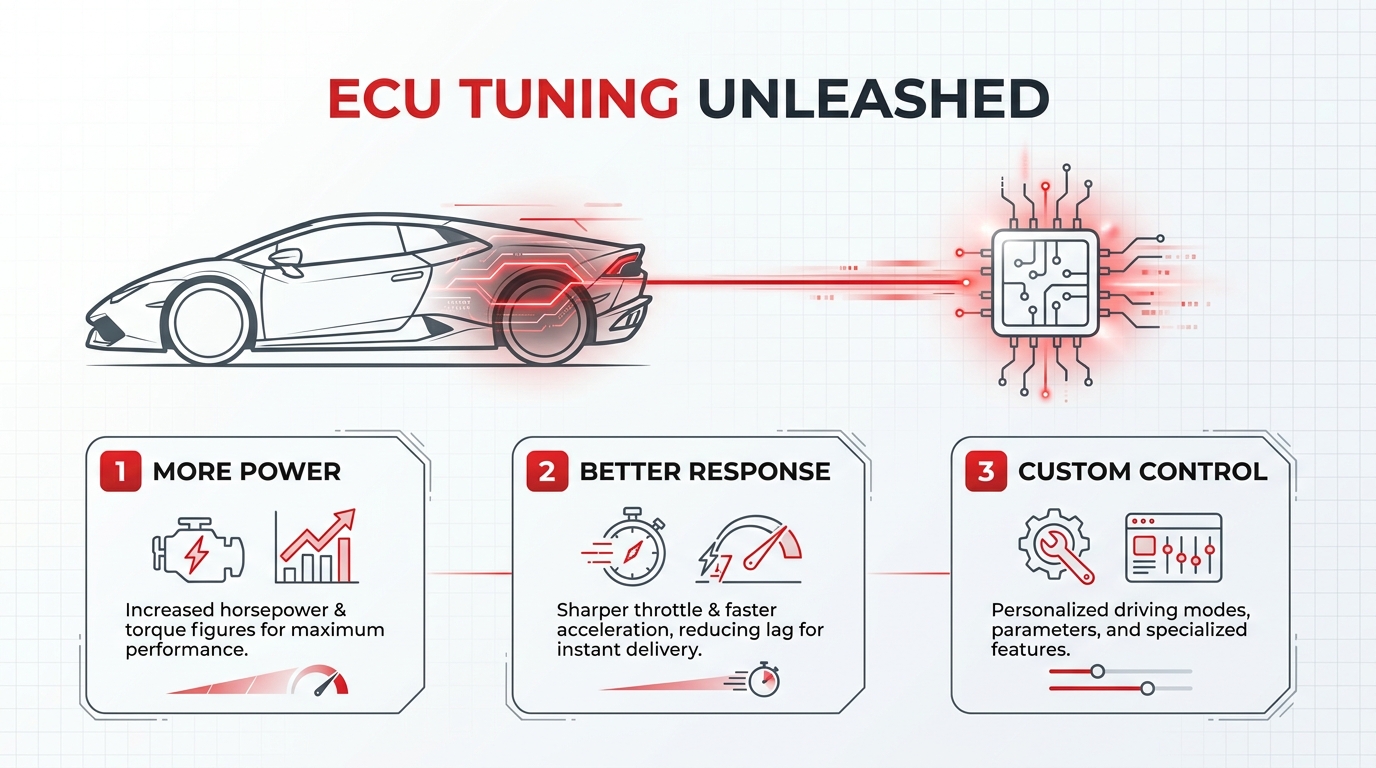
Lamborghini ECU tuning is the process of reconfiguring a factory engine control unit to unlock performance beyond the manufacturer’s stock calibration, targeting parameters such as ignition timing, fuel delivery, boost pressure, and throttle mapping.
This guide covers how ECU tuning works across Lamborghini platforms, the leading software options and hardware upgrades available in 2026, what tuning costs and performance gains actually look like by stage, and the safety, warranty, and legal considerations every owner should understand before modifying their vehicle.
ECU tuning affects each Lamborghini differently depending on engine architecture. The naturally aspirated Huracán responds to fuel map and timing recalibration, the twin-turbo Urus unlocks substantial forced-induction headroom, and the Revuelto’s hybrid V12 demands exhaust-paired tuning to deliver meaningful gains.
The software landscape spans six major platforms, from Unitronic’s staged calibrations for the Huracan V10 to the Novitec N-Tronic module designed for use alongside exhaust hardware, each with distinct authorization requirements, delivery methods, and compatibility considerations.
Tuning costs range from entry-level ECU flashes starting under $2,000 to full hardware-plus-software stage packages exceeding $8,990, with custom dyno calibrations consistently outperforming generic box tunes in verified power output.
Warranty exposure, legal compliance, and the specific risks of tuning a leased or rented Lamborghini round out what any serious enthusiast needs to weigh before committing to a modification that alters the factory powertrain.
What Does ECU Tuning Do for a Lamborghini?
ECU tuning reconfigures a Lamborghini’s factory engine control unit to unlock performance beyond stock calibration. The following sections cover how tuning affects ignition timing and fuel delivery, what hardware changes amplify software gains, and which parameters tuners modify first.
How Does ECU Tuning Affect Engine Performance?
ECU tuning affects engine performance by optimizing ignition timing, throttle mapping, and fuel delivery to improve horsepower, torque, and overall responsiveness. According to Eurocharged, professional tuning achieves these gains by recalibrating the parameters the factory deliberately restricts for emissions compliance and broad market usability. Key adjustments include:
- Increasing boost pressure targets
- Modifying fuel delivery rates stored in ECU memory
- Removing top speed limiters
- Reconfiguring Air-Fuel Ratio (AFR) settings
For a platform as precise as a Lamborghini V10 or V12, even conservative recalibration produces measurable results across the entire rev range.
What Engine Parameters Does ECU Tuning Modify?
The engine parameters ECU tuning modifies include rev limiters, ignition timing retard, fuel addition for launch control, and boost pressure targets. These variables interact directly with the knock control systems and fuel pressure sensors already built into Lamborghini powertrains. Because Lamborghini uses four factory-fitted fuel pressure sensors on the Huracan to monitor fuel film and boost aim within its knock control system, a skilled calibrator can push targets closer to the engine’s mechanical limits without crossing into detonation. User-defined launch control fuel maps are among the most performance-critical parameters for track-focused owners.
What Is the Difference Between a Flash Tune and a Piggyback Module?
A flash tune is a direct rewrite of the ECU’s native calibration tables, while a piggyback module intercepts and modifies sensor signals before they reach the factory ECU. Flash tunes offer deeper, more integrated control over fuel maps, ignition timing, and boost targets. Piggyback modules, such as the NOVITEC Tectronic unit, are paired with supporting hardware like sport metal catalysts to prevent exhaust-related error codes without permanent ECU modification. The right choice depends on how deeply an owner wants to modify the vehicle and whether reversibility matters, making flash tunes the preferred path for maximum power and piggyback solutions the cleaner option for drivability-focused builds.
Which Lamborghini Models Benefit Most from ECU Tuning in 2026?
The Lamborghini models that benefit most from ECU tuning in 2026 are the Huracán, Urus, and Revuelto. Each platform responds differently based on engine architecture, forced induction potential, and hybrid integration. The sections below cover model-specific gains for each.
How Does ECU Tuning Improve the Lamborghini Huracán?
ECU tuning improves the Lamborghini Huracán by recalibrating ignition timing, throttle mapping, and fuel delivery to extract more horsepower, torque, and engine responsiveness from its naturally aspirated V10. The process also optimizes the Air-Fuel Ratio to sharpen engine dynamics across the rev range. According to Eurocharged, these adjustments target the core parameters governing combustion efficiency, making the Huracán more responsive without hardware changes. VF Engineering HEX Tuning for the 2022+ Huracán STO and Tecnica, for example, raises output from 630 HP to 650 HP and torque from 443 TQ to 455 TQ. For Huracán owners, a well-calibrated ECU flash is often the highest-value single modification available.
How Does ECU Tuning Improve the Lamborghini Urus?
ECU tuning improves the Lamborghini Urus by unlocking the headroom built into its 4.0-liter twin-turbo engine, delivering gains that no naturally aspirated Lamborghini can match on a per-dollar basis. NOVITEC’s tune for the Urus S produces 782 hp and 1,032 Nm of peak torque, enabling a 0-100 km/h sprint in 3.1 seconds. Software-only options start at $2,695.00 for VF Engineering’s throttle and drivability-focused calibration, while the M-Engineering Power Package combining an ECU tune with upgraded intercoolers is priced at $8,990.00. Pearson’s calibration delivers dyno-verified gains of 110 WHP and 100 ft-lbs of torque over stock. The Urus is, in practical terms, the most tuning-friendly Lamborghini in the current lineup.
How Does ECU Tuning Improve the Lamborghini Revuelto?
ECU tuning improves the Lamborghini Revuelto by recalibrating the 6.5L V12’s power delivery parameters alongside its 48-volt mild-hybrid system, which contributes 34 horsepower to the factory total of 1,015 CV. Because the Revuelto’s hybrid architecture adds complexity, effective tuning typically pairs ECU recalibration with complementary hardware. Gintani’s ECU tune is built to work in conjunction with their F1 exhaust system featuring stainless steel headers, optimizing flow and combustion together. The NOVITEC program raises total output from 1,001 to 1,048 horsepower through exhaust-integrated recalibration. For Revuelto owners, standalone software tuning yields limited results; pairing the ECU calibration with a high-flow exhaust is the approach that delivers meaningful, measurable gains.
What Are the Best Lamborghini ECU Tuning Software Options in 2026?
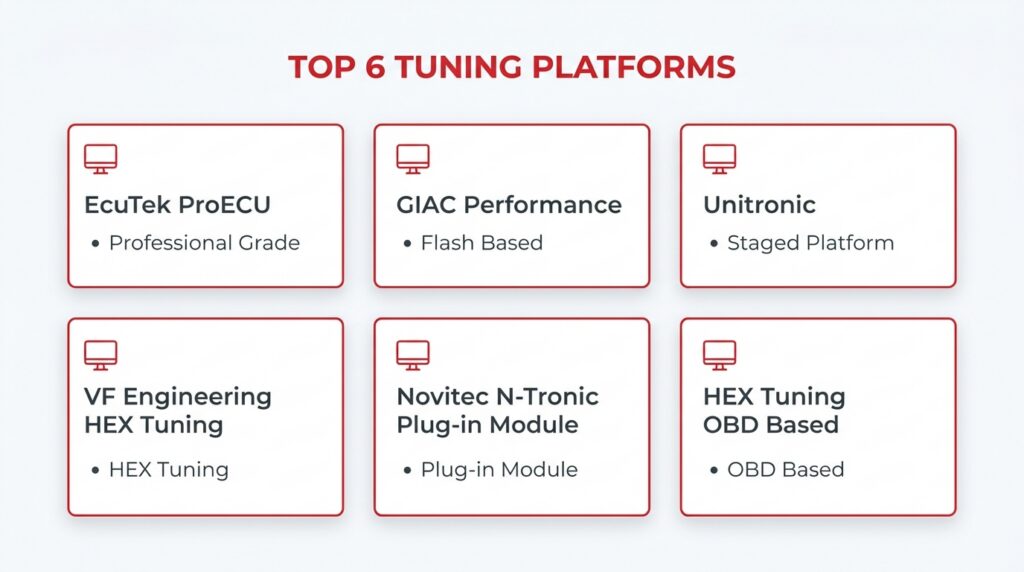
The best Lamborghini ECU tuning software options in 2026 include platforms ranging from plug-and-play modules to full custom flash solutions. The sections below cover six leading options: EcuTek ProECU, GIAC, Unitronic, VF Engineering, Novitec N-Tronic, and HEX Tuning.
EcuTek ProECU
EcuTek ProECU is a professional-grade ECU flashing platform widely used by authorized Lamborghini tuning specialists. It supports direct ECU communication for reading and writing calibration files, giving tuners precise control over fuel maps, ignition timing, and throttle response. Automotive specialists note that custom dyno calibrations delivered through platforms like ProECU consistently outperform generic box tunes in real-world performance gains.
GIAC Performance Tuning
GIAC Performance Tuning is a flash-based ECU software solution developed specifically for high-performance European vehicles, including select Lamborghini models. According to GIAC, its performance tuning products are intended for closed-course competition and are legal in California only for racing vehicles that may never be used on a public highway. Owners should confirm street-use compliance in their state before purchase.
Unitronic Performance Software
Unitronic Performance Software is a staged ECU tuning platform covering multiple Lamborghini models with verified power figures. Unitronic Stage 1 software for the Lamborghini Huracan 5.2L FSI V10 increases output to 660 HP and 590 LB-FT of torque, up from a stock 580 HP and 516 LB-FT. For owners seeking incremental gains, Unitronic’s tiered upgrade structure makes it one of the most scalable software solutions available.
VF Engineering ECU Flash
VF Engineering ECU Flash is a calibration solution delivered through the HEX Tuning platform, targeting Lamborghini Huracan variants with documented output improvements. It supports both daily-driven configurations and track-focused setups, making it a versatile option across the Huracan lineup.
Novitec N-Tronic Module
The Novitec N-Tronic module is a plug-in performance device that optimizes engine management without requiring a full ECU reflash. The NOVITEC Tectronic module is designed for use in combination with sport metal catalysts or cat-replacement pipes to prevent error indications from the exhaust system. This hardware dependency makes it best suited for owners already investing in an exhaust upgrade.
HEX Tuning Lamborghini Suite
HEX Tuning Lamborghini Suite is an OBD-based ECU software platform offering calibration files for multiple Huracan variants. It delivers measurable gains in throttle response and power output through dealer-flashed or remote-tuning workflows, and its competitive entry price makes it a practical starting point for Huracan owners exploring ECU upgrades for the first time.
What Are the Best Lamborghini ECU Hardware Upgrades for 2026?
The best Lamborghini ECU hardware upgrades for 2026 include performance air intakes, upgraded intercoolers, high-flow exhaust systems, and piggyback tuning modules. Each upgrade targets a specific constraint in the factory setup and works alongside ECU software recalibration for compounding gains.
Performance Air Intake Systems
Performance air intake systems increase airflow volume and reduce intake restriction entering the engine. On naturally aspirated V10 and V12 platforms like the Huracan and Revuelto, unrestricted cold air delivery directly supports ECU remaps that raise rev limits and sharpen throttle response. Upgraded intakes are typically the lowest-cost hardware entry point and serve as a prerequisite for higher-stage software tunes.
Upgraded Intercoolers and Heat Exchangers
Upgraded intercoolers reduce charge air temperature before it enters the engine, allowing the ECU to sustain higher boost targets without triggering thermal protection. On the turbocharged Urus, this is especially critical. The M-Engineering Power Package for the Lamborghini Urus bundles an ECU tune with upgraded intercoolers, priced at $8,990.00, reflecting how tightly these two upgrades are paired for consistent, heat-soak-resistant performance.
High-Flow Exhaust and Downpipe Systems
High-flow exhaust and downpipe systems reduce back pressure and improve exhaust scavenging efficiency. According to Lamborghini-Talk community tuners, sharper throttle response and enhanced power delivery on the Revuelto are achieved through ECU recalibration paired specifically with high-flow exhaust systems. Gintani’s ECU tune for the Revuelto is engineered to work in conjunction with their F1 exhaust featuring stainless steel headers, illustrating how software and exhaust hardware must be co-developed for optimal calibration.
Piggyback Tuning Modules
Piggyback tuning modules intercept and modify signals between factory sensors and the OEM ECU without directly flashing or replacing the stock unit. The NOVITEC Tectronic module operates on this principle, used in combination with sport metal catalysts or cat-replacement pipes to suppress error codes triggered by exhaust modifications. This approach suits owners who want reversible performance gains while preserving the factory ECU’s base programming intact.
How Much Does Lamborghini ECU Tuning Cost in 2026?
Lamborghini ECU tuning costs vary widely based on tune type, model, and included hardware. The following sections cover basic ECU flash pricing, custom dyno tune rates, and full stage upgrade package costs.

How Much Does a Basic ECU Flash Cost for a Lamborghini?
A basic ECU flash for a Lamborghini typically covers software-only solutions delivered via OBD-II port without custom calibration. HEX Tuning ECU software for the 2015–2019 Lamborghini Huracan (LP580-2/610-4) retails at $1,795.00, while VF Engineering’s performance ECU software for the 2018+ Lamborghini Urus is priced at $2,695.00. These off-the-shelf flash solutions are the most accessible entry point, but buyers should understand they deliver a fixed calibration rather than one tailored to their specific vehicle’s condition or supporting modifications.
How Much Does a Custom Dyno Tune Cost for a Lamborghini?
A custom dyno tune for a Lamborghini costs more than a basic ECU flash but delivers calibration mapped specifically to your engine’s live data. According to automotive specialists on Lamborghini-Talk, “box tunes” offer minimal gains compared to custom dyno calibrations for many Huracan owners, making price a primary factor in selection. Custom tuning sessions typically add labor, dyno time, and iterative calibration passes on top of software costs, placing them at a premium over pre-mapped solutions.
How Much Do Full Stage Upgrade Packages Cost?
Full stage upgrade packages for a Lamborghini combine ECU software with hardware components such as intercoolers, intakes, or exhaust systems. The M-Engineering Power Package for the Lamborghini Urus, which includes an ECU tune and intercoolers, is priced at $8,990.00. For owners who already hold a stage tune, incremental upgrades remain cost-efficient: Unitronic prices each stage step-up on the Urus at $150 USD, moving from Stage 1 to Stage 1+ or from Stage 1+ to Stage 2.
What Performance Gains Can You Expect from Lamborghini ECU Tuning?
Performance gains from Lamborghini ECU tuning vary by model, tune stage, and supporting hardware. The sections below break down realistic horsepower and torque increases across Stage 1, Stage 2, and Stage 3 calibrations.
What Horsepower Gains Does a Stage 1 Tune Deliver?
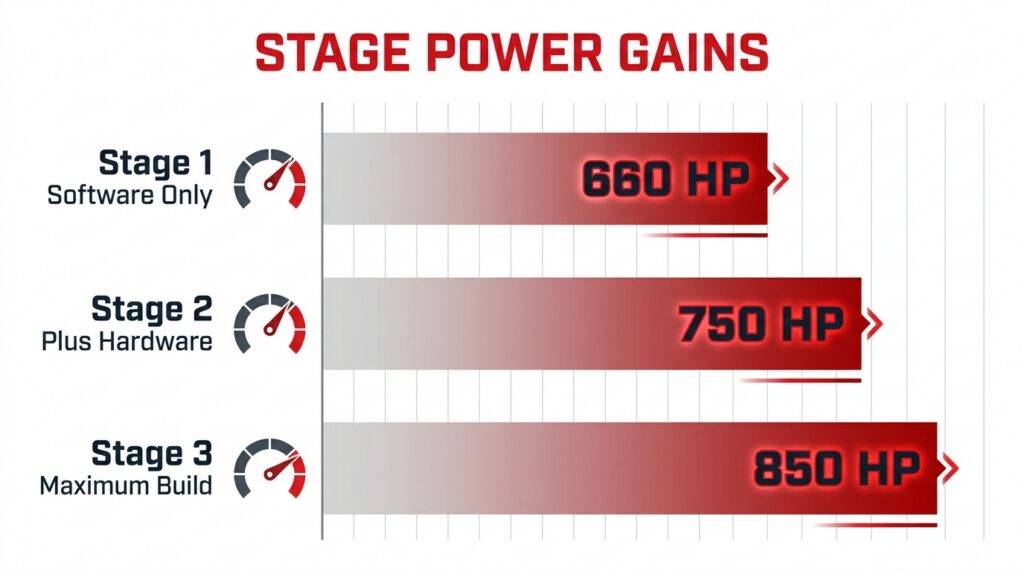
Stage 1 horsepower gains from Lamborghini ECU tuning are typically achieved through software-only recalibration, with no hardware modifications required. Unitronic Stage 1 performance software for the Lamborghini Huracan 5.2L FSI V10 increases output from a stock 580 HP and 516 LB-FT to 660 HP and 590 LB-FT. For the Revuelto, NOVITEC’s program lifts total output from 1,001 to 1,048 horsepower by pairing ECU recalibration with a custom exhaust system that reshapes the V12’s power delivery. Stage 1 represents the lowest-risk entry point into tuning, and for naturally aspirated Lamborghinis, it consistently delivers meaningful results without touching the drivetrain.
What Horsepower Gains Does a Stage 2 Tune Deliver?
Stage 2 horsepower gains from Lamborghini ECU tuning require supporting hardware, such as upgraded intercoolers, high-flow intake systems, or performance exhaust components. On turbocharged platforms like the Urus, Stage 2 calibrations unlock additional boost pressure that Stage 1 software cannot safely access without thermal management upgrades. The jump from Stage 1 to Stage 2 is where torque gains become most noticeable, particularly under sustained acceleration. For owners already running a Stage 1 tune, upgrading is cost-efficient given how tuners like Unitronic structure incremental pricing.
What Horsepower Gains Does a Stage 3 Tune Deliver?
Stage 3 horsepower gains from Lamborghini ECU tuning represent the most aggressive recalibration tier, typically requiring upgraded fuel systems, high-flow catalysts, and extensive supporting modifications. At this level, power delivery is limited by the engine’s mechanical ceiling rather than software constraints, making proper hardware preparation critical. Stage 3 calibrations are best suited for dedicated track builds or owners pursuing maximum output with full awareness of increased mechanical stress. This tier is not ideal for street-driven or leased vehicles, as the strain on drivetrain components increases substantially.
Is Lamborghini ECU Tuning Safe for the Engine and Drivetrain?
Lamborghini ECU tuning is safe for the engine and drivetrain when performed by a qualified specialist using software calibrated for the specific model. Professional tuners design their maps within the mechanical limits of Lamborghini’s engineering tolerances, preserving long-term reliability while extracting additional performance.
The safety of any tune depends on several key factors:
- Tuner experience: Specialists familiar with Lamborghini’s V10, V12, and twin-turbo V8 platforms understand the stock hardware limits and calibrate accordingly.
- Software quality: Reputable platforms such as VF Engineering HEX Tuning are engineered specifically for each model variant, reducing the risk of over-stressing components.
- Supporting hardware: Running increased power targets without matching fuel delivery, cooling, or intercooler upgrades places disproportionate stress on the drivetrain.
- Fuel quality: High-performance tunes typically require premium or higher-octane fuel to prevent knock, which can cause long-term engine damage if ignored.
- Conservative power targets: Stage 1 software tunes, which require no hardware modifications, carry the lowest risk profile and represent the safest entry point for most owners.
Aggressive modifications, such as removing rev limiters or running maximum boost without dyno verification, introduce measurable risk. Reputable tuners mitigate this through iterative dyno testing and conservative calibration margins. When tuning stays within verified limits and is paired with proper maintenance, the engine and drivetrain risks remain minimal.
Does ECU Tuning Void a Lamborghini Factory Warranty?
ECU tuning can void a Lamborghini factory warranty, but the outcome depends on how the modification is applied and whether Lamborghini can prove a causal link between the tune and any claimed failure. Understanding both Lamborghini’s warranty terms and your federal consumer rights is essential before proceeding.

What Is Lamborghini’s Factory Warranty Policy?
Lamborghini’s factory warranty provides three-year, unlimited-mileage coverage on all new vehicles from the date of delivery under normal conditions of use, according to Automobili Lamborghini’s official warranty documentation. Any modification that falls outside “normal conditions of use” gives Lamborghini grounds to deny warranty claims on affected components. ECU tuning, which alters factory calibration for fuel delivery, boost targets, and ignition timing, falls squarely into that territory. In practice, dealers can use diagnostic software to detect whether the ECU has been modified, making it difficult to conceal a tune during a warranty service visit.
Does the Magnuson-Moss Warranty Act Protect Tuned Lamborghinis?
The Magnuson-Moss Warranty Act protects tuned Lamborghinis in a limited but meaningful way. According to the Auto Care Association, the Act prohibits manufacturers from voiding an entire warranty simply because an aftermarket modification was installed. Lamborghini must demonstrate that the ECU tune directly caused the specific component failure being claimed. This means a tune cannot automatically void coverage for unrelated systems, such as interior electronics or suspension components. However, any powertrain claim, including engine, transmission, or drivetrain failures, is highly vulnerable to denial once a modified ECU is detected. Owners should treat powertrain warranty coverage as effectively forfeited after tuning.
Should You Disclose ECU Tuning to Your Lamborghini Dealer?
Disclosing ECU tuning to your Lamborghini dealer is a decision with significant financial consequences. Dealers routinely run diagnostic scans that log ECU modifications, so concealing a tune is rarely successful and can be considered fraud in warranty claim situations. Some tuning providers offer reversible flashes, allowing the ECU to be returned to stock calibration before a service appointment. While this approach is widely used, it carries risk: some manufacturers track cumulative modification flags that persist even after reversal. For owners of vehicles still under the three-year factory warranty, delaying an ECU tune until after the warranty period expires is the most financially sound strategy available.
How Do You Choose the Right ECU Tuning Shop for a Lamborghini?
Choosing the right ECU tuning shop for a Lamborghini requires evaluating credentials, model-specific experience, dyno capabilities, and software compatibility. The following criteria cover what separates qualified specialists from generalists.
Does the Shop Have Lamborghini-Specific Experience?
The right ECU tuning shop for a Lamborghini has documented, model-specific experience with platforms such as the Huracan, Urus, or Revuelto, not just general European performance vehicles. Lamborghini powertrains, including the Huracan’s 5.2L V10 with four factory fuel pressure sensors and the Revuelto’s hybrid V12 architecture, require tuners familiar with their unique knock control systems and hybrid integration. Ask directly for completed builds on the same model and engine variant you own.
What Certifications or Software Authorizations Should a Shop Hold?
The certifications a Lamborghini tuning shop should hold include authorized access to platforms such as Unitronic, VF Engineering HEX Tuning, or GIAC. These providers vet and approve dealers before granting flash access. Unauthorized tools risk corrupting factory calibrations. Verifying dealer status with the software brand directly takes minutes and eliminates significant risk.
Should You Prioritize a Shop with an In-House Dyno?
Yes, you should prioritize a tuning shop with an in-house dyno, because dyno validation confirms actual power output rather than estimated gains. Automotive specialists note that for many Huracan owners, box tunes offer minimal gains compared to custom dyno calibrations, making verified horsepower results a critical differentiator when selecting a shop.
How Important Are Customer Reviews for an ECU Tuning Shop?
Customer reviews are important for an ECU tuning shop because they surface real-world outcomes on specific models, reveal warranty dispute handling, and confirm whether stated power gains were dyno-verified. Prioritize reviews that include before-and-after figures and mention the specific Lamborghini variant tuned, as experience varies significantly between the Urus, Huracan, and Revuelto platforms.
What Should You Know Before Tuning a Leased or Rented Lamborghini?
Tuning a leased or rented Lamborghini carries significant legal and financial risks. The sections below cover how to experience a tuned Lamborghini without ownership and the key takeaways from this guide.
Can You Experience a Tuned Lamborghini Through an Exotic Car Rental?
Yes, you can experience a tuned Lamborghini through an exotic car rental, and it is often the most practical route for enthusiasts who want tuned performance without ownership obligations. Rental agreements strictly prohibit lessees or renters from modifying the vehicle’s ECU, so any performance tuning is exclusively the rental company’s decision. Standard exotic car insurance policies often exclude aftermarket modifications, creating coverage gaps that rental companies must address independently. According to Monza Exotics, exotic car rental companies utilize Supplemental Liability Protection (SLP) to provide extra liability coverage above the minimum provided by the rental agreement, helping close those gaps for tuned vehicles.
What Are the Key Takeaways About Lamborghini ECU Tuning in 2026?
The key takeaways about Lamborghini ECU tuning in 2026 center on performance potential, financial commitment, and legal boundaries. Every prospective tuner should understand these core points:
- Ownership matters most: ECU tuning a leased or financed Lamborghini without lender approval can trigger default clauses and void insurance coverage.
- Warranty risk is real: Factory warranty protection can be challenged following ECU modifications, even under Magnuson-Moss protections.
- Software quality varies: Custom dyno calibrations consistently outperform generic “box tunes” for meaningful, reliable power gains.
- Costs scale with ambition: Entry-level software flashes start under $2,000; full staged hardware packages can exceed $9,000.
- Rental is a zero-risk alternative: Fisher Luxury Rental lets drivers experience Lamborghini performance in Phoenix and Portland without modification liability.