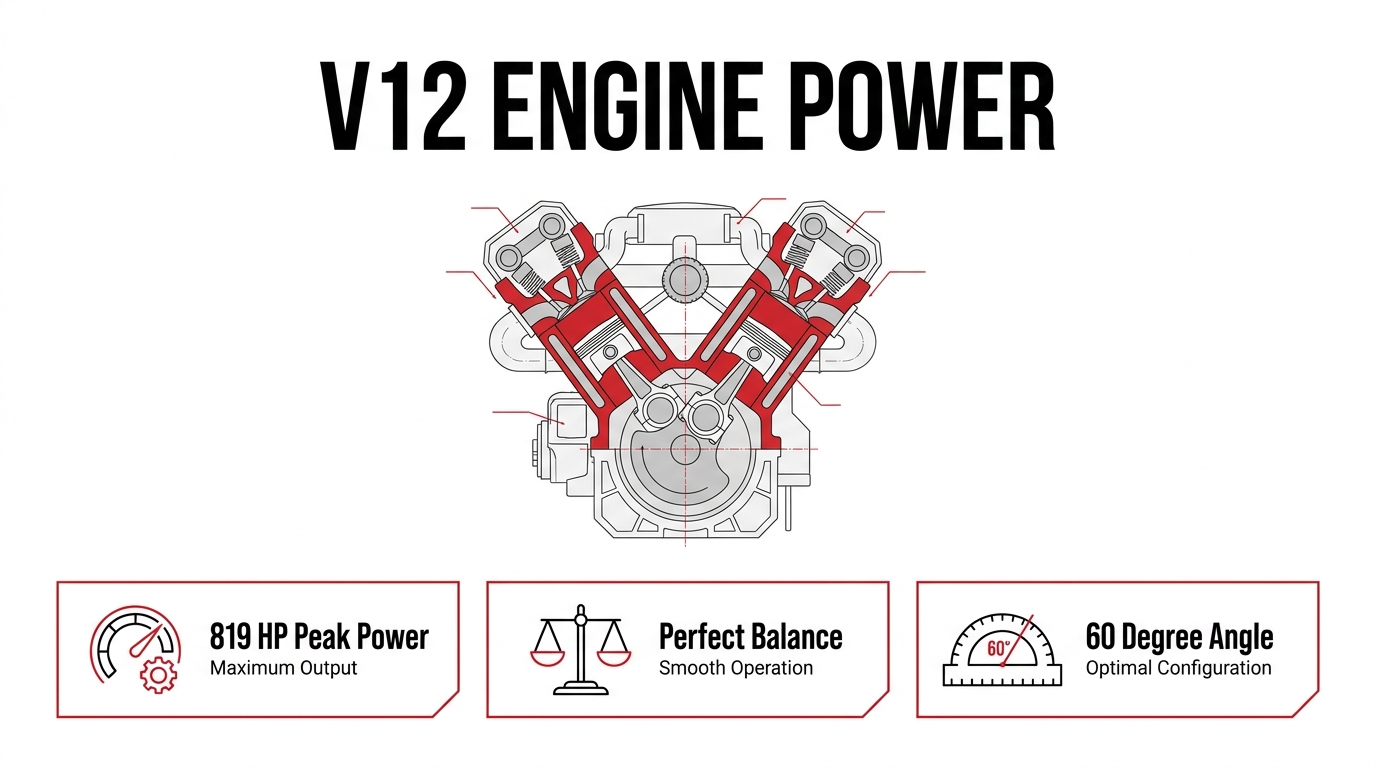
A V12 engine is an internal combustion engine with 12 cylinders arranged in two banks of six, set at a V-angle on a shared crankshaft. Its 60-degree bank geometry produces perfect primary and secondary mechanical balance, a quality no smaller V-configuration can match without artificial compensation.
This guide covers V12 engineering and physics, power delivery characteristics, the most powerful V12 cars in 2026, acoustic identity, how the configuration compares to rival layouts, and how the V12’s future is being shaped by emissions regulations and electrification.
We open with how the V12’s cylinder arrangement and firing order create its signature smoothness and refinement. Two straight-six banks, each inherently balanced, fire evenly every 60 degrees of crankshaft rotation, eliminating vibration that plagues V8 and V10 layouts.
From there, we examine how displacement and forced induction shape V12 power delivery differently. Naturally aspirated units like the Ferrari 12Cilindri reward high-rpm driving with immediate throttle response, while turbocharged variants like the Pagani Utopia generate over 800 lb-ft of torque from near idle.
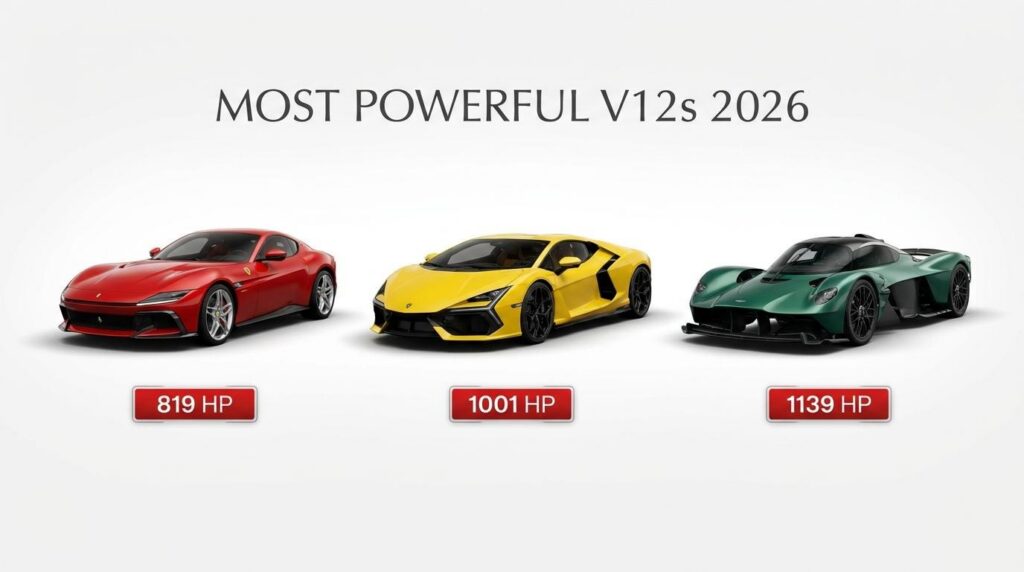
We then profile the most powerful V12 machines available in 2026, from the 819 hp Ferrari 12Cilindri to the 1,139 hp Aston Martin Valkyrie hybrid, and identify which six automakers still build V12 engines today.
Finally, we address what is pushing the V12 toward extinction, covering Euro 7 compliance costs and the electrification strategies replacing it, before explaining how exotic car rental makes the V12 experience accessible without ownership.
What Is a V12 Engine and How Does It Work?
A V12 engine is an internal combustion engine with 12 cylinders arranged in two banks of six, set at an angle to form a “V” shape on a shared crankshaft. The sections below cover what makes the cylinder configuration unique, why the layout produces natural balance, and how firing order creates the V12’s signature smoothness.

What Makes the V12 Cylinder Configuration Unique?
The V12 cylinder configuration is unique because it combines two inline-six banks into a single compact engine architecture, preserving the inherent natural balance of each six-cylinder bank while sharing one crankshaft. Most V-engine configurations, such as V6 or V8, require balance shafts or counterweights to suppress vibration. The V12 needs neither, making it mechanically self-contained in a way no smaller V-configuration can match. According to Stirlingkit, the world’s first V12, the “Craig-Dörwald” engine built in 1904 by Putney Motor Works, used a 90-degree bank angle and displaced 18.4 liters, demonstrating just how early engineers recognized the layout’s structural advantages.
Why Does a V12 Engine Produce Natural Balance?
A V12 engine produces natural balance because it consists of two straight-six banks, each inherently balanced, arranged at a 60-degree V-angle. According to Wikipedia, this configuration achieves perfect primary and secondary engine balance, eliminating the residual vibration forces that affect V8 and V10 layouts. The 60-degree bank angle is particularly significant: Car and Driver identifies it as the “Gold Standard” for mechanical balance, noting that 60 degrees divides evenly into 720 degrees of crankshaft rotation across 12 cylinders, producing a perfectly even firing interval. This geometry is not incidental; it is the physical reason a V12 idles and cruises with a refinement that engineers cannot replicate in smaller configurations without artificial compensation.
How Does Firing Order Contribute to V12 Smoothness?
Firing order contributes to V12 smoothness by distributing combustion events evenly across the engine’s 720-degree cycle, with each cylinder firing every 60 degrees of crankshaft rotation. No two consecutive power strokes overlap or cluster, so torque delivery remains continuous rather than pulsed. This even spacing eliminates the torque spikes that create vibration in engines with fewer cylinders, such as V8s firing every 90 degrees. The result is a power delivery that feels linear and uninterrupted at any rpm, a characteristic that makes V12 engines equally valued in ultra-luxury grand tourers and high-revving supercars alike.
Why Are V12 Engines Known for Smoothness and Refinement?
V12 engines are known for smoothness and refinement because their architecture achieves perfect mechanical balance, eliminating the vibrations that plague smaller configurations. The physics behind this balance, the resulting power delivery, and the sensory experience it creates all explain the configuration’s enduring appeal in luxury and performance vehicles.
According to Wikipedia, a four-stroke V12 engine achieves perfect primary and secondary balance because it consists of two straight-six banks, each inherently balanced, arranged at a 60-degree V-angle that produces an even firing event every 60 degrees of crankshaft rotation. No counterweights or balance shafts are needed to suppress vibration, which means the engine’s energy goes directly into smooth, uninterrupted power delivery rather than fighting itself.
This structural harmony translates directly into the cabin experience. Vibration through the steering wheel, seat, and floorboard is virtually absent at any rpm, a quality that no V8 or V10 can fully replicate without additional engineering compromises. Packard recognized this as early as 1915, when the “Twin Six” established the V12’s reputation for luxury smoothness in series production.
The refinement extends beyond feel. Naturally aspirated V12 engines deliver immediate throttle response and linear power buildup across a wide rpm band, without the torque surges or lag that turbocharged engines introduce. Road & Track describes the Lamborghini Revuelto as a vehicle that “perfectly balances sportiness with refinement” through its hybrid V12 architecture, capturing precisely why engineers still choose twelve cylinders when the experience matters as much as the numbers.
For drivers, this is the V12’s defining quality: it makes enormous power feel effortless.
What Are V12 Engines Known For in Terms of Power Delivery?
V12 engines are known for exceptionally smooth, linear power delivery across a broad rpm range. The three H3s below cover how displacement, forced induction, and aspiration method each shape the V12 power experience differently.

How Does Displacement Affect V12 Power Output?
Displacement directly affects V12 power output by determining how much air and fuel the engine can combust per cycle. Larger-displacement V12s generate more torque at lower rpm, while smaller, high-revving units prioritize peak horsepower. The contrast is striking across current production models:
- The Ferrari 12Cilindri uses a 6.5-liter naturally aspirated V12 producing 819 hp at 9,250 rpm.
- The Gordon Murray T.50 uses a 3.9-liter Cosworth V12 producing 654 hp but redlines at 12,100 rpm, the highest of any road car engine.
- The Rolls-Royce Cullinan Series II pairs a 6.75-liter twin-turbo V12 with its larger displacement to generate 627 lb-ft of torque.
Smaller displacement demands higher rpm to achieve peak output, whereas greater displacement builds torque earlier in the rev range. For drivers prioritizing accessible thrust over a screaming redline, larger-displacement units are often the more rewarding choice.
How Does Forced Induction Change V12 Performance?
Forced induction changes V12 performance by multiplying low-end torque output well beyond what displacement alone can produce. Turbocharging compresses intake air, allowing more fuel to burn per cycle and broadening the usable power band significantly. According to Autoevolution, the Pagani Utopia’s 6.0-liter twin-turbocharged Mercedes-AMG V12 generates 864 horsepower and 811 lb-ft of torque, numbers that would be unattainable without boost pressure at that displacement. The Rolls-Royce Cullinan Series II similarly uses twin turbos to produce 627 lb-ft from its 6.75-liter unit. The trade-off is a power delivery character that builds progressively with boost rather than climbing linearly with rpm, which fundamentally changes how the engine feels under acceleration.
How Does a Naturally Aspirated V12 Feel Compared to Turbo?
A naturally aspirated V12 feels immediate, linear, and directly connected to throttle input, while a turbocharged V12 delivers stronger low-end torque with a more progressive, surge-style power build. Naturally aspirated V12 engines are characterized by immediate throttle response and linear power delivery, whereas turbocharged variants provide significantly higher low-end torque but different acoustic profiles. The Ferrari 12Cilindri’s 6.5-liter naturally aspirated unit, revving freely to 9,500 rpm, rewards drivers who build through the rev range. A twin-turbo unit like the Rolls-Royce V12 delivers effortless, wave-like thrust from near idle. Neither is objectively superior; the right choice depends entirely on whether the driver values visceral mechanical engagement or serene, abundant torque.
Which Cars Have the Most Powerful V12 Engines in 2026?
The most powerful V12 engines in 2026 appear in a short list of hypercars and ultra-luxury vehicles, each taking a distinct approach to extracting performance from twelve cylinders. The sections below cover the Ferrari 12Cilindri, Lamborghini Revuelto, Aston Martin Valkyrie, Mercedes-AMG S 65 Final Editions, Pagani Utopia, Rolls-Royce V12 variants, and the Gordon Murray T.50.
Ferrari 812 Successor
The Ferrari 12Cilindri is the spiritual successor to the 812 Superfast, carrying forward Ferrari’s commitment to the naturally aspirated V12. According to Ferrari, its 6.5-liter V12 delivers 819 horsepower at 9,250 rpm, with a 9,500 rpm redline. Car and Driver notes that “the V12 soundtrack is one of the best in Ferrari history, especially in high revs.” Among naturally aspirated road cars in 2026, the 12Cilindri sets the benchmark for high-rpm character and acoustic intensity.
Lamborghini Revuelto
The Lamborghini Revuelto produces a combined 1,001 horsepower by pairing a 6.5-liter naturally aspirated V12 with three electric motors. According to Lamborghini, total system output reaches 1,015 CV, making the Revuelto the most powerful production Lamborghini ever built. Road & Track describes it as a vehicle that “perfectly balances sportiness with refinement,” offering road and track dominance through its hybrid V12 architecture.
Aston Martin Valkyrie
The Aston Martin Valkyrie features a 6.5-liter naturally aspirated V12 developed by Cosworth, producing a combined 1,139 horsepower when integrated with its hybrid system. That figure places the Valkyrie among the highest-output road-legal hypercars in existence. The Cosworth unit’s extreme compression and near-Formula 1 engineering allow it to operate at rpm levels unattainable by conventionally built V12s, making it one of the most technically advanced combustion power plants currently in production.
Mercedes-AMG S 65 Final Editions
The Mercedes-AMG S 65 Final Edition represents the end of AMG’s hand-built 6.0-liter twin-turbocharged V12 in the S-Class lineage. While active production has concluded, the Final Edition variant produced 621 horsepower and 738 lb-ft of torque. Mercedes-Benz has confirmed its V12 portfolio is being adapted to meet Euro 7 emissions regulations, preserving the configuration’s viability in select models through at least 2027.
Pagani Utopia
The Pagani Utopia is powered by a 6.0-liter twin-turbocharged V12 developed by Mercedes-AMG, generating 864 horsepower and 811 lb-ft of torque. That torque figure reflects the core advantage of turbocharged V12 architecture: massive low-end pulling power that naturally aspirated units cannot match. Paired with a manual gearbox option, the Utopia uses this output in one of the most driver-focused hypercar packages available in 2026.
Rolls-Royce Spectre V12 Variants
Rolls-Royce V12 variants in the current lineup, including the 2026 Cullinan Series II, use a 6.75-liter twin-turbocharged V12 producing 563 horsepower and 627 lb-ft of torque. Rolls-Royce has stated that the V12 engine will remain in production through the end of the decade, despite the brand’s announced transition to an all-electric lineup by 2030. The 6.75-liter unit prioritizes effortless torque delivery and near-silent refinement over outright peak power.
Gordon Murray T.50
The Gordon Murray T.50 uses a 3.9-liter Cosworth-developed V12 that produces 654 horsepower and revs to 12,100 rpm, the highest redline of any road car engine ever produced. Despite the relatively modest displacement, the T.50’s specific output and rev ceiling reflect a philosophy prioritizing mechanical purity over forced induction. In an era where hybrid assistance and turbocharging dominate power figures, the T.50 stands as the definitive argument for what a naturally aspirated V12 can achieve through engineering precision alone.
What Makes the V12 Sound Different From Other Engine Types?
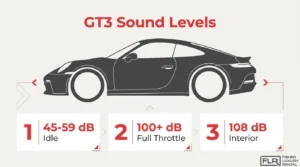
The V12 engine produces a more complex, higher-pitched exhaust note than V8 or V10 engines because its 12 cylinders generate higher-frequency dominant harmonics. Acoustic engineering research identifies a “12th” interval in the V12’s spectrum, compared to the simpler “8th” (octave) produced by a V8. The result is a layered, operatic tone that no fewer cylinders can replicate.
Three acoustic factors separate the V12 from other configurations:
- Firing frequency: 12 cylinders fire in rapid, evenly spaced succession, producing a denser, smoother sound wave than 8 or 10 cylinders.
- Harmonic complexity: Higher cylinder count generates richer overtones, creating that signature “choir” quality at high revs.
- Throttle character: Naturally aspirated V12s deliver an immediate, linear acoustic crescendo as rpm climb, while turbocharged variants like the Rolls-Royce or Pagani units produce deeper, more subdued notes shaped by boost pressure.
Car and Driver describes the Ferrari 12Cilindri’s V12 soundtrack as “one of the best in Ferrari history, especially in high revs,” capturing exactly why the configuration commands reverence. EVO Magazine characterizes the V12 Vantage’s sound as one that “hangs” like an engine with a heavy flywheel, emphasizing its distinct mechanical presence. In practice, no synthetic exhaust note engineering has yet matched what physics and 12 cylinders produce organically.
How Much Horsepower Can a V12 Engine Produce in 2026?
V12 engines in 2026 produce anywhere from 563 hp in luxury grand tourers to over 1,100 hp in hybrid hypercars. The sections below cover production V12 output, track-focused configurations, and hybrid-assisted systems.
How Much Power Do Production V12 Engines Make?
Production V12 engines make between 563 and 864 horsepower in 2026, depending on configuration and application. Naturally aspirated examples include the Ferrari 12Cilindri, which delivers 819 hp at 9,250 rpm from a 6.5-liter unit. At the other end of the spectrum, the 2026 Rolls-Royce Cullinan Series II produces 563 hp from a 6.75-liter twin-turbocharged V12, prioritizing torque and refinement over peak power. The Pagani Utopia, equipped with a Mercedes-AMG 6.0-liter twin-turbocharged V12, generates 864 hp alongside 811 lb-ft of torque. For grand touring applications, the turbocharged approach delivers the stronger low-end pull; for driver-focused machines, the naturally aspirated route remains the more rewarding choice.
How Much Power Do Track-Focused V12 Engines Make?
Track-focused V12 engines make exceptional power relative to their displacement, prioritizing high-revving output over torque. The Gordon Murray Automotive T.50 uses a 3.9-liter Cosworth-developed V12 producing 654 hp at a redline of 12,100 rpm, the highest of any road car engine ever built. This power-to-displacement ratio is extraordinary, and the engine’s character is defined by its ability to sustain peak output across an unusually wide rev range. For enthusiasts who prioritize mechanical engagement over raw numbers, this approach arguably delivers a more compelling experience than outputs twice as large.
How Much Power Do Hybrid-Assisted V12 Engines Make?
Hybrid-assisted V12 engines make the highest total outputs of any V12 configuration in 2026. The Lamborghini Revuelto pairs a 6.5-liter naturally aspirated V12 with three electric motors for a combined 1,001 hp, according to Lamborghini. The Aston Martin Valkyrie goes further, combining its Cosworth-developed 6.5-liter naturally aspirated V12 with a hybrid system to reach a combined 1,139 hp. Motor Trend also reports that the Bugatti Tourbillon, expected in summer 2026, features a hybrid V12 system representing the next evolution in hypercar powertrains. The hybrid formula allows manufacturers to preserve the V12’s acoustic and mechanical character while meeting modern performance benchmarks that combustion alone cannot achieve.
Which Automakers Still Build V12 Engines in 2026?
The automakers that still build V12 engines in 2026 are Ferrari, Lamborghini, Rolls-Royce, Aston Martin, Pagani, and Gordon Murray Automotive. Each approaches the configuration differently, from naturally aspirated purity to hybrid-assisted power, but all share a commitment to the V12 as a defining engineering statement.
The following manufacturers each represent a distinct philosophy in keeping the V12 alive:
- Ferrari (12Cilindri)
- Lamborghini (Revuelto)
- Rolls-Royce (Cullinan Series II)
- Aston Martin (Valkyrie)
- Pagani (Utopia)
- Gordon Murray Automotive (T.50)
Ferrari
Ferrari builds a naturally aspirated 6.5-liter V12 in the 12Cilindri, producing 819 horsepower at 9,250 rpm with a maximum redline of 9,500 rpm. The engine represents Ferrari’s purist approach to the configuration: no turbochargers, no hybrid assistance, just displacement and revs. For a road car, 9,500 rpm is extraordinary, and that rev ceiling is arguably the most compelling reason to choose this engine over any electrified alternative.
Lamborghini
Lamborghini builds the Revuelto around a 6.5-liter naturally aspirated V12 paired with three electric motors, generating a combined 1,001 horsepower. According to Road & Track, the Revuelto “perfectly balances sportiness with refinement,” delivering both road and track dominance through its hybrid V12 architecture. The hybrid system adds torque-fill at low rpm without dulling the V12’s high-rev character.
Rolls-Royce
Rolls-Royce builds its Cullinan Series II with a 6.75-liter twin-turbocharged V12 producing 563 horsepower and 627 lb-ft of torque. Rolls-Royce has confirmed the V12 will remain in production through the end of the decade, even as the brand transitions toward an all-electric lineup by 2030. No other manufacturer deploys a V12 so deliberately as a luxury instrument rather than a performance tool.
Aston Martin
Aston Martin builds the Valkyrie hypercar around a 6.5-liter naturally aspirated V12 developed by Cosworth, producing a combined 1,139 horsepower with its hybrid system. The Cosworth unit is purpose-engineered for extreme performance, reflecting Aston Martin’s commitment to V12 power at the pinnacle of its lineup.
Pagani
Pagani builds the Utopia with a 6.0-liter twin-turbocharged V12 sourced from Mercedes-AMG, delivering 864 horsepower and 811 lb-ft of torque. The Mercedes-AMG partnership gives Pagani access to a thoroughly developed forced-induction V12 without the cost of in-house development.
Gordon Murray Automotive
Gordon Murray Automotive builds the T.50 with a 3.9-liter Cosworth-developed V12 that revs to 12,100 rpm, the highest redline of any road car engine ever produced. At 654 horsepower, the T.50’s output appears modest beside hybrid rivals, but its power-to-weight philosophy makes raw numbers secondary to the driving experience.
Why Are V12 Engines Becoming Rare in Modern Supercars?
V12 engines are becoming rare because two converging pressures, tightening global emissions standards and the accelerating shift toward electrification, make them increasingly difficult and costly to justify in production. The following sections cover how regulations and electrification each contribute to the V12’s decline.
How Do Emissions Regulations Affect V12 Production?
Emissions regulations affect V12 production by raising compliance costs and technical complexity to levels that are difficult to sustain at low volumes. Euro 7 standards, set for full implementation by 2027, require light-duty vehicles to maintain emissions below strict limits for at least 10 years or 124,000 miles, according to Global MRV. Under EPA 2026 model year limits, fleet-average CO2 must not exceed 170 grams per mile, a threshold that a large-displacement V12 struggles to meet without significant hybrid assistance or engine downsizing. Mercedes-Benz has adapted its V12 portfolio to meet Euro 7, extending viability through at least 2027, but the engineering investment required is considerable. For low-volume supercar producers, those costs are prohibitive without the scale to spread them across hundreds of thousands of units.
How Does Electrification Threaten the V12’s Future?
Electrification threatens the V12’s future by replacing it with lighter, more efficient powertrains that deliver comparable or superior performance figures. Between 2015 and 2026, manufacturers including BMW and Mercedes-Benz have phased out V12 configurations in flagship sedans, choosing electrified V8 or V6 alternatives instead. Rolls-Royce has announced a full transition to an electric lineup by 2030, though the V12 will remain in production for current models through the end of the decade. The most likely survival path for the V12 is the hybrid route already taken by the Lamborghini Revuelto, where electric motors compensate for efficiency shortfalls while preserving the engine’s character. Limited-production V12 models tend to hold collectible value precisely because buyers recognize the configuration is finite.
What Is the Difference Between a V12 and a Twin-Turbo V8?
The difference between a V12 and a twin-turbo V8 comes down to cylinder count, power delivery character, acoustic profile, and mechanical complexity. A V12 offers superior natural balance and a high-revving, linear power curve, while a twin-turbo V8 trades some smoothness for greater low-end torque and packaging efficiency.
The key differences span four dimensions:
- Engine balance and smoothness
- Power delivery and throttle response
- Sound character
- Size, weight, and emissions compliance
Engine Balance: V12 vs. Twin-Turbo V8
A V12 engine achieves perfect primary and secondary balance because its two straight-six banks, arranged at a 60-degree angle, fire evenly every 60 degrees of crankshaft rotation. No counterweights or balance shafts are needed. A twin-turbo V8 requires additional engineering to suppress the inherent secondary imbalance that its eight-cylinder firing sequence produces. For drivers who prioritize mechanical refinement, the V12’s natural balance is a genuine advantage that no turbocharged V8 can fully replicate.
Power Delivery: Linear vs. Torque-Led
A V12 engine delivers power linearly across a wide rev range, rewarding drivers who push toward the redline. Naturally aspirated V12 engines offer immediate throttle response with no turbo lag, whereas a twin-turbo V8 produces significantly higher low-end torque but introduces a brief lag before boost builds. The Pagani Utopia’s 6.0-liter twin-turbocharged V12 demonstrates that forced induction can also be applied to a V12 to generate 864 horsepower and 811 lb-ft of torque, combining both philosophies.
Sound: Acoustic Profile Comparison
A V12 engine produces a higher-pitched, more complex exhaust note than a V8 because its 12 cylinders generate higher-frequency dominant harmonics, specifically producing a “12th” interval in its acoustic spectrum compared to the “8th” interval of a V8. A twin-turbo V8 typically sounds deeper and more aggressive at low rpm but lacks the stratospheric, mechanical shriek a V12 produces near its redline. This acoustic difference alone is why many enthusiasts consider the V12 irreplaceable.
How Does a V12 Compare to a V10 or Flat-12 Engine?
A V12 compares to a V10 and flat-12 through differences in balance, packaging, acoustic character, and power delivery. The sections below cover how each configuration differs in smoothness, sound, and real-world application.
V12 vs. V10: Balance and Character
A V12 outperforms a V10 in mechanical balance because its 60-degree bank angle produces perfect primary and secondary balance, whereas a V10 generates minor secondary vibrations due to uneven firing intervals. The V12 fires every 60 degrees of crankshaft rotation; a V10 fires every 72 degrees, creating a less uniform pulse. According to Car and Driver, the V12’s 60-degree bank angle is considered the “Gold Standard” for mechanical balance, as its firing events divide evenly into the 720-degree cycle. A V10 compensates with raw, aggressive character, which is why Formula 1 favored it during the 2000s. For refinement and long-distance comfort, the V12 holds a clear advantage.
V12 vs. Flat-12: Packaging and Sound
A V12 differs from a flat-12 primarily in installation height and center of gravity. The flat-12, used historically in Ferrari’s Formula 1 cars, mounts cylinders horizontally in two opposing banks, lowering the car’s mass center for better handling. However, its wide footprint makes road car packaging impractical. Both configurations share the 12-cylinder acoustic richness, producing higher-frequency harmonics than a V8 or V10, but the V12’s upright V-arrangement fits conventional engine bays without the width penalty. For road cars, the V12’s geometry remains far more versatile than the flat-12’s demanding layout.
How Can You Experience a V12 Engine Without Buying One?
You can experience a V12 engine without buying one through exotic car rental services that include V12-powered vehicles in their fleets. The sections below cover Fisher Luxury Rental’s exotic car offerings and the key takeaways from V12 engine power and legacy.
Does Fisher Luxury Rental Offer V12 Exotic Cars to Drive?
Fisher Luxury Rental offers an exclusive selection of exotic supercars and luxury performance vehicles for rental in Phoenix, Arizona, as well as locations in Oregon and Washington. The fleet includes models such as the Ferrari 488 Spider and the Ferrari California T Convertible, giving drivers access to high-performance Italian engineering without ownership costs.
Naturally aspirated V12 engines deliver immediate throttle response and linear power, while turbocharged V12 variants provide higher low-end torque with different acoustic profiles. Renting puts both experiences within reach for a single day. For anyone who has read about 819-horsepower Ferrari powertrains or 1,001-horsepower Lamborghini hybrid systems and wants the real sensation behind the wheel, rental is the most accessible path. Fisher Luxury Rental brings that level of performance within reach in Phoenix and Portland.
What Are the Key Takeaways About V12 Engine Power and Legacy?
The key takeaways about V12 engine power and legacy are that the configuration represents the pinnacle of naturally aspirated performance, acoustic refinement, and mechanical balance in automotive history. As manufacturers shift toward electrification, the V12’s window is narrowing, making today’s examples increasingly significant.
The most important conclusions from this article are:
- The V12’s 60-degree bank angle produces perfect primary and secondary balance, setting it apart from every other common engine layout.
- Peak 2026 V12 output ranges from 654 hp in the Gordon Murray T.50 to a combined 1,139 hp in the Aston Martin Valkyrie’s hybrid system.
- Rolls-Royce plans to maintain V12 production through the end of the decade before transitioning to an all-electric lineup by 2030.
- Exotic car rental offers the most practical way to experience V12 performance without the acquisition cost of a six- or seven-figure vehicle.
The V12 is not simply an engine; it is a benchmark. Driving one now, while these machines are still being built, is an opportunity worth taking.