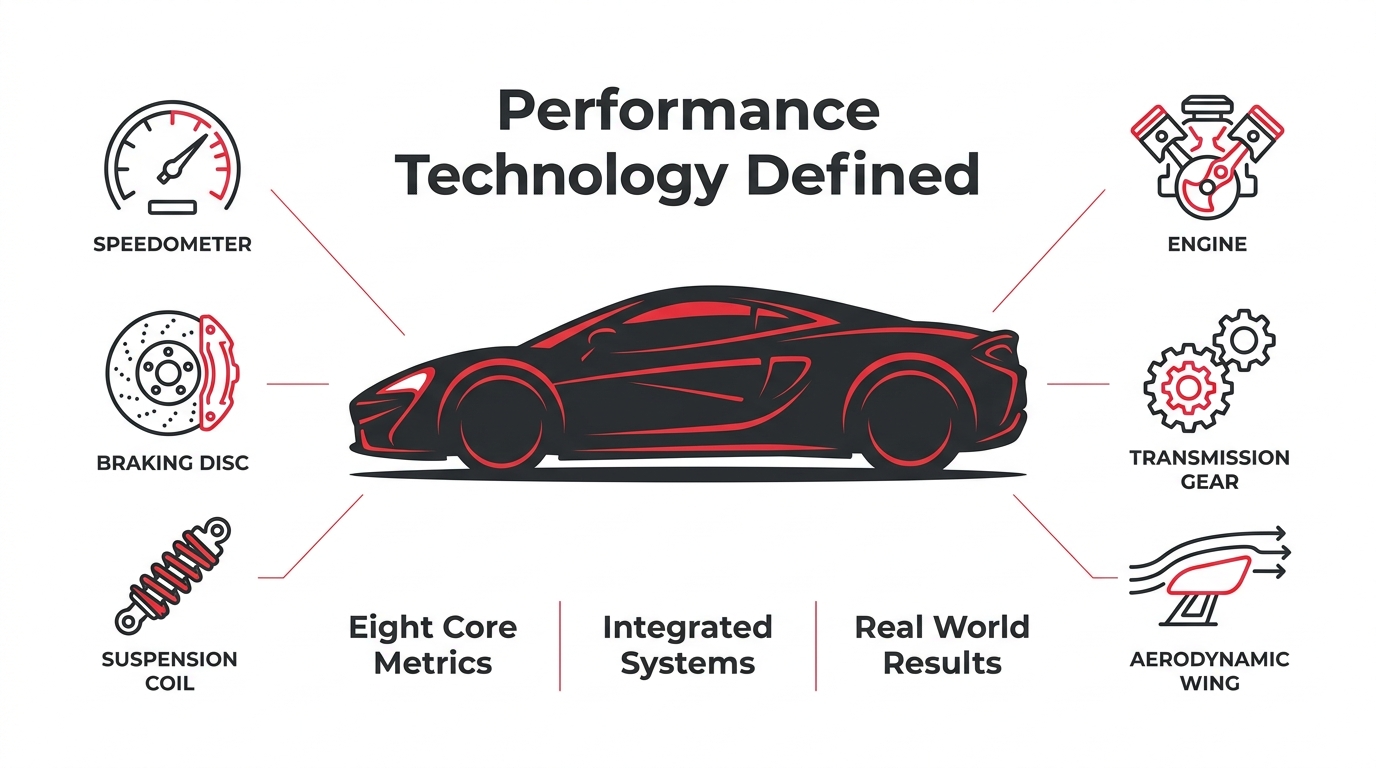
Car performance technology is the integrated set of mechanical and electronic systems that govern how a vehicle accelerates, handles, brakes, and sustains speed. These systems, spanning powertrain architecture, aerodynamic design, transmission behavior, suspension response, and braking precision, work together to translate raw engine output into measurable, controllable motion.
This guide covers core performance metrics, the powertrain technologies that generate them, transmission and aerodynamic systems that shape them, suspension and braking hardware that refine them, and the gap between manufacturer specifications and real-world driving.
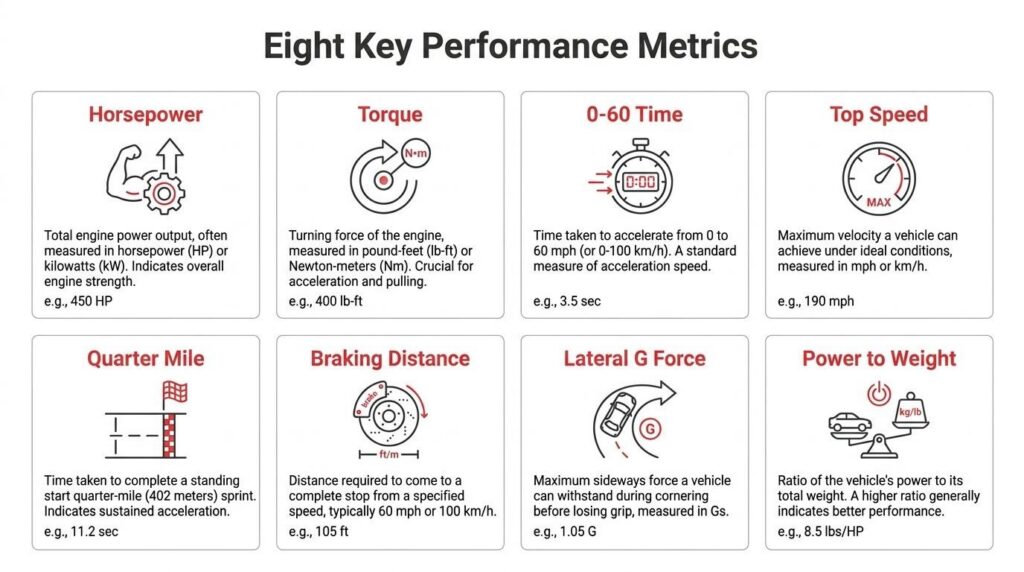
The eight standard metrics (horsepower, torque, 0-60 mph time, top speed, quarter-mile time, braking distance, lateral g-force, and power-to-weight ratio) each isolate a specific capability. SAE International’s J2944 Recommended Practice establishes consistent definitions for these measures, making cross-vehicle comparison meaningful rather than arbitrary.
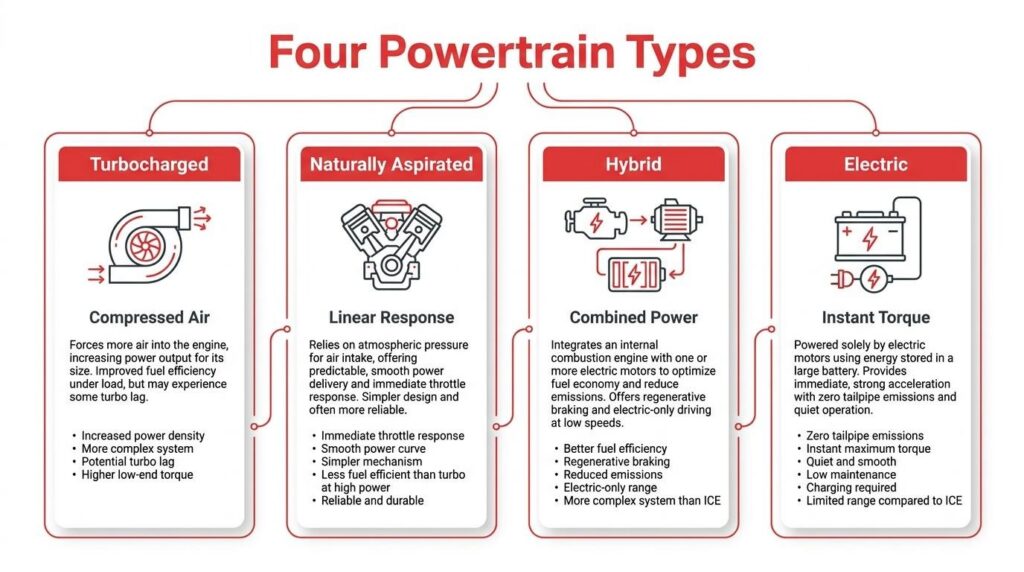
Engine architecture determines where those numbers begin. Turbocharged engines compress air for greater output per displacement, naturally aspirated units deliver linear throttle response with minimal lag, hybrid systems stack electric torque on top of combustion power, and fully electric motors produce maximum torque instantaneously across the entire RPM range.
Transmission choice, aerodynamic load, suspension tuning, and braking hardware then determine how cleanly that power reaches the road. Dual-clutch systems shift in 100 to 200 milliseconds; active aerodynamic surfaces balance downforce and drag simultaneously; adaptive suspension keeps tire contact consistent through corners; and carbon-ceramic brakes maintain friction at temperatures up to 1,400°C where steel setups begin to fade.
Finally, published specifications represent controlled-condition results. Real-world variables such as altitude, temperature, and road surface regularly produce outcomes that diverge from the figures on a manufacturer’s spec sheet.
What Does Car Performance Technology Mean?
Car performance technology refers to the engineering systems, hardware, and design principles that determine how a vehicle accelerates, handles, brakes, and sustains speed. This section covers what the term encompasses and why its core metrics matter.
What Is Car Performance Technology?
Car performance technology is the integrated set of mechanical and electronic systems that govern a vehicle’s dynamic capabilities, including its engine output, aerodynamic profile, transmission behavior, suspension response, and braking precision. These systems work together to translate raw power into measurable, controllable motion across real-world driving conditions.
The term covers everything from powertrain architecture to chassis engineering, and understanding it requires knowing how each subsystem contributes to the overall driving experience. For enthusiasts and renters of exotic vehicles alike, performance technology is what separates a genuinely capable machine from one that simply looks the part.
Why Do Performance Metrics Matter?
Performance metrics matter because they provide objective, standardized measurements that allow drivers, engineers, and reviewers to compare vehicles accurately. Without consistent measurement standards, claims like “fast” or “powerful” are meaningless. The SAE J2944 Recommended Practice, published by SAE International, establishes standard definitions for driving performance measures to ensure consistency across automotive research and testing.
Metrics such as horsepower, torque, braking distance, and lateral g-force each isolate a specific capability, giving a complete picture of what a vehicle can do. In practice, these numbers inform purchasing decisions, track preparation, and rental selection.
What Is the Difference Between “Quickest” and “Fastest”?
“Quickest” and “fastest” are distinct performance terms: quickest refers to acceleration (how rapidly a vehicle reaches a given speed), while fastest refers to top speed (the maximum velocity a vehicle can sustain). The two are frequently confused but measure entirely different performance characteristics.
A car can be the quickest in its class without holding the highest top speed, and vice versa. This distinction is fundamental when interpreting 0-60 mph times versus Vmax figures in manufacturer specifications or review data.
What Are the Key Metrics Used to Measure Car Performance?
The key metrics used to measure car performance include horsepower, torque, 0-60 mph time, top speed, quarter-mile time, braking distance, lateral G-force, and power-to-weight ratio. According to SAE International, the SAE J2944 Recommended Practice establishes standard names and functional definitions for these driving performance measures to ensure consistency across automotive research. The sections below define each metric and explain what it reveals about a vehicle.
Horsepower
Horsepower measures an engine’s ability to perform work over time. Higher horsepower numbers indicate greater sustained output, which directly translates to higher top speeds and stronger overall performance across extended acceleration runs. Certified horsepower figures follow SAE Method J1349, which standardizes how manufacturers report maximum engine output.
Torque
Torque is a rotating force produced by an engine’s crankshaft. The more torque an engine produces, the greater its ability to perform work at any given moment, which explains why high-torque vehicles feel more responsive during initial acceleration and low-speed pulling. While horsepower determines sustained performance, torque governs how quickly that performance is delivered off the line.
0-60 MPH Acceleration Time
The 0-60 mph acceleration time measures how quickly a vehicle reaches 60 mph from a standstill. It is the most widely used benchmark for comparing everyday performance across vehicle classes, capturing powertrain output, drivetrain efficiency, and launch control capability in a single number.
Top Speed
Top speed measures the maximum velocity a vehicle can sustain under ideal conditions. It reflects the balance between engine power output and aerodynamic drag, meaning two vehicles with identical horsepower figures can have meaningfully different top speeds depending on their drag coefficients and gearing.
Quarter-Mile Time
The quarter-mile time measures elapsed time and terminal speed across a 1,320-foot straight-line distance. The National Hot Rod Association uses this 1,320-foot standard as the benchmark for drag racing, making it one of the most recognized objective tests for comparing acceleration performance across different vehicle classes.
Braking Distance
Braking distance is the distance a vehicle travels from the point when its brakes are fully applied to when it comes to a complete stop. According to Trafitec braking trial research, professional test drivers achieve average deceleration values of 8.1 to 8.6 m/s² on dry roads, with wet-road values ranging from 7.2 to 8.5 m/s², demonstrating how significantly surface conditions affect stopping performance.
Lateral G-Force
Lateral G-force measures the cornering acceleration a vehicle generates during a turn, expressed in units of gravitational force. Higher lateral G-force values indicate that a vehicle can corner at greater speeds without losing grip, making this metric especially relevant for evaluating suspension tuning, tire performance, and chassis rigidity in performance cars.
Power-to-Weight Ratio
Power-to-weight ratio measures how much horsepower a vehicle produces relative to its total mass, typically expressed in horsepower per pound or kilogram. It is often a more accurate predictor of real-world performance than horsepower alone, since a lighter vehicle with moderate power can outperform a heavier vehicle with a larger engine in acceleration, braking, and cornering responsiveness.
How Does Engine Technology Affect Car Performance?
Engine technology affects car performance by determining how effectively a powertrain converts fuel or electrical energy into usable power. The following sections cover four core powertrain types: turbocharged engines, naturally aspirated engines, hybrid systems, and fully electric motors.
How Do Turbocharged Engines Improve Performance?
Turbocharged engines improve performance by forcing compressed air into the combustion chamber, enabling more fuel to burn per cycle and increasing power output without enlarging engine displacement. According to SAE International, turbocharged engines offer high performance with low CO2 emissions, which has driven significant industry-wide downsizing. Altitude also limits this advantage: reduced air density at elevation decreases oxygen availability, which directly lowers combustion efficiency in any forced-induction system. Turbocharging remains one of the most practical tools for balancing output with emissions targets across performance and mainstream segments alike.
How Do Naturally Aspirated Engines Deliver Performance?
Naturally aspirated engines deliver performance by drawing air into the cylinders at atmospheric pressure, relying entirely on displacement, compression ratio, and engine tuning for power. When properly tuned, naturally aspirated engines exhibit minimal throttle delay from 5% to 100% output, unlike the inherent lag found in turbocharged systems. Modern performance hybrids such as the LaFerrari pair a 6.3-liter naturally aspirated V-12 with a KERS-style hybrid system to supplement peak output. The linear power delivery of naturally aspirated engines makes them a preferred choice for drivers who prioritize precise throttle response over raw peak figures.
How Do Hybrid Powertrains Enhance Performance Metrics?
Hybrid powertrains enhance performance metrics by combining an internal combustion engine with one or more electric motors, allowing the system to deploy instant electric torque alongside sustained combustion power. The LaFerrari’s KERS-derived hybrid architecture supplements its V-12 at peak load moments, improving acceleration without adding displacement or forced induction. This dual-source approach compresses 0-60 times and strengthens power-to-weight ratios that neither powertrain type could achieve independently. Hybrid systems represent a transitional technology that delivers measurable gains across nearly every tracked performance benchmark.
How Do Fully Electric Motors Change Performance Dynamics?
Fully electric motors change performance dynamics by delivering maximum torque instantaneously across the full RPM range, eliminating the power band constraints present in combustion engines. Tesla Model S electric motors can achieve efficiency levels as high as 94% according to manufacturer claims. However, BMW M CEO Frank van Meel has noted that “a proper supercar is ‘not here yet,’” acknowledging that high-performance electric vehicles still face engineering challenges in replicating the sustained, driver-connected experience of combustion supercars. Emerging technologies such as magneto-rheological fluid clutches, which transition from liquid to solid in milliseconds, may further close that gap as electric performance platforms mature.
What Role Does Transmission Technology Play in Performance?
Transmission technology plays a direct role in how quickly and smoothly a car delivers engine power to the wheels. The following sections cover how dual-clutch, traditional automatic, and manual transmissions each affect acceleration, smoothness, and driver engagement.
How Does a Dual-Clutch Transmission Improve Acceleration?
A dual-clutch transmission improves acceleration by pre-selecting the next gear while the current gear is still engaged, eliminating the power gap between shifts. According to SAE International, a DCT can complete a gear change in approximately 100 to 200 milliseconds, significantly reducing torque interruption. The system uses at least two clutch discs: one handling odd-numbered gears and one handling even-numbered gears, allowing both to operate in parallel. This architecture makes the DCT one of the most effective transmission types for sustained hard acceleration.
How Does a Traditional Automatic Compare for Performance?
A traditional automatic transmission compares to a DCT with notably smoother, more refined gear changes due to its torque converter design. That smoothness comes at a cost: conventional torque converter automatics generally shift more slowly than DCTs, though shift times have improved considerably across many models over the past decade. For drivers prioritizing comfort over outright acceleration, the traditional automatic remains a compelling choice.
How Does a Manual Transmission Affect Driver Engagement?
A manual transmission affects driver engagement by placing full control of gear selection, clutch timing, and shift rhythm in the driver’s hands. No algorithm selects the gear for you; every decision is deliberate. Enrico Galliera of Ferrari stated that “Ferrari is not interested in self-driving technology,” a position that reflects how brands with a heritage of driver-focused performance view the human connection in driving as non-negotiable. For enthusiasts, the manual transmission is less a performance tool and more a philosophy.
With transmission choice settled, aerodynamic design becomes the next major variable shaping how a car performs at speed.
How Do Aerodynamics Influence Car Performance Metrics?
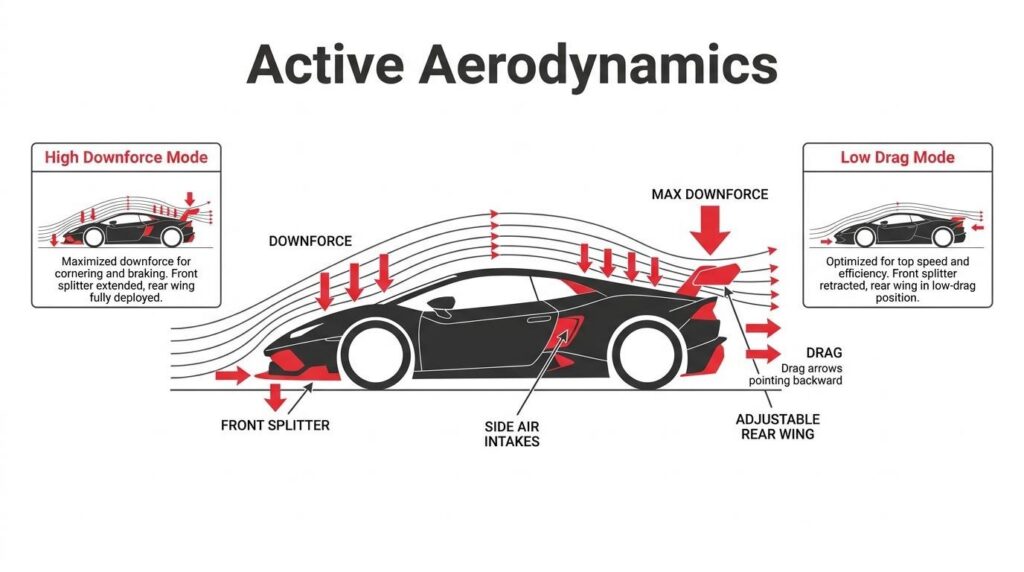
Aerodynamics influence car performance metrics by shaping how air interacts with a vehicle’s body, directly affecting downforce, drag, and stability. The following sections cover how active systems function at speed, how downforce translates into lateral g-force, and how drag reduction unlocks higher top speeds.
How Does Active Aerodynamics Work at High Speeds?
Active aerodynamics works by automatically adjusting movable surfaces, such as wings, flaps, and spoilers, in real time to balance downforce and drag as speed increases. The Porsche 911 GT3 RS with the Manthey Kit demonstrates this capability clearly, producing more than 1,000 kg of downforce at 285 km/h, enabling higher cornering speeds. At the regulatory level, the 2026 Formula 1 regulations will introduce sweeping changes to how racing vehicles actively manage both downforce and drag simultaneously. Active systems represent one of the most impactful advances in performance engineering, because they deliver track-tuned aerodynamic behavior without the top-speed penalty that fixed high-downforce setups impose.
How Does Downforce Affect Cornering and Lateral G-Force?
Downforce affects cornering and lateral g-force by pressing the tires harder into the road surface, increasing the grip available for directional changes. According to Wikipedia’s Skidpad entry, lateral acceleration is measured in meters per second squared (m/s²) or scaled to g-force units, making it the direct metric through which aerodynamic load becomes quantifiable. Greater downforce raises the ceiling on achievable lateral g before tire slip occurs, allowing drivers to sustain higher cornering speeds on circuit layouts.
How Does Drag Reduction Improve Top Speed?
Drag reduction improves top speed by lowering aerodynamic resistance on straights, allowing the engine’s power output to accelerate the vehicle more effectively. According to COMSOL, drag reduction systems (DRS) use movable aerodynamic elements to reduce air resistance on straights while maintaining high downforce through corners. The trade-off between peak downforce and low drag is the central engineering tension in performance vehicle design, and active systems that solve both simultaneously represent the current frontier of the discipline.
What Suspension and Handling Technologies Improve Performance?
Suspension and handling technologies improve performance by increasing grip, stability, and traction across varying road and driving conditions. The sections below cover adaptive suspension, all-wheel drive, and electronic stability systems.
How Does Adaptive Suspension Improve Cornering?
Adaptive suspension improves cornering by automatically adjusting damper stiffness in real time based on road and body-motion inputs. Semi-active coilover systems, for example, use wheel- and body-acceleration sensors to tune damping fully automatically, keeping the tire contact patch more consistently pressed against the road surface. The result is reduced body roll and improved lateral grip through corners. For drivers, this means a vehicle that feels planted and responsive without the harshness of a fully rigid race setup. Adaptive suspension is one of the most underappreciated technologies in performance cars because it simultaneously improves comfort and lap times.
How Does All-Wheel Drive Affect Acceleration Metrics?
All-wheel drive affects acceleration metrics by distributing engine torque across all four wheels simultaneously, reducing wheelspin during hard launches. When power reaches all four contact patches instead of two, traction improves significantly, particularly from a standing start on low-grip surfaces. This is why AWD performance vehicles consistently post faster 0-60 mph times than comparable rear-wheel-drive models under real-world conditions. The trade-off is added weight and mechanical complexity, which can slightly reduce top-end efficiency.
How Do Electronic Stability Systems Enhance Performance?
Electronic stability systems enhance performance by detecting and correcting oversteer and understeer through selective brake application and throttle reduction. These systems monitor steering angle, yaw rate, and lateral acceleration, then intervene within milliseconds to keep the vehicle on its intended path. On performance vehicles, stability systems are typically tunable, allowing drivers to reduce intervention thresholds in sport modes while retaining a safety baseline. The combination of these three technologies, adaptive suspension, AWD, and electronic stability control, creates a measurable improvement in both objective lap metrics and driver confidence.
How Do Braking Technologies Impact Performance?
Braking technologies directly affect stopping distance, pedal feel, and fade resistance under repeated hard use. The subsections below cover carbon-ceramic brake performance and brake-by-wire response improvements.
How Do Carbon-Ceramic Brakes Reduce Stopping Distance?
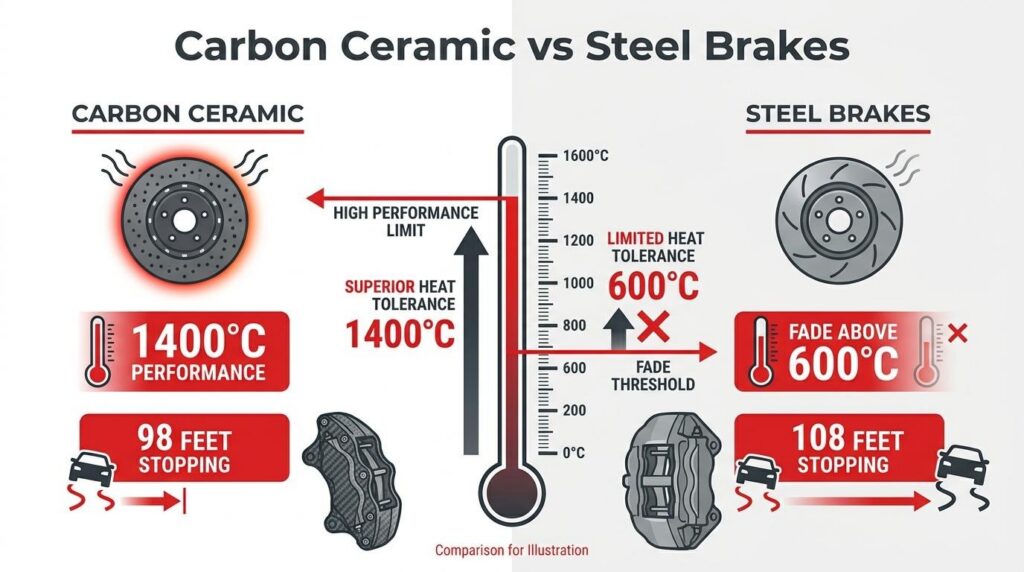
Carbon-ceramic brakes reduce stopping distance by maintaining consistent friction at extreme temperatures, where standard steel brakes begin to fade. According to CMC Materials, carbon-ceramic brakes maintain effectiveness at temperatures up to 1,400°C, delivering fade-free performance after repeated hard stops.
Real-world testing confirms the advantage: in comparative testing, a BMW M4 with optional carbon-ceramic brakes stopped from 60 mph in 98 feet, while a Lexus RC F with standard steel brakes required 108 feet. Beyond stopping power, carbon-ceramic discs outlast steel brakes by at least a 3:1 ratio in replacement intervals, making them a long-term performance investment despite their higher upfront cost.
How Does Brake-by-Wire Technology Improve Response?
Brake-by-wire technology improves response by replacing conventional hydraulic lines with electronic actuators, enabling faster, more precise braking inputs. Steel-sheathed brake lines further support this goal: by reducing line expansion under pressure, they deliver a more direct pedal feel and shorter response times. Taken together, these technologies represent a meaningful shift in how braking precision is achieved at the hardware level.
What Is the Difference Between Performance on Paper and Real Driving?
The difference between performance on paper and real driving is that laboratory-tested specifications rarely translate directly into what a driver experiences on public roads. Manufacturer figures represent ideal, controlled conditions, while real-world results vary with environment, driver behavior, and vehicle condition.
Why Do Manufacturer Specs Differ from Real-World Results?
Manufacturer specs differ from real-world results because testing occurs under controlled laboratory conditions that most drivers never replicate. According to the Australian Automobile Association, the gap between lab tests and real-world vehicle performance is widening, with some vehicles failing to match their lab results in independent testing. Environmental factors play a significant role: altitude reduces air density, which limits oxygen availability for combustion and directly lowers engine output. Temperature, road surface, and load conditions add further variability. Car manufacturer performance reports also contain inconsistencies that independent assessments frequently challenge, meaning the headline numbers on a spec sheet should be treated as a ceiling, not a guarantee.
How Do Horsepower and Torque Figures Translate to the Road?
Horsepower and torque figures translate to the road differently depending on when and how each force is applied. According to Amsoil, horsepower measures an engine’s ability to perform work over time, while torque measures the ability to perform work at a given moment. In practical terms, torque determines how forcefully a car accelerates from a standstill or when overtaking, while horsepower sustains speed at higher RPMs. A car with impressive peak horsepower but modest low-end torque can feel sluggish in everyday traffic despite a strong spec sheet. Understanding both figures together, rather than in isolation, gives a far more accurate picture of how a vehicle will actually feel to drive.
How Can You Experience Car Performance Technology Firsthand?
Reading about horsepower, torque, and lateral g-force builds understanding, but nothing replaces sitting behind the wheel of a car engineered around those metrics. The following sections cover how Fisher Luxury Rental delivers that experience and what key performance concepts to carry forward.
Can Renting Exotic Cars from Fisher Luxury Rental Help You Feel Performance Metrics in Action?
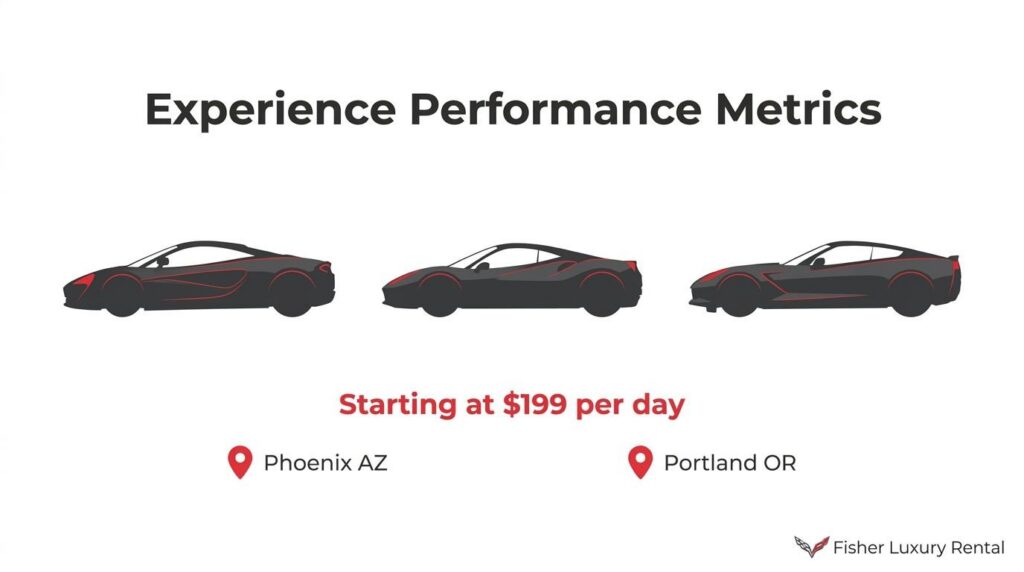
Yes, renting exotic cars from Fisher Luxury Rental can help you feel performance metrics in action by placing you directly behind the wheel of vehicles built around the specifications covered in this guide. Braking distance, lateral g-force, and 0-60 acceleration are abstract numbers until experienced in a McLaren 720S, Ferrari 488 Spider, or Corvette C8 Z06.
Fisher Luxury Rental offers a fleet of top-trim exotic and luxury vehicles in Phoenix, AZ and Portland, OR, starting from $199 per day. Every vehicle in the fleet represents the full-spec version of its model, so the performance figures you read about reflect what you actually drive. This is the difference between knowing a number and knowing how it feels.
What Are the Key Takeaways About Car Performance Technology and Metrics We Covered?
The key takeaways about car performance technology and metrics covered in this guide are organized around the core systems that define how a vehicle performs in the real world. Understanding these concepts helps you evaluate any exotic car before and during a rental experience.
- Horsepower and torque measure an engine’s ability to perform work over time and at a given moment, respectively, and together define acceleration character.
- 0-60 time and quarter-mile time are the standard real-world benchmarks for comparing acceleration across vehicle classes.
- Braking distance and carbon-ceramic brakes determine how quickly a car can shed speed, with top-spec systems stopping significantly shorter than standard setups.
- Lateral g-force reflects cornering capability, shaped directly by aerodynamic downforce and suspension tuning.
- Transmission technology, including dual-clutch systems, determines how cleanly power reaches the wheels during acceleration.
- Lab-to-road discrepancies are real: published figures are controlled-condition results, and real-world driving introduces variables like altitude, temperature, and driver input.
The most important takeaway is that performance metrics are a system, not individual numbers. Each figure connects to others, and the best way to understand how they interact is to drive a vehicle built around all of them together.