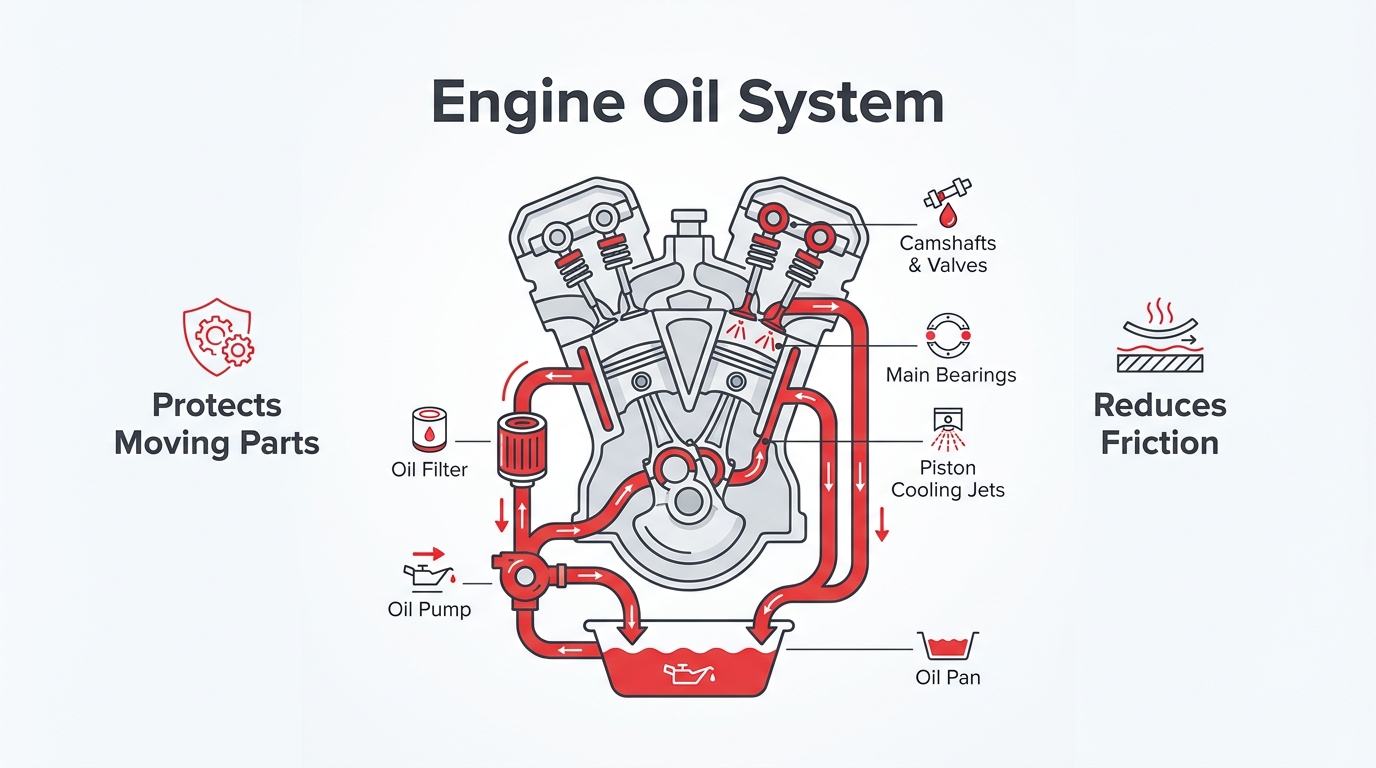
An engine oil system is the network of components that stores, pressurizes, filters, and circulates oil throughout an engine to protect its moving parts from friction, heat, and corrosion.
This guide covers the core components and circulation process, the different oil types and viscosity ratings, how lubrication functions protect engine health, how to recognize oil system problems, and what high-performance vehicles demand from their lubrication systems.
The oil pan, pump, filter, galleries, pressure sensor, oil cooler, pickup tube, and PCV valve each play a distinct role in keeping oil moving through a continuous pressurized loop. Understanding how these parts interact explains why a single failure point can starve an entire engine of lubrication within seconds.
Conventional, synthetic, synthetic blend, and high-mileage oils each suit different engines and operating conditions, while SAE viscosity ratings determine how an oil performs across temperature extremes. Choosing the wrong type or grade for your engine creates measurable risks, from accelerated bearing wear to compromised combustion sealing.
Engine oil lubrication performs five functions: reducing friction, managing heat, preventing corrosion, suspending contaminants, and improving ring-to-wall sealing in the combustion chamber. Each function depends on oil that retains its viscosity and additive integrity within service intervals.
High-performance and exotic vehicles place significantly greater demands on oil systems, often requiring full-synthetic formulations to specific API or ACEA standards, dry-sump configurations with multi-stage pumps, and tighter service schedules to prevent coking in turbocharger feed lines.
What Is an Engine Oil System?
An engine oil system is the network of components that stores, pressurizes, filters, and circulates oil throughout an engine to protect its moving parts. It covers everything from the oil pan that holds the oil at rest to the galleries that deliver it under pressure to critical wear surfaces.
What Does an Engine Oil System Do?
An engine oil system performs four core functions: lubrication, cooling, cleaning, and corrosion protection. Together, these functions maintain engine performance and extend component life. Motor oil provides wear protection, thermal management, and corrosion inhibition that are essential for engine longevity, according to a sustainability study published in MDPI. Without a functioning oil system, metal-on-metal contact would cause rapid, irreversible engine damage within minutes of operation.
What Are the Basic Parts of an Engine Oil System?
The basic parts of an engine oil system are the oil pan, oil pump, oil filter, oil galleries, and oil pressure sensor. The oil pan stores oil when the engine is off and helps cool returning hot oil. The oil pump draws from the pan and pressurizes oil for delivery to components such as the crankshaft, camshaft, connecting rods, and cylinder walls. The filter removes contaminants before oil enters the galleries. These parts work as a closed-loop circuit, continuously recirculating oil through the engine.
How Does an Engine Oil System Relate to Vehicle Performance?
An engine oil system directly determines how efficiently and safely an engine operates under load. Insufficient oil pressure starves bearing surfaces of lubrication, while degraded oil loses its ability to transfer heat and suspend contaminants. For high-performance and exotic vehicles, this relationship is especially critical, since performance engines generate greater heat and mechanical stress than standard engines.
Why Is Engine Oil Important for Vehicle Performance?
Engine oil is important for vehicle performance because it performs several interconnected functions: lubricating moving parts, managing heat, preventing corrosion, and keeping internal components clean. The sections below cover each of these protective roles in detail.
How Does Engine Oil Reduce Friction Between Parts?
Engine oil reduces friction by forming a thin protective film between metal surfaces that would otherwise grind against each other. According to an MDPI Sustainability Journal study, motor oil provides wear protection, thermal management, and corrosion inhibition functions that are essential for engine performance and longevity. Lubricant additives make up between 0.1 and 30 percent of the finished oil formulation, giving manufacturers precise control over how aggressively the film resists shear and heat. Without this film, metal-on-metal contact would accelerate wear on the crankshaft, connecting rods, camshaft, and cylinder walls within minutes.
How Does Engine Oil Help With Engine Cooling?
Engine oil helps with engine cooling by absorbing heat from combustion-adjacent components and carrying it away. The oil pan acts as a thermal reservoir, cooling heated oil as it returns from the engine before the pump recirculates it. This secondary cooling function is particularly important in components that coolant circuits cannot reach directly, such as piston undersides and connecting rod bearings. Treating oil purely as a lubricant underestimates its role: it is also a critical thermal transfer medium.
How Does Engine Oil Protect Against Corrosion?
Engine oil protects against corrosion through chemical additives that neutralize acids formed during combustion. The API SP and ILSAC GF-6A/6B standards, introduced in May 2020, were specifically designed to provide protection against low-speed pre-ignition (LSPI) and tighter corrosion inhibition requirements. Moisture and combustion byproducts that accumulate in aged oil accelerate oxidation on bearing surfaces and cylinder walls, which is why staying current with oil changes is the simplest corrosion prevention strategy available.
How Does Engine Oil Keep the Engine Clean?
Engine oil keeps the engine clean by suspending combustion soot, metal particles, and carbon deposits and carrying them to the oil filter for removal. Detergent and dispersant additives prevent these contaminants from bonding to surfaces and forming sludge. Over time, as the oil’s additive package depletes, its capacity to suspend contaminants drops, making regular oil changes essential for maintaining internal cleanliness.
How Does Engine Oil Improve Sealing in Combustion?
Engine oil improves sealing in combustion by filling microscopic gaps between piston rings and cylinder walls, helping maintain compression pressure. A properly lubricated ring-to-wall interface reduces blow-by, the leakage of combustion gases into the crankcase, which directly protects both power output and emission control systems. This sealing function depends on oil maintaining adequate viscosity under operating temperatures, reinforcing why using the correct viscosity grade matters beyond simple lubrication.
What Are the Main Components of an Engine Oil System?
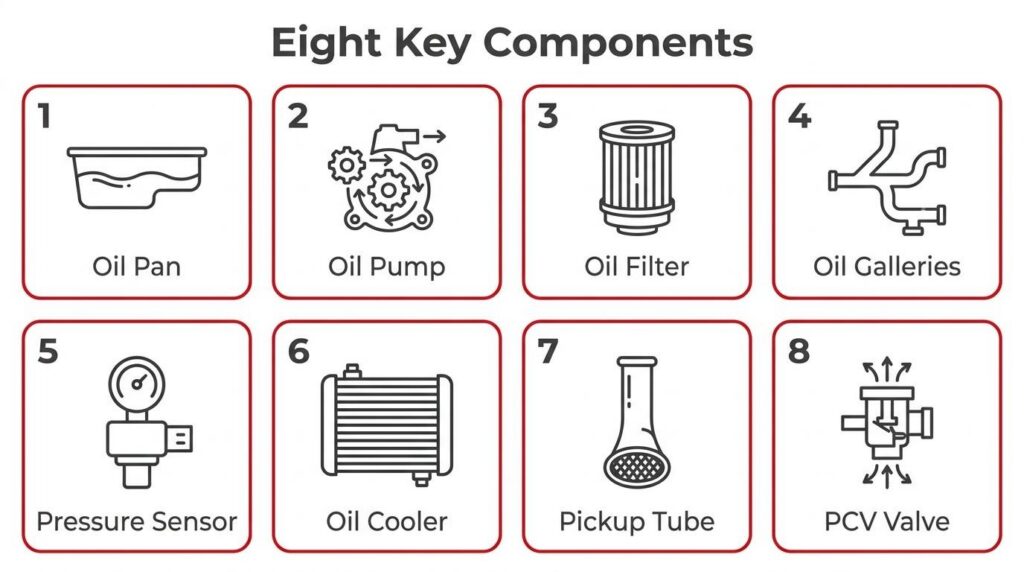
The main components of an engine oil system are the oil pan, oil pump, oil filter, oil galleries, oil pressure sensor, oil cooler, pickup tube and strainer, and PCV valve. Each component plays a distinct role in circulating, filtering, and protecting engine oil throughout operation.
Oil Pan
The oil pan is the reservoir that holds engine oil when the engine is off and helps cool heated oil as it returns from the engine. According to CarParts.com, the oil sump acts as both a storage vessel and a passive cooling surface for returning oil. Positioned at the base of the engine block, it feeds the rest of the lubrication system on every startup.
Oil Pump
The oil pump draws oil from the oil pan and delivers it to critical engine components, including the crankshaft, connecting rods, camshaft, and cylinder walls. It is the system’s pressure source, forcing oil through every downstream component. Without consistent pump output, lubrication fails across the entire engine.
Oil Filter
The oil filter receives pressurized oil from the pump and forces it through the filter media from the outside inward, removing contaminants before the oil exits into the oil galleries. This flow path ensures only clean oil reaches bearing surfaces and machined passages.
Oil Galleries and Passages
Oil galleries are internal channels drilled into the engine block and cylinder head that route pressurized oil to bearings, camshaft journals, and valve train components. These passages form the distribution network connecting the pump and filter to every lubricated surface.
Oil Pressure Sensor
The oil pressure sensor monitors system pressure and triggers a warning when pressure drops below safe operating thresholds. Accurate measurement requires removing the sensor or an engine block oil gallery plug and installing a mechanical gauge, according to PSI Engines. In DOD/AFM engines, sludge buildup on the VLOM screen beneath the sensor can generate false low-pressure readings.
Oil Cooler
The oil cooler reduces oil temperature by transferring heat to the engine coolant circuit or directly to ambient air. It is particularly important in turbocharged and high-performance engines where thermal load on the oil is significantly higher than in standard applications.
Pickup Tube and Strainer
The pickup tube and strainer connect the oil pump inlet to the bottom of the oil pan, drawing oil upward while the strainer screens out large debris before it reaches the pump. A restricted or damaged pickup tube directly reduces pump output and system pressure.
PCV Valve
The PCV valve controls the positive crankcase ventilation system by regulating the volume of blow-by gases recirculated from the crankcase back into the intake manifold. It prevents pressure buildup inside the crankcase that would otherwise force oil past seals and gaskets, contributing to leaks and oil consumption.
How Does Engine Oil Circulate Through the System?
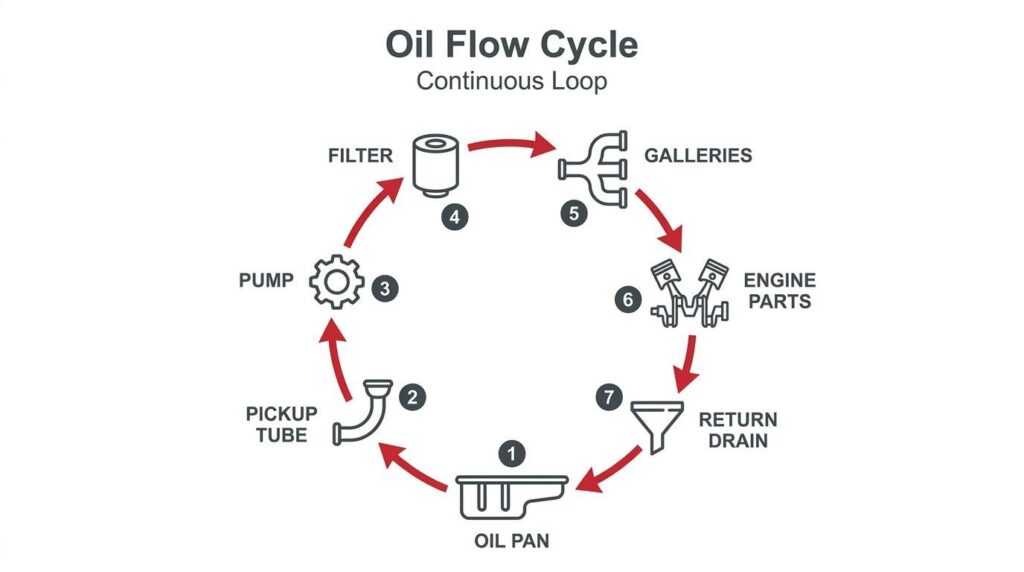
Engine oil circulates through the system in a continuous pressurized loop, moving from the oil pan through the pump, filter, galleries, and engine components before returning to the sump. The PCV valve supports this system by managing crankcase pressure throughout the cycle.
According to a technical breakdown of PCV systems, the PCV valve is the controlling factor in the positive crankcase ventilation system, regulating the amount of engine blow-by gases recirculated back into the intake. Without proper crankcase pressure regulation, oil contamination and pressure imbalances can disrupt the entire lubrication circuit.
The circulation sequence follows a consistent path through key components:
- Oil pan: Stores oil when the engine is off and cools returning heated oil.
- Pickup tube and strainer: Draw oil from the pan into the pump.
- Oil pump: Pressurizes and delivers oil to engine components.
- Oil filter: Removes contaminants before oil enters the galleries.
- Oil galleries: Route pressurized oil to the crankshaft, camshaft, and cylinder walls.
- PCV valve: Regulates crankcase blow-by gases to maintain system integrity.
- Return drain passages: Return oil to the pan to restart the cycle.
This closed-loop design means every component depends on the others, making a single point of failure, such as a clogged filter or weak pump, capable of starving the entire engine of lubrication.
What Are the Different Types of Engine Oil?
The main types of engine oil are conventional, synthetic, synthetic blend, and high-mileage motor oil. Each type suits different engine ages, driving conditions, and performance requirements.
What Is Conventional Motor Oil?
Conventional motor oil is a petroleum-based lubricant refined directly from crude oil. It remains the most widely used oil type globally, accounting for approximately 45% of global motor oil demand, according to Market Reports World. While it performs reliably in standard engines under normal driving conditions, its molecular structure is less uniform than synthetic alternatives, making it more susceptible to breakdown under extreme heat or stress. Conventional oil is best suited to older engines with simpler tolerances and drivers who follow frequent change intervals.
What Is Synthetic Motor Oil?
Synthetic motor oil is a chemically engineered lubricant designed to outperform conventional oil in temperature stability, oxidation resistance, and long-drain capability. Its molecules are uniform in size and structure, providing more consistent film protection across engine components. Synthetic oil holds roughly 38% of global motor oil demand and is the fastest-growing segment in the market. For high-performance and luxury vehicles, full synthetic is generally the correct choice, offering superior protection where engine tolerances are tightest.
What Is Synthetic Blend Motor Oil?
Synthetic blend motor oil combines conventional base oil with synthetic additives to offer a performance step above conventional oil at a lower cost than full synthetic. According to a LinkedIn market analysis, the synthetic blend motor oil market is projected to grow at a CAGR of 4.3% from 2025 to 2032, reflecting rising demand from drivers seeking better protection without the full-synthetic price point. It suits mid-range vehicles and drivers who want improved oxidation resistance and thermal stability without committing to a full synthetic formulation.
What Is High-Mileage Motor Oil?
High-mileage motor oil is a specially formulated lubricant designed for vehicles with over 75,000 miles on the odometer. It contains seal conditioners, antioxidants, and additional detergents that address the specific wear patterns found in older engines, such as increased oil consumption, minor seal leaks, and sludge buildup. These additives help restore pliability to aging gaskets and seals, reducing the likelihood of oil leaks and maintaining compression in worn cylinders. For aging luxury or performance vehicles still in active use, high-mileage oil is often the most practical and protective choice available.
What Do Engine Oil Viscosity Ratings Mean?
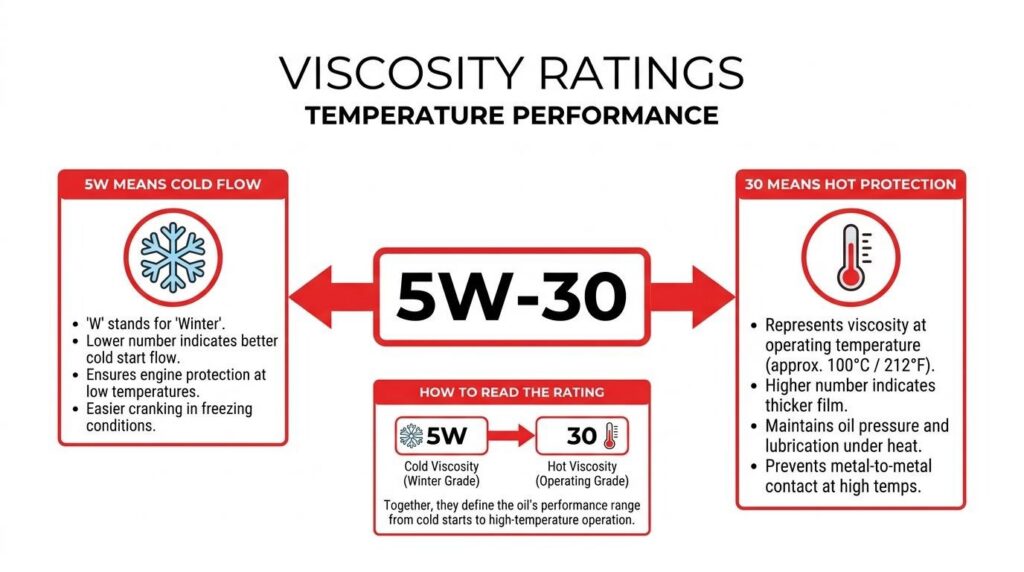
Engine oil viscosity ratings indicate how an oil flows at different temperatures. The sections below explain what the first and second numbers in a rating represent, and which grades suit hot or cold operating conditions.
What Does the First Number in an Oil Rating Indicate?
The first number in an oil rating indicates the oil’s cold-temperature flow resistance. SAE ratings define the thickness of engine oil and its behavior at various temperatures, with the digit in front of “W” denoting cold temperature flow. The “W” stands for winter. A lower number, such as 0W or 5W, means the oil flows more easily during cold starts, reaching critical engine components faster before full operating temperature is achieved. This matters most during ignition, when most engine wear occurs.
What Does the Second Number in an Oil Rating Indicate?
The second number in an oil rating indicates the oil’s viscosity at full operating temperature, typically measured at 100°C. A higher second number, such as 40 or 50, means the oil maintains a thicker film at heat, providing greater protection under sustained load. This number reflects how well the oil resists thinning as engine temperature rises, which directly affects lubrication quality during extended driving.
Which Viscosity Rating Is Best for Hot Climates?
The viscosity rating best suited for hot climates is one with a higher second number, such as 5W-40 or 10W-40, which maintains adequate film thickness under sustained heat. According to research published on ResearchGate on laboratory diagnostics of engine oils, a reduction in oil viscosity exceeding 30% of the nominal value at 40°C is treated as an indicator of abnormal operating conditions such as fuel dilution. In consistently hot environments, using an oil that thins too aggressively under heat risks accelerated wear on bearings and cylinder walls.
Which Viscosity Rating Is Best for Cold Climates?
The viscosity rating best suited for cold climates is one with a lower first number, such as 0W-20 or 0W-30, which flows quickly at low temperatures to protect the engine immediately on startup. In freezing conditions, a high first number like 10W or 15W creates resistance during cranking, slowing oil delivery to the crankshaft, camshaft, and valve train before the engine warms. Choosing a low-W grade ensures full lubrication coverage from the first second of ignition, where cold-start wear is most concentrated.
What Are the Key Functions of Engine Oil Lubrication?
Engine oil lubrication serves five core functions: reducing friction, managing heat, preventing corrosion, keeping the engine clean, and improving combustion sealing. The following sections explain how each function protects engine performance and longevity.
How Does Engine Oil Reduce Friction Between Parts?
Engine oil reduces friction by creating a thin hydrodynamic film between metal surfaces that would otherwise grind against each other. The oil pump draws oil from the oil pan and delivers it to critical components, including the crankshaft, connecting rods, camshaft, and cylinder walls. This continuous pressurized flow keeps every high-contact surface separated and protected.
The chemistry behind this protection matters as much as the oil itself. According to Machinery Lubrication, lubricant additives typically range between 0.1 and 30 percent of the finished engine oil formulation, with anti-wear and friction-modifier additives doing much of the protective work at boundary contact zones. Choosing an oil with the right additive package for your engine type is one of the highest-impact lubrication decisions an owner can make.
How Does Engine Oil Help With Engine Cooling?
Engine oil helps with engine cooling by absorbing heat from friction-generating components and transferring it away from critical surfaces. The oil sump, or oil pan, acts as the reservoir where oil sits when the engine is off and also helps cool the heated oil that returns to it between circulation cycles. This passive thermal regulation supplements the primary coolant system, particularly around areas the coolant circuit cannot reach.
Maintaining adequate oil level and viscosity is essential for this cooling function to work. Low oil volume reduces heat-carrying capacity, increasing thermal stress across bearings and cylinder walls.
How Does Engine Oil Protect Against Corrosion?
Engine oil protects against corrosion by coating internal metal surfaces with a chemical barrier that prevents moisture and acidic combustion byproducts from causing oxidative damage. According to a study published in the MDPI Sustainability Journal, motor oil provides wear protection, thermal management, and corrosion inhibition functions essential for engine performance and longevity.
Modern oil standards reinforce this protection. The API SP and ILSAC GF-6A/6B standards, introduced in May 2020, were designed to address low-speed pre-ignition while also raising the bar on deposit and corrosion control. Corrosion inhibition is often underestimated relative to friction reduction, but it directly determines long-term engine health, especially in engines that sit idle or operate in humid climates.
How Does Engine Oil Keep the Engine Clean?
Engine oil keeps the engine clean by suspending contaminants, soot, and combustion byproducts in the oil stream so the filter can capture them before they accumulate as harmful deposits. Detergent and dispersant additives within the oil formulation neutralize acidic compounds and prevent sludge from bonding to internal surfaces. Without this cleaning function, passages narrow, heat transfer degrades, and wear accelerates.
Regular oil changes remove the saturated, contaminated oil before its additive package is fully depleted, restoring the engine’s cleansing capacity.
How Does Engine Oil Improve Sealing in Combustion?
Engine oil improves sealing in combustion by filling microscopic surface irregularities on cylinder walls and piston rings, forming a dynamic seal that reduces blow-by gases escaping into the crankcase. This sealing effect maintains compression pressure, directly supporting combustion efficiency and power output. Thinner oils may reduce friction but can compromise this ring seal, while excessively thick oils create drag without meaningful sealing gains.
Matching oil viscosity to manufacturer specifications ensures the right balance between film strength and ring-seating performance across operating temperatures.
What Are Common Signs of Engine Oil System Problems?
Common signs of engine oil system problems include low oil pressure warnings, unusual noises, degraded oil appearance, visible leaks, and excessive oil consumption. The following sections cover each warning sign and what it means for your engine’s health.
What Does Low Oil Pressure Warning Mean?
The low oil pressure warning means the oil pressure sensor has detected insufficient pressure in the lubrication system. This can result from a failing oil pump, a clogged pickup tube, low oil level, or oil that has thinned beyond its effective viscosity range. According to United Tires, signs of low engine oil pressure include engine noise, excessive oil consumption, exhaust smoke, and the oil warning light. Ignoring this warning, even briefly, risks metal-to-metal contact and accelerated engine wear. When this light activates, stopping the engine promptly is the safest response.
What Do Unusual Engine Noises Indicate About Oil?
Unusual engine noises indicate that oil is no longer reaching critical components in sufficient volume or pressure. Common sounds include knocking, ticking, and rattling, each pointing to under-lubricated parts such as the crankshaft bearings, camshaft lobes, or valve train. Knocking typically signals worn main bearings; ticking often points to the valve train or lifters. These noises usually worsen at startup before oil pressure builds, which is a key diagnostic clue.
What Does Dark or Gritty Oil Suggest?
Dark or gritty oil suggests contamination, thermal breakdown, or extended service intervals. Fresh oil is amber and translucent; oil that appears nearly black has accumulated combustion byproducts and oxidized particles. Gritty texture specifically indicates metallic debris or silica contamination from a worn or bypassed filter. A ResearchGate laboratory diagnostics study found that a viscosity reduction exceeding 30% of the nominal value at 40°C indicates abnormal conditions such as fuel dilution, which can also darken oil prematurely. Checking oil condition at every fill-up is a low-cost early warning habit worth developing.
What Does an Oil Leak Under the Vehicle Mean?
An oil leak under the vehicle means one or more sealing points in the oil system have failed, such as a gasket, seal, drain plug, or oil filter. Common failure locations include the valve cover gasket, rear main seal, and oil pan gasket. Fresh leaks appear as slick, amber-to-brown puddles; older leaks leave dark, baked-on residue on nearby components. Even a slow drip reduces total oil volume over time, compounding pressure and lubrication deficits.
What Causes Excessive Oil Consumption?
Excessive oil consumption is caused by oil burning in the combustion chamber, external leaks, or both occurring simultaneously. Worn piston rings allow oil to migrate past the cylinder wall and combust, producing blue-gray exhaust smoke. Degraded valve stem seals produce the same symptom, particularly on startup when oil pools above the closed valve. High-mileage engines are most susceptible, as cumulative wear widens the tolerances that oil seals depend on. Monitoring the dipstick between oil changes is the most reliable way to detect consumption before it becomes critical.
How Often Should You Change Your Engine Oil?
Oil change frequency depends on the type of oil your engine uses and the demands placed on it. The sections below cover conventional oil, synthetic oil, and high-performance engine intervals.
How Often Should You Change Conventional Oil?
Conventional oil should be changed every 3,000 to 5,000 miles under normal driving conditions. Conventional motor oil degrades faster than synthetic because it contains fewer refined base stocks and fewer performance additives. Heat cycles, contaminants, and oxidation break down its protective properties relatively quickly, making shorter intervals necessary to prevent engine wear.
How Often Should You Change Synthetic Oil?
Synthetic oil should be changed every 7,500 to 15,000 miles, depending on the manufacturer’s recommendation and driving conditions. Its more refined molecular structure resists thermal breakdown and contamination far longer than conventional oil. Always follow the vehicle’s owner manual rather than defaulting to a fixed mileage interval, as some modern engines equipped with oil life monitoring systems will adjust intervals dynamically.
How Often Should You Change Oil in High-Performance Engines?
Oil change intervals in high-performance engines are typically shorter, often every 3,000 to 5,000 miles, even when using full synthetic oil. According to Tomorrow’s Technician, most late-model Ferrari vehicles require oil meeting API SN or ACEA A3/B4 specifications, reflecting the tighter tolerances and higher thermal loads these engines produce. Dry sump systems, turbochargers, and sustained high-RPM operation all accelerate oil degradation, making stricter maintenance schedules essential for preserving engine integrity.
How Does Engine Oil Differ in High-Performance Vehicles?
Engine oil in high-performance vehicles differs significantly from standard passenger car oil, requiring stricter specifications, advanced formulations, and specialized service protocols. The following sections cover exotic car oil requirements, dry sump systems, and turbocharged engine oil demands.
Why Do Exotic Cars Require Specialized Engine Oil?
Exotic cars require specialized engine oil because their engines operate under extreme thermal loads, tight tolerances, and complex lubrication architectures that standard oils cannot adequately protect. According to Tomorrow’s Technician, most late-model Ferrari vehicles require oil meeting API SN or ACEA A3/B4 specifications to function correctly within their lubrication systems. Vehicles with dry-sump configurations or multi-plug oil pans also demand dedicated service protocols that differ entirely from conventional oil change procedures. Using the wrong specification in an exotic engine risks accelerated wear, voided warranties, and costly damage.
What Role Do Dry Sump Systems Play in Supercars?
Dry sump systems play the role of replacing a traditional oil pan reservoir with an external tank, keeping oil away from the crankshaft and maintaining consistent oil pressure during high-G cornering, hard acceleration, and braking. A dry sump oil pump consists of at least two stages: one pressure stage and one or more scavenging stages that actively pull oil from the engine. This design prevents oil starvation under conditions that would overwhelm a conventional wet sump system. For supercars, it is arguably the single most important oil system feature enabling track-level performance.
How Do Turbo and Twin-Turbo Engines Affect Oil Needs?
Turbo and twin-turbo engines affect oil needs by exposing the lubricant to significantly higher heat, particularly at the turbocharger bearings, which spin at tens of thousands of RPM and rely entirely on pressurized oil for cooling and lubrication. These engines demand full-synthetic oil with strong thermal stability and oxidation resistance to prevent coking, a condition where oil bakes into carbon deposits inside turbo oil feed lines. Oil change intervals are also typically shorter in turbocharged performance engines to remove heat-degraded oil before it causes bearing damage.
How Does Proper Engine Oil Maintenance Protect Luxury Cars?
Proper engine oil maintenance protects luxury cars by preserving lubrication integrity, preventing premature wear, and sustaining peak power output in high-performance engines. The following sections connect exotic vehicle oil requirements to what Fisher Luxury Rental delivers for renters.
Can Renting a Meticulously Maintained Exotic Car From Fisher Luxury Rental Guarantee Peak Engine Performance?
Yes, renting a meticulously maintained exotic car from Fisher Luxury Rental can guarantee peak engine performance. Exotic vehicles, including the Ferrari 488 Spider and McLaren 720S in Fisher Luxury Rental’s fleet, depend on specialized lubrication systems that require strict service protocols. According to Tomorrow’s Technician, most late-model Ferrari vehicles require oil meeting API SN or ACEA A3/B4 specifications, and exotic vehicles with dry-sump configurations or multi-plug oil pans require specialized service protocols beyond standard maintenance routines.
Fisher Luxury Rental services only top-trim models and maintains each vehicle to manufacturer specifications, so every rental delivers the engine performance these machines were engineered to produce.
What Are the Key Takeaways About Engine Oil Systems and Lubrication Basics?
The key takeaways about engine oil systems and lubrication basics are that oil selection, viscosity compliance, and consistent maintenance directly determine engine protection and longevity. For exotic rentals, these principles are not optional considerations; they are the foundation of a reliable, high-performance driving experience.
Core lessons from this guide include:
- Engine oil performs three critical functions: wear protection, thermal management, and corrosion inhibition.
- Oil system components, such as the pump, filter, galleries, and sump, work together to maintain continuous lubrication under pressure.
- SAE viscosity ratings govern oil behavior across operating temperatures, and using the wrong grade risks engine damage.
- Exotic and high-performance engines often use dry-sump systems requiring manufacturer-specific oil specifications.
- Maintenance intervals and oil type must align with the vehicle’s design and operating conditions.
Fisher Luxury Rental’s commitment to fleet quality means every vehicle is serviced to these exact standards before it reaches your hands.