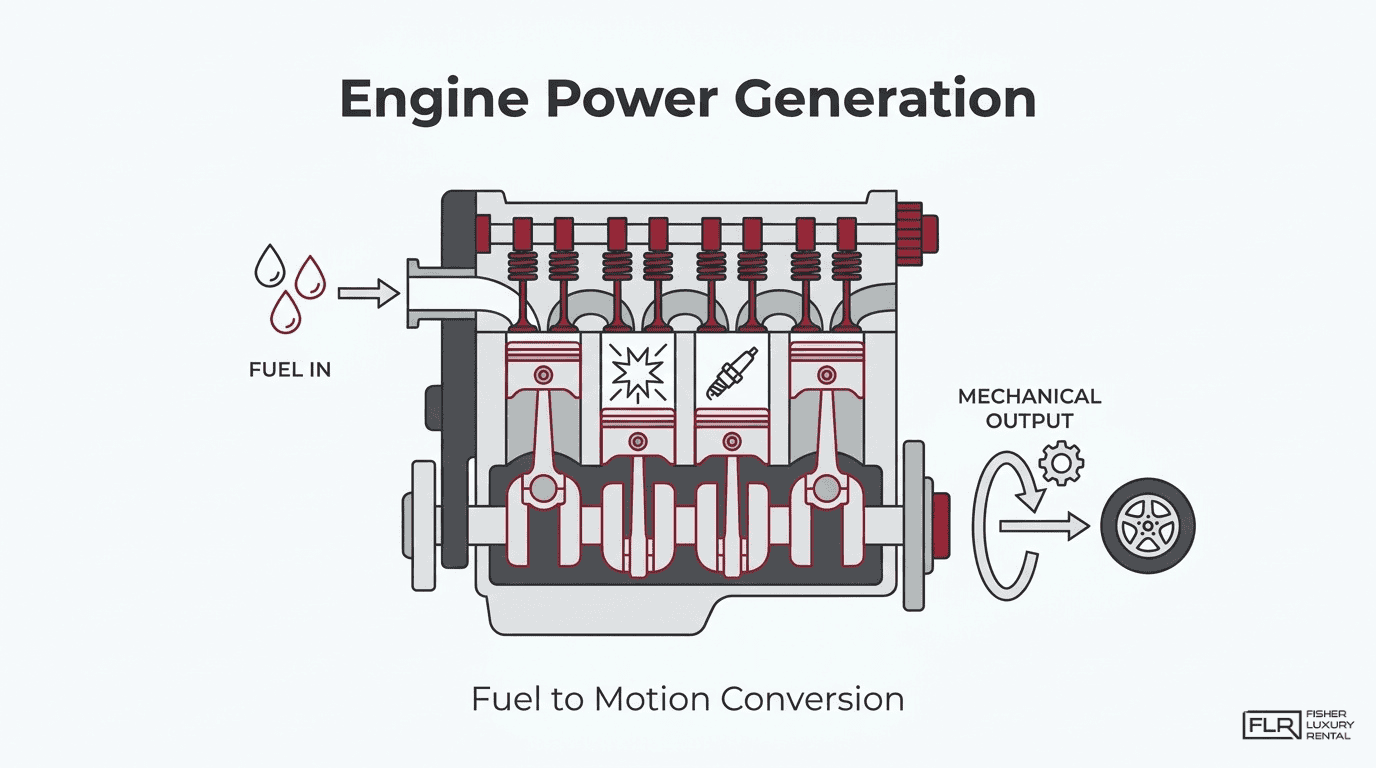
A car engine generates power by converting the chemical energy in fuel into rotational mechanical force through a precisely controlled combustion process. Every component in the system plays a specific role in that conversion, from the first intake of air and fuel to the moment torque reaches the drive wheels.
This guide covers engine components and their functions, the four-stroke combustion cycle, how fuel becomes mechanical energy, the distinction between horsepower and torque, different engine types and how each produces power, the factors that shape total output, how power travels from the engine to the wheels, and what maintenance does to preserve it all.
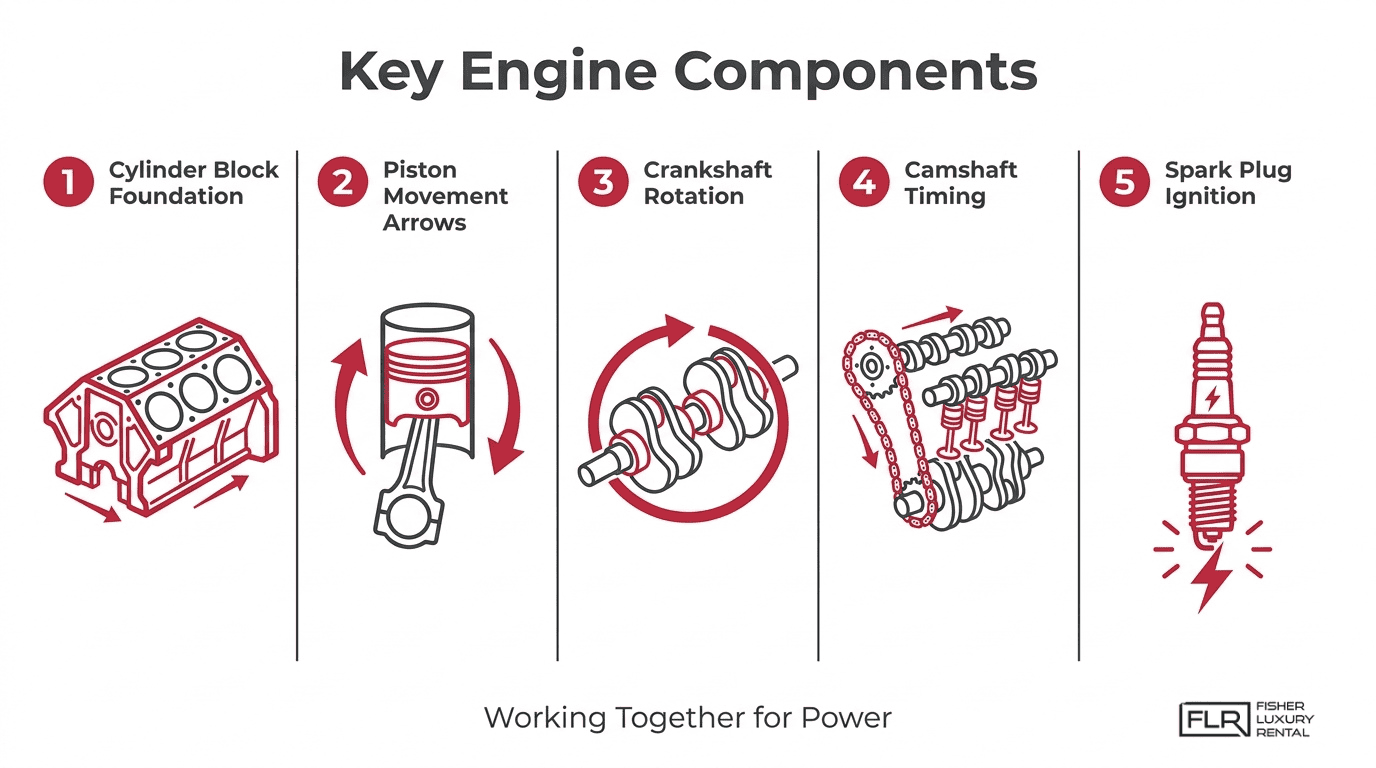
The cylinder block, pistons, crankshaft, camshaft, and spark plugs each contribute a distinct function, and understanding how they work together reveals why a single failing part can reduce output across the entire powertrain.
The four-stroke cycle moves through intake, compression, combustion, and exhaust in a precise sequence, with each stroke supporting the one power-generating event at the center of the process.
Air-fuel mixture preparation, combustion temperature, and exhaust scavenging determine how completely fuel converts to usable energy, making each stage equally important to peak output.
Horsepower and torque measure different aspects of engine performance, one describing rotational force and the other the rate at which that force is applied, and they peak at different points in the RPM range for reasons tied to engine physics.
Turbocharged, supercharged, naturally aspirated, and hybrid powertrains each generate power through distinct mechanical approaches, with displacement, compression ratio, fuel injection, and tuning shaping how much output each design ultimately delivers.
What Are the Main Components That Generate Power in a Car Engine?
The main components that generate power in a car engine are the cylinder block, pistons, crankshaft, camshaft, and spark plugs. Each part plays a distinct role in converting fuel into the mechanical energy that moves a vehicle.
What Role Does the Cylinder Block Play in Power Generation?
The cylinder block is the structural core of a car engine, housing the cylinders where combustion occurs. It supports every major moving component, including pistons and the crankshaft, while containing the oil and coolant passages that prevent thermal damage. According to the Society of Automotive Engineers, approximately 80% of engine blocks are manufactured from cast iron, though aluminum alloys are increasingly used to reduce weight in passenger car diesel engines.
How Do Pistons Convert Energy Into Motion?
Pistons convert combustion energy into linear motion by moving up and down inside the cylinders in response to expanding gases. That reciprocating motion is then passed to the crankshaft for conversion into rotation. Aluminum-silicon alloys are the primary material for automotive pistons because of their low coefficient of thermal expansion, high strength-to-weight ratio, and efficient heat dissipation.
What Does the Crankshaft Do to Deliver Usable Power?
The crankshaft converts the pistons’ linear motion into the rotational force that ultimately drives the wheels. Automotive experts define torque as the force delivering acceleration and pulling power from a stop, while horsepower determines top speed and sustained performance. SAE standards J1349 and J1995 govern how manufacturers measure and verify this output, with J1349 specifically covering “As-Installed Net Power and Torque.”
How Does the Camshaft Control Engine Timing?
The camshaft controls the precise timing of intake and exhaust valve openings throughout each combustion cycle. By rotating in sync with the crankshaft, it ensures fuel-air mixture enters and exhaust gases exit at exactly the right moments. Accurate valve timing directly affects combustion efficiency and overall power output, making the camshaft one of the most tuning-sensitive components in the engine.
What Role Do Spark Plugs Play in Igniting Fuel?
Spark plugs ignite the compressed air-fuel mixture inside each cylinder, initiating the combustion event that drives the pistons. Spark plug gap size significantly impacts flame kernel propagation and overall engine performance. Higher compression ratios, ranging from 8:1 to 12:1 in spark ignition engines, allow greater thermal efficiency by extracting more energy from each combustion event.
Understanding these components together reveals why even one failing part can reduce output across the entire powertrain.
How Does the Four-Stroke Combustion Cycle Work?
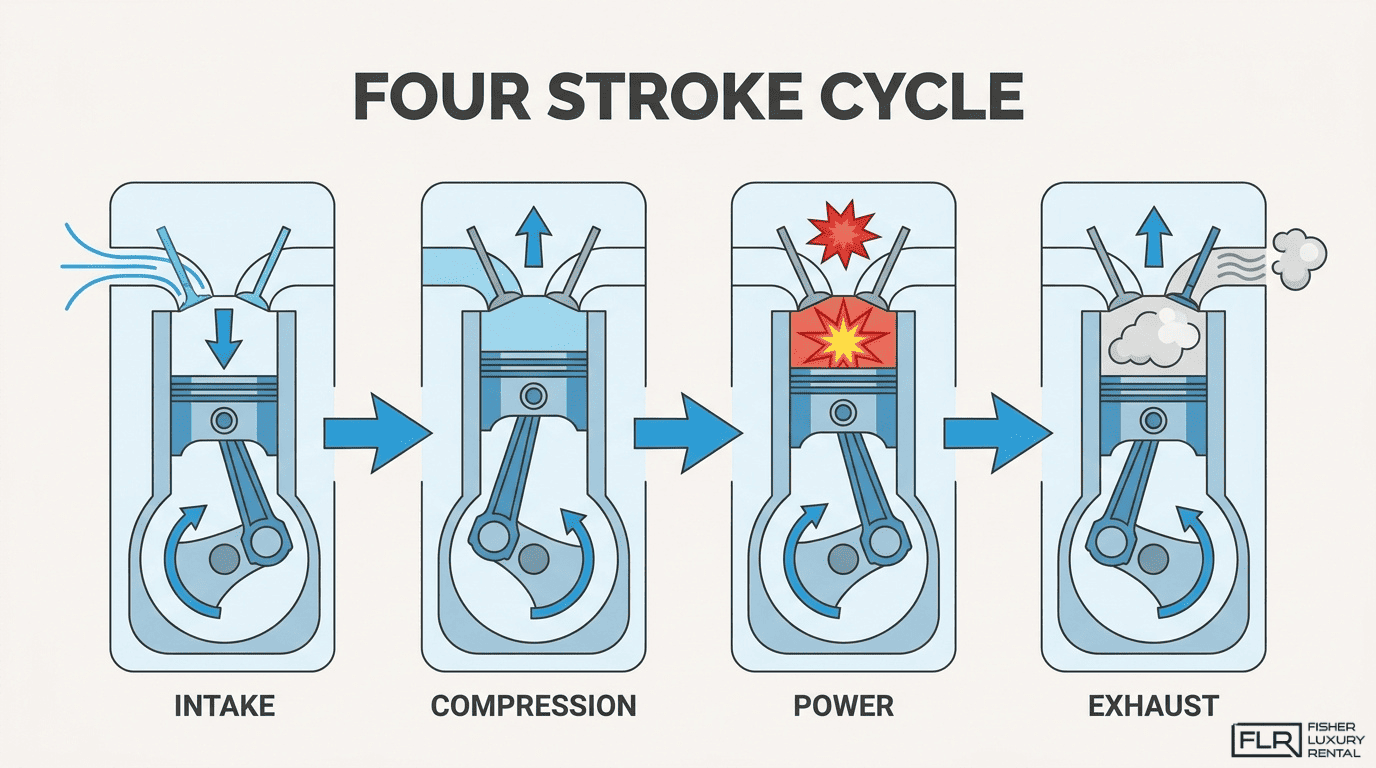
The four-stroke combustion cycle works by converting fuel energy into mechanical motion across four distinct piston strokes: intake, compression, power, and exhaust. Each stroke plays a specific role in sustaining continuous engine operation.
What Happens During the Intake Stroke?
The intake stroke is the first phase of the four-stroke cycle, where the piston moves downward and the intake valve opens to draw an air-fuel mixture into the cylinder. This descending motion creates a pressure drop, pulling the charge into the combustion chamber. The quality and volume of this mixture directly influence everything that follows, making intake efficiency foundational to overall power output.
How Does the Compression Stroke Build Pressure?
The compression stroke builds pressure by closing both valves and driving the piston upward, compressing the air-fuel charge into a much smaller volume. Higher compression concentrates the mixture’s energy, enabling a more forceful combustion event. According to research from West Virginia University, a four-stroke engine operating in direct injection compression ignition mode can achieve thermal efficiencies between 46% and 49% with compression ratios ranging from 17 to 35, illustrating how dramatically ratio selection shapes efficiency.
What Occurs During the Power Stroke?
The power stroke occurs when the compressed mixture ignites, forcing the piston downward with significant force and transferring energy to the crankshaft. This is the only stroke that generates mechanical energy; the other three strokes support and sustain it. The force of combustion is what ultimately propels the vehicle, making this stroke the core event of the entire cycle.
How Does the Exhaust Stroke Complete the Cycle?
The exhaust stroke completes the cycle by pushing spent combustion gases out of the cylinder as the piston rises with the exhaust valve open. Once the chamber is cleared, the engine resets for the next intake stroke. According to ScienceDirect, the full four-stroke cycle can be modeled using zero-dimensional two-zone computations to predict thermodynamic parameters, confirming how precisely sequenced each phase must be for efficient operation.
How Does Fuel Turn Into Mechanical Energy?
Fuel turns into mechanical energy through three sequential processes: air-fuel mixture preparation, high-temperature combustion, and exhaust gas expulsion. The following sections explain how each stage contributes to the power a car engine produces.
How Does Air-Fuel Mixture Preparation Affect Power?
Air-fuel mixture preparation affects power by determining how completely fuel burns inside the cylinder. For gasoline engines, the stoichiometric air-fuel ratio is the point where all fuel burns with all available oxygen, while the minimum ratio required for combustion is approximately 6:1, according to a study published in SpringerLink. A mixture that is too rich wastes fuel; one that is too lean burns incompletely and reduces output. Modern fuel injection systems meter this ratio precisely, giving the engine a consistent charge on every intake stroke and maximizing the energy available for conversion.
What Role Does Combustion Temperature Play in Energy Output?
Combustion temperature plays a direct role in energy output because higher temperatures drive greater pressure expansion inside the cylinder, which pushes the piston with more force. The thermodynamic relationship is straightforward: the larger the temperature differential between the burning gases and the exhaust, the more work the engine can extract from each combustion event. Compression ratio governs how hot the mixture gets before ignition, with spark ignition engines typically running ratios of 8:1 to 12:1 and compression ignition engines running 12:1 to 24:1 to reach the temperatures needed for greater thermal efficiency. In practice, combustion temperature is one of the most underestimated levers in engine performance, directly setting the ceiling on how much mechanical energy a given quantity of fuel can release.
How Do Exhaust Gases Exit After Energy Is Extracted?
Exhaust gases exit through the exhaust valve, which opens near the end of the power stroke once pressure inside the cylinder has dropped. The piston then travels upward on the exhaust stroke, sweeping spent gases out of the cylinder and into the exhaust manifold. From there, gases move through the catalytic converter and muffler before exiting the tailpipe. Efficient scavenging, the complete removal of exhaust gases before the next intake stroke begins, is critical because any residual gas displaces fresh air-fuel mixture and reduces the energy available in the next combustion event.
What Is the Difference Between Horsepower and Torque?
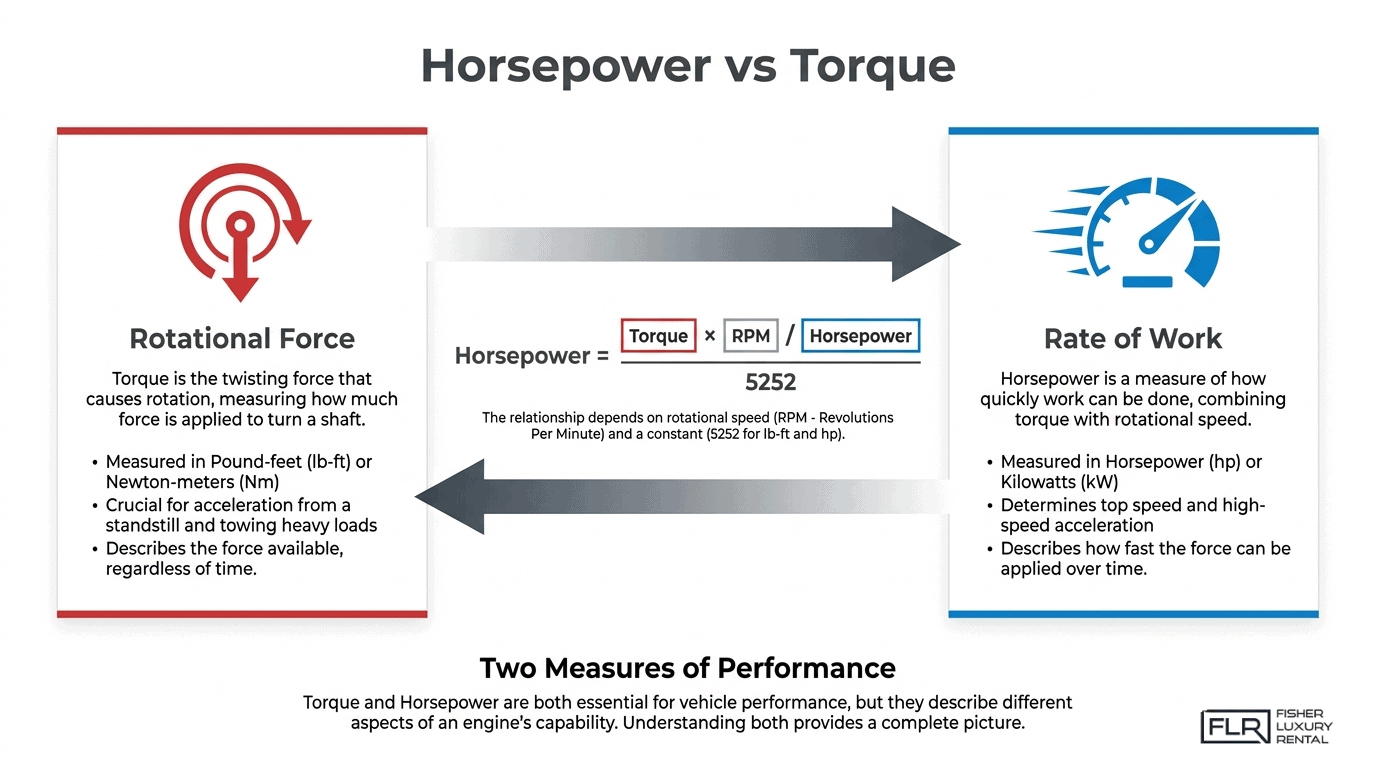
The difference between horsepower and torque is that torque measures rotational force while horsepower measures how quickly that force is applied over time. Together, they define how a vehicle accelerates, pulls, and sustains speed across different driving conditions.
How Is Horsepower Measured in a Car Engine?
Horsepower is measured by calculating how much work an engine performs per unit of time, expressed in the formula: horsepower equals torque multiplied by RPM, divided by 5,252. This relationship means horsepower is not a standalone force but a rate of doing work derived from torque output. Manufacturers use SAE J1349, the “As-Installed Net Power and Torque” standard, to ensure engines deliver advertised performance figures under controlled atmospheric conditions.
How Is Torque Measured in a Car Engine?
Torque is measured in pound-feet (lb-ft) or Newton-meters (Nm) and represents the rotational force the crankshaft applies to the drivetrain. Higher torque at lower RPMs produces stronger acceleration from a standstill, which is why diesel trucks and electric motors feel so forceful off the line. According to Kelley Blue Book, torque delivers acceleration and pulling power from a stop, while horsepower governs top speed and sustained performance.
Why Do Horsepower and Torque Peak at Different RPMs?
Horsepower and torque peak at different RPMs because each reflects a different aspect of engine behavior across its operating range. Torque typically peaks at lower RPMs, where cylinder filling and combustion pressure are most efficient. Horsepower peaks higher in the rev range, where the engine performs more work cycles per second. This divergence explains why sports cars feel most alive near redline while trucks feel strongest pulling from rest.
How Do Different Engine Types Generate Power?
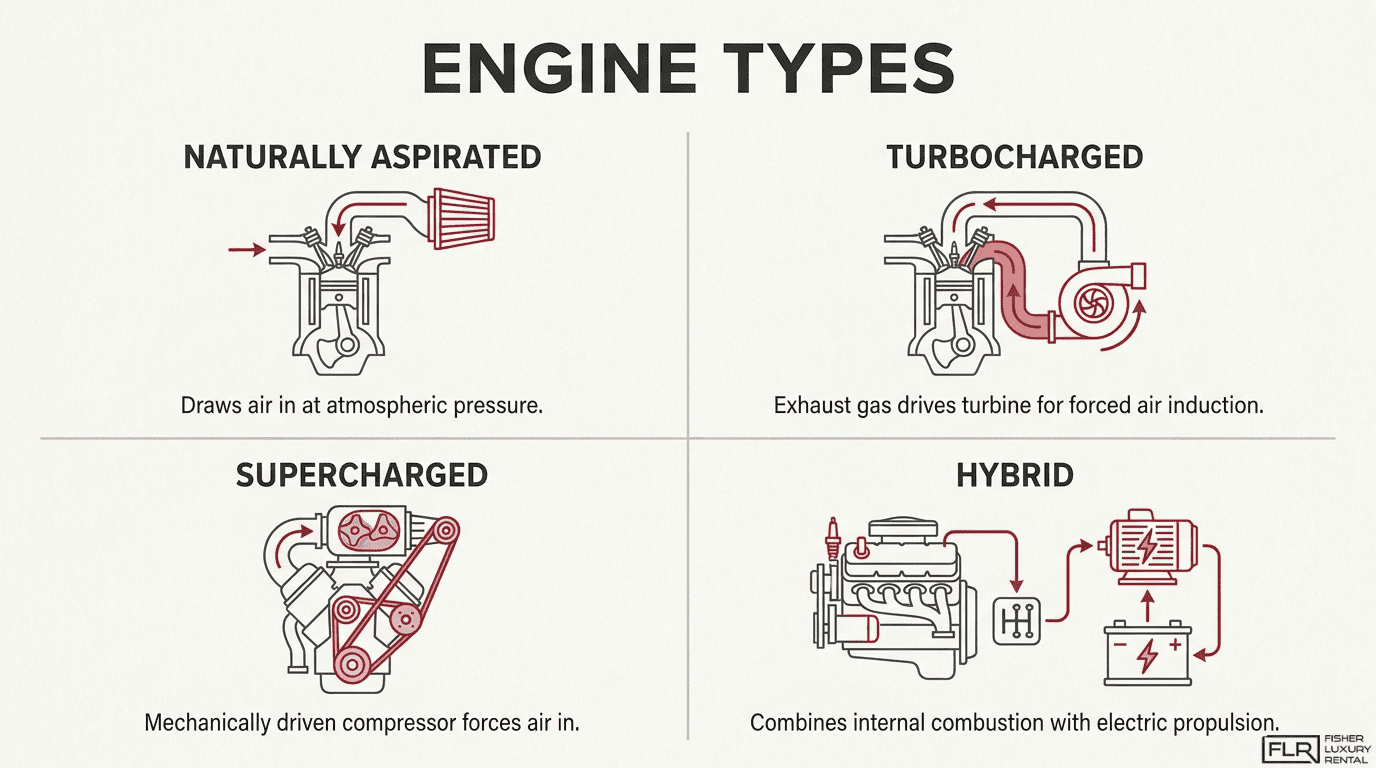
Different engine types generate power through distinct methods of air compression, fuel delivery, and energy conversion. The sections below cover turbocharged, supercharged, naturally aspirated, and hybrid engine designs.
How Does a Turbocharged Engine Generate More Power?
A turbocharged engine generates more power by forcing compressed air into the combustion chamber, allowing more fuel to burn with each cycle. The turbocharger uses exhaust gases to spin a turbine, which drives a compressor, recycling otherwise wasted energy. Because more air enters the cylinder, fuel delivery increases proportionally, producing greater combustion pressure and higher output. Keeping oil fresh is critical to turbo longevity; a maintenance interval of no more than 12,000 km is recommended by MDPI (Energies) to prevent oil degradation and protect turbocharger bearings under high thermal stress. Turbocharged engines reward diligent maintenance far more than naturally aspirated designs, making oil change discipline one of the highest-return habits a turbocharged vehicle owner can adopt.
How Does a Supercharged Engine Differ in Power Delivery?
A supercharged engine differs in power delivery by drawing energy directly from the crankshaft to drive its compressor, unlike a turbocharger that runs on exhaust pressure. This belt-driven connection means boost is available instantly at any RPM, eliminating turbo lag entirely. However, driving the compressor consumes crankshaft energy, which contributes to drivetrain losses. According to Motor Trend, drivetrain losses are commonly estimated using a “15% rule,” though actual figures vary; some automatic transmissions achieve only 80-85% efficiency. Supercharged systems trade some mechanical efficiency for the predictable, linear power delivery that many performance drivers prefer.
How Does a Naturally Aspirated Engine Produce Power?
A naturally aspirated engine produces power by relying entirely on atmospheric pressure to draw air into the cylinders, with no supplemental forced induction. Without a turbocharger or supercharger, the engine’s output is limited by the volume of air that enters each intake stroke. Research published via NIH (PMC) found that turbocharged engines can improve output power by up to 165% compared to naturally aspirated engines of the same displacement at 5,000 rpm. Naturally aspirated engines also generally show lower power-to-weight ratios versus turbocharged diesel counterparts, according to an SAE International technical paper. Despite their output ceiling, naturally aspirated engines remain valued for their mechanical simplicity, linear throttle response, and long-term reliability.
How Do Hybrid Engines Combine Electric and Gas Power?
Hybrid engines combine electric and gas power by pairing an internal combustion engine with one or more electric motors and a battery pack, drawing from both sources based on driving conditions. At low speeds, the electric motor handles propulsion; under acceleration or highway loads, the combustion engine activates, and regenerative braking recovers energy to recharge the battery. This demand-driven switching reduces fuel consumption and emissions without sacrificing range. According to Visual Capitalist, the share of traditional internal combustion engines in new vehicle sales worldwide fell from over 90% in 2019 to approximately 57% in 2025, reflecting rapid hybrid and electric adoption. Hybrid powertrains now represent one of the most significant engineering shifts in modern automotive history.
What Factors Determine How Much Power an Engine Produces?
Engine power output depends on several interacting variables. The sections below cover displacement, compression ratio, fuel injection technology, and tuning.
How Does Engine Displacement Affect Power Output?
Engine displacement affects power output by determining how much air-fuel mixture the engine can process per cycle. Larger displacement means more combustion volume per stroke, which generally produces more torque and horsepower. According to the SAE J1349 standard, an assumed mechanical efficiency of 85% is applied when calculating true engine power output under standard atmospheric conditions, reflecting real-world losses between combustion and the crankshaft. Displacement sets the ceiling for what tuning and forced induction can then amplify.
How Does Compression Ratio Influence Performance?
Compression ratio influences performance by controlling how much the air-fuel mixture is squeezed before ignition. Higher compression generates greater pressure at the point of combustion, extracting more energy from each fuel charge. Spark ignition engines typically run ratios between 8:1 and 12:1, while compression ignition engines operate between 12:1 and 24:1 for greater thermal efficiency.
How Does Fuel Injection Technology Impact Power?
Fuel injection technology impacts power by controlling the precision, timing, and volume of fuel delivered to each cylinder. Direct injection systems spray fuel at high pressure directly into the combustion chamber, enabling leaner, more efficient burns compared to older port injection designs. This precision allows engineers to optimize power across a wider RPM range without sacrificing fuel economy.
How Does Engine Tuning Change Power Delivery?
Engine tuning changes power delivery by adjusting ignition timing, air-fuel ratios, valve timing, and boost pressure to match a vehicle’s specific performance goals. These calibrations shift where peak torque and horsepower occur in the RPM range. For drivers prioritizing low-end pull, tuning biases delivery toward lower RPMs; for top-end performance, it shifts toward higher RPMs. Understanding these variables is what separates a stock engine from a purpose-built performance machine.
How Does Engine Power Reach the Wheels?
Engine power reaches the wheels through the drivetrain, a system that transfers rotational force from the crankshaft through the transmission, driveshaft, and differential to the drive wheels.
How Does the Transmission Transfer Engine Power?
The transmission transfers engine power by converting crankshaft rotation into usable wheel torque across a range of gear ratios. Lower gears multiply torque for acceleration; higher gears reduce engine speed for efficient cruising. Not all power generated survives this journey, though. Drivetrain losses are commonly estimated using a “15% rule,” with some automatic transmissions achieving only 80–85% efficiency, according to Motor Trend.
How Does the Driveshaft Carry Power to the Rear Axle?
The driveshaft carries power from the transmission to the rear differential using a rotating steel or aluminum shaft. It connects via universal or constant-velocity joints that accommodate suspension movement and angular misalignment. Without these flexible joints, power delivery would break down under normal driving conditions, making them essential to efficient force transfer.
What Does the Differential Do to Distribute Power?
The differential distributes power between the left and right drive wheels while allowing each to rotate at different speeds during cornering. Without a differential, the inside wheel would scrub against the road surface during turns, creating handling instability and tire wear. In all-wheel-drive systems, an additional center differential splits torque between the front and rear axles as well.
With the drivetrain routing power efficiently to the wheels, the focus shifts to how ongoing maintenance keeps that power output consistent over time.
Why Does Regular Maintenance Affect Engine Power?
Regular maintenance affects engine power by preserving the mechanical and chemical conditions that combustion depends on. Neglected oil, clogged filters, and worn spark plugs each degrade a different part of the power-generation process.
How Does Engine Oil Condition Affect Power Output?
Engine oil condition affects power output by controlling friction between moving components, including pistons, crankshaft bearings, and camshaft lobes. As oil degrades, its viscosity breaks down and sludge deposits form, restricting flow to critical surfaces. According to MDPI Energies, a maintenance interval of no more than 12,000 km is recommended for modern vehicles to prevent oil degradation and maintain optimal performance. Once oil loses its protective film strength, metal-on-metal contact increases, and the engine must overcome greater internal resistance, directly reducing the power delivered to the drivetrain.
How Do Dirty Air Filters Reduce Engine Performance?
Dirty air filters reduce engine performance by restricting the volume of air entering the intake, which leans out the air-fuel mixture and limits combustion pressure. A stoichiometric air-fuel ratio requires sufficient oxygen to burn all available fuel; a blocked filter prevents that balance. When airflow is starved, the engine cannot reach its designed combustion efficiency, and power output drops noticeably, particularly at higher RPMs where air demand is greatest.
How Do Worn Spark Plugs Affect Combustion Quality?
Worn spark plugs affect combustion quality by producing a weaker, less consistent spark that delays or partially ignites the air-fuel mixture. According to ScienceDirect, spark plug gap size significantly impacts flame kernel propagation and overall engine performance. A misfiring or slow-igniting cylinder wastes fuel and generates less cylinder pressure during the power stroke, reducing the engine’s effective output. Replacing spark plugs on schedule is one of the most cost-efficient ways to preserve full combustion performance.
What Happens to Power Output When Maintenance Is Neglected?
Power output degrades progressively when maintenance is neglected, through sludge buildup, restricted airflow, and incomplete combustion working in combination. Mighty Auto Parts confirms that neglecting maintenance intervals allows sludge deposits to restrict oil flow, eventually causing significant power loss or catastrophic engine failure. In practice, a poorly maintained engine can lose measurable horsepower well before any warning light appears, making routine servicing the most reliable power-preservation strategy available to any driver.
How Can You Experience High-Performance Engine Power?
Understanding engine mechanics is one thing; feeling that power firsthand is another. This section covers how renting an exotic car translates theory into experience, and the core takeaways from how car engines generate power.
Can Renting an Exotic Car Help You Feel Engine Power?
Yes, renting an exotic car helps you feel engine power in a way no article or video can replicate. Vehicles like the Ferrari 488 Spider, McLaren 720S, and Lamborghini Huracan Spyder translate every engineering principle covered in this guide into a physical, sensory experience: torque pressing you into the seat, horsepower pulling you toward redline, and exhaust notes that reflect combustion happening in real time.
Fisher Luxury Rental offers direct access to this experience in Phoenix and Portland. Fisher Luxury Rental’s fleet includes top-trim exotic and luxury vehicles, so every rental puts you behind the wheel of a machine built to demonstrate exactly what high-displacement, high-compression engines are capable of delivering.
What Are the Key Takeaways About How Car Engines Work?
The key takeaways about how car engines work center on one core process: controlled combustion converted into rotational motion. Every component, from the cylinder block and pistons to the crankshaft and camshaft, serves a specific role in that conversion. Horsepower determines sustained speed; torque delivers immediate pull. Forced induction, compression ratio, and fuel delivery all shape how much power an engine ultimately produces. Regular maintenance preserves that output over time.
For anyone serious about understanding performance, the most practical next step is experiencing it directly. Knowing what torque and horsepower mean on paper becomes far more meaningful the moment you accelerate in a vehicle built around maximizing both.