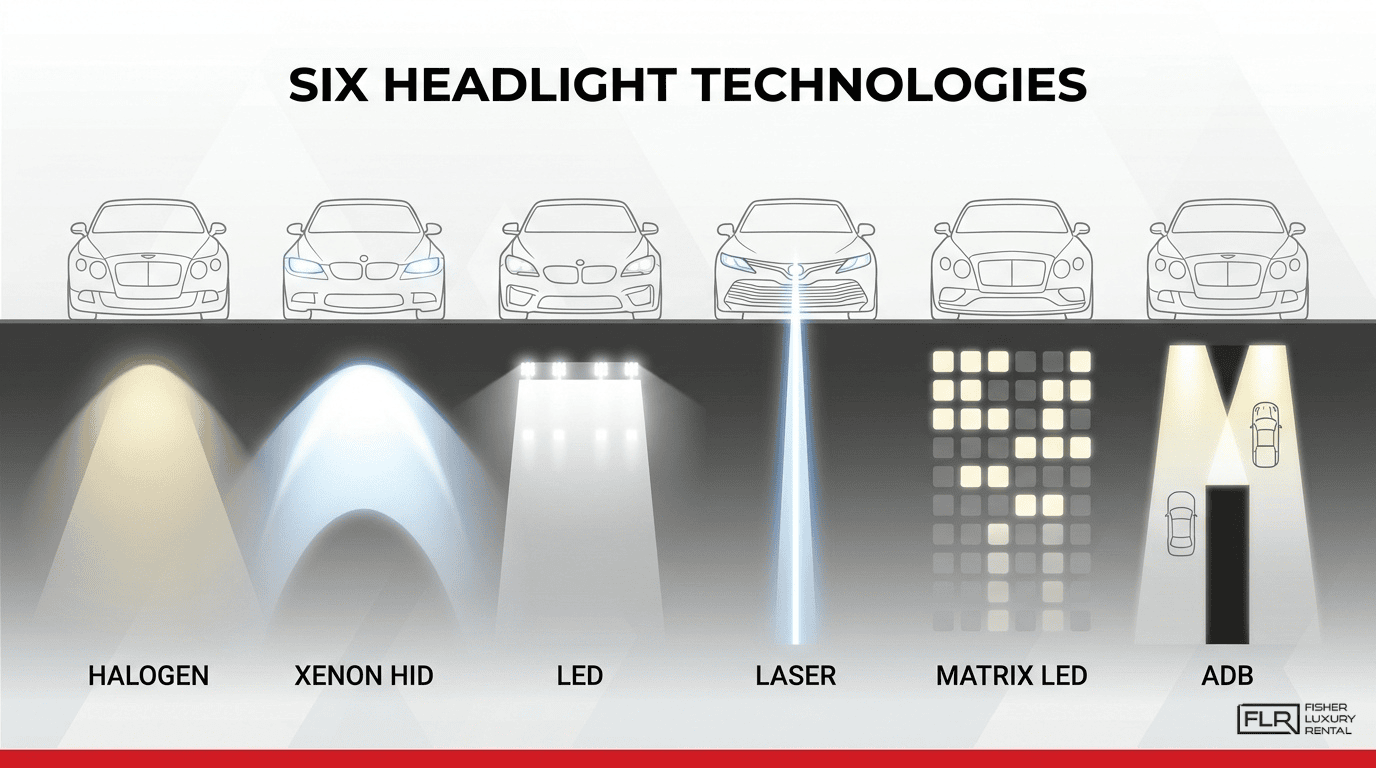
Car headlight technology encompasses six distinct systems: halogen, xenon HID, LED, laser, matrix LED, and adaptive driving beam (ADB), each representing a separate generation of illumination engineering with measurable differences in brightness, range, lifespan, and cost.
This guide covers how each technology works, how they compare in real-world performance, what ownership and replacement costs look like, how safety and regulation shape what reaches the road, and how to experience the most advanced systems firsthand.
Halogen and xenon HID headlights form the foundational tier: simple, proven systems with well-understood trade-offs in output and longevity. We cover their operating principles, beam distances, lifespan benchmarks, and replacement costs in full.
LED and laser systems represent a step-change in both efficiency and capability. OEM LED modules last up to 45,000 hours, while laser headlights project up to 600 meters, nearly double the range of conventional LED high beams. We examine how each produces light, what that means for night driving visibility, and what replacement costs look like at the luxury and exotic tier.
Matrix LED and ADB systems are the current apex of production headlight intelligence. We break down how individually controllable LED arrays create precise shadow zones around other vehicles, why IIHS data shows “good”-rated headlights reduce single-vehicle nighttime crashes by 19%, and how the 2022 NHTSA rule change opened the U.S. market to ADB certification.
Finally, we look at how luxury and exotic brands, including Porsche, McLaren, Lamborghini, and Range Rover, deploy these technologies, and how Fisher Luxury Rental provides direct, behind-the-wheel access to factory-installed advanced headlight systems.
What Are the Main Types of Car Headlight Technology Available Today?
The main types of car headlight technology available today are halogen, xenon HID, LED, laser, matrix LED, and adaptive driving beam systems. Each represents a distinct generation of illumination engineering, ranging from basic filament-based bulbs to pixel-level intelligent beam control.
Halogen Headlights
Halogen headlights are the oldest and most widely used technology still found on the road today. They produce light by passing electric current through a tungsten filament inside a halogen gas-filled glass capsule. Affordable and simple to replace, halogen units remain standard on entry-level vehicles, though they offer the shortest beam range and lowest efficiency of all modern headlight types.
Xenon HID Headlights
Xenon HID headlights are high-intensity discharge systems that generate light through a high-voltage arc between two electrodes inside a xenon gas-filled quartz tube. They produce significantly more light than halogen and deliver a cooler, whiter beam. A brief warm-up period is required before reaching full brightness, which distinguishes them from instant-on LED systems. The 1991 BMW 7 Series first introduced this technology to production vehicles.
LED Headlights
LED headlights use semiconductors to convert electricity directly into light, making them far more energy-efficient than halogen or HID alternatives. They reach full brightness instantly, generate less heat, and offer a longer operational lifespan. Their compact form factor also gives designers greater freedom in shaping distinctive front-end signatures, which is why LED adoption has accelerated sharply across both mainstream and premium segments.
Laser Headlights
Laser headlights use blue laser diodes to excite a phosphorous element, producing an intensely coherent white light capable of projecting up to 600 meters, nearly double the range of conventional LED high beams, according to BMW Group PressClub. Their exceptional range makes them particularly valuable at highway speeds, where earlier detection of road hazards directly improves reaction time. The Audi R8 LMX was the first production vehicle to offer laser high-beams as standard equipment in 2014.
Matrix LED Headlights
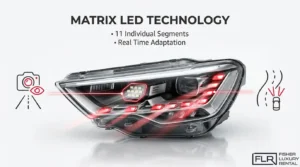
Matrix LED headlights are systems that use an array of individually controllable LEDs, each capable of being dimmed or switched off selectively. This allows the headlight to cast “shadow boxes” around oncoming and preceding vehicles while maintaining full high-beam brightness across the rest of the road. Audi introduced the first production matrix LED system on the 2013 Audi A8 with 25 independent segments. Audi’s Digital Matrix LED units take this further, utilizing approximately 1.3 million micromirrors per unit, each capable of tilting up to 5,000 times per second to project precise patterns on the road.
Adaptive Driving Beam Headlights
Adaptive driving beam (ADB) headlights are systems that automatically and continuously reshape the beam pattern in real time based on traffic, speed, and road geometry, eliminating the need to manually switch between high and low beams. In February 2022, NHTSA amended FMVSS No. 108 to formally permit ADB headlamp certification on new U.S. vehicles, opening the American market to this technology. Range Rover’s 2024 Digital LED headlights feature 1.2 million pixels and a “light carpet” function that illuminates the vehicle’s own lane, while the McLaren 750S integrates adaptive LEDs with blade DRLs that optimize both visibility and front-end aerodynamics. ADB represents the current apex of production headlight intelligence, and its U.S. regulatory clearance signals a significant shift in how next-generation vehicles will light the road ahead.
How Does Each Headlight Technology Actually Work?
Each headlight type produces light through a distinct physical or electronic mechanism. The sections below break down the operating principles behind halogen, xenon HID, LED, laser, and matrix adaptive systems.
How Do Halogen Headlights Produce Light?
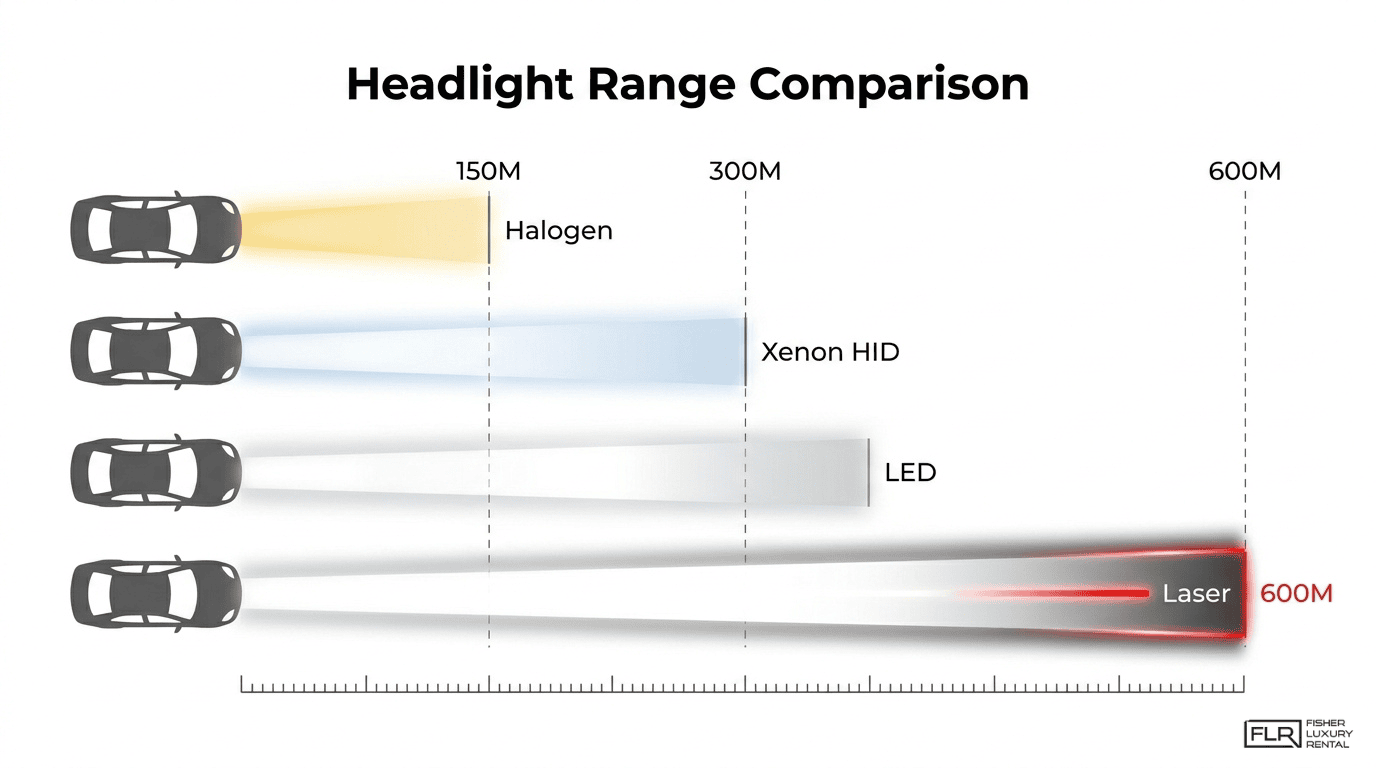
Halogen headlights produce light by passing an electric current through a tungsten filament sealed inside a glass capsule filled with halogen gas. The halogen gas creates a regenerative cycle that redeposits evaporated tungsten back onto the filament, extending its life compared to standard incandescent bulbs. According to NAOEVO, this process typically generates 700 to 1,200 lumens at a warm color temperature of 3,000K to 3,500K, with a beam distance of approximately 150 meters. Reliable and inexpensive to replace, halogen remains the baseline against which all newer technologies are measured.
How Do Xenon HID Headlights Produce Light?
Xenon HID headlights produce light by striking a high-voltage electrical arc between two electrodes inside a quartz tube filled with xenon gas. Unlike halogen filaments, there is no physical element to burn out; instead, ionized xenon plasma sustains the arc. According to BayOptiks, HID systems produce 3,200 to 3,500 lumens at color temperatures ranging from 4,300K to 6,000K, significantly brighter and whiter than halogen output. One practical limitation is a brief warm-up period before the arc reaches full brightness. The 1991 BMW 7 Series (E32) was the first production vehicle to introduce this technology.
How Do LED Headlights Produce Light?
LED headlights produce light by passing electrical current through semiconductor diodes, which emit photons directly without heat-dependent combustion or gas discharge. This solid-state process reaches color temperatures of 5,500K to 6,500K while consuming significantly less power than halogen or HID systems, according to TotalEnergies. Because no filament or arc is involved, LEDs respond instantaneously and generate far less waste heat at the light source. Their compact size also gives designers greater freedom in optic and housing layout, which is a key reason LED headlights have become the dominant technology across modern luxury and performance vehicles.
How Do Laser Headlights Produce Light?
Laser headlights produce light by firing blue laser diodes at a phosphorous element, which converts the energy into a highly coherent, intense white beam. According to BMW Group PressClub, this process can project a beam distance of up to 600 meters (approximately 1,968 feet), nearly double the range of conventional LED high beams. Laser systems are also exceptionally durable, with a technical lifespan exceeding 30,000 hours of operation. Because raw laser light never exits the housing directly, the system remains safe for road use. The Audi R8 LMX, launched in 2014, was the first production car to feature laser high-beams as standard equipment.
How Do Matrix LED and Adaptive Beam Systems Produce Light?
Matrix LED systems produce light through an array of individually controllable LEDs that can be selectively dimmed or deactivated in real time. According to Shine Lighting, this creates precise “shadow boxes” around oncoming or preceding vehicles, allowing the driver to maintain full high-beam illumination everywhere else on the road. Audi introduced the first fully functional Matrix LED system on the 2013 Audi A8, using 25 independently controlled segments. Modern implementations have advanced considerably: Porsche’s HD Matrix LED technology, introduced in late 2022, uses a chip with over 16,000 individually controllable micro-LEDs per module and delivers light distribution up to twice as bright as previous systems. Matrix systems represent the most intelligent application of LED technology available today.
How Do Modern Headlight Technologies Compare in Brightness and Range?
Modern headlight technologies vary significantly in how far and how brightly they illuminate the road. The following sections compare halogen, xenon HID, LED, and laser systems across beam distance and light output.
How Far Do Halogen Headlights Illuminate the Road?
Halogen headlights illuminate the road to approximately 150 meters, producing 700 to 1,200 lumens at a warm color temperature of 3,000K to 3,500K. That range is adequate for moderate urban speeds but falls short on high-speed highways where longer sight distances matter. One important legal note: despite recent regulatory changes, aftermarket LED replacement bulbs intended for use in halogen housings remain federally illegal in the U.S. for on-road use as of 2024, according to Headlight Revolution.
How Far Do Xenon HID Headlights Illuminate the Road?
Xenon HID headlights illuminate the road significantly farther than halogen, producing 3,200 to 3,500 lumens at color temperatures between 4,300K and 6,000K. That output is roughly three times the brightness of a standard halogen bulb, translating to a noticeably whiter, wider beam that extends well beyond 150 meters. The tradeoff is a brief warm-up period before the system reaches full intensity, which can momentarily limit visibility after startup.
How Far Do LED Headlights Illuminate the Road?
LED headlights illuminate the road with high-efficiency output at color temperatures of 5,500K to 6,500K, producing crisp, daylight-adjacent light that improves contrast and object recognition at distance. LEDs consume considerably less power than halogen or HID systems while matching or exceeding HID brightness. Because they reach full intensity instantly with no warm-up delay, they are particularly effective in situations requiring immediate high-beam activation.
How Far Do Laser Headlights Illuminate the Road?
Laser headlights illuminate the road up to 600 meters, according to BMW Group, nearly double the range of conventional LED high beams. The technology uses blue laser diodes to excite a phosphorous element, generating a highly coherent white light of exceptional intensity. That 600-meter projection distance gives drivers on open highways substantially more reaction time at speed, making laser systems the current peak of production headlight range.
How Long Does Each Type of Headlight Technology Last?
Headlight lifespan varies significantly by technology type. The sections below cover expected operational hours for halogen bulbs, xenon HID bulbs, LED modules, and laser modules.
How Long Do Halogen Bulbs Typically Last?
Halogen bulbs typically last between 450 and 1,000 hours of operation under normal driving conditions. Because the tungsten filament degrades gradually through repeated heating and cooling cycles, output dims noticeably before the bulb fails completely. For most drivers, this translates to roughly two to five years of use, making halogen the shortest-lived headlight technology available today.
How Long Do Xenon HID Bulbs Typically Last?
Xenon HID bulbs typically last between 2,000 and 3,000 hours of operation. According to BayOptiks, HID systems produce 3,200 to 3,500 lumens using a high-voltage arc inside a xenon-filled quartz tube, but that warm-up arc cycle gradually degrades the electrodes over time. This lifespan represents a meaningful improvement over halogen, though it falls well short of solid-state alternatives like LED.
How Long Do LED Headlight Modules Typically Last?
LED headlight modules typically last far longer than any gas-discharge or filament-based alternative. According to XenonPro, OEM LED headlight units carry an expected operational lifespan of up to 45,000 hours, which can exceed 20 years of typical vehicle use. In practice, the LED module will outlast most other mechanical components on the vehicle, making LED the clear longevity leader among mainstream headlight technologies.
How Long Do Laser Headlight Modules Typically Last?
Laser headlight modules typically last more than 30,000 hours of operation. According to AutoWorks Service and Repair, laser bulbs set a high durability benchmark for high-performance applications. While this falls below the OEM LED ceiling, it still represents decades of typical use and comfortably surpasses both halogen and xenon HID systems in operational life.
How Much Does Each Headlight Technology Cost to Replace?
Headlight replacement costs vary significantly by technology type, from affordable halogen bulbs to premium laser assemblies exceeding several thousand dollars. The sections below break down costs for halogen, xenon HID, LED, and laser systems.
How Much Do Halogen Headlight Replacements Cost?
Halogen headlight replacements cost the least of any current technology. A single halogen bulb typically runs $15 to $50, while a complete halogen assembly replacement for standard vehicles generally falls between $150 and $300, including parts and labor. Because halogen systems use simple, widely available components, repair shops can source and install them quickly. For budget-conscious drivers, halogen remains the most economical replacement option by a significant margin.
How Much Do Xenon HID Headlight Replacements Cost?
Xenon HID headlight replacements cost more than halogen due to the high-voltage ballast units and specialized bulbs the system requires. Parts alone for an HID assembly commonly range from $200 to $500 per side, and total replacement costs including labor frequently reach $400 to $800. The ballast, which regulates the high-voltage arc, is often the most expensive component to source and replace.
How Much Do LED Headlight Replacements Cost?
LED headlight replacements cost considerably more than halogen or HID systems, particularly for integrated OEM assemblies. According to HawkGlow, a complete modern headlight assembly in 2025 ranges from $150 to $800 for standard vehicles, though advanced LED and matrix units can exceed $2,000 per side. Specialized LED projector units on performance vehicles illustrate the upper extreme: Ford Bronco Sport LED projector assemblies reach $1,380, reflecting the complexity of integrated electronic components.
How Much Do Laser Headlight Replacements Cost?
Laser headlight replacements cost the most of any production headlight technology available today. Complete laser headlight assemblies on vehicles such as the BMW i8 or Audi R8 can reach $3,000 to $6,000 or more per unit when sourced as OEM parts, with dealer labor adding substantially to the total. Given this, laser headlight repair costs represent one of the most significant long-term ownership considerations for exotic and luxury vehicle buyers.
What Headlight Technology Do Luxury and Exotic Cars Use?
Luxury and exotic cars use the most advanced headlight technologies available, including full LED systems, Matrix LED, HD Matrix LED, and adaptive configurations. The sections below cover Ferrari, Lamborghini, Porsche, McLaren, and premium SUV brands.
What Headlights Do Ferrari and Lamborghini Models Use?
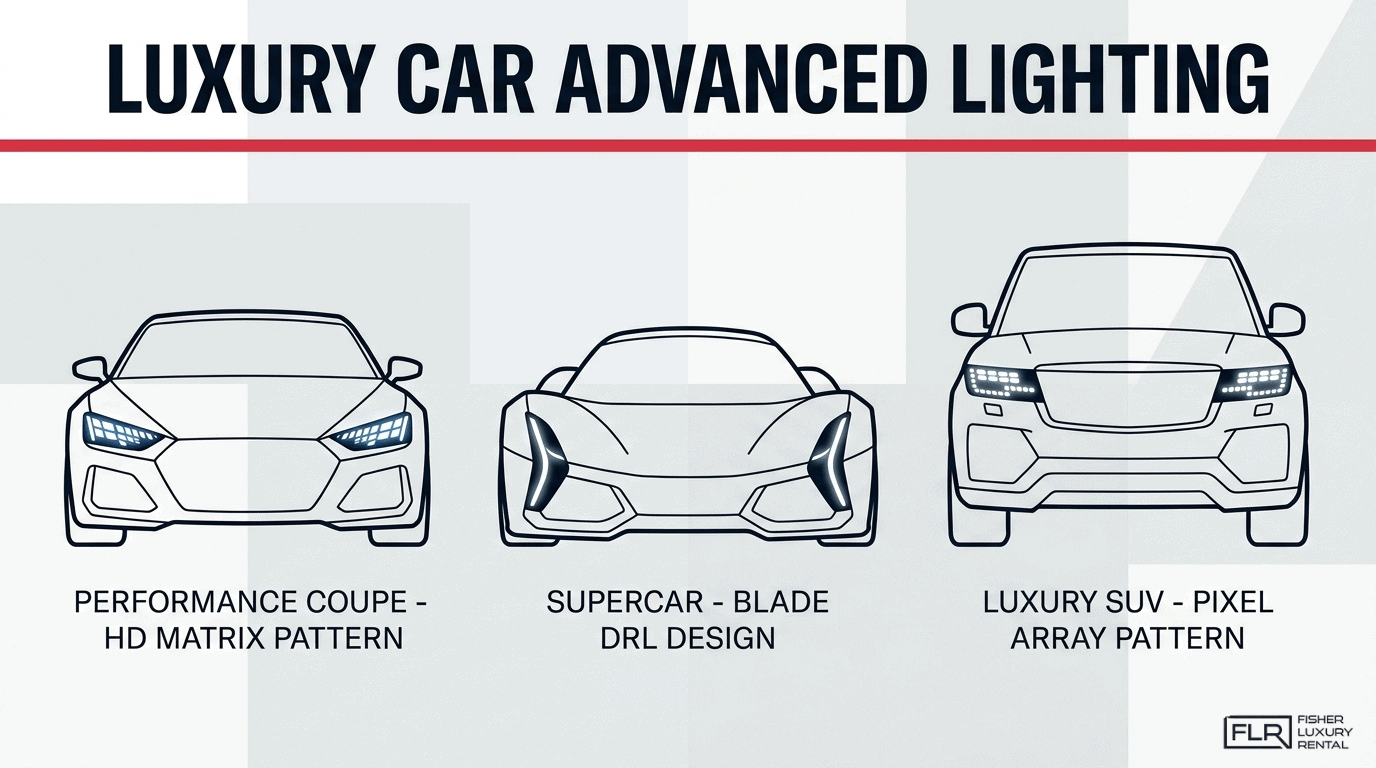
The headlights Ferrari and Lamborghini models use are full LED systems, with each brand integrating signature design elements into the lighting architecture. The Lamborghini Revuelto features futuristic Y-shaped LED daytime running lights and advanced LED main modules that reinforce the brand’s sharp, angular design language for the 2024 to 2025 model years. Ferrari similarly equips its current lineup with LED headlight units designed to complement aerodynamic bodywork. Both brands treat their lighting systems as visual identity statements, not just functional components. For drivers who want to experience these systems firsthand, Fisher Luxury Rental’s fleet includes the Ferrari 488 Spider and the Lamborghini Huracan Spyder.
What Headlights Do Porsche and McLaren Models Use?
The headlights Porsche and McLaren models use represent two distinct approaches to advanced LED technology. Porsche’s HD Matrix LED system, introduced in late 2022, uses a chip containing over 16,000 individually controllable micro-LEDs per module, delivering light distribution up to twice as bright as previous systems. The McLaren 750S takes a different direction, incorporating adaptive LED headlights as standard equipment with signature blade DRLs that sweep into front aero-sockets, optimizing both visibility and cooling airflow. Both systems operate far beyond basic illumination, functioning as integrated performance and aerodynamic components. Fisher Luxury Rental’s fleet includes both the Porsche 911 Carrera S and the McLaren 720S.
What Headlights Do High-End Luxury SUVs Use?
The headlights high-end luxury SUVs use are advanced pixel-based LED systems that prioritize adaptive beam precision. Range Rover’s 2024 models offer Digital LED headlights with 1.2 million pixels, providing advanced beam masking and a “light carpet” function that illuminates the vehicle’s lane for enhanced safety. Audi’s Digital Matrix LED headlights push resolution even further, using approximately 1.3 million micromirrors per unit, each capable of tilting up to 5,000 times per second to project precise light patterns on the road surface. These systems reflect a broader industry shift: in luxury SUVs, headlight technology is now a primary differentiator between trim levels, not an afterthought.
Which Headlight Technology Is Best for Night Driving Safety?
The best headlight technology for night driving safety is Matrix LED or Adaptive Driving Beam (ADB), as these systems maximize road illumination while actively managing glare for other drivers. The sections below explain why road illumination outweighs glare concerns as the primary safety factor.
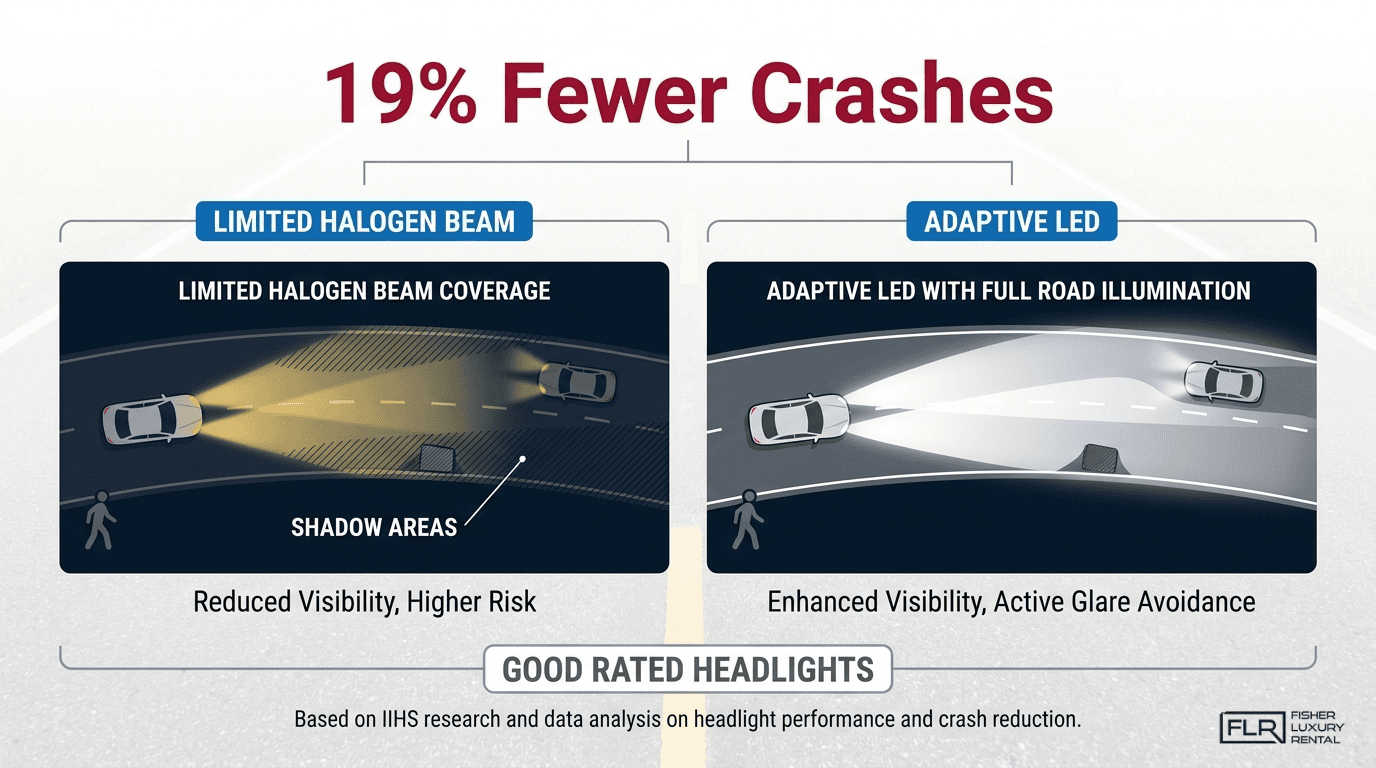
According to IIHS President David Harkey, “although it can certainly be uncomfortable, headlight glare contributes to far fewer crashes than insufficient visibility.” This framing is critical: the safest headlight is the one that lights the road most effectively, not the one that produces the least glare. Matrix LED and ADB systems achieve both goals simultaneously by maintaining full high-beam coverage while automatically masking oncoming drivers from direct light. For most night driving scenarios, any well-rated LED or Matrix LED system will deliver a meaningful safety advantage over halogen. The real risk on dark roads is not seeing far enough ahead, and modern adaptive systems address that gap better than any previous technology.
What Are Adaptive Headlight Features and Why Do They Matter?
Adaptive headlight features are systems that automatically adjust a vehicle’s light beam direction, intensity, or pattern in response to driving conditions, vehicle speed, and surrounding traffic. The H3s below cover how steering-responsive systems work, what Adaptive Driving Beam technology does, and why these features improve nighttime safety.
What Are Steering-Responsive Adaptive Headlights?
Steering-responsive adaptive headlights are systems that pivot the headlight beam horizontally to follow the direction the steering wheel turns. Rather than projecting a fixed straight beam, the headlights swivel into corners as the driver steers, illuminating the actual path of travel instead of the road ahead in a straight line. This is especially valuable on winding roads and highway on-ramps, where fixed beams leave the inside of a curve in shadow. In February 2022, NHTSA amended FMVSS No. 108 to formally permit Adaptive Driving Beam headlamps on new U.S. vehicles, signaling regulatory recognition that adaptive systems deliver measurable visibility gains.
What Is Adaptive Driving Beam (ADB) Technology?
Adaptive Driving Beam technology is a headlight system that continuously modulates individual LED segments to maintain full high-beam coverage while masking only the precise zones occupied by oncoming or preceding vehicles. Unlike traditional high-beam assist, which simply toggles the entire beam off, ADB preserves maximum road illumination everywhere except directly around other road users. Range Rover’s 2024 Digital LED headlights demonstrate this capability with 1.2 million pixels, enabling precise beam masking and a dedicated “light carpet” function that illuminates the driver’s lane boundary. This approach directly addresses what IIHS research identifies as the primary crash risk: insufficient road illumination, not glare.
Why Do Adaptive Features Matter for Nighttime Driving Safety?
Adaptive headlight features matter because they extend usable illumination time and coverage without forcing drivers to choose between blinding oncoming traffic and reducing their own visibility. Fixed systems create a binary trade-off; adaptive systems eliminate it. Vehicles with headlights rated “good” by the IIHS experience 19% fewer single-vehicle nighttime crashes per mile than those rated “poor,” according to IIHS research. Adaptive systems are among the primary factors that separate top-rated headlight assemblies from lower-tier ones. For drivers who regularly navigate rural highways or poorly lit urban roads, adaptive features represent one of the highest-value safety investments in modern vehicle technology.
How Do Headlight Regulations Affect Available Technology?
Headlight regulations directly shape which technologies manufacturers can legally offer in each market. The sections below cover the key U.S. federal standards, the landmark 2022 ADB ruling, and the legal status of aftermarket upgrades.
What Federal Standards Govern Headlight Technology in the U.S.?
Federal Motor Vehicle Safety Standard (FMVSS) No. 108 is the primary U.S. regulation governing headlight technology, setting mandatory requirements for beam pattern, intensity, and photometric performance for all vehicles sold domestically. Because FMVSS No. 108 historically prescribed specific beam-pattern outputs rather than performance outcomes, it effectively blocked technologies already common in Europe, such as adaptive driving beams, from reaching American roads. This regulatory lag created a situation where U.S. drivers had access to less advanced lighting than drivers in comparable markets, a frustrating gap that persisted for years despite the safety benefits being well-documented.
How Did the 2022 NHTSA Rule Change What Technologies Are Now Legal?
The 2022 NHTSA rule change expanded the technologies that are now legal by amending FMVSS No. 108 to permit Adaptive Driving Beam (ADB) headlamp certification on new U.S. vehicles. In February 2022, NHTSA issued this final rule, formally opening the American market to ADB systems that automatically adjust beam shape and intensity around other road users. Before this change, automakers could not legally certify ADB systems regardless of how sophisticated their technology was, meaning shoppers had fewer advanced lighting options than the underlying technology permitted.
Are Aftermarket LED Headlight Upgrades Legal in the United States?
Aftermarket LED headlight upgrades are not fully legal for on-road use in the United States. Despite the 2022 ADB ruling, aftermarket LED replacement bulbs designed for use in halogen housings remain federally illegal for on-road use as of 2024. The core issue is that LED emitters produce a fundamentally different light distribution than the tungsten filaments halogen housings were engineered to focus, creating uncontrolled glare even when the bulbs appear brighter to the driver. Consumers should treat any aftermarket LED “upgrade” bulb as a compliance risk, not a safety improvement.
How Can You Experience the Latest Headlight Technology Firsthand?
You can experience the latest headlight technology firsthand by renting a luxury or exotic vehicle that features factory-installed advanced systems. The sections below cover rental access through Fisher Luxury Rental and the key takeaways from this complete guide.
Can Renting an Exotic or Luxury Car from Fisher Luxury Rental Show You Advanced Headlight Systems in Action?
Yes, renting an exotic or luxury car from Fisher Luxury Rental can show you advanced headlight systems in action. Exotic car rental services allow enthusiasts to experience advanced lighting systems like Audi’s Digital Matrix LED in real-world driving conditions without the high cost of vehicle ownership.
Fisher Luxury Rental’s fleet includes vehicles such as the Audi R8 Spyder, McLaren 720S, Porsche 911 Carrera S, and Ferrari 488 Spider, all equipped with factory-installed advanced LED systems. Advanced LED and matrix headlight assemblies can exceed $2,000 per side to replace, making ownership a significant financial commitment. Renting delivers the same firsthand experience at a fraction of that cost. The U.S. automotive lighting market is projected to grow from $10.41 billion in 2024 to $17.24 billion by 2033, reflecting just how rapidly these technologies are reaching the road.
What Are the Key Takeaways About Modern Car Headlight Technology?
The key takeaways about modern car headlight technology are that each generation offers measurably better brightness, range, lifespan, and safety than the last. The right choice depends on your priorities across four areas:
- Technology tier: Halogen suits budget applications; LED and Matrix LED deliver the best balance of efficiency and performance for most drivers.
- Visibility range: Laser systems project up to 600 meters, roughly four times the reach of a standard halogen beam.
- Longevity: OEM LED modules last up to 45,000 hours, far outlasting halogen or HID alternatives.
- Real-world experience: Renting an exotic or luxury vehicle remains the most practical way to evaluate cutting-edge headlight systems before committing to ownership.
Understanding these distinctions helps drivers make informed decisions about safety, cost, and the driving experience they want.