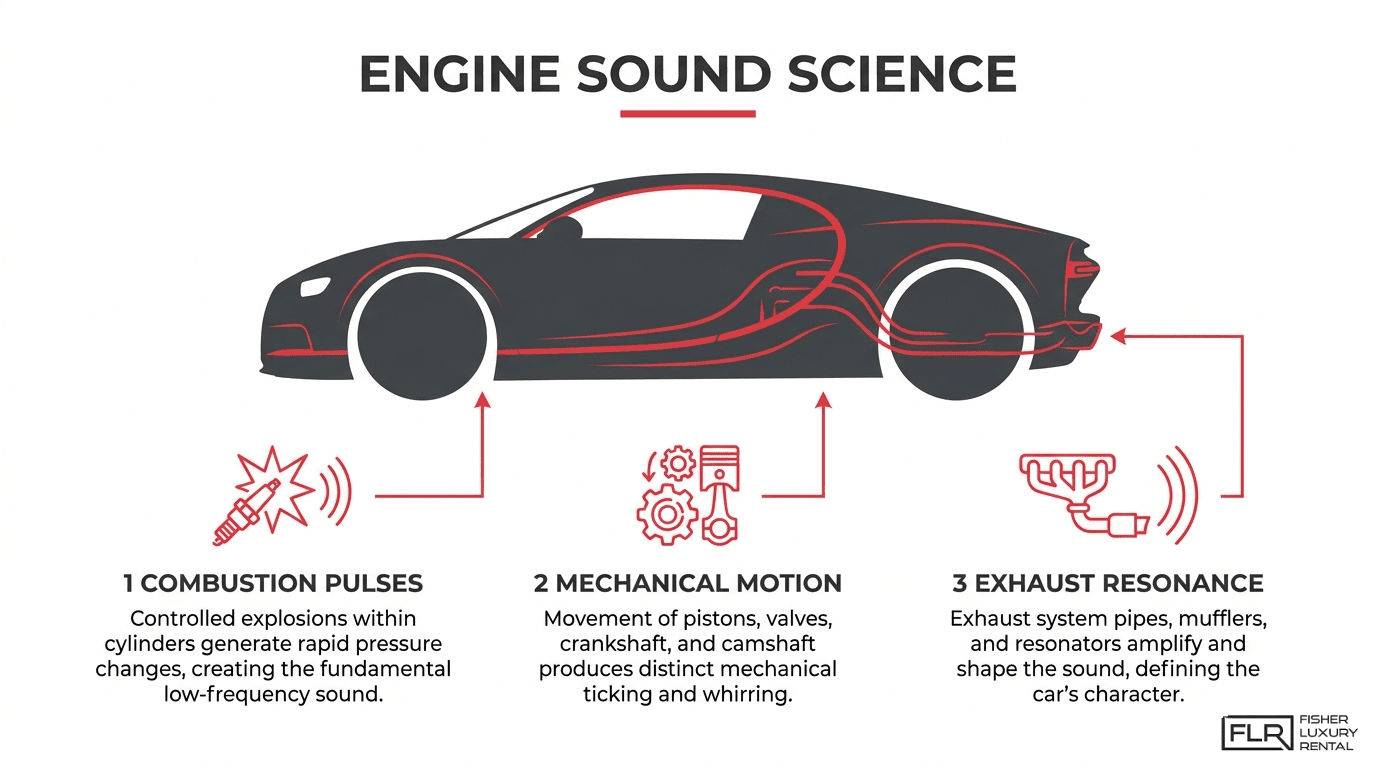
Engine sound is the acoustic result of combustion pressure pulses, mechanical motion, and engineered resonance working together across multiple interconnected systems. Every note a great engine produces is deliberate, shaped by physics and refined by design.
This guide covers how engines generate sound in the first place, why certain configurations sound better than others, how harmonics and exhaust geometry define tonal character, what psychoacoustics reveals about human auditory preference, how intake and exhaust systems sculpt the final note, how automakers engineer and actively tune that sound, what separates legendary supercar acoustics from ordinary engines, how forced induction and electrification change the acoustic equation, and how to experience these sounds firsthand.
Combustion events generate the fundamental frequency and firing character, while mechanical components layer texture and richness on top. Configurations from flat-plane V8s to V12s each produce a distinct harmonic signature rooted in cylinder count, crankshaft geometry, and firing interval spacing.
Exhaust pipe length, diameter, and header design function like tuned musical instruments, setting resonant frequencies that determine pitch, depth, and tonal complexity. Ferrari, Porsche, and Lamborghini each exploit these principles in specific, documented ways.
Psychoacoustics explains why the human ear finds certain engine notes viscerally powerful. Sub-bass frequencies below 60 Hz are felt physically in the body, not just heard, which is why displacement and rumble register as mechanical authority rather than mere noise.
Automakers now combine active exhaust valves, resonator placement, AI-driven acoustic engineering, and digital sound synthesis to control the final result with precision. For electric vehicles, that synthesis is becoming the primary acoustic strategy as combustion disappears from the equation.
What Actually Creates the Sound an Engine Produces?
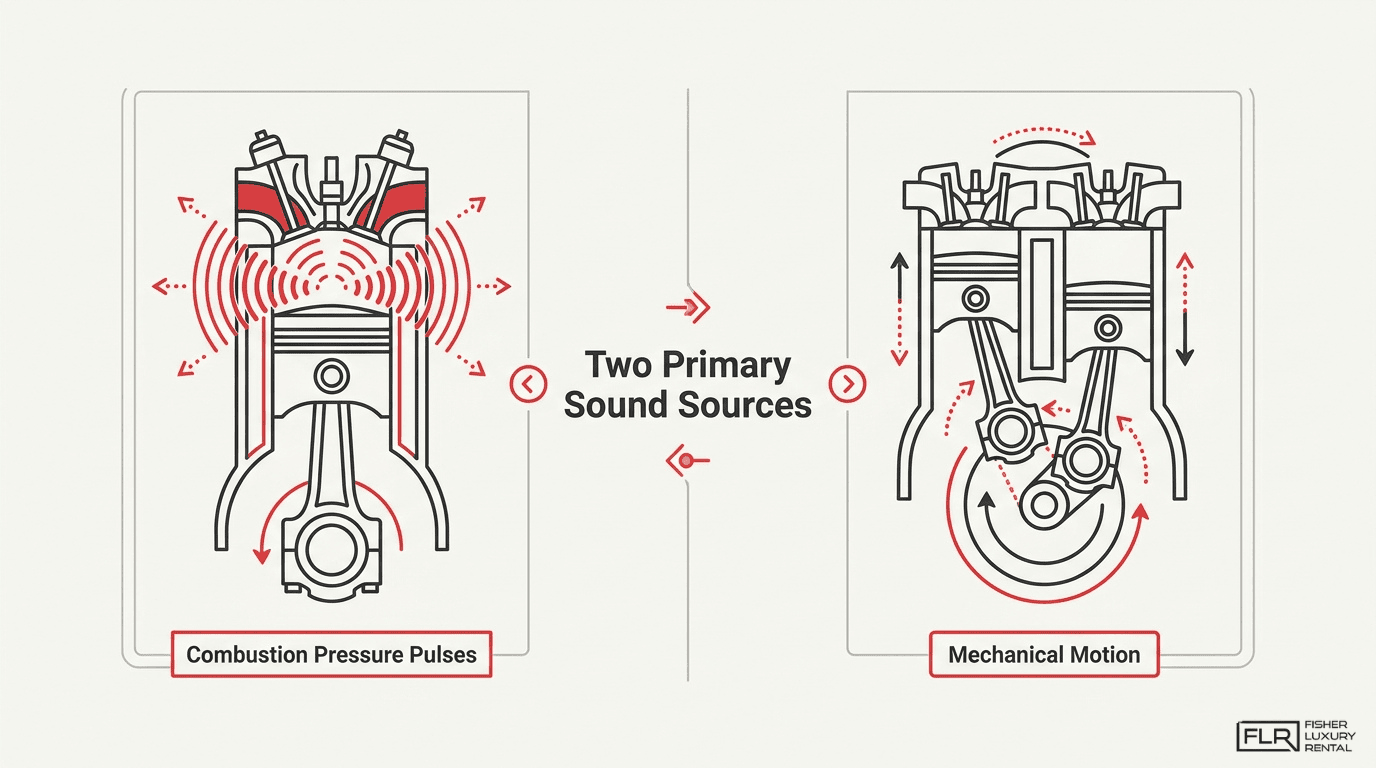
Engine sound results from two primary sources: combustion pressure pulses and mechanical motion. According to the Acoustical Society of America, a four-stroke eight-cylinder engine produces four pressure pulses per crankshaft revolution, since fuel ignites once every two revolutions per cylinder. The sections below cover how combustion, exhaust expulsion, and mechanical components each shape that sound.
How Does the Combustion Cycle Generate Sound Waves?
The combustion cycle generates sound waves by igniting a compressed fuel-air mixture inside each cylinder, creating a rapid pressure spike that propagates outward as an acoustic pulse. These pulses repeat with every firing event, and their frequency, timing, and intensity together form the engine’s fundamental note. The regularity of those intervals determines whether the result is a smooth tone or a rough, uneven growl. The Lexus LFA’s Yamaha-tuned V10 demonstrates this precisely: its perfectly even firing intervals produce what engineers describe as a “roar of an angel,” a real-world example of how combustion timing shapes acoustic character.
What Role Does Exhaust Gas Expulsion Play in Engine Noise?
Exhaust gas expulsion plays a major role in shaping both the volume and tonal quality of engine noise. According to the Acoustical Society of America, a large part of the deterministic component of engine noise comes from combustion pressure pulses exiting the cylinders through the exhaust path. Engine sound is further shaped by harmonics, which are quieter tones layered above the fundamental note, and these are influenced by engine layout (inline, V, or flat), RPM, and exhaust system design. Resonators refine the final output by canceling unwanted frequencies: their chamber dimensions cause reflected waves to destructively interfere with specific tones. Automakers increasingly rely on data analytics and AI to manage this complexity through virtual prototyping and noise source identification, driven partly by stricter global emissions and noise pollution regulations.
How Do Mechanical Components Contribute to Engine Sound?
Engine noise is defined as the combined output of gas loads in the cylinders and mechanical motions within the engine, comprising both combustion noise and mechanical noise, with their relative contributions varying by engine type. Valve train activity, piston slap, crankshaft rotation, and ancillary component vibrations all layer onto the combustion signature. Porsche demonstrates this integration deliberately: its naturally aspirated flat-six uses a multi-valve intake manifold system that opens and closes compartments based on RPM, tuning both sound and performance simultaneously. Research from Duke University confirms that artificial engine sound synthesis replicates this layering by summing harmonic components of rotating crank sounds against combustion tones, mapped to RPM and pedal pressure in real time. Mechanical contribution is often underestimated, but it directly determines the texture and richness that separates a memorable engine note from a generic one.
Why Do Some Engine Configurations Sound Better Than Others?
Engine configuration determines firing interval, vibration balance, and harmonic content, and these three factors shape every aspect of how an engine sounds. The sections below cover how crankshaft design, cylinder count, and geometric layout create the tones heard in flat-plane V8s, flat-sixes, inline-sixes, V12s, and V10s.
How Does a Flat-Plane Crank V8 Sound Different From a Cross-Plane V8?
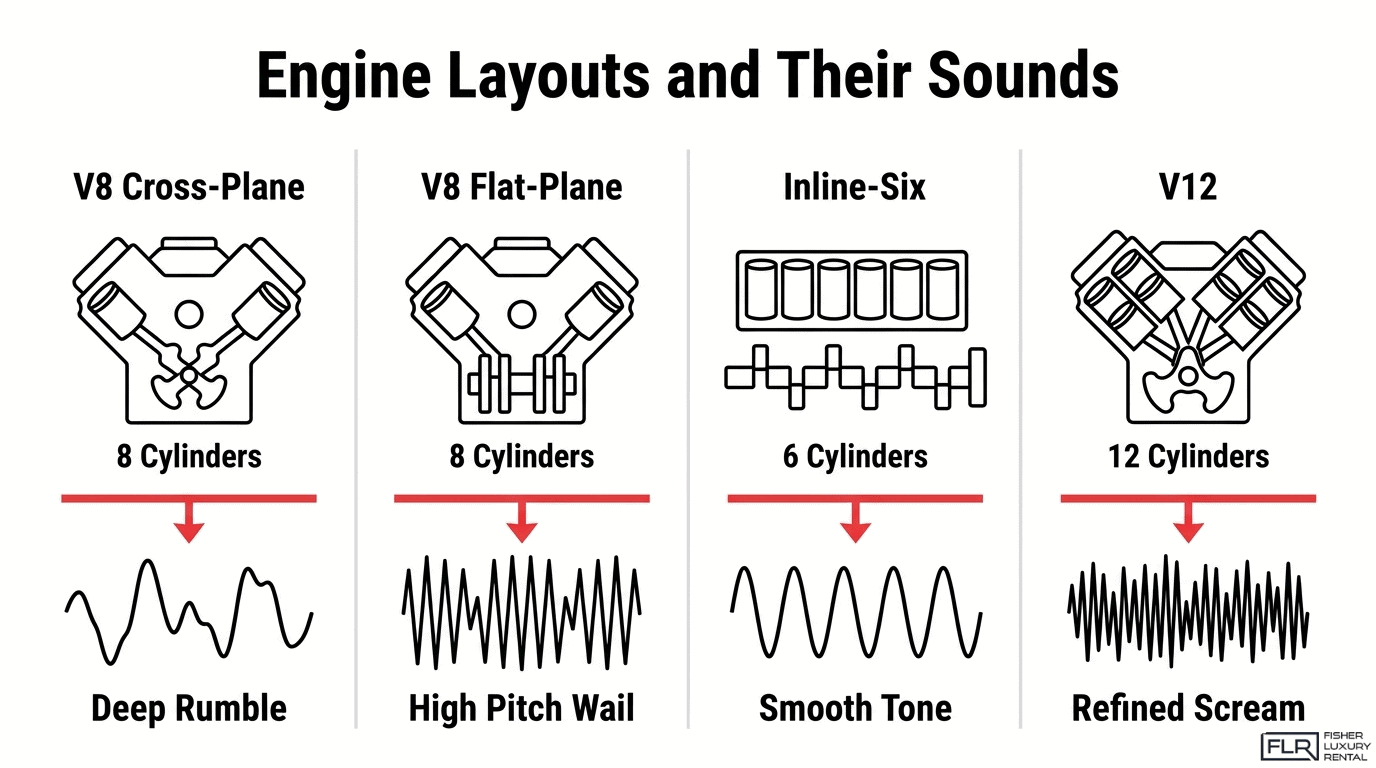
A flat-plane crank V8 sounds different from a cross-plane V8 because crankshaft geometry controls the firing sequence between cylinder banks. According to OnAllCylinders, cross-plane crankshafts have four journals at 90-degree intervals, producing unevenly spaced firings within each bank but balanced forces between banks, which generates the classic deep, burbling American V8 note. Flat-plane crankshafts arrange two pairs of journals 180 degrees apart, so the engine alternates firing between banks evenly, producing more efficient exhaust scavenging and a sharper, higher-pitched tone. Flat-plane V8s are also lighter and better suited to high-revving applications, though they generate more vibration and deliver less torque. The result is two unmistakably different characters: thunderous low-end rumble versus a high-revving, raspy scream.
What Gives a Flat-Six Engine Its Distinctive Tone?
A flat-six engine’s distinctive tone comes from its horizontally opposed cylinder layout combined with even firing intervals. With three cylinders on each side firing alternately at 120-degree intervals, the engine produces a balanced, textured exhaust note. Porsche improves its naturally aspirated flat-six by gating the intake manifold with multiple valves that open and close based on RPM, optimizing both sound and performance across the rev range. That engineering precision produces the flat-six’s signature purposeful bark, one of the most recognizable sounds in motorsport.
Why Does an Inline-Six Produce Such a Smooth Sound?
An inline-six produces such a smooth sound because it is a perfectly balanced even-firing engine. Each of its six cylinders fires at equal 120-degree intervals, meaning no firing is closer together than another and no overlapping vibration interrupts the harmonic flow. An inline-six also requires no balancer shaft, since opposing pistons naturally cancel each other’s forces. The outcome is a turbine-like, refined exhaust note that feels effortless at any RPM, which is why it remains the benchmark for smoothness in six-cylinder engineering.
What Makes a V12 Sound So Refined and Exotic?
A V12 engine sounds so refined and exotic because it is essentially two inline-sixes sharing a crankshaft. With twelve cylinders firing at perfectly even 60-degree intervals, combustion events overlap almost continuously, producing an unbroken, silky wave of exhaust pulses. The high cylinder count keeps individual pressure spikes small while sustaining consistent acoustic energy, which creates a smooth, layered wail that becomes more complex and musical as RPM climbs. No other configuration delivers that same sense of effortless, orchestrated power.
Why Does a V10 Engine Scream at High RPM?
A V10 engine screams at high RPM because ten cylinders firing at 72-degree intervals generate an extremely high combustion frequency within a compact displacement. As RPM rises, the dominant harmonic frequency climbs rapidly into the upper midrange, creating the urgent, wailing character that defines V10 sound. The Lexus LFA’s V10, tuned by Yamaha, demonstrates this precisely: its perfectly even firing intervals produce what Toyota describes as the “roar of an angel,” a sound so high in frequency that Yamaha had to redesign the instrument cluster because the needle could not respond fast enough to track the revs.
How Does Firing Order Affect an Engine’s Sound Character?
Firing order directly shapes an engine’s exhaust pulse timing, which determines whether the resulting sound is smooth and refined or ragged and characterful. The sections below cover how even firing intervals produce a clean note and what happens acoustically when those intervals are unequal.
How Does Even Firing Order Create a Smooth Exhaust Note?
Even firing order creates a smooth exhaust note by spacing combustion events at identical crankshaft intervals, such as every 180 degrees in a 4-cylinder or every 120 degrees in a 6-cylinder. This regularity produces a consistent, evenly timed stream of exhaust pulses with no clustering or gaps, so the ear perceives a clean, steady tone rather than a lumpy or erratic one.
Header design reinforces this quality. According to MotoIQ, tri-Y headers pair opposite cylinders in the firing order, generating an additional assisting wave that keeps the primary pipe in tune longer, broadening the powerband and sustaining tonal consistency across a wider RPM range. Automotive exhaust designers, much like organ builders, also exploit harmonic differences between open and closed pipe configurations to create timbral variety within that smooth foundation.
What Happens Sonically With an Uneven Firing Order?
Uneven firing order produces a throaty, burbling exhaust note because combustion events are clustered unevenly around the crankshaft’s rotation. Some firings arrive in quick succession while others are separated by longer gaps, creating an irregular pulse stream that the ear interprets as a distinctive, rhythmic chop.
Cross-plane V8s are the classic example: their crankshaft journals are spaced at 90-degree intervals, which deliberately staggers firings within each cylinder bank to aid mechanical balance. The sonic trade-off is that recognizable American muscle burble. Headers partially manage this by preventing high-pressure exhaust pulses from one cylinder from contaminating adjacent cylinders during valve overlap, preserving as much tonal clarity as possible within an inherently irregular pulse sequence.
What Role Do Exhaust Harmonics and Resonance Play?
Exhaust harmonics and resonance shape both the sound character and scavenging efficiency of an engine. The following sections cover how sound wave frequencies combine into timbre, why certain overtones sound musical, and how pipe length determines resonant frequency.
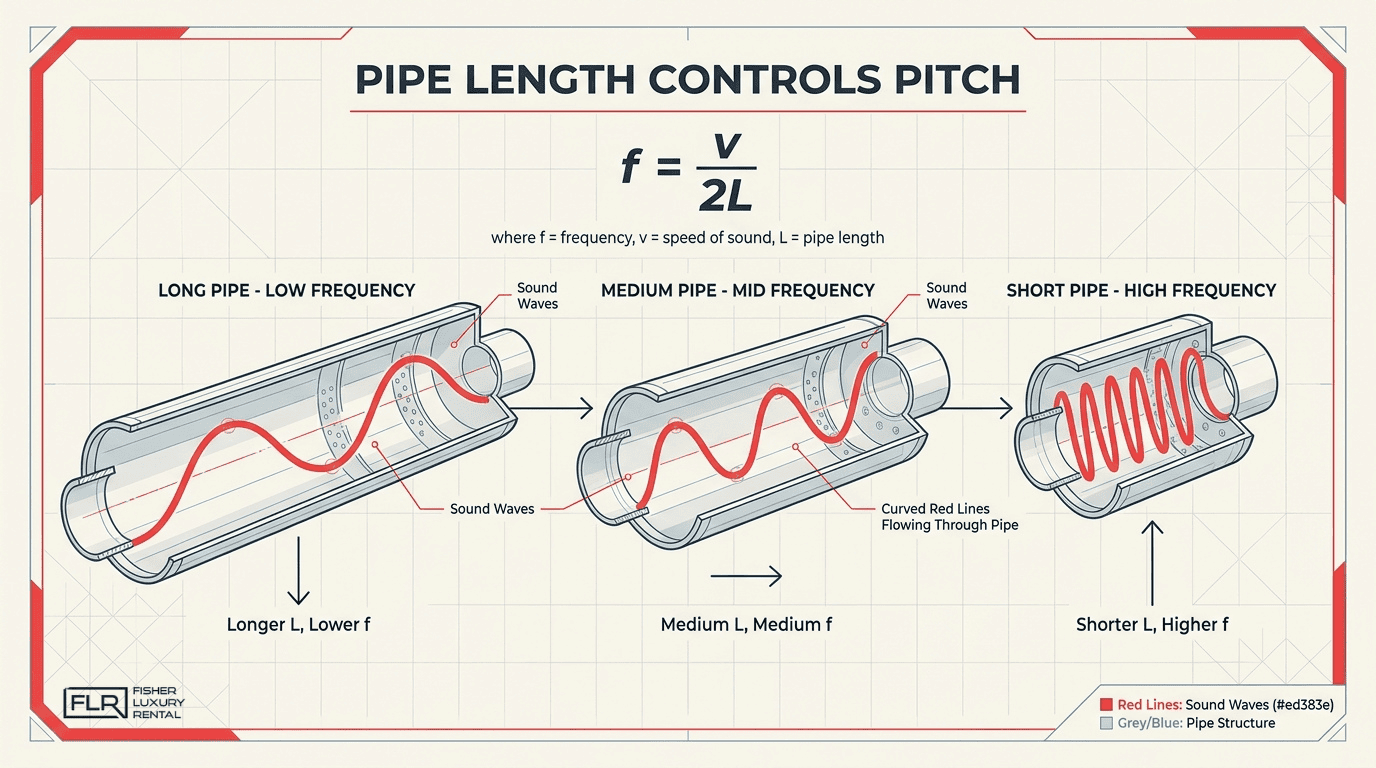
How Do Sound Wave Frequencies Combine to Form Timbre?
Sound wave frequencies combine to form timbre through pipe resonance, which occurs when sound waves inside a pipe reflect off the ends and reinforce each other at specific frequencies, producing a standing wave. The frequencies produced depend on the pipe’s length and whether its ends are open or closed. This is precisely why two exhaust systems with identical displacement can produce entirely different tonal characters.
Why Do Certain Harmonic Overtones Sound Musical to Us?
Certain harmonic overtones sound musical to us because harmonics are integer multiples of the fundamental frequency. A sound at 60 Hz, for example, produces its first harmonic at 120 Hz and its second at 240 Hz, forming a natural harmonic series the human ear recognizes as musical. Longer primary pipes generate a deeper, high-intensity harmonic, much like a wind instrument. Ferrari takes this further, engineering their engines to emphasize the 3rd and 6th harmonics on the air intake, producing a tone resembling a flute or organ.
How Does Exhaust Pipe Length Influence Resonant Frequency?
Exhaust pipe length influences resonant frequency directly: longer pipes produce lower resonant frequencies and deeper sound, while shorter pipes raise pitch. For open-ended pipes, the resonant frequency follows fn = n * v / (2L); for one closed end, it is fn = n * v / (4L), with only odd harmonics present. According to MotoIQ, a properly designed exhaust pipe is tuned like a musical instrument, most effective across just a few hundred RPM, with stepped primaries extending the tuned range. Pipe diameter also matters: a larger diameter slows exhaust gas speed, lowering pitch further.
Why Does the Human Ear Prefer Certain Engine Sounds?
The human ear prefers certain engine sounds because of how auditory physiology and psychological interpretation interact with specific frequencies, harmonics, and rhythmic pulse patterns. The following sections cover how psychoacoustics frames our response to engine notes, which frequency ranges feel most pleasing, and why low-frequency rumble reads as power.
How Does Psychoacoustics Explain Our Response to Engine Notes?
Psychoacoustics explains our response to engine notes by linking the physical properties of sound waves to how the brain interprets rhythm, pitch, and timbre. Engine firing intervals map directly to musical concepts: even-firing engines produce steady, predictable pulses the brain processes as harmony, while odd-firing engines generate irregular rhythms that the ear registers as a throaty, burbling character. According to Car Throttle, engine sound is shaped by harmonics layered over a fundamental note, with the engine layout, RPM, and exhaust design all influencing which overtones dominate. In essence, a great-sounding engine is one whose harmonic structure aligns with patterns the human auditory system finds ordered and musically coherent.
What Frequency Ranges Sound Most Pleasing to Humans?
The frequency ranges that sound most pleasing to humans are those within the mid-bass and lower-midrange bands, roughly 80 Hz to 800 Hz, where the ear resolves pitch with the greatest clarity and emotional engagement. According to Acoustical Surfaces, the average human ear hears from 20 Hz to 20,000 Hz, though many adults register only up to 15 to 17 kHz as aging and noise exposure reduce upper-frequency sensitivity. This narrowing actually concentrates perceptual attention on the mid-range bands where engine fundamentals and dominant harmonics live, making those frequencies more emotionally impactful than ever.
Why Do We Associate Deep Low-Frequency Rumble With Power?
We associate deep low-frequency rumble with power because sub-bass frequencies, ranging from approximately 20 to 60 Hz, are felt physically in the body and bones rather than just heard through the ears. This somatic experience, vibrating the chest and seat, bypasses purely cognitive evaluation and triggers an instinctive, visceral sense of mechanical force. Large-displacement engines idle and accelerate within these sub-bass ranges, so the association between rumble and power is reinforced every time a bigger engine produces more physical sensation than a smaller one. That physical resonance is arguably what separates a truly great engine note from one that merely sounds loud.
How Do Intake and Exhaust Systems Shape the Final Sound?
Intake and exhaust systems shape the final sound by controlling turbulent airflow, acoustic resonance, and pressure wave behavior throughout the engine. According to the Acoustical Society of America, the stochastic sound component produced by the engine is primarily due to turbulent airflow from the air intake and exhaust systems. The sections below cover header geometry, muffler design, and intake tract length.
How Do Header Design and Manifold Geometry Alter Tone?
Header design and manifold geometry alter tone by controlling how exhaust pressure pulses travel, reflect, and reinforce each other through the primary pipes. Pipe length, diameter, shape, and material thermal properties all influence the resonant frequency and tonal character of the system.
Two primary header configurations produce distinctly different results:
- 4-1 headers merge all primaries into a single collector, creating a stronger pulse down the primary and more peak power over a narrower RPM range, making them the preferred choice on race cars.
- Tri-Y headers pair opposite cylinders in the firing order, generating an additional assisting wave that keeps the primary pipe in tune longer and broadens the usable powerband.
According to MotoIQ, a 4-1 header design is usually more effective at tuning for peak power, as the main pulse sent down the primary is stronger. From an acoustic standpoint, 4-1 headers also produce a sharper, higher-pitched exhaust note at peak RPM, while Tri-Y headers tend to deliver a fuller, more layered tone across a wider range.
What Effect Do Muffler Types Have on Sound Character?
Muffler types have a direct effect on sound character by determining which frequencies are absorbed, reflected, or cancelled before the exhaust exits the tailpipe. The three common designs each take a different acoustic approach:
- Absorption mufflers use packing material such as fiberglass or steel wool to dissipate sound energy across a broad frequency range, producing a deeper, quieter tone.
- Reactive (chambered) mufflers use internal chambers that reflect sound waves back on themselves to cancel specific frequencies, creating a more aggressive, tonal exhaust note.
- Resonator mufflers are tuned to eliminate a targeted narrow frequency band, commonly used upstream to remove a specific drone without altering overall volume significantly.
Resonators are specifically designed so that reflected waves within the resonance chamber cancel unwanted frequencies, making them a precise tool for exhaust tuning rather than general noise reduction.
How Does Intake Tract Length Change Induction Sound?
Intake tract length changes induction sound by setting the resonant frequency at which the air column inside the intake pipe vibrates most efficiently. Longer intake tracts lower the resonant frequency, producing a deeper, throatier induction growl at lower RPM. Shorter tracts raise the resonant frequency, emphasizing higher-pitched induction noise at high RPM.
The speed of sound in air changes approximately 0.606 m/s per degree Celsius, meaning intake air temperature directly shifts these resonant frequencies in real-world conditions. Porsche exploits this principle by gating the intake manifold with multiple valves, opening and closing compartments based on engine RPM to optimize both sound and performance across the rev range. This approach is among the most sophisticated intake acoustic strategies in production engineering, treating the intake system as a tunable instrument rather than a passive air delivery duct.
How Do Automakers Engineer and Tune Exhaust Notes?
Automakers engineer exhaust notes through a combination of hardware design, electronically controlled valve systems, and increasingly, digital sound synthesis. The following sections cover acoustic engineering methods, active exhaust valve technology, and the role of sound symposers in modern vehicles.
What Acoustic Engineering Methods Do Manufacturers Use?
Acoustic engineering methods manufacturers use include virtual prototyping, AI-driven noise source identification, active sound design, and physical tuning of exhaust geometry. According to Market Research Future, automakers are increasingly applying data analytics and AI for predictive noise management alongside traditional hardware-based approaches. Stricter global noise and emissions regulations have made these investments essential, not optional. For electric vehicles specifically, novel sound generation strategies are required to create engaging acoustic experiences across multiple driving conditions, since EVs lack the combustion events that naturally produce character in traditional powertrains.
How Do Active Exhaust Valves Change Sound on Demand?
Active exhaust valves change sound on demand by using electronically controlled valves or baffles that open and close to adjust exhaust loudness according to driver preference. According to Ford Middle East, the Ford Mustang’s active exhaust system uses a two-part valve and actuator assembly that continuously responds to throttle inputs, widening the exhaust path under hard acceleration for a louder tone and restricting it during quiet cruising. This gives drivers meaningful real-time control over the acoustic character of the vehicle without any mechanical compromise to performance.
Why Do Some Cars Use Sound Symposers or Amplified Audio?
Some cars use sound symposers or amplified audio because their cabins are too well-insulated, or their engines too quiet, to deliver the acoustic engagement drivers expect. A sound symposer is a passive device that pipes intake or exhaust noise directly into the cabin through a resonating tube and membrane. Amplified audio systems take a more active approach, using microphones to sample real engine sound and broadcasting it through the car’s speakers, synchronized with RPM. Both methods allow automakers to tune the perceived sound independently from the physical exhaust system, which is particularly valuable as downsized turbocharged engines and electrification reduce natural acoustic output.
What Makes Iconic Supercar and Exotic Engine Notes Legendary?
Iconic supercar engine notes are legendary because of deliberate acoustic engineering layered on top of exceptional mechanical design. The sections below break down exactly what gives the Ferrari V8, Lamborghini V10, Porsche flat-six, and McLaren twin-turbo V8 their unmistakable voices.

What Gives a Ferrari V8 Its High-Pitched Wail?
The Ferrari V8’s high-pitched wail comes from its flat-plane crankshaft, which alternates firing between cylinder banks for more efficient exhaust scavenging and a sharper, higher-frequency sound compared to cross-plane V8s. Ferrari engines are also musically engineered to utilize the 3rd and 6th harmonics on the air intake, similar to a flute or organ, producing a tone that registers as genuinely melodic rather than mechanical. The flat-plane design also allows the engine to rev higher, pushing dominant harmonics into a frequency range the human ear finds thrilling.
Why Is the Lamborghini V10 Howl So Recognizable?
The Lamborghini V10 howl is so recognizable because ten cylinders firing in rapid sequence generate an exceptionally dense stream of exhaust pulses, pushing the dominant harmonic frequency higher as RPM climbs. With more cylinders producing pressure pulses per crankshaft revolution than a V8, the V10 delivers a layered, overlapping harmonic structure that builds into a sustained scream at high RPM. That sheer acoustic density, combined with minimal sound suppression, gives the Lamborghini V10 its signature intensity.
What Creates the Distinctive Porsche Flat-Six Bark?
The distinctive Porsche flat-six bark is created by the engine’s horizontally opposed cylinder layout, which generates a unique firing sequence and mechanical resonance unlike inline or V configurations. According to Hagerty, Porsche further refines the sound by gating the intake manifold with multiple valves that open and close based on engine RPM, optimizing both induction noise and performance across the rev range. The result is a punchy, textured bark with a mechanical directness that enthusiasts associate exclusively with the 911 lineage.
Why Does the McLaren Twin-Turbo V8 Sound Aggressive?
The McLaren twin-turbo V8 sounds aggressive because forced induction compresses the intake charge before combustion, intensifying cylinder pressure and producing sharper, more forceful exhaust pulses. The flat-plane crankshaft used in engines like the McLaren 720S adds the same high-revving, cross-bank alternating firing character found in Ferrari V8s, generating a raw, high-frequency edge. Turbocharged induction also adds a distinctive spool and blow-off texture layered beneath the exhaust note, creating acoustic aggression across multiple frequency ranges simultaneously.
How Does Turbocharging or Supercharging Change Engine Sound?
Turbocharging and supercharging change engine sound by altering airflow, pressure dynamics, and the acoustic character of both the intake and exhaust systems. Forced induction adds entirely new sound layers, including boost-specific tones, compressor whine, and pressure release signatures, on top of the base combustion note.
How Does a Turbocharger Alter the Exhaust and Intake Note?
A turbocharger alters the exhaust and intake note by routing exhaust gases through a turbine housing, which dampens raw combustion pulses before they exit the tailpipe. This muffling effect reduces the sharp crack of naturally aspirated exhausts and replaces it with a deeper, more compressed tone at lower RPM. On the intake side, the compressor generates a distinct high-pitched whine that rises in pitch as boost pressure builds. The result is a layered sound profile combining a subdued exhaust note with compressor noise and, on throttle lift, the unmistakable flutter or whoosh of a blow-off valve releasing pressurized air.
What Sound Does a Supercharger Produce That a Turbo Does Not?
A supercharger produces a mechanical whine directly tied to engine RPM, unlike a turbocharger whose compressor speed is driven by exhaust flow. Because a supercharger is belt-driven, its characteristic screech is present from idle and intensifies linearly as engine speed climbs. This gives supercharged engines an immediacy of sound that mirrors throttle input without the lag in acoustic character associated with turbocharged setups. The Roots-type and twin-screw superchargers each generate a distinct pitch signature, while centrifugal superchargers produce a whine closer in character to a turbocharger’s compressor tone.
How Do Blow-Off Valves and Wastegates Contribute to Engine Sound?
Blow-off valves and wastegates contribute to engine sound by venting pressurized air at specific points in the boost cycle, producing two of the most recognizable sounds in performance driving. A blow-off valve releases compressed intake air on throttle lift, generating the iconic whoosh or flutter heard in turbocharged cars. A wastegate controls maximum boost pressure by diverting exhaust gas away from the turbine; when it opens, it produces a chattering or fluttering sound from the exhaust side. These pressure-relief acoustics sit entirely outside the base combustion and mechanical noise categories and are unique signatures of forced induction systems.
How Do Electric Motors Compare Sonically to Combustion Engines?
Electric motors compare sonically to combustion engines in a fundamental way: they eliminate the combustion cycle entirely, removing the pressure pulses, harmonic overtones, and exhaust resonance that define traditional engine sound. The sections below cover how EVs generate noise differently, what frequencies they produce, and how automakers are filling the acoustic gap.
How Do Electric Motors Generate Sound Differently?
Electric motors generate sound through electromagnetic forces and mechanical rotation rather than combustion. Without fuel ignition, there are no pressure pulses, no exhaust gas expulsion, and no firing-order harmonics. According to Magna’s 2025 acoustic engineering analysis, EVs emit higher frequencies and produce sounds fundamentally different from internal combustion engines. The dominant noise sources in an electric drivetrain include gear whine, inverter switching tones, and tire contact noise, all of which occupy a much narrower and less emotionally engaging frequency range than a combustion engine’s layered harmonic structure.
Why Do EVs Sound Less Emotionally Engaging Than ICE Engines?
EVs sound less emotionally engaging than ICE engines because they lack the broadband harmonic content that psychoacoustics research links to perceived power and excitement. Combustion engines produce rich stacks of overtones across dozens of frequency bands simultaneously. Electric motors, by contrast, produce narrow tonal bands concentrated in higher frequency ranges, which the human auditory system does not associate with mechanical authority or drama. From an engineering perspective, the absence of sub-bass combustion pulses and mid-range exhaust harmonics removes the frequencies humans literally feel through the body, which is where the emotional connection to a powerful engine originates.
How Are Automakers Creating Artificial Sound for Electric Vehicles?
Automakers are creating artificial sound for electric vehicles through active sound design systems that synthesize and broadcast engineered audio inside and outside the cabin. According to Springer’s 2025 review of EV acoustic strategies, automakers are focusing on novel active sound design methods and sound generation strategies to create diverse acoustic experiences under multiple driving conditions. Artificial engine sound can be synthesized by combining mechanical and combustion sound components, where mechanical tones are built by summing harmonic components that represent rotating drivetrain elements. One real-time synthesis technique maps RPM and accelerator pedal pressure data directly to sound output, preserving a sense of dynamic response even without a combustion source.
How Can You Experience Legendary Engine Sounds Firsthand?
Understanding the science behind engine sound is one thing; feeling it resonate through your chest at wide-open throttle is another entirely. These two H3s cover how exotic car rentals provide direct acoustic access and distill the key lessons from the science of engine sound.
Can Renting an Exotic Car Let You Hear These Engines in Person?
Yes, renting an exotic car lets you hear these engines in person, with nothing lost in translation between theory and reality. Fisher Luxury Rental offers vehicles like the Ferrari 488 Spider, McLaren 720S, Lamborghini Huracan Spyder, and Porsche 911 Carrera S, each representing a distinct acoustic signature rooted in the physics covered throughout this article. The Ferrari’s flat-plane harmonics, the Lamborghini’s naturally aspirated V10 scream, and the Porsche flat-six bark are not experiences a recording can replicate. Sub-bass frequencies below 60 Hz are felt in the body, not just heard. Renting puts you behind the wheel of the science itself, making it the most direct way to understand why these engines sound legendary.
What Are the Key Takeaways About the Science of Engine Sound?
The key takeaways about the science of engine sound connect combustion physics, engineering geometry, and human perception into one unified picture. Every remarkable engine note results from deliberate decisions across multiple systems:
- Combustion cycle: Pressure pulses from ignition events create the fundamental frequency and firing character.
- Engine configuration: Cylinder count, layout, and crankshaft design (flat-plane vs. cross-plane) determine harmonic spacing and tonal identity.
- Exhaust geometry: Pipe length and diameter shape resonant frequency and pitch depth.
- Psychoacoustics: The human ear’s sensitivity to specific frequency ranges explains why certain notes feel viscerally powerful.
- Active engineering: Automakers tune intake harmonics, exhaust valves, and resonator placement to sculpt the final sound intentionally.
The most important insight is that great engine sound is never accidental. It is engineered, the same way a musical instrument is built to produce a specific voice.