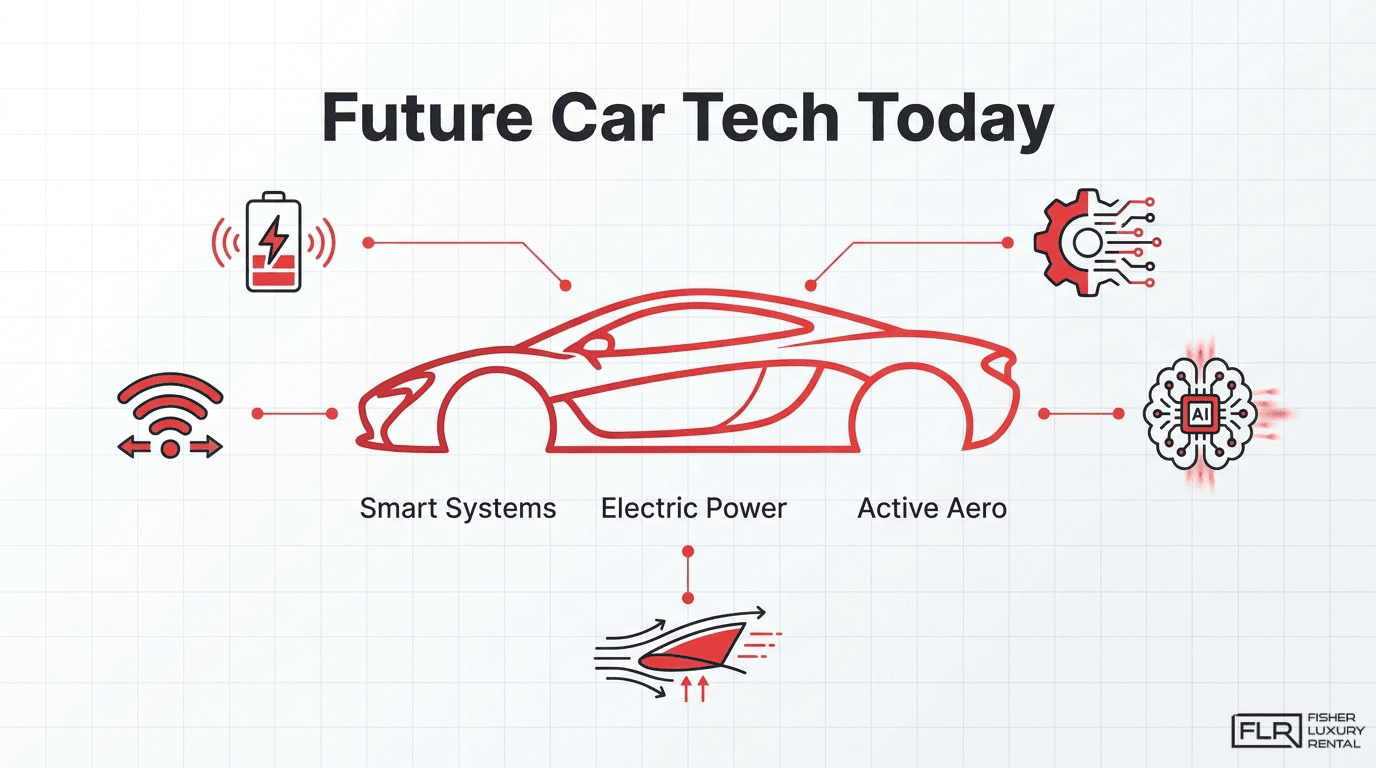
Exotic car technology advancements are the engineering developments across powertrains, materials, aerodynamics, driver assistance, cockpit systems, suspension, and artificial intelligence that collectively define what high-performance vehicles can achieve today and in the near future.
This guide covers what is driving next-generation powertrain design, how manufacturers are rethinking structure and weight through advanced materials, what aerodynamics and chassis engineering now look like at the production level, how driver-assistance and cockpit technology are evolving, which brands are leading these shifts, and how AI is reshaping exotic car engineering from the ground up.
Hybrid and fully electric powertrains are now the performance benchmark, with the Lamborghini Revuelto delivering 1,015 CV through a V12 paired with three electric motors, while synthetic eFuels offer a carbon-neutral path for combustion engines to remain viable.
Advanced materials including graphene-enhanced carbon fiber and 3D-printed components are moving from concept stage into production, reducing weight and manufacturing costs simultaneously.
Active aerodynamics, ground effect technology, and predictive adaptive suspension with 5-millisecond damper response represent a direct transfer of motorsport engineering into road-legal hypercars.
AI-driven driving modes, dense sensor suites, V2X connectivity, augmented reality HUDs, and biometric personalization are transforming the cockpit and chassis into systems that actively learn and respond to each driver.
Ferrari, Lamborghini, McLaren, Porsche, and Rimac each hold distinct positions in this technology landscape, with strategies ranging from phased electrification to full electric hypercar production, and machine learning is now a core tool in how engineers tune suspension and manage battery performance.
What Powertrain Technologies Are Defining the Next Generation of Exotic Cars?
The powertrain technologies defining the next generation of exotic cars are hybrid systems, full electric architectures, and synthetic fuels. The sections below cover how each approach reshapes performance, sustainability, and the future of the combustion engine.
How Are Hybrid Powertrains Transforming Exotic Car Performance?
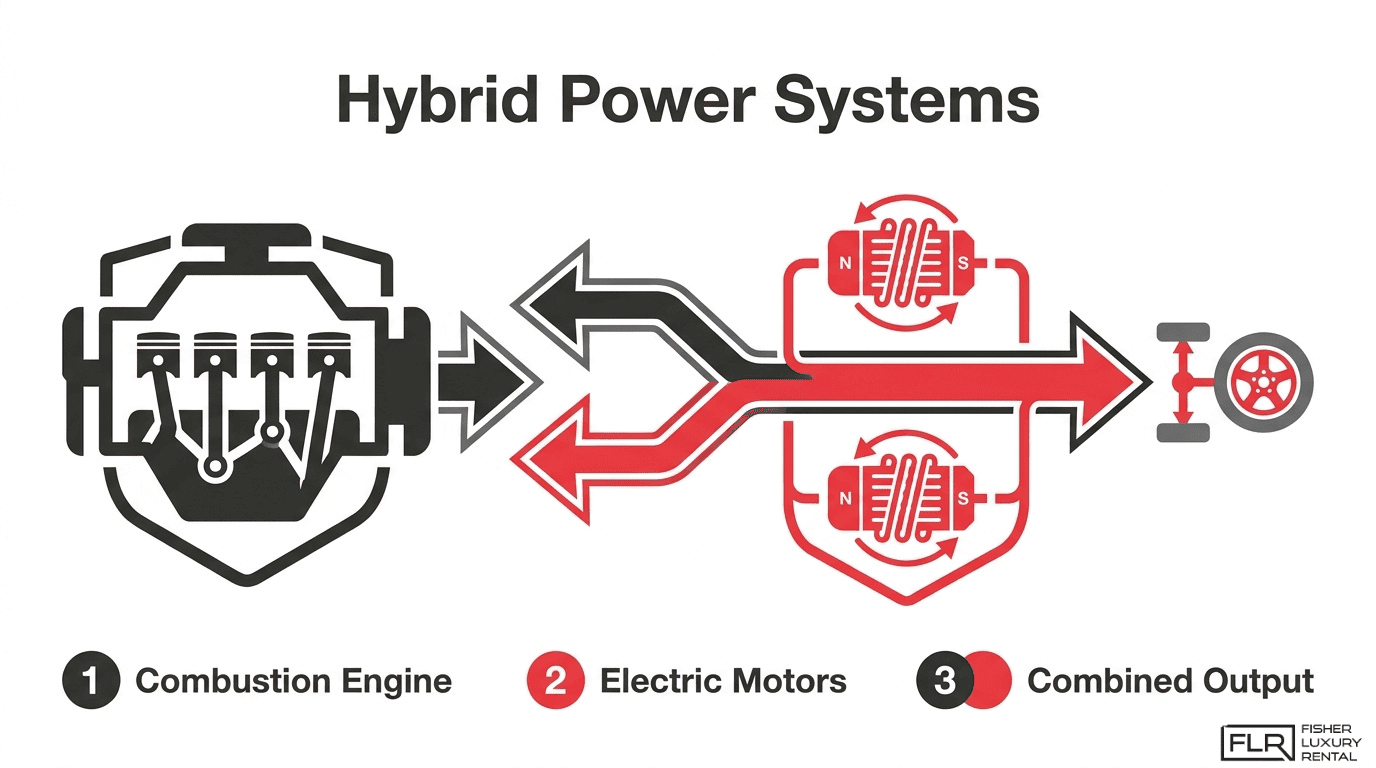
Hybrid powertrains are transforming exotic car performance by combining internal combustion engines with electric motors to deliver unprecedented power alongside improved efficiency. The Lamborghini Revuelto, the first HPEV (High Performance Electrified Vehicle) hybrid super sports car, exemplifies this shift: its 1,015 CV powertrain pairs a new V12 engine with three electric motors and a dual-clutch e-gearbox, according to Automobili Lamborghini.
Other leading examples include:
- Ferrari SF90 Stradale: 4.0-liter V8 with three electric motors producing 986 hp combined.
- McLaren Artura: Twin-turbo V-6 plug-in hybrid delivering 690 hp and 531 lb-ft of torque.
Hybrid architecture is not a compromise, it is now the performance benchmark in the exotic segment.
What Role Does Full Electric Architecture Play in Future Supercars?
Full electric architecture plays a foundational role in future supercars by enabling instant torque delivery, torque vectoring, and platform flexibility that combustion-only layouts cannot match. McLaren CEO Michael Leiters has confirmed openness to technology partnerships for a potential electric supercar, per Road and Track.
Current production benchmarks include:
- Rimac Nevera: 120 kWh battery pack, 730V maximum voltage, limited to 150 units.
- Lotus Evija: Maximum speed exceeding 320 kph, positioned as the most powerful electric sports car produced.
- Aspark Owl: 0-60 mph in 1.72 seconds with a 260 mph top speed.
Electric architecture removes the rotational constraints of traditional drivetrains, giving engineers new freedom to distribute power and mass.
How Is Synthetic Fuel Technology Preserving Combustion Engines in Exotics?
Synthetic fuel technology is preserving combustion engines in exotics by offering a carbon-neutral drop-in replacement for fossil fuels, extending the viable lifespan of high-displacement ICE powerplants. eFuels are synthetic, liquid fuels produced from hydrogen derived purely from renewable energy and CO2 filtered directly from ambient air, according to the Porsche Newsroom.
Porsche, partnering with Highly Innovative Fuels (HIF), has been producing synthetic fuel industrially in Punta Arenas, Chile since the end of 2022, with the pilot plant designed for a maximum output of 130,000 liters. McLaren CEO Michael Leiters has stated that the company will continue using combustion engines for the foreseeable future while exploring e-fuels alongside hybrid technology.
For exotic car enthusiasts, eFuels represent the most compelling path to retaining the character and sound of high-performance combustion engines without compromising on environmental responsibility.
What Advanced Materials Are Exotic Car Manufacturers Using Now?
Exotic car manufacturers are using advanced materials such as carbon fiber composites, graphene-enhanced panels, and 3D-printed components to reduce weight while increasing structural rigidity. The following sections cover how each material category is reshaping exotic vehicle construction.
How Is Carbon Fiber Engineering Evolving for Exotic Vehicles?
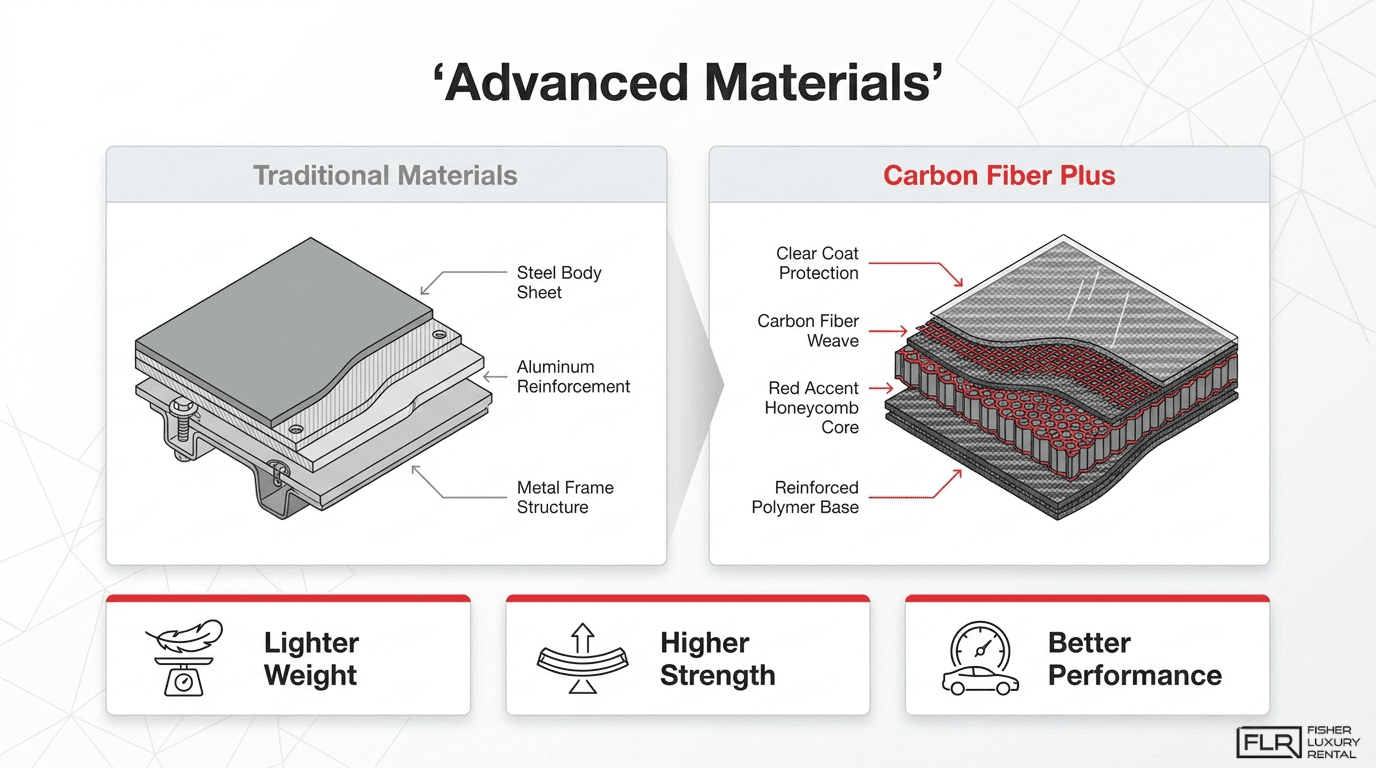
Carbon fiber engineering is evolving through more refined fabrication methods, surface finishing techniques, and graphene integration. Bugatti has used carbon fiber for monocoque construction and body shaping for over 30 years, according to the Bugatti Newsroom. Koenigsegg takes finishing further: the Jesko’s carbon fiber body panels are sanded to the center of the weave, achieving a raw aesthetic while simultaneously reducing weight. These approaches reflect a broader shift from carbon fiber as a structural necessity to a precision craft. Manufacturers now treat every layer and surface treatment as an opportunity to extract measurable performance gains.
What Are Exotic Automakers Doing With Graphene-Enhanced Composites?
Graphene-enhanced composites are materials that combine traditional carbon fiber with graphene additives to produce lighter, stronger, and more energy-efficient body panels. The BAC Mono R is the first production car to fully incorporate graphene-enhanced carbon fiber across every body panel, as reported by Composites World. Graphene additives are also being investigated more broadly for their potential to improve vehicle lightweighting in future automotive applications. This makes graphene-enhanced composites one of the most significant material science advances currently entering production-level exotic car manufacturing.
How Are 3D-Printed Components Changing Exotic Car Production?
3D-printed components are changing exotic car production by reducing manufacturing costs and enabling complex geometries that traditional tooling cannot achieve. According to Fortune Business Insights, the global automotive 3D printing market was valued at USD 3.13 billion in 2025 and is projected to reach USD 3.71 billion in 2026. Companies adopting 3D printing can reduce production costs by up to 30%, per Market Research Future. For low-volume exotic manufacturers, this cost flexibility is particularly valuable, allowing rapid prototyping and bespoke part production without committing to expensive mold tooling.
How Is Aerodynamics Technology Advancing in Exotic Cars?
Aerodynamics technology in exotic cars is advancing through active aero systems, computational fluid dynamics simulations, and ground effect engineering. The sections below cover each of these developments in detail.
What Are Active Aerodynamics Systems in Modern Supercars?
Active aerodynamics systems are mechanisms that adjust a car’s aerodynamic surfaces in real time to optimize downforce and drag based on speed and driving conditions. Unlike static wings, these systems respond dynamically during acceleration, braking, and cornering.
The GMA T.50 supercar uses a 400mm fan to rapidly accelerate air under the car, forcing it through active aerodynamic elements to achieve exceptional downforce. Formula 1 has pushed this technology further: according to Silverstone, F1’s 2026 regulations allow front and rear wings to move while on track, with full activation enabled by race control.
Active aero is one of the clearest examples of motorsport technology transferring directly to road cars, and its adoption in production hypercars signals a significant shift in how performance is managed dynamically.
How Do Digital Wind Tunnel Simulations Improve Exotic Car Design?
Digital wind tunnel simulations improve exotic car design by using computational fluid dynamics (CFD) software to model airflow around a vehicle without physical prototypes. Engineers can test hundreds of body configurations rapidly, identifying drag sources and downforce opportunities far earlier in development.
CFD allows manufacturers to iterate on complex surfaces, such as underbody tunnels, diffusers, and canards, with precision that physical testing alone cannot match. This reduces development time and cost while enabling more aggressive aerodynamic geometries.
What Is Ground Effect Technology in Next-Generation Hypercars?
Ground effect technology is an aerodynamic approach that uses the shaped underbody of a vehicle to accelerate airflow beneath the car, generating low pressure that pulls the car toward the road surface without relying solely on wings. This produces substantial downforce with minimal aerodynamic drag.
The GMA T.50 demonstrates ground effect capability at its most advanced: the car is designed to generate approximately 2.5G to 3G of downforce under braking, optimizing stability through its full aerodynamic package. Ground effect fundamentally changes the downforce-to-drag ratio compared to traditional wing-dependent designs, making it one of the most efficient performance strategies available to next-generation hypercar engineers.
What Driver-Assistance and Autonomous Features Are Coming to Exotics?
Driver-assistance and autonomous features coming to exotics include AI-adaptive driving modes, multi-sensor ADAS hardware, and V2X connectivity. The following sections cover how each of these technologies is being deployed across the latest supercars and hypercars.
How Are Exotic Cars Integrating Adaptive AI-Driven Driving Modes?
Exotic cars are integrating adaptive AI-driven driving modes by using real-time sensor data to continuously adjust throttle response, traction control, and stability systems to match road conditions and driver behavior. According to GM Insights, modern Advanced Driver-Assistance Systems (ADAS) now incorporate biometric monitoring as standard equipment to further personalize safety and response profiles. This means each drive session can adapt not just to road surfaces, but to the individual behind the wheel. For performance-focused buyers, this represents a meaningful shift: the car learns the driver rather than forcing the driver to manage the car.
What Advanced Sensor Suites Are Supercars Now Equipped With?
The advanced sensor suites supercars are now equipped with include cameras, radars, and ultrasonic sensors working together to build a continuous real-time map of the vehicle’s environment. According to Rimac Automobili’s technical specifications, the Rimac Nevera carries 13 cameras, 6 radars, and 12 ultrasonic sensors dedicated to its ADAS hardware. Fingerprint sensors and facial recognition algorithms are also entering the space, enabling rapid, secure vehicle access as part of biometric integration. A sensor array of this density was unthinkable in production cars a decade ago, and the Nevera sets the benchmark every new hypercar will be measured against.
How Is Vehicle-to-Everything Connectivity Used in Luxury Exotics?
Vehicle-to-Everything (V2X) connectivity is used in luxury exotics to enable real-time communication between the car and its surrounding environment, including other vehicles and road infrastructure. According to Porsche Engineering, V2X technology allows this data exchange to occur even without an active internet connection, using direct wireless protocols. In practice, this means an exotic can receive hazard warnings, traffic signal timing, and road condition data before the driver sees them, allowing the car’s systems to pre-position suspension, braking, and traction responses proactively. V2X is the connectivity layer that transforms a standalone performance machine into an actively aware participant in the broader road environment.
How Are Exotic Car Cockpits and Infotainment Systems Evolving?
Exotic car cockpits are evolving through three interconnected technologies: augmented reality displays, haptic controls, and biometric personalization. Each advancement reshapes how drivers interact with their vehicles at speed.
What Augmented Reality Displays Are Appearing in Exotic Cars?
Augmented reality displays appearing in exotic cars include windshield-projected heads-up displays (HUDs) that overlay navigation, speed, and performance data directly onto the driver’s line of sight. Rather than requiring drivers to glance away from the road, AR HUDs deliver critical information without breaking visual focus. According to a 2024 digital cockpit market analysis published on LinkedIn, the integration of AR and HUDs is a key trend transforming the automotive digital cockpit market between 2024 and 2033. This technology is particularly well-suited to exotic cars, where split-second awareness is the difference between control and chaos.
How Are Haptic Controls Replacing Physical Buttons in Supercars?
Haptic controls are replacing physical buttons in supercars by using vibration-based tactile feedback embedded in steering wheels, touchscreens, and gear selectors. Drivers receive physical confirmation of inputs without looking away from the road. This approach reduces cockpit clutter, enabling cleaner interior designs while maintaining intuitive driver interaction. For high-performance driving environments, haptic feedback delivers a more precise and distraction-free interface than traditional mechanical buttons.
What Biometric Personalization Features Do New Exotics Offer?
Biometric personalization features in new exotic cars include fingerprint sensors, facial recognition systems, and driver monitoring tools that automatically adjust seat position, driving modes, and display preferences. Enhanced fingerprint sensors and advanced facial recognition algorithms allow for quick and secure vehicle access, according to Yahoo Finance. Beyond access, biometric signals are being explored for emotion recognition and multimodal fusion in smart cockpits, enabling a higher degree of real-time personalization as driving conditions change.
What Suspension and Handling Innovations Are Shaping Exotic Cars?
Suspension and handling innovations shaping exotic cars include predictive adaptive suspension, active torque vectoring, and electromagnetic damper technology. The sections below explain how each system works and why they represent a meaningful leap forward in chassis engineering.
How Do Predictive Adaptive Suspension Systems Work in Supercars?
Predictive adaptive suspension systems work by using sensors and AI to read road conditions ahead and adjust damper stiffness before the wheel reaches an obstacle. According to KED Cars, these systems offer a 5-millisecond damper response and a 20-meter prediction range, enabling adaptation to gravel, dirt, and light off-road surfaces. AI further enhances this by adjusting suspension settings in real time alongside engine and aerodynamic controls. This proactive approach is a significant improvement over reactive damping, which responds only after the wheel has already made contact with the surface.
What Is Active Torque Vectoring in Modern Exotic Vehicles?
Active torque vectoring is a chassis control technology that distributes drive torque independently between wheels to optimize cornering grip and stability. The Lamborghini Revuelto applies electric torque vectoring across all four wheels, even in fully electric drive mode, delivering exceptional handling precision. Research published via SAE Mobilus confirms that adaptive torque vector control for distributed-drive intelligent electric vehicles is actively being developed using combined model and data-driven approaches. For electric and hybrid exotics, torque vectoring replaces mechanical differentials with instant, wheel-level torque control.
How Are Electromagnetic Dampers Improving Exotic Car Ride Quality?
Electromagnetic dampers improve exotic car ride quality by replacing hydraulic fluid resistance with magnetically controlled force, enabling near-instant stiffness adjustments. A study published in IEEE Xplore analyzed, prototyped, and experimentally characterized an adaptive hybrid electromagnetic damper for automotive suspension systems, confirming its real-world performance. Unlike conventional passive dampers, electromagnetic units can continuously modulate response to match changing road inputs and driver demands. This makes them well-suited to exotic cars where the balance between track-focused firmness and road-going comfort is critical.
Which Exotic Car Brands Are Leading Future Technology Trends?
The exotic car brands leading future technology trends are Ferrari, Lamborghini, McLaren, Porsche, and Rimac. The H3s below cover each brand’s specific electrification strategy, performance breakthroughs, and influence on the broader hypercar segment.
What Technologies Is Ferrari Pioneering for Its Future Lineup?
The technologies Ferrari is pioneering for its future lineup include a diversified powertrain strategy spanning ICE, hybrid, and fully electric models. According to Forbes, Ferrari anticipates its product lineup will be 40% ICE, 40% hybrid, and 20% electric by 2030, including the upcoming Elettrica. Ferrari CEO Benedetto Vigna has also committed that the brand’s first all-electric car will “stir the emotions” like its legendary predecessors. This balanced approach reflects Ferrari’s belief that performance and electrification are not mutually exclusive goals.
How Is Lamborghini Approaching Electrification and Hybridization?
Lamborghini is approaching electrification and hybridization through its Direzione Cor Tauri strategy, a phased program designed to electrify the entire model lineup. Lamborghini CEO Stephan Winkelmann stated that the Revuelto is a milestone and an important pillar in that strategy. Lamborghini also confirmed plans to achieve a full-hybrid lineup by the end of 2024. The Revuelto’s V12 paired with three electric motors demonstrates that hybridization can amplify, rather than dilute, Lamborghini’s signature aggression.
What Performance Technology Breakthroughs Are Coming From McLaren?
The performance technology breakthroughs coming from McLaren include hybrid powertrains, a potential hybrid SUV, and an electric supercar. McLaren CEO Michael Leiters confirmed the company will continue using combustion engines for the foreseeable future while exploring hybrid technology, e-fuels, and technology partnerships to support next-generation models. Road & Track reported that Leiters is open to external synergies to accelerate development. McLaren’s willingness to pursue multiple technology paths simultaneously positions it as one of the more strategically flexible exotic brands.
How Is Porsche Advancing Battery and EV Tech for Exotic Models?
Porsche is advancing battery and EV technology through its investment in synthetic eFuels and electric platform development. In partnership with Highly Innovative Fuels (HIF), Porsche has been industrially producing synthetic fuel in Punta Arenas, Chile, since the end of 2022. This dual-track approach, investing in both battery-electric and eFuel technologies, allows Porsche to extend the life of combustion engines while developing fully electric exotic models.
What Is Rimac’s Influence on the Electric Hypercar Segment?
Rimac’s influence on the electric hypercar segment is substantial, as the Nevera has redefined what all-electric performance means at the highest level. The Rimac Nevera is an all-electric two-seat hypercar limited to 150 units, with global homologation. Competing benchmarks include the Lotus Evija, the first British all-electric hypercar with a top speed exceeding 320 kph, and the Aspark Owl, which accelerates from 0-60 mph in 1.72 seconds with a 260 mph top speed. The most common PAA question in this space, “What is the fastest electric hypercar?”, reflects how intensely competitive this segment has become. Rimac’s engineering has raised the benchmark that every new electric hypercar must now meet.
How Is Artificial Intelligence Changing Exotic Car Engineering?
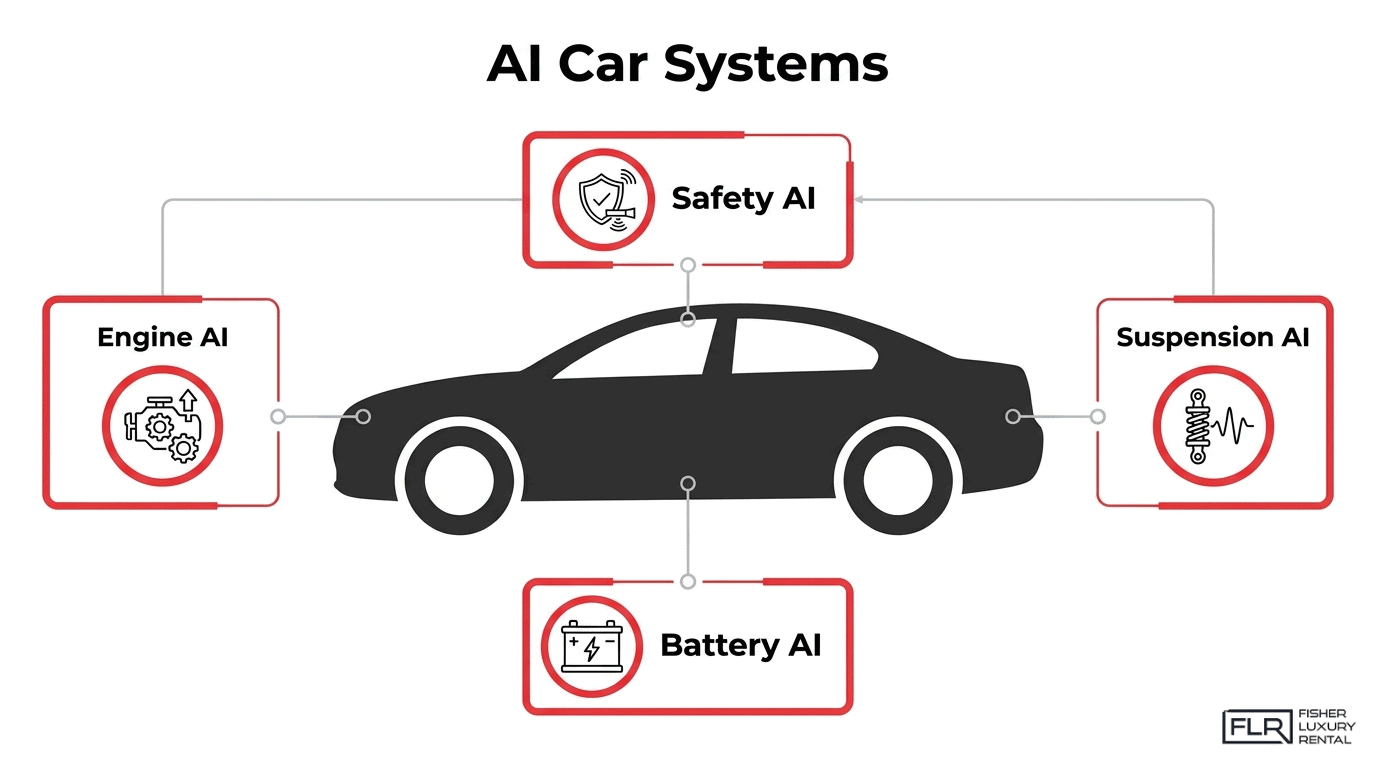
Artificial intelligence is changing exotic car engineering by reshaping how engineers approach data analysis, performance prediction, and real-time system control. The sections below cover AI’s role in engine and battery management, and machine learning’s application in chassis tuning.
How Does AI Optimize Real-Time Engine and Battery Management?
AI optimizes real-time engine and battery management by analyzing continuous data streams on engine conditions, fuel quality, and driving style to adjust performance and fuel efficiency dynamically. This allows powertrains to respond to conditions faster than any manual calibration could achieve.
AI-enhanced battery management systems use machine learning to advance safety, performance, and longevity in electric vehicle batteries. According to a 2026 report from Tech Xplore, smart AI charging can extend EV battery life by 23% without increasing charging time.
What Role Does Machine Learning Play in Exotic Car Chassis Tuning?
Machine learning plays a critical role in exotic car chassis tuning by estimating suspension parameters to detect and assess performance degradation. According to ScienceDirect research, proficient chassis tuning is critical to overall race car performance, and machine learning approaches provide engineers with data-driven insight into how suspension components behave under real-world stress.
Rather than relying solely on driver feedback, machine learning models identify degradation patterns objectively, making chassis development faster and more precise. This data-first approach is one of the most underutilized competitive advantages in exotic car development today.
How Can You Experience the Latest Exotic Car Technology Firsthand?
You can experience the latest exotic car technology firsthand by renting directly from a luxury exotic car provider. The sections below cover how Fisher Luxury Rental makes cutting-edge supercar tech accessible, plus the key takeaways from this article.
Can Renting Luxury Exotics From Fisher Luxury Rental Let You Test Cutting-Edge Supercar Tech?
Yes, renting luxury exotics from Fisher Luxury Rental lets you test cutting-edge supercar tech without the commitment of ownership. Fisher Luxury Rental offers vehicles such as the McLaren 720S, Ferrari 488 Spider, and Porsche 911 Carrera S, putting hybrid powertrains, advanced aerodynamics, and AI-driven driving systems directly in your hands. According to Custom Market Insights, the global luxury car rental market was valued at USD 35.36 billion in 2025, growing at a CAGR of 8.94%, reflecting surging consumer demand to access high-performance vehicles experientially. Fisher Luxury Rental serves Phoenix, AZ and Portland, OR, offering top-trim models exclusively. For enthusiasts who want to feel adaptive suspension, active aero, and biometric cockpits in real conditions, renting is the most practical path available today.

What Are the Key Takeaways About Exotic Car Technology Advancements We Covered?
Exotic car technology advancements are converging across powertrains, materials, aerodynamics, and AI to redefine what performance vehicles can do. The most actionable conclusions from this article are:
- Hybrid and electric powertrains dominate: Vehicles like the Lamborghini Revuelto and McLaren Artura demonstrate that electrification enhances, rather than diminishes, exotic car performance.
- Advanced materials reduce weight significantly: Carbon fiber and graphene-enhanced composites are now production-level technologies, not concept-stage experiments.
- Active aerodynamics and ground effect are mainstream: Systems once exclusive to Formula 1 now appear in road-legal hypercars.
- AI optimizes everything in real time: Engine management, suspension tuning, and battery longevity all benefit from machine learning integration.
- Cockpit technology personalizes the driving experience: AR displays and biometric personalization create environments tailored to individual drivers.
- Renting remains the most accessible entry point: Fisher Luxury Rental bridges the gap between reading about these technologies and actually experiencing them.
The clearest takeaway is that exotic car technology is no longer future-facing speculation. It is available now, and Fisher Luxury Rental puts it within reach.