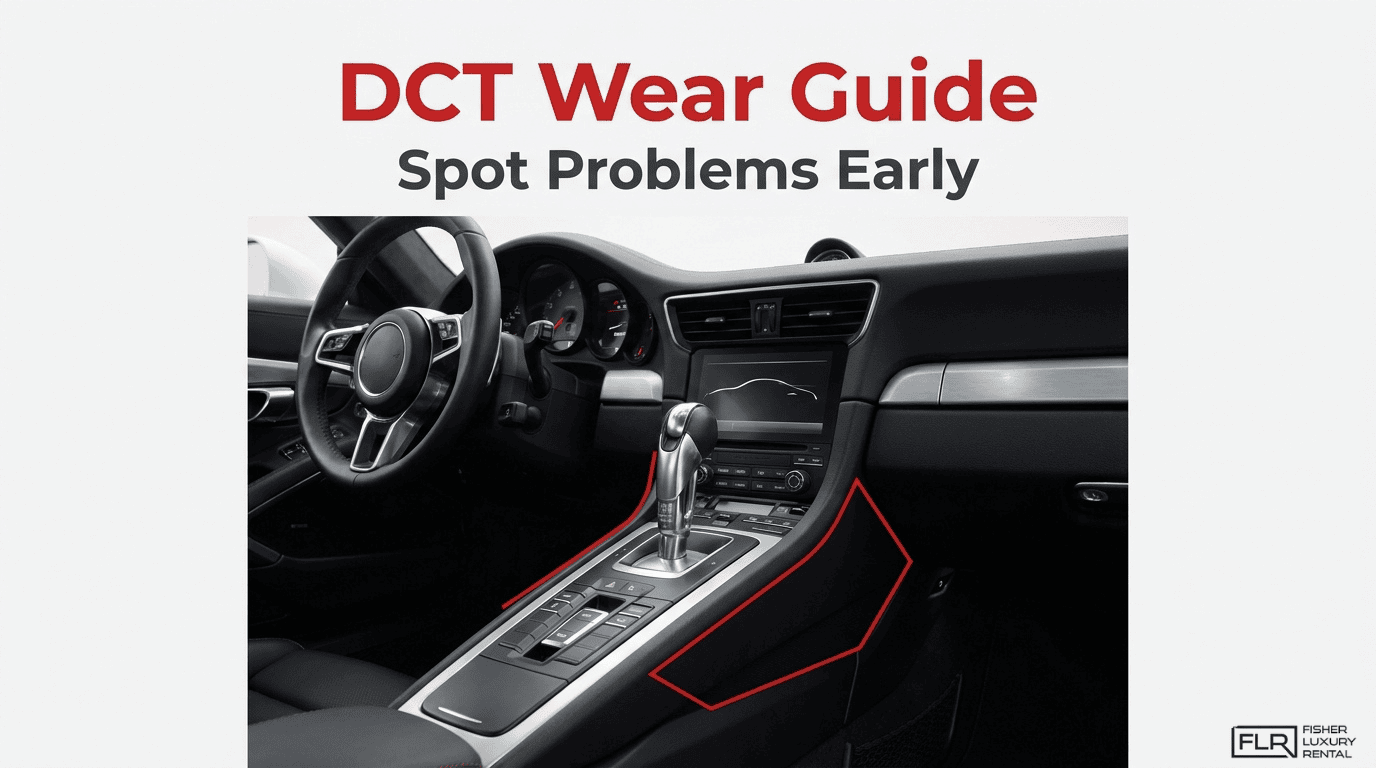
A dual clutch transmission uses two separate clutches to control alternating gear sets simultaneously, enabling near-instantaneous gear changes without a torque converter. Each clutch manages its own group of gears, and a combined electronic-hydraulic unit called the mechatronic unit coordinates every shift in real time.
This guide covers how a DCT works, the symptoms that signal wear, which components fail first, how problems differ across exotic car brands, what drives accelerated wear, how to diagnose faults early, what repairs cost, and how preventive maintenance extends transmission life.
DCT operation and its common failure symptoms form the foundation of understanding this transmission. We cover how gear sets are split between two clutches, how wet and dry clutch designs handle heat differently, and how symptoms like shudder, slipping, grinding, and overheating each point to specific internal faults.
Component-level failures follow a predictable sequence: clutch packs wear first, followed by the mechatronic unit, flywheel, and valve body assemblies. Each has its own warning signs and repair trajectory.
Brand-specific vulnerabilities vary significantly. Lamborghini Huracán models face documented oil deficiency recalls, Ferrari California transmissions develop sensor degradation, McLaren gearboxes suffer hydraulic leaks from the SAV block, and Porsche PDK units accumulate clutch and valve wear under performance use.
Driving habits, diagnostic procedures, and repair costs complete the picture. Full exotic DCT rebuilds regularly exceed $16,000, making early detection and correct maintenance the most effective tools an owner has.
How Does a Dual Clutch Transmission Work?
A dual clutch transmission works by using two separate clutches to control alternating gear sets simultaneously, enabling near-instantaneous gear changes without a torque converter. The sections below cover how the gear groups are split, how wet and dry clutch designs differ, and how the mechatronic unit coordinates the entire shift process.
How Are DCT Gears Split Between Two Clutches?
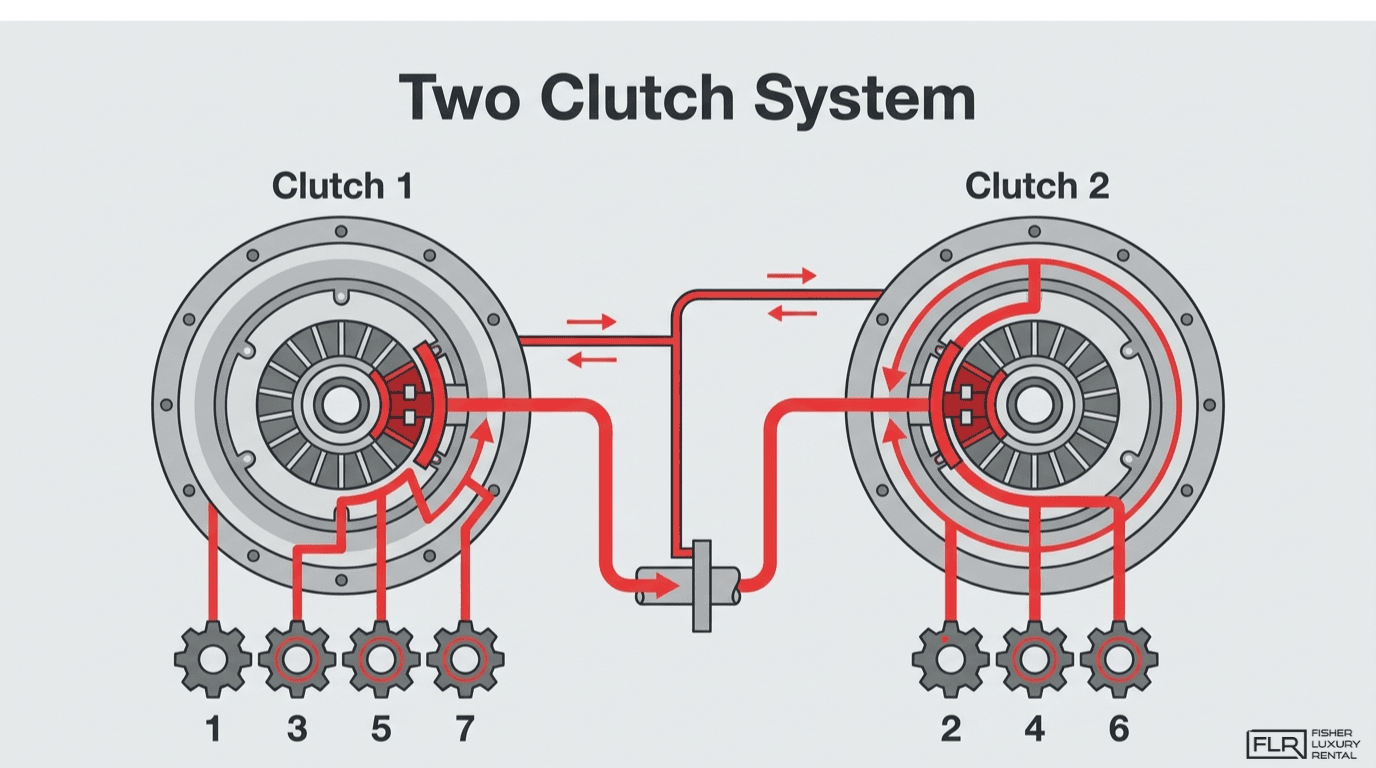
DCT gears are split into two groups: odd-numbered gears (1, 3, 5, 7) and even-numbered gears (2, 4, 6), each connected to its own dedicated clutch. According to MDPI research on DCT power shift systems, this arrangement allows the next gear’s synchronizer to pre-engage before the current gear releases, producing seamless power transfer with no interruption in drive torque. While one clutch handles the active gear, the other is already staged and waiting, which is what separates a DCT from a conventional automatic.
What Is the Difference Between Wet and Dry DCT Clutches?
The difference between wet and dry DCT clutches is how heat and lubrication are managed inside each design. Wet clutch packs are submerged in oil, providing continuous lubrication and heat absorption, making them suitable for high-performance and heavy-duty applications. According to Clutch Masters Industries, dry clutches use a pressure plate clamping against the flywheel in open air, delivering a more direct mechanical feel but struggling with heat management under repeated slipping or hard use. For exotic cars operating at high torque, wet clutch designs are generally the more durable choice.
What Does the Mechatronic Unit Do in a DCT?
The mechatronic unit is the combined electronic and hydraulic control brain of a DCT. According to Ravenol, the mechatronic unit in Volkswagen and Audi Group vehicles integrates both electronic and hydraulic control systems to manage gear changes, clutch engagement, and overall transmission operation. It reads driver inputs, vehicle speed, and load conditions, then actuates the correct clutch and synchronizer at precisely the right moment. When the mechatronic unit begins to wear internally, shift quality degrades in progressively noticeable ways across the entire transmission.
What Are the Most Common Symptoms of DCT Problems?
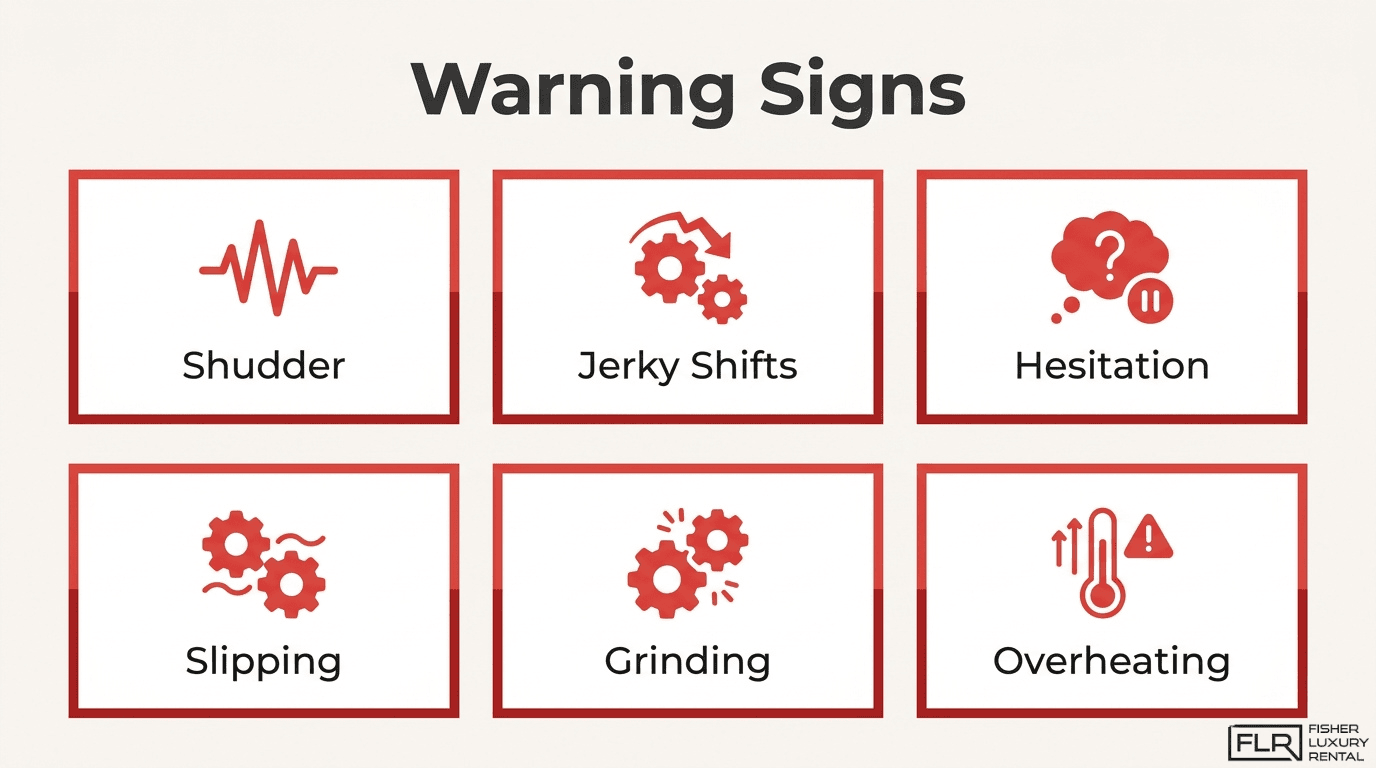
The most common symptoms of DCT problems include shuddering at low speeds, jerky gear changes, hesitation when shifting, gear slipping, grinding noises, burning smells, and overheating warnings. The sections below examine each symptom, its root cause, and what it signals about transmission health.
Why Does a DCT Shudder or Vibrate During Low-Speed Driving?
A DCT shudders during low-speed driving because the odd-gear clutch, which handles all first-gear starts, experiences the highest slip load of any clutch in the system. According to Motronix, clutch pack wear manifests as low-speed shudder, creeping vibration in stop-and-go traffic, and a gradual loss of smooth engagement, particularly on this odd-gear clutch. Software calibration drift can amplify the symptom even before mechanical wear becomes severe. In practice, low-speed shudder is often the earliest warning a driver will feel before harder symptoms develop.
What Causes Jerky or Harsh Gear Changes in a Dual Clutch?
Jerky or harsh gear changes in a dual clutch are caused by faults in clutch pack condition, hydraulic control accuracy, or mechatronic calibration. DCT gears are divided into two groups, odd-numbered and even-numbered, each connected to a separate clutch, and smooth power shifts depend on precise pre-engagement of synchronizers between them. When clutch surfaces wear or hydraulic pressure drops, that pre-engagement timing breaks down and produces an abrupt handoff between clutches.
The mechatronic unit in Volkswagen and Audi Group vehicles integrates both electronic and hydraulic control to manage every shift, meaning even minor valve wear can disrupt the handoff timing across all gears. Insufficient transmission oil compounds the problem. Lamborghini recalled certain 2020 to 2022 Huracan EVO and 2022 Huracan STO vehicles specifically because low transmission oil led to clutch slippage, confirming that fluid level is a direct factor in shift quality.
Why Does a DCT Hesitate or Delay When Shifting?
A DCT hesitates or delays when shifting due to hydraulic pressure problems, mechatronic unit faults, or internal clutch wear. According to Planet Gears UK, delayed gear engagement, where a noticeable pause occurs before the car moves after selecting Drive or Reverse, is a recognized indicator of these underlying faults. Because the DCT relies on pre-selecting the next gear hydraulically, any pressure loss collapses that pre-selection and forces the transmission to engage reactively rather than proactively.
What Does It Mean When a DCT Slips Between Gears?
DCT gear slipping means the clutch pack is failing to hold engine torque through the engaged clutch disc, allowing the engine to rev without a corresponding increase in vehicle speed. This condition typically points to worn friction material on the clutch plates, contaminated clutch surfaces, or insufficient hydraulic clamping pressure from the mechatronic unit. Slipping accelerates heat buildup inside the transmission, which further degrades fluid and clutch material in a self-reinforcing cycle.
Why Do Odd Grinding or Clunking Noises Come From a DCT?
Grinding or clunking noises from a DCT come from worn synchronizers, damaged gear teeth, or bearing failure inside the transmission housing. Because a DCT pre-engages the next gear before the shift is complete, a worn synchronizer cannot bring the incoming gear shaft up to speed smoothly, producing a grinding sensation at the moment of engagement. Clunking on engagement or disengagement more often indicates excessive clearance in the drivetrain or a loose component reacting to torque load changes.
What Causes a Burning Smell From a Dual Clutch Transmission?
A burning smell from a dual clutch transmission is caused by overheated clutch material, degraded transmission fluid, or a fluid leak contacting hot exhaust or engine components. Wet dual clutch transmissions submerge the clutch packs in oil specifically to absorb heat, according to Ravenol, making them more heat-tolerant than dry designs. However, when fluid leaks or breaks down, that thermal buffer disappears. A known issue in McLaren models up to 2021 involved a clutch oil leak from the Synchro Actuation Valve block where the SAV was not torqued correctly, preventing hydraulic fluid from pressurizing gears properly and allowing heat to concentrate at the clutch surfaces.
Why Does a DCT Overheat Warning Light Appear on the Dash?
A DCT overheat warning light appears on the dash because the transmission’s fluid temperature has exceeded safe operating limits, triggering the thermal protection system. Common causes include extended low-speed driving, repeated hard launches, towing beyond the transmission’s rated capacity, or degraded fluid that can no longer transfer heat efficiently. Once the warning activates, the transmission control unit typically limits available gears or reduces shift aggression to protect internal components from heat damage. Ignoring an overheat warning risks accelerating clutch pack and mechatronic unit wear simultaneously.
Which Dual Clutch Components Fail First?
The components that fail first in a dual clutch transmission are typically the clutch packs, followed by the mechatronic unit, flywheel, and solenoid/valve body assemblies. Each fails through a distinct pattern. The sections below cover how each component deteriorates and what warning signs accompany each failure.
How Quickly Do DCT Clutch Packs Wear Out?
DCT clutch packs wear out faster than most owners expect, particularly under low-speed stop-and-go driving where the clutches slip repeatedly to manage power delivery. Juddering or shaking when pulling away from a stop is one of the most frequently reported early symptoms, caused by worn clutch surfaces or contaminated friction material. According to Motronix, transmission fluid breaks down under heat and shear stress, losing its ability to maintain consistent clutch engagement pressure and hydraulic response, which accelerates wear on both the clutch packs and mechatronic unit simultaneously. Dry clutch designs face this challenge most acutely, since they rely on air cooling rather than fluid submersion to manage friction heat.
When Does the Mechatronic Unit Start to Fail?
The mechatronic unit starts to fail gradually, making early detection difficult without diagnostic tools. According to Motronix, mechatronic unit failure develops as a pattern of increasingly frequent shift issues: beginning with a brief delay when engaging Drive or Reverse, then progressing to abrupt upshifts and momentary power loss as internal valve wear advances. Because the mechatronic unit manages both hydraulic pressure and electronic shift commands, deterioration in either subsystem compounds the other. Catching this early matters enormously, as a neglected unit can accelerate clutch pack wear simultaneously.
How Do DCT Flywheel Problems Develop Over Time?
DCT flywheel problems develop gradually through heat cycling, torsional stress, and surface wear caused by repeated clutch engagement. The flywheel absorbs energy each time the clutch engages, and over many thousands of cycles, the friction surface can develop hot spots, warping, or cracking. In high-performance applications, aggressive driving amplifies these stresses significantly. Symptoms include vibration at idle, shuddering during engagement, and increased transmission noise during gear changes.
What Causes DCT Solenoid and Valve Body Issues?
DCT solenoid and valve body issues are caused by contaminated fluid, internal bore wear, and pressure loss from degraded seals. Solenoids regulate hydraulic flow to each clutch circuit; when they stick or fail, shift timing becomes inconsistent and pressure delivery drops. Valve body gaskets are a common failure point in high-mileage transmissions. A comprehensive Ferrari FF DCT rebuild, including replacement of all pressure sensors, valve body gaskets, seals, and hardware, costs just over $16,000 according to FerrariChat community repair records, illustrating how costly solenoid and valve body neglect can become.
How Does DCT Wear Differ Across Luxury and Exotic Car Brands?
DCT wear differs across luxury and exotic car brands because each manufacturer uses a proprietary transmission architecture with unique failure points. The sections below cover brand-specific problems in Lamborghini, Ferrari, McLaren, and Porsche models.

What DCT Problems Are Common in Lamborghini Huracán Models?
DCT problems common in Lamborghini Huracán models center on insufficient transmission oil. Lamborghini recalled certain 2020–2022 Huracán EVO and 2022 Huracán STO vehicles because the gearbox may contain an inadequate amount of transmission oil, which can cause clutch slippage and transmission oil leaks. For a car operating at supercar power levels, even a marginal oil deficiency accelerates clutch pack degradation faster than most owners anticipate.
What Dual Clutch Issues Affect Ferrari California and Roma?
The dual clutch issues affecting Ferrari California models frequently involve internal sensor degradation. According to FerrariChat forum documentation, the Ferrari California DCT transmission issue often involves the sensors within the DCT and specifically the plastic ties that secure them degrading over time, eventually leading to transmission failure. These are small components with outsized consequences, making early inspection critical.
How Does the McLaren Seamless Shift Gearbox Wear Over Time?
The McLaren Seamless Shift Gearbox wears over time primarily through hydraulic pressure loss. A known issue affecting McLaren models up to 2021 involves a clutch oil leak originating from the Synchro Actuation Valve (SAV) block inside the transmission. The SAV was not torqued correctly at the factory, preventing hydraulic fluid from correctly pressurizing as different gears are selected, which compromises shift quality and accelerates internal wear.
What PDK Transmission Problems Appear in Porsche 911 Models?
PDK transmission problems in Porsche 911 models typically involve clutch wear, mechatronic valve degradation, and fluid breakdown under sustained performance driving. Porsche’s recommended maintenance schedule for 981 Boxster and Cayman models calls for brake fluid replacement at 20,000 miles and spark plugs, brake fluid, and drive belt inspection at 40,000 miles, underscoring how proactive servicing keeps the PDK performing reliably. Skipping these intervals on a 911 is one of the most common mistakes owners make.
What Driving Habits Accelerate Dual Clutch Wear?
The driving habits that accelerate dual clutch wear include frequent low-speed slipping, aggressive launches, stop-and-go traffic creeping, and repeated gear hunting on hills. Understanding which behaviors stress each clutch pack helps owners and renters protect one of the most mechanically complex transmissions available.
How Does Frequent Stop-and-Go Traffic Damage a DCT?
Frequent stop-and-go traffic damages a DCT by forcing the odd-gear clutch to repeatedly engage and slip at low speeds, generating sustained heat with minimal recovery time. According to Motronix, clutch pack wear manifests as low-speed shudder, creeping vibration in traffic, and gradual loss of smooth engagement, particularly on the odd-gear clutch that handles first-gear starts. Urban driving cycles are genuinely punishing for DCTs because the transmission was optimized for decisive engagement, not prolonged partial slip.
Does Aggressive Launching Wear Out a Dual Clutch Faster?
Yes, aggressive launching wears out a dual clutch faster by forcing the clutch pack to absorb the full torque spike of a high-RPM release rather than a gradual engagement. Transmission fluid breaks down under heat and shear stress, losing its ability to maintain consistent clutch engagement pressure and hydraulic response, which accelerates wear on both the mechatronic unit and the clutch packs simultaneously, according to Motronix. Repeated hard launches compound this degradation rapidly.
Can Towing or Overloading a Vehicle Damage the DCT?
Yes, towing or overloading a vehicle can damage the DCT by exceeding the torque and heat thresholds the clutch packs were designed to manage. A dry clutch, according to Clutch Masters Industries, can struggle with heat management under frequent slipping or towing abuse because it lacks the oil submersion that wet clutch designs use to dissipate heat. Even wet-clutch DCTs face accelerated fluid degradation when sustained loads push temperatures beyond their operating range.
How Does Improper Warm-Up Behavior Stress a Dual Clutch?
Improper warm-up behavior stresses a dual clutch by demanding full engagement before the transmission fluid reaches its optimal operating viscosity. Cold fluid cannot maintain consistent hydraulic pressure or provide adequate lubrication to the clutch packs, increasing mechanical friction during the most vulnerable phase of operation. Allowing a brief warm-up period before spirited driving is one of the simplest and most overlooked ways to extend DCT service life.
How Do You Diagnose DCT Problems Before They Get Worse?
You diagnose DCT problems before they get worse by combining live diagnostic data, adaptation value analysis, and methodical inspection of clutch, hydraulic, and sensor systems. The subsections below cover the key diagnostic tools, warning signs to monitor, and when to act.
What Diagnostic Tools Detect DCT Faults Early?
The diagnostic tools that detect DCT faults early include manufacturer-specific scan tools capable of reading adaptation values and live hydraulic data. According to Motronix, the mechatronic unit stores adaptation data revealing how much the transmission has compensated for clutch wear, pressure loss, and shift timing drift. Generic OBD-II readers miss this layer entirely. For S-Tronic, DSG, PDK, and similar systems, accessing raw adaptation tables is the only reliable way to quantify wear before symptoms escalate into mechanical failure.
What Warning Signs Indicate a DCT Needs Immediate Inspection?
The warning signs that indicate a DCT needs immediate inspection are delayed gear engagement, juddering under low-speed acceleration, and erratic or abrupt upshifts. According to Planet Gears UK, delayed engagement after selecting Drive or Reverse can signal hydraulic pressure problems, mechatronic unit faults, or internal clutch wear. Any single symptom appearing repeatedly warrants a scan; two or more symptoms appearing together means the transmission is already in progressive failure.
Can a DCT Be Diagnosed Without Removing It From the Car?
Yes, a DCT can be diagnosed without removing it from the car in most cases. Live pressure readings, adaptation value retrieval, and fault code analysis through a connected scan tool provide a clear picture of clutch condition, solenoid response, and hydraulic integrity. Physical removal becomes necessary only when internal components, such as valve body seals or clutch packs, require direct inspection or replacement. Early software-based diagnosis consistently prevents the kind of deferred damage that turns a repair into a full rebuild.
What Does a DCT Repair or Replacement Typically Cost?
DCT repair costs vary significantly by the component involved and the vehicle platform. The sections below cover clutch pack replacement, mechatronic unit repair, and full exotic car rebuilds.
How Much Does a DCT Clutch Pack Replacement Cost?
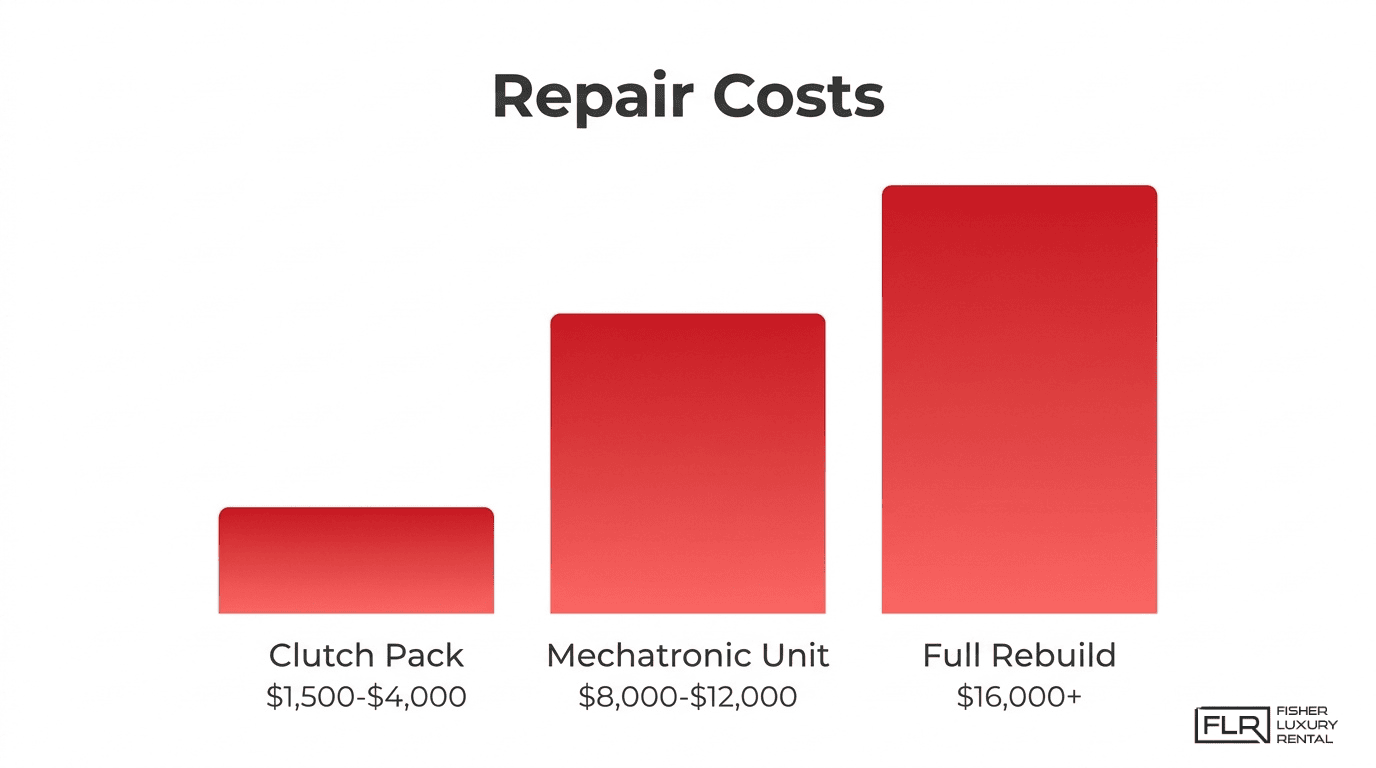
DCT clutch pack replacement cost depends on the vehicle brand, transmission type, and whether wet or dry clutches are involved. On mainstream performance vehicles, clutch pack service typically ranges from $1,500 to $4,000 in parts and labor. On exotic platforms, that figure climbs considerably, as specialized tooling, proprietary components, and limited service networks all drive up the price. Wet clutch systems, which require fluid flushes and pressure testing alongside the mechanical work, add further cost compared to dry clutch replacements.
How Much Does a Mechatronic Unit Repair Cost?
Mechatronic unit repair cost on exotic and performance vehicles can range from targeted component service to complete unit replacement. Accurate diagnosis matters greatly here: according to Motronix, S-Tronic mechatronic diagnosis requires reading adaptation values and live hydraulic data, since the unit stores compensation history for clutch wear, pressure loss, and shift timing drift. On Ferrari FF models, even a minimal repair tells a clear cost story. A Weep Hole Repair Kit for a Ferrari FF DCT leak runs just under $2,000 in seals and hardware, with labor to install reaching $8,700, per FerrariChat community repair data. Mechatronic work on other exotic brands follows comparable or higher labor trajectories.
How Much Does a Full DCT Rebuild Cost on an Exotic Car?
A full DCT rebuild cost on an exotic car regularly exceeds $16,000. A comprehensive Ferrari FF DCT rebuild, covering synchro testing, speed sensor, temperature sensor, all pressure sensors, valve body gaskets, seals, and hardware, costs just over $16,000, according to FerrariChat repair documentation. That figure assumes a rebuildable gearbox; units with cracked casings or failed synchro hubs often require replacement rather than rebuild, pushing costs higher still. For owners of high-value exotics, a single transmission event can represent a repair bill that rivals the annual ownership cost of a mainstream vehicle.
Can Preventive Maintenance Extend the Life of a DCT?
Yes, preventive maintenance can extend the life of a DCT by slowing the progression of clutch pack wear, protecting the mechatronic unit, and preserving hydraulic response. The sections below cover fluid service intervals, driving habit adjustments, and software update practices.
How Often Should DCT Transmission Fluid Be Changed?
DCT transmission fluid requires regular replacement because it breaks down under heat and shear stress, losing its ability to maintain consistent clutch engagement pressure and hydraulic response, which accelerates wear on both the mechatronic unit and the clutch packs simultaneously. Most manufacturers recommend fluid changes every 40,000 miles under normal conditions, though performance driving or stop-and-go traffic shortens that interval significantly. Degraded fluid is one of the most preventable causes of premature DCT failure, making timely service one of the highest-return maintenance investments available to an exotic car owner.
What Driving Habits Help Protect a DCT From Premature Wear?
The driving habits that protect a DCT from premature wear include avoiding prolonged clutch slip at low speeds, minimizing aggressive launch control use, and not holding the vehicle on a hill by feathering the throttle. The odd-gear clutch handles all first-gear starts and is the most wear-prone component in the system. Allowing the car to creep naturally rather than slipping the clutch in slow traffic reduces heat buildup and extends clutch pack service life considerably.
Do DCT Software Updates Improve Transmission Longevity?
Yes, DCT software updates improve transmission longevity by refining clutch engagement timing, shift pressure calibration, and thermal protection logic. Manufacturers routinely release updated TCU calibrations that correct aggressive engagement points identified during real-world fleet data collection. Running outdated software can cause the transmission to over-stress clutch packs during normal shifts, producing wear patterns that would otherwise be avoidable. Checking for available software updates at every scheduled service interval is a low-cost step that meaningfully reduces mechanical stress over a vehicle’s lifetime.
How Should You Experience DCT Performance Without Long-Term Wear Concerns?
Experiencing DCT performance without long-term wear concerns means separating the thrill of driving from the financial risk of ownership. The H3s below cover how Fisher Luxury Rental makes that possible and recap the key DCT wear signals covered throughout this guide.
Can Renting an Exotic Car From Fisher Luxury Rental Let You Enjoy a DCT Without Ownership Risk?
Yes, renting an exotic car from Fisher Luxury Rental lets you enjoy a DCT without ownership risk. Vehicles like the McLaren 720S, Ferrari 488 Spider, Ferrari California T, Lamborghini Huracan Spyder, and Porsche 911 Carrera S are available to drive without inheriting any clutch wear, mechatronic history, or repair liability.
DCT ownership exposes drivers to repair bills ranging from thousands to over $16,000 for a full rebuild on an exotic car. A rental puts you behind the wheel of a maintained, top-trim vehicle for a single day at a fraction of that exposure.
Fisher Luxury Rental maintains its fleet to deliver the driving experience these transmissions were engineered for, without the long-term commitment.
What Are the Key Takeaways About DCT Wear Signs and Dual Clutch Problems We Covered?
The key takeaways about DCT wear signs and dual clutch problems center on recognizing early symptoms before they escalate into major repairs. According to Planet Gears UK, delayed gear engagement after selecting Drive or Reverse signals hydraulic pressure problems, mechatronic unit faults, or internal clutch wear.
The most important warning signs to watch for include:
- Shudder at low speed: Worn or contaminated clutch packs engaging unevenly from a stop.
- Delayed engagement: A noticeable pause before the car moves, pointing to hydraulic or mechatronic issues.
- Jerky or harsh shifts: Software calibration drift or clutch pack degradation disrupting gear transitions.
- Grinding or clunking noises: Mechanical wear inside the transmission requiring immediate attention.
- Burning smell: Overheated clutch material, especially critical in dry-clutch systems.
Understanding these signals is your best defense against escalating repair costs on any DCT-equipped exotic car.