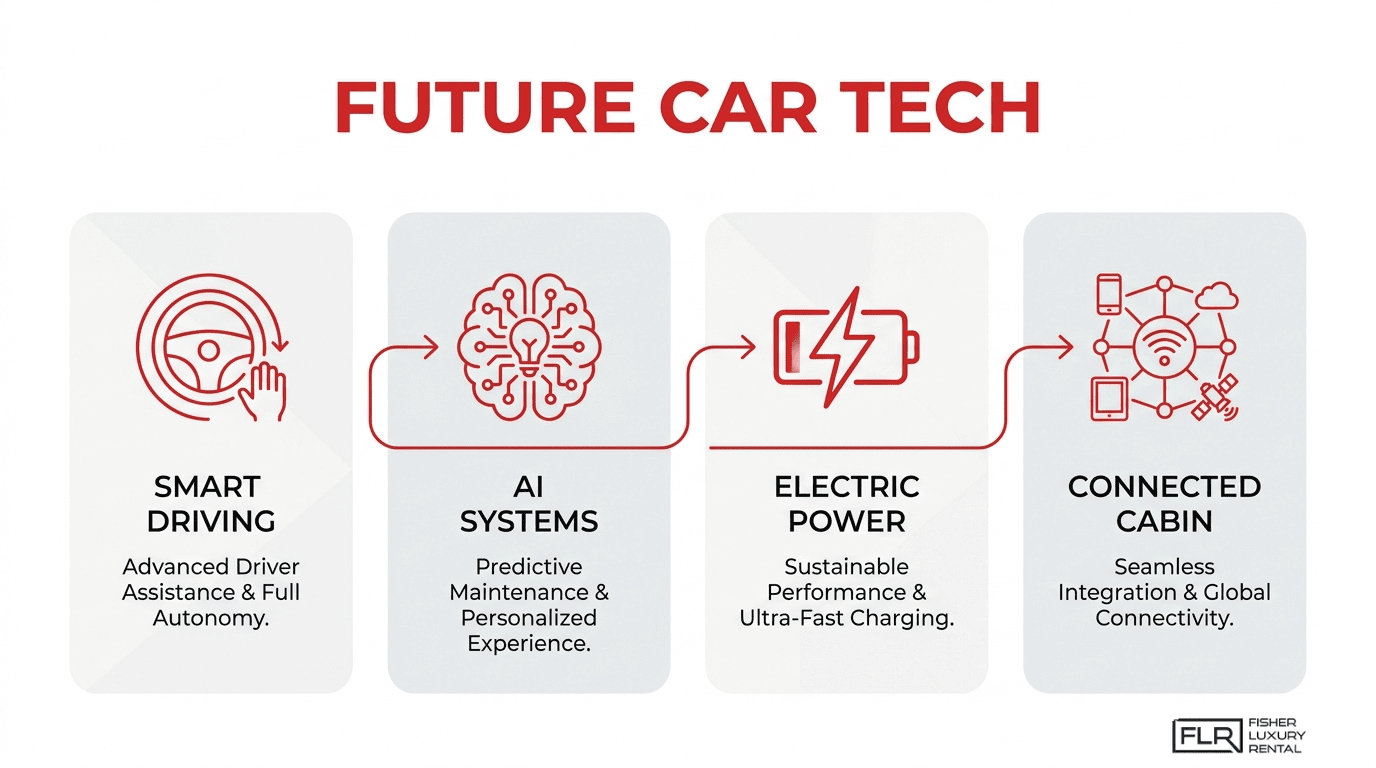
Luxury car technology trends are the advanced engineering and software systems redefining what premium vehicles deliver, spanning autonomous driving, artificial intelligence, electrification, connectivity, sustainability, and driver wellness.
This guide covers how ADAS and AI are reshaping the driving experience, what electrification and infotainment innovations are entering production vehicles, how sustainable materials and active body technologies are redefining interior and aerodynamic design, and what OTA software and biometric wellness systems mean for vehicle ownership going forward.
Advanced driver-assistance systems are evolving from highway-focused tools into urban-capable, predictive safety platforms, with Level 3 conditional automation now in limited production and LiDAR becoming the sensor standard for higher autonomy levels. AI takes this further by powering generative voice assistants, predictive cabin personalization, and real-time machine learning that anticipates conditions before the driver reacts.
On the performance side, electric hypercars now surpass combustion benchmarks outright, solid-state batteries are approaching 600-mile range with nine-minute charging, and 800-volt architecture is removing the practical friction of EV ownership. Inside the cabin, augmented reality head-up displays, 5G connectivity, and pillar-to-pillar OLED screens are converging into immersive digital cockpits that treat every occupant as part of the experience.
Sustainable materials including mycelium leather and Econyl are replacing traditional leather across luxury interiors, while active aerodynamic elements and camera-guided adaptive suspension systems shift body engineering from passive geometry to real-time mechanical response. Over-the-air software updates turn vehicles into continuously improving platforms, and biometric wellness systems now monitor heart rate variability, stress response, and cabin air quality to make the interior a proactive health environment.
What Advanced Driver-Assistance Systems Are Emerging in Luxury Cars?
Advanced driver-assistance systems (ADAS) are emerging in luxury cars across several rapidly evolving fronts, including adaptive cruise control, LiDAR sensing, hands-free driving, and predictive safety technologies. The sections below explore how each capability is advancing in premium vehicles.
How Is Adaptive Cruise Control Evolving Beyond Highway Driving?
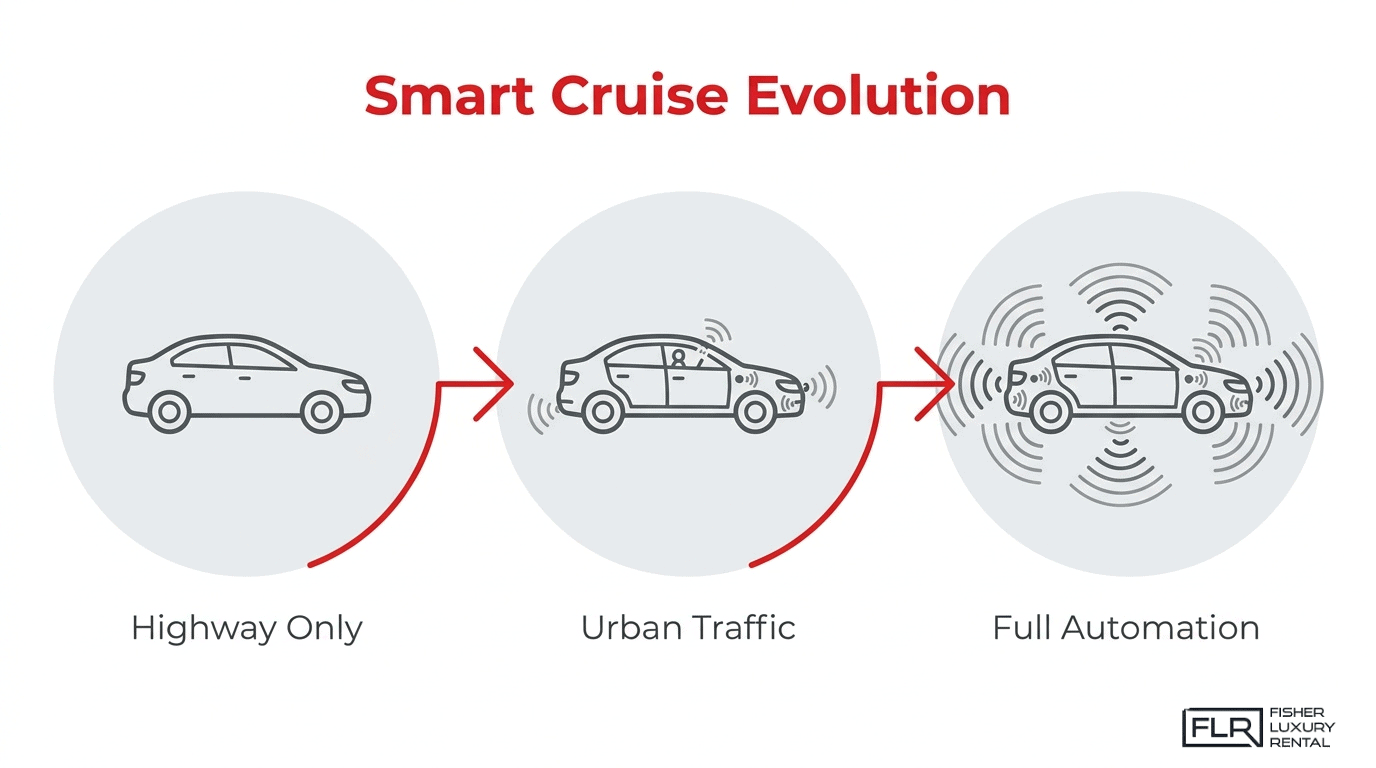
Adaptive cruise control is evolving beyond highway driving to handle urban stop-and-go traffic, intersection management, and low-speed maneuvering. Modern systems now integrate lane-centering, automatic braking, and traffic-jam assist into a unified control loop. According to Mordor Intelligence, adaptive cruise control led the highway driving assist market with a 38.48% share in 2025, reflecting how foundational this technology has become before its urban expansion even reaches full maturity.
What Role Does LiDAR Play in Next-Generation Luxury Vehicles?
LiDAR plays a central role in next-generation luxury vehicles by providing precise, three-dimensional environmental mapping that cameras and radar alone cannot match. Mercedes-Benz has signed agreements with both Luminar Technologies and Hesai to integrate their latest LiDAR products into smart-driving cars globally. The automotive LiDAR sensors market was estimated at USD 1.3 billion in 2025 and is projected to grow at a 24.1% CAGR through 2035, according to Global Market Insights. For luxury brands, LiDAR is the sensor layer that makes higher autonomy levels credible and commercially viable.
How Are Luxury Brands Advancing Hands-Free Driving Capabilities?
Luxury brands are advancing hands-free driving capabilities primarily through Level 3 conditional automation systems. Under the SAE J3016 standard, Level 3 autonomy defines conditional automation, where the driver must remain ready to resume control. Mercedes-Benz’s Drive Pilot is the first Level 3 hands-free system available on a production car, with both Drive Pilot and BMW’s Personal Pilot approved for limited use in Germany. NHTSA has also released research on performance requirements and regulatory frameworks for Level 3 through Level 5 systems, signaling that regulatory infrastructure is catching up to the technology.
What Predictive Safety Features Are New to High-End Models?
Predictive safety features new to high-end models include AI-assisted driver monitoring, automatic emergency braking with object classification, and real-time road hazard anticipation. AI contributes to predictive maintenance and driver safety systems that assess conditions before incidents occur, not just in response to them. High-end models increasingly combine physiological monitoring with environmental sensing, allowing the vehicle to respond to both driver state and road conditions simultaneously. This convergence of sensing layers makes predictive safety one of the most consequential ADAS advances entering the luxury segment today.
How Is Artificial Intelligence Transforming the Luxury Driving Experience?
Artificial intelligence is transforming the luxury driving experience through smarter voice assistants, predictive cabin personalization, and real-time performance optimization. The sections below cover how each AI application reshapes what drivers expect from a premium vehicle.
How Do AI-Powered Voice Assistants Differ in Luxury Vehicles?
AI-powered voice assistants in luxury vehicles differ from standard systems by using generative AI to hold natural, context-aware conversations rather than responding to rigid commands. According to Mercedes-Benz USA, the MBUX Voice Assistant now initiates Microsoft Bing searches and generates natural language responses via ChatGPT through Microsoft Azure OpenAI Service, delivering up-to-date answers to knowledge-based questions. This functionality is rolling out as a free update to over three million MBUX-equipped vehicles globally. Most mainstream voice systems remain limited to preset commands, making this generative layer a genuine differentiator at the luxury tier.
What Is Predictive Personalization in Luxury Car Cabins?
Predictive personalization in luxury car cabins is the use of AI to anticipate occupant preferences, including climate, seating, audio, and ambient lighting, before the driver manually adjusts anything. AI-driven analysis of passenger data supports personalized climate control in modern autonomous and semi-autonomous vehicles, with emotion-aware systems further accelerating this capability through advances in ubiquitous sensing. The practical value here is significant: a vehicle that learns patterns over time reduces driver distraction and elevates the cabin from a transport space to an environment that responds like a personal concierge.
How Does Machine Learning Optimize Performance in Real Time?
Machine learning optimizes vehicle performance in real time by continuously analyzing sensor data to adjust parameters such as energy distribution, suspension response, and powertrain output. According to research published via IEEE Xplore, machine learning techniques in the automotive industry increase protection by predicting potential breakdowns and enabling more personalized services. Separately, predictive maintenance algorithms and energy optimization tools allow manufacturers to enhance vehicle efficiency and reduce emissions. For luxury drivers, this means a car that does not simply respond to conditions but anticipates them, narrowing the gap between human intuition and machine precision.
What Electrification Trends Are Redefining Luxury Performance?
Electrification trends are redefining luxury performance by pushing electric hypercars beyond combustion benchmarks, enabling longer ranges through battery innovation, and accelerating charging through 800-volt architecture. The H3s below cover each of these shifts in detail.
How Are Electric Hypercars Surpassing Combustion Benchmarks?
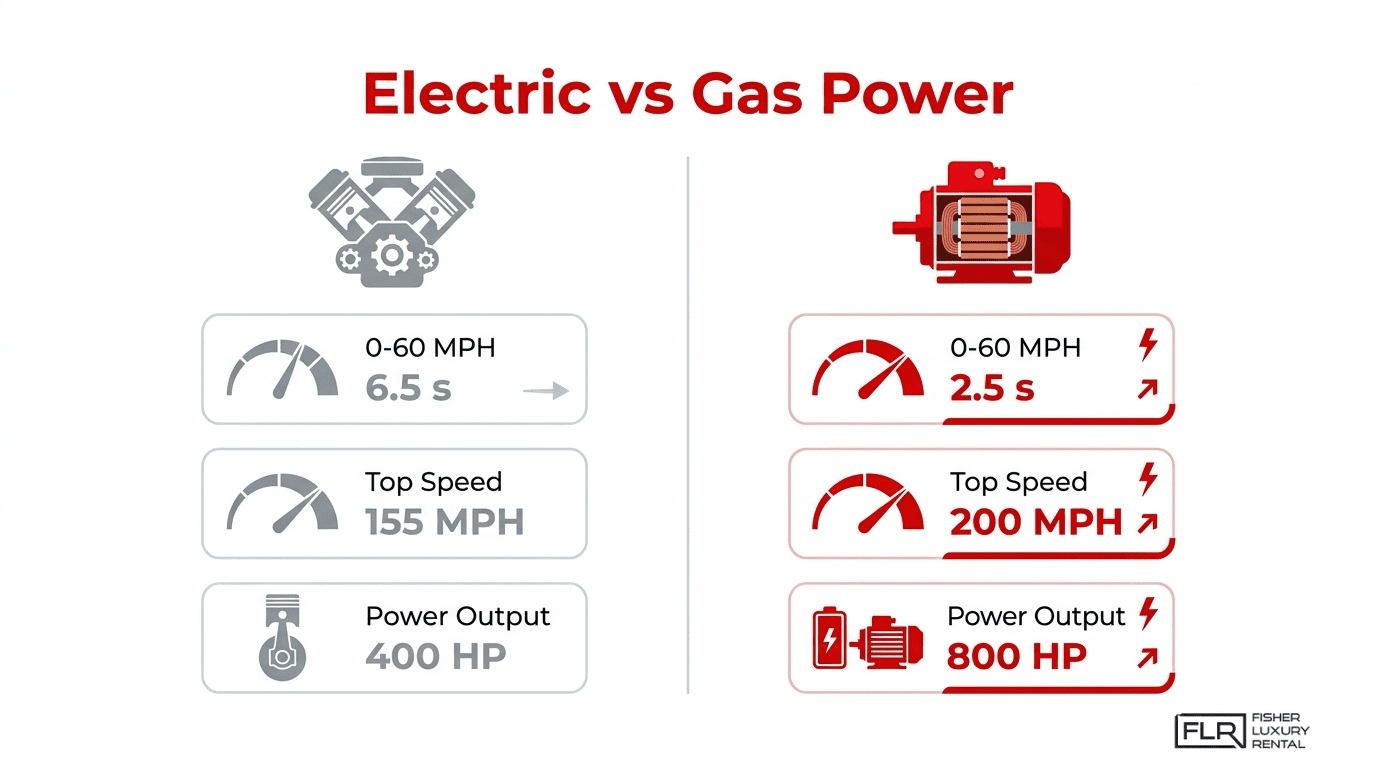
Electric hypercars are surpassing combustion benchmarks through instant torque delivery, multi-motor drivetrains, and power outputs that traditional internal combustion engines simply cannot match. The Rimac Nevera produces 1,914 HP, reaches a top speed of 258 MPH, and accelerates from 0 to 62 MPH in 1.9 seconds. The Pininfarina Battista pairs four electric motors with a combined output of 1,877 bhp, achieving 0 to 60 MPH in under two seconds.
These figures are not incremental improvements; they represent a categorical shift. No production combustion hypercar currently matches this combination of output, acceleration, and consistency across repeated runs.
What Battery Innovations Are Extending Range in Premium EVs?
Battery innovations extending range in premium EVs include solid-state battery technology, which offers higher energy density, lighter weight, and faster charging than conventional lithium-ion cells. Major automakers, including Toyota, Honda, Nissan, Ford, and BMW, are actively developing solid-state batteries for these reasons.
Samsung SDI has unveiled a solid-state battery capable of delivering a 600-mile range with a full charge in just 9 minutes. Samsung SDI, BMW, and Solid Power have also signed a formal collaboration agreement to advance all-solid-state battery development, signaling that production-ready solid-state cells are closer than many expect.
How Is 800-Volt Architecture Changing Luxury EV Charging?
800-volt architecture is changing luxury EV charging by delivering significantly faster charging speeds and greater efficiency compared to conventional 400-volt systems. According to Global Market Insights, the 800V EV architecture market was valued at USD 3.45 billion in 2024 and is projected to grow at a CAGR of 21.3% through 2034, reflecting rapid adoption across premium platforms.
For luxury EV buyers, 800-volt systems reduce charging stops from inconveniences into brief pauses, fundamentally changing long-distance ownership calculus.
What Infotainment and Connectivity Innovations Are Luxury Brands Introducing?
Infotainment and connectivity innovations enhance user experience by merging navigation, communication, and entertainment into seamless digital ecosystems. The sections below cover augmented reality head-up displays, 5G cabin connectivity, and curved pillar-to-pillar screen technology.
How Are Augmented Reality Head-Up Displays Changing Navigation?
Augmented reality head-up displays are changing navigation by projecting turn-by-turn directions, speed data, and hazard alerts directly onto the windshield at eye level, eliminating the need to look away from the road. Nearly every car manufacturer offers at least one 2024 or 2025 model with a HUD, according to Kelley Blue Book, with luxury brands offering it across multiple models. Unlike traditional instrument clusters, AR HUDs overlay digital cues onto the real-world environment ahead, creating a continuous visual context that conventional displays simply cannot replicate. This makes AR HUD technology one of the most meaningful safety-forward advances in premium cabin design today.
What Does 5G Connectivity Enable Inside a Luxury Cabin?
5G connectivity enables real-time vehicle-to-infrastructure communication, ultra-low-latency streaming, remote diagnostics, and simultaneous high-bandwidth data exchange for all cabin occupants. The Passenger Vehicle 5G Connectivity Market is projected to grow from USD 2.29 billion in 2024 to USD 4.55 billion by 2031, at a CAGR of 10.3%, according to Yahoo Finance. Beyond faster entertainment streaming, 5G supports over-the-air software delivery, cloud-based navigation updates, and connected safety systems that react to live traffic and road condition data.
How Are Curved OLED and Pillar-to-Pillar Screens Reshaping Dashboards?
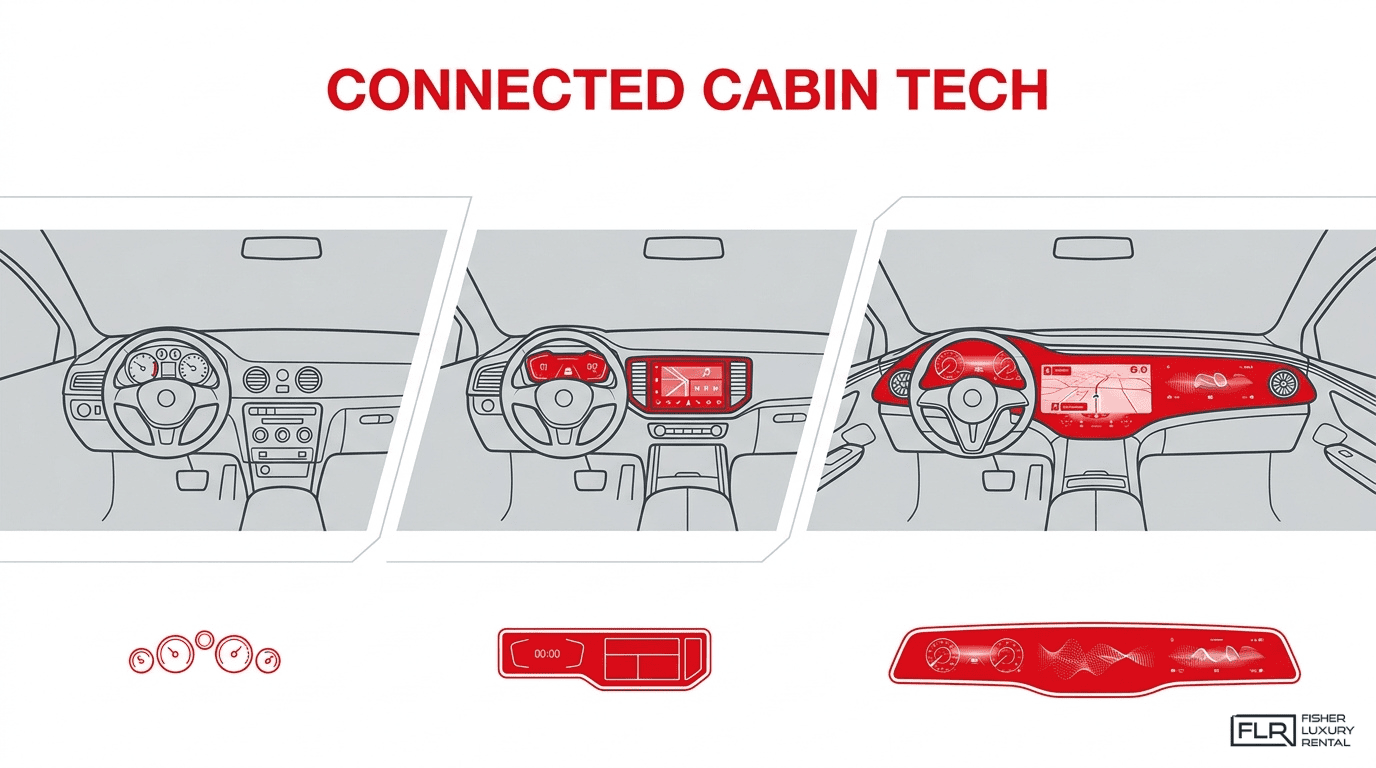
Curved OLED and pillar-to-pillar screens are reshaping dashboards by replacing fragmented instrument clusters and center stacks with single continuous display surfaces that span the full width of the cabin. Pillar-to-pillar screens offer immersive displays with exceptional pixel density, as demonstrated by the Cadillac CELESTIQ’s 55-inch diagonal glass screen, which gives front-seat occupants an 8K pixel density HD display. The Mercedes MBUX Hyperscreen similarly stretches pillar to pillar as the largest screen ever fitted in a Mercedes. The U.S. pillar-to-pillar display market is forecast to grow at a 45.5% CAGR from 2026 to 2036, driven by EV platforms and premium SUVs, according to Fact.MR. These expansive interfaces fundamentally shift the luxury cabin from a driver-centric cockpit into a shared, experience-first environment.
How Are Luxury Automakers Using Sustainable Materials and Design?
Sustainable materials reduce environmental impact by replacing high-carbon inputs like traditional leather with recycled and bio-based alternatives. The sub-sections below cover the specific materials entering luxury interiors and how manufacturing practices are shifting to reflect these priorities.
What Recycled and Bio-Based Materials Are Replacing Traditional Leather?
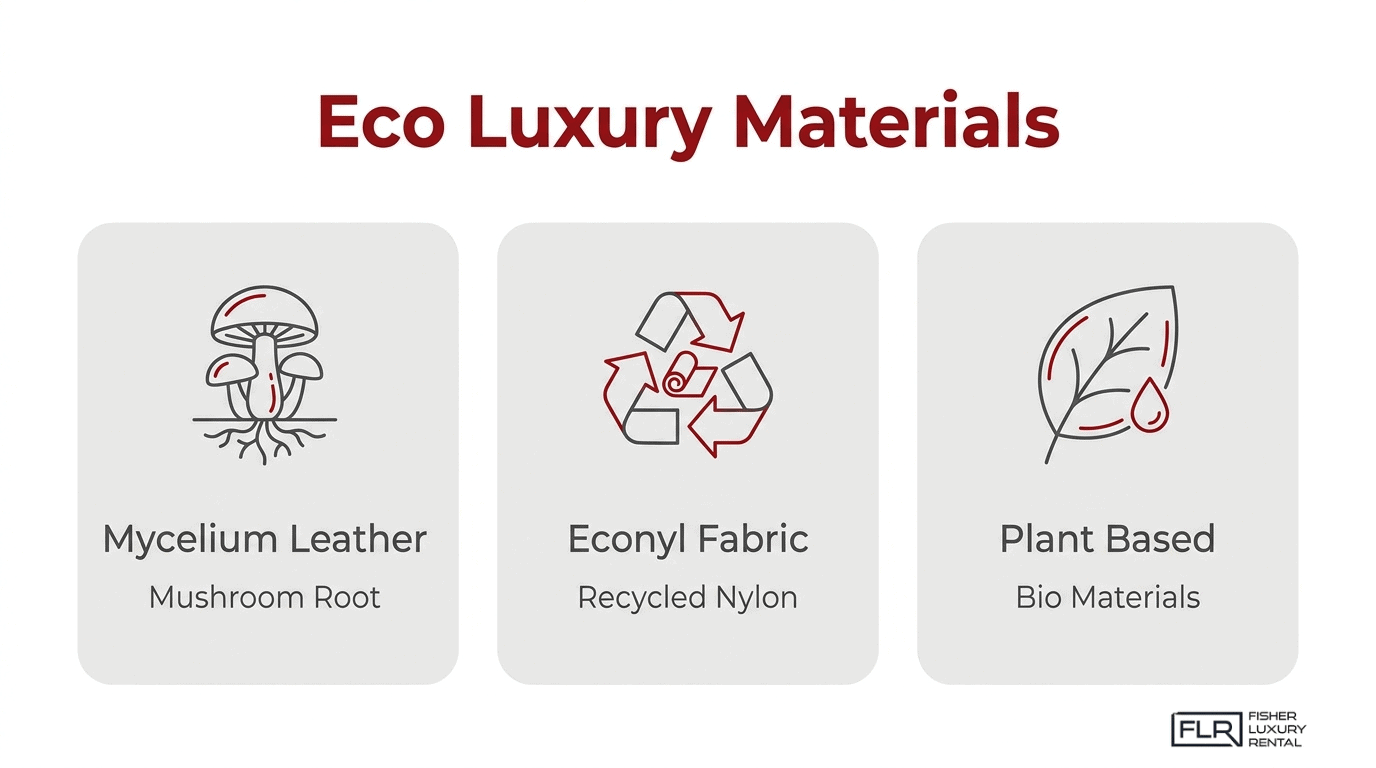
The recycled and bio-based materials replacing traditional leather include mycelium leather, Econyl, and plant-derived composites. Mycelium leather, grown from mushroom root structures, offers a biodegradable, low-impact alternative that aligns with automakers’ carbon reduction goals. Cadillac has developed a new material using MycoWorks’ Fine Mycelium technology that could replace conventional leather in automotive applications. Econyl, made from regenerated nylon waste, provides a circular economy solution for luxury textile manufacturing. Automakers are also turning plant scraps and algae into synthetic leather alternatives.
How Is Sustainable Manufacturing Influencing Luxury Car Interiors?
Sustainable manufacturing is influencing luxury car interiors by integrating circular economy principles directly into material sourcing and production. Design paths derived from algae, mushrooms, and fruit-based materials are emerging as viable interior components, reducing dependence on petrochemical inputs. This shift means interior quality is no longer defined solely by traditional premium materials. For discerning buyers, sustainably manufactured interiors now signal craftsmanship and environmental responsibility in equal measure.
What Aerodynamic and Active Body Technologies Are Trending?
Aerodynamic and active body technologies in 2025 are shifting from passive design to real-time mechanical response. The following sections cover active aerodynamic elements and adaptive air suspension systems leading this shift.
How Do Active Aerodynamic Elements Improve Performance?
Active aerodynamic elements improve performance by dynamically adjusting airflow, drag, and downforce in real time rather than relying on fixed body geometry. The 2025 AMG lineup, for example, incorporates redesigned body panels, optimized air intakes, and active aerodynamic elements such as adjustable spoilers and diffusers that respond to speed and driving conditions. These systems reduce aerodynamic drag at highway speeds while increasing downforce during aggressive cornering, directly improving stability, efficiency, and handling precision.
From an engineering standpoint, this shift from static to active aero represents one of the most meaningful performance gains available without adding engine output — a change that benefits both track-focused drivers and long-range EV efficiency.
What Is Adaptive Air Suspension Doing Differently in 2025?
Adaptive air suspension in 2025 is doing something fundamentally different: using cameras and real-time road data to anticipate terrain changes before the wheel reaches them. The Mercedes-Benz S-Class MAGIC BODY CONTROL system scans the road ahead and pre-adjusts suspension at each corner independently, eliminating reactive lag. The Cadillac CELESTIQ extends this further with active air suspension that automatically raises or lowers ride height to optimize both aerodynamics and road clearance. Magnetorheological damper technology, now advancing through semi-active systems, enables instantaneous stiffness changes that passive or even traditional active setups cannot match.
How Is Over-the-Air Software Redefining Vehicle Ownership?
Over-the-air software is redefining vehicle ownership by transforming cars from static hardware purchases into continuously evolving platforms that improve after the sale. OTA updates enable automakers to push new features, fix bugs, and enhance performance remotely, without a dealership visit.
According to Mordor Intelligence, the automotive over-the-air updates market is expected to reach USD 4.78 billion in 2025 and grow at a CAGR of 18.63% to reach USD 11.23 billion by 2030. Tesla pioneered this model in the automotive industry, and luxury brands have followed by embedding OTA capability across their software-defined vehicle architectures.
The two most significant advantages OTA upgrades deliver are continuous improvement and enhanced customer satisfaction, shifting ownership from a depreciating asset model toward an ongoing service relationship. For luxury buyers especially, this means a vehicle purchased today can gain capabilities tomorrow that did not exist at delivery.
What Biometric and Wellness Features Are Entering Luxury Cabins?
Biometric and wellness features entering luxury cabins include physiological monitoring systems, stress detection sensors, heart rate variability tracking, eye-tracking alertness tools, and advanced air purification technologies. These systems collectively transform the cabin into a proactive health environment.
Biometric features monitor driver wellness by collecting real-time physiological data and triggering adaptive cabin responses. According to Global Market Insights, the in-car wellness monitoring system market was estimated at USD 3.1 billion in 2025 and is expected to grow at a CAGR of 16.7% between 2026 and 2035.
Advanced driver monitoring solutions integrate physiological sensing, enabling real-time health assessments through heart rate, stress, and other biometric data. Hyundai’s health and wellness concept demonstrated measurable capability in this space, incorporating heart-rate variability for stress response alongside eye tracking and facial recognition to assess alertness and emotional state.
Luxury automakers such as Tesla and Volvo have integrated advanced air filtration systems, including activated carbon layers and ionization, to enhance cabin air quality alongside biometric sensing. This combination of air quality management and physiological monitoring positions biometric wellness as one of the most consequential comfort upgrades in modern luxury vehicles; a feature set that goes well beyond traditional seat adjustment and climate control.
How Can You Experience the Latest Luxury Car Technology Firsthand?
The best way to experience the latest luxury car technology firsthand is to get behind the wheel of a modern exotic or luxury vehicle. The sections below cover how renting from Fisher Luxury Rental delivers that access and what key technology trends you should carry away from this article.
Can Renting an Exotic Car from Fisher Luxury Rental Showcase These Innovations?
Yes, renting an exotic car from Fisher Luxury Rental can showcase these innovations directly through hands-on driving. Vehicles like the McLaren 720S, Mercedes S580, and Porsche 911 Carrera S put cutting-edge driver-assistance systems, advanced infotainment, and precision engineering within reach for a single day.
Fisher Luxury Rental stocks top-trim models exclusively, meaning renters engage with the full technology suite each manufacturer intended, not a stripped-down variant. Options like the Ferrari 488 Spider and Lamborghini Huracan Spyder offer performance benchmarks that no brochure or video can replicate. For car enthusiasts, special occasion renters, and first-time exotic drivers in Phoenix, Scottsdale, Portland, and Vancouver, this is the most direct path to understanding what modern luxury engineering actually feels like in motion.
What Are the Key Takeaways About Luxury Car Technology Trends?
The key takeaways about luxury car technology trends are that innovation is accelerating across every dimension of the vehicle, and the luxury rental market adapts directly to these shifts by refreshing fleets to reflect them.
The most actionable conclusions from this article are:
- ADAS and autonomy are moving from driver-assist to conditional hands-free operation, with Level 3 systems now in limited production.
- AI and machine learning power personalized cabin experiences, predictive maintenance, and conversational voice assistants.
- Electric performance has surpassed combustion benchmarks, backed by solid-state battery progress and 800V charging infrastructure.
- Infotainment has evolved into immersive digital cockpits featuring pillar-to-pillar displays and 5G connectivity.
- Sustainable materials such as mycelium leather and Econyl are replacing traditional interior components.
- OTA software updates transform vehicles into continuously improving platforms rather than static products.
- Biometric and wellness systems monitor driver health and adapt the cabin environment in real time.
Experiencing these technologies in person remains the most reliable way to evaluate them. Renting a vehicle from Fisher Luxury Rental’s fleet is the most accessible entry point.