Car acceleration problems occur when the engine fails to deliver power smoothly or fully in response to throttle input. These issues range from momentary hesitation and sluggishness to complete stalling, and each pattern points to a different set of causes.
This guide covers what acceleration problems look and feel like, the mechanical causes behind them, how to diagnose and fix each one, what repairs cost, how to prevent them, and how turbocharged engines differ from naturally aspirated ones.
Understanding what a symptom means saves time before any tool is picked up. Hesitation, jerking, slow starts, uphill power loss, and stalling each narrow the cause differently, and recognizing the right category is the fastest path to the right repair.
The top causes fuel delivery, airflow, ignition, and sensors, including failing fuel pumps, clogged injectors, dirty air filters, faulty MAF sensors, worn spark plugs, and clogged catalytic converters. Each one disrupts engine output in a specific way, and repair costs range from under $264 for spark plugs to over $2,300 for a catalytic converter.
Diagnosis starts with an OBD-II scanner, which retrieves trouble codes that point directly to the failing component. From there, fixes target the specific system at fault, whether that is the fuel system, airflow, ignition, or transmission.
Prevention comes down to consistent maintenance on filters, plugs, injectors, and sensors before symptoms develop. Most acceleration problems are not sudden failures; they build gradually from deferred service.
What Does It Mean When Your Car Has Acceleration Problems?
Car acceleration problems mean the engine fails to deliver power smoothly or fully when the gas pedal is pressed. These issues range from momentary hesitation to complete power loss, and the sections below cover what each type feels like and how they differ.
What Does Hesitation During Acceleration Feel Like?
Hesitation during acceleration feels like a momentary delay or stumbling when the gas pedal is pressed, often described by drivers as a “flat spot” or “lag” in engine response. According to the National Highway Traffic Safety Administration (NHTSA), this sensation signals a brief breakdown in the combustion or fuel delivery cycle. The hesitation is most noticeable during low-speed throttle inputs, such as pulling into traffic or accelerating from a stop. It is easy to dismiss as a minor annoyance, but persistent hesitation typically points to an underlying mechanical issue, such as a failing sensor, clogged injector, or ignition fault, that will worsen without attention.
What Is the Difference Between Slow Acceleration and No Acceleration?
The difference between slow acceleration and no acceleration lies in the degree of power loss. Firestone Complete Auto Care categorizes car acceleration problems into three distinct types: reduced power (sluggishness), temporary loss of power (stumbling or sputtering), and sudden, complete loss of power (stalling). Slow acceleration means the engine still responds but delivers less power than expected, making the vehicle feel heavy or unresponsive. No acceleration means the engine fails to produce forward motion at all, often accompanied by stalling or an engine that revs without translating power to the wheels. Recognizing which category applies helps pinpoint the cause faster and guides the most effective repair approach.
What Are the Top Causes of Car Acceleration Problems?
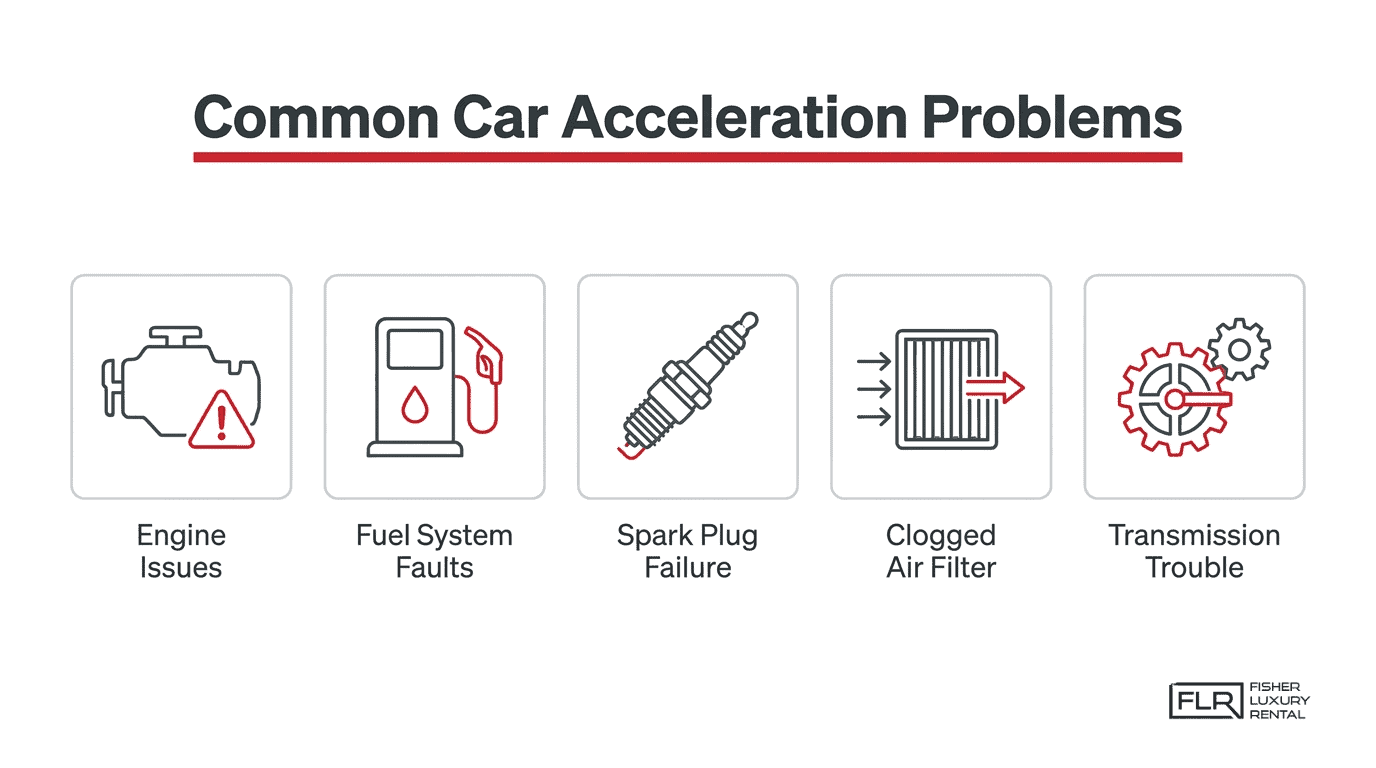
The top causes of car acceleration problems span fuel delivery, airflow, ignition, sensors, and drivetrain components. The sections below cover each cause, how it disrupts engine output, and what it typically costs to address.

Clogged or Dirty Air Filter
A clogged or dirty air filter restricts airflow into the engine, starving combustion and reducing available power. According to a study on air filter selection for automobile engines, increased filter resistance due to clogging can decrease engine power and raise fuel consumption by 1% to 15%. OEM maintenance schedules generally recommend replacing the engine air filter every 30,000 miles. This is one of the cheapest acceleration fixes available and is often the first place worth checking.
Failing Fuel Pump
A failing fuel pump reduces fuel pressure to the injectors, causing sluggish acceleration, power loss under load, or stalling at speed. RepairPal estimates fuel pump replacement in 2026 at $1,001 to $1,210, with parts alone running $816 to $977. Symptoms often worsen during hard acceleration when fuel demand peaks, making the pump’s deficiency most noticeable at higher engine loads.
Clogged or Dirty Fuel Injectors
Clogged or dirty fuel injectors disrupt the precise fuel spray pattern the engine needs for clean combustion. According to a 2023 NHTSA technical bulletin, carbon buildup on fuel injectors can cause hesitation on acceleration and trigger misfire diagnostic trouble codes. Fuel injector replacement averages $741 to $927 (RepairPal). Cleaning is often attempted first, but severely fouled injectors typically require full replacement to restore performance.
Faulty Mass Airflow Sensor
A faulty mass airflow (MAF) sensor sends incorrect air volume data to the ECU, causing the engine to run rich or lean and producing hesitation under acceleration. MAF sensor replacement is estimated between $263 and $408 (RepairPal). Because the MAF reading directly shapes the fuel map, even a partially failing sensor can create noticeable flat spots when throttle demand increases.
Worn or Fouled Spark Plugs
Worn or fouled spark plugs fail to ignite the air-fuel mixture consistently, producing misfires, stumbling, and poor throttle response. According to the U.S. Environmental Protection Agency, ignition components including spark plugs create symptoms of poor acceleration, stumble, and rough running when failing. Spark plug replacement averages $208 to $264 (RepairPal), and OEM schedules typically call for replacement at 60,000-mile intervals.
Malfunctioning Throttle Position Sensor
A malfunctioning throttle position sensor (TPS) provides incorrect throttle angle data to the ECU, causing erratic acceleration, surging, or a complete loss of power response. TPS replacement typically costs between $182 and $258 (RepairPal). Because the TPS directly tells the engine how aggressively the driver is demanding power, even minor signal errors translate to unpredictable acceleration behavior.
Clogged Catalytic Converter
A clogged catalytic converter creates excessive exhaust backpressure that restricts engine breathing and progressively reduces power output, most noticeably during acceleration. RepairPal places catalytic converter replacement costs at $2,274 to $2,333, reflecting the precious metals required in its construction. A severely clogged converter can reduce performance significantly enough to trigger a check-engine light alongside the acceleration complaint.
Failing Oxygen Sensor
A failing oxygen sensor provides inaccurate exhaust composition data to the ECU, disrupting the air-fuel ratio and degrading acceleration quality. Oxygen sensor replacement averages $434 to $537, with parts representing the majority of that cost at $345 to $406 (RepairPal). Running on a faulty O2 signal typically causes the engine to operate outside its optimal fuel trim, leading to sluggishness and increased emissions.
Vacuum Leak in the Intake System
A vacuum leak in the intake system introduces unmetered air into the engine, throwing off the air-fuel mixture calculated by the ECU. Research published via the International Journal of Engineering and Advanced Technology confirms that unmetered air from a vacuum leak causes engine stumbling, hesitation during acceleration, and reduced overall performance. Vacuum leaks are particularly tricky because they can be small cracks or failed gaskets that produce inconsistent symptoms.
Slipping Transmission
A slipping transmission fails to transfer engine power efficiently to the drivetrain, causing the engine to rev without a proportional increase in vehicle speed. A transmission fluid change, the first line of maintenance, averages $232 to $290 (RepairPal). If fluid degradation is not the issue, internal clutch pack or solenoid wear may require more extensive diagnosis and repair to restore normal power delivery.
Dirty or Failing Throttle Body
A dirty or failing throttle body restricts or disrupts airflow between the air intake and the engine, causing stumbling, rough idle, and sluggish acceleration. Carbon deposits accumulate on the throttle plate over time and prevent it from opening fully when the driver demands full throttle. Cleaning the throttle body is often a low-cost maintenance step that restores response before a full replacement becomes necessary.
Faulty Ignition Coils
Faulty ignition coils fail to deliver sufficient voltage to the spark plugs, producing misfires that directly degrade acceleration performance. According to the EPA, ignition components including coils produce symptoms of poor acceleration, stumble, and rough running when they fail. Individual coil-on-plug systems allow a single faulty coil to cause cylinder-specific misfires that worsen noticeably under acceleration load, making coil failure relatively straightforward to isolate with a scanner.
What Are the Symptoms That Point to Specific Acceleration Issues?
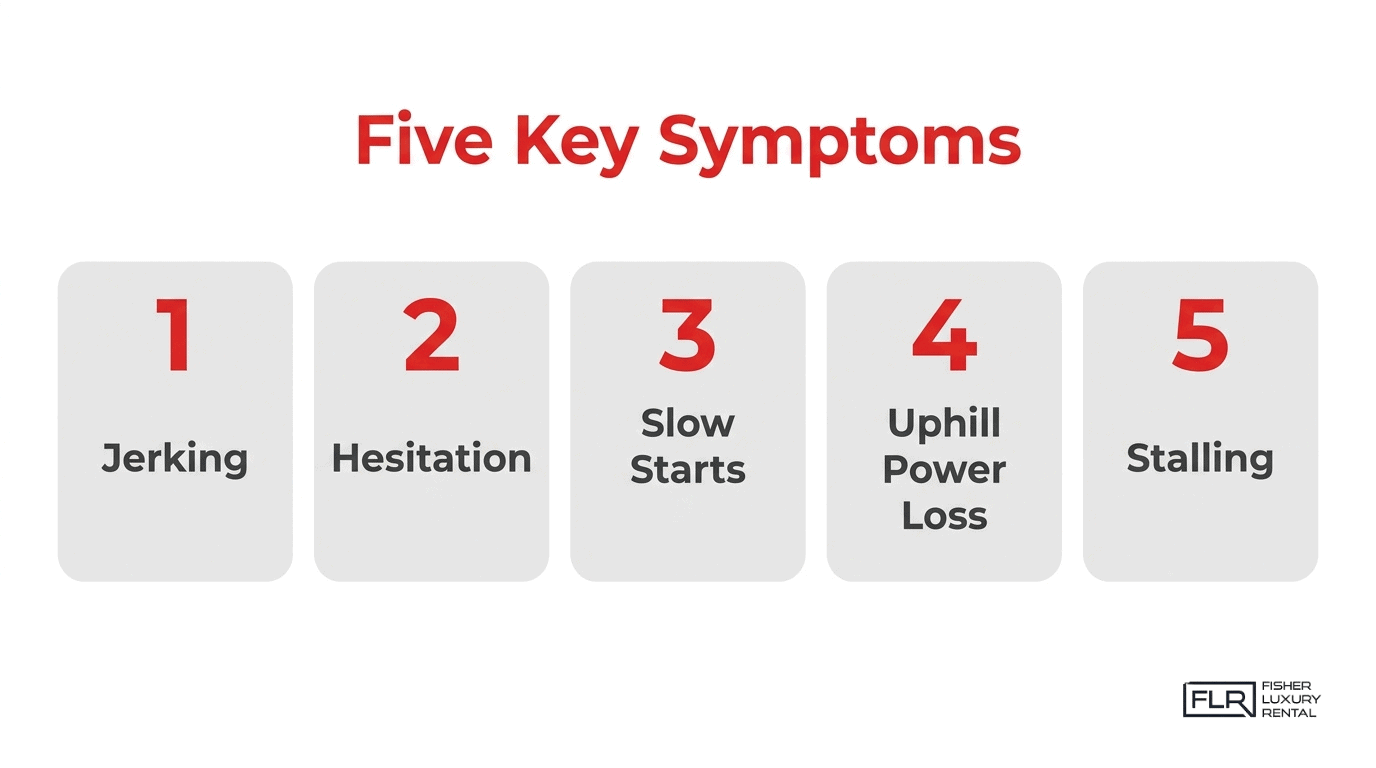
Symptoms of acceleration problems fall into five recognizable patterns: jerking, hesitation, slow starts, uphill power loss, and stalling or sputtering. Identifying which pattern you experience narrows the cause significantly before any diagnostic work begins.
What Does It Mean When Your Car Jerks During Acceleration?
A car that jerks during acceleration is experiencing an inconsistent or interrupted delivery of power from the engine to the drivetrain. The jerk typically signals a misfiring cylinder, a faulty ignition coil, or worn spark plugs disrupting combustion timing. According to the U.S. Environmental Protection Agency, ignition components such as spark plugs and ignition coils produce symptoms including poor acceleration, stumble, and rough running when they begin to fail. Carbon buildup on fuel injectors can produce a similar jerking sensation by disrupting the precise fuel spray pattern each cylinder needs.
What Causes a Car to Hesitate When You Press the Gas?
Hesitation when pressing the gas is caused by a momentary interruption in fuel delivery, airflow, or sensor communication between the throttle and engine management system. The National Highway Traffic Safety Administration defines acceleration hesitation as a momentary delay or stumbling when the gas pedal is pressed, often described as a “flat spot” or “lag” in engine response. Common sources include a dirty throttle body, a failing mass airflow sensor, a vacuum leak introducing unmetered air, or carbon-fouled fuel injectors reducing atomization quality.
Why Does Your Car Accelerate Slowly From a Stop?
A car that accelerates slowly from a stop lacks sufficient fuel volume, airflow, or combustion efficiency to build power quickly from low RPM. A restricted fuel filter is a frequent culprit: it performs adequately at idle but cannot supply the increased fuel demand that acceleration requires, causing the vehicle to feel sluggish. A clogged air filter compounds the problem, since restricted airflow reduces the air-fuel ratio the engine needs. Slow starts from rest are often overlooked until the condition worsens noticeably, making early attention especially worthwhile.
What Does It Mean When Your Car Loses Power Going Uphill?
Power loss going uphill means the engine cannot sustain the additional load that climbing requires, pointing to a fuel delivery shortfall, a clogged catalytic converter, or a transmission slipping under torque demand. Unlike flat-road hesitation, uphill power loss exposes weaknesses that normal driving conditions may mask entirely. A partially blocked catalytic converter restricts exhaust flow enough to reduce engine output under sustained load, while a slipping transmission fails to transfer available torque efficiently to the wheels.
Why Does Your Car Stall or Sputter When Accelerating?
Stalling or sputtering when accelerating is the most severe symptom category, representing what Firestone Complete Auto Care classifies as a sudden, complete loss of power. A failing fuel pump that cannot maintain adequate pressure under load, a severely misfiring ignition system, or a vacuum leak introducing large volumes of unmetered air can each push the engine beyond its ability to sustain combustion. Sputtering that progresses to stalling at speed warrants immediate diagnosis, as continued driving compounds the underlying damage and raises the risk of a dangerous loss of control.
How Do You Diagnose Car Acceleration Problems?
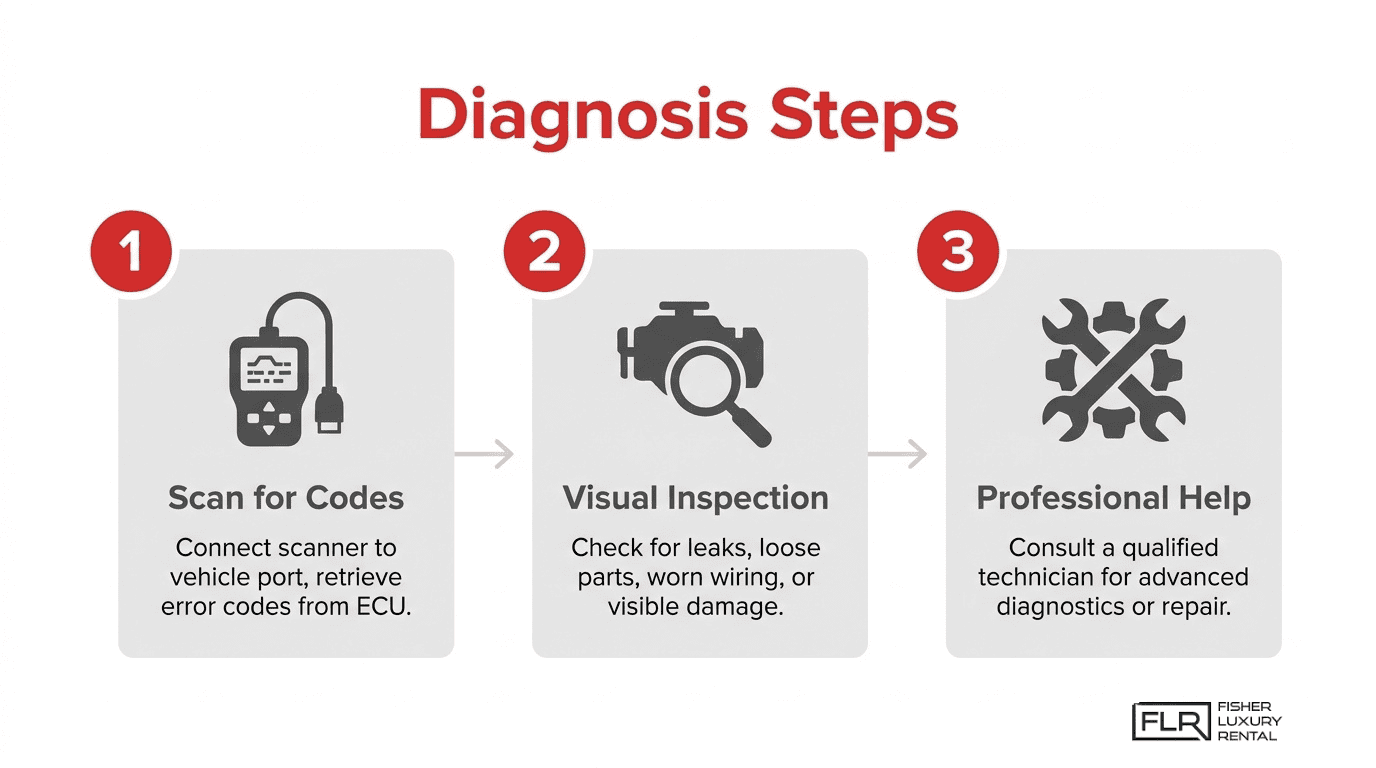
Diagnosing car acceleration problems involves three core steps: reading fault codes with an OBD-II scanner, performing a systematic visual inspection, and knowing when professional diagnosis is necessary.
Can an OBD-II Scanner Identify Acceleration Issues?
Yes, an OBD-II scanner can identify acceleration issues by retrieving diagnostic trouble codes (DTCs) stored by the vehicle’s computerized engine control system. According to Utah State University research on automotive diagnostics, DTCs pinpoint specific component failures across sensors and the powertrain. Codes such as P0300 (misfire), P0171 (lean fuel trim), or P0101 (MAF sensor range) all correlate directly with poor acceleration. Scanning is the fastest first step because it narrows a broad symptom list down to specific, testable components rather than guessing.
What Should You Check First When Your Car Won’t Accelerate?
The first things to check when your car won’t accelerate are the air filter, fuel filter, and spark plugs, as these are the most common and lowest-cost culprits. Start with the easiest visual checks:
- Air filter: A clogged filter restricts airflow and can reduce engine power noticeably.
- Fuel filter: A restricted fuel filter performs adequately at idle but causes sluggishness under the higher fuel demand of acceleration, according to Firestone Complete Auto Care.
- Spark plugs: Worn or fouled plugs cause stumbling and hesitation during acceleration.
- Vacuum lines: Look for cracked or disconnected hoses that allow unmetered air into the intake.
When Should You Take Your Car to a Mechanic for Acceleration Issues?
You should take your car to a mechanic for acceleration issues when the check engine light is on, when the vehicle stalls under load, or when basic inspections reveal no obvious cause. These signs suggest failures in components such as the fuel pump, catalytic converter, oxygen sensor, or transmission that require specialized tools and expertise to diagnose accurately. Ignoring persistent power loss is a safety risk worth taking seriously.
How Do You Fix Car Acceleration Problems?
Fixing car acceleration problems requires targeting the specific system at fault, whether that is the fuel system, airflow and sensors, ignition components, or transmission. The sections below address each repair category with actionable solutions.
How Do You Fix Fuel System Issues Causing Poor Acceleration?
Fuel system issues causing poor acceleration are fixed by replacing the faulty component restricting fuel delivery, such as a clogged fuel filter, dirty fuel injectors, or a failing fuel pump.
- Fuel filter: Replace the filter if restricted. According to Firestone Complete Auto Care, a clogged fuel filter may perform adequately at idle but causes sluggishness or power loss under the increased fuel demand of acceleration.
- Fuel injectors: Clean injectors using professional ultrasonic cleaning or fuel system additives for minor carbon buildup. Severe cases require full replacement.
- Fuel pump: Replace the pump if output pressure tests below specification. A failing pump cannot sustain the flow rate the engine requires at higher RPMs.
How Do You Fix Airflow and Sensor Problems Affecting Acceleration?
Airflow and sensor problems affecting acceleration are fixed by cleaning or replacing the component disrupting the engine’s air-fuel mixture calculation, such as a dirty air filter, faulty MAF sensor, or malfunctioning throttle position sensor.
- Air filter: Replace a clogged filter. Research published in Academia.edu confirms that increased air filter resistance decreases engine power and can raise fuel consumption by 1% to 15%.
- MAF sensor: Clean the sensor with MAF-specific cleaner spray; replace it if cleaning does not restore normal readings.
- Throttle position sensor (TPS): Replace a faulty TPS. A bad signal causes the ECU to miscalculate throttle demand, producing hesitation.
- Vacuum leaks: Locate and seal any cracked hoses or intake manifold gaskets. Unmetered air entering through a leak causes engine stumbling and hesitation during acceleration.
- Throttle body: Clean carbon deposits from the throttle body bore and plate to restore accurate airflow control.
In practice, starting with the air filter before purchasing sensors often saves unnecessary parts costs, since restricted airflow mimics sensor failure symptoms closely.
How Do You Fix Ignition System Failures That Reduce Acceleration?
Ignition system failures that reduce acceleration are fixed by replacing worn spark plugs, faulty ignition coils, or damaged spark plug wires that are causing incomplete combustion.
According to the U.S. Environmental Protection Agency (EPA), ignition components such as spark plugs and ignition coils produce overlapping failure symptoms including poor acceleration, stumble, and rough running. OEM maintenance schedules typically recommend replacing spark plugs every 60,000 miles to maintain optimal performance. The repair steps are:
- Spark plugs: Inspect for fouling, wear, or incorrect gap. Replace all plugs as a set.
- Ignition coils: Test each coil with a multimeter or by swapping coils between cylinders to isolate misfires. Replace any coil showing failure.
- Spark plug wires: Inspect for cracks or high resistance. Replace the full set when wear is present
How Do You Fix Transmission Problems That Cause Sluggish Acceleration?
Transmission problems that cause sluggish acceleration are fixed by servicing the fluid, recalibrating the transmission control module, or replacing worn internal components such as clutch packs or a slipping torque converter.
The repair approach depends on severity:
- Fluid service: Change degraded transmission fluid first. Fresh fluid restores hydraulic pressure and shift quality in many early-stage slipping cases.
- TCM recalibration: A transmission control module (TCM) software update can correct erratic shift timing causing perceived acceleration lag.
- Internal component repair: Worn clutch packs or a failing torque converter require disassembly and rebuild by a certified transmission specialist.
Transmission problems are often the most expensive acceleration fix, so confirming the diagnosis with a full scan for DTCs before committing to teardown is essential.
How Much Does It Cost to Repair Car Acceleration Problems?
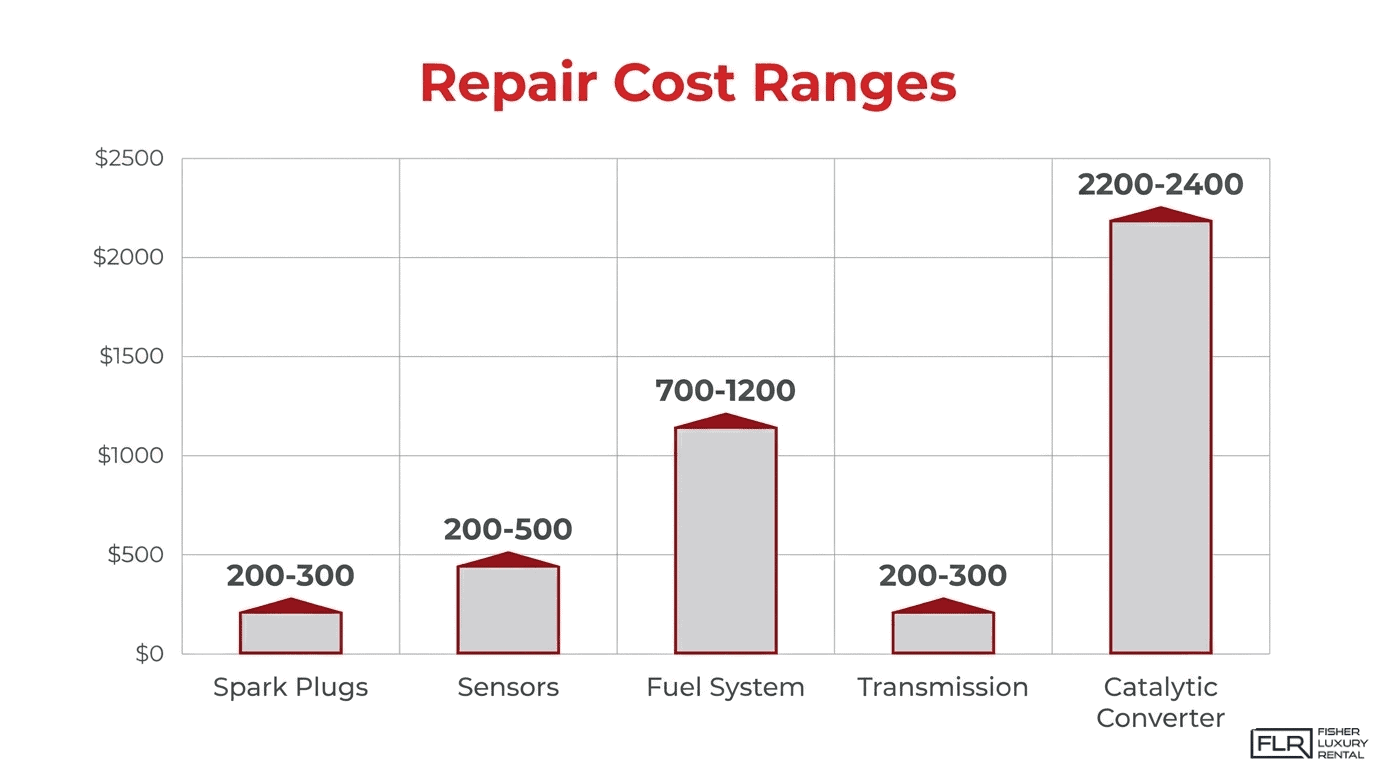
Repair costs for car acceleration problems vary widely depending on the failed component. The sections below cover estimated costs for fuel system components, sensors, ignition parts, and catalytic converters based on 2026 RepairPal data.
How Much Does It Cost to Replace Fuel Injectors or a Fuel Pump?
The cost to replace fuel injectors or a fuel pump depends on which component has failed. According to RepairPal, fuel injector replacement averages between $741 and $927, while a full fuel pump replacement runs significantly higher, estimated between $1,001 and $1,210. Labor for the fuel pump alone ranges from $185 to $233, with parts accounting for $816 to $977 of the total. Between the two, fuel pump failure tends to be the more urgent and expensive repair, given that a completely failed pump stops the engine from running at all.
How Much Does It Cost to Replace Sensors Related to Acceleration?
The cost to replace sensors related to acceleration varies by sensor type. The three most common sensors affecting acceleration are:
- Oxygen sensor: $434 to $537, with parts making up $345 to $406 of that total (RepairPal).
- Mass airflow (MAF) sensor: $263 to $408.
- Throttle position sensor (TPS): $182 to $258, making it the least expensive sensor replacement of the three.
Oxygen sensors carry the highest parts cost because they are precision emissions components, but all three are relatively straightforward repairs compared to fuel system or exhaust work.
How Much Does It Cost to Fix Ignition or Spark Plug Issues?
Ignition and spark plug issues are among the most affordable acceleration repairs to fix. Spark plug replacement averages between $208 and $264, including both labor and parts, according to RepairPal. Because the EPA notes that worn spark plugs and ignition coils produce symptoms including poor acceleration, stumbling, and rough running, addressing these components early prevents compounding engine damage. For the money, spark plug replacement offers one of the best cost-to-performance returns of any acceleration-related repair.
How Much Does a Catalytic Converter Replacement Cost?
Catalytic converter replacement costs between $2,274 and $2,333, making it the most expensive acceleration-related repair on this list. The high price reflects the precious metals inside the converter and the specialized labor required for exhaust system work. Because a clogged catalytic converter restricts exhaust flow and directly limits engine power output, the repair is unavoidable once the component fully fails. Getting the exhaust system diagnosed early, before complete blockage, remains the best way to confirm whether a replacement is truly necessary.
How Can You Prevent Car Acceleration Problems?
You can prevent car acceleration problems by following a consistent maintenance schedule that addresses the fuel system, air intake, ignition components, and filters before symptoms develop.
Key preventive maintenance tasks include:
- Replace spark plugs every 60,000 miles and the engine air filter every 30,000 miles, per OEM maintenance schedules cited by Des Moines University.
- Replace the fuel filter on schedule, as a restricted fuel filter causes sluggishness and power loss specifically during acceleration, according to Firestone Complete Auto Care.
- Clean fuel injectors regularly, since carbon buildup on injectors leads to hesitation and misfire codes, per NHTSA.
- Check for vacuum leaks in the intake system, as unmetered air causes engine stumbling and hesitation when accelerating.
- Monitor oxygen sensor, MAF sensor, and throttle position sensor health using an OBD-II scanner to catch early failures before they compound.
- Change transmission fluid on schedule to prevent slipping, which directly degrades acceleration response.
A clogged air filter alone can increase fuel consumption by 1% to 15% due to restricted airflow, making filter replacement one of the highest-return preventive steps available. In practice, most acceleration problems are not sudden failures; they develop gradually from deferred maintenance. Treating the above items as routine rather than reactive keeps repair costs low and keeps performance where it belongs.
Do Acceleration Problems Differ Between Turbocharged and Naturally Aspirated Engines?
Yes, acceleration problems differ between turbocharged and naturally aspirated engines, primarily in their root causes and how power loss is experienced. Turbocharged engines introduce unique failure points, such as wastegate faults and boost pressure lag, while naturally aspirated engines rely entirely on mechanical and sensor reliability for consistent throttle response.
Turbocharged engines tend to have a sluggish response to very rapid acceleration compared to naturally aspirated engines because the turbocharger requires time to spool up and build boost pressure, according to research from MIT. This inherent characteristic means that even a healthy turbocharged engine can feel hesitant under hard acceleration, making it harder to distinguish normal turbo lag from a genuine performance fault.
A stuck or failing turbocharger wastegate compounds this further. When the wastegate malfunctions, the engine management system loses control of boost, resulting in irregular power delivery with noticeable lag or sudden surges rather than smooth, progressive acceleration.
Naturally aspirated engines, by contrast, lack these boost-dependent variables entirely. Their acceleration problems trace directly to fuel delivery, ignition quality, airflow restrictions, or sensor faults, making diagnosis comparatively straightforward. Without a turbocharger in the system, there are fewer components capable of introducing unpredictable power fluctuations.
From a diagnostic standpoint, turbocharged engines demand that mechanics rule out boost system integrity alongside the standard checks. Overlooking the wastegate or boost pressure sensor when diagnosing a turbocharged vehicle is one of the most common diagnostic oversights, and it can lead to misdiagnosis of unrelated sensor faults.
How Does Driving a Well-Maintained High-Performance Rental Compare to Dealing With Acceleration Issues?
Driving a properly maintained exotic car eliminates the hesitation, sluggishness, and power loss that plague neglected vehicles. The sections below cover what Fisher Luxury Rental offers and the key lessons from this guide on acceleration problems.
Can Renting an Exotic Car From Fisher Luxury Rental Guarantee Peak Acceleration Performance?
Yes, renting an exotic car from Fisher Luxury Rental can guarantee peak acceleration performance through its commitment to top-trim, well-maintained vehicles. Every car in the Fisher Luxury Rental fleet is selected at the highest trim level, meaning ignition components, fuel systems, and airflow sensors are kept in optimal condition rather than suffering the degraded performance that comes from deferred maintenance.
For drivers who want to experience what clean fuel injectors, properly functioning spark plugs, and responsive throttle actually feel like, a well-serviced exotic rental removes every variable that causes acceleration problems. Fisher Luxury Rental maintains its exotic and luxury vehicles with a strong focus on quality and performance, ensuring an exceptional driving experience from the first press of the accelerator.
What Are the Key Takeaways About Car Acceleration Problems and Their Solutions?
The key takeaways about car acceleration problems center on early identification, accurate diagnosis, and targeted repair. The most important conclusions from this guide are:
- Recognize the symptom type first. Acceleration problems fall into three categories: reduced power, temporary stumbling, and complete stalling. Identifying which type you have narrows the cause significantly.
- Start with the least expensive diagnostics. An OBD-II scanner can surface diagnostic trouble codes pointing to specific component failures before spending on repairs.
- Address airflow and ignition issues early. Clogged air filters, fouled spark plugs, and vacuum leaks are among the most common and most preventable causes of poor acceleration.
- Budget realistically for repairs. Costs range from under $264 for spark plug replacement to over $2,300 for a catalytic converter, so knowing the cause prevents overspending.
- Proactive maintenance prevents most problems. Adhering to service intervals for filters, plugs, and fuel system components keeps acceleration sharp and avoids compounding failures.
For drivers who want to skip the diagnostics entirely, renting a properly serviced exotic from Fisher Luxury Rental delivers the full performance these vehicles were engineered to provide.