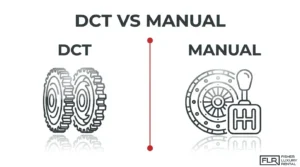

A dual-clutch transmission (DCT) is a multi-speed gearbox that uses two separate clutches, one for odd-numbered gears and one for even-numbered gears, allowing the next gear to pre-select while the current gear remains fully engaged. This architecture eliminates the torque interruption that affects both manual gearboxes and single-clutch automated systems, making it the dominant transmission choice across Ferrari, Lamborghini, McLaren, and Porsche.
This guide covers how DCTs work mechanically, the performance and efficiency advantages they deliver, the real ownership drawbacks enthusiasts face, how the technology compares across rival transmission types, and how street and track contexts affect which choice makes sense.
DCT mechanics and function explain why the technology produces measurably faster shifts: in a 991-generation Porsche PDK, the actual shift event completes in under 50 to 75 milliseconds, a margin no human clutch-and-shift sequence can match.
The performance benefits are substantial, but they come with trade-offs. Repair costs run high, a full PDK replacement can reach $28,700, and low-speed jerkiness remains a genuine daily-driving limitation inherent to the dual-clutch architecture.
Understanding which brands use DCTs, and how each manufacturer tunes the system differently, matters for anyone evaluating a purchase. Ferrari, Lamborghini, McLaren, and Porsche each apply proprietary calibration to optimize shift behavior for their specific performance targets.
Comparing DCTs against torque-converter automatics, traditional manuals, and single-clutch AMTs clarifies where the technology leads and where it still concedes ground. Context matters: a DCT performs differently in stop-and-go traffic than it does on a racetrack at full throttle.
What Is a Dual-Clutch Transmission and How Does It Work?
A dual-clutch transmission (DCT) is a type of multi-speed gearbox that uses two separate clutches: one for odd-numbered gears and one for even-numbered gears. The sections below cover what separates a DCT from a traditional automatic and how its two clutches operate in sync.
What Makes a DCT Different From a Traditional Automatic?
A DCT differs from a traditional automatic in how its gear changes are physically executed. In a conventional automatic, the driver’s shifter input drives gear selection. In a DCT, shift forks are moved by an actuation system and a hydraulic mechatronic unit, removing the driver from the mechanical loop entirely, according to Tremec.
The performance gap this creates is measurable. The Ferrari 488 GTB, equipped with a seven-speed dual-clutch automatic, reaches 60 mph in 2.9 seconds, while the Porsche 911 GT3 with a six-speed manual requires 3.4 seconds for the same sprint. That half-second difference is a direct consequence of how the DCT executes gear changes with no mechanical hesitation.
How Do the Two Clutches in a DCT Operate Together?
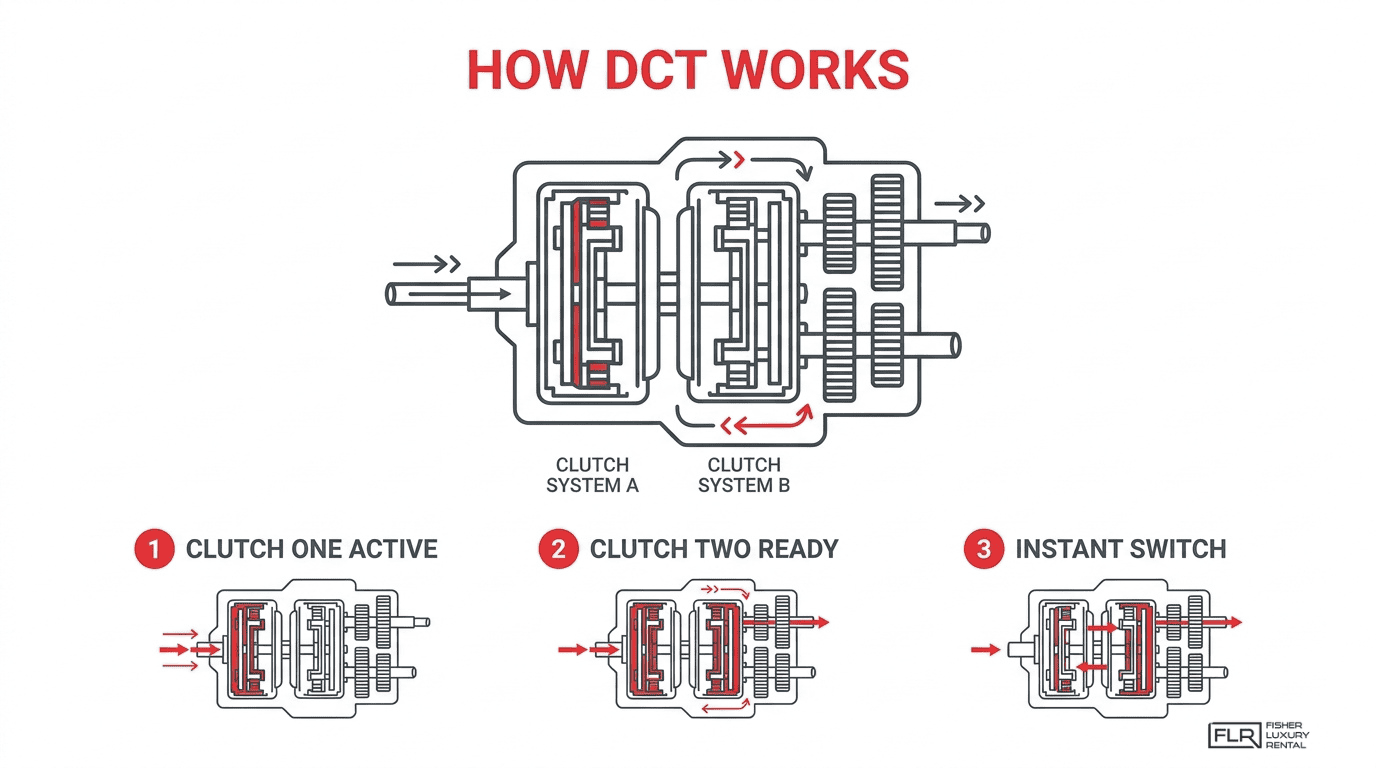
The two clutches in a DCT operate by pre-selecting the next gear while the current gear remains fully engaged. One clutch handles the active gear; the other holds the upcoming gear in standby. When a shift is triggered, the active clutch opens while the standby clutch closes simultaneously, transferring drive torque with virtually no interruption.
According to Porsche’s technical documentation on PDK, the new gear engages simply by closing the now-active clutch while opening the previously active one. A mechatronic unit, integrating both the electronic and hydraulic control functions into a single component, coordinates this precise overlap to eliminate the power gap that affects conventional automated systems.
What Are the Key Benefits of a DCT in a Sports Car?
The key benefits of a DCT in a sports car include faster shift times, stronger launch performance, improved fuel efficiency, smoother power delivery, and greater driver control. The following sections cover each advantage in detail.
How Does a DCT Deliver Faster Shift Times Than Other Transmissions?
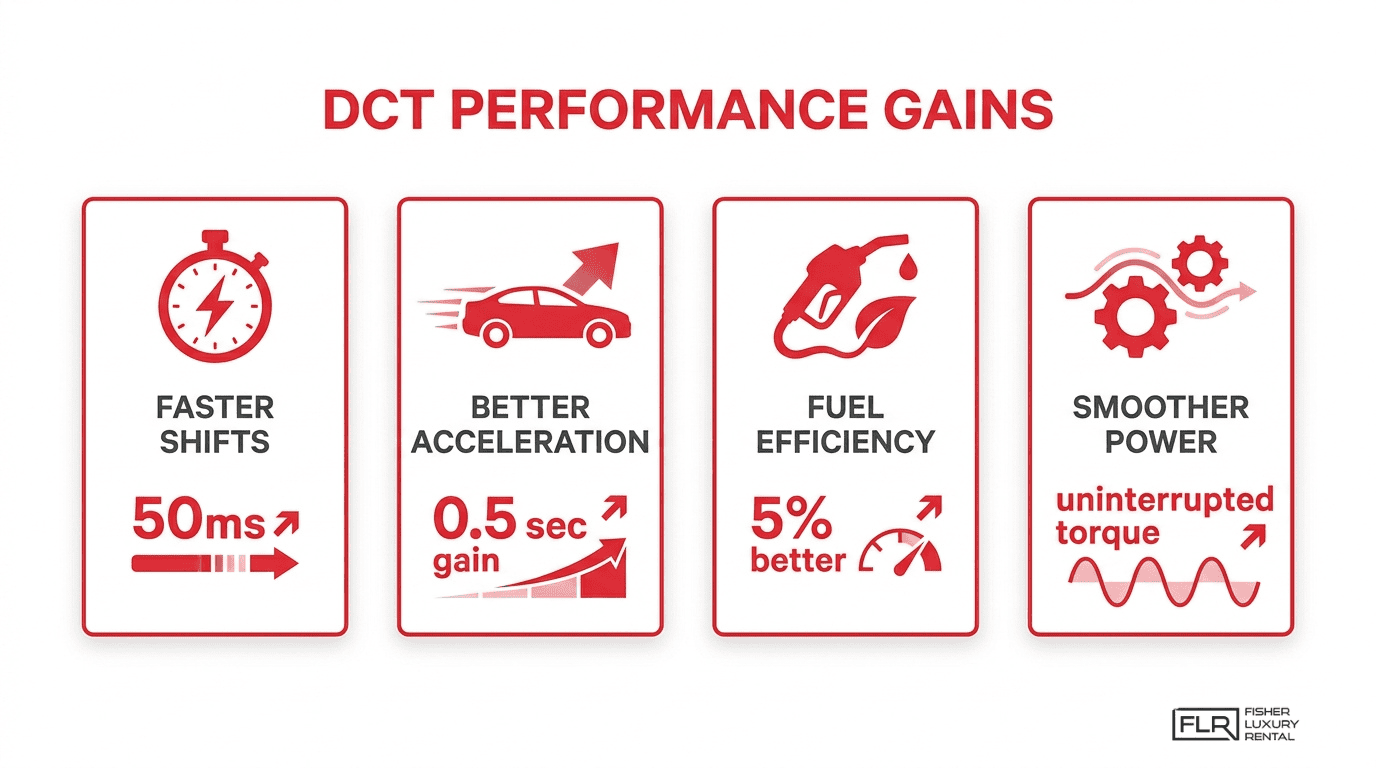
A DCT delivers faster shift times than other transmissions by pre-selecting the next gear on a second clutch while the current gear remains engaged, eliminating the pause that interrupts power flow. Automated manual transmissions (AMTs), by contrast, control a single clutch with a computer, which introduces measurable power interruption during each shift.
The performance gap is well documented across multiple platforms:
- The 991-generation Porsche PDK executes a shift in under 50 to 75 milliseconds after the command is made.
- The McLaren 720S 8-speed DCT shifts 30% faster than previous McLaren generations, with shift estimates as low as 8 milliseconds.
- The 992-generation Porsche 911 GT3 PDK reaches 60 mph in 3.2 seconds, 0.5 seconds quicker than the manual variant at 3.7 seconds.
- According to Motor Trend, the 2025 Hyundai Elantra N DCT reached 60 mph in 4.8 seconds versus 5.7 seconds for the six-speed manual.
Those fractions of a second accumulate rapidly on track, where every gear change under full throttle represents a direct performance cost.
Why Does a DCT Improve Acceleration and Launch Performance?
A DCT improves acceleration and launch performance because it maintains continuous torque to the drivetrain during upshifts, with no torque break between gear changes. Where a manual driver must disengage the clutch and an AMT must pause engagement, a DCT transfers drive seamlessly from one pre-loaded clutch to the next.
This architecture is especially effective at launch. The transmission control unit can hold the engine at an optimal rev range while modulating clutch engagement precisely, producing consistent and repeatable starts. That consistency is extremely difficult for a human driver to replicate on a manual, particularly across multiple attempts.
How Does a DCT Enhance Fuel Efficiency in High-Performance Engines?
A DCT enhances fuel efficiency in high-performance engines by optimizing shift points electronically and eliminating the fluid coupling losses associated with a torque-converter automatic. The EPA identifies the DCT as one of the two primary manual transmission architectures using automated shifting to improve fuel economy and meet greenhouse gas standards.
The regulatory pressure behind this technology is significant. The adoption of DCTs in high-performance applications is partly driven by the need to satisfy increasingly strict CAFE (Corporate Average Fuel Economy) standards without sacrificing competitive performance figures. By 2022, modern automatics including DCTs had become more than 5% more efficient than manual counterparts, a complete reversal from 1990 when automatics were 5% less efficient than manuals.
Why Do DCTs Provide Smoother Power Delivery Under Hard Driving?
DCTs provide smoother power delivery under hard driving because each upshift transfers torque instantaneously from one clutch to the other, with no gap in engine output to the wheels. In aggressive driving conditions, that uninterrupted torque flow means the car remains planted and predictable through corners and acceleration zones rather than lurching with each gear change.
This also benefits chassis balance. Without the brief unloading of the drivetrain that occurs in a manual upshift, the car’s suspension and tire contact patches experience far less disturbance mid-corner. For drivers pushing a sports car near its limits, that stability is a genuine safety and performance advantage that is easy to underestimate.
How Does a DCT Give Drivers More Control in Manual Mode?
A DCT gives drivers more control in manual mode by allowing paddle-shift or sequential gear selection without requiring clutch input, while the transmission software still prevents destructive downshifts that could over-rev the engine. The driver retains full authority over gear selection but is protected from mechanical errors.
Automotive journalist Aaron Robinson captured the breadth of this capability, writing that “The M3 M DCT simply does everything well except tow a hot-dog stand.” Modern DCTs effectively function as both a fully automatic transmission in city driving and a precision sequential gearbox on track, adapting to the driver’s intent without any compromise in either mode. That dual-mode versatility makes a well-tuned DCT one of the most complete transmission solutions available in a performance sports car today.
What Are the Drawbacks of a DCT in a Sports Car?
The drawbacks of a DCT in a sports car include low-speed jerkiness, high repair costs, clutch wear under track use, mechatronic complexity, and reduced driver engagement. The following sections examine each of these disadvantages in detail.
Why Can a DCT Feel Jerky at Low Speeds and in Traffic?
A DCT can feel jerky at low speeds because the transmission’s hydraulic system struggles to modulate clutch engagement smoothly during slow, stop-and-go conditions. Unlike a manual driver who feathers the clutch intuitively, the mechatronic unit must predict and execute engagement algorithmically. According to research published in Advanced Transmission Systems, low hydraulic pressure in a DCT causes slow gear engagement, slipping, or jerky shifts, which are among the most common complaints from owners of high-performance dual-clutch systems. This characteristic is particularly noticeable in city traffic, where the system was never optimized to perform.
How Expensive Are DCT Repairs and Maintenance Compared to Other Transmissions?
DCT repairs and maintenance are significantly more expensive than those for conventional transmissions. A full PDK transmission replacement at a dealership can cost approximately $28,700, including a complete new transmission and control module programming. Routine fluid services on exotic DCT-equipped vehicles carry similarly elevated costs. The integrated nature of the mechatronic unit means that even minor electronic faults can require replacing an expensive combined assembly rather than a single inexpensive component.
Why Do DCTs Have a Shorter Clutch Lifespan Under Track Use?
DCT clutch packs have a shorter effective lifespan under track use because repeated hard launches, aggressive downshifts, and sustained high-heat operation accelerate clutch wear far beyond normal street conditions. While a dual-clutch transmission clutch pack can last over 200,000 miles with proper maintenance and no abuse, track driving introduces sustained thermal loads that the system was not designed to handle continuously. Drivers who regularly attend track days should budget for significantly more frequent clutch inspections and replacements than street-only owners.
How Does DCT Complexity Affect Long-Term Reliability?
DCT complexity affects long-term reliability primarily through its mechatronic unit, the most common failure point in early DCT systems. This component integrates the electronic control unit and the hydraulic control unit into a single assembly, meaning heat-related damage to its sensors or solenoids can disable the entire transmission. Because the mechatronic unit manages simultaneous clutch engagement and disengagement, any electronic degradation directly impacts shift quality and drivability. Greater integration delivers impressive performance when functioning correctly, but it also means a single component failure carries outsized repair consequences.
Why Do Some Drivers Miss the Engagement of a True Manual?
Some drivers miss the engagement of a true manual because a DCT removes the physical, tactile feedback loop between driver and drivetrain. Automotive journalist Steve Siler noted in 2011 that a dual-clutch automated manual transmission brings “virility” to the BMW 135i, yet many enthusiasts argue that automated clutch actuation eliminates the skill-based satisfaction of heel-toe downshifts and clutch modulation. The DCT optimizes every shift for speed and efficiency, which is precisely what makes it feel clinical to drivers who regard gear selection as an expressive, participatory act rather than a mechanical task to be automated.
Which Sports Car Brands Use DCT Transmissions?
Several leading sports car manufacturers use DCT transmissions, including Ferrari, Lamborghini, McLaren, and Porsche. Each brand applies its own proprietary tuning to the dual-clutch architecture, optimizing shift behavior for its specific performance targets.

Which Ferraris Feature a Dual-Clutch Transmission?
Ferraris that feature a dual-clutch transmission include models like the Roma, which routes power to the rear wheels through an eight-speed DCT, achieving a 0–62 mph time of 3.4 seconds. Ferrari’s dual-clutch units are tuned for both track sharpness and road composure, making them among the most sophisticated applications of this technology in production sports cars. According to Clutch Masters, the first production model to feature a dual-clutch transmission was the 2003 Volkswagen Golf R32, though Ferrari has since evolved the architecture well beyond its origins.
Which Lamborghini Models Come Equipped With a DCT?
The Lamborghini Huracán is equipped with a DCT, specifically the Graziano DL800 seven-speed dual-clutch transmission engineered for high-performance applications. The Urus S, by contrast, uses an eight-speed conventional automatic paired with permanent all-wheel drive and active rear torque vectoring rather than a dual-clutch system. Fluid changes for the Huracán’s DCT cost between $800 and $1,500, making routine maintenance a meaningful ownership consideration.
Which McLaren Models Use a Dual-Clutch Gearbox?
McLaren models that use a dual-clutch gearbox include the 720S and the Artura. The Artura’s eight-speed DCT incorporates an electric motor for reverse gear, eliminating the traditional mechanical reverse and reducing overall weight. This engineering choice reflects McLaren’s approach to using the dual-clutch architecture not just for performance, but as a platform for hybrid powertrain integration.
Which Porsche Models Offer the PDK Dual-Clutch System?
Porsche models that offer the PDK dual-clutch system include the 911 series, where PDK was first introduced as an optional extra in 2008, and select Panamera variants, which became the first Porsche models to receive PDK as standard equipment in 2009. Low hydraulic pressure remains one of the most reported issues across PDK-equipped vehicles, causing slow engagement or jerky shifts, and the mechatronic unit remains the most common early failure point due to heat damage to its sensors and solenoids. A full PDK replacement at a dealership can reach approximately $28,700, underscoring why proper maintenance is critical for these systems.
How Does a DCT Compare to Other Transmission Types in Sports Cars?
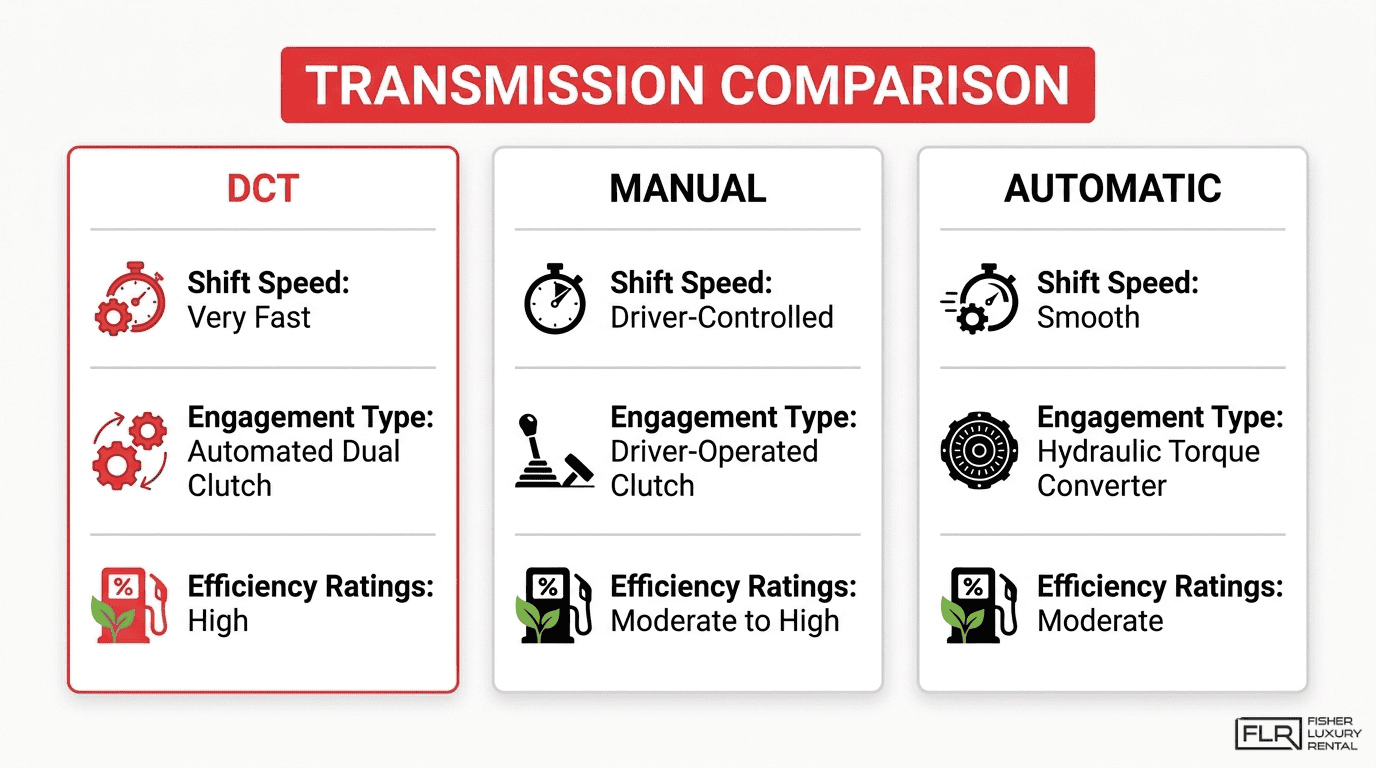
A DCT outperforms most rival transmission types in raw shift speed and power delivery continuity. The comparisons below cover torque-converter automatics, traditional manual gearboxes, and single-clutch automated manuals.
How Does a DCT Compare to a Torque-Converter Automatic?
A DCT compares to a torque-converter automatic by offering faster, more direct gear changes without the energy loss of a fluid coupling. Torque-converter automatics use hydraulic fluid to transmit power between the engine and transmission, which introduces inherent slip and a slight delay in throttle response. A DCT’s mechanical clutch packs eliminate that slip, delivering more immediate acceleration. By 2022, modern automatics including DCTs had become over 5% more efficient than manual counterparts, reversing a 1990 gap where automatics trailed manuals by the same margin. For sports car applications, the DCT’s combination of automatic convenience and near-manual directness makes it the stronger choice.
How Does a DCT Compare to a Traditional Manual Gearbox?
A DCT compares to a traditional manual gearbox by delivering measurably faster shifts with no power interruption between gears. In a manual, the driver must disengage the clutch, select the next gear, and re-engage, creating a brief torque gap. A DCT eliminates this gap entirely by pre-selecting the next gear while the current one is still engaged. The 992-generation Porsche 911 GT3 PDK reaches 60 mph in 3.2 seconds, 0.5 seconds faster than the 3.7-second manual variant, according to Renndriver. The trade-off is tactile engagement: many enthusiasts value the physical connection a three-pedal setup provides, and that sensory dimension is something no DCT fully replicates.
How Does a DCT Compare to a Single-Clutch Automated Manual?
A DCT compares to a single-clutch automated manual (AMT) by maintaining uninterrupted power flow during upshifts, where an AMT cannot. According to IEEE Xplore, AMTs are essentially conventional manual transmissions controlled by a computer, which results in slower shift times and a noticeable torque interruption with each gear change. That interruption produces the characteristic jerky acceleration associated with early paddle-shift systems found in older Ferrari and Lamborghini models. A DCT’s twin-clutch architecture solves this by keeping one clutch engaged while the other pre-selects the incoming gear. For modern sports car performance standards, the single-clutch AMT is effectively obsolete, and most manufacturers have replaced it with DCT systems entirely.
Is a DCT Better Suited for Street Driving or Track Driving?
A DCT suits both street driving and track driving, but it excels in different ways depending on the context. Street use benefits from its smooth automatic shifts and fuel efficiency, while track use benefits from its lightning-fast gear changes and uninterrupted power delivery.
How Does a DCT Perform in Everyday Street Driving Conditions?
A DCT performs well in everyday street driving by automating clutch operation and shifting smoothly without driver input. In stop-and-go traffic, however, the transmission’s wet or dry clutch packs can feel hesitant or jerky at very low speeds, a known limitation of the dual-clutch architecture. Modern DCTs increasingly compensate with refined torque management software, making city driving progressively more comfortable. For commuters who also weekend on a canyon road, the DCT’s ability to transition between relaxed automatic mode and aggressive paddle-shift control makes it genuinely versatile.
How Does a DCT Perform on a Racetrack or During Performance Driving?
A DCT performs at its highest level on a racetrack, where its pre-selected gear and near-instantaneous clutch swap eliminate the power interruption that plagues other transmission types. According to 6SpeedOnline, shift events in a 991-generation Porsche PDK can complete in under 50 to 75 milliseconds, a margin no human clutch-and-shift sequence can match. Keeping both hands on the steering wheel through high-speed corners while swapping gears via paddle shifters also reduces driver workload at critical moments. For pure lap-time performance, no other road-legal transmission architecture currently outperforms the DCT.
Which Driving Style Gets the Most From a DCT Transmission?
The driving style that gets the most from a DCT transmission is one that demands both performance and convenience across varied conditions. Drivers who push hard on track days but also drive the same car to the office extract maximum value, because the DCT delivers race-car shift speeds without requiring manual clutch skill. Enthusiasts who prioritize raw mechanical engagement over outright performance may still prefer a traditional manual, but for anyone measuring value in lap times, acceleration figures, and daily drivability combined, the DCT is difficult to surpass.
How Should You Experience a DCT Sports Car With an Exotic Car Rental?
Experiencing a DCT sports car firsthand means moving beyond spec sheets and into the driver’s seat. The two H3s below cover how Fisher Luxury Rental makes that possible and what key lessons to carry forward from this article.
Can Renting a Luxury Sports Car From Fisher Luxury Rental Help You Experience a DCT Firsthand?
Yes, renting a luxury sports car from Fisher Luxury Rental can help you experience a DCT firsthand. Fisher Luxury Rental offers a fleet that includes DCT-equipped exotics such as the Ferrari 488 Spider, McLaren 720S, and Porsche 911 Carrera S, all available in Phoenix, AZ and Portland, OR.
Reading about 8-millisecond shift times is one thing; feeling seamless, throttle-flat gear changes through the paddle shifters of a 720S or 488 Spider is entirely different. Fisher Luxury Rental stocks top-trim models exclusively, meaning you drive the vehicle as its engineers intended, not a stripped specification. For any car enthusiast weighing a DCT purchase, a single rental day delivers more decision-making clarity than hours of research.
What Are the Key Takeaways About DCT Transmission Pros and Cons for Sports Cars?
The key takeaways about DCT transmission pros and cons for sports cars are that the technology delivers measurable performance gains but carries real ownership trade-offs worth understanding before buying.
Core conclusions from this article:
- Shift speed advantage: DCTs execute gear changes in milliseconds, directly improving acceleration times over both manuals and traditional automatics.
- Fuel efficiency gain: By 2022, modern automatics including DCTs surpassed manuals in efficiency by over 5%, reversing a decades-old dynamic.
- Low-speed behavior: DCTs can feel jerky in stop-and-go traffic, a genuine daily-driving limitation.
- Repair costs: Major service events on exotic DCT systems are expensive, often running into thousands of dollars.
- Driver engagement: Consumer interest in the AT vs. DCT debate reflects that the choice is as much about driving feel as raw numbers.
For most performance enthusiasts, DCT advantages outweigh the drawbacks on road and track. Renting before buying remains the most practical way to decide.