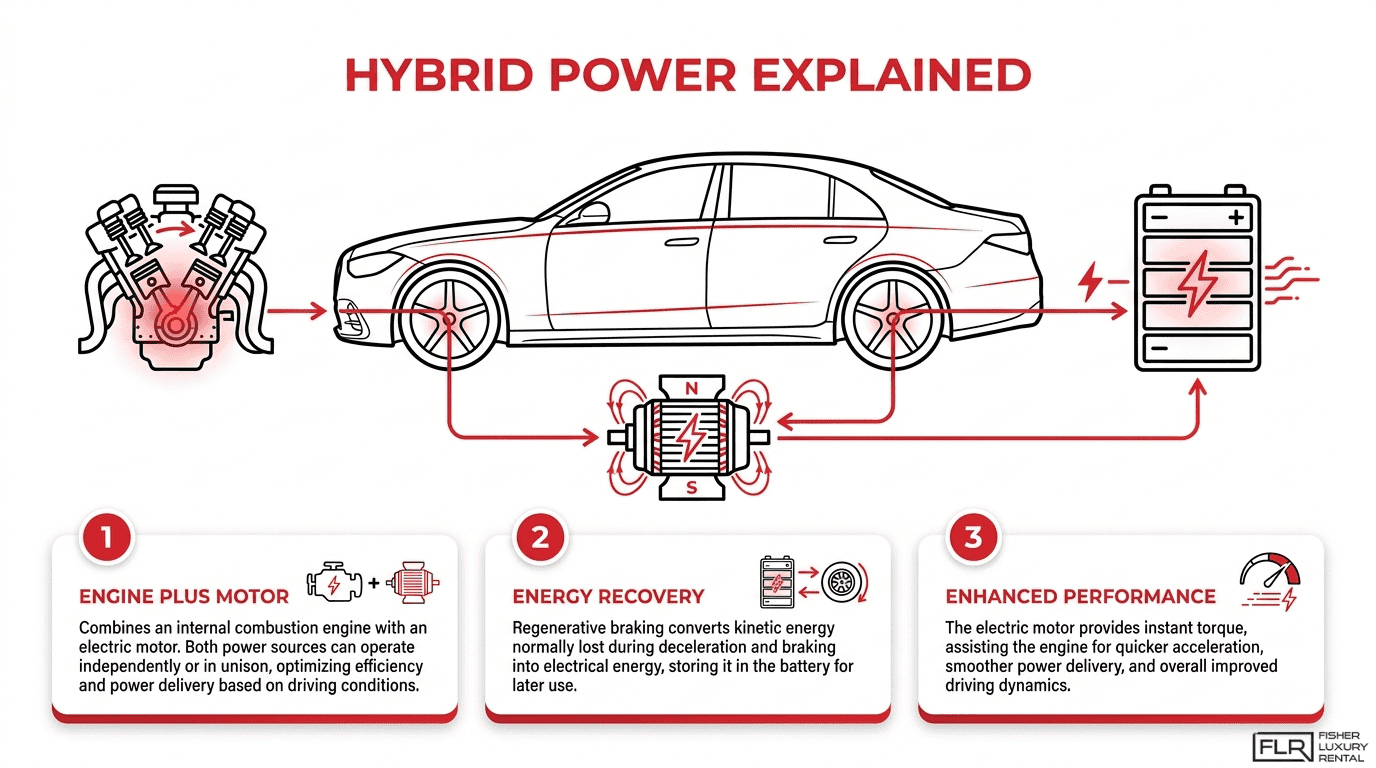
A hybrid powertrain combines an internal combustion engine (ICE) with one or more electric motors and a high-voltage traction battery to drive the wheels, using both power sources in coordination to improve efficiency, reduce emissions, and enhance performance beyond what either system delivers alone.
This guide covers how hybrid systems are built, how they operate, the main powertrain architectures, their benefits and drawbacks, which luxury and performance vehicles use them, and how the technology translates into real driving experience and ownership costs.
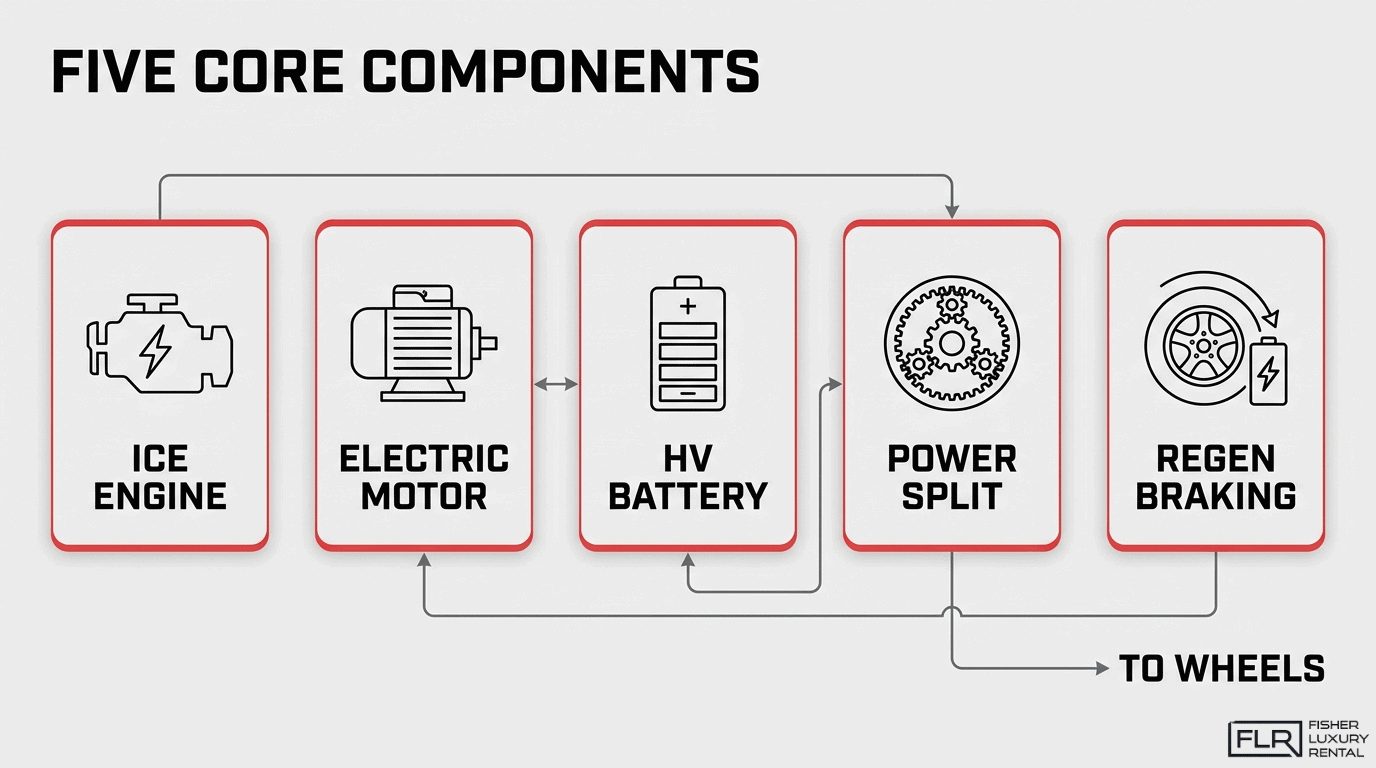
Hybrid powertrains are built from five core components: the ICE, electric motor, high-voltage traction battery, power-split device, and regenerative braking system. Each element has a defined role, and understanding how they interact explains why hybrids behave differently from conventional vehicles.
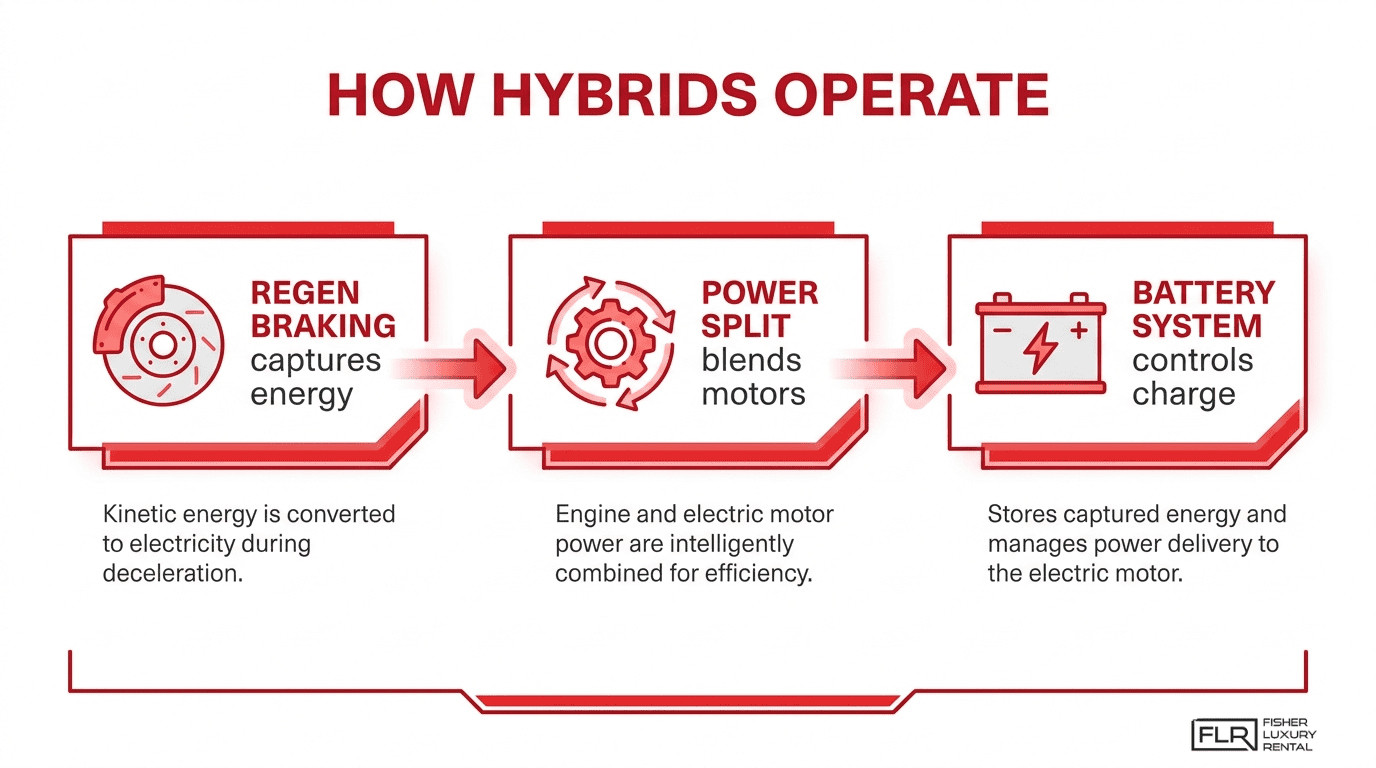
Three internal systems govern how a hybrid powertrain operates in real time: regenerative braking, which recovers kinetic energy during deceleration; a planetary gear power-split device, which continuously blends engine and motor output; and a battery management system that holds state of charge at a precise threshold to keep the system responsive under all driving conditions.
Five distinct hybrid architectures exist, each balancing electric and combustion power differently. Parallel, series, series-parallel, plug-in hybrid (PHEV), and mild hybrid (MHEV) configurations serve different priorities, from maximum fuel savings to supercar-level output in models like the Ferrari SF90 Stradale and McLaren Artura.
The benefits of hybrid powertrains, including fuel efficiency gains, lower emissions, and instant electric torque, come alongside real drawbacks: higher purchase prices, battery degradation over time, added weight, and dual-system maintenance complexity that requires specialist technicians.
What Components Make Up a Hybrid Powertrain?
A hybrid powertrain combines an internal combustion engine (ICE), one or more electric motors, and a high-voltage battery to drive the wheels. The sections below cover each core component and its role in the system.
Internal Combustion Engine
The internal combustion engine is the primary power source in most hybrid vehicles, burning gasoline or diesel to generate mechanical energy. According to Horse Powertrain, pairing the ICE with an electric motor allows engineers to downsize the engine without sacrificing performance, since the electric motor supplies supplemental torque during acceleration. This combination is what makes hybrid vehicles more efficient than conventional ICE-only designs.
Electric Motor
The electric motor serves two functions in a hybrid powertrain: it drives the wheels and captures energy during deceleration. Most hybrid systems use one or more permanent magnet AC motors positioned between the engine and the transmission. During braking, the motor reverses its role, acting as a generator to convert kinetic energy back into electrical energy stored in the high-voltage battery.
High-Voltage Traction Battery
The high-voltage traction battery stores the electrical energy the hybrid system needs to power the electric motor. These battery packs typically operate at hundreds of volts and are managed by a dedicated battery management system (BMS) that monitors charge, temperature, and cell health. A separate low-voltage 12V auxiliary battery starts the vehicle and powers accessories before the traction battery engages.
Power-Split Device and Transmission
The power-split device (PSD) blends power from the engine and electric motor and routes it to the drivetrain. The Toyota Prius uses a single planetary gear set as its PSD, coupling the ICE, a generator, and the electric motor to seamlessly blend both power sources. Transmission efficiency in planetary gear hybrid systems depends on input speed, torque, and speed ratio working together.
Regenerative Braking System
The regenerative braking system recovers kinetic energy that conventional brakes waste as heat. Rather than relying solely on friction pads, the electric motor absorbs braking force and feeds recovered energy back to the traction battery. This integration is also why hybrid brake pads experience significantly less wear compared to those in conventional vehicles.
How Does a Hybrid Powertrain Work?
A hybrid powertrain works by combining an internal combustion engine with one or more electric motors, coordinating power sources through three key systems: regenerative braking, a power-split device, and a battery management system.
How Does Regenerative Braking Capture Energy?
Regenerative braking captures energy by converting the kinetic energy lost during deceleration into electricity, which is stored in the high-voltage battery. Hybrid electric vehicles cannot be plugged in to recharge; instead, they rely on regenerative braking and the internal combustion engine to replenish battery charge. According to a 2024 Department of Energy report, regenerative braking returns approximately 22% of available energy to the battery under typical conditions. In premium models, recovery rates exceeding 70% are achievable under optimal conditions as of late 2025, according to S&P Global. That gap between 22% and 70% underscores how much room remains for efficiency gains, and premium hybrid platforms are closing it faster than most drivers realize.
How Does the Power-Split Device Manage Two Motors?
The power-split device manages two motors by using a single planetary gear set to continuously blend output from the internal combustion engine, a generator, and an electric motor. In the Toyota Prius, this planetary gear set couples all three components, allowing the system to route power to the wheels, charge the battery, or do both simultaneously depending on driving demand. Transmission efficiency in a planetary gear hybrid powertrain is expressed as a function of three parameters: input speed, torque, and speed ratio. This architecture eliminates the need for a traditional stepped transmission, which is a frequently overlooked advantage in how smoothly series-parallel hybrids deliver power.
How Does the Battery Management System Control Charge?
The battery management system (BMS) controls charge by continuously monitoring and adjusting the battery’s state of charge to keep it within an optimal operating window. The Toyota Prius BMS, for example, maintains a state of charge set point of 60%, ensuring the battery retains enough capacity to absorb regenerative braking energy while also delivering power back to the drivetrain on demand. Most competing articles omit this specific threshold, even though it directly explains why hybrid batteries remain responsive across varied driving conditions. Maintaining this balance is what allows the hybrid system to function efficiently without ever depleting or overcharging the pack.
With regenerative braking, planetary gear coordination, and active charge management working together, the hybrid powertrain operates as a tightly integrated system rather than two separate powerplants.
What Are the Types of Hybrid Powertrains?
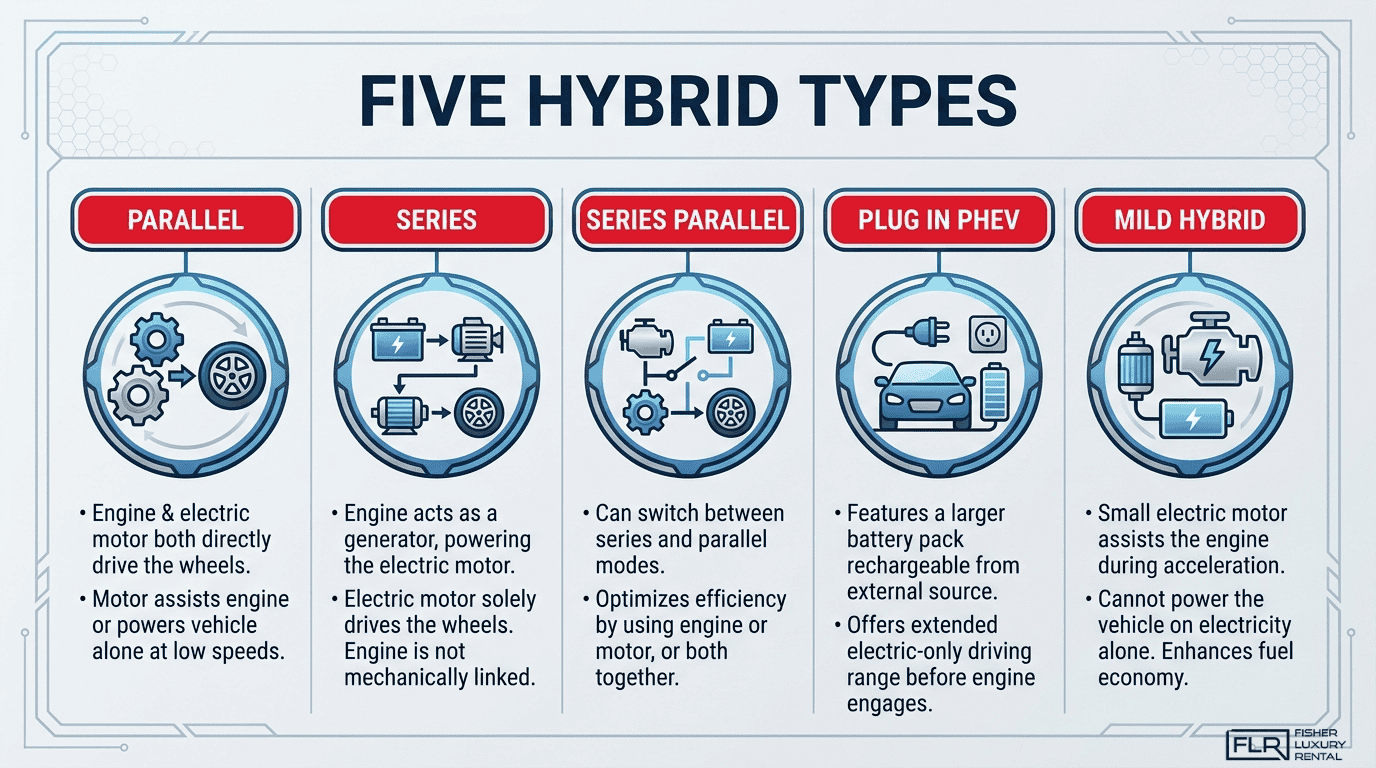
The types of hybrid powertrains are parallel, series, series-parallel, plug-in hybrid (PHEV), and mild hybrid (MHEV). Each architecture balances electric and combustion power differently, affecting efficiency, performance, and charging capability.
Parallel Hybrid
A parallel hybrid powers the wheels using both the internal combustion engine and the electric motor simultaneously or independently. Both power sources connect directly to the drivetrain, allowing the system to select whichever combination suits current driving conditions. Most conventional non-plug-in hybrids, including many Toyota and Honda models, use this layout. Because the ICE remains central to propulsion, parallel hybrids are typically simpler and lighter than series configurations.
Series Hybrid
A series hybrid uses the internal combustion engine exclusively to generate electricity, with the electric motor providing all wheel propulsion. The ICE never drives the wheels directly, functioning instead as an on-board generator. This arrangement allows the engine to run at its most efficient operating point regardless of vehicle speed, which can improve fuel economy in stop-and-go urban traffic. The trade-off is greater complexity in managing power flow between the generator, battery, and drive motor.
Series-Parallel Hybrid (Power-Split Hybrid)
A series-parallel hybrid combines both architectures, enabling the ICE and electric motor to drive the wheels together or independently depending on load conditions. The Toyota Prius is the benchmark example, using a planetary gear set called the Power Split Device to couple the engine, generator, and drive motor seamlessly. This flexibility makes the series-parallel layout one of the most fuel-efficient configurations available in mainstream hybrid vehicles.
Plug-In Hybrid (PHEV)
A plug-in hybrid (PHEV) is a hybrid powertrain with a larger battery that can be recharged from an external power source, extending zero-emission electric-only driving range. The Range Rover PHEV delivers up to 116 km (72 miles) of electric-only range, covering approximately 75% of clients’ average daily journeys. At the performance extreme, the Ferrari SF90 Stradale represents the PHEV format applied to supercar engineering: its V8 turbo system produces 1,000 cv with a weight-to-power ratio of just 1.57 kg/cv, making it Ferrari’s first series-production plug-in hybrid.
Mild Hybrid (MHEV)
A mild hybrid (MHEV) uses a small electric motor to assist the combustion engine but cannot propel the vehicle on electricity alone. The 48-volt belt-integrated starter-generator (BISG) is the most common MHEV architecture, and the U.S. Environmental Protection Agency has recognized 48V BISG technology in its assessment of CO2-reducing technologies for regulatory compliance. SEG Automotive describes the 48V mild hybrid system as a low-cost, flexible, and easy-to-integrate option with reduced safety constraints that fits all existing powertrain architectures. For luxury vehicles where a full hybrid system adds unwanted weight or cost, the MHEV approach delivers meaningful efficiency gains with minimal engineering disruption.
How Does a Parallel Hybrid Powertrain Differ From a Series Hybrid?
A parallel hybrid powertrain differs from a series hybrid in how power reaches the wheels. The sections below compare their mechanical layouts, performance trade-offs, and efficiency profiles.
How Does a Parallel Hybrid Send Power to the Wheels?
A parallel hybrid powertrain sends power to the wheels through both the internal combustion engine and the electric motor simultaneously, or independently. Both power sources connect directly to the drivetrain, allowing the ICE to take the lead at highway speeds while the electric motor fills in during acceleration or low-speed driving. This dual-path arrangement keeps the engine running at higher efficiency ranges more consistently than a series layout permits.
How Does a Series Hybrid Send Power to the Wheels?
A series hybrid powertrain sends power to the wheels exclusively through the electric motor. The internal combustion engine acts only as a generator, producing electricity to charge the high-voltage battery rather than directly driving the wheels. This architecture supports a smaller, consistently loaded ICE, which can reduce emissions in stop-and-go conditions. A hybrid powertrain combining ICE with an electric motor and battery can allow for a smaller engine overall, as the electric motor provides supplemental power.
Which Architecture Performs Better in Real-World Driving?
The better-performing architecture depends on the driving scenario. Parallel hybrids excel on highways, where direct mechanical coupling between the ICE and wheels avoids energy conversion losses. Series hybrids deliver advantages in urban stop-and-go traffic, where the generator-fed electric motor operates most efficiently. According to Automotive Manufacturing Solutions, the market share of new vehicles with hybrid or electric powertrains is projected to rise from around 8% in 2020 to 55% by 2030, making both architectures increasingly relevant. For high-performance applications, the McLaren Artura demonstrates how parallel-style hybrid integration can yield 700PS from a twin-turbocharged V6 with an electric motor contributing up to 95PS and 225 Nm of torque. In practice, the parallel layout offers more flexibility for performance-oriented drivers, while series layouts suit city-centric, efficiency-focused use cases.
What Is a Plug-In Hybrid and How Does It Compare to a Standard Hybrid?
A plug-in hybrid (PHEV) is a hybrid vehicle with a larger battery pack that can be recharged from an external power source, allowing extended electric-only driving that a standard hybrid cannot offer. The sections below cover real-world emissions, maintenance savings, long-range luxury PHEV examples, and regulatory battery standards.
How Does a Plug-In Hybrid Differ From a Standard Hybrid?
A plug-in hybrid differs from a standard hybrid primarily in its ability to accept external charging, giving it a significantly larger usable battery and a meaningful electric-only driving range. A standard hybrid recharges only through regenerative braking and the internal combustion engine, so its electric motor assists rather than replaces fuel use. PHEVs can run on electricity alone for daily commutes, then fall back on gasoline for longer trips, making them considerably more flexible for mixed-use driving.
What Are the Real-World Emissions of a Plug-In Hybrid?
Real-world CO2 emissions for plug-in hybrid vehicles in Europe average 137.7 g/km, according to a study published in MDPI Energies, which is substantially higher than their official WLTP test cycle ratings. That gap exists because real-world drivers frequently run on gasoline once the electric charge depletes. Compared to conventional internal combustion engine vehicles, however, PHEVs still deliver meaningful brake wear particle emission reductions of 96–98%, versus 61–82% for standard hybrids, reflecting the greater share of electric operation.
What Are the Maintenance Cost Advantages of a Plug-In Hybrid?
The maintenance cost advantage of a plug-in hybrid is significant: Consumer Reports surveys show PHEVs and BEVs together incur about 80% fewer maintenance and repair costs than gas-only vehicles. Fewer cold starts, reduced brake wear from regenerative braking, and simpler thermal management on electric-mode miles all contribute. In practice, this advantage is most pronounced for drivers who charge regularly and complete most daily trips on electricity alone.
What Luxury PHEVs Demonstrate the Technology?
Luxury PHEVs demonstrate the technology across performance and comfort segments, with models such as the 2024 BMW X5 xDrive50e leading the segment. The X5 xDrive50e combines a new inline-6 engine with 48V mild-hybrid technology and delivers increased electric range over its predecessor. Euro 7 standards, agreed in 2024, further raise the bar by requiring BEV and PHEV passenger cars to retain 80% of their energy storage capability after 5 years or 100,000 km, protecting long-term ownership value.
What Are the Main Barriers to Plug-In Hybrid Adoption?
The main barriers to plug-in hybrid adoption are high purchase prices and a lack of public charging infrastructure, identified by the World Economic Forum as the primary obstacles limiting consumer uptake. Without reliable access to charging, PHEV owners default to gasoline operation, erasing the efficiency and emissions advantages the technology promises. Closing the charging infrastructure gap is, in this respect, just as critical as closing the price gap for widespread PHEV adoption to follow through on its environmental potential.
What Are the Benefits of a Hybrid Powertrain?
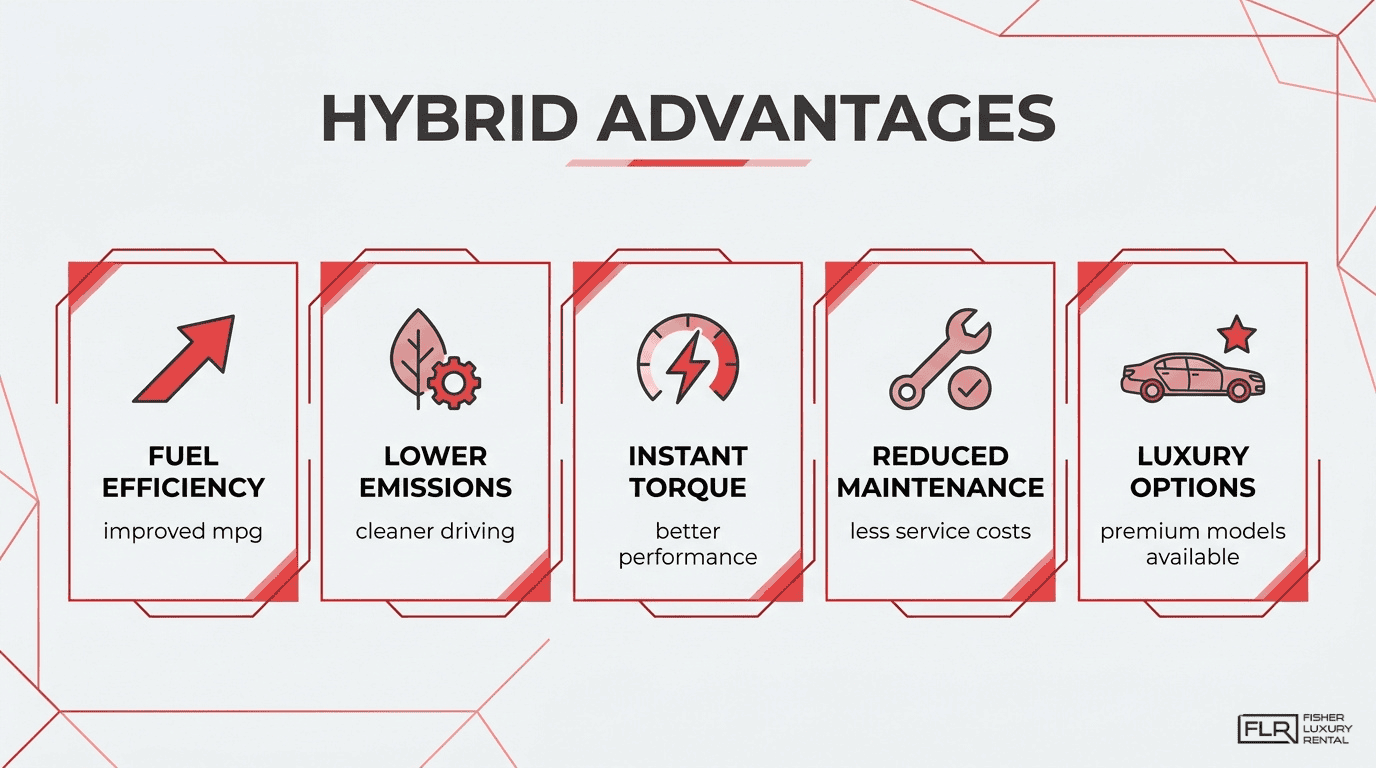
The benefits of a hybrid powertrain include improved fuel efficiency, reduced emissions, and enhanced driving performance. The sections below examine how each advantage works in practice.
How Does a Hybrid Powertrain Improve Fuel Efficiency?
A hybrid powertrain improves fuel efficiency by optimizing how power is generated, transmitted, and recovered across driving conditions. Transmission efficiency in a planetary gear hybrid powertrain depends on three parameters: input speed, torque, and speed ratio, according to research published in Springer’s SN Applied Sciences. Because the system continuously balances these variables, the engine operates closer to its most efficient range rather than working hardest during low-speed or stop-and-go conditions. The electric motor handles lighter loads, reducing fuel demand during city driving where conventional engines are least efficient. This coordination between combustion and electric power is what makes real-world fuel savings possible, not just headline figures on a test cycle.
How Does a Hybrid Powertrain Reduce Emissions?
A hybrid powertrain reduces emissions by supplementing or replacing combustion power with electric drive, cutting both exhaust output and particulate pollution. The 48-volt mild hybrid system, according to SEG Automotive, is a low-cost, easy-to-integrate option compatible with all existing powertrain architectures, making emissions reduction accessible without a full electrification overhaul. By reducing how often and how hard the internal combustion engine fires, tailpipe CO2 and nitrogen oxide output drop meaningfully in urban cycles. Brake wear particle emissions also fall because regenerative braking replaces friction braking across much of normal driving.
How Does a Hybrid Powertrain Enhance Driving Performance?
A hybrid powertrain enhances driving performance by delivering instant electric torque alongside combustion power, producing stronger acceleration from low speeds. The electric motor fills torque gaps that typically occur as a gasoline engine spools up, eliminating the lag common in conventionally powered vehicles. In performance-oriented hybrids, the two power sources work simultaneously during hard acceleration, resulting in combined output figures that neither source could achieve alone. For luxury vehicles especially, this translates into effortless power delivery and a noticeably smoother throttle response across all driving scenarios.
What Are the Drawbacks of a Hybrid Powertrain?
The drawbacks of a hybrid powertrain include higher purchase costs, complex dual-system maintenance, added vehicle weight from battery packs, and battery degradation over time. Understanding these limitations helps buyers make informed decisions across cost, performance, and long-term ownership considerations.
Higher Upfront Purchase Price
The primary cost drawback of a hybrid powertrain is a higher purchase price compared to equivalent conventional vehicles. The added expense reflects the cost of the electric motor, high-voltage battery pack, and power management electronics. According to the World Economic Forum, high purchase prices remain one of the primary barriers to hybrid and plug-in hybrid adoption. For budget-conscious buyers, this premium can outweigh near-term fuel savings, making the financial case harder to justify without longer ownership periods.
Battery Degradation and Replacement Costs
Lithium-ion batteries used in hybrid vehicles face performance degradation over time, reducing electric driving range and efficiency as the pack ages. According to U.S. News and World Report, most manufacturers address this risk by providing battery warranties covering up to 8 years or 100,000 miles. Once outside warranty, replacement costs can be substantial. Buyers should treat battery lifespan as a significant long-term ownership variable, particularly when purchasing used hybrids where remaining warranty coverage may be limited or already expired.
Added Weight and Packaging Complexity
A hybrid powertrain adds significant weight to a vehicle through its battery pack, electric motor, and associated power electronics. This additional mass can partially offset the efficiency gains the hybrid system is designed to deliver, particularly in performance-oriented applications where power-to-weight ratio matters. The engineering required to package both an internal combustion engine and an electric drivetrain within a standard vehicle platform also increases mechanical complexity, leaving fewer trade-off options for suspension tuning, cargo space, and structural design.
Dual-System Maintenance Complexity
Hybrid powertrains require maintenance across two distinct systems: the internal combustion engine and the electric drivetrain components. Technicians need specialized training and diagnostic tools to service high-voltage battery systems, inverters, and electric motors safely, which limits the pool of qualified repair facilities. While routine brake and fluid service intervals are often extended due to regenerative braking reducing mechanical wear, any failure in the high-voltage system requires specialist attention that most independent shops cannot provide.
Which Luxury and Performance Cars Use Hybrid Powertrains?
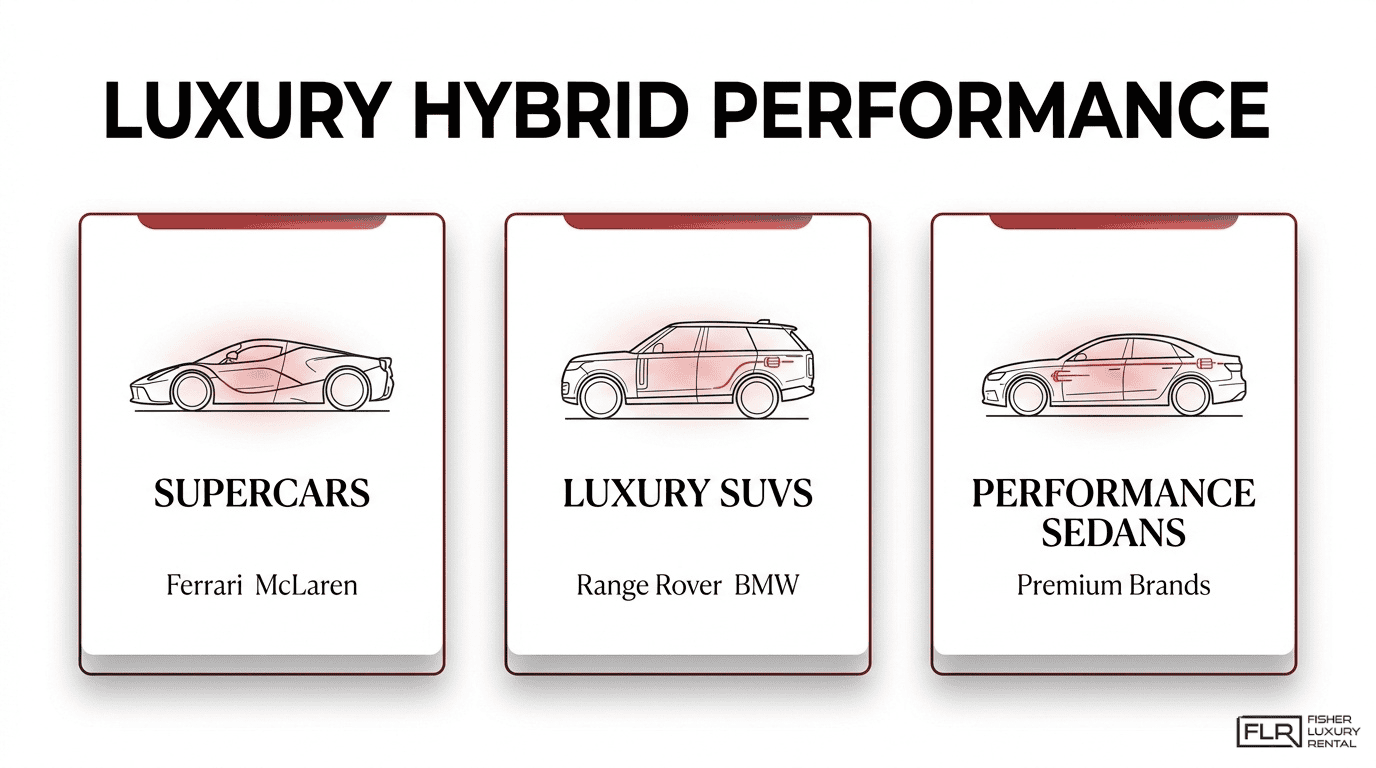
Luxury and performance cars that use hybrid powertrains span three categories: supercars, luxury SUVs, and high-performance sedans. The sections below cover standout models in each segment.
Which Hybrid Supercars Lead in Performance?
The hybrid supercars that lead in performance include the Ferrari SF90 Stradale, the McLaren Artura, and the Porsche 918 Spyder. According to Ferrari, the SF90 Stradale is the brand’s first series-production PHEV, pairing a V8 turbo engine with electric motors for 1,000cv of maximum power and a weight-to-power ratio of 1.57 kg/cv. The McLaren Artura produces 700PS through a twin-turbocharged V6, with its E-motor contributing up to 95PS and 225 Nm of torque. The Porsche 918 Spyder pairs a 4.6-liter V8 with two electric motors, delivering a combined 887 horsepower and 944 lb-ft of torque. These models prove that hybrid integration no longer compromises supercar credentials; it elevates them.
Which Luxury SUVs Offer Hybrid Powertrains?
The luxury SUVs that offer hybrid powertrains include the Range Rover PHEV and the BMW X5 xDrive50e. Land Rover reports that the Range Rover PHEV delivers an electric-only range of up to 116 km (72 miles), covering approximately 75% of clients’ average daily journeys. The 2024 BMW X5 xDrive50e pairs a new inline-6 engine with 48V mild-hybrid technology, expanding electric range over its predecessor. For drivers prioritizing daily usability alongside premium refinement, these SUVs represent the most practical hybrid choice in the luxury segment.
Which High-Performance Sedans Feature Hybrid Systems?
High-performance sedans that feature hybrid systems include models from BMW, Porsche, and Mercedes-Benz, which integrate mild-hybrid and plug-in hybrid architectures to combine executive comfort with reduced emissions. Mild-hybrid 48V systems are particularly common across this segment, providing torque-fill at low speeds and improved fuel economy without requiring external charging. The result is a driving character that feels seamless, with electric assistance sharpening throttle response rather than softening the experience.
How Does a Hybrid Powertrain Affect the Driving Experience?
A hybrid powertrain affects the driving experience through smoother acceleration, quieter cabin operation, and more responsive low-speed power delivery. The sections below cover how instant electric torque changes performance feel, how the transition between power sources works, and what drivers notice most.
How Does Instant Electric Torque Change Acceleration Feel?
Instant electric torque changes acceleration feel by delivering maximum torque from a standstill, without waiting for engine RPMs to build. Unlike a conventional gasoline engine, the electric motor responds the moment the driver presses the accelerator, producing a surge of smooth, linear power. This characteristic is especially noticeable in performance hybrids: the Porsche 918 Spyder combines a 4.6-liter V8 with two electric motors to produce 887 horsepower and 944 lb-ft of torque, a figure that conventional powertrains of equivalent displacement struggle to match off the line. In everyday driving, this translates to effortless merging, confident overtaking, and a feeling of immediacy that traditional engines simply cannot replicate at low speeds.
How Smooth Is the Transition Between Electric and Gasoline Power?
The transition between electric and gasoline power in a hybrid powertrain is generally seamless, though it depends on the powertrain architecture. Series-parallel systems, like those used in the Toyota Prius, use a Power Split Device to blend both sources continuously, so most drivers never feel a distinct handoff. Parallel hybrids may produce a subtle change in engine note as the combustion engine engages, but modern calibration minimizes any jolt or hesitation. At low speeds and in stop-and-go traffic, many hybrids operate in electric-only mode, keeping the cabin noticeably quieter. The overall effect is a more refined, composed ride than a conventional gasoline-only vehicle delivers.
What Do Drivers Notice Most About Hybrid Regenerative Braking?
What drivers notice most about hybrid regenerative braking is a firmer, more resistive brake pedal feel compared to conventional friction brakes. As the electric motor switches to generator mode under deceleration, it creates drag that slows the vehicle while recovering energy. According to a 2024 Department of Energy report, regenerative braking returns approximately 22% of available energy back to the battery in standard hybrid vehicles. Brake fade is also less common, since friction brakes are engaged less frequently. Hybrid electric vehicles show brake wear particle emission reductions of 61 to 82% compared to conventional internal combustion engine vehicles, meaning brake pads last significantly longer. Most drivers adapt quickly, finding the braking feel natural within a short time behind the wheel.
How Do You Maintain a Hybrid Powertrain Compared to a Conventional Engine?
Hybrid powertrain maintenance differs from conventional engine care in several key ways, primarily because regenerative braking reduces wear on mechanical components. The sections below cover brake servicing, battery care, and routine upkeep.
How Does Regenerative Braking Reduce Brake Wear?
Regenerative braking reduces brake wear by converting kinetic energy into electricity rather than dissipating it as heat through friction pads. This means the mechanical brakes engage far less frequently than on a conventional vehicle. According to USA Today, hybrid vehicles cost 35–45% less annually on maintenance and repairs than conventional gasoline cars, with brake pads lasting two to three times longer as a direct result. For owners, this translates into significantly extended brake service intervals and lower cumulative repair costs over the vehicle’s life. Regenerative braking is one of the most underappreciated financial advantages of hybrid ownership.
How Do You Maintain a Hybrid Battery?
Hybrid battery maintenance centers on monitoring the high-voltage traction battery and the supporting 12V auxiliary battery. Lithium-ion batteries used in hybrid vehicles can experience performance degradation over time, which is why most manufacturers provide warranties covering the battery for up to 8 years or 100,000 miles, per U.S. News and World Report. Routine maintenance includes periodic battery health checks, keeping the battery within its thermal operating range, and avoiding deep discharge cycles. The 12V auxiliary battery also requires standard inspection and replacement on a conventional schedule, separate from the traction battery.
What Routine Services Does a Hybrid Powertrain Still Require?
The routine services a hybrid powertrain still requires include engine oil changes, coolant flushes, air filter replacements, and tire rotations. The internal combustion engine component of a hybrid follows a largely conventional service schedule, though oil change intervals may extend slightly because the engine runs less frequently. Transmission fluid and spark plug intervals also apply where relevant. Despite the reduced brake and fuel system demands, hybrid owners should not assume the vehicle is maintenance-free. Staying current on ICE-related services preserves the powertrain’s long-term reliability and protects the efficiency gains the hybrid system delivers.
How Can You Experience Hybrid Luxury Vehicles With a Premium Rental?
You can experience hybrid luxury vehicles with a premium rental by choosing a provider that stocks electrified powertrains alongside exotic and high-performance models. The sections below cover Fisher Luxury Rental’s fleet and the key takeaways from hybrid powertrain technology.
Can Fisher Luxury Rental Help You Drive Exotic Cars With Advanced Powertrains?
Yes, Fisher Luxury Rental can help you drive exotic cars with advanced powertrains, including performance vehicles from Ferrari, McLaren, and Porsche, available across Phoenix and Portland locations. The fleet spans dual-power systems and high-output engines in top-trim configurations, giving drivers firsthand exposure to the electrified drivetrain technology discussed throughout this article.
Battery electric and hybrid vehicles are rapidly reshaping the automotive market. According to the International Energy Agency, battery electric cars accounted for 70% of the total electric car stock in 2023, with global sales reaching nearly 14 million units. Choosing a rental over ownership also sidesteps the long-term cost concerns around battery degradation, which manufacturers typically warrant for up to 8 years or 100,000 miles.
For car enthusiasts who want the experience without the commitment, Fisher Luxury Rental offers the most practical entry point available.
What Are the Key Takeaways About Hybrid Powertrains and How They Work?
The key takeaways about hybrid powertrains and how they work center on three core principles: combined power sources, energy recovery, and reduced running costs. According to the U.S. Department of Energy’s Alternative Fuels Data Center, hybrid electric vehicles use an internal combustion engine and one or more electric motors, recharging through regenerative braking rather than an external plug.
The most practical conclusions from this article are:
- Hybrid powertrains pair an ICE with an electric motor and high-voltage battery, enabling a smaller engine without sacrificing output.
- Regenerative braking recovers kinetic energy that conventional vehicles waste entirely.
- Maintenance costs run 35-45% lower annually than gasoline-only vehicles, with brake pads lasting two to three times longer.
- Battery warranties up to 8 years or 100,000 miles protect long-term ownership value.
- Luxury models from Ferrari, McLaren, and Porsche demonstrate that electrified powertrains enhance rather than compromise performance.
Understanding these fundamentals makes it far easier to evaluate any hybrid model, whether you plan to rent, buy, or simply appreciate what the technology delivers behind the wheel.