A car’s top speed is the maximum velocity it can sustain when engine thrust exactly equals the combined resistance of aerodynamic drag, drivetrain losses, and rolling friction. Every variable in a vehicle’s design, from the combustion chamber to the contact patch, either raises or lowers that ceiling.
This guide covers engine power and forced induction, aerodynamics and drag mechanics, drivetrain architecture, vehicle weight and materials, tire capability, environmental conditions, electronic limiting, road surface, supercar comparisons, and how to experience this performance firsthand.
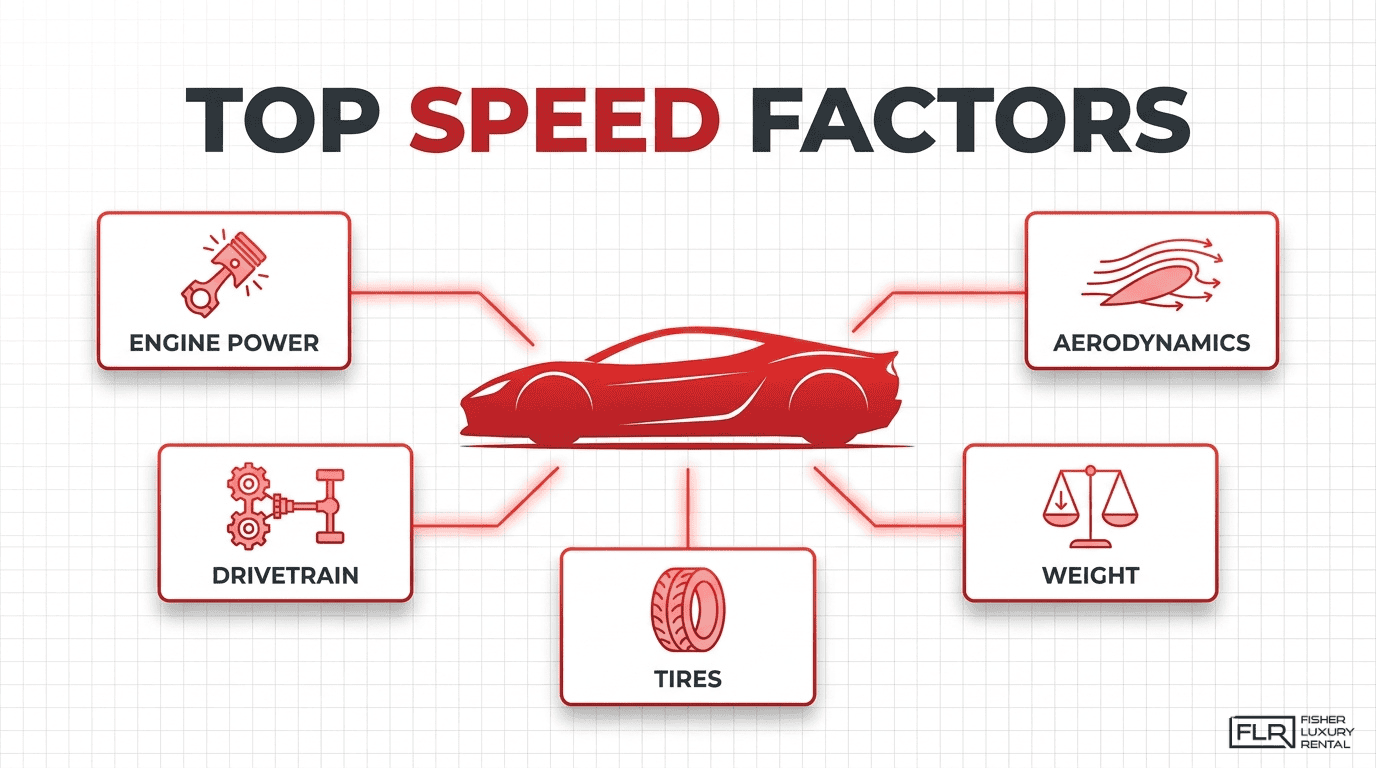
Engine power sets the foundation, with horsepower, displacement, turbocharging, and supercharging each determining how much thrust reaches the drivetrain across the speed range.
Aerodynamics governs how efficiently that thrust overcomes air resistance, where drag coefficient, body shape, spoilers, and frontal area interact to define the terminal velocity ceiling.
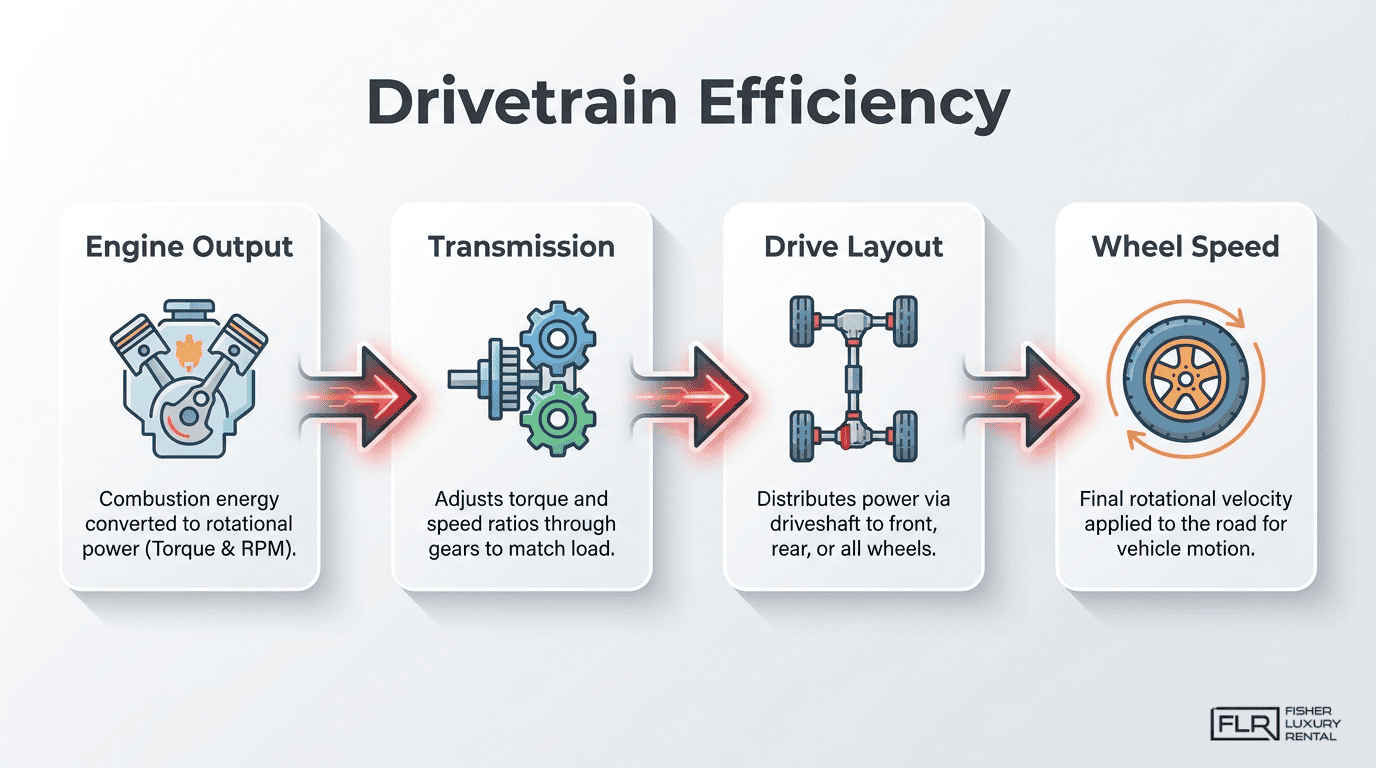
The drivetrain translates engine output into wheel speed through gear ratios, transmission type, drive layout, and final drive ratio, each introducing efficiency gains or losses that shift the top-speed result.
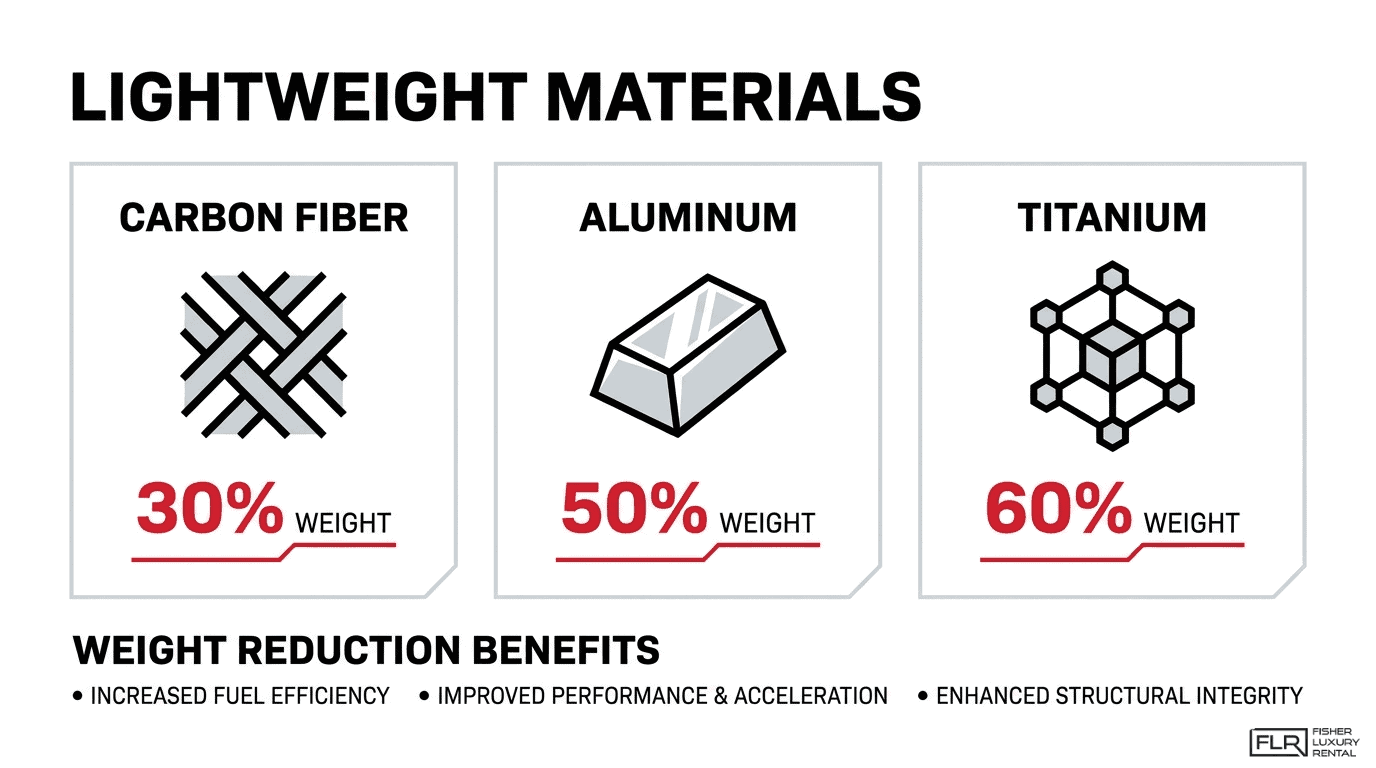
Vehicle weight and materials set the power-to-weight ratio, where carbon fiber, aluminum, and titanium reduce the mass the engine must accelerate without sacrificing structural integrity.
Tires impose hard limits through speed ratings, rolling resistance, and contact-patch geometry, while altitude, temperature, and headwinds alter air density and engine efficiency in ways that measurably change peak performance.
Real-world Lamborghini, Ferrari, and McLaren figures then show how these variables combine in practice, and Fisher Luxury Rental provides the opportunity to feel that engineering directly behind the wheel.
How Does Engine Power Influence a Car’s Top Speed?
Engine power influences a car’s top speed by determining how much force the drivetrain can sustain against aerodynamic drag at high velocity. The following sections cover how horsepower, displacement, forced induction, and engine type each shape a vehicle’s maximum speed potential.
How Do Horsepower and Torque Determine Top Speed?
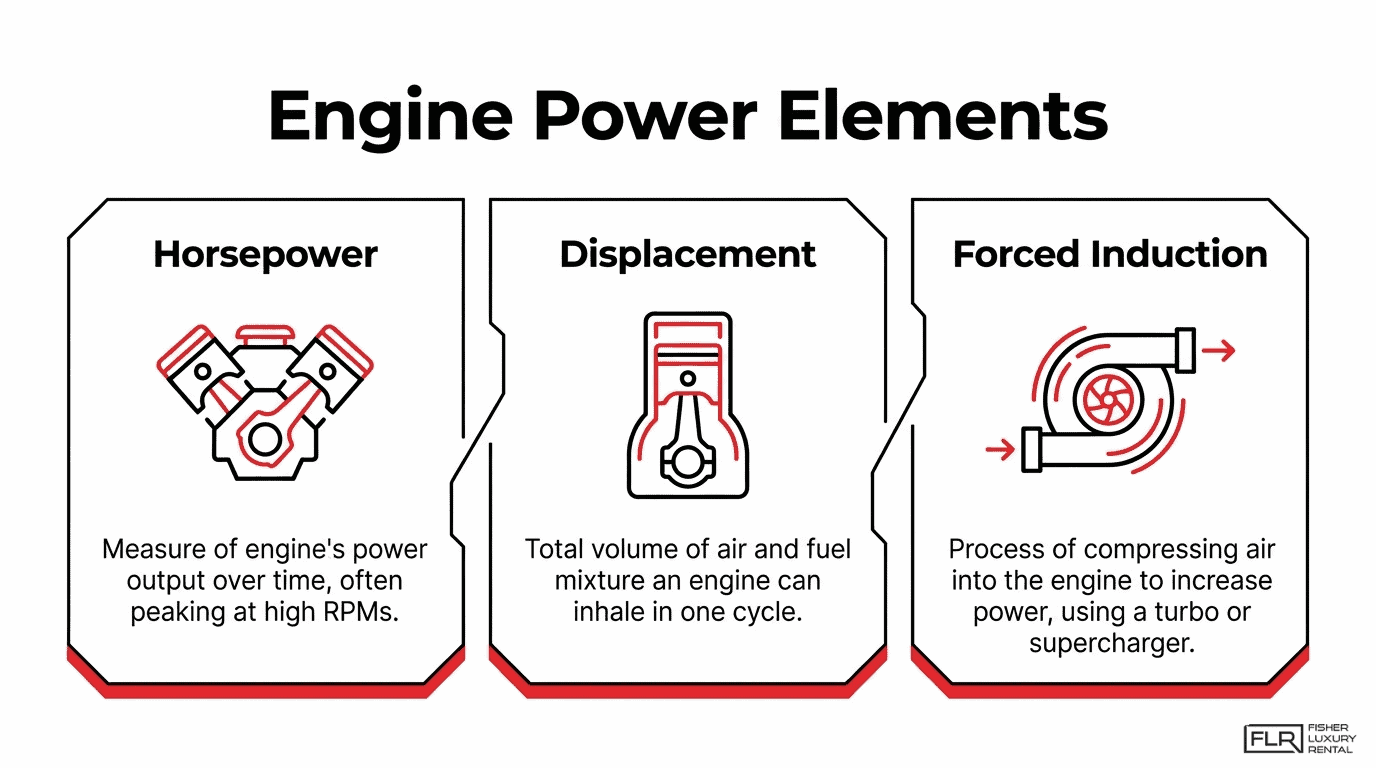
Horsepower and torque determine top speed by defining the engine’s capacity to overcome drag as velocity increases. Horsepower governs sustained high-speed performance, while torque provides the rotational force needed to accelerate through the rev range. At top speed, drag grows exponentially with velocity, so the engine must produce enough horsepower to maintain equilibrium against that resistance. Torque matters most during acceleration; horsepower becomes the dominant factor at the speed ceiling. A real-world example is the Lamborghini Revuelto, whose 1,015 CV powertrain combines a V12 engine with three electric motors and a dual-clutch e-gearbox, illustrating how stacking power sources raises the ceiling significantly.
How Does Engine Displacement Affect Top Speed?
Engine displacement affects top speed by controlling how much air and fuel the engine processes per cycle, directly setting the upper boundary of power output. Larger displacement engines move more air-fuel mixture per rotation, generating greater force without relying on additional hardware. However, displacement alone does not guarantee speed; thermal efficiency, compression ratio, and load all shape how effectively that volume converts to usable output. Bigger displacement provides a strong foundation, but real-world top speed depends on how efficiently the entire powertrain harnesses that potential.
How Do Turbochargers and Superchargers Increase Top Speed?
Turbochargers and superchargers increase top speed by forcing more compressed air into the combustion chamber, enabling the engine to burn additional fuel and produce more power without increasing displacement. A turbocharger uses exhaust gases to spin a compressor, while a supercharger draws mechanical power directly from the crankshaft. Both methods raise power output substantially above what a naturally aspirated engine of the same size could achieve. Forced induction is one of the most effective strategies for closing the gap between displacement limitations and high-speed performance targets, making it a standard feature in many modern performance and exotic vehicles.
How Does a Naturally Aspirated Engine Compare for Top Speed?
A naturally aspirated engine compares less favorably for raw top speed versus forced induction alternatives, but it delivers distinct advantages in power delivery characteristics. Without a turbocharger or supercharger, a naturally aspirated engine relies entirely on displacement, compression ratio, and engine speed to generate output. This produces a linear, predictable power curve with no lag, which many performance engineers and drivers prefer for high-revving precision. The trade-off is a lower power ceiling at equivalent displacement. For top speed purposes, naturally aspirated engines remain competitive when paired with very high displacement or high-revving configurations, though turbocharged rivals typically achieve higher peak figures with smaller package sizes.
How Does Aerodynamics Affect a Car’s Top Speed?
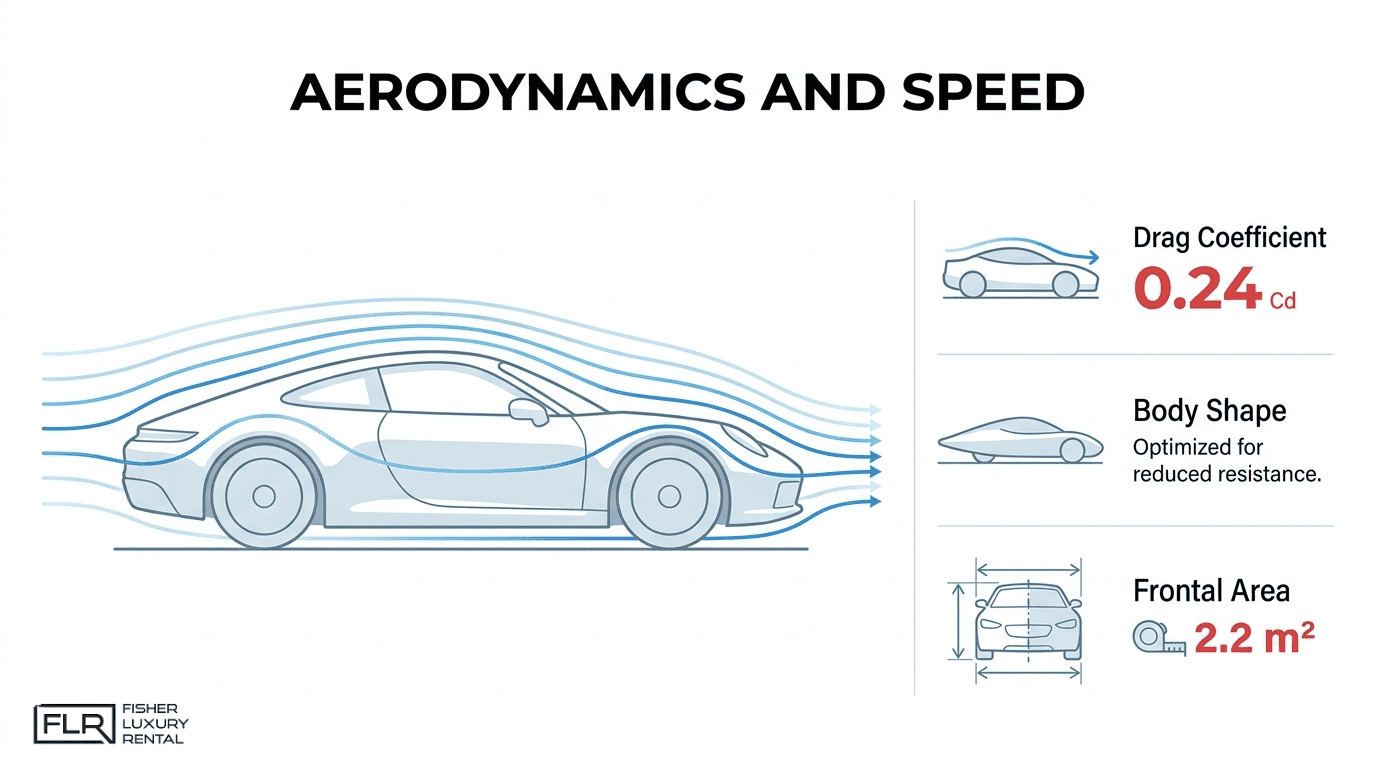
Aerodynamics affects a car’s top speed by determining how much air resistance the vehicle must overcome at high velocity. The following sections cover drag coefficient, body shape, spoilers, and frontal area.
How Does Drag Coefficient Limit Top Speed?
The drag coefficient limits top speed by quantifying how efficiently a vehicle moves through air. A lower coefficient means less aerodynamic resistance, allowing higher terminal velocity for the same engine output. According to NASA, the drag coefficient for each vehicle configuration is calculated by dividing the axial force by the dynamic pressure (1/2ρV², where ρ is air density and V is velocity). A wind-averaged drag coefficient accounts for varying wind speed distributions at real-world driving conditions, per SAE International. Even small reductions in this value can meaningfully raise a car’s theoretical speed ceiling.
How Does Vehicle Body Shape Influence Air Resistance?
Vehicle body shape influences air resistance by controlling how airflow separates, attaches, and circulates around the exterior. Sleek, tapered profiles encourage attached laminar flow, while blunt shapes create turbulent wakes that sharply increase drag. Features such as sloped rooflines, flush door handles, and smooth underbody panels all reduce aerodynamic penalties. Body shape is arguably the single most controllable drag variable at the design stage, making it the foundation on which every other aerodynamic modification builds.
How Do Spoilers and Active Aerodynamics Change Top Speed?
Spoilers and active aerodynamics change top speed by managing the trade-off between downforce and drag. Fixed rear spoilers generate downforce that improves stability but adds drag, which can reduce maximum velocity. Active aerodynamic systems, such as adjustable wings and deployable flaps, resolve this conflict by flattening or retracting at high speed to minimize resistance while extending at cornering speeds for grip. For pure top-speed runs, active systems that reduce drag beyond what a fixed element allows give cars a measurable straight-line advantage.
How Does Frontal Area Impact High-Speed Performance?
Frontal area impacts high-speed performance because it directly scales total drag force. As expressed by MotorTrend, CD = D / (1/2 × ρV² × A), where A is the car’s frontal area. A larger frontal area multiplies drag force proportionally, meaning a wide, tall vehicle generates significantly more resistance than a narrow, low-slung alternative at equivalent speeds. This is why purpose-built top-speed cars prioritize an extremely compact cross-section alongside a low drag coefficient. Reducing frontal area and drag coefficient together produces compounding gains that no engine upgrade alone can replicate.
How Does the Drivetrain Affect Top Speed?
The drivetrain affects top speed by determining how engine power reaches the wheels, how efficiently that power is sustained across speed ranges, and how much energy is lost through mechanical friction or wheel spin. The sections below cover gear ratios, transmission types, AWD vs. RWD layouts, and final drive ratios.
How Does Gear Ratio Selection Affect Top Speed?
Gear ratio selection affects top speed by controlling the relationship between engine RPM and wheel rotation speed. A taller (numerically lower) gear ratio allows the engine to spin at a lower RPM for any given road speed, preserving power delivery at higher velocities. Short gear ratios prioritize acceleration but cause the engine to hit its RPM ceiling before maximum velocity is reached. Cars optimized for top speed use a closely spaced gearbox with a long final ratio in the highest gear, keeping the engine within its peak power band through the full speed range without over-revving.
How Does Transmission Type Change Top Speed Potential?
Transmission type changes top speed potential by affecting shift speed, mechanical efficiency, and power continuity. The main transmission types relevant to performance are:
- Manual gearboxes give the driver precise gear selection but introduce power interruptions during clutch engagement.
- Dual-clutch transmissions (DCTs) pre-select the next gear, executing shifts in milliseconds with no meaningful power loss, making them the preferred choice in most high-performance and hypercar platforms.
- Continuously variable transmissions (CVTs) keep the engine at its optimal RPM but suffer mechanical efficiency losses that limit their use in top-speed applications.
- Torque-converter automatics offer smooth power delivery but add parasitic losses compared to DCTs at sustained high speeds.
For sustained top-speed runs, dual-clutch transmissions offer the best combination of shift speed and mechanical efficiency.
How Does All-Wheel Drive Compare to Rear-Wheel Drive for Top Speed?
All-wheel drive (AWD) distributes engine torque across all four wheels, while rear-wheel drive (RWD) sends power exclusively to the rear axle. According to Georgia State University, tire coefficients of friction measure approximately 0.7 on dry roads and 0.4 on wet roads. AWD exploits this friction across more contact patches, improving traction during acceleration runs. However, AWD systems add mechanical complexity, weight, and parasitic drivetrain losses that work against top-speed efficiency. Most purpose-built top-speed record cars use RWD precisely because it minimizes drivetrain loss at the upper velocity range, where traction is rarely the limiting factor. AWD is the stronger choice for all-condition performance; RWD favors outright maximum velocity on controlled surfaces.
How Does Final Drive Ratio Determine Maximum Velocity?
The final drive ratio determines maximum velocity by setting the multiplication factor applied to the transmission’s output before torque reaches the wheels. A shorter final drive ratio (higher number) multiplies torque aggressively, improving low-speed acceleration but capping top speed because the drivetrain runs out of gear before the aerodynamic drag limit is reached. A taller final drive ratio (lower number) reduces torque multiplication, allowing wheel speed to continue rising at high RPM without the drivetrain becoming the bottleneck. Engineers balance final drive ratio against the car’s drag characteristics and engine power curve to match the speed at which aerodynamic resistance equals available engine thrust, which is where true maximum velocity is achieved.
How Does Vehicle Weight Affect Top Speed?
Vehicle weight directly limits top speed by increasing the force an engine must overcome to accelerate and sustain high velocity. The following H3s cover how curb weight, power-to-weight ratio, and lightweight materials each shape a car’s maximum speed potential.
How Does Curb Weight Limit Acceleration to Top Speed?
Curb weight limits acceleration to top speed by increasing the inertia an engine must overcome at every stage of acceleration. A heavier vehicle requires more force to reach the same velocity as a lighter one, meaning engine power is consumed fighting mass rather than building speed. This relationship is governed by Newton’s second law: force equals mass times acceleration. For supercars, even a 100-kilogram reduction in curb weight can meaningfully shorten the time needed to reach peak velocity, making weight management as strategically important as raw horsepower.
How Does Power-to-Weight Ratio Relate to Top Speed?
Power-to-weight ratio relates to top speed by measuring how much usable power moves each kilogram of the vehicle. A higher ratio means more acceleration capability and a higher terminal velocity ceiling. Two cars can share identical engine output, yet the lighter one will reach top speed faster and, in some configurations, achieve a higher absolute maximum. This is why manufacturers of high-performance vehicles obsess over reducing mass alongside increasing output. Shedding weight amplifies the effect of every added horsepower, making power-to-weight ratio one of the most reliable predictors of real-world top-speed performance.
How Do Lightweight Materials Improve Top Speed?
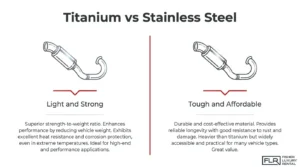
Lightweight materials improve top speed by reducing curb weight without sacrificing structural strength, which directly raises the effective power-to-weight ratio. Common materials used in high-performance vehicles include carbon fiber reinforced polymer, aluminum alloys, and titanium for fasteners and exhaust components. Carbon fiber, in particular, offers the highest strength-to-weight advantage among production-viable materials, which is why it appears in the body panels, monocoques, and interior structures of elite supercars. Reducing mass also lowers rolling resistance and the rotational inertia of unsprung components, compounding the speed gains beyond what engine output alone could achieve.
How Do Tires Affect a Car’s Top Speed?
Tires affect a car’s top speed through speed ratings, grip levels, rolling resistance, and contact-patch geometry. The sections below cover how each of these factors caps or enables maximum velocity.
How Does Tire Speed Rating Limit Maximum Speed?
Tire speed rating limits maximum speed by defining the highest velocity a tire is certified to sustain safely under load. Every tire carries a standardized letter code, such as H (130 mph), V (149 mph), W (168 mph), or Y (186 mph), stamped into the sidewall. Exceeding the rated speed generates heat faster than the tire can dissipate it, risking structural failure. Manufacturers match a vehicle’s factory tires to its governed or mechanical top speed precisely for this reason. Fitting a lower-rated tire to a high-performance car effectively imposes a new, lower speed ceiling regardless of engine capability.
How Does Tire Grip and Rolling Resistance Affect Top Speed?
Tire grip and rolling resistance affect top speed in opposing ways: higher grip improves traction at speed, while higher rolling resistance robs power before it reaches the road. Rolling resistance is the continuous energy a tire expends deforming against the pavement surface as it rolls. Softer, stickier compounds provide better grip but generate more rolling resistance, creating a trade-off engineers must balance. According to Georgia State University research citing Jones and Childers, dry-road friction coefficients reach approximately 0.7, dropping to around 0.4 on wet surfaces. On high-speed runs, even small increases in rolling resistance translate directly into measurable losses in achievable top speed.
How Does Tire Size and Width Influence High-Speed Stability?
Tire size and width influence high-speed stability through contact-patch area, sidewall stiffness, and the mechanics of pavement friction. Wider tires spread load across a larger contact patch, improving lateral stability at elevated speeds. However, width also increases the aerodynamic frontal area at the wheel well and raises rolling resistance. Sidewall height matters equally: a lower-profile sidewall flexes less, reducing the hysteresis effect. According to the Federal Highway Administration, hysteresis is the friction component that results from the tire compressing against the pavement surface, and surface texture influences both hysteresis and adhesion simultaneously. Selecting the right size is a genuine engineering balance, not simply a matter of going wider.
How Does Altitude and Weather Affect a Car’s Top Speed?
Altitude and weather affect a car’s top speed by changing air density, engine thermal efficiency, and aerodynamic drag. The sections below cover how thin air at elevation, temperature extremes, and headwinds each reduce achievable top speed.
How Does Air Density at High Altitude Change Top Speed?
Air density at high altitude reduces top speed by limiting the oxygen available for combustion. Thinner air produces less dense intake charge, which directly reduces the power an internal combustion engine can generate. Turbocharged engines partially compensate by compressing intake air, but even forced induction systems reach physical limits as ambient pressure drops. Naturally aspirated engines are hit hardest, losing roughly 3% power per 1,000 feet of elevation gain. For drivers chasing true top-speed performance, high-altitude environments are simply less favorable than sea-level roads.
How Does Temperature Affect Engine Output and Top Speed?
Temperature affects engine output and top speed by altering both combustion efficiency and the thermal burden on critical systems. According to Ferrari’s engineering documentation on the SF90 Stradale, the engine bay must manage combustion temperatures of nearly 900°C alongside heat-sensitive electronics, inverters, and battery components, all requiring precise thermal management. Cold ambient conditions create a different problem: a Purdue University study found that lower outside temperatures reduce cooling load, which decreases engine speed and degrades thermal efficiency. Both extremes, excessive heat and extreme cold, pull performance away from the ideal operating window.
How Does Wind Resistance and Headwind Lower Top Speed?
Wind resistance and headwind lower top speed by increasing the aerodynamic drag force the engine must overcome. Drag scales with the square of velocity, so a headwind effectively adds to the car’s speed relative to the air, multiplying drag force significantly at high speeds. A 30 mph headwind on a car travelling at 150 mph creates drag equivalent to 180 mph airspeed, demanding substantially more power just to maintain pace. Tailwinds produce the opposite effect, reducing effective airspeed and lowering drag. This is why controlled top-speed records are typically set on calm days with minimal crosswind exposure.
How Does Electronic Limiting Affect a Car’s Top Speed?
Electronic limiting affects a car’s top speed by cutting engine power or fuel delivery once a programmed velocity threshold is reached. This section covers why manufacturers install these software governors and how much additional speed becomes accessible when they are removed.
Why Do Manufacturers Use Electronic Speed Limiters?
Manufacturers use electronic speed limiters primarily for safety, tire compliance, and regulatory reasons. Most consumer tires carry speed ratings that cap safe sustained use at specific velocities, so a limiter prevents drivers from exceeding what the tire can reliably handle. Liability concerns play an equally large role: automakers limit vehicles to speeds that the average driver can safely manage on public roads. Many European manufacturers voluntarily agreed to cap passenger cars at 250 km/h (155 mph), a gentleman’s agreement that keeps performance accessible without exposing brands to legal risk. In some markets, regulatory pressure or insurance requirements reinforce these caps further.
How Much Faster Can a Car Go with the Limiter Removed?
A car can go meaningfully faster with the limiter removed, though the true ceiling depends on engine power, aerodynamics, and gearing rather than software alone. The 155 mph cap common on German performance cars is often well below their mechanical potential: vehicles like the BMW M5 or Porsche 911 Turbo can reach 190+ mph once the electronic restriction is lifted. However, removing a limiter exposes the car to the very tire and thermal stress the cap was designed to prevent. At extreme velocities, aerodynamic drag grows exponentially, meaning power requirements increase sharply for every additional mile per hour gained. The limiter, in practice, is often the least restrictive factor compared to drag and tire limits.
What Role Does Road Surface and Terrain Play in Top Speed?
Road surface and terrain directly limit how much of a car’s mechanical top speed is achievable in practice. Friction coefficients, elevation gradients, and pavement texture each reduce or restrict the velocity a car can sustain.
How Does Pavement Quality Affect Achievable Top Speed?
Pavement quality affects achievable top speed by determining how much grip the tires can generate and how efficiently power transfers to the road. According to Georgia State University, dry roads produce a coefficient of friction around 0.7, while wet roads drop to approximately 0.4, cutting available traction significantly. On rough or deteriorating pavement, tire contact becomes inconsistent, introducing vibration that destabilizes the car at high speeds. Smooth, well-maintained asphalt allows tires to maintain full contact, enabling the vehicle to sustain its mechanical limits.
How Does Uphill or Downhill Gradient Change Top Speed?
Uphill gradient reduces top speed because the drivetrain must overcome gravitational resistance in addition to aerodynamic drag. On a steep incline, even a powerful engine loses speed as energy diverts to climbing rather than accelerating. Downhill terrain produces the opposite effect: gravity assists acceleration, and some vehicles reach speeds beyond their flat-surface capability. However, downhill runs also increase braking demand and aerodynamic loading, which introduce their own handling challenges at high velocity.
Why Do Tracks Outperform Public Roads for Top Speed Runs?
Tracks outperform public roads for top speed runs because they combine consistent surface quality, controlled gradients, and sufficient straight-line distance. Public roads include intersections, surface variation, and legal speed limits that make true top speed testing impossible. Purpose-built facilities like the Nardo Ring or the Autobahn provide the controlled conditions manufacturers and record-setters need. Surface and terrain constraints mean real-world top speed is almost always lower than a vehicle’s rated maximum, making controlled environments essential for accurate performance measurement.
How Do Different Supercars Compare in Top Speed?
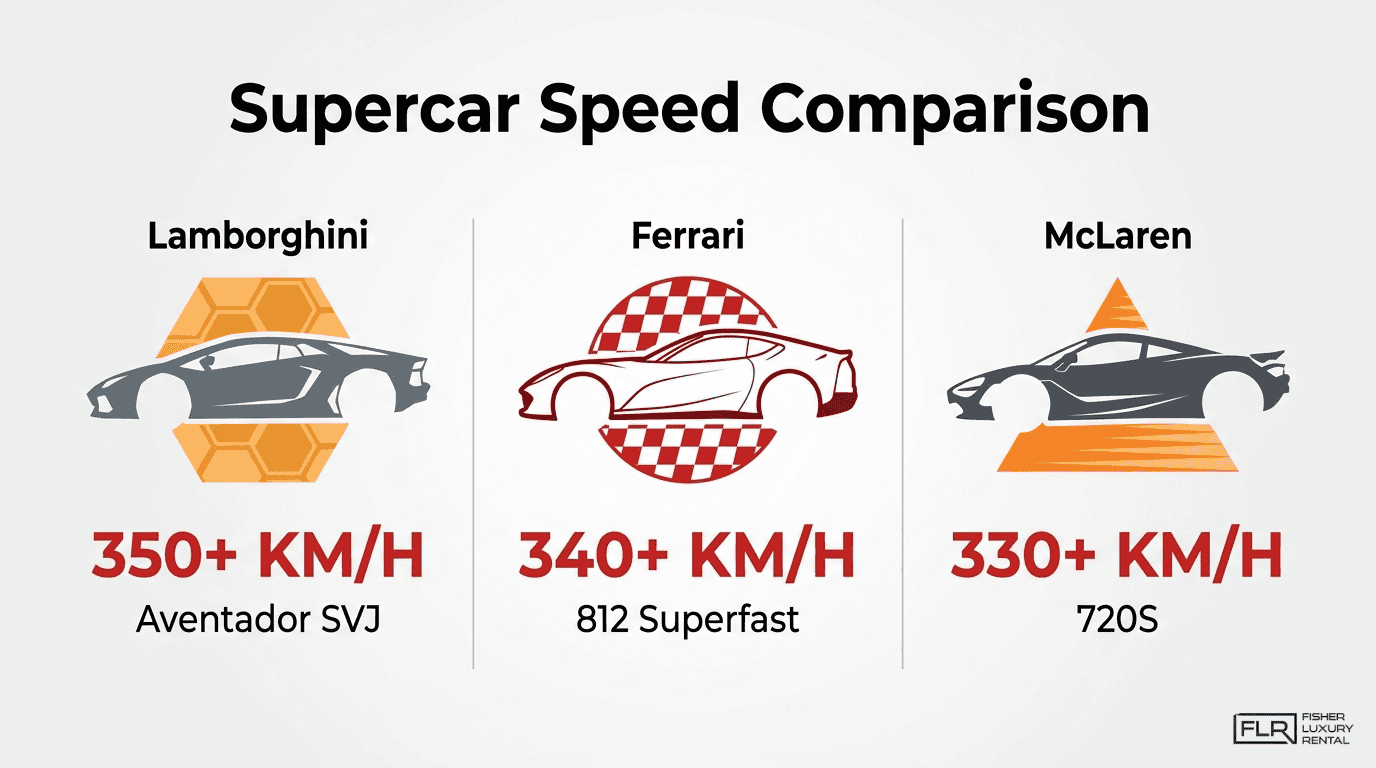
Different supercars vary significantly in top speed depending on their powertrain architecture, aerodynamic tuning, and weight management. The sections below compare Lamborghini, Ferrari, and McLaren across their top-performing models.
How Fast Can a Lamborghini Reach at Top Speed?
The Lamborghini Revuelto reaches a top speed of approximately 217 mph (350 km/h). This performance comes from a 1,015 CV powertrain that combines a naturally aspirated V12 engine, three electric motors, and a dual-clutch e-gearbox, according to Lamborghini. The Huracan STO achieves around 193 mph, while the Urus Performante reaches 190 mph. Across the lineup, Lamborghini consistently prioritizes power density and mechanical drama over outright aerodynamic efficiency, which makes their top-speed figures as impressive as they are loud.
How Fast Can a Ferrari Reach at Top Speed?
The Ferrari SF90 Stradale reaches a top speed of approximately 211 mph (340 km/h). Its hybrid powertrain generates over 1,000 horsepower through a combination of a twin-turbocharged V8 and three electric motors. The Ferrari 488 Spider achieves around 205 mph, powered by a 3.9-liter twin-turbo V8 producing 660 horsepower. Ferrari engineering balances aerodynamic precision with raw output, making their top-speed numbers among the most validated in the supercar segment.
How Fast Can a McLaren Reach at Top Speed?
The McLaren 720S reaches a top speed of 212 mph (341 km/h), powered by a 4.0-liter twin-turbocharged V8 producing 710 horsepower. McLaren’s carbon fiber MonoCell II chassis keeps curb weight exceptionally low at 1,283 kg, which directly amplifies the 720S’s power-to-weight advantage at high velocity. The Speedtail, McLaren’s flagship, pushes further to 250 mph, making it one of the fastest road cars ever produced. McLaren’s obsessive focus on weight reduction arguably gives it the most engineering-efficient path to top speed of the three brands.
How Can You Experience Top Speed Performance Firsthand?
Experiencing top speed performance firsthand means getting behind the wheel of a real exotic car. The H3s below cover renting from Fisher Luxury Rental and the key factors that shape every high-performance drive.
Can Renting an Exotic Car from Fisher Luxury Rental Let You Feel True High-Performance Power?
Yes, renting an exotic car from Fisher Luxury Rental can let you feel true high-performance power. Fisher Luxury Rental offers fleet vehicles such as the McLaren 720S, Ferrari 488 Spider, and Lamborghini Huracan Spyder, each engineered for the kind of acceleration, handling, and raw output that no test drive replicates. Fisher Luxury Rental stocks top-trim models exclusively, so every rental delivers the full factory performance specification rather than a de-contented variant. For car enthusiasts in Phoenix or Portland, this is the most direct path to experiencing the engineering principles covered throughout this article in a real-world setting.
What Are the Key Factors That Affect a Car’s Top Speed?
The key factors that affect a car’s top speed are engine power output, aerodynamic drag, drivetrain efficiency, vehicle weight, tire capability, and environmental conditions such as altitude and temperature. According to a Purdue University study, lower outside temperatures reduce cooling load, which in turn decreases engine speed and degrades thermal efficiency, illustrating how even ambient conditions influence peak performance. Together, these factors interact as a system: a powerful engine is constrained by drag, drag is shaped by body design, and the drivetrain must convert all of it into wheel speed without loss. Understanding each variable helps explain why two cars with similar horsepower figures can reach meaningfully different top speeds.