
A V12 engine is an internal combustion engine with twelve cylinders arranged in two banks of six, forming a V-shape around a shared crankshaft at a 60-degree bank angle. This configuration achieves perfect primary and secondary reciprocating balance without counterweights, producing six power pulses per crankshaft revolution and a level of mechanical refinement no other common production engine layout matches.
This guide covers V12 architecture and balance mechanics, power output across induction types, torque and RPM specs, manufacturer-specific engines, how the V12 compares to V8 and V10 configurations, the role of displacement and tuning, and the engine’s future in an era of tightening emissions standards.
The V12’s structural design, specifically the 60-degree bank angle and self-cancelling inertial forces between opposing cylinder banks, is the mechanical foundation behind its signature smoothness. Understanding this architecture explains why the configuration stands apart from every alternative.
Power output ranges from roughly 563 hp in twin-turbocharged grand tourers to over 1,160 hp in hybrid-assisted hypercars. Naturally aspirated V12s peak near 830 hp at high rpm, forced-induction variants prioritize torque at lower engine speeds, and hybrid-assisted units combine both approaches to set the absolute output ceiling.
Five manufacturers still build V12 engines today: Ferrari, Lamborghini, Mercedes-AMG, Rolls-Royce, and Aston Martin. Each takes a distinct engineering approach, and their collective commitment to the architecture is a deliberate statement against the electrification trend reshaping the broader industry.
Displacement, induction type, ECU tuning, and regulatory pressure each shape what a V12 can produce now and whether the engine survives in its current form.
What Is a V12 Engine and How Does It Work?
A V12 engine is an internal combustion engine with twelve cylinders arranged in two banks of six, forming a V-shape around a shared crankshaft. This layout combines mechanical elegance with engineering precision, making it the preferred architecture for the world’s most demanding performance and luxury vehicles.
What Is the Basic Structure of a V12 Engine?
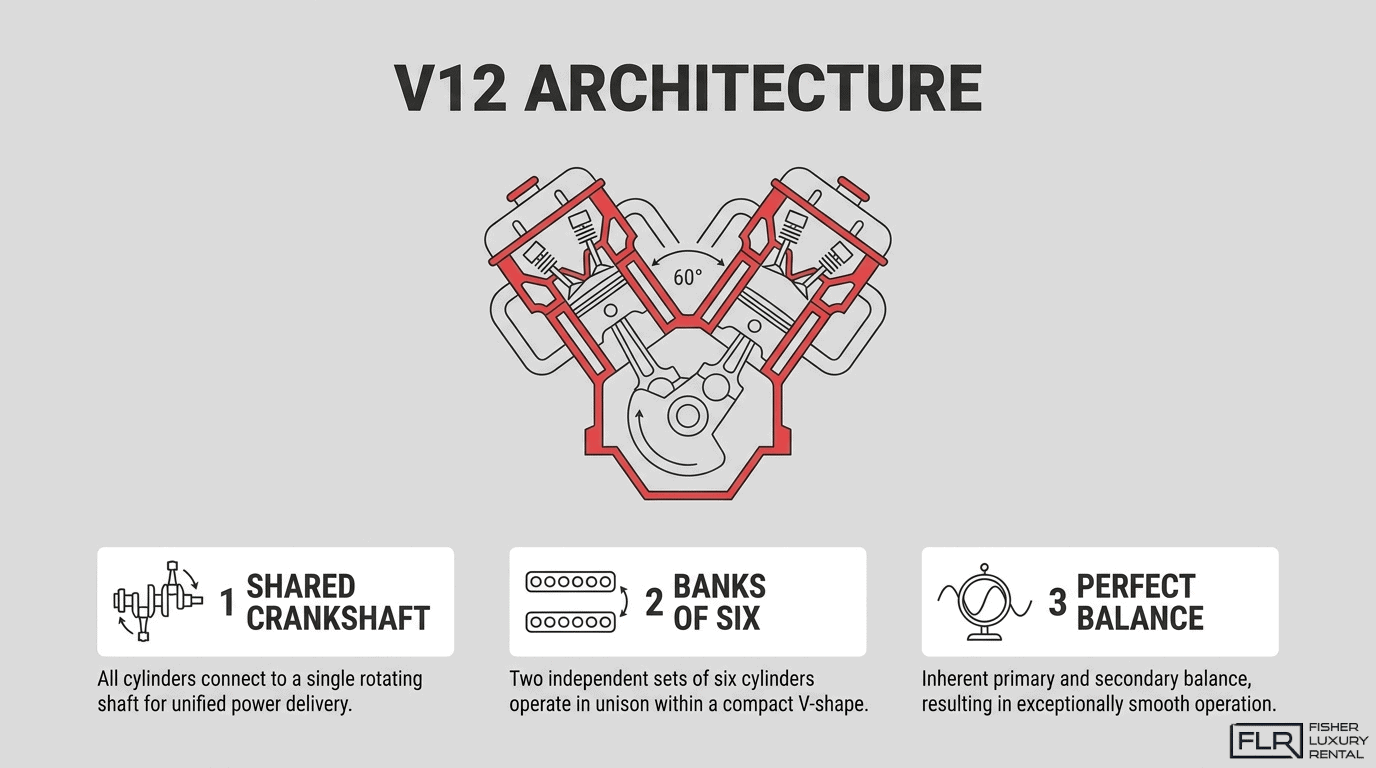
The basic structure of a V12 engine consists of two banks of six cylinders mounted at a 60-degree angle to each other, sharing a single crankshaft. According to SAE International, this 60-degree bank angle is the optimal V12 configuration because it produces firing intervals every 60 degrees of crankshaft rotation, delivering continuous power with minimal vibration harmonics. Each cylinder bank effectively functions as a self-contained straight-six unit, which is itself an inherently balanced design.
How Does a V12 Engine Produce Power?
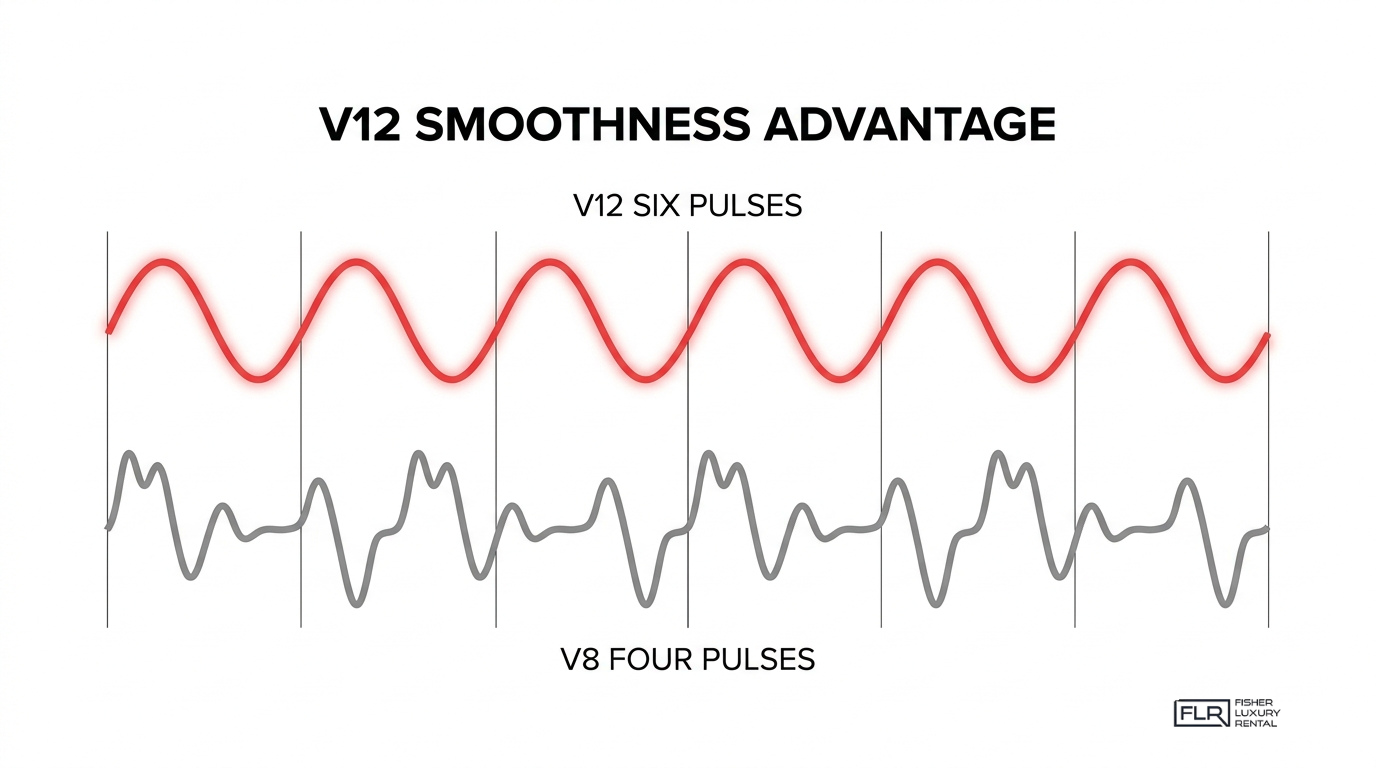
A V12 engine produces power through six power pulses per crankshaft revolution. Each pulse occurs as a piston fires, driving the crankshaft through its rotation cycle. Because these pulses are evenly distributed at 60-degree intervals, power delivery is nearly continuous rather than occurring in distinct surges. This firing density is a core reason the V12 architecture feels so distinctively smooth under acceleration.
Why Does a V12 Have Perfect Engine Balance?
A V12 has perfect engine balance because the inertial forces of each piston bank are completely cancelled out by the opposing bank. Unlike V8 or V10 configurations, a 60-degree V12 achieves both primary and secondary reciprocating balance without requiring external counterweights or balance shafts. According to the International Journal of Mechanical Engineering and Technology, this self-cancelling inertial force is a structural advantage unique to the V12 among common production engine layouts. In practice, this translates into an engine that runs with exceptional refinement at any RPM.
What Makes the V12 Configuration Different From Other Engines?
The V12 configuration differs from other engines through its architecture, balance characteristics, firing interval precision, and regulatory position in the modern automotive landscape. The sections below cover its structural layout, its mechanical advantages over smaller engine formats, and the emissions pressures now shaping its future.
How Is a V12 Engine Structured?
A V12 engine is structured as two banks of six cylinders arranged in a V shape, typically at a 60-degree angle. Each bank functions as a self-balancing straight-six, so the complete assembly achieves perfect primary and secondary reciprocating balance without requiring balance shafts. This geometry is what separates the V12 from virtually every other production engine layout.
What Makes V12 Balance Superior to Other Configurations?
V12 balance is superior to other configurations because the inertial forces produced by pistons in each cylinder bank cancel each other out completely, according to research published in the International Journal of Mechanical Engineering and Technology. V8 and V10 architectures cannot achieve this without supplementary counterbalancing. The result is an engine that operates with minimal vibration harmonics across its entire rev range, a mechanical advantage no other common configuration matches.
How Does the V12 Firing Order Create Smoother Power Delivery?
The V12 firing order creates smoother power delivery by generating six power pulses per crankshaft revolution. At a 60-degree bank angle, firing intervals occur every 60 degrees of crankshaft rotation, producing continuous, even power delivery. By comparison, a V8 produces only four pulses per revolution. This higher pulse frequency is why V12 torque feels linear rather than rhythmic, making throttle response feel almost turbine-like.
How Do Emissions Regulations Affect the V12 Engine’s Future?
Emissions regulations affect the V12 engine’s future significantly. According to the International Council on Clean Transportation (ICCT), Euro 7 targets a 35% reduction in nitrogen oxide emissions compared to Euro 6, placing large-displacement internal combustion engines under direct regulatory pressure. Automakers producing V12 engines must now invest in advanced exhaust and catalyst technologies just to maintain compliance, adding cost and engineering complexity that smaller engine configurations do not face to the same degree.
How Much Horsepower Does a V12 Engine Typically Produce?
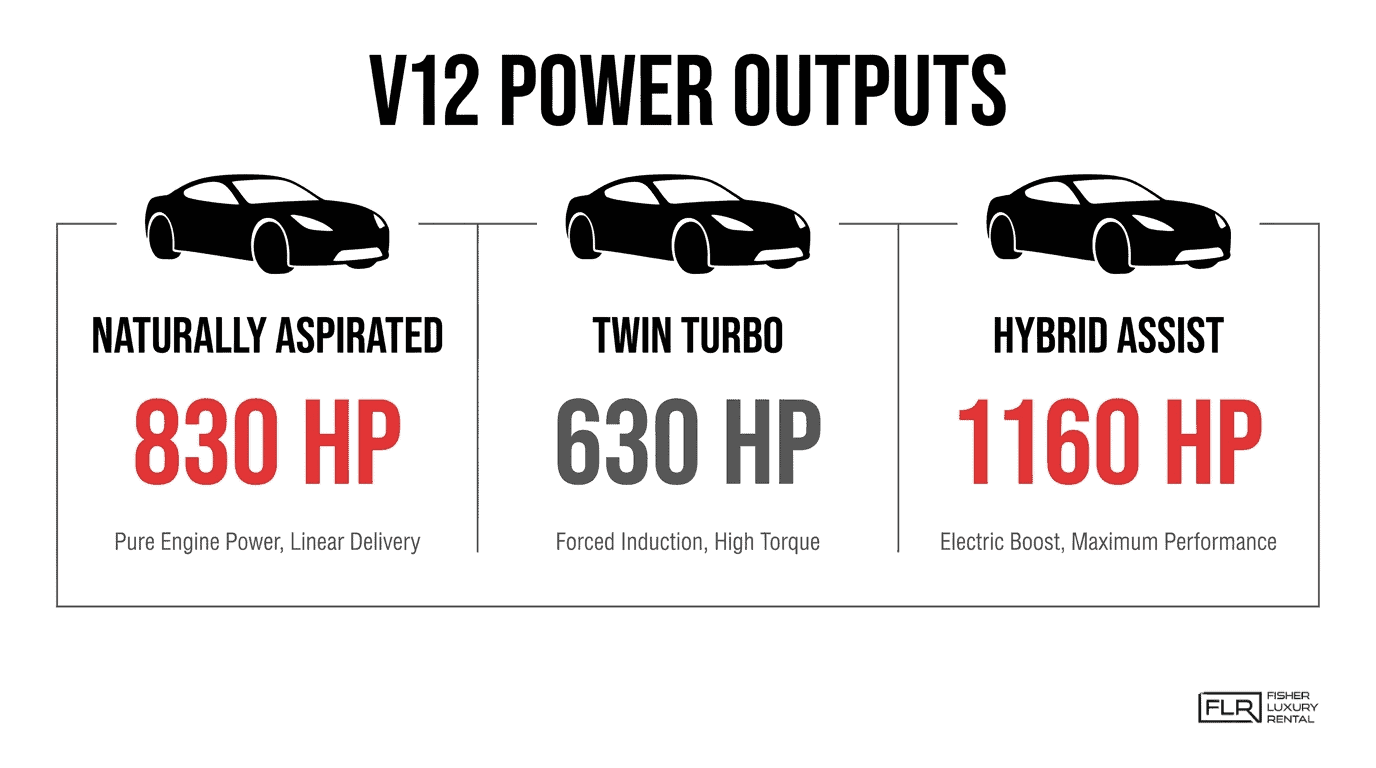
V12 horsepower output varies significantly by induction type, ranging from roughly 560 hp in grand tourers to over 1,100 hp in hybrid hypercars. The three primary configurations are naturally aspirated, twin-turbocharged, and hybrid-assisted.
How Much HP Does a Naturally Aspirated V12 Produce?
A naturally aspirated V12 produces between approximately 560 hp and 830 hp in modern road cars, with peak examples exceeding 800 hp at very high rpm. The Ferrari Daytona SP3 represents the current benchmark: its 6.5-liter naturally aspirated V12 produces 829 hp at 9,250 rpm and 514 lb-ft of torque at 7,250 rpm, according to Ferrari S.p.A. This high-rpm power delivery is a defining characteristic of unassisted V12 architecture. Ferrari’s global marketing director Emanuele Carando reinforced the format’s longevity, stating, “We will produce naturally-aspirated V12s until the law [no longer] allows us to.” For driving enthusiasts, naturally aspirated V12s remain unmatched in throttle linearity and acoustic character, even as forced induction continues to close the raw power gap.
How Much HP Does a Twin-Turbocharged V12 Produce?
A twin-turbocharged V12 produces between approximately 563 hp and 630 hp in current luxury and performance applications, with substantially higher torque figures than naturally aspirated equivalents. The Mercedes-AMG M279 6.0L twin-turbocharged V12 delivers 630 hp and 1,000 Nm of torque in its highest factory specification. The Rolls-Royce Phantom uses a 6.75-liter twin-turbocharged V12 producing 563 hp and 900 Nm of torque. Forced induction increases air density in the combustion chamber, generating significantly more torque at lower rpm than a naturally aspirated engine of similar displacement. For grand tourers and ultra-luxury sedans, this torque-rich, low-rpm delivery is precisely the right tool.
How Much HP Does a Hybrid-Assisted V12 Produce?
A hybrid-assisted V12 produces the highest total output of any V12 configuration, typically exceeding 1,000 hp through combined combustion and electric motor output. The Lamborghini Revuelto’s 6.5-liter V12 contributes to a combined hybrid system output of 1,001 hp, while the Aston Martin Valkyrie’s hybrid-assisted V12 powertrain reaches 1,160 hp with a redline of 11,100 rpm, according to Aston Martin Lagonda. Electric motor integration fills the low-rpm torque gap that naturally aspirated V12s leave open, creating a powertrain that is both more responsive and more powerful than either technology alone. For anyone who wants to understand what a modern V12 can truly deliver, the hybrid-assisted examples set the absolute ceiling.
What Are the Torque and RPM Specs of a V12 Engine?
The torque and RPM specs of a V12 engine vary significantly by induction type and intended use, spanning from grand touring luxury to hypercar performance. Turbocharged V12s prioritize low-end torque, while naturally aspirated variants chase peak RPM.
According to Mercedes-Benz Group Media, the Mercedes-AMG M279 6.0L twin-turbocharged V12 generates 630 hp and 1,000 Nm of torque in its highest factory specification, demonstrating how forced induction maximizes torque density at relatively modest RPM. Naturally aspirated V12s take the opposite approach: the Ferrari Daytona SP3 reaches peak power at 9,250 rpm, trading raw torque volume for an extraordinarily broad and responsive power band. Rolls-Royce tunes its 6.75-liter twin-turbo V12 for effortless thrust, delivering 900 Nm at very low engine speeds to suit its grand touring character.
From an engineering standpoint, 1,000 Nm of torque from a turbocharged V12 is exceptional for a production road car, and it is this combination of high torque at accessible RPM that makes these engines so commanding in real-world driving conditions.
Which Automakers Build V12 Engines Today?
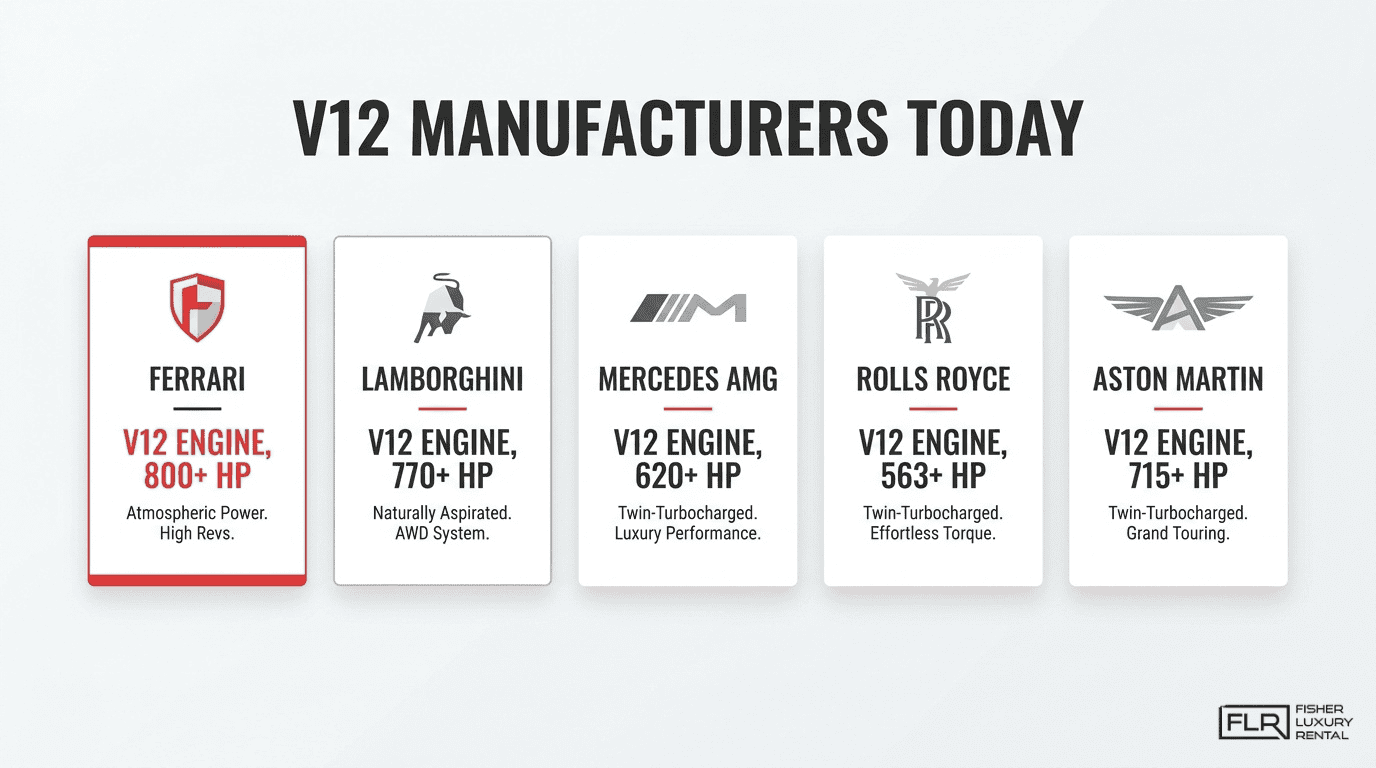
A small group of manufacturers still builds V12 engines today, including Lamborghini, Ferrari, Mercedes-AMG, Rolls-Royce, and Aston Martin. Each brand takes a distinct engineering approach, ranging from naturally aspirated high-revving units to twin-turbocharged luxury powerplants.
What Are the Specs of Lamborghini’s V12 Engine?
The specs of Lamborghini’s V12 engine center on the 6.5-liter unit found in the Revuelto, which displaces 6,498.5 cm³ and contributes to a combined hybrid system output of 1,015 CV (1,001 hp). This makes the Revuelto the most powerful production V12 Lamborghini ever built. Pairing a high-revving combustion V12 with electric motors is a bold engineering choice, and it sets a benchmark that naturally aspirated rivals will struggle to match without electrification.
What Are the Specs of Ferrari’s V12 Engine?
The specs of Ferrari’s V12 engine are best represented by the 812 Competizione, which uses a 6.5-liter naturally aspirated unit with a 13.5:1 compression ratio and a maximum output of 830 cv at 9,250 rpm. Ferrari’s commitment to the naturally aspirated V12 format runs deep. Emanuele Carando, Ferrari’s global marketing director, stated: “We will produce naturally-aspirated V12s until the law no longer allows us to.”
What Are the Specs of Mercedes-AMG’s V12 Engine?
The specs of Mercedes-AMG’s V12 engine are defined by the M279, a 6.0-liter twin-turbocharged unit that generates 630 hp and 1,000 Nm of torque in its highest factory specification. This engine powered the S 65 Final Edition, which served as AMG’s farewell to the V12 format in passenger cars. The M279 also underpins the Pagani Huayra in a detuned M158 variant, displacing 5,980 cc with a 9.0:1 compression ratio.
What Are the Specs of Rolls-Royce’s V12 Engine?
The specs of Rolls-Royce’s V12 engine are anchored by the 6.75-liter twin-turbocharged unit in the Phantom, which produces 563 horsepower and 900 Nm of torque. Rolls-Royce prioritizes effortless torque delivery over peak power figures, and the 6.75-liter displacement reflects that philosophy. For buyers in the ultra-luxury segment, this engine defines a standard of refinement that no V8 alternative can replicate.
What Are the Specs of Aston Martin’s V12 Engine?
The specs of Aston Martin’s V12 engine are headlined by the new twin-turbocharged unit confirmed for the 2025 Vanquish, producing 835 PS and 1,000 Nm of torque. According to Aston Martin Media, this clean-sheet V12 represents a deliberate statement against the electrification trend sweeping the industry. Delivering 1,000 Nm from a forced-induction V12 puts the Vanquish directly in competition with Rolls-Royce and the top AMG S-Class variants on torque output alone.
How Does V12 Power Compare to V8 and V10 Engines?
V12 power compares to V8 and V10 engines primarily through its superior firing frequency and torque smoothness. The subsections below examine how cylinder count directly shapes power delivery quality.
According to Engine History research by RJ Raymond, a V12 engine produces six power pulses per crankshaft revolution, compared to just four pulses from a V8. That difference means the V12 delivers torque in a near-continuous wave rather than the distinct, spaced surges characteristic of smaller-cylinder configurations. A V10 sits between these two extremes, generating five pulses per revolution, offering more refinement than a V8 but still falling short of the V12’s seamless power flow.
For drivers, this distinction is felt rather than just measured. The V8 and V10 deliver raw, aggressive thrust with more pronounced power pulses, which many enthusiasts find exciting. The V12, however, produces a glassy smoothness at high revs that feels fundamentally different in character, less mechanical and more turbine-like. That quality is precisely why manufacturers reserve the V12 for their most prestigious, ultra-high-performance flagship models.
What Gives a V12 Engine Its Signature Smoothness?
A V12 engine’s signature smoothness comes from its architecture: two banks of six cylinders, each functioning as an inherently balanced straight-six. This mechanical symmetry cancels inertial forces and produces continuous, refined power delivery. The sections below explain the specific mechanical reasons behind that refinement.
How Does the 60-Degree Bank Angle Create Balance?
The 60-degree bank angle creates balance by producing even firing intervals every 60 degrees of crankshaft rotation. According to SAE International, this configuration is the optimal V12 geometry because it eliminates uneven power pulses and minimizes vibration harmonics. Each cylinder fires in a perfectly timed sequence, so power delivery feels continuous rather than rhythmic or interrupted. No other common bank angle achieves this same mechanical symmetry.
Why Does a V12 Have Perfect Primary and Secondary Balance?
A V12 engine has perfect primary and secondary balance because the inertial forces of pistons in each bank are completely cancelled by the opposing pistons in that same bank. The International Journal of Mechanical Engineering and Technology confirms that unlike V8 and V10 architectures, the V12 achieves this cancellation without requiring balance shafts or counterweights. That self-correcting inertia is what makes a V12 feel so uniquely refined at high rpm. In practice, this balance is nearly impossible to replicate in fewer cylinders.
How Do Six Power Pulses Per Revolution Affect Smoothness?
Six power pulses per crankshaft revolution affect smoothness by providing torque delivery that is nearly constant. Engine History research confirms that a V12 produces six pulses per revolution, compared to only four in a V8, meaning combustion events overlap continuously rather than leaving gaps in power. That overlapping cadence eliminates the torque “valleys” drivers feel in lower-cylinder-count engines, producing the glassy, uninterrupted acceleration that defines the V12 character.
Why Is the V12 Considered the Ultimate Performance Engine?
The V12 is considered the ultimate performance engine because it combines mechanical perfection, extreme power output, and an unmatched sensory experience that no other production engine architecture replicates. Despite growing electrification pressure, the V12 retains a singular status among engineers, drivers, and collectors alike.
How Does Displacement Affect V12 Power Output?
Displacement directly shapes a V12 engine’s power ceiling, torque character, and rpm behavior. Larger displacement volumes allow more air and fuel per combustion cycle, raising both peak horsepower and torque output. The following sub-sections examine how this relationship plays out across specific engine sizes.
How Does a Larger Displacement V12 Produce More Power?
A larger displacement V12 produces more power by increasing combustion chamber volume, which allows greater air-fuel mixture per cycle and generates higher peak force on each piston stroke. The Rolls-Royce Phantom’s 6.75-liter twin-turbocharged V12 delivers 563 hp and 900 Nm of torque, while Ferrari’s 6.5-liter naturally aspirated V12 in the 812 Competizione reaches 830 cv at 9,250 rpm with a 13.5:1 compression ratio, according to Ferrari’s technical specifications. Larger displacement also allows engineers to extract high output without extreme compression ratios, preserving long-term mechanical reliability.
Does Displacement or Forced Induction Matter More for V12 Output?
Displacement and forced induction both matter for V12 output, but they serve different performance goals. Forced induction engines generate significantly more horsepower and torque than similarly sized naturally aspirated engines by increasing air density in the combustion chamber. The Mercedes-AMG M279 6.0-liter twin-turbocharged V12 reaches 630 hp and 1,000 Nm of torque, whereas Ferrari’s larger 6.5-liter naturally aspirated unit peaks near 830 cv. Displacement determines the power ceiling at atmospheric pressure; turbocharging multiplies output beyond that ceiling. For raw torque at low rpm, forced induction wins decisively, while high-displacement naturally aspirated V12s deliver a linear, high-revving power curve that is difficult to replicate artificially.
What Role Does Engine Tuning Play in V12 Horsepower?
Engine tuning plays a significant role in V12 horsepower by unlocking output beyond factory limits. The primary tuning method covered below is ECU remapping, along with its effects on fuel delivery, ignition timing, and real-world power gains.
How Does ECU Remapping Increase V12 Power?
ECU remapping increases V12 power by modifying factory-programmed settings that control fuel injection and ignition timing. Manufacturers deliberately leave performance headroom in stock calibrations to meet emissions targets and ensure broad drivability. According to the Complete Car Tuning Guide, chip tuning recalibrates these parameters to extract significantly more horsepower and torque from the same displacement. For a V12 platform already producing 600 to 800 hp at the factory, even modest percentage gains translate to substantial real-world increases. Tuning is arguably the most cost-effective upgrade for V12 owners who want measurable performance improvement without mechanical modifications.
Are V12 Engines Becoming Rarer in Modern Supercars?
Yes, V12 engines are becoming rarer in modern supercars, driven by tightening emissions regulations, electrification trends, and the rising cost of compliance. However, several manufacturers are actively resisting this shift, ensuring the architecture survives into the near future.
Why Are Fewer Supercars Using V12 Engines Today?
Fewer supercars are using V12 engines today primarily because of regulatory and electrification pressure. Euro 7, adopted under Regulation (EU) 2024/1257 on 24 April 2024, targets a 35% reduction in NOx emissions compared to Euro 6, according to the International Council on Clean Transportation. Large-displacement combustion engines face the steepest compliance costs. Simultaneously, the EPA’s 2024 Automotive Trends Report confirms that high-performance engine segments, including V12s, face increasing pressure as overall fleet electrification accelerates. For supercar manufacturers, developing a compliant V12 now requires significant investment in exhaust and catalyst technology, which narrows the field to brands with the resources and willingness to commit.
Which Brands Are Still Committed to Building V12 Engines?
The brands still committed to building V12 engines include Ferrari, Lamborghini, Rolls-Royce, and Aston Martin. Ferrari’s global marketing director Emanuele Carando stated directly: “We will produce naturally-aspirated V12s until the law [no longer] allows us to.” Lamborghini CEO Stephan Winkelmann reinforced this by noting that customer interest in full-electric models is “close to zero,” supporting the brand’s decision to retain V12 hybrid powertrains in models like the Revuelto. Aston Martin confirmed a new twin-turbocharged V12 for the 2025 Vanquish, signaling fresh investment rather than phase-out. These commitments show that for ultra-premium brands, the V12 remains a core identity statement, not just a powertrain option.
Is the V12 Engine Facing Extinction or Evolution?
The V12 engine is facing evolution rather than extinction, at least within a defined window. University of Bologna engineers report that future Euro 7 compliance will require innovative exhaust and catalyst technologies, not elimination. Hybrid integration, as seen in the Lamborghini Revuelto and Aston Martin Valkyrie, extends V12 viability by offsetting emissions at low-speed operation while preserving combustion performance at peak loads. The architecture is contracting in volume but not disappearing. The brands still building V12s are doing so with deliberate purpose, positioning the engine as a rare, aspirational offering rather than a mainstream configuration.
How Can You Experience V12 Power Behind the Wheel?
You can experience V12 power behind the wheel by renting an exotic supercar or reviewing the key specifications that define these engines. The sections below cover rental access and a consolidated summary of V12 output benchmarks.
Does Renting an Exotic V12 Supercar Let You Feel Peak Output?
Yes, renting an exotic V12 supercar lets you feel peak output without the cost of ownership. Fisher Luxury Rental offers exotic vehicles, including Ferrari models, that deliver the high-revving character and visceral acceleration V12 engines are known for. Fisher Luxury Rental serves Phoenix, AZ and Portland, OR, giving enthusiasts in both markets direct access to performance machines. For drivers who want to understand what 800-plus horsepower actually feels like under throttle, a single rental session communicates what no specification sheet can replicate.
What Are the Key Takeaways About V12 Engine Power Output?
The key takeaways about V12 engine power output are that output ranges vary significantly by induction type, displacement, and hybrid assistance, spanning from refined grand tourers to record-breaking hypercars. The figures below summarize the benchmark models covered in this article:
| Model | Engine | Peak Output |
| Aston Martin Valkyrie | Hybrid-assisted V12 | 1,160 hp / 11,100 rpm |
| Lamborghini Revuelto | 6.5L Hybrid V12 | 1,001 hp (combined) |
| Ferrari 812 Competizione | 6.5L NA V12 (13.5:1 CR) | 830 cv at 9,250 rpm |
| Rolls-Royce Phantom | 6.75L Twin-Turbo V12 | 563 hp / 900 Nm |
According to researchers at the University of Bologna, future Euro 7 regulations will require innovative exhaust and catalyst technologies to allow high-performance V12 engines to maintain this level of peak output while meeting stricter emission limits. That regulatory pressure makes today’s unrestricted V12 figures historically significant, and experiencing them now, whether by studying specs or getting behind the wheel, is a window that may not remain open indefinitely.