A transmission in a performance vehicle controls how engine power reaches the wheels by selecting gear ratios that match speed, load, and driver demand across a wide range of driving conditions.
This guide covers how each transmission type works, how the major supercar brands apply them, how transmission choice shapes driving feel and lap performance, what modes like sport and track actually do, and what maintenance and reliability look like across each system.
How transmissions function and what separates each type: We examine what gear ratios do to acceleration, why keeping the engine in its power band matters, and how shift speed affects real performance. From there, we break down every major transmission type, including manual, automatic, automated manual, dual-clutch, CVT, and sequential gearboxes, covering the mechanical distinctions that make each one distinct.
DCT technology and supercar applications: Dual-clutch transmissions dominate modern exotic cars because two independent clutch packs eliminate power interruption between gears. We cover what actually makes sub-100ms shifts possible, which brands use DCTs, and how Ferrari’s F1 gearbox, Porsche’s PDK, and McLaren’s SSG each approach the same core architecture differently.
Performance comparisons and transmission modes: Manual versus automatic across acceleration, driver engagement, and track suitability gets examined with specific data. We also cover what sport, manual, and race modes change in practice, and how launch control behavior differs between DCT, torque converter, and manual systems.
Maintenance, reliability, and firsthand experience: Each transmission type carries different service costs and failure patterns. We close with how renting from Fisher Luxury Rental provides direct seat time across multiple transmission architectures.
What Does a Transmission Do in a Performance Vehicle?
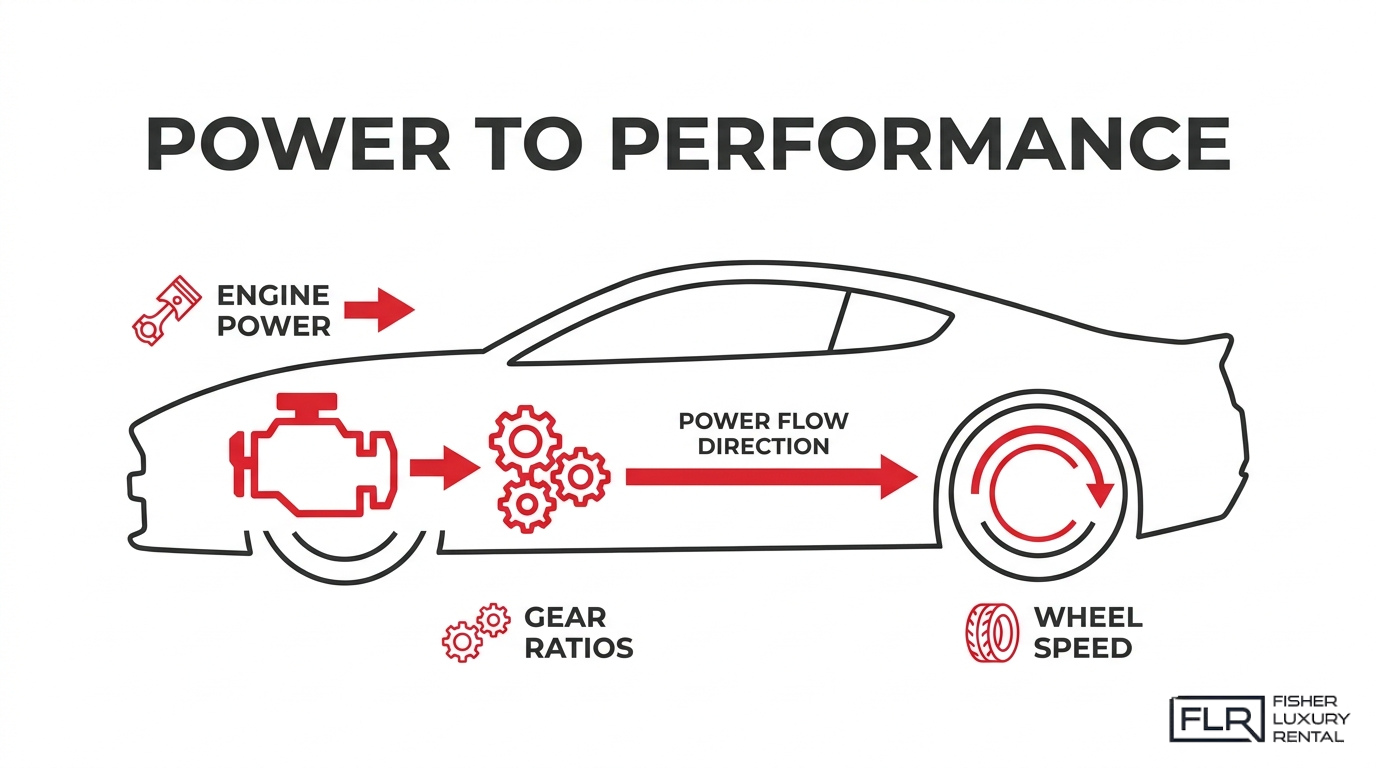
A transmission in a performance vehicle manages engine power delivery to the wheels by selecting the correct gear ratio for speed, load, and driver demand. It controls torque multiplication during acceleration and allows the engine to operate within its optimal power band across a wide range of speeds.
The following H3 sections cover how gear ratios shape acceleration, how the transmission keeps the engine in its power band, and why shift speed matters in high-performance driving.
How Do Gear Ratios Affect Performance?
Gear ratios in a performance vehicle determine how engine torque is multiplied and delivered to the driven wheels. Lower gear ratios multiply torque for hard acceleration off the line, while higher ratios reduce engine RPM at speed for efficiency and top-end performance. According to SCS Gearbox, lower gear ratios require fewer rotations of the driving gear to turn the driven gear once, enabling faster speeds but with reduced torque. For performance driving, selecting the right ratio at the right moment is what separates a quick car from a fast one.
Why Does Keeping the Engine in Its Power Band Matter?
Keeping the engine in its power band means maintaining RPM within the range where the engine produces peak horsepower and torque. A transmission achieves this by shifting up or down to prevent the engine from falling below or exceeding that optimal window. In a performance vehicle, dropping out of the power band mid-corner or during a straight-line run costs meaningful time and responsiveness. This is why transmission design, including gear spacing and shift speed, is engineered with the engine’s power curve in mind.
How Does Shift Speed Impact Performance Driving?
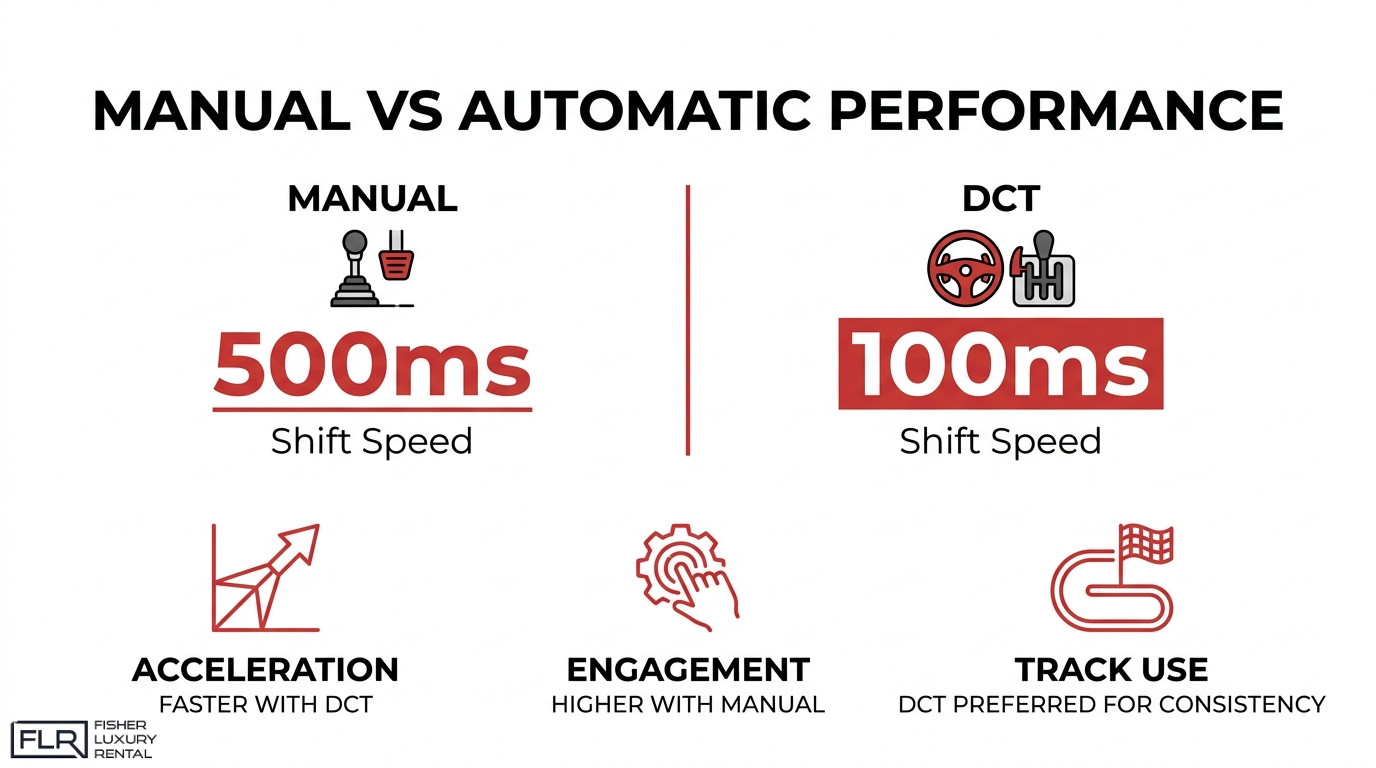
Shift speed in a performance vehicle directly affects acceleration continuity and lap times. Every millisecond spent between gears is a brief interruption in power delivery, which compounds over the course of a drive or race. DCT transmissions shift in approximately 100 milliseconds on average, while a skilled driver executing a manual shift takes around 500 milliseconds. That 400-millisecond gap, multiplied across dozens of shifts per lap, produces a measurable performance advantage that modern exotic car manufacturers engineer around.
What Are the Main Types of Transmissions in Performance Cars?
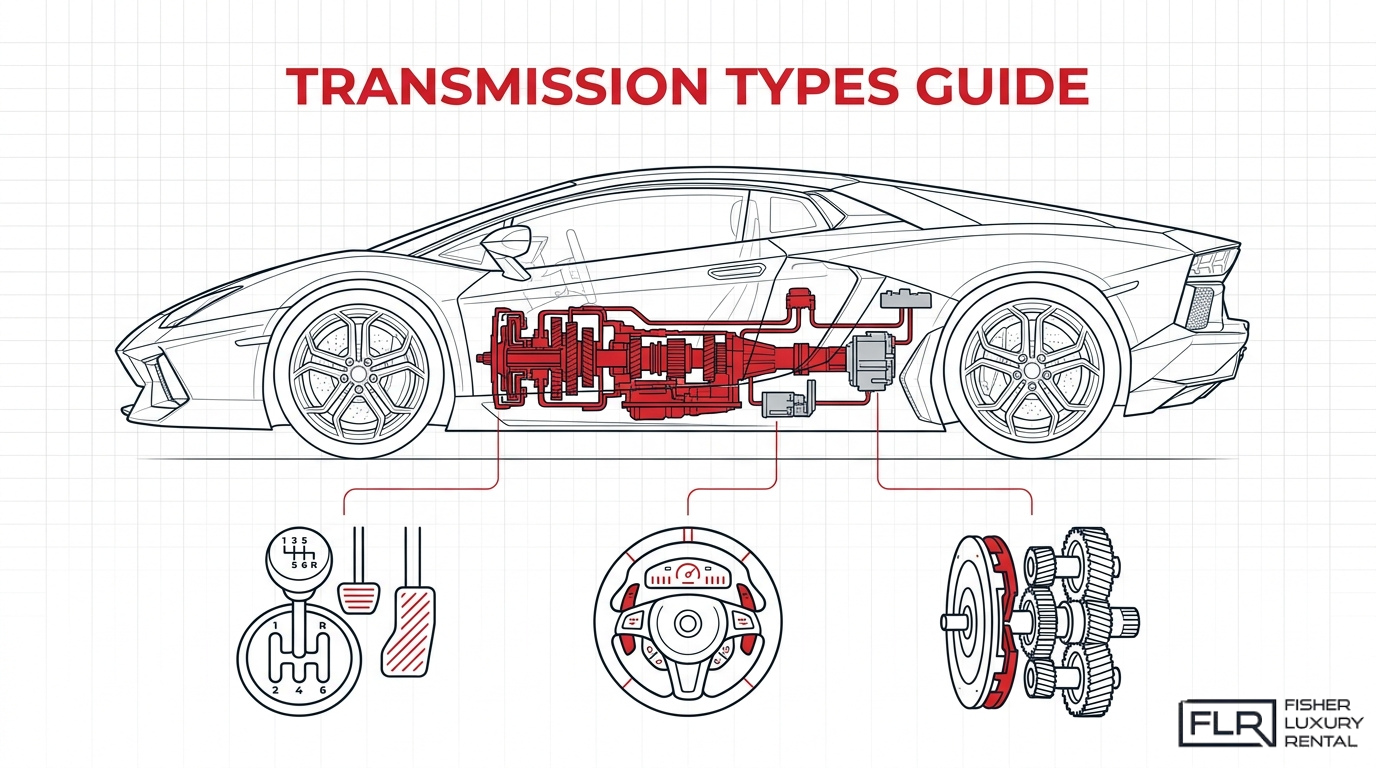
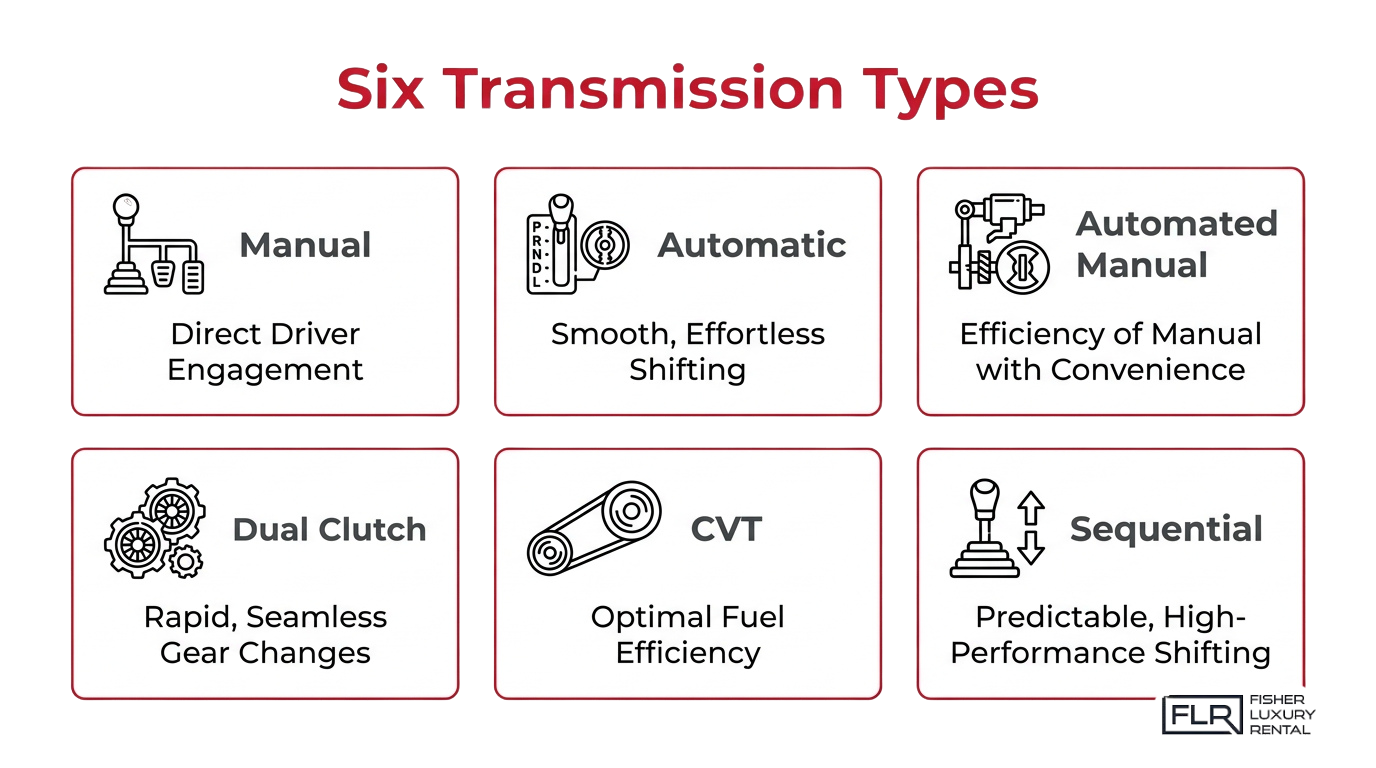
The main types of transmissions in performance cars are manual, automatic, automated manual, dual-clutch, continuously variable, and sequential manual. Each type offers a distinct balance of driver control, shift speed, and mechanical complexity.
Manual Transmission
A manual transmission is a gearbox that requires the driver to operate a clutch pedal and physically select gears using a gear lever. This direct mechanical connection between driver and drivetrain is why enthusiasts regard it as the most engaging way to drive. On a track, however, the numbers tell a different story: DCTs shift in roughly 100 milliseconds, while an average driver takes 500 milliseconds to complete a manual shift. According to Engineering Explained, if there is a clock running or a competitor to beat, modern automatics are superior. The emotional appeal of the manual remains undeniable, but its performance ceiling is limited by human reaction time. Clutch replacement, one of the most common manual transmission repairs, typically costs between $500 and $1,500.
Automatic Transmission
An automatic transmission is a self-shifting gearbox that selects gear ratios without driver input, using a hydraulic torque converter instead of a manual clutch. Modern multi-speed automatics have closed the performance gap considerably. Nine-speed automatics, for example, improve both highway fuel economy and acceleration because gears 1 through 7 are shorter than those found in older 7-speed units, keeping the engine in its optimal power band more consistently.
Automated Manual Transmission
An automated manual transmission (AMT) is a conventional manual gearbox fitted with electronic actuators that handle clutch and gear selection automatically. The Lamborghini Aventador uses a 7-speed Independent Shifting Rod (ISR) AMT, chosen for its compact, lightweight design and ability to handle extreme torque, with Lamborghini claiming shift times of 50 milliseconds. The ISR name is Lamborghini’s proprietary designation for this system.
Dual-Clutch Transmission
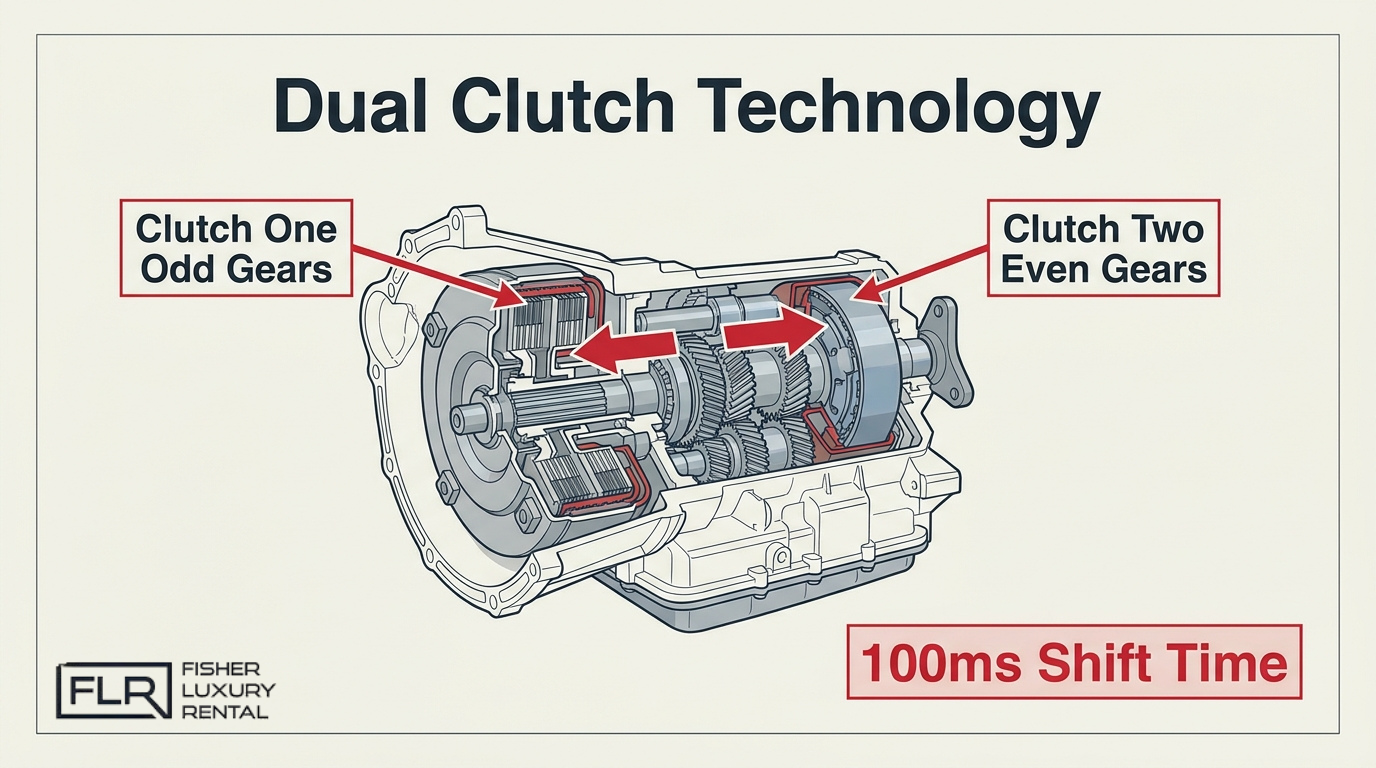
A dual-clutch transmission (DCT) is a gearbox that uses two separate clutch packs, one for odd-numbered gears and one for even-numbered gears, allowing the next gear to be pre-selected before the current shift completes. Ferrari’s DCT, commonly called the F1 gearbox, uses sophisticated electrohydraulic controls to deliver lightning-quick changes with no interruption in power delivery, a design rooted in Formula 1 racing heritage. DCTs carry brand-specific names across manufacturers, including DSG at Volkswagen Group and PDK at Porsche. Fluid service for a Lamborghini Huracán’s DCT typically costs between $800 and $1,500.
Continuously Variable Transmission
A continuously variable transmission (CVT) is a gearbox with no fixed gear steps, instead using a belt-and-pulley system to provide a seamless, infinite range of gear ratios. CVTs maximize fuel efficiency and smooth power delivery but are rarely chosen for high-performance exotic cars due to their inability to handle extreme torque loads and their disconnected driving feel.
Sequential Manual Transmission
A sequential manual transmission is a gearbox where gears are selected one at a time in a fixed order, either up or down, without the ability to skip ratios. Most racing sequential gearboxes use dog-ring engagement rather than synchromesh, relying on large interlocking teeth for fast, positive gear changes. A dog box can be configured for sequential shifting through manual or pneumatic actuation, and some systems support both methods within the same unit.
How Does a Dual-Clutch Transmission Work in Exotic Cars?
A dual-clutch transmission works by using two separate clutches, one for odd-numbered gears and one for even-numbered gears, so the next gear is always pre-selected and ready to engage before the current gear disengages. The sections below cover what makes DCT shift times so fast and which supercar brands use this technology.
What Makes DCT Shift Times So Fast?
DCT shift times are so fast because two independent clutches operate simultaneously, eliminating the gap in power delivery that occurs in single-clutch systems. Sub-100ms shift figures represent the mechanical shift event itself, not total drivetrain response time. According to Mike Everitt, MD of Vocis, a specialist in dual-clutch control systems, achieving genuinely fast, smooth shifting without “tricks” requires highly optimized interaction between software and hardware, with rigorous attention to fluid dynamics and control algorithm calibration. Speed without smoothness is meaningless at the limit, making software calibration as critical as mechanical design.
Which Supercar Brands Use Dual-Clutch Transmissions?
The supercar brands that use dual-clutch transmissions include Ferrari, McLaren, Porsche, and Lamborghini (Huracán). Ferrari’s DCT, known as the F1 gearbox, uses two separate clutches for odd and even gear sets with electrohydraulic controls. Porsche’s version is called the PDK, while McLaren uses a proprietary Sequential Shift Gearbox (SSG). Each brand-specific system carries a unique name, but all share the same core dual-clutch architecture optimized for minimal torque interruption under hard acceleration.
How Does a Manual Transmission Compare to an Automatic for Performance?
A manual transmission compares to an automatic for performance across three key dimensions: raw acceleration speed, driver engagement, and track suitability. Each heading below addresses one dimension with specific data.
Which Transmission Delivers Faster Acceleration?
Modern automatic transmissions deliver faster acceleration than manual transmissions in most performance scenarios. DCTs shift in approximately 100 milliseconds on average, while an average driver shifts a manual in 500 milliseconds. That 400-millisecond gap compounds across every gear change, producing measurable differences in 0-60 and quarter-mile times. Torque converter automatics like the ZF 8HP have also closed the gap significantly, offering competitive straight-line performance without the driver skill dependency that a manual requires.
Which Transmission Offers More Driver Engagement?
Manual transmissions offer more driver engagement, but that engagement comes with mechanical trade-offs. According to Evan Griffey of MotorTrend, synchromesh gear engagement is best at lower engine speeds and requires more time to facilitate shifts compared to a dog box. DCTs occupy a middle ground: the ZF 8HP automatic launches like a traditional automatic, while a DCT launches more like a manual, with some drivers reporting 1.5x better 60-foot times on a DCT with minimal effort. Manuals reward skill; automatics reward consistency.
Which Transmission Is Better for Track Use?
For track use, modern automatics, particularly dual-clutch transmissions, outperform manual gearboxes when lap time is the priority. The question of how much lap time manual versus automatic transmissions gain is a recurring topic documented by Road and Track, and the data consistently favors automatics. Faster, more consistent shift execution and optimized launch control give DCTs a structural advantage over a human-operated clutch. For drivers chasing enjoyment over times, a manual still delivers an experience no automatic can fully replicate.
What Is a Paddle-Shift Transmission and Why Do Supercars Use It?
A paddle-shift transmission is a system that lets drivers change gears using paddles mounted behind the steering wheel, eliminating the need for a clutch pedal while retaining manual gear-selection control. Supercars use it to combine racing-derived speed with everyday usability. The following sub-sections cover how paddles work mechanically, their Formula 1 origins, and why exotic manufacturers adopted them.
How Do Paddle Shifters Work Mechanically?
Paddle shifters work by sending an electronic signal to the transmission’s control unit when the driver pulls a paddle, triggering the clutch and gear-change automatically. The right paddle upshifts; the left paddle downshifts. Because the electronics handle clutch engagement, shifts occur far faster than a human foot could manage, and power delivery remains nearly uninterrupted throughout the change.
Where Did Paddle-Shift Technology Originate?
Paddle-shift technology originated in Formula 1 racing. Ferrari adapted its semi-automatic paddle-shift transmission directly from its Formula 1 program for road cars, delivering faster and smoother gear changes than traditional manual transmissions. That racing lineage gave the system immediate credibility: the same mechanism winning championships on track was now accessible behind the wheel of a road-going Ferrari.
Why Do Supercar Manufacturers Prefer Paddle Shifts Over Clutch Pedals?
Supercar manufacturers prefer paddle shifts over clutch pedals because they enable sub-second gear changes without breaking the driver’s focus or grip on the wheel. At extreme speeds, removing the clutch pedal eliminates one potential driver error and keeps both hands on the wheel in high-stress cornering situations. For high-torque engines that punish slow or mis-timed shifts, the precision of an electronically managed gear change is genuinely safer and faster than the best human foot response.
How Does a Sequential Gearbox Differ From a Dual-Clutch?
A sequential gearbox differs from a dual-clutch in its engagement mechanism and internal architecture. Sequential gearboxes use dog-ring engagement, while dual-clutch transmissions use two separate clutch packs to pre-select gears. The sections below cover each system’s defining characteristics and where the lines blur in modern supercars.
Dog-Ring Engagement vs. Clutch-Pack Pre-Selection
Sequential gearboxes use dog-ring engagement, where numerous large teeth (dogs) mate directly into matching openings in the drive gear, with no synchronizing mechanism to equalize shaft speeds, according to MotorTrend. Dual-clutch transmissions, by contrast, use two clutch packs to hold odd and even gears simultaneously, swapping between them without interrupting torque. Dog-ring systems are inherently more direct and mechanically robust, making them common in dedicated racing applications where speed and strength outweigh refinement.
Where McLaren Blurs the Line
McLaren’s Sequential Shift Gearbox (SSG) is a proprietary name for their dual-clutch transmission system. Despite carrying “sequential” in its name, the SSG operates on dual-clutch principles. The McLaren MP4-12C’s SSG is designed to be the lightest and most compact in its class, setting new standards for refinement and durability. This naming convention reflects how manufacturers often market DCT systems with sequential paddle-shift interfaces, which can create genuine confusion about the underlying architecture.
What Transmission Does a Lamborghini Use?
Lamborghini uses two distinct transmission types across its model lineup: the 7-speed Independent Shifting Rod (ISR) automated manual in the Aventador and a dual-clutch transmission (DCT) in the Huracán. Each reflects a different engineering philosophy optimized for Lamborghini’s performance targets.
The Aventador’s ISR Gearbox Explained
The Aventador’s transmission is a 7-speed Independent Shifting Rod (ISR) automated manual, chosen for its compact, lightweight design and ability to handle extreme torque. According to autoevolution, the ISR uses two independent shifting rods simultaneously, one disengaging a gear while the other engages the next, delivering official shift times of 50 milliseconds and shifting 40% faster than other automated manuals. This mechanical parallel action is the core reason the ISR achieves supercar-grade response without the added weight of a dual-clutch setup. For a mid-engine V12 application, that weight savings is genuinely significant.
The Huracán’s Dual-Clutch Transmission
The Huracán’s transmission is a dual-clutch unit, using two separate clutch packs to pre-select the next gear before the shift executes. This design delivers minimal torque interruption during acceleration, making throttle response feel seamless from corner exit to top speed. Fluid changes for the Huracán’s DCT typically cost between $800 and $1,500, reflecting the system’s precision engineering and service requirements.
What Transmission Does a Ferrari Use?
Ferrari uses a dual-clutch transmission, commonly called the F1 gearbox, reflecting its direct lineage from Formula 1 racing. This section covers how the system works, its electrohydraulic controls, and why Ferrari adopted it for road cars.
How Does Ferrari’s F1 Gearbox Work?
Ferrari’s F1 gearbox works by using two separate clutches: one for odd-numbered gears and one for even-numbered gears. Sophisticated electrohydraulic controls pre-select the next gear while the current one remains engaged, achieving lightning-quick gear changes with no interruption in power delivery. According to Ferrari of Long Island, this architecture eliminates the torque gap that traditional single-clutch systems produce, making every upshift and downshift feel seamless under full acceleration.
Why Did Ferrari Switch From Manual to Dual-Clutch?
Ferrari switched from manual to dual-clutch transmissions because the semi-automatic paddle-shift system was adapted directly from the company’s Formula 1 racing program, delivering faster and smoother gear changes than any traditional manual could achieve on a road car. The racing heritage gave Ferrari engineers a proven mechanical and software foundation to build upon, compressing decades of gearbox development into production models.
What Do Ferrari Paddle Shifters Control?
Ferrari paddle shifters control gear selection through the electrohydraulic actuators in the F1 gearbox, allowing the driver to upshift or downshift without removing their hands from the steering wheel. The paddles send an electronic signal that triggers the clutch and gear engagement sequence in milliseconds, preserving both performance and driver focus during spirited driving.
What Transmission Does a McLaren Use?
McLaren uses a dual-clutch transmission, specifically its proprietary Sequential Shift Gearbox (SSG). This section covers how the SSG works, what makes it unique, and why it sets McLaren apart in the supercar segment.
What Is the McLaren Sequential Shift Gearbox (SSG)?
The McLaren Sequential Shift Gearbox (SSG) is a proprietary dual-clutch transmission system developed to be the lightest and most compact in its class. According to cartechnical, the SSG sets new standards for refinement and durability in dual-clutch transmissions. Its weight and packaging advantages directly support McLaren’s obsession with a low center of gravity and balanced chassis dynamics. For a supercar brand built on engineering purity, the SSG is not just a gearbox; it is a core performance component.
How Does the McLaren SSG Pre-Cog Feature Work?
The McLaren SSG pre-cog feature works by allowing the driver to apply light pressure on the gear-change paddle, which engages the next gear and prepares the clutch ahead of the full shift command. When full paddle pressure follows, the gearchange completes in a fraction of the normal time. This staged input system effectively eliminates delay, giving the driver an almost instantaneous response during hard acceleration.
What McLaren Models Use the SSG Transmission?
The McLaren models that use the SSG transmission include the MP4-12C, which was the first production car to feature this dual-clutch system. The SSG has since carried forward across McLaren’s broader model lineup, including the 720S available through Fisher Luxury Rental’s exotic fleet.
How Does Transmission Choice Affect Driving Feel and Fun?
Transmission choice affects driving feel and fun by shaping how power reaches the wheels, how quickly gears change, and how much control the driver experiences. The following H3s cover gear count’s role in vehicle response and how launch control varies by transmission type.
How Does Gear Count Impact Performance Vehicle Response?
Gear count impacts performance vehicle response by determining how precisely a transmission can match engine output to driving conditions. More gears allow the engine to stay closer to its power band, reducing torque interruption and improving acceleration feel. Dual-clutch transmissions combine this advantage with rapid, seamless shifts: according to cartechnical, DCTs deliver minimal torque interruption during acceleration, making them a preferred choice for performance vehicles like the McLaren MP4-12C. Tighter gear spacing translates directly into more responsive throttle feedback, which is the detail most drivers actually feel as “sharpness” during hard acceleration.
How Do Launch Control Systems Depend on Transmission Type?
Launch control systems depend on transmission type because each design manages clutch engagement and torque delivery differently at the moment of release. In DCT systems, launch control works by prepping the clutches to receive maximum torque the instant the brake is released, enabling precise and consistent torque output from a standing start. Torque converter automatics and traditional manuals use different mechanisms: torque converters rely on fluid coupling, while manual launches depend entirely on driver clutch technique. According to Car Throttle, this clutch pre-loading in DCT launch control allows repeatably optimized starts that manual or torque converter systems cannot match for consistency. DCT launch control is, in practical terms, the single most driver-accessible performance advantage these transmissions offer.
What Should You Know About Transmission Modes in Exotic Cars?
Transmission modes in exotic cars let drivers shift the vehicle’s character on demand, from relaxed cruising to aggressive performance. The three key modes covered below are sport mode, manual mode, and race or track mode.
What Does Sport Mode Do to Transmission Behavior?
Sport mode adjusts transmission behavior by triggering quicker upshifts, holding gears longer into the rev range, and sharpening throttle response. Most performance cars also pair these transmission changes with stiffer suspension settings and a more aggressive exhaust tone, making the overall driving feel noticeably more urgent. For drivers renting an exotic car for the first time, engaging sport mode is the quickest way to access the car’s intended performance character without requiring manual input.
What Does Manual Mode Do in an Automatic Performance Car?
Manual mode in an automatic performance car allows the driver to select gears individually, typically via paddle shifters, without disconnecting the automatic safety nets. This gives drivers a sense of control similar to a true manual without the clutch pedal. However, the lap-time advantage is not always clear-cut. Comparing data traces between automatic and manual Toyota GR Supras revealed that the automatic consistently lost time under braking, braking earlier than the manual. According to Engineering Explained, if there is a clock running on track, modern automatics, especially dual-clutch transmissions, are the faster choice. Manual mode, then, serves driver engagement more than outright speed.
What Changes in Race or Track Mode?
Race or track mode represents the most aggressive transmission configuration available in exotic cars. In this mode, shift points move to the highest possible rpm, rev-matching behavior becomes more precise, and any comfort-oriented dampening of throttle input is removed entirely. Stability and traction control systems are often reduced or disabled alongside the transmission changes, giving the driver maximum authority over power delivery. This mode is best suited for controlled environments, since the car responds with full immediacy to driver inputs.
How Do Torque Converter Automatics Compete in Modern Supercars?
Torque converter automatics compete in modern supercars by combining fluid coupling technology with sophisticated electronic controls, closing the performance gap against DCTs in real-world driving conditions. The sections below examine how they launch, shift, and compare against dual-clutch rivals.
How Does a Torque Converter Automatic Launch Compared to a DCT?
A torque converter automatic launches differently than a DCT, with the ZF 8HP behaving like a traditional automatic while a DCT launches more like a manual transmission. According to data shared by HTG Tuning, some drivers achieve 1.5x better 60-foot times with minimal effort using a DCT, suggesting the torque converter’s fluid coupling introduces more variability at launch. That said, the ZF 8HP’s ability to slip the converter smoothly makes it more forgiving for everyday drivers, which is an underappreciated advantage in real-world high-performance driving.
How Do ZF 8HP Shift Speeds Compare to DCT Shift Speeds?
The ZF 8HP shift speeds compare closely to DCT shift speeds in modern benchmarks, though direct side-by-side 0-60 and quarter-mile data between the two remains an active gap in published automotive testing. Both transmission types rely heavily on electronic control calibration to optimize shift timing. In practice, the difference between a well-tuned torque converter automatic and a DCT narrows considerably at legal road speeds, making the ZF 8HP a credible performer across luxury and near-supercar platforms.
Are Torque Converter Automatics Still Used in Supercars?
Yes, torque converter automatics are still used in supercars, particularly where refinement, broad torque handling, and smooth power delivery outweigh the marginal shift-speed advantage of a DCT. Platforms prioritizing grand touring character over outright lap-time performance frequently favor torque converter units like the ZF 8HP. As electronic controls grow more sophisticated, the mechanical penalty of fluid coupling continues to shrink, keeping torque converter automatics relevant in high-performance applications where driver comfort and consistent launches matter as much as raw speed.
What Are Common Transmission Problems in High-Performance Cars?
Common transmission problems in high-performance cars include overheating, clutch wear, fluid degradation, and software faults in electronically controlled systems. Each transmission type carries its own failure patterns, shaped by the mechanical demands placed on it during spirited or track-oriented driving.
Overheating and Fluid Breakdown in DCTs
Overheating is one of the most prevalent issues in dual-clutch transmissions under high-performance use. DCT clutch packs generate significant heat during repeated aggressive launches and low-speed maneuvering, accelerating fluid breakdown. Degraded fluid reduces lubrication efficiency and triggers erratic shift behavior. Fluid changes for a Lamborghini Huracán’s dual-clutch transmission can cost between $800 and $1,500, reflecting how maintenance-intensive these systems are when driven hard.
Clutch Wear in Manual and Automated Manual Transmissions
Clutch wear is the most common failure point in manual and automated manual transmissions. Repeated aggressive clutch engagement, especially at high RPM, degrades friction material faster than normal driving. Clutch replacements for manual transmissions generally cost between $500 and $1,500. Automated manual systems like Lamborghini’s ISR gearbox face similar wear patterns, compounded by the speed and frequency of their mechanical shifting cycles.
Software and Calibration Faults in Modern Performance Gearboxes
Software faults represent a growing category of transmission problems as gearboxes become more electronically controlled. Shift mapping errors, sensor failures, and calibration drift can cause hesitation, harsh engagement, or missed gear selections. According to cartechnical, Mike Everitt, MD of Vocis, notes that achieving fast, smooth shifting without faults requires highly optimized interaction between software and hardware, with rigorous attention to fluid dynamics and control algorithm calibration. Poor software calibration is often the root cause of drivability complaints even in mechanically sound units.
How Does Transmission Type Affect Maintenance and Reliability?
Transmission type directly affects both the frequency and cost of maintenance a performance vehicle requires. Manual, automatic, and dual-clutch transmissions each carry distinct service intervals, wear patterns, and repair expense profiles.
According to Key Transmission and Gears, routine transmission maintenance typically costs between $1,000 and $2,000 over 10 years, whereas a single major failure can cost between $2,500 and over $6,000. Staying ahead of service intervals is the single most cost-effective decision a performance car owner can make.
Maintenance cost and reliability vary meaningfully across transmission types:
- Manual transmissions require periodic clutch replacements, which generally cost between $500 and $1,500, plus gear oil changes at regular intervals.
- Dual-clutch transmissions (DCTs) demand specialized fluid services; a Lamborghini Huracán DCT fluid change, for example, runs between $800 and $1,500 per service.
- Torque converter automatics require transmission fluid and filter changes but generally have longer service intervals than DCTs under normal driving conditions.
- Automated manual transmissions (AMTs) combine mechanical clutch wear with electronic actuator maintenance, adding complexity to the service schedule.
Ferrari models, which typically use sophisticated DCT or paddle-shift systems, carry annual maintenance costs ranging from $3,000 to $8,000, reflecting the precision engineering these drivetrains demand.
How Can You Experience Different Transmission Types in Exotic Cars?
Experiencing transmission types firsthand means going beyond specs and actually driving the cars. The two H3s below cover renting through Fisher Luxury Rental as a practical path to comparison, followed by the key takeaways from this guide.
Can Renting Luxury Cars From Fisher Luxury Rental Let You Compare Transmission Types Firsthand?
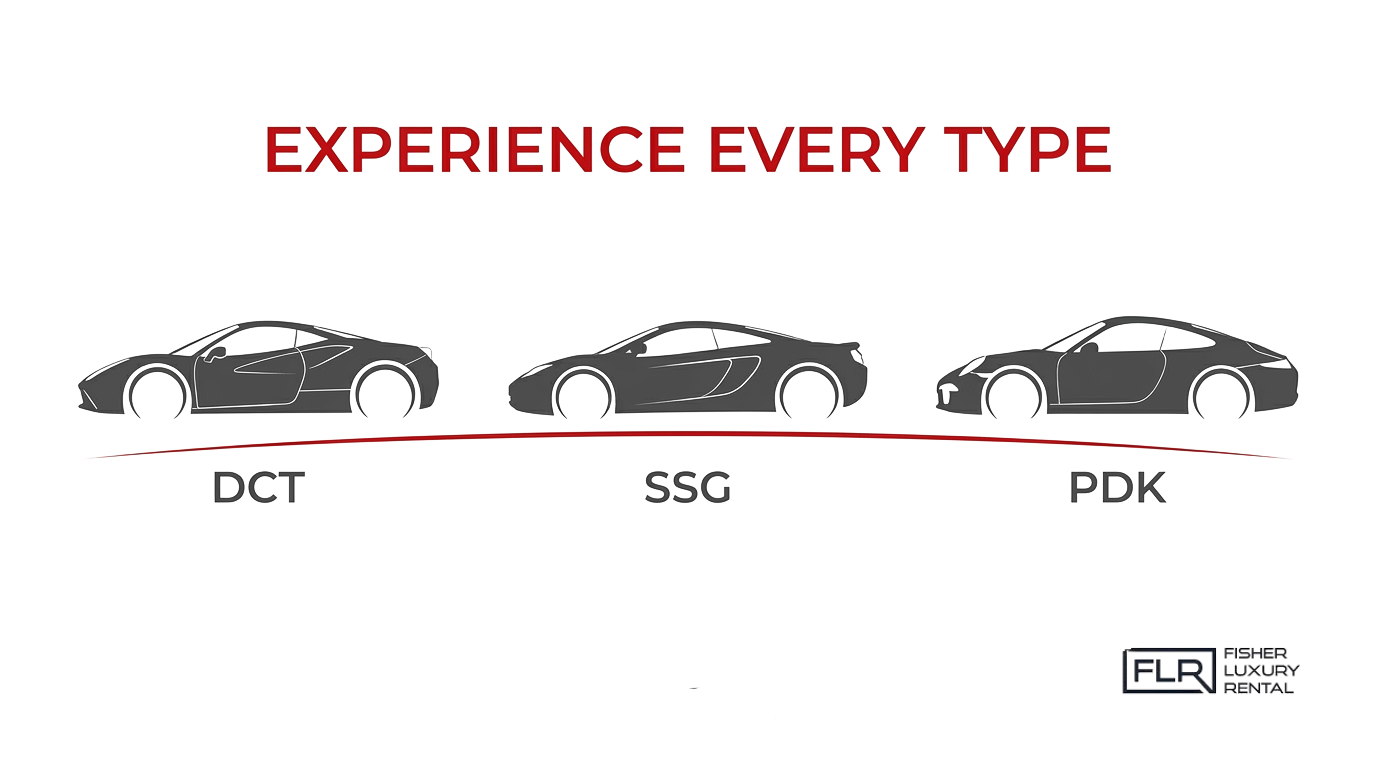
Yes, renting luxury cars from Fisher Luxury Rental lets you compare transmission types firsthand through direct seat time in vehicles like the Ferrari 488 Spider, McLaren 720S, and Porsche 911 Carrera S. Each model uses a distinct transmission architecture, from Ferrari’s paddle-shift dual-clutch system to Porsche’s PDK, giving drivers a real-world basis for comparison no specification sheet can replicate.
Exotic car rentals carry a premium over standard luxury rentals due to exclusivity, power, and brand appeal, and that premium buys access to engineering that most drivers never otherwise encounter. Fisher Luxury Rental’s fleet spans multiple transmission types across its lineup, making back-to-back comparisons genuinely achievable within a single rental period.
What Are the Key Takeaways About Transmission Types for Performance Vehicles?
The key takeaways about transmission types for performance vehicles are that each system involves a distinct trade-off between speed, engagement, and usability:
- Dual-clutch transmissions (DCT) deliver the fastest shifts and minimal torque interruption, making them the dominant choice in modern exotics such as Ferrari and McLaren models.
- Automated manual transmissions like Lamborghini’s ISR prioritize lightweight compactness and high-torque handling over everyday smoothness.
- Traditional manual transmissions sacrifice raw speed for driver involvement, remaining valued for the analog connection they preserve.
- Torque converter automatics offer seamless daily usability but generally trail DCTs in outright shift performance.
- Sequential gearboxes serve track-focused applications where durability and shift precision outweigh refinement.
Choosing the right transmission comes down to how and where you drive. For most performance enthusiasts, a DCT delivers the best blend of speed and accessibility, but nothing builds that instinct faster than driving the cars themselves.