
A car engine is a machine that converts fuel or electrical energy into mechanical energy, producing the rotational force that moves a vehicle. Engine type determines everything measurable about how a car behaves, from power output and fuel economy to exhaust note and towing capability.
This guide covers fuel source classifications, cylinder layouts, cylinder count, aspiration systems, stroke cycles, performance comparisons, real-world selection guidance, and the specific engines powering today’s most iconic exotic cars.
Gasoline, diesel, electric, hybrid, and hydrogen fuel cell engines each convert energy through distinct processes, which shapes their performance character at a fundamental level.
Cylinder layout, whether inline, V-type, flat, W-type, or rotary, determines how cylinders are physically arranged, affecting balance, packaging, and handling dynamics.
Cylinder count scales performance from compact three-cylinder efficiency to twelve-cylinder prestige, with each step up adding displacement, torque, and mechanical complexity.
Aspiration systems, covering naturally aspirated, turbocharged, supercharged, and twin-turbocharged configurations, define how air enters the combustion chamber and directly set the ceiling on power output and throttle response.
Stroke cycles, efficiency comparisons, and selection guidance for commuting, performance, and towing translate the technical distinctions into practical decisions.
The guide closes with the specific engines inside Lamborghini, Ferrari, McLaren, and Porsche models, and how renting an exotic car puts every configuration difference you have read about directly through the steering wheel.
What Is a Car Engine and Why Does the Engine Type Matter?
A car engine is a machine designed to convert one or more forms of energy into mechanical energy, providing the power necessary for a vehicle to function. Engine type matters because it directly determines performance, fuel efficiency, sound, and driving character. The sub-sections below cover how engines are defined, what displacement means, and why these distinctions shape every driving experience.
What Is a Car Engine?
A car engine is the mechanical heart of any vehicle, converting fuel or electrical energy into the rotational force that moves the car. According to Universal Technical Institute (UTI), the combustion cycle in an internal combustion engine consists of four distinct strokes: intake, compression, combustion, and exhaust. These strokes repeat thousands of times per minute, generating continuous mechanical output. Understanding this foundation is essential before comparing engine configurations.
Why Does Engine Type Matter?
Engine type matters because it governs every measurable aspect of a vehicle’s behavior, including power output, fuel consumption, towing capability, and exhaust note. Displacement, the total volume swept by all pistons in an engine and typically measured in liters or cubic centimeters, is one of the primary variables that differs across engine types. As Travis Langness of SlashGear observes, “Several impressive engines are being built today and these are being used in all sorts of vehicles. Supercars and sports cars are faster than ever.” Choosing the right engine type means aligning these variables with your specific driving goals.
What Are the Main Types of Car Engines by Fuel Source?
The main types of car engines by fuel source are gasoline, diesel, electric, hybrid, and hydrogen fuel cell. Each type converts energy differently, which directly shapes a vehicle’s performance, efficiency, and driving character.

Gasoline Engine
A gasoline engine is an internal combustion engine (ICE) that uses spark plugs to ignite a compressed air-fuel mixture, driving pistons through a four-stroke cycle of intake, compression, combustion, and exhaust. Most gasoline engines follow this four-stroke design, making them the most widely recognized powertrain layout on the road. According to Universal Technical Institute, diesel engines also use a four-stroke cycle but rely on high compression ratios rather than spark plugs to ignite the mixture, which distinguishes the two ICE types at a fundamental mechanical level.
Diesel Engine
A diesel engine is an internal combustion engine that ignites fuel through compression heat rather than a spark. This high-compression design generates strong low-RPM torque, making diesel engines well suited for towing, hauling, and long-distance driving where sustained pulling power matters more than peak horsepower.
Electric Motor
An electric motor powers a vehicle by converting electrical energy stored in a battery pack into mechanical energy, producing zero tailpipe emissions. Unlike ICE powertrains, electric motors deliver instant torque from a standstill, which creates rapid, linear acceleration without the need for a traditional transmission.
Hybrid Engine
A hybrid engine combines a conventional internal combustion engine with one or more electric motors, drawing on both power sources depending on driving conditions. This pairing improves fuel economy in stop-and-go traffic by allowing the electric motor to handle low-speed loads while the combustion engine takes over at higher speeds or under heavier demand.
Hydrogen Fuel Cell Engine
A hydrogen fuel cell engine generates electricity through a chemical reaction between hydrogen and oxygen, powering an electric motor with water vapor as the only byproduct. As UTI notes, ICE is the standard acronym for engines that burn fuel internally to convert chemical energy into mechanical energy; hydrogen fuel cell vehicles replace that combustion process entirely with an electrochemical one, producing no carbon emissions at the point of use.
What Are the Common Engine Configurations by Cylinder Layout?
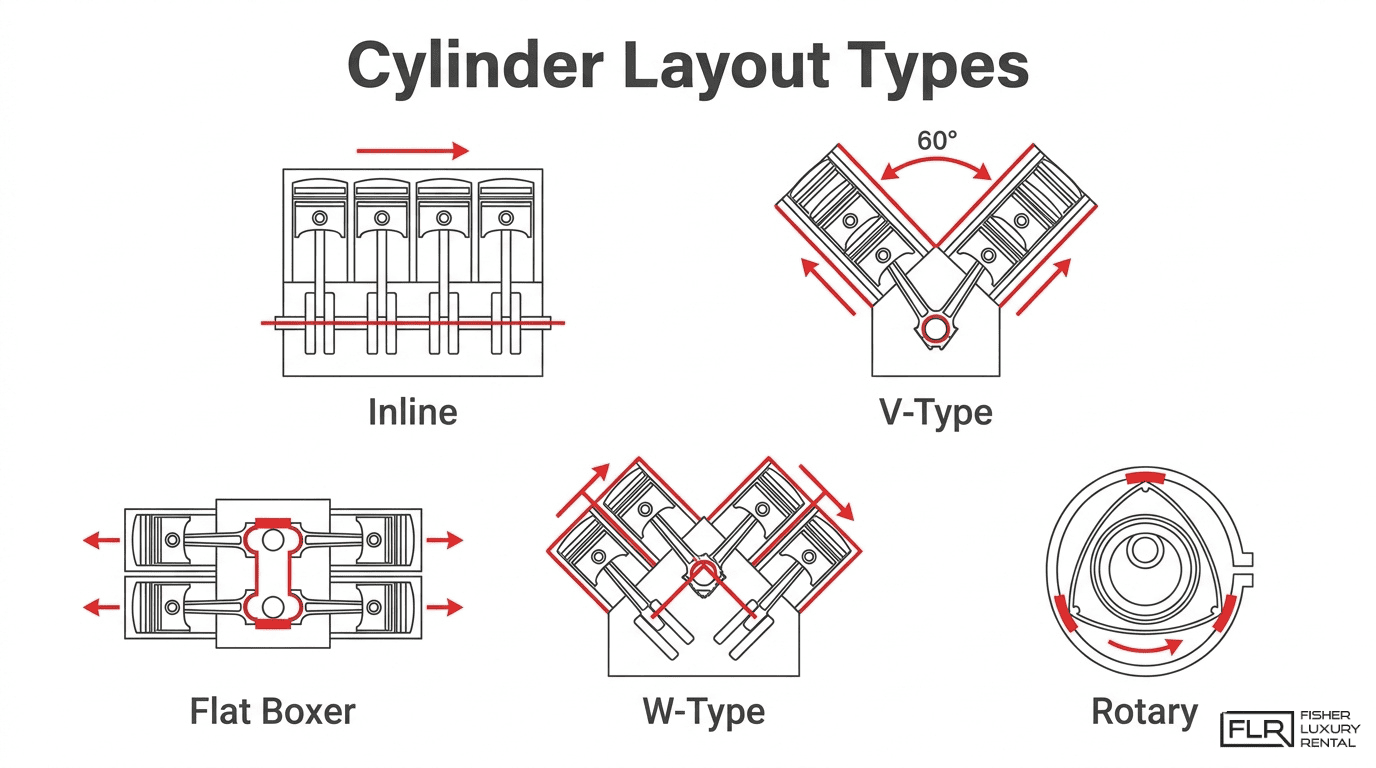
The common engine configurations by cylinder layout include inline, V-type, flat (boxer), W-type, and rotary (Wankel) designs. Each layout positions cylinders differently, affecting balance, size, performance, and where the engine fits within a vehicle’s chassis.
Inline Engine
The inline engine is a configuration where cylinders are arranged side-by-side in a single upright row. According to Universal Technical Institute, this layout is popular due to its compact design, making it straightforward to manufacture and easy to package in a vehicle’s engine bay. Three-cylinder inline engines, in particular, appear frequently in smaller vehicles and hatchbacks, where fuel economy is prioritized over outright power.
V-Type Engine
The V-type engine arranges cylinders in two angled banks that form a V-shape when viewed from the front. This layout allows more cylinders to fit within a shorter engine length compared to an inline design, which is why V6 and V8 configurations are common in high-performance and larger vehicles. The V-shape also distributes weight more evenly across the engine bay, improving handling balance.
Flat (Boxer) Engine
The flat engine, also called a boxer engine, has cylinders that lie horizontally opposite each other. Universal Technical Institute notes that this configuration offers a notably low center of gravity, which improves vehicle stability and cornering dynamics. A standout real-world example is the Porsche 911 GT3 (992), which uses a 4.0-litre flat-six producing 510PS (375kW) and an extraordinary per-litre output of 127.5PS, according to Goodwood. Few layouts can match the boxer’s contribution to handling feel at the limit.
W-Type Engine
The W-type engine combines three or four cylinder banks arranged in a W-shape, effectively merging two V-configurations onto a single crankshaft. This design packs a high cylinder count into a surprisingly short engine block, making it suitable for flagship luxury and performance vehicles where space inside the engine bay is at a premium.
Rotary (Wankel) Engine
The rotary engine, commonly called the Wankel engine, uses a triangular rotor spinning inside an oval-shaped housing rather than reciprocating pistons. This design is mechanically simpler, produces a smooth power delivery, and runs at high rpm with minimal vibration. Its compact, lightweight construction is its greatest engineering advantage, though higher fuel consumption and emissions remain practical limitations that have limited widespread adoption.
What Are the Types of Car Engines by Cylinder Count?
The types of car engines by cylinder count range from compact three-cylinder units to high-displacement twelve-cylinder powerplants. The sections below cover each configuration, including its typical application, performance profile, and notable examples.
Three-Cylinder Engine
A three-cylinder engine is a compact inline configuration commonly found in small vehicles and hatchbacks, prized for its fuel efficiency. Modern engineering has pushed this layout well beyond economy duty: according to SlashGear, the 2024 Toyota GR Corolla uses a 1.6-liter three-cylinder engine producing 300 horsepower, an extraordinary output of 187.5 hp per liter.
Four-Cylinder Engine
A four-cylinder engine is the most common engine configuration across the automotive market, covering vehicles from small economy cars to midrange sedans and crossovers. Its inline layout keeps packaging compact while delivering a practical balance of fuel economy and output, making it the default choice for everyday transportation worldwide.
Six-Cylinder Engine
A six-cylinder engine occupies the middle ground between efficiency and performance, available in both inline-six and V6 layouts. Inline-six designs are valued for their natural mechanical balance, while V6 configurations fit more easily into transverse engine bays. This count is standard in midsize trucks, sport sedans, and entry-level luxury vehicles.
Eight-Cylinder Engine
An eight-cylinder engine, almost always arranged in a V8 layout, delivers high displacement and strong torque across a broad RPM range. V8 engines power performance cars, full-size trucks, and muscle cars where towing capacity or outright power is the priority. The V8 remains the benchmark configuration for American performance and heavy-duty capability.
Ten-Cylinder Engine
A ten-cylinder engine typically uses a V10 layout, offering displacement and a distinctive exhaust character that sits between V8 aggression and V12 refinement. V10 engines appear in performance-focused sports cars and select high-output trucks, delivering a combination of high rev capability and significant torque that few other configurations match.
Twelve-Cylinder Engine
A twelve-cylinder engine, arranged as a V12, represents the pinnacle of multi-cylinder engineering, providing exceptional smoothness at high speeds due to its near-perfect primary and secondary balance. Twelve-cylinder layouts power flagship exotic and luxury vehicles where refinement, high-rpm output, and prestige are equally important alongside raw performance.
How Does Engine Aspiration Affect Performance?
Engine aspiration determines how an engine draws air into its cylinders, directly shaping its power output, responsiveness, and displacement requirements. The four main aspiration types are naturally aspirated, turbocharged, supercharged, and twin-turbocharged engines.
What Is a Naturally Aspirated Engine?
A naturally aspirated engine is one that draws air into its cylinders at normal atmospheric pressure, without any forced induction system. According to MAT Foundry Group, naturally aspirated engines tend to use larger displacements to compensate for the absence of extra boost. The Chevrolet Corvette Z06’s 5.5-liter LT6 V8 delivers 670 horsepower with no turbochargers or superchargers, making it one of the most powerful naturally aspirated engines ever built. The 2025 Lamborghini Revuelto pairs its 6.5-liter naturally aspirated V12 with three electric motors to produce 1,001 horsepower. Naturally aspirated engines reward drivers with linear throttle response and mechanical purity that forced induction can rarely replicate.
What Is a Turbocharged Engine?
A turbocharged engine is one that uses exhaust gas pressure to spin a compressor, forcing more air into the combustion chamber to increase power output. Turbochargers convert otherwise wasted exhaust energy into usable performance, making them an efficient path to higher horsepower from smaller displacements. They operate at speeds of up to 250,000 rpm, demanding precision engineering throughout.
What Is a Supercharged Engine?
A supercharged engine is one that uses a belt- or chain-driven compressor mounted at the air intake to force additional air into the engine. Unlike a turbocharger, a supercharger draws its power directly from the engine’s crankshaft, delivering immediate boost with no lag. This makes supercharged engines especially responsive at low rpm, producing strong power from a standing start.
What Is a Twin-Turbocharged Engine?
A twin-turbocharged engine is one that uses two separate turbochargers to compress intake air, typically one per cylinder bank in a V-configuration. This setup reduces the lag associated with a single large turbo, delivering quicker spool times and broader power across the rev range. The 2025 McLaren Artura’s twin-turbo V6 hybrid powertrain produces a combined 690 horsepower, illustrating how twin-turbo architecture supports both efficiency and high output in modern performance vehicles.
What Are the Different Engine Stroke Cycles?
Engine stroke cycles define how many piston strokes an engine requires to complete one full combustion sequence. The two principal cycles found in internal combustion engines are the two-stroke cycle and the four-stroke cycle, each with distinct mechanical processes and real-world applications.
Two-Stroke Engine
A two-stroke engine is an engine that completes one full combustion cycle in just two piston strokes: compression and combustion/exhaust happening in rapid succession. Because power fires on every revolution of the crankshaft, two-stroke engines generate high power relative to their size and weight. This makes them common in smaller equipment such as motorcycles, chainsaws, and marine outboards, where compactness and power density matter more than fuel efficiency. However, they consume more fuel and produce higher emissions than four-stroke alternatives, which limits their use in modern passenger cars.
Four-Stroke Engine
A four-stroke engine is an engine that completes one combustion cycle across four distinct piston strokes: intake, compression, combustion, and exhaust. According to Universal Technical Institute, most internal combustion engines use this four-stroke cycle, and diesel engines follow the same sequence, differing only by using high compression ratios rather than spark plugs to ignite the air-fuel mixture. The four-stroke design burns fuel more completely and produces lower emissions, making it the dominant architecture for passenger vehicles worldwide. For anyone evaluating car engine types, understanding the stroke cycle is foundational because it directly shapes fuel economy, power delivery, and emissions output.
How Do Engine Types Differ in Performance and Efficiency?
Engine types differ in performance and efficiency across three key dimensions: maximum horsepower output, fuel economy, and exhaust character. The following H3s compare leading configurations in each area.

Which Engine Type Delivers the Most Horsepower?
The engine type that delivers the most horsepower is the large-displacement V12, found in flagship exotic cars. The four-cylinder is the most common configuration, offering balanced output for everyday vehicles, while V12 engines sit at the top of the power hierarchy. According to Ferrari, the 2024 Ferrari 12Cilindri is powered by a 6.5 L F140 HD V12 engine that delivers 819 hp at a top speed of 9,500 rpm. For maximum horsepower, displacement and cylinder count matter most, making V12 and high-displacement V8 configurations the benchmark for performance-focused buyers.
Which Engine Type Offers the Best Fuel Efficiency?
The engine type that offers the best fuel efficiency is the hybrid powertrain, which pairs a gasoline engine with an electric motor to recapture energy during braking. According to SlashGear, front-wheel drive Toyota Prius models are rated as high as 57 mpg combined by the EPA in 2024, far exceeding any purely combustion-based alternative. Even performance-oriented hybrids balance output and economy better than traditional gasoline engines alone. For daily driving, a hybrid engine remains the strongest choice when fuel costs are a priority.
Which Engine Type Produces the Best Exhaust Sound?
The engine type that produces the best exhaust sound is the high-revving, naturally aspirated V8 or V12. The combustion cycle, consisting of intake, compression, combustion, and exhaust strokes, generates the acoustic character drivers recognize. Turbochargers, while boosting power by using exhaust gas pressure to force more air into the engine, muffle some of the raw exhaust note compared to naturally aspirated configurations. For pure, unfiltered sound, naturally aspirated engines with large cylinder counts remain unmatched.
With a clear picture of how engine types compare on power, efficiency, and sound, choosing the right configuration becomes a much more informed decision.
How Do You Choose the Right Engine Type for Your Needs?
Choosing the right engine type depends on your primary use case: daily commuting, high-performance driving, or towing. The sections below cover the best engine match for each scenario.
What Engine Type Is Best for Daily Commuting?
The best engine type for daily commuting is a four-cylinder gasoline or hybrid engine. Four-cylinders are the most common configuration across small to midrange vehicles, balancing fuel economy with adequate output for stop-and-go traffic. Hybrid engines add an electric motor to reduce fuel consumption further, making them well-suited for urban driving patterns where regenerative braking recovers energy. For most commuters, prioritizing a turbocharged four-cylinder hybrid over a larger displacement engine yields meaningfully lower running costs without sacrificing drivability.
What Engine Type Is Best for High-Performance Driving?
The best engine type for high-performance driving is a V-type engine. According to Universal Technical Institute, V-engines arrange their cylinders in a V-shape when viewed from the front, a configuration commonly found in high-performance models because it accommodates more cylinders within a compact footprint while supporting higher displacement and power output. V8 and V12 engines dominate track-focused and exotic cars precisely for this reason. If pure performance is the goal, a large-displacement, naturally aspirated V-engine delivers the most linear and responsive power delivery.
What Engine Type Is Best for Towing and Heavy Loads?
The best engine type for towing and heavy loads is a diesel or large-displacement gasoline V8. Diesel engines produce excellent low-RPM torque, which is ideal for pulling heavy equipment without straining the drivetrain, while gasoline engines offer smoother acceleration for lighter trailering. According to Merchants Fleet, the Ford F-150 achieves a towing capacity of up to 13,500 lbs, making it a benchmark in the half-ton truck segment. For serious hauling, diesel torque characteristics make it the more practical long-term choice.
What Engine Types Power Today’s Most Iconic Exotic Cars?
Iconic exotic cars use a mix of naturally aspirated V12s, turbocharged V8s, hybrid twin-turbo V6s, and high-revving flat-six engines. The sections below cover Lamborghini, Ferrari, McLaren, and Porsche in detail.
What Engines Do Lamborghini Models Use?
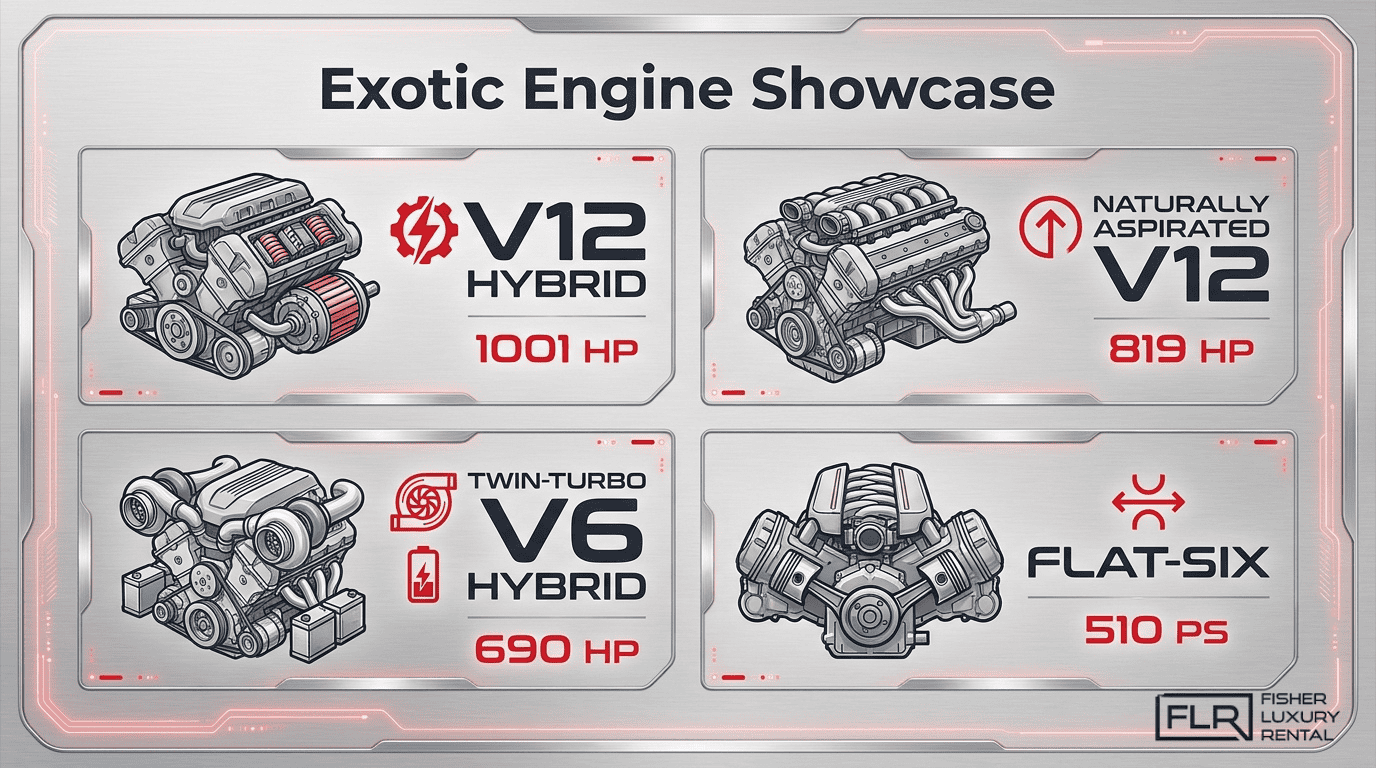
Lamborghini models use naturally aspirated V12 engines paired with hybrid electric systems in their flagship lineup. The 2025 Lamborghini Revuelto features a 6.5-liter naturally aspirated V12 combined with three electric motors, producing a combined 1,001 horsepower (747 kW), according to Lamborghini’s official specifications. That output makes the Revuelto one of the most powerful production cars available today. The hybrid architecture extends Lamborghini’s V12 legacy while meeting modern efficiency demands, a balance that signals where the brand is heading.
What Engines Do Ferrari Models Use?
Ferrari models use high-revving naturally aspirated V12 engines in their most celebrated configurations. The 2024 Ferrari 12Cilindri is powered by a 6.5-liter F140 HD V12 engine delivering 819 hp at a screaming top speed of 9,500 rpm, per Ferrari’s official model page. Few production engines match that combination of displacement and redline, making the 12Cilindri a benchmark for naturally aspirated performance.
What Engines Do McLaren Models Use?
McLaren models use twin-turbocharged engines, often paired with hybrid systems for maximum output. The 2025 McLaren Artura uses a twin-turbo V6 plug-in hybrid powertrain producing a combined 690 horsepower and 531 lb-ft of torque, according to Car and Driver. This PHEV configuration gives the Artura instant electric torque alongside the responsiveness of forced induction, making it one of the most technically advanced supercars in McLaren’s current lineup.
What Engines Do Porsche Models Use?
Porsche models use flat-six engines in their most iconic configurations, particularly in the 911 lineup. According to Goodwood, the Porsche 911 GT3 (992) features a 4.0-liter naturally aspirated flat-six producing 510 PS (375 kW), with individual throttle bodies and a class-leading output of 127.5 PS per liter. The flat-six layout lowers the center of gravity, a key factor in the 911’s legendary handling balance.
How Can You Experience Different Engine Types Firsthand?
Experiencing different engine types firsthand means getting behind the wheel of cars that represent each configuration. The two H3s below cover exotic car rental as a direct path to that experience and distill the key takeaways from this complete guide.
Can Renting an Exotic Car Let You Feel the Difference?
Yes, renting an exotic car lets you feel the difference between engine types in a way no specification sheet can replicate. A naturally aspirated V12 in a Ferrari 488 Spider delivers a linear, screaming power build to redline, while the twin-turbocharged V8 in a McLaren 720S surges with forced-induction urgency from low RPM. The Porsche 911 Carrera S offers the distinctive character of a rear-mounted flat-six, balancing precision with an unmistakable exhaust note. Fisher Luxury Rental carries all three platforms, starting at $599, $1,299, and $499 per day respectively, making back-to-back comparison genuinely accessible. No amount of reading substitutes for feeling these differences through the seat and steering wheel.
What Are the Key Takeaways About Car Engine Types?
The key takeaways about car engine types are that configuration, aspiration, cylinder count, and fuel source each shape a fundamentally different driving experience. The most actionable conclusions from this guide are:
- Cylinder layout determines character: Inline engines prioritize compactness, V-engines balance power and packaging, and flat-six engines lower the center of gravity for superior handling.
- Aspiration defines power delivery: Naturally aspirated engines reward high-RPM driving with linear response; turbocharged engines build boost for strong mid-range pull; supercharged engines deliver instant torque from idle.
- Cylinder count scales performance: Four-cylinders serve daily efficiency, V8s and V10s serve performance, and V12s serve maximum prestige and output.
- Fuel source sets the entire operating envelope: Gasoline rewards spirited driving, diesel prioritizes torque and range, and hybrid systems layer electric efficiency onto combustion performance.
Fisher Luxury Rental’s fleet spans naturally aspirated, turbocharged, and hybrid exotic platforms across Phoenix and Portland, letting you move from reading to experiencing.