Paddle shifters are driver-operated controls mounted behind the steering wheel that allow manual gear selection without a clutch pedal, connecting to electrohydraulic or shift-by-wire systems to deliver shift speeds and driver engagement no traditional gearbox can match.
This guide covers how paddle shifters work and evolved, the core technologies defining modern exotic systems, how those systems differ across leading brands, the materials shaping paddle construction, and how these advancements translate into real driving performance on track, across driving modes, and into hybrid and electric applications.
Paddle shifters originated in John Barnard’s 1989 Ferrari 640 Formula 1 car and reached road vehicles by 1992, with dual-clutch transmissions later pushing shift times to as low as 50 milliseconds in the Lamborghini Aventador’s AMT.
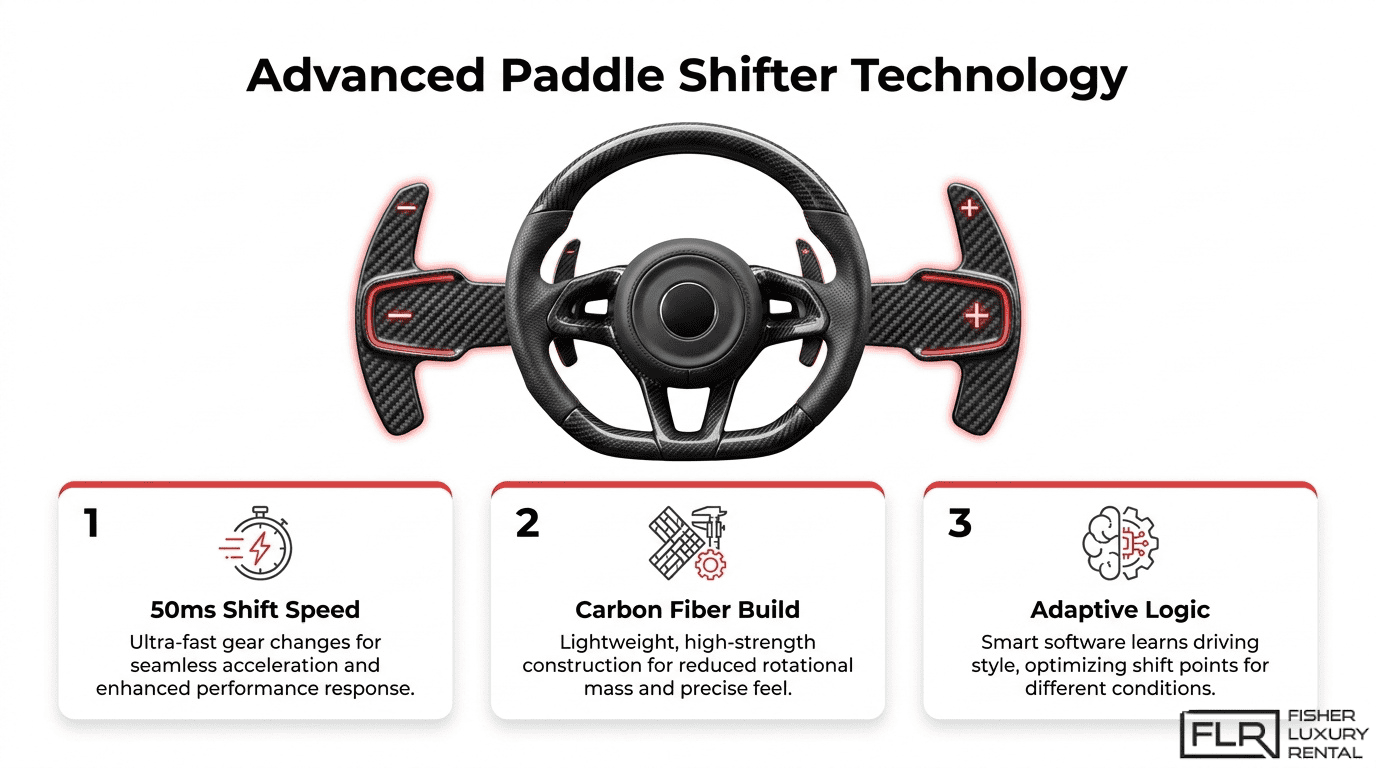
Modern exotic cars layer adaptive shift logic, haptic feedback, rev-matching, and electrohydraulic actuation onto that mechanical foundation, turning paddles into intelligent co-pilots rather than simple switches. Ferrari’s SF90 XX Stradale uses patented gear-shift algorithms to optimize combustion pressure cycles in real time, while McLaren’s SSG pre-loads the clutch on light paddle pressure so full pressure completes the shift almost instantaneously.
Carbon fiber, forged aluminum, and titanium each serve a distinct role in paddle construction, with carbon fiber delivering the highest stiffness-to-weight ratio and the clearest tactile feedback under high-frequency inputs.
In hybrid and electric exotics, paddles extend beyond gear selection entirely, controlling regenerative braking intensity and blending combustion and electric power outputs. The Porsche Taycan’s recuperation system alone generates up to 290 kilowatts during braking through paddle-managed regen.
What Are Paddle Shifters and How Do They Work in Exotic Cars?
Paddle shifters are driver-operated controls mounted behind the steering wheel that allow manual gear selection without a clutch pedal. In exotic cars, they connect to sophisticated electrohydraulic or shift-by-wire systems, delivering shift speeds and driver engagement far beyond what any traditional manual gearbox can offer. The sections below cover how they are defined, how they function mechanically, and what makes them unique in high-performance vehicles.
What Are Paddle Shifters?
Paddle shifters are lever-shaped controls positioned behind the steering wheel, used to manually upshift or downshift a vehicle’s transmission. The right paddle typically commands an upshift; the left commands a downshift. Rather than requiring a driver to depress a clutch pedal, the system handles clutch actuation electronically, allowing the driver to stay focused on throttle and steering inputs.
How Do Paddle Shifters Work Mechanically?
Paddle shifters work by sending an electronic signal to the transmission control unit, which then actuates the gear change through an electrohydraulic or shift-by-wire system. According to Ferrari, this electrohydraulic actuation replaces the driver’s foot on the clutch pedal entirely, enabling gearshifts in as little as 150 milliseconds. The Journal of Advanced Applied Sciences confirms that modern shift-by-wire systems have fully replaced traditional mechanical linkages with electronically controlled gear selection, eliminating the physical connection between paddle and gearbox.
What Makes Paddle Shifters Different in Exotic Cars?
Paddle shifters in exotic cars differ from mainstream vehicles in their placement, construction, and integration depth. There are two primary mounting configurations: column-mounted paddles, which stay fixed to the steering column regardless of steering lock, and wheel-mounted paddles, which rotate with the steering wheel. In exotic cars, wheel-mounted paddles are standard because they keep upshift and downshift controls always within reach at the driver’s fingertips, regardless of cornering angle. The systems are also integrated with electronic differentials, launch control, and adaptive driving modes in ways that mainstream vehicles never approach.
How Have Paddle Shifters Evolved in High-Performance Vehicles?
Paddle shifters have evolved from hydraulic Formula 1 prototypes into sophisticated electronically controlled systems found in modern exotic cars. The sections below trace that evolution: from early F1 origins, through the DCT revolution, to today’s software-driven shift optimization.

How Did Early Formula 1 Technology Influence Road Car Paddle Shifters?
Early Formula 1 technology influenced road car paddle shifters by demonstrating that clutchless, hydraulically automated gear changes were mechanically viable at the highest performance level. John Barnard pioneered the paddle-shift semi-automatic gearchange system in the 1989 Ferrari 640 F1 car, using hydraulics to automate both the gearchange and clutch operation. That racing breakthrough translated directly to production vehicles: by 1992, the Ferrari Mondial T featured an automatic clutch with electronic control of an electro-mechanical actuator, making it one of the earliest road cars to carry paddle-shift-derived technology.
How Did the Shift from Sequential Manual to DCT Change Paddle Shifters?
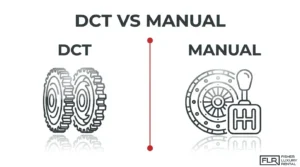
The shift from sequential manual gearboxes to dual-clutch transmissions changed paddle shifters by making gear changes dramatically faster and mechanically seamless. DCT architecture allows the next gear to be prepared while the current one remains engaged, completing a shift simply by opening one clutch and closing the other. According to Ferrari, the electrohydraulic paddle shift system achieves gearshifts in 150 milliseconds, eliminating the need for a driver’s foot on the clutch pedal entirely.
Modern exotic brands have since pushed DCT-based shift times even further:
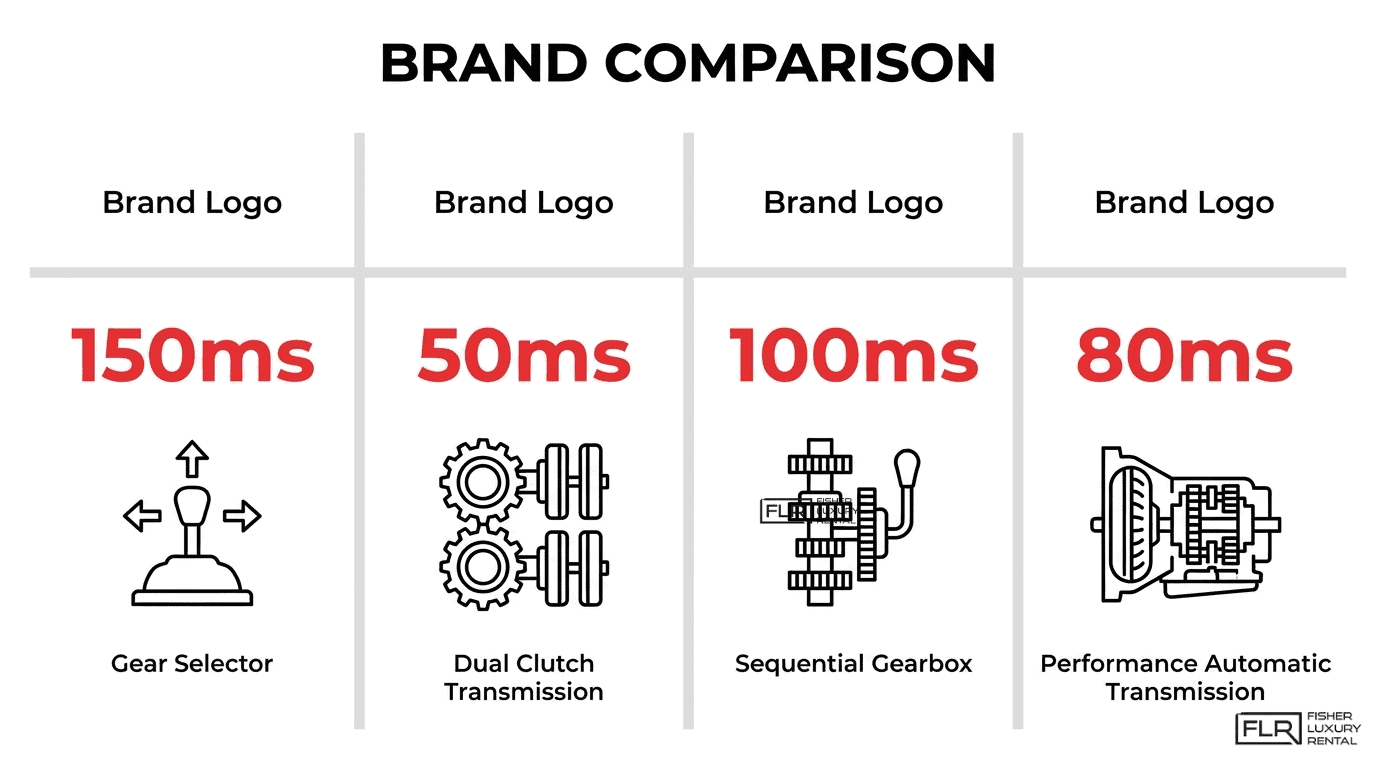
- Lamborghini Aventador AMT: 50-millisecond shift time via a 7-speed Automated Manual Transmission.
- Mercedes-AMG Speedshift MCT: 100-millisecond shifts in Manual mode, replacing the torque converter with a wet start-off clutch.
- Porsche PDK (Doppelkupplung): Nearly imperceptible shifts, with two clutch packs engaging successive gears in tandem.
- McLaren SSG: A “pre-cog” facility where light paddle pressure pre-engages the next gear, completing the shift in a fraction of normal time on full pressure.
The global automotive paddle shifter system market reflects this momentum, valued at $4.2 billion in 2025 and projected to reach $7.8 billion by 2034 at a CAGR of 7.1%, according to DataIntelo. DCT technology is clearly the dominant architecture driving that growth.
How Have Electronic and Software Advances Improved Shift Speed?
Electronic and software advances have improved shift speed by enabling the transmission, clutch, and differential to operate as a coordinated system rather than independent mechanical components. The Ferrari E-Diff, for example, integrates directly with the F1-paddle shift system to vary torque distribution during high-speed cornering, optimizing traction alongside each shift event. According to Mike Everitt, MD of Vocis, the secret to smooth DCT shifting is “a highly-optimised interaction between the software and the hardware” to ensure responses are “quick, accurate, consistent and progressive.” Software coordination is arguably where the biggest gains now live: the mechanical limits of actuator speed have nearly been reached, making calibration the true competitive frontier.
What Paddle Shifter Technologies Define Modern Exotic Cars?
Modern exotic cars combine several advanced paddle shifter technologies, including adaptive shift logic, haptic feedback systems, rev-matching, electrohydraulic actuation, and launch control integration, each sharpening the connection between driver intent and mechanical response.

What Is Adaptive Shift Logic in Exotic Car Paddle Shifters?
Adaptive shift logic is a software-driven system that uses engine torque signals, vehicle speed, and acceleration data to learn individual driving styles and determine optimal shift points for either efficiency or performance. Rather than applying fixed shift parameters, the system adjusts continuously to match the driver’s behavior. A compelling example is the Ferrari SF90 XX Stradale, which uses patented gear-shift logic first introduced on the Ferrari Daytona SP3 to deliver more engaging dynamic acceleration profiles through optimized combustion chamber pressure cycles. This kind of machine-learning integration represents the clearest signal that paddle shifters have become intelligent co-pilots, not just mechanical switches.
What Are Haptic Feedback Paddle Shifters?
Haptic feedback paddle shifters are systems that convey tactile or kinesthetic information through the steering wheel, pedals, or seats to improve driver awareness and safety during manual gear changes. By translating shift events into physical sensation, the system closes the feedback loop that traditional mechanical linkages once provided. According to Strategic Market Research, the automotive haptic feedback system market is projected to reach $2.1 billion by 2024, driven by the integration of tactile interfaces in high-performance vehicle interiors. For exotic car drivers, this technology restores an intuitive, physical dimension to what is otherwise a fully electronic interaction.
What Is Rev-Matching Technology in Paddle Shifter Systems?
Rev-matching technology is an automatic function within paddle shifter systems that blips the throttle during downshifts to synchronize engine speed with transmission speed, eliminating driveline shock and maintaining vehicle stability. In high-performance driving, unsynchronized downshifts can unsettle the chassis under braking. Integrated rev-matching removes the need for heel-toe technique, allowing drivers to focus entirely on braking and cornering inputs without sacrificing smoothness or mechanical protection.
What Are Electrohydraulic Actuation Systems in Paddle Shifters?
Electrohydraulic actuation systems are the mechanical foundation of many exotic car paddle shifter setups, using hydraulic pressure controlled by electronic signals to execute clutch engagement and gear selection faster than any driver’s foot could. According to research published in the Journal of Mechanical Science and Technology, electro-hydraulic actuators for dual-clutch transmissions are modeled using physics-based control synthesis to optimize shifting performance in hybrid electric high-performance vehicles. This physics-based approach to actuator tuning is what separates a precisely calibrated exotic car shift event from a generic automated gearbox.
What Is Launch Control Integration with Paddle Shifters?
Launch control integration is a feature that works alongside paddle shifter systems to manage wheelspin, clutch engagement, and power delivery at standing starts for maximum acceleration. Paddle shifters function as the interface for shift-by-wire (SbW) systems, which have replaced traditional mechanical linkages with fully electronically controlled gear selection, according to the Journal of Advanced Applied Sciences. During a launch sequence, the SbW system takes sequential control of gear progression, allowing the driver to focus entirely on steering. Together, these technologies make the difference between a fast start and a perfectly optimized one.
How Do Paddle Shifter Systems Differ Across Exotic Car Brands?
Paddle shifter systems differ across exotic car brands in transmission architecture, shift speed, and control philosophy. The H3s below compare Ferrari against Lamborghini, McLaren against Porsche, and Aston Martin against Mercedes-AMG.
How Do Ferrari Paddle Shifters Perform Compared to Lamborghini?
Ferrari paddle shifters perform through a tightly integrated electrohydraulic F1-derived system, while Lamborghini paddle shifters perform through a 7-speed Automated Manual Transmission (AMT) capable of 50-millisecond shift times. Ferrari’s approach pairs paddle inputs with the E-Diff electronic differential, varying torque distribution through corners to sharpen response rather than simply accelerating gearchanges. Lamborghini also applies Forged Composites technology to hardware construction, producing shifter components with complex geometries that are lighter and more resistant than conventional materials. Both philosophies prioritize engagement, but Lamborghini’s AMT architecture trades some smoothness for raw mechanical immediacy.
How Do McLaren Paddle Shifters Compare to Porsche Systems?
McLaren paddle shifters compare to Porsche systems most sharply in pre-shift preparation. The McLaren SSG features a “pre-cog” facility: light pressure on the paddle engages the next gear and loads the clutch, so full pressure completes the shift almost instantaneously. Porsche’s Doppelkupplung (PDK) uses two transmission shafts in tandem, with one clutch pack already holding the next gear while the other remains engaged, producing nearly imperceptible shift times without requiring driver pre-loading. According to Mike Everitt, MD of Vocis, smooth DCT shifting depends on “a highly-optimised interaction between the software and the hardware” to keep responses “quick, accurate, consistent and progressive.” In practice, McLaren rewards deliberate driver technique; PDK delivers seamless speed with less conscious input.
How Do Aston Martin Paddle Shifters Differ from Mercedes-AMG?
Aston Martin paddle shifters differ from Mercedes-AMG systems primarily in clutch architecture and shift-mode tuning. Mercedes-AMG’s Speedshift MCT (Multi-Clutch Technology) replaces the traditional torque converter with a wet start-off clutch, enabling 100-millisecond shifts in Manual mode while retaining smooth low-speed behavior. Aston Martin applies ZF 8-speed torque-converter automatics with paddle actuation, prioritizing grand-touring refinement over outright shift aggression. The MCT’s wet clutch gives AMG models a more mechanical, sport-focused character that suits track use, whereas Aston Martin’s setup favors linear, progressive response across a wider range of driving conditions. For drivers choosing between the two, the defining variable is whether immediacy or composure matters more.
What Materials Are Used in Advanced Exotic Car Paddle Shifters?
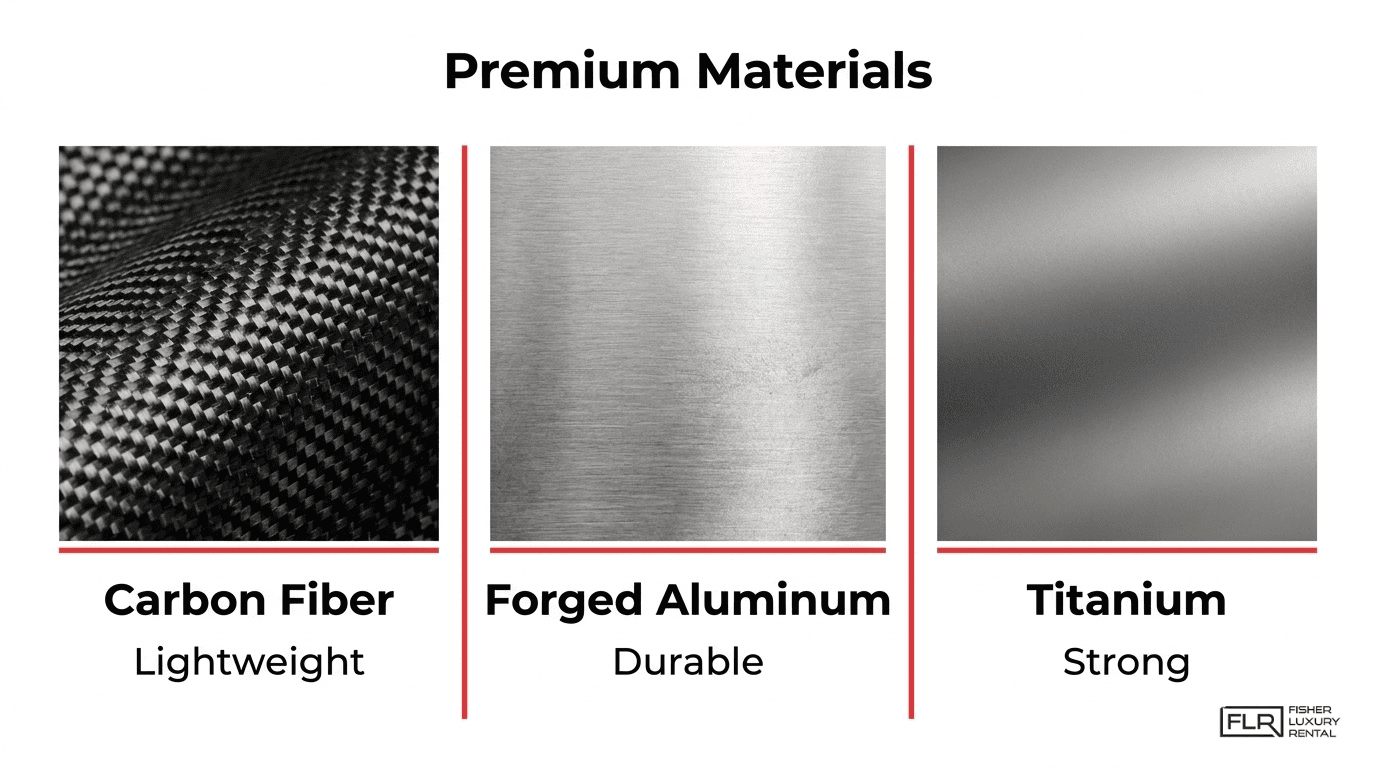
The materials used in advanced exotic car paddle shifters are carbon fiber, forged aluminum, and titanium, each chosen for a specific balance of weight, rigidity, and tactile response. The sections below cover how each material contributes to performance feel, durability, and structural efficiency.
How Do Carbon Fiber Paddle Shifters Enhance Performance Feel?
Carbon fiber paddle shifters enhance performance feel by combining an exceptional strength-to-weight ratio with distinct tactile feedback that aluminum and plastic cannot replicate. Carbon fiber-reinforced polymers transmit shift inputs with minimal flex, so the driver receives an immediate, precise response at the fingertip rather than a dampened or vague sensation.
Lamborghini’s Forged Composites technology extends this advantage further. According to Automobili Lamborghini’s Huracan Performante technical overview, Forged Composites allows engineers to produce components with complex geometries that are simultaneously lighter and more resistant than traditional materials, making it possible to shape paddles that conform ergonomically to the driver’s fingers without sacrificing rigidity.
From a materials engineering standpoint, carbon fiber is the benchmark choice for paddle shifters in flagship exotic cars precisely because no other material delivers the same combination of low mass, high stiffness, and sensory clarity under high-frequency inputs.
How Do Forged Aluminum Paddle Shifters Improve Durability?
Forged aluminum paddle shifters improve durability by using a grain-aligned microstructure produced during the forging process, which resists cracking and fatigue under repeated mechanical stress far better than cast or machined aluminum. The forging process eliminates internal voids, creating a denser part that maintains dimensional stability even after thousands of shift cycles. Forged aluminum also tolerates heat exposure well, an important quality in high-performance cabins where interior temperatures rise significantly during track use. Its machinability allows manufacturers to achieve tight tolerances on contact surfaces, producing consistent actuation feel over the component’s lifespan.
How Do Titanium Paddle Shifters Balance Weight and Strength?
Titanium paddle shifters balance weight and strength by offering a density roughly 40% lower than steel while maintaining comparable tensile strength, placing them between carbon fiber and steel on the performance material spectrum. Research from the WSU Research Exchange confirms that high-performance titanium alloys are used in automotive applications requiring a high strength-to-weight ratio, though they demand specific machining parameters that add manufacturing complexity compared to carbon fiber. In practice, titanium paddles appeal to manufacturers seeking a metallic tactile quality and premium aesthetic without the mass penalty of steel, making them a natural choice for ultra-luxury and limited-production exotic interiors where both feel and weight savings matter equally.
With material selection directly shaping how a paddle feels and lasts, understanding the transmission systems those paddles control reveals the full picture of exotic car shifting performance.
What Role Do Paddle Shifters Play in Dual-Clutch Transmissions?
Paddle shifters play the role of driver-controlled interfaces that command gear changes within a dual-clutch transmission (DCT), allowing instant upshifts and downshifts without interrupting power delivery. The DCT architecture handles clutch engagement automatically, while the paddle translates driver intent into precise electromechanical action.
The McLaren SSG illustrates how tightly paddle input and DCT hardware can be integrated. Its “pre-cog” facility lets light paddle pressure engage the next gear and pre-load the clutch, so full pressure completes the shift in a fraction of normal time. According to Mike Everitt, MD of Vocis, the secret to smooth DCT shifting is “a highly-optimised interaction between the software and the hardware” to ensure responses are “quick, accurate, consistent and progressive.”
In practice, the paddle shifter does not simply send a binary on/off signal. It triggers a coordinated sequence: the transmission control unit reads the input, opens the active clutch, closes the pre-selected clutch, and confirms gear engagement, all within milliseconds. This tight software-hardware coupling is what separates a truly responsive exotic car DCT from a hesitant dual-clutch system found in mass-market vehicles.
How Do Paddle Shifters Enhance the Driving Experience on Track?
Paddle shifters enhance the driving experience on track by giving drivers direct, instantaneous control over gear selection without removing their hands from the steering wheel. The sections below cover driver focus, shift precision, and rev-matching benefits in a track environment.
How Do Paddle Shifters Keep Drivers Focused During High-Speed Cornering?
Paddle shifters keep drivers focused during high-speed cornering by eliminating the need to operate a clutch pedal, freeing full mental attention for braking points and steering inputs. According to Ferrari, the electrohydraulic paddle shift system completes gear changes in 150 milliseconds, reducing the cognitive load that manual clutch operation would otherwise demand at high speed. With both hands fixed on the wheel and both feet available for braking and throttle modulation, a driver can process corner entry and exit without interruption. For track driving specifically, this division of inputs is not a luxury — it is a measurable safety and performance advantage.
How Does Shift Speed Improve Lap Times Through Paddle Shifters?
Shift speed improves lap times through paddle shifters by minimizing the time the engine spends outside its optimal power band during acceleration. The Lamborghini Aventador’s 7-speed AMT achieves shift times of just 50 milliseconds, a margin so narrow that power delivery remains virtually unbroken between gears. Faster shifts mean shorter intervals of reduced torque on corner exits, which directly translates to improved drive-out speed and lower cumulative lap times. Every millisecond of uninterrupted power delivery compounds across a full lap.
How Does Rev-Matching Through Paddle Shifters Stabilize the Car Under Braking?
Rev-matching through paddle shifters stabilizes the car under braking by automatically blipping the throttle to match engine speed to the lower gear before the clutch engages. Without rev-matching, a downshift under braking causes a sudden jolt of engine braking that can unsettle rear traction. Automated rev-matching, managed through the paddle system’s onboard software, eliminates this instability and allows drivers to downshift confidently while trail-braking deep into corners. This makes track driving more consistent and repeatable, which is precisely what separates fast laps from merely quick ones.
Can Paddle Shifters Improve Lap Times Compared to Fully Automatic Modes?
Yes, paddle shifters can improve lap times compared to fully automatic modes by giving the driver direct control over shift timing, allowing gear changes to be optimized for each corner entry, apex, and exit. The sub-sections below cover how shift timing, brake points, and cornering strategies each contribute to faster laps.
How Does Manual Shift Timing Give Drivers a Lap Time Advantage?
Manual shift timing gives drivers a lap time advantage by allowing upshifts and downshifts to occur at the precise RPM peak for maximum torque delivery, rather than at the transmission’s generalized automatic logic point. Fully automatic modes prioritize smoothness and fuel efficiency, which can cause premature upshifts before the power band is fully exploited on track exits.
The Lamborghini Aventador’s 7-speed AMT achieves shift times of just 50 milliseconds, meaning driver-initiated shifts via paddle carry virtually no mechanical penalty while restoring full timing control to the driver.
How Do Paddle Shifters Help with Braking Zones on a Race Track?
Paddle shifters help with braking zones by enabling sequential downshifts timed precisely to the vehicle’s deceleration rate, keeping the engine within the optimal RPM range for corner entry. Automatic mode cannot consistently replicate this because its logic is calibrated for road driving, not threshold braking profiles on track.
Rev-matching technology built into modern exotic car transmissions blunts the skill barrier further, blipping the throttle automatically during each paddle-initiated downshift to prevent rear-wheel instability under heavy braking.
How Do Paddle Shifters Optimize Cornering and Exit Acceleration?
Paddle shifters optimize cornering and exit acceleration by letting the driver select the exact gear that keeps the engine at peak torque output through the apex and onto the straight. Holding a gear through a corner with a paddle command prevents the automatic mode from hunting for a higher gear mid-turn, which can unsettle chassis balance.
According to Ferrari, adaptive gear-shift logic on the SF90 XX Stradale uses patented algorithms derived from the Ferrari Daytona SP3 to optimize combustion chamber pressure cycles for more dynamic acceleration profiles, a system that works most effectively when driver input and software logic operate together rather than the transmission making all decisions independently.
What Are Common Paddle Shifter Driving Modes in Exotic Cars?
Common paddle shifter driving modes in exotic cars are Sport, Race (or Corsa), and Comfort. Each mode reconfigures shift timing, throttle response, and transmission behavior to suit different driving conditions and driver preferences.
What Does Sport Mode Do to Paddle Shifter Response?
Sport mode sharpens paddle shifter response by reducing shift latency and holding gears longer before automatic upshifts. The transmission prioritizes engine output over fuel economy, keeping the powertrain in its optimal rev range more aggressively. Throttle mapping tightens, so paddle inputs translate into faster, more decisive gear changes. Sport mode is the practical middle ground for drivers who want noticeably quicker response without the extreme stiffness of full race settings, making it well-suited for spirited road driving rather than dedicated track use.
What Does Race or Corsa Mode Change for Paddle Shifter Behavior?
Race or Corsa mode transforms paddle shifter behavior by disabling or overriding automatic upshifts entirely, placing full gear selection responsibility with the driver. Shift times compress to their minimum thresholds, and the transmission holds each gear to the rev limiter unless the driver pulls the paddle. Suspension, stability control, and exhaust systems typically reconfigure simultaneously. According to Lamborghini, the Aventador’s AMT achieves shift times of just 50 milliseconds in its most aggressive setting, illustrating how Race mode extracts the system’s absolute performance ceiling for track environments.
What Happens When You Use Paddle Shifters in Comfort Mode?
Paddle shifters in Comfort mode remain functional but operate within a softer, more lenient transmission map. The system permits manual override via the paddles, yet it will still execute automatic upshifts earlier to prioritize smoothness and low engine noise. Throttle response softens, shift quality becomes more gradual, and the transmission may revert to full automatic control after a brief period of paddle inactivity. Comfort mode is best suited for urban driving or long highway stretches where driver fatigue is a concern, though seasoned drivers will find that paddle engagement in this mode feels noticeably less immediate than in Sport or Race settings.
What Should Beginners Know Before Using Paddle Shifters?
Beginners should know that paddle shifters require active driver involvement: the right paddle upshifts, the left paddle downshifts, and no clutch pedal is needed. The sections below cover timing, mode selection, and the most common mistakes first-time users make.
How Do You Upshift and Downshift with Paddle Shifters?
Upshifting with paddle shifters is done by pulling the right paddle, while downshifting is done by pulling the left paddle. In most exotic cars, a brief, deliberate pull registers the shift command immediately. Beginners often tap too lightly or hold the paddle too long; a firm, short pull delivers the cleanest response. Because modern systems like Porsche’s PDK execute shifts in nearly imperceptible time, gear changes feel almost instant once the input is correct.
When Should Beginners Shift Gears Using Paddle Shifters?
Beginners should shift gears using paddle shifters when the engine reaches the upper third of its RPM range for upshifts, and before entering a corner for downshifts. Watching the tachometer is the most reliable guide at first. Downshifting too late into a corner loads the rear wheels abruptly, which is especially consequential in high-powered exotics. Starting in Sport mode rather than Race mode gives the adaptive shift logic more room to compensate for imprecise timing while building confidence.
What Are the Most Common Mistakes Beginners Make with Paddle Shifters?
The most common mistakes beginners make with paddle shifters are:
- Ignoring the tachometer: Shifting without watching RPMs leads to either lugging the engine or over-revving it.
- Holding the paddle instead of pulling: Most systems register a single clean pull, not a sustained hold.
- Downshifting too aggressively: Skipping multiple gears at high speed stresses the drivetrain and upsets vehicle balance.
- Relying on paddle mode in slow traffic: Returning to automatic mode in stop-and-go conditions reduces fatigue and wear.
- Neglecting drive mode selection: Using Race or Corsa mode before understanding the car’s throttle sensitivity amplifies every input error.
With these fundamentals in place, even a first session behind the wheel of an exotic car can feel controlled and rewarding.
How Do Paddle Shifters Work in Hybrid and Electric Exotic Cars?
Paddle shifters in hybrid and electric exotic cars serve functions beyond gear selection, managing regenerative braking levels and adapting to single-speed EV drivetrains. The sections below cover how these two adaptations work.
How Do Paddle Shifters Control Regenerative Braking Levels?
Paddle shifters control regenerative braking levels by allowing the driver to increase or decrease braking force intensity through the electric motors, converting kinetic energy into stored electrical energy. In most hybrid and electric exotics, pulling the left paddle increases regeneration strength, while the right paddle reduces it, giving drivers precise deceleration control without touching the brake pedal. According to Porsche’s Taycan development team, the recuperation system can generate up to 290 kilowatts during braking, accounting for approximately one-third of the vehicle’s total range. Porsche’s Ingo Albers deliberately avoided pure one-pedal driving because “you apply the brakes to slow down, which is a learned behavior and it’s authentic,” keeping the paddle-controlled regen system intuitive for performance drivers.
How Are Paddle Shifters Adapted for Single-Speed EV Drivetrains?
Paddle shifters are adapted for single-speed EV drivetrains by repurposing their physical inputs entirely for regenerative braking control rather than gear selection, since electric motors require no traditional transmission. In hybrid models like the Ferrari SF90 Stradale, however, the control logic manages power flows from three electric motors and a V8 ICE, using an eManettino selector to choose between four power management modes, giving paddles a meaningful role in blending combustion and electric output. For pure EVs with no gearbox, paddles become a driver engagement tool, preserving the tactile, hands-on feel that exotic car buyers expect even when mechanical gears are absent.
How Can You Experience Paddle Shifter Technology in a Luxury Rental?
Experiencing paddle shifter technology firsthand is possible through a luxury exotic car rental. Fisher Luxury Rental offers vehicles equipped with advanced paddle shifter systems, covering both the rental experience and the key takeaways from modern paddle shifter advancements.
Can Renting an Exotic Car from Fisher Luxury Rental Let You Test Advanced Paddle Shifter Systems?
Yes, renting an exotic car from Fisher Luxury Rental lets you test advanced paddle shifter systems across several high-performance vehicles. Fisher Luxury Rental’s fleet includes the Ferrari 488 Spider, McLaren 720S, Lamborghini Huracan Spyder, and Porsche 911 Carrera S, each equipped with manufacturer-grade paddle shifter technology. Rather than reading about 50-millisecond shift times or dual-clutch pre-engagement, renters can activate these systems directly from the driver’s seat. Fisher Luxury Rental stocks top-trim models exclusively, meaning the paddle systems in the fleet reflect each manufacturer’s highest-specification calibration, not entry-level configurations. For car enthusiasts in Phoenix or Portland, this represents one of the most accessible ways to experience exotic transmission technology without ownership.
What Are the Key Takeaways About Paddle Shifter Advancements for Exotic Cars?
The key takeaways about paddle shifter advancements for exotic cars center on speed, intelligence, and material refinement. Modern systems have evolved from John Barnard’s 1989 hydraulic Formula 1 mechanism into fully electronic shift-by-wire architectures capable of sub-100-millisecond actuation. Adaptive shift logic now reads engine torque, vehicle speed, and acceleration data to optimize gear selection in real time. Carbon fiber and titanium paddle construction deliver both reduced weight and distinct tactile feedback. According to DataIntelo, the global automotive paddle shifter market was valued at $4.2 billion in 2025 and is projected to reach $7.8 billion by 2034, reflecting sustained industry investment in this technology. For drivers, the practical result is a system that responds to intention almost instantaneously, making paddle-shifted exotics genuinely faster and more engaging than any predecessor.