The fastest electric supercars and hypercars are production-built, battery-electric vehicles capable of exceeding 250 mph and reaching 60 mph in under two seconds, with power outputs ranging from 1,000 bhp to over 2,000 hp.
This guide covers the top speed and acceleration figures for today’s leading models, their 0-60 mph rankings, the horsepower each produces, the engineering principles behind their performance advantage over combustion rivals, real-world driving range, pricing, upcoming electric supercar projects from major manufacturers, and the challenges the segment still faces.
Leading models such as the Rimac Nevera R, Aspark Owl, and McMurtry Spéirling currently hold the fastest certified launch times in production car history, with the Spéirling reaching 60 mph in just 1.55 seconds.
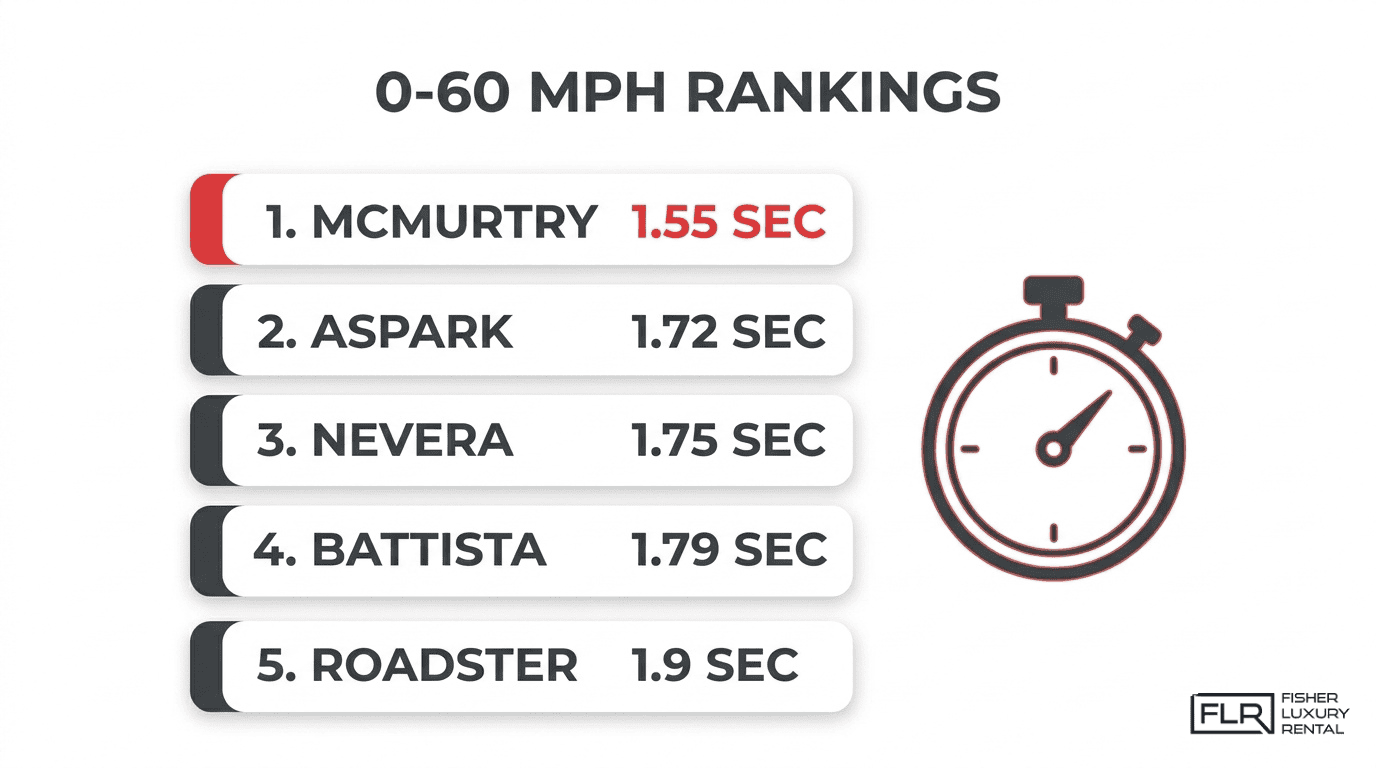
The 0-60 mph rankings place the McMurtry Spéirling, Aspark Owl, Rimac Nevera, Pininfarina Battista, and Tesla Roadster in a tight cluster, all delivering sub-2-second sprints through instant torque and all-wheel-drive electric powertrains.
Electric motors deliver maximum torque from zero RPM without the rev-building delay of combustion engines; torque vectoring systems extend that advantage into cornering by adjusting wheel-level power up to 100 times per second.
Claimed range across the segment spans 250 miles for the Lotus Evija to a projected 620 miles for the Tesla Roadster, while prices run from $1.17 million to $3.75 million, placing every model firmly in ultra-high-net-worth territory.
Ferrari, Porsche, and Lamborghini are each advancing electric or hybrid supercar programs, though battery weight, charging infrastructure, and thermal management remain the segment’s defining engineering challenges.
How Fast Can Today’s Electric Hypercars Actually Go?
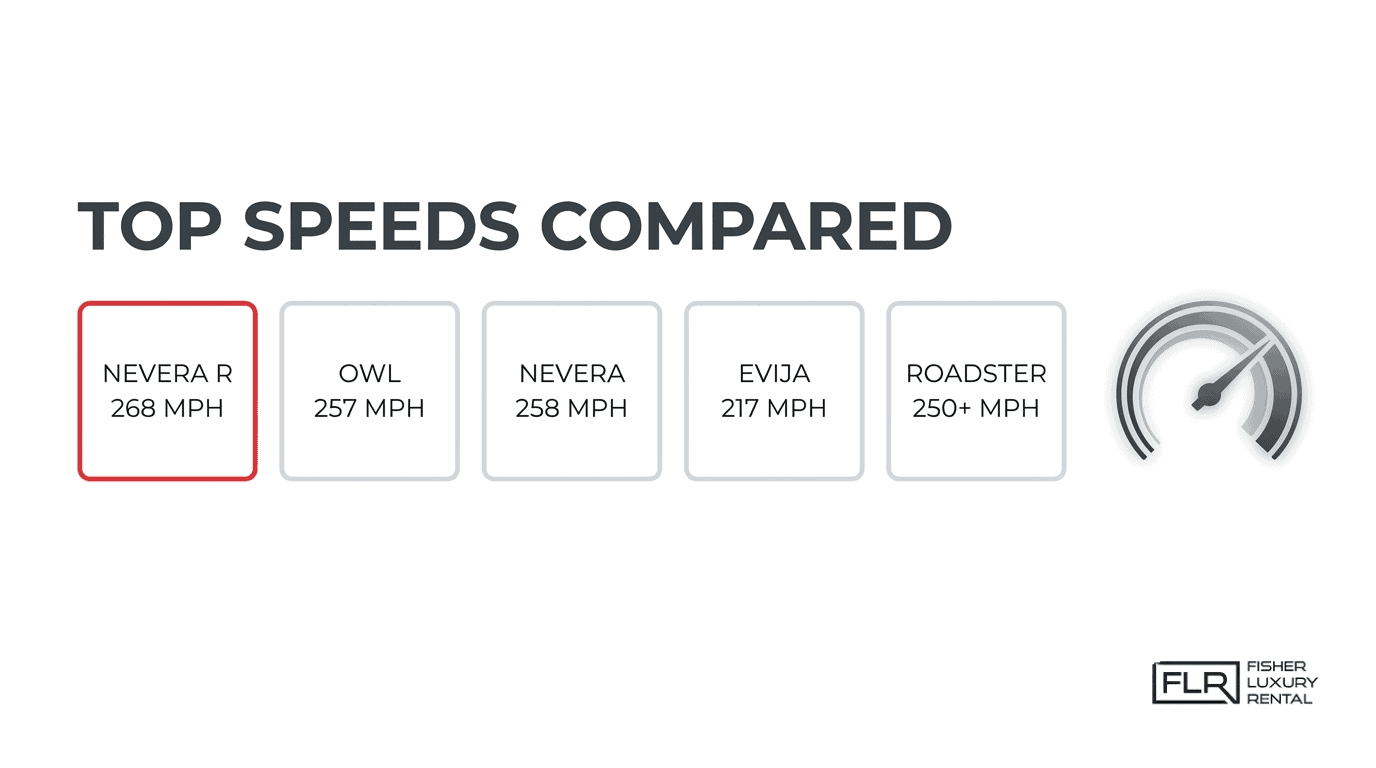
Today’s electric hypercars reach top speeds between 217 mph and 268 mph, with 0-60 mph times as low as 1.66 seconds. The sections below cover the Rimac Nevera, Pininfarina Battista, Lotus Evija, Aspark Owl, and Tesla Roadster in detail.
How Fast Is the Rimac Nevera?
The Rimac Nevera has a top speed of 415 kph (258 mph), making it one of the fastest production electric vehicles ever built. It produces 1,740 lb-ft of torque and carries a 120 kWh Lithium Manganese Nickel battery. The base price for the 2023 model is $2,400,000.
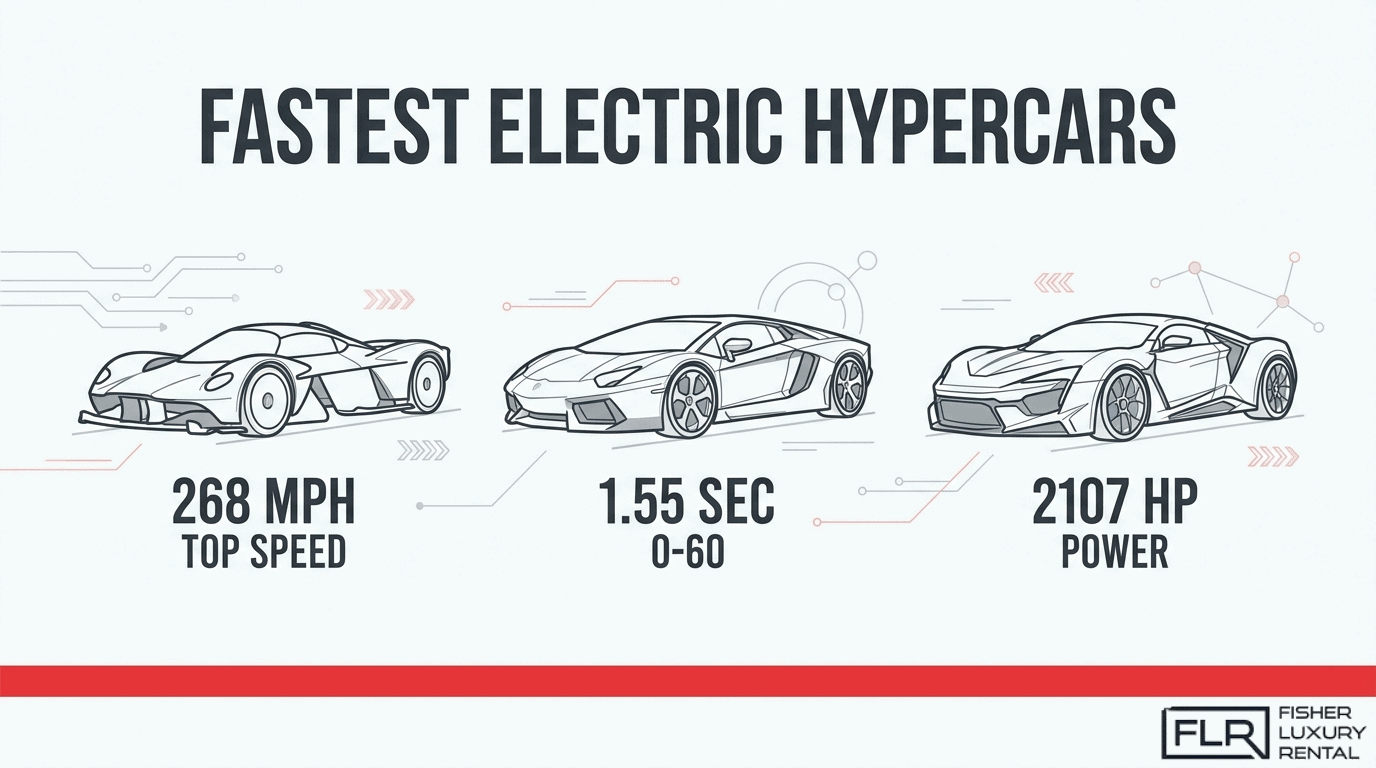
The Nevera R pushes the platform further. According to MotorTrend, the Rimac Nevera R’s claimed 1.66-second 0-60 mph time was certified by Dewesoft at the Automotive Testing Papenburg proving grounds in Germany. That same variant reaches 268.2 mph and produces 2,107 hp. For sheer certified performance data, the Nevera R currently represents the benchmark for production electric hypercars.
How Fast Is the Pininfarina Battista?
The Pininfarina Battista achieves 0-60 mph in 1.79 seconds, with 1,900 hp, 2,340 Nm of torque, and a top speed of 350 km/h. Paolo Dellacha, Automobili Pininfarina’s Chief Product and Engineering Officer, stated: “In Battista, we have achieved performance beyond our original, extreme targets.” No more than 150 examples will be hand-crafted, each priced from €2.2 million plus local taxes. Its blend of Italian coachbuilding heritage and hypercar performance makes it one of the most distinctive electric vehicles in production.
How Fast Is the Lotus Evija?
The Lotus Evija has a governed top speed of 217 mph and accelerates from 0-62 mph in under three seconds. More impressively, it reaches 186 mph in just 8.6 seconds. As Jethro Bovingdon noted in MotorTrend, a Bugatti Chiron requires 13.6 seconds to cover that same distance. The Evija runs on a 93 kWh battery, charges to 80% in 18 minutes on a 350 kW DC fast charger, and is priced at $2.3 million, with production limited to 130 units.
How Fast Is the Aspark Owl?
The Aspark Owl has a top speed of 413 km/h (257 mph) and accelerates from 0-60 mph in 1.72 seconds. It produces 1,984 hp and is priced between $3,100,000 and $3,750,000 in the US. Production is limited to just 50 units. Given its combination of sub-1.75-second acceleration and near-260 mph top speed, the Owl remains one of the most extreme electric hypercars ever produced.
How Fast Is the Tesla Roadster?
The Tesla Roadster has a top speed of over 250 mph and accelerates from 0-60 mph in 1.9 seconds, according to Tesla. It delivers 10,000 lb-ft of wheel torque, a figure that dwarfs every combustion-engined competitor in the hypercar segment. The 2026 model is expected to be priced between $200,000 and $250,000, according to Car and Driver, which places it far below its electric hypercar rivals while still matching or exceeding their headline performance numbers on paper.
What Are the Quickest Electric Supercars by 0-60 MPH Time?
The quickest electric supercars by 0-60 mph time include the McMurtry Spéirling, Aspark Owl, Rimac Nevera, Pininfarina Battista, and Tesla Roadster. Each model below delivers its sprint time through instant torque and all-wheel-drive electric powertrains.
How Quick Is the Rimac Nevera From 0 to 60?
The Rimac Nevera is quick from 0 to 60 mph, completing the sprint in 1.75 seconds. That puts it among the fastest production cars ever built, electric or otherwise. For context, most high-performance combustion supercars need three or more seconds to reach the same benchmark, making the Nevera’s time a genuine engineering statement.
How Quick Is the Pininfarina Battista From 0 to 60?
The Pininfarina Battista is quick from 0 to 60 mph in 1.79 seconds, according to Automobili Pininfarina. Priced from €2.2 million plus local taxes, the Battista is limited to 150 individually hand-crafted examples, making this level of acceleration an extraordinarily exclusive experience.
How Quick Is the Tesla Roadster From 0 to 60?
The Tesla Roadster is quick from 0 to 60 mph in 1.9 seconds, per Tesla’s official specifications. Expected to start around $200,000, it offers hypercar-level acceleration at a fraction of the cost of its European rivals, making it the most accessible sub-2-second EV on this list.
How Quick Is the Aspark Owl From 0 to 60?
The Aspark Owl is quick from 0 to 60 mph in 1.72 seconds, per Aspark Company’s official figures. Production is capped at just 50 units, with pricing ranging from $3.1 million to $3.75 million, making it one of the rarest sub-2-second machines on the planet.
How Quick Is the McMurtry Spéirling From 0 to 60?
The McMurtry Spéirling is the quickest electric supercar from 0 to 60 mph, hitting the benchmark in just 1.55 seconds, according to Motor1.com. Its 1,000 bhp (745 kW) output, 1,300 kg kerb weight, and 100 kWh battery system combine to produce a power-to-weight ratio that overwhelms nearly every rival. The Pure variant charges to full in 25 minutes via a 350 kW charger and tops out at 190 mph, all within a production run of just 100 units priced at £895,000 ($1.17 million). Among all production electric supercars, the Spéirling’s 1.55-second figure currently stands unmatched.
How Much Horsepower Do Electric Hypercars Produce?
Electric hypercars produce between 1,888 hp and 2,011 hp, depending on the model. The sections below break down the output figures for the Rimac Nevera, Lotus Evija, Pininfarina Battista, and Aspark Owl.
How Much Power Does the Rimac Nevera Make?
The Rimac Nevera makes 1,888 hp (1,407.7 kW; 1,914 PS). That output is distributed across four individual electric motors, one at each wheel. According to Motor Authority Senior Editor Kirk Bell, Rimac later updated the battery, brakes, suspension, and power delivery to create the Nevera R, adding revised steering, more negative camber, and larger Michelin Cup 2 Pilot Sport tires. The Nevera’s torque vectoring system adjusts wheel twist up to 100 times per second, ensuring power is applied precisely where grip is available. For a car producing 1,740 lb-ft of torque, that level of real-time control is what separates a fast car from a drivable one.
How Much Power Does the Lotus Evija Make?
The Lotus Evija makes 2,011 hp and 1,256 lb-ft of torque from its four-motor powertrain. According to Viknesh Vijayenthiran, Editor at Motor Authority, that combined output makes the Evija the most powerful production car in the world. Only 130 units will be built, priced at $2.3 million each.
How Much Power Does the Pininfarina Battista Make?
The Pininfarina Battista makes 1,900 hp and 2,340 Nm of torque. It reaches 60 mph in 1.79 seconds and tops out at 350 km/h. Production is capped at 150 hand-crafted units, priced from €2.2 million.
How Much Power Does the Aspark Owl Make?
The Aspark Owl makes 1,984 hp and reaches 60 mph in 1.72 seconds, with a top speed of 257 mph. Only 50 examples exist, priced between $3.1 million and $3.75 million, making it the most exclusive model in this group by production volume.
What Makes Electric Supercars Faster Than Gas Supercars?
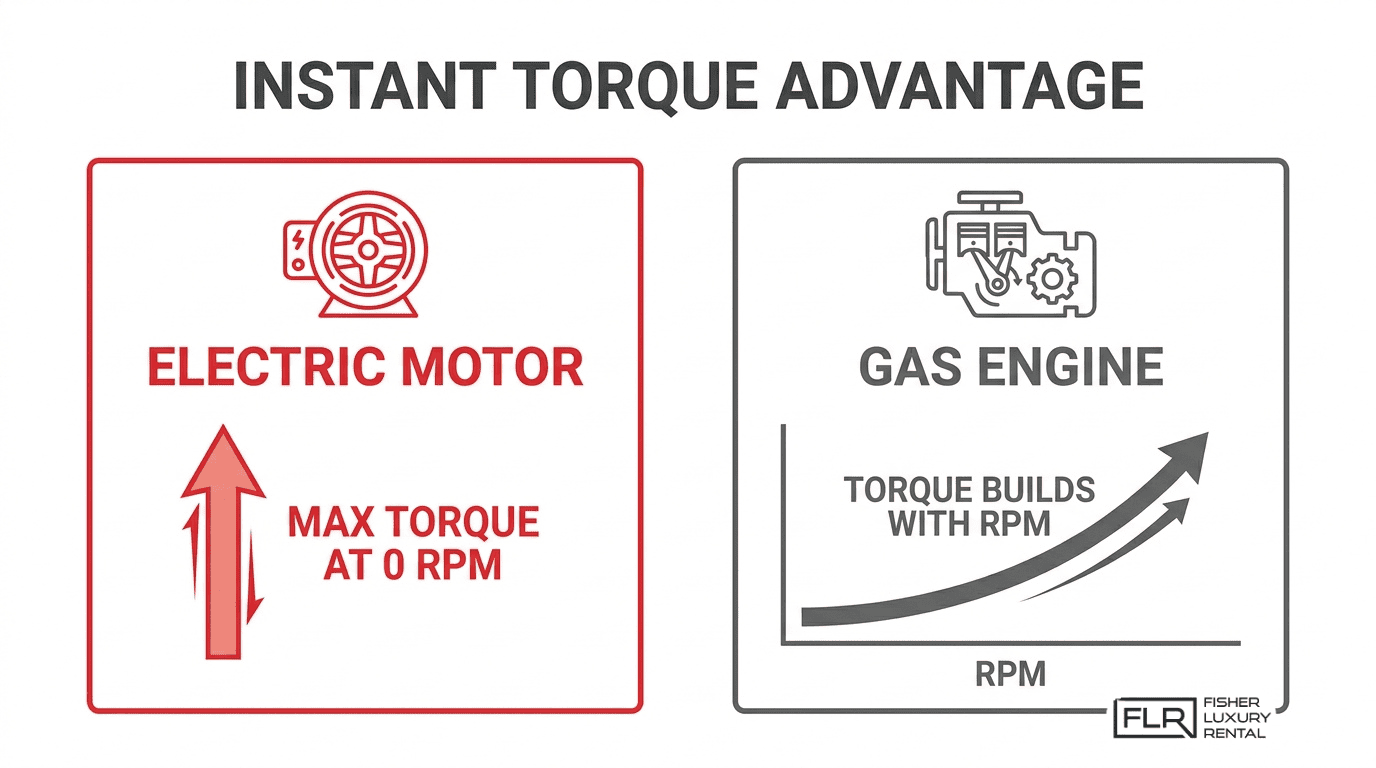
Electric supercars are faster than gas supercars in acceleration because electric motors deliver maximum torque instantly, from zero RPM, without the power build-up that combustion engines require. The sections below cover instant torque delivery, torque vectoring systems, and how these engineering advantages translate to real-world performance gains over gas-powered rivals.
How Does Instant Torque Give Electric Hypercars an Advantage?
Instant torque gives electric hypercars an advantage by delivering maximum twisting force from zero RPM, eliminating the power-building delay inherent in combustion engines. The sections below cover the physics behind this capability and how torque vectoring extends that advantage into cornering and handling.
What Is Instant Torque in an Electric Motor?
Instant torque is an electric motor’s ability to deliver its maximum twisting force to the wheels from zero RPM, without needing to rev up or build power gradually. According to Motor Authority, this happens because the force generated is directly proportional to the electric current applied within a magnetic field — meaning full torque is available the instant current flows.
In a combustion engine, peak torque arrives only after the engine climbs through its RPM range, a mechanical delay that electric motors simply do not share. This physics advantage is structural, not incremental, making it one of the most decisive performance differences between electric and gas-powered hypercars.
How Does Torque Vectoring Improve Electric Hypercar Handling?
Torque vectoring improves electric hypercar handling by enabling variable torque distribution between two wheels on the same axle, creating a yaw movement, which is a rotation of the vehicle around the Z-axis, for enhanced cornering control. Because electric motors respond to current changes in milliseconds, this adjustment happens faster and more precisely than any mechanical differential can achieve.
The result is a car that actively steers itself through corners using power, not just braking. For hypercars where lateral grip is as critical as straight-line speed, torque vectoring transforms instant torque from a launch advantage into a full-circuit performance tool.
What Is the Driving Range of the Fastest Electric Supercars?
The driving range of the fastest electric supercars varies significantly by model, from 250 miles to a projected 620 miles. Range anxiety remains a real concern: according to BBC Future, many motorists fear being stranded without charging access, making range a key priority for manufacturers.
What Is the Range of the Rimac Nevera?
The range of the Rimac Nevera is a claimed 490 km (300 miles). For a hypercar producing nearly 1,900 hp, that figure represents a meaningful balance between raw performance and real-world usability. Drivers who push the car to its limits on track should expect considerably less in practice.
What Is the Range of the Pininfarina Battista?
The range of the Pininfarina Battista is up to 476 km (300 miles U.S. combined EPA). Automobili Pininfarina achieved this figure under WLTP testing conditions, making the Battista roughly comparable to the Nevera in everyday driving distance despite its 1,900 hp output.
What Is the Range of the Tesla Roadster?
The range of the Tesla Roadster is expected to reach 620 miles, according to Tesla. That projection would place it far ahead of every current electric hypercar in range, while still delivering a 0-60 mph time of 1.9 seconds and a top speed exceeding 250 mph. No other model in this segment combines those two capabilities at that level.
What Is the Range of the Lotus Evija?
The range of the Lotus Evija is claimed to be up to 250 miles with normal driving, according to Motor Authority. Backed by a 93 kWh battery, that figure is the lowest among the models in this comparison, reflecting the Evija’s prioritization of outright performance over range efficiency.
How Much Do the Fastest Electric Hypercars Cost?
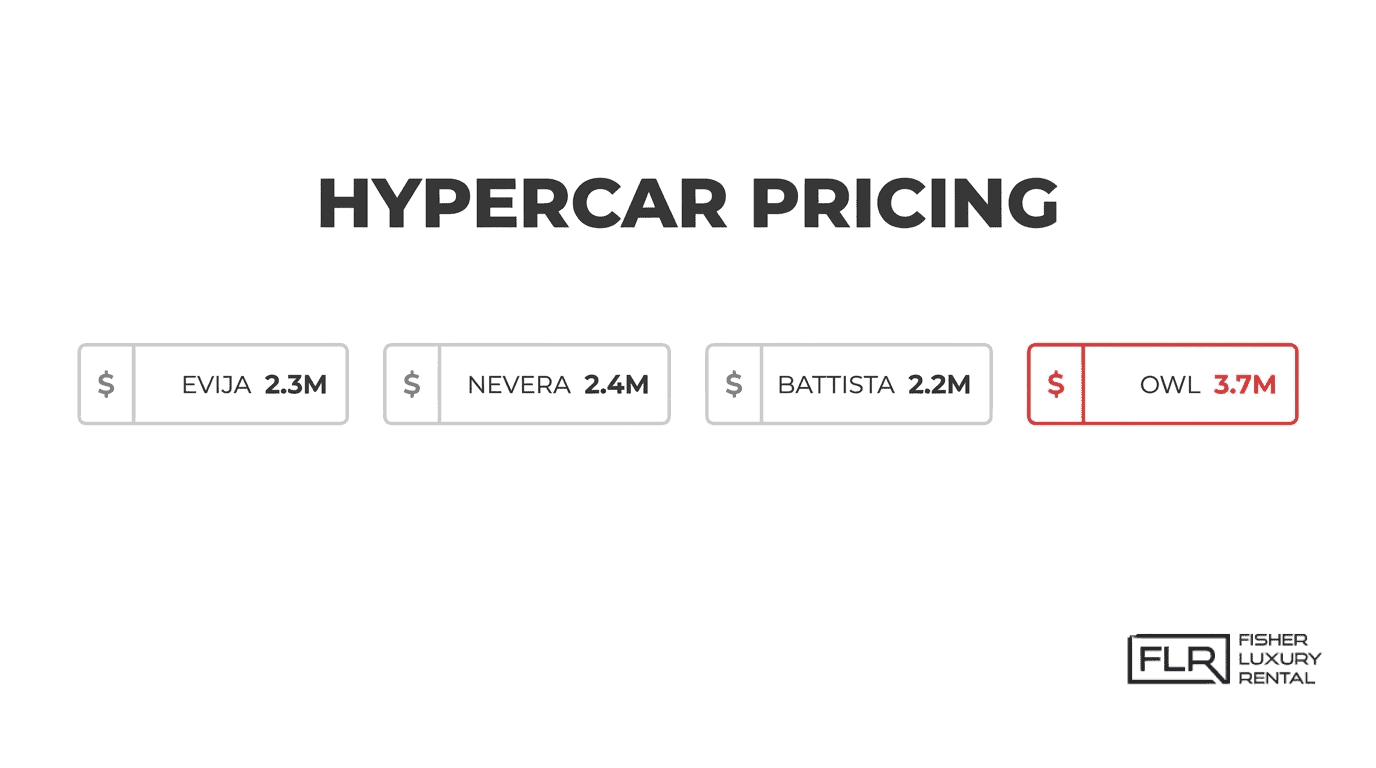
The fastest electric hypercars cost between $2.3 million and $3.75 million, placing them among the most expensive production vehicles ever built. The sections below break down the exact pricing for the Rimac Nevera, Pininfarina Battista, Lotus Evija, and Aspark Owl.
How Much Does the Rimac Nevera Cost?
The Rimac Nevera costs $2,400,000 as its base price, according to a 2023 Motor1.com first-drive review. Production is capped at 150 units, making exclusivity a core part of its value proposition. For buyers seeking even more performance, the Nevera R offers upgraded power and handling at a premium above the standard model’s price.
How Much Does the Pininfarina Battista Cost?
The Pininfarina Battista is priced from €2.2 million plus local taxes, according to Automobili Pininfarina. No more than 150 examples will be individually hand-crafted, reinforcing its status as a collector-grade hypercar. At that price, buyers receive 1,900 hp and a bespoke build process overseen by one of Italy’s most storied design houses.
How Much Does the Lotus Evija Cost?
The Lotus Evija costs $2.3 million plus taxes, making it the most accessible entry among this group despite delivering 2,011 hp. According to Road & Track, production is strictly limited to 130 units worldwide. Given its power output and rarity, the Evija’s pricing represents strong value relative to its direct competitors.
How Much Does the Aspark Owl Cost?
The Aspark Owl costs between $3,100,000 and $3,750,000 in the U.S. market, making it the most expensive hypercar in this comparison. According to Car and Driver, production is limited to just 50 customers globally, the smallest run of any electric hypercar covered here. That extreme scarcity, combined with a 1.72-second 0-60 time, justifies the significant price premium over rivals.
Which Automakers Are Building Electric Supercars Next?
The automakers building electric supercars next include Ferrari, Porsche, and Lamborghini, each taking distinct approaches ranging from full electrification to plug-in hybrid strategies. The sections below cover each manufacturer’s confirmed plans and timelines.
What Is Ferrari’s Electric Supercar Plan?
Ferrari’s electric supercar plan targets a mixed powertrain lineup by 2030: 20% pure internal combustion, 40% plug-in hybrids, and 40% pure EVs. Ferrari intends to continue V-12 production as long as possible while simultaneously developing its first fully electric model. This balanced strategy reflects Ferrari’s caution about alienating its traditionally minded customer base while still capturing the electric performance segment.
What Is Porsche’s Electric Supercar Strategy?
Porsche’s electric supercar strategy centers on bringing the 718 Boxster and Cayman fully electric in 2026. These entry-level sports cars represent Porsche’s first committed step toward an all-electric performance lineup. Given how foundational the 718 platform is to Porsche’s sports car identity, this move signals broader electrification ambitions across the brand’s higher-performance tiers.
What Happened to the Lamborghini Lanzador EV?
The Lamborghini Lanzador EV was canceled before reaching production. Originally scheduled for a 2028 release as a fully electric model, Lamborghini reversed course in favor of a plug-in hybrid model arriving in 2029, according to Wired. This decision mirrors a broader industry trend of legacy supercar brands retreating from pure BEV commitments as technical and market challenges mount.
How Do Electric Hypercars Compare to Gas-Powered Hypercars?
Electric hypercars compare to gas-powered hypercars most decisively in acceleration, where instant torque delivery gives battery-electric vehicles a measurable edge over combustion rivals. The sections below examine straight-line speed, sustained top speed, and real-world usability differences.
Do Electric Hypercars Outperform Gas Hypercars in Acceleration?
Electric hypercars outperform gas hypercars in acceleration because electric motors deliver maximum torque from zero RPM, eliminating the rev-building delay inherent to combustion engines. The Lotus Evija reaches 186 mph in 8.6 seconds; according to MotorTrend, a Bugatti Chiron, powered by an 8.0L quad-turbo W16 producing 1,600 hp, requires 13.6 seconds to reach the same speed. That 5-second gap at high velocity is not marginal; it reflects a fundamental physics advantage that no ICE tune can fully close.
Do Gas Hypercars Still Hold a Top-Speed Advantage?
Gas hypercars still hold a theoretical top-speed advantage in extreme high-velocity conditions. The Koenigsegg Jesko Absolut is theorized to exceed 500 km/h in ideal conditions, surpassing the Bugatti Chiron’s benchmark. By contrast, the Rimac Nevera R tops out at 268.2 mph, and most electric hypercars govern top speed to protect battery and thermal systems. For outright top-speed records, combustion still leads; for the speeds drivers actually experience on road or track, electric hypercars are competitive or superior.
How Do Electric and Gas Hypercars Compare on Range and Usability?
Electric and gas hypercars compare unfavorably on refueling convenience, though the range gap is narrowing. The Tesla Roadster targets 620 miles per charge, while most electric hypercars deliver 250 to 300 miles. Gas hypercars refuel in minutes at any fuel station, whereas DC fast charging adds time and infrastructure dependency. Battery and charging limitations remain the core usability hurdle for electric hypercars in everyday driving scenarios.
What Are the Biggest Challenges Facing Electric Supercars?
The biggest challenges facing electric supercars are battery weight, limited range under performance driving, charging infrastructure gaps, and thermal management. These obstacles shape how manufacturers design, price, and position every electric hypercar on the market today.
How Does Battery Weight Affect Electric Supercar Performance?
Battery weight affects electric supercar performance by adding significant mass that counteracts the power advantages of an electric drivetrain. The Rimac Nevera carries a 120 kWh lithium manganese nickel battery, while the McMurtry Spéirling Pure uses a 100 kWh battery system in a car weighing just 1,300 kg. In a segment where every kilogram matters, battery packs create a fundamental engineering tension: more capacity means more range but less agility. This trade-off is one reason why electric hypercars remain far more expensive and production-limited than their gas-powered counterparts.
Does Limited Range Restrict Electric Hypercar Usability?
Yes, limited range restricts electric hypercar usability, particularly during high-performance driving where energy consumption accelerates dramatically. According to BBC Future, many motorists fear being stranded when charging points are unavailable, making range a top engineering priority for manufacturers. The Lotus Evija delivers up to 250 miles under normal driving, but aggressive track use reduces that figure considerably. The Tesla Roadster’s projected 620-mile range represents the most ambitious solution to this problem, though it has yet to enter production.
Why Is Charging Infrastructure a Challenge for Electric Supercars?
Charging infrastructure is a challenge for electric supercars because even the fastest DC chargers demand meaningful downtime between performance sessions. The Lotus Evija reaches 80% charge in 18 minutes using a 350 kW DC fast charger, and the McMurtry Spéirling Pure requires 25 minutes under the same conditions. A PMC study published in the National Library of Medicine confirms that battery and charging limitations represent the core hurdle preventing full-scale BEV adoption. For track-day use or long road trips, this dependency on specialized infrastructure remains a practical limitation that no current electric hypercar has fully resolved.
How Can You Experience Supercar Performance Firsthand?
Experiencing supercar performance firsthand means getting behind the wheel of a genuine high-performance exotic car. The sections below cover renting from Fisher Luxury Rental and the key takeaways from the electric hypercar world.
Can Renting an Exotic Car From Fisher Luxury Rental Deliver a Supercar Thrill?
Yes, renting an exotic car from Fisher Luxury Rental can deliver a genuine supercar thrill. Fisher Luxury Rental offers a carefully selected fleet of high-performance vehicles, including the Ferrari 488 Spider, McLaren 720S, and Lamborghini Huracan Spyder Convertible, serving customers across the Phoenix Metropolitan Area and Northwest Oregon.
The Ferrari 488 Spider available through Fisher Luxury Rental produces 661 horsepower from a Twin-Turbo 3.9L V8 engine, reaches a top speed of 205 mph, and accelerates from 0 to 60 in just 3.0 seconds. That is genuine supercar performance accessible without a multimillion-dollar purchase.
Fisher Luxury Rental pairs its fleet with white glove deliveries and high cleanliness standards, making the experience feel as premium as the machines themselves. For enthusiasts who want to feel what serious horsepower and razor-sharp throttle response actually feel like from the driver’s seat, this is one of the most practical paths available.
What Are the Key Takeaways About the Fastest Electric Supercars and Hypercars?
The key takeaways about the fastest electric supercars and hypercars are that the segment is redefining performance benchmarks while growing rapidly as a market force. According to Global Market Insights Inc., battery electric hypercars held a 27% market share in 2025 and are projected to grow from USD 1.5 billion to USD 3 billion by 2035, registering a 6.9% CAGR as the fastest-growing propulsion segment.
The most important practical conclusions from this article include:
- Sub-2-second 0-60 mph times are now achievable in production electric hypercars, with models such as the Rimac Nevera, Aspark Owl, and McMurtry Spéirling leading that benchmark.
- Instant torque delivery, not raw displacement, is the core engineering advantage that puts electric hypercars ahead of gas rivals in straight-line acceleration.
- Range anxiety remains a real engineering challenge, though top models now offer between 250 and 620 miles of claimed range.
- Electric hypercar prices span from around $1.17 million to over $3.75 million, placing these vehicles firmly in the collector and ultra-high-net-worth segment.
- For most enthusiasts, renting a purpose-built exotic car remains the most accessible way to experience supercar-level performance without ownership barriers.
The electric hypercar era is no longer a concept. It is already producing the world’s quickest accelerating production vehicles, and the gap between electric and combustion performance is narrowing faster than most predicted.