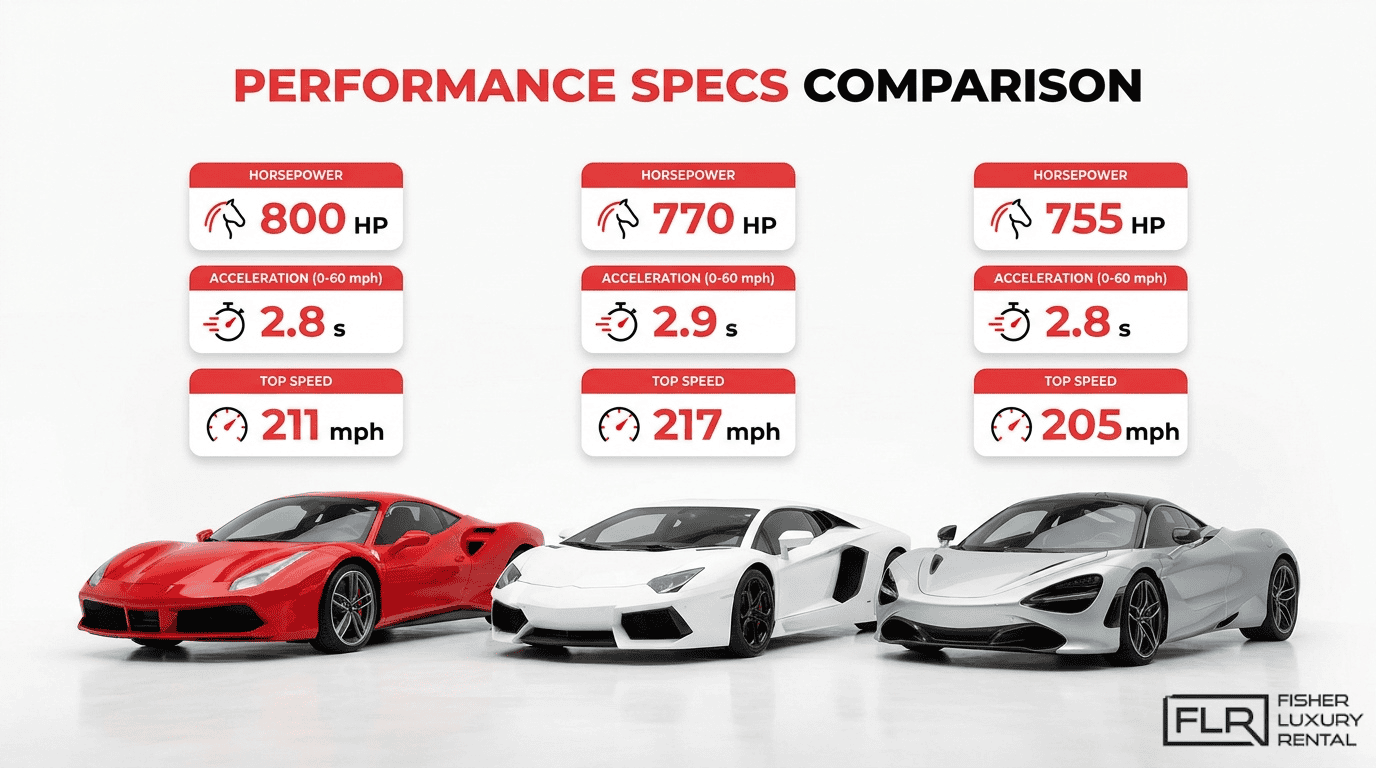
Comparing exotic car performance specs means evaluating horsepower, torque, power-to-weight ratio, acceleration times, aerodynamics, braking, and drivetrain layout as an interconnected system rather than a list of isolated numbers. No single figure captures what an exotic actually delivers; the complete picture emerges only when all dimensions are read together.
This guide covers the core metrics that define exotic car performance, how engine configuration and drivetrain layout shape power delivery and handling, how transmission type and aerodynamics factor into real-world speed, how braking and suspension specs affect the driving experience, how to compare specs across the major exotic brands, and why those numbers ultimately feel different behind the wheel.
Horsepower and torque form the foundation, but power-to-weight ratio is the truer predictor of real-world acceleration, and 0-60 times contextualize all three within a standardized benchmark. Engine architecture, from twin-turbo V8s to naturally aspirated V12s to hybrid systems, determines how power arrives and at what RPM; drivetrain layout then dictates how that power translates into traction and cornering balance.
Transmission speed and gear ratios control how efficiently the engine stays in its peak power band through acceleration runs. Aerodynamic downforce and braking systems determine whether a car can carry speed safely into corners and shed it predictably when needed. Brand-to-brand comparisons reveal that identical spec figures often represent entirely different driving philosophies, particularly between Lamborghini, Ferrari, McLaren, and Porsche.
Finally, drive modes, chassis feedback, and sensory engagement separate the lived experience from what any data sheet can communicate, making firsthand rental experience the most reliable final step in any serious comparison.
What Are the Core Performance Specs That Define an Exotic Car?
The core performance specs that define an exotic car are horsepower, torque, power-to-weight ratio, acceleration times, and top speed. Each metric reveals a different dimension of what a car can do, and understanding all five together gives you a complete picture before comparing models.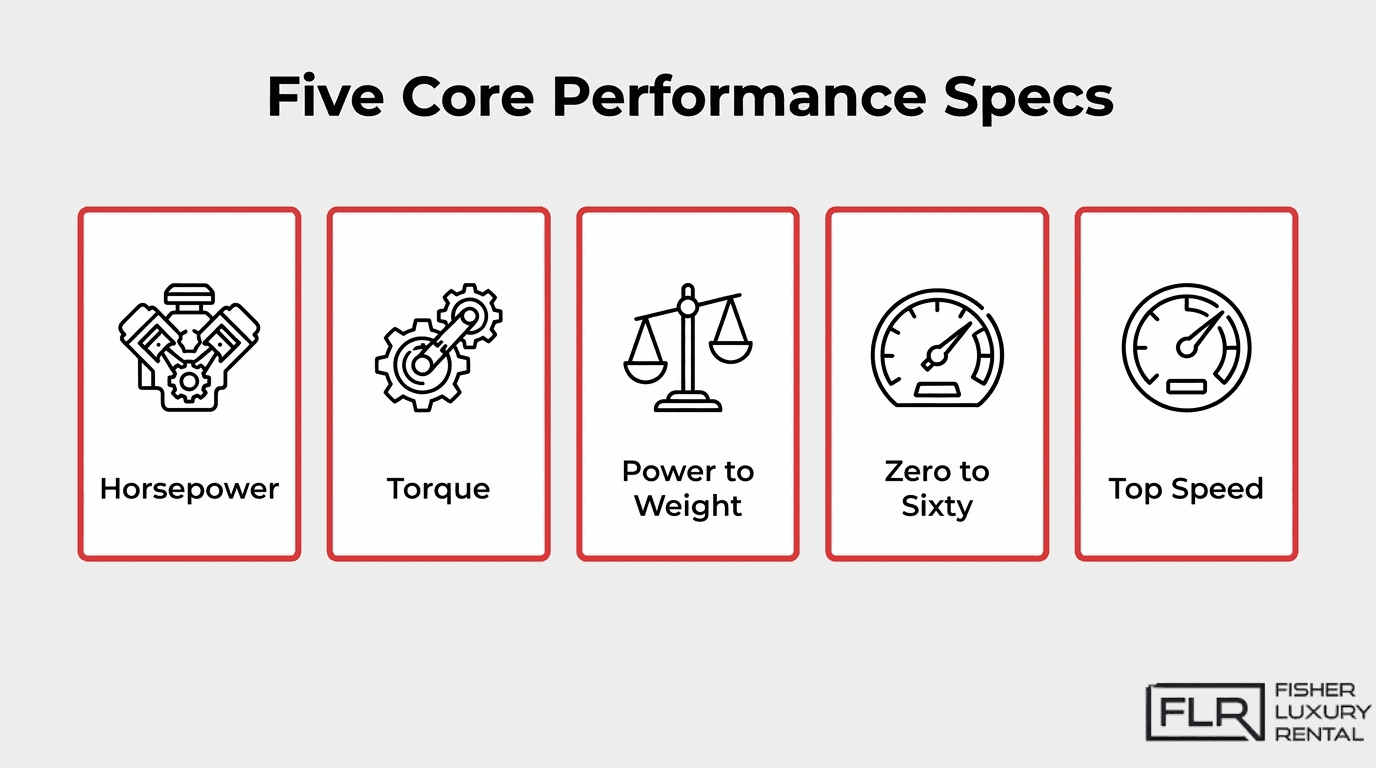
What Does Horsepower Tell You About an Exotic Car?
Horsepower tells you how much sustained power an exotic car produces at high engine speeds. It directly determines a car’s ability to maintain speed on highways and reach its top velocity ceiling. Higher horsepower generally means greater capability at speed, but it only tells part of the story. Without knowing the car’s weight, gearing, and drivetrain layout, a raw horsepower number alone cannot predict how a car actually feels or performs on the road.
What Does Torque Reveal That Horsepower Doesn’t?
Torque reveals low-end pulling force, which governs how quickly a car accelerates from a standstill. The 2023 Lamborghini Urus Performante illustrates this clearly: its 4.0-liter twin-turbo V-8 produces 657 horsepower and 627 lb-ft of torque, completing the quarter mile in 11.3 seconds at 121.3 mph. That torque figure is what launches the vehicle off the line before peak horsepower even comes into play. In turbocharged exotics especially, torque often explains why a car feels faster in everyday driving than its horsepower rating suggests.
Why Does the Power-to-Weight Ratio Matter More Than Raw Power?
Power-to-weight ratio matters more than raw power because it determines how much output is available per kilogram of vehicle mass, which directly governs real-world acceleration and agility. A heavier car with 700 horsepower can feel slower than a lighter car with 500 horsepower if the weight difference is significant enough. This is why Richard Lane of Autocar describes the Lamborghini Revuelto’s handling as “more natural and intuitive than you’d ever expect” for a V12 flagship. Its favorable power-to-weight ratio transforms what could be an unwieldy machine into something genuinely responsive.
What Do 0–60 mph and Quarter-Mile Times Actually Measure?
The 0–60 mph and quarter-mile times measure a car’s launch capability and short-burst acceleration under controlled conditions. The 0–60 figure captures the explosive first phase of acceleration, while the quarter-mile time adds sustained thrust over a longer distance, revealing how well the powertrain, traction, and gearing work together. These two numbers are among the most standardized benchmarks in exotic car comparisons because they are repeatable, testable, and directly comparable across brands and models.
How Does Top Speed Factor Into Exotic Car Comparisons?
Top speed factors into exotic car comparisons as a ceiling metric that reflects the combined output of the engine, aerodynamic drag coefficient, and gearing limits. It signals engineering ambition and the car’s maximum theoretical capability on unrestricted roads. For most drivers, top speed is rarely achievable in practice, making it more useful as a comparative indicator than a real-world driving metric. When evaluating exotics, top speed is best read alongside 0–60 and power-to-weight figures to understand whether a car prioritizes outright velocity or balanced all-around performance.
How Do Engine Configurations Affect Exotic Car Performance?
Engine configuration directly shapes how an exotic car delivers power, responds to driver input, and behaves at the limit. The sections below compare twin-turbo V8s against naturally aspirated V12s, examine flat-six versus mid-mounted V10 layouts, and explore what hybrid powertrains add to the equation.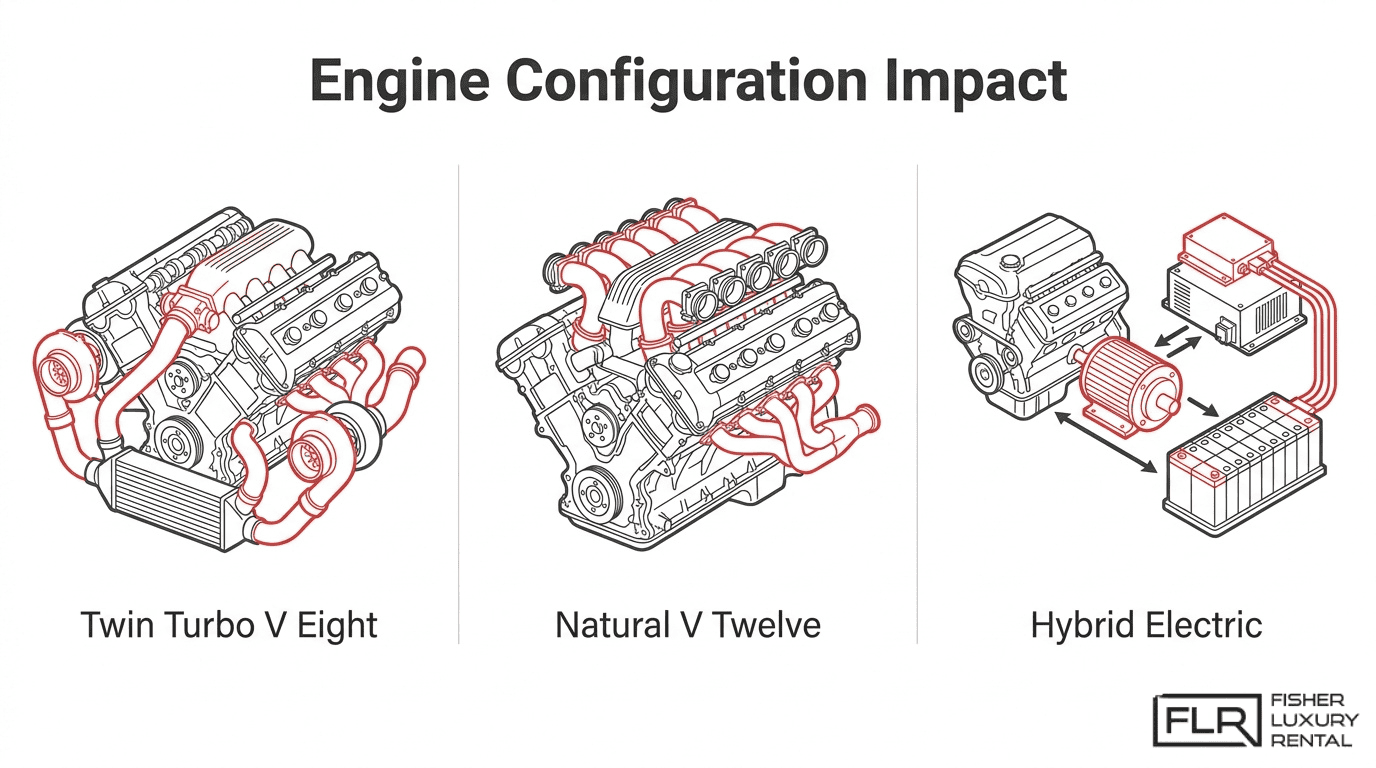
How Does a Twin-Turbo V8 Compare to a Naturally Aspirated V12?
A twin-turbo V8 compares to a naturally aspirated V12 by trading linear power delivery for forced-induction torque at lower RPMs, while the V12 prioritizes high-revving character and mechanical refinement. According to Top Gear, the McLaren F1’s naturally aspirated V12 produces 627 bhp, while McLaren’s current twin-turbo V8 road cars start at 540 bhp. V12 engines can reach thermal efficiency levels of 50%, whereas V8 engines typically range between 29% and 40%. Naturally aspirated V12s deliver a purer throttle response with no turbo lag; twin-turbo V8s produce broader usable torque bands that favor real-world acceleration. For most driving contexts, the twin-turbo V8’s tractability makes it the more versatile performer, even if the V12’s high-RPM wail remains unmatched.
How Does a Flat-Six Engine Perform Differently Than a Mid-Mounted V10?
A flat-six engine performs differently than a mid-mounted V10 primarily through its low center of gravity and compact dimensions versus the V10’s larger displacement and higher power ceiling. The flat-six, as used in Porsche’s 911, sits low and rearward, contributing to distinctive balance characteristics and predictable cornering behavior. A mid-mounted V10, as found in the Porsche Carrera GT, places its 612 hp and 590 Nm of torque at the vehicle’s mass center, optimizing weight distribution for sharper turn-in and higher lateral grip. The V10’s greater cylinder count produces a broader powerband and more visceral sound signature. The flat-six rewards driver skill through mechanical feedback; the mid-V10 rewards precision with outright dynamic capability.
How Do Hybrid Powertrains Change Exotic Car Performance?
Hybrid powertrains change exotic car performance by adding instant electric torque to supplement the combustion engine, filling power gaps that traditional layouts cannot eliminate. Ferrari’s SF90 Stradale demonstrates this clearly: its PHEV architecture combines a V8 combustion engine with three electric motors to produce 1,000 cv, enabling a 0-100 km/h time of 2.5 seconds, according to Ferrari. The electric motors deliver torque before combustion power builds, effectively eliminating the lag inherent in turbocharged setups. Hybrids also enable torque vectoring through individual motor control, which improves handling precision beyond what mechanical differentials alone can achieve. Engine configuration in the hybrid era is no longer just about cylinder count or aspiration method; it is about how intelligently power from multiple sources is integrated and deployed.
How Does Drivetrain Layout Influence Handling and Speed?
Drivetrain layout directly shapes how an exotic car distributes power, manages weight, and responds to driver inputs. The two sub-sections below examine rear-wheel drive versus all-wheel drive, then compare mid-engine and front-engine configurations.
How Does Rear-Wheel Drive Compare to All-Wheel Drive?
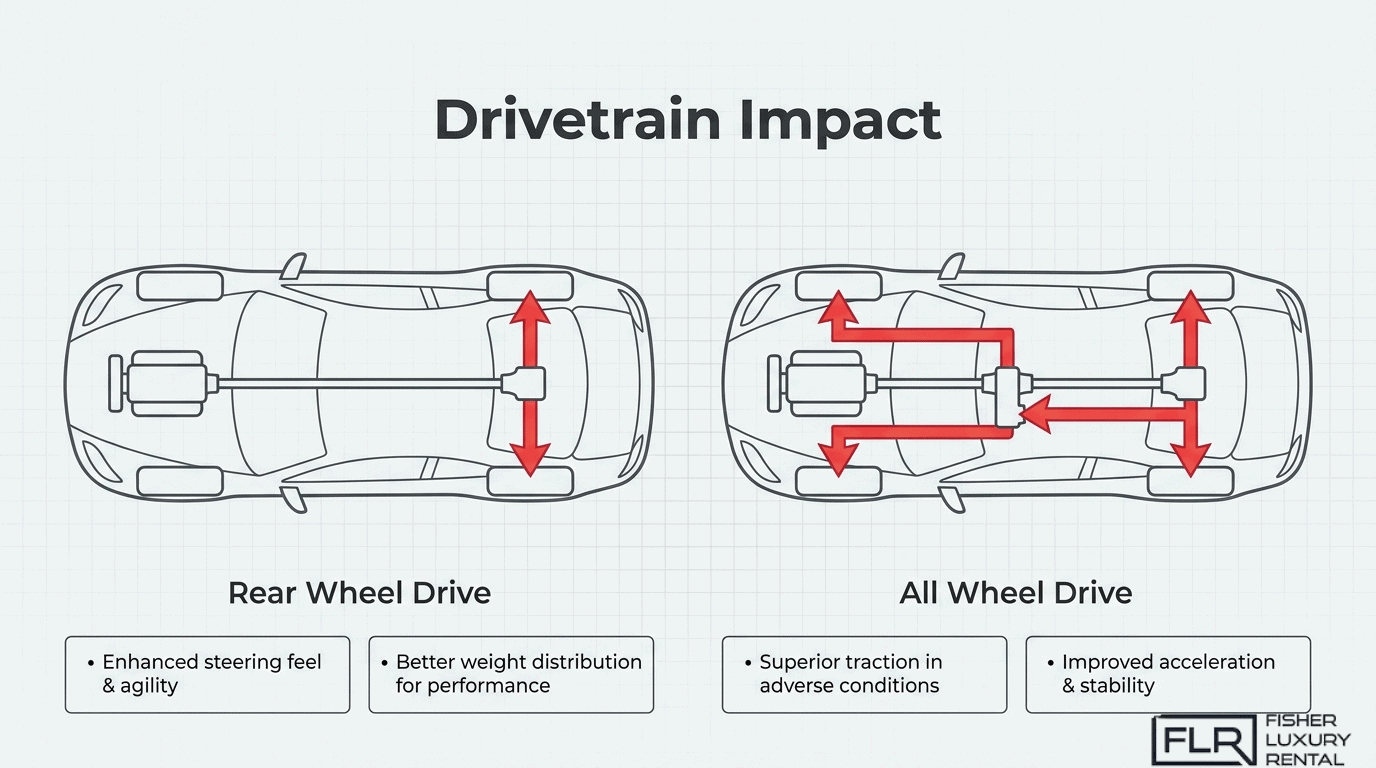
Rear-wheel drive compares to all-wheel drive by concentrating driven force at the rear axle, producing sharper steering response and a more driver-focused balance, while all-wheel drive distributes power across all four wheels for greater traction under acceleration. The tradeoff is real: RWD rewards precision but demands more skill, especially at the limit.
According to TopSpeed, the Hennessey Venom F5 Evolution delivers 2,031 horsepower and 1,445 lb-ft of torque through a rear-wheel drive driveline, demonstrating that RWD remains viable even at extreme power levels when chassis engineering is optimized. AWD systems, by contrast, excel in mixed conditions and enable faster off-the-line launches by eliminating wheelspin across both axles.
How Does a Mid-Engine Layout Differ From a Front-Engine Layout?
A mid-engine layout differs from a front-engine layout by positioning the engine between the axles, concentrating mass near the car’s center of gravity for more neutral, responsive cornering. A front-engine layout places mass ahead of the driver, which can improve straight-line stability but adds understeer tendency at high cornering speeds.
The Porsche Carrera GT illustrates mid-engine advantages with its 5.7-liter naturally aspirated V10 producing approximately 612 hp, mounted behind the driver to achieve near-ideal weight distribution. Front-engine designs, common in grand tourers, trade agility for comfort and usable cabin space. For performance comparison purposes, mid-engine exotic cars generally set the benchmark for lateral grip and dynamic balance.
What Role Does Transmission Type Play in Performance?
Transmission type plays a direct role in how quickly an exotic car delivers power, how smoothly it accelerates, and how engaged the driver feels. The following sections cover dual-clutch automatics versus traditional automatics, and how gear count and shift speed shape real-world acceleration.
How Does a Dual-Clutch Automatic Compare to a Traditional Automatic?
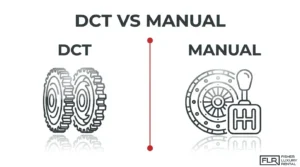
A dual-clutch automatic compares to a traditional automatic by pre-selecting the next gear on a second clutch while the current gear is still engaged, eliminating the torque-converter lag that defines conventional automatics. Traditional automatics use hydraulic fluid coupling to transfer power, which introduces a measurable delay during upshifts. Dual-clutch transmissions deliver power more continuously, keeping the engine closer to its peak power band through each shift. For exotic car comparisons, this difference matters most at wide-open throttle, where a traditional automatic’s slip can cost tenths of a second in acceleration runs.
How Does Gear Count and Shift Speed Affect Acceleration?
Gear count and shift speed affect acceleration by determining how precisely the engine stays in its optimal power range across a speed run. More gears allow shorter ratio gaps, keeping revs in the powerband longer. According to Engineering Explained, modern dual-clutch transmissions in supercars complete a gear shift in approximately 150 to 200 milliseconds from the moment the paddle is pulled. The 2023 Porsche 911 GT3 RS demonstrates this advantage directly: it reaches 60 mph in 3.0 seconds and achieves its 184 mph top speed in seventh gear, using every ratio efficiently. Faster shifts reduce the power interruption between gears, and with seven or eight tightly spaced ratios, the engine never falls far off its peak output.
How Do You Compare Aerodynamics and Downforce Between Exotics?
You compare aerodynamics and downforce between exotics by examining active aero systems, drag coefficients, and measurable downforce figures at speed. The sections below cover how downforce is generated and why ground effects matter for track performance.
How Is Downforce Generated on an Exotic Car?
Downforce is generated on an exotic car through a combination of front splitters, rear wings, diffusers, and active aerodynamic elements that redirect airflow to press the car into the road surface. These components work together to increase grip without adding mechanical weight to the suspension.
At 177 mph, the Porsche 911 GT3 RS (992) generates 1,895 lbs (860 kg) of total downforce, roughly double the output of previous RS models, according to Stuttcars. That figure illustrates how modern active aero systems have transformed road-legal exotics into cars capable of genuine track performance. Passive designs on earlier models could never approach those numbers, making active aero one of the most consequential upgrades in contemporary exotic engineering.
Why Do Ground Effects and Active Aero Matter for Track Laps?
Ground effects and active aero matter for track laps because they increase mechanical grip at high speed without adding weight, allowing a car to carry more corner speed and brake later. Ground effects work by channeling air under the car through shaped floor tunnels, creating a low-pressure zone that pulls the chassis toward the track.
Active aerodynamic systems adjust wing angles and underbody airflow in real time based on speed and driver input, balancing peak downforce against drag reduction on straights. The Porsche 911 GT3 RS (992.1) recorded an official Nürburgring Nordschleife lap time of 6:49.328, a benchmark that reflects the combined effect of its active aero and downforce package in race conditions.
How Do Braking and Suspension Specs Affect the Driving Experience?
Braking and suspension specs directly determine how an exotic car transfers speed into control. The sections below break down how carbon-ceramic brakes compare to steel and what adaptive suspension changes at the performance level.
How Do Carbon-Ceramic Brakes Compare to Steel Brakes?
Carbon-ceramic brakes outperform steel brakes in stopping distance, fade resistance, and weight reduction. According to Bimmerpost forum testing data, a BMW M4 equipped with optional carbon-ceramic brakes stops from 60 mph in 98 feet, compared to 108 feet for a Lexus RC F running standard steel brakes. That 10-foot difference matters significantly at speed. The Aston Martin DBX707 illustrates the scale required for high-performance applications: its carbon-ceramic rotors measure 420mm at the front and 390mm at the rear, engineered specifically to manage repeated hard braking at a 193 mph top speed. Steel brakes cost less but fade under sustained heat, making carbon-ceramic the clear choice for any exotic driven hard.
What Does an Adaptive Suspension System Change About Performance?
Adaptive suspension changes how an exotic car manages ride comfort, cornering stability, and body control across different driving conditions. Unlike fixed dampers, adaptive systems adjust stiffness in real time using electronically controlled valves, allowing the driver to switch between a compliant daily-driving mode and a track-focused setting without sacrificing either. This means a single car can absorb road imperfections on a boulevard and then flatten body roll through high-speed corners minutes later. For renters evaluating an exotic’s real-world usability, adaptive suspension is often the spec that determines whether a car feels accessible or punishing on public roads.
How Should You Compare Specs Across Different Exotic Car Brands?
Comparing specs across exotic car brands requires looking beyond headline horsepower numbers to evaluate acceleration, top speed, drivetrain philosophy, and real-world handling. The following H3s break down Lamborghini vs. Ferrari, McLaren vs. Porsche, and exotic SUVs vs. sports cars.
How Do Lamborghini and Ferrari Performance Specs Differ?
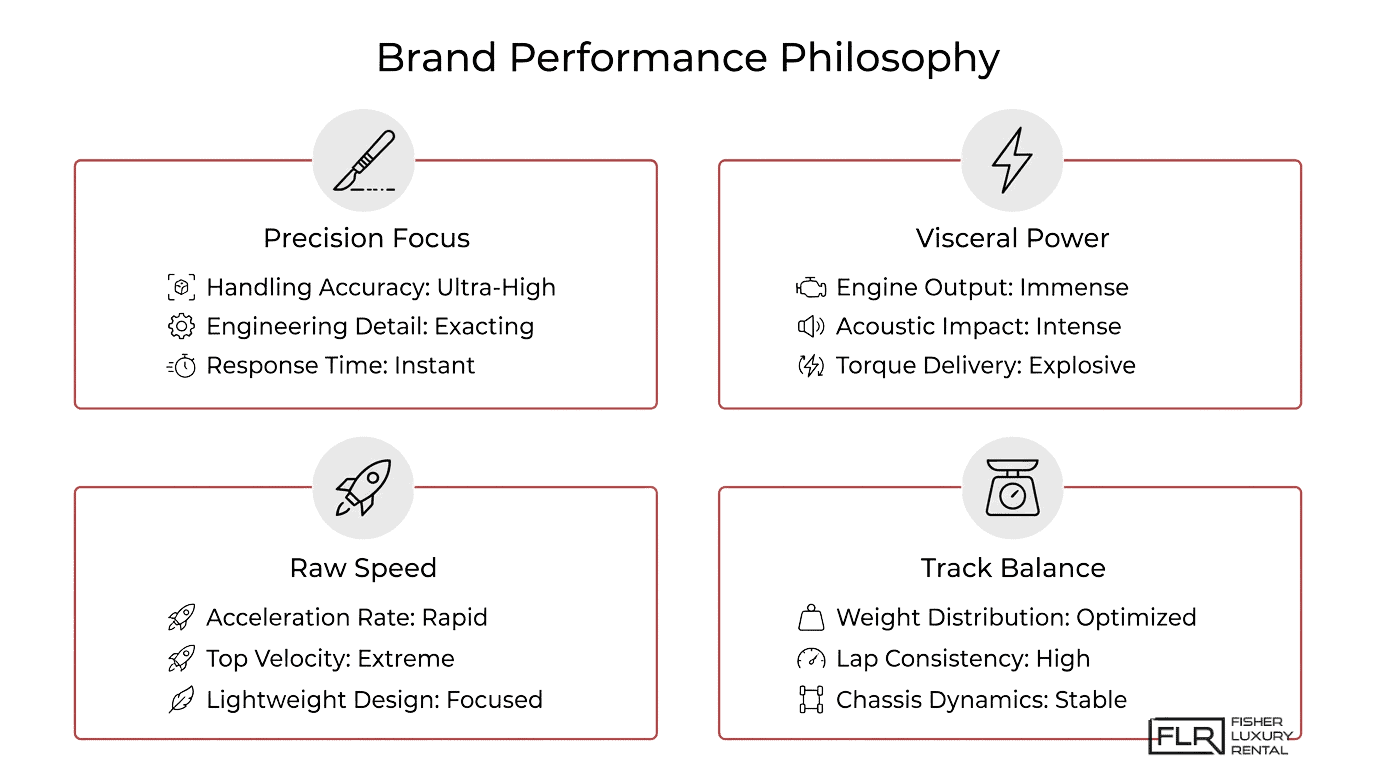
Lamborghini and Ferrari performance specs differ primarily in powertrain philosophy and character. The Lamborghini Revuelto achieves 0 to 100 km/h in 2.5 seconds with a top speed exceeding 350 km/h, powered by a naturally aspirated V12 hybrid system. Ferrari’s SF90 Stradale matches that 2.5-second benchmark using a PHEV architecture that pairs a V8 with three electric motors to produce 1,000 cv.
Autocar reviewer Richard Lane notes the Revuelto’s “handling is more natural and intuitive than you’d ever expect” for a V12 flagship, suggesting Lamborghini has closed the driver-engagement gap that once separated the two brands. Ferrari’s approach is more surgical; Lamborghini’s is visceral and theatrical. Both deliver equivalent straight-line pace, but the driving experience they offer is genuinely distinct.
How Does McLaren Compare to Porsche on Key Performance Metrics?
McLaren compares to Porsche by prioritizing raw power density and straight-line aggression, while Porsche emphasizes precision, balance, and track-optimized downforce. The McLaren F1’s naturally aspirated V12 produces 627 bhp, while McLaren’s current road car lineup uses twin-turbo V8 engines starting at 540 bhp. The 2023 Porsche 911 GT3 RS accelerates from 0 to 60 mph in 3.0 seconds and reaches a top speed of 184 mph.
Ferdinand Porsche remarked, “I couldn’t find the sports car of my dreams, so I built it myself,” a founding philosophy that still shapes Porsche’s obsession with driver-tuned dynamics over pure power output. McLaren builds for sensation; Porsche builds for mastery. Buyers should weigh which priority matters more before comparing spec sheets directly.
How Do Exotic SUVs Compare to Exotic Sports Cars in Performance?
Exotic SUVs compare to exotic sports cars by closing the acceleration gap significantly while sacrificing handling precision and ultimate top speed. The Lamborghini Urus Performante reaches 0 to 100 km/h in approximately 3.3 seconds with a top speed of 306 km/h, while the Aston Martin DBX707 matches that 3.3-second sprint. A supercar, by definition, is a street-legal sports car with race track-like power, speed, and handling, a standard most dedicated sports cars still edge past exotic SUVs on, particularly through corners.
For renters evaluating both categories, exotic SUVs offer supercar-level acceleration with everyday practicality, making them an excellent entry point for first-time exotic drivers.
Why Do Performance Specs Feel Different Behind the Wheel?
Performance specs measure what a car can do in controlled conditions. How those numbers translate to the driver depends on tactile feedback, software calibration, and how much the car communicates with the person behind the wheel.
How Does Driver Engagement Differ From Raw Numbers?
Driver engagement differs from raw numbers because specifications capture peak capability, not the quality of the experience delivering it. A car producing 700 horsepower on paper may feel clinical and detached, while a lighter, lower-powered machine with an analog steering rack and a high-revving naturally aspirated engine can feel electrifying. Richard Lane of Autocar notes that the Lamborghini Revuelto’s “handling is more natural and intuitive than you’d ever expect” for a V12 flagship, a quality no spec sheet communicates. Throttle response linearity, steering weight, chassis feedback through corners, and exhaust note all shape perceived performance. Two cars sharing an identical 0–60 time can feel completely different to drive, because the numbers describe the destination, not the journey.
What Do Drive Modes and Configurable Settings Change?
Drive modes change how a car’s powertrain, steering, suspension, and stability systems behave in real time. Most modern exotics offer modes such as Comfort, Sport, and Track, each remapping throttle maps, gearshift aggressiveness, damper stiffness, and traction control thresholds. A Lamborghini in Strada mode and the same car in Corsa mode are functionally different vehicles, even though the horsepower figure printed in the brochure stays identical. This gap between static specs and dynamic configuration is often the most overlooked factor when comparing exotics on paper. The only reliable way to understand how these settings transform a car is to drive it, not read about it.
How Can You Experience Exotic Car Performance Firsthand?
Experiencing exotic car performance firsthand bridges the gap between spec sheets and reality. The following sections cover how renting an exotic car enables real-world comparison and what key lessons to carry forward when evaluating performance.
Can Renting an Exotic Car Help You Compare Specs in Real Life?
Yes, renting an exotic car can help you compare specs in real life by translating abstract numbers into sensory feedback no data sheet can replicate. Horsepower figures, torque curves, and 0-60 times read differently when you feel them through the seat and steering wheel.
Market analysis identifies a “try-before-you-buy” trend where consumers use luxury rentals to evaluate vehicles before committing to a purchase. This makes renting one of the most practical and cost-efficient methods for genuine spec comparison across models like the McLaren 720S, Ferrari 488 Spider, or Porsche 911 Carrera S.
Fisher Luxury Rental offers exactly this opportunity, with a fleet spanning performance benchmarks from the Lamborghini Huracan Spyder to the Corvette C8 Z06, letting drivers experience each vehicle’s character directly.
What Are the Key Takeaways About Comparing Exotic Car Specs?
The key takeaways about comparing exotic car specs are that no single metric tells the full story; the most accurate comparison combines data with direct driving experience. Horsepower, torque, power-to-weight ratio, drivetrain layout, transmission speed, aerodynamics, and braking all interact to shape how a car actually performs.
The most actionable lessons from this guide are:
- Prioritize power-to-weight ratio over raw horsepower when comparing acceleration potential.
- Match drivetrain layout to your driving environment, since rear-wheel drive rewards skill while all-wheel drive maximizes traction.
- Treat 0-60 times and quarter-mile figures as directional benchmarks, not the final verdict on performance feel.
- Factor in aerodynamics and braking specs when comparing cars intended for high-speed use.
- Use a real-world rental experience to validate what the numbers suggest before drawing firm conclusions.
Fisher Luxury Rental makes this process accessible, offering top-trim exotic vehicles in Phoenix and Portland so drivers can move from comparison research to firsthand discovery.