Hybrid exotic cars are high-performance vehicles that combine internal combustion engines with one or more electric motors, producing powertrains that exceed what either technology achieves alone.
This guide covers performance engineering, real-world fuel efficiency, the leading models on the market today, driving dynamics, environmental impact, how hybrids compare to fully electric supercars, the ownership cost picture, and what the future of this technology looks like.
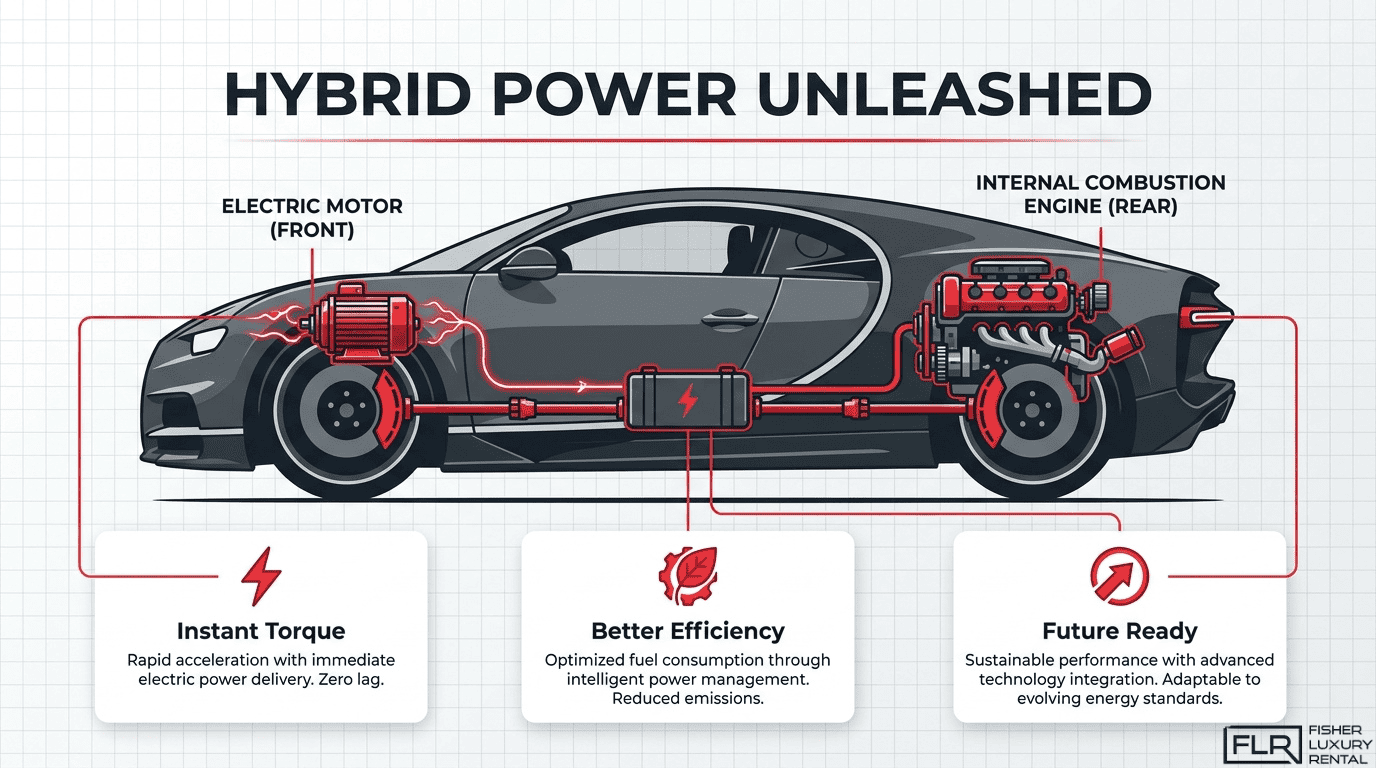
Hybrid systems deliver instant electric torque alongside combustion power, enabling models like the Ferrari SF90 Stradale and Lamborghini Revuelto to exceed 1,000 hp while achieving measurably lower fuel consumption than their pure ICE predecessors.
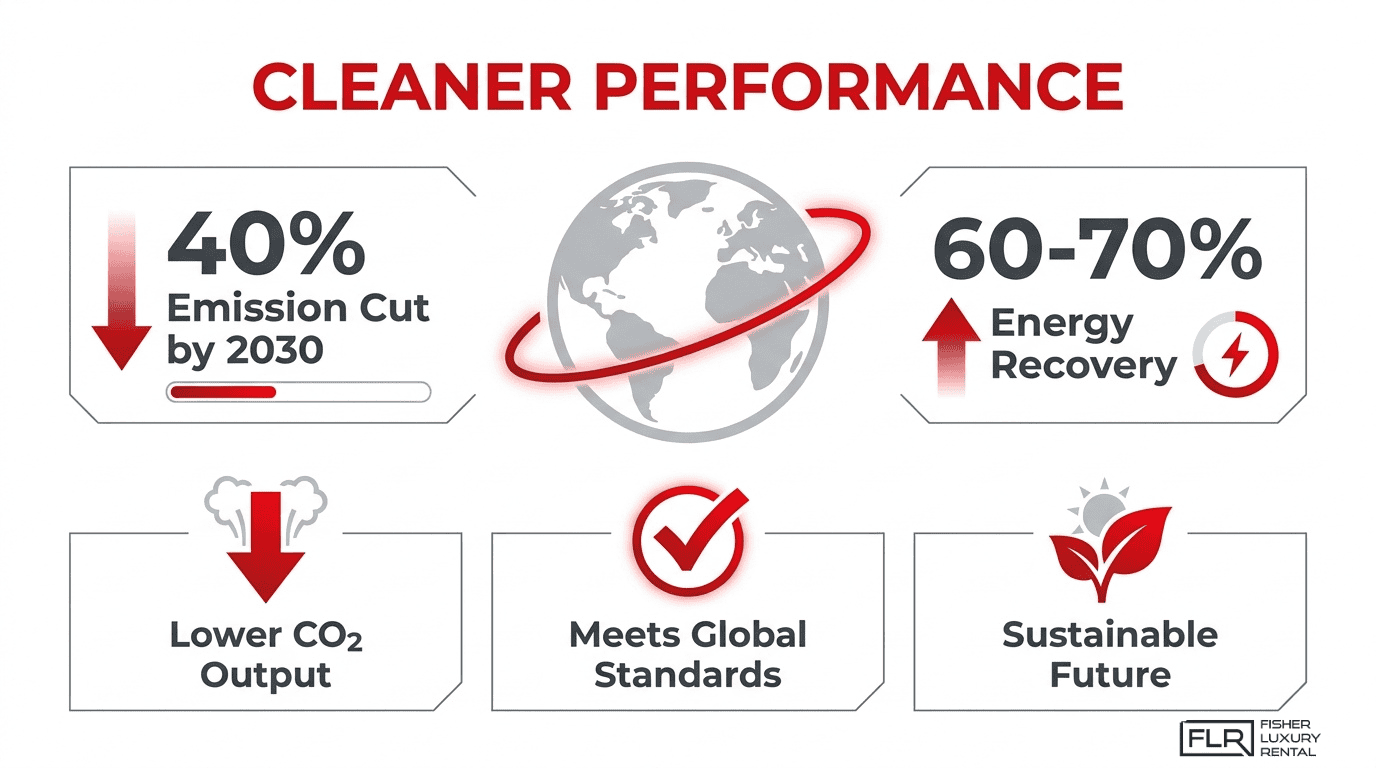
Efficiency gains come from regenerative braking, which recovers up to 60 to 70 percent of kinetic energy during deceleration, combined with electric-only driving modes that reduce fuel demand during low-speed operation.
The current market spans a range of engineering philosophies, from the McLaren Artura’s 39 MPGe combined rating to the Koenigsegg Gemera’s 2,300 hp output, and each model reflects a different balance of priorities.
Hybrid weight placement and active torque vectoring reshape handling and power delivery in ways that diverge meaningfully from traditional supercar dynamics.
Environmental strategy is now embedded at the brand level: Lamborghini has committed to cutting lifecycle emissions by 40 percent by 2030, and Ferrari is set to reveal its first fully electric vehicle in 2025, with hybrid architecture serving as the bridge technology between combustion and full electrification.
Ownership considerations including insurance costs, depreciation rates, and maintenance differences round out the full picture for anyone weighing a hybrid exotic purchase or rental.
Why Do Hybrid Exotic Cars Deliver Superior Performance?
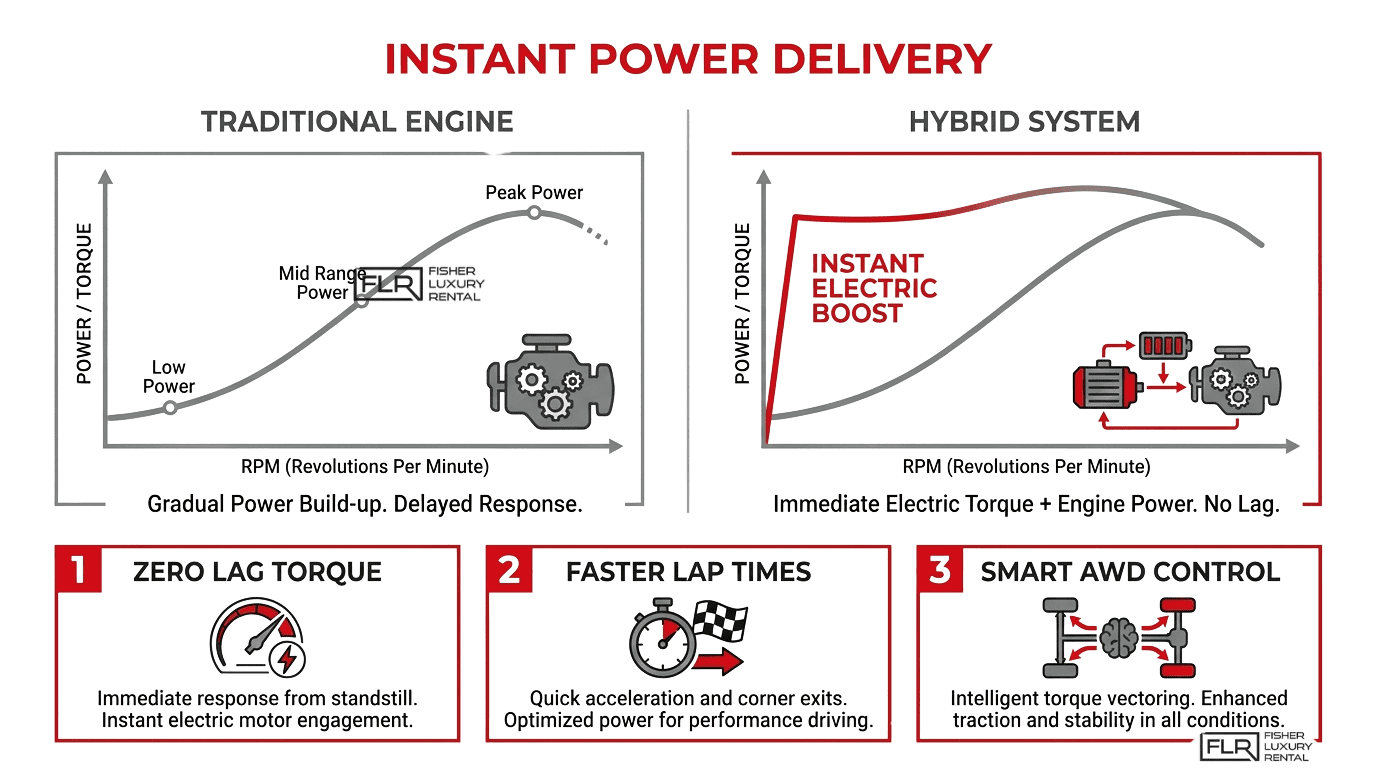
Hybrid exotic cars deliver superior performance by combining instant electric torque with high-output combustion engines, enabling faster acceleration, shorter lap times, and on-demand all-wheel drive. The following sections cover how electric motors enhance torque, improve track performance, and unlock AWD capability.
How oes Electric Torque Enhance Acceleration?
Electric torque enhances acceleration by delivering maximum rotational force instantly, without the rev-building delay of a combustion engine. Both the Ferrari SF90 Stradale and Lamborghini Revuelto demonstrate this through dedicated front e-axle systems. The SF90’s front axle uses two independent electric motors to control each wheel individually, sharpening torque vectoring and traction through corners. According to YASA, the Revuelto’s front e-axle pairs two motors delivering 110kW and 300Nm of torque each, enabling precise power distribution under acceleration and braking. Together, these systems allow drivers to exploit full power earlier and more confidently than any conventional supercar layout allows.
How Does Hybrid Power Improve Lap Times on Track?
Hybrid power improves lap times by closing the performance gap that combustion engines leave between gear changes and throttle response. Electric motors fill those gaps instantaneously, sustaining thrust through corners where a pure ICE would bog or hesitate. Ferrari CEO Benedetto Vigna stated directly: “Electrification is a way to improve performance,” confirming the brand views hybrid architecture as a performance tool, not a compromise. In practice, seamless electric fill-in during transitions means the powertrain delivers usable force more consistently, producing faster sector times even without peak power increases.
How Do Hybrid Systems Enable All-Wheel Drive Capability?
Hybrid systems enable all-wheel drive by using front-mounted electric motors to power the front axle independently from the rear combustion drivetrain, requiring no mechanical connection between axles. This approach is lighter and more responsive than a traditional AWD driveshaft arrangement. Both the Ferrari SF90 Stradale and Lamborghini Revuelto use this architecture, placing electric motors on the front axle while the combustion engine drives the rear. The result is torque vectoring across all four wheels, with each motor adjustable individually in milliseconds.
How Do Hybrid Exotic Cars Achieve Better Fuel Efficiency?
Hybrid exotic cars achieve better fuel efficiency by combining electric motors with internal combustion engines, recovering braking energy, and enabling zero-emission electric-only driving. The H3s below cover real-world fuel savings, electric-only range, and regenerative braking recovery rates.
How Much Fuel Do Hybrid Supercars Save Compared to ICE Models?
Hybrid supercars save fuel by supplementing the combustion engine with electric power during low-demand driving, reducing how often the engine operates at full load. Consumer Reports notes that two of the most common questions from buyers considering electrified performance vehicles are whether a hybrid, PHEV, or EV will actually save money, and what separates these powertrain types from each other. The honest answer is that savings depend heavily on driving style. Drivers who use electric-only modes during city commutes see the most measurable gains, while track-focused drivers prioritize power delivery over economy.
How Far Can Hybrid Exotic Cars Drive in Electric-Only Mode?
Hybrid exotic cars can drive in electric-only mode for ranges that vary significantly by model and battery size. Plug-in hybrid supercars with larger battery packs generally offer more electric range than mild or full hybrid configurations. For most exotic PHEVs, electric-only capability is designed for urban driving and low-speed maneuverability rather than extended highway range. Consumer Reports’ hybrid and EV buying guide recommends evaluating real-world electric range against typical daily driving patterns before selecting a powertrain type.
How Does Regenerative Braking Improve Overall Efficiency?
Regenerative braking improves overall efficiency by converting kinetic energy, normally lost as heat during deceleration, back into usable electrical energy stored in the battery. According to Electric and Hybrid Vehicle Technology International, regenerative braking systems can recover as much as 60 to 70 percent of the kinetic energy typically lost during vehicle deceleration. In exotic cars that brake hard and frequently, this recovery rate compounds meaningfully across a full drive cycle. This makes regenerative braking one of the highest-impact efficiency tools available in hybrid supercar engineering.
Which Hybrid Exotic Cars Lead the Market Today?
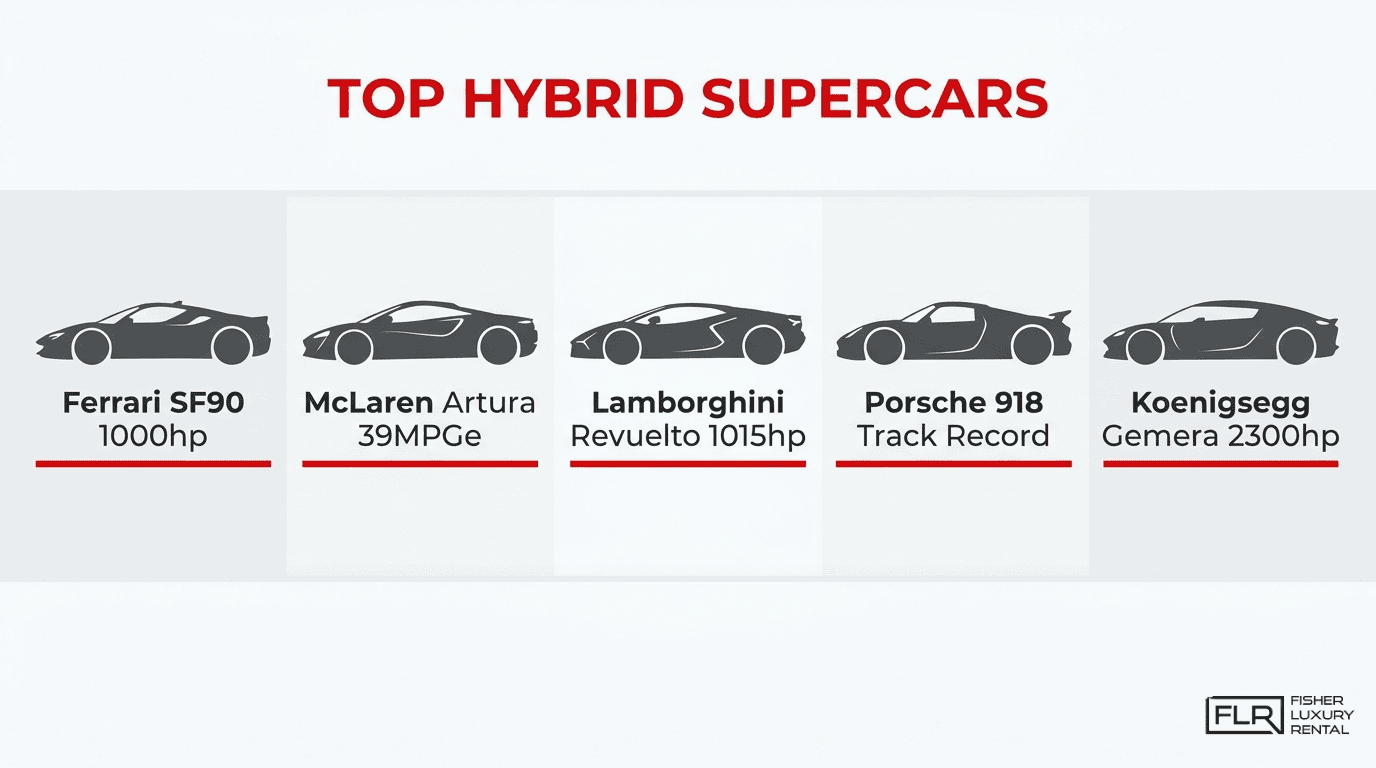
The hybrid exotic cars leading the market today include the Ferrari SF90 Stradale, McLaren Artura, Lamborghini Revuelto, Porsche 918 Spyder, and Koenigsegg Gemera. Each model combines combustion and electric power differently, spanning a range of outputs, efficiency ratings, and engineering philosophies.
Ferrari SF90 Stradale
The Ferrari SF90 Stradale features a plug-in hybrid architecture pairing a 90° V8 turbo engine producing 780 cv with three electric motors for a combined maximum power of 1,000 cv. This system accelerates the car from 0 to 100 km/h in just 2.5 seconds. Under WLTP testing, Ferrari reports weighted combined CO2 emissions of 154 g/km and fuel consumption of 6.1 l/100 km, a remarkable figure for a car at this performance level.
McLaren Artura
The McLaren Artura uses a 7.4 kWh lithium-ion battery delivering an EPA-estimated 11 miles of all-electric range and a total system output of 671 horsepower. According to Edmunds, the 2024 Artura achieves 17 mpg city and 21 mpg highway, with a combined efficiency rating of up to 39 MPGe. For a mid-engine supercar, that MPGe figure makes the Artura one of the more practically efficient machines in its class.
Lamborghini Revuelto
The Lamborghini Revuelto combines a naturally aspirated 6.5-liter V12 with three electric motors to produce 1,015 CV (1,001 hp), reaching 100 km/h in 2.5 seconds and exceeding 350 km/h. Lamborghini Chairman and CEO Stephan Winkelmann described the Revuelto as a “strategic inflection point” that stays faithful to the brand’s V12 DNA while embracing hybrid innovation. The Revuelto achieves 23 MPGe combined and 12 MPG on gasoline alone.
Porsche 918 Spyder
The Porsche 918 Spyder is a landmark hybrid exotic that proved electrification and track dominance are compatible. According to Porsche AG, on September 4, 2013, the 918 Spyder set a production car lap record at the Nürburgring Nordschleife with a time of 6 minutes and 57 seconds, a benchmark that reshaped industry expectations for hybrid supercars.
Koenigsegg Gemera
The Koenigsegg Gemera delivers 2,300 hp and 2,750 N·m of torque on E85 fuel through its HV8 powertrain, supported by a 14 kWh 850V lithium-ion battery pack. No other production hybrid exotic currently exceeds this power output, positioning the Gemera at the absolute ceiling of what electrified combustion engineering has achieved. It is both a four-seat grand tourer and the most powerful hybrid road car in production today.
How Does Hybrid Technology Affect the Driving Experience?
Hybrid technology affects the driving experience by transforming how power is delivered, how the car handles at speed, and how the cabin feels to occupants. The sub-sections below cover power delivery character, weight distribution and handling, and cabin noise levels.
What Does the Power Delivery Feel Like in a Hybrid Supercar?
Power delivery in a hybrid supercar feels immediate, seamless, and layered. Electric motors contribute instantaneous torque from a standstill, eliminating the brief hesitation that turbocharged engines produce before the combustion side reaches full boost. The result is a sensation that feels continuous rather than peaking at a particular rev range. Ferrari CEO Benedetto Vigna captured this directly, stating that “electrification is a way to improve performance,” reinforcing that hybrid integration is a deliberate performance tool, not a compromise. For drivers accustomed to pure ICE exotics, the sensation is noticeably more linear and confidence-inspiring, particularly when accelerating out of slow corners where traction is most at risk.
How Does Hybrid Weight Distribution Affect Handling?
Hybrid weight distribution affects handling by adding battery and motor mass, which engineers strategically position low in the chassis to lower the center of gravity. Placing battery packs along the floor reduces body roll and improves cornering stability compared to heavier, high-mounted combustion components. The front electric motors on models like the Ferrari SF90 Stradale and Lamborghini Revuelto simultaneously enable torque vectoring, actively distributing power between front wheels during cornering. This combination of lower mass placement and active torque control produces sharper turn-in response and more neutral mid-corner balance than many traditional supercars achieve.
Are Hybrid Exotic Cars Quieter Than Traditional Supercars?
Hybrid exotic cars are quieter than traditional supercars at low speeds and during electric-only operation, but they retain their signature combustion character at higher throttle loads. In urban driving or when departing a hotel quietly, the electric mode produces near-silent movement. At full power, the V12 of the Lamborghini Revuelto and the turbocharged V8 of the Ferrari SF90 Stradale still deliver the acoustic drama their owners expect. According to Top Gear, Lamborghini’s sustainability strategy targets a 40% reduction in life-cycle emissions by 2030, and quieter low-speed electric operation contributes to meeting tightening urban noise regulations without sacrificing the high-rpm soundtrack that defines these cars.
What Are the Environmental Benefits of Hybrid Exotic Cars?
The environmental benefits of hybrid exotic cars include reduced carbon emissions and improved compliance with tightening global emission regulations. The sections below cover how these powertrains cut lifecycle CO2 output and satisfy stricter standards worldwide.
How Much Do Hybrid Supercars Reduce Carbon Emissions?
Hybrid supercars reduce carbon emissions through combined electric and combustion powertrains that lower fuel consumption and CO2 output across a vehicle’s full lifecycle. According to Top Gear, Automobili Lamborghini has committed to cutting its lifecycle emissions by 40% by 2030 compared to 2021 levels, a target made possible specifically by its hybrid powertrain transition.
This level of ambition from a brand historically synonymous with large-displacement V12 engines signals how seriously the supercar segment is treating emissions reduction, not as a regulatory checkbox but as a core engineering goal.
How Do Hybrid Exotics Meet Stricter Global Emission Standards?
Hybrid exotics meet stricter global emission standards by combining electric motors with combustion engines to reduce tailpipe CO2 output below thresholds set by regulations in the EU, US, and other major markets. The electric drive modes allow these vehicles to run with zero local emissions during low-speed or urban driving, directly addressing the strictest segments of modern emissions frameworks.
For manufacturers, the hybrid architecture also provides measurable compliance headroom: lower fleet-average CO2 figures help brands avoid regulatory penalties while continuing to produce high-performance models.
How Do Hybrid Exotic Cars Compare to Fully Electric Supercars?
Hybrid exotic cars and fully electric supercars each offer distinct advantages depending on priority: range and flexibility versus instant torque and zero emissions. The sections below break down where each technology leads.
Where Do Hybrids Outperform Full EVs in Range and Flexibility?
Hybrid exotic cars outperform full EVs in range and flexibility by combining a combustion engine with electric motors, eliminating range anxiety entirely. A driver can refuel at any gas station globally, a convenience no current electric supercar matches. For long-distance drives or touring routes through areas with sparse charging infrastructure, this dual-fuel architecture is genuinely superior. The combustion engine also preserves the visceral soundtrack that defines exotic car culture, something full EVs cannot replicate. For renters and enthusiasts who want maximum freedom without planning routes around charging stops, hybrids remain the more practical choice.
Where Do Fully Electric Supercars Have the Advantage?
Fully electric supercars have the advantage in instantaneous torque delivery, zero tailpipe emissions, and lower per-mile energy costs. With no combustion cycle delay, electric powertrains can dispatch full torque from a standstill, producing acceleration figures that challenge even the most powerful hybrids. The zero-emissions profile also gives EVs a clear regulatory advantage as urban low-emission zones expand globally. According to Reuters, Ferrari is scheduled to reveal its first fully electric vehicle on October 9, 2025, at its headquarters in Maranello, signaling that even the most tradition-bound supercar brands now see compelling reasons to go fully electric.
What Does the Future Hold for Hybrid Exotic Car Technology?
The future of hybrid exotic car technology points toward lighter, more powerful battery systems and near-universal adoption of electrified powertrains across elite brands. The H3s below cover two pivotal developments: battery breakthroughs and the industry shift toward hybrid standards.
How Will Battery Advances Change Hybrid Supercar Design?
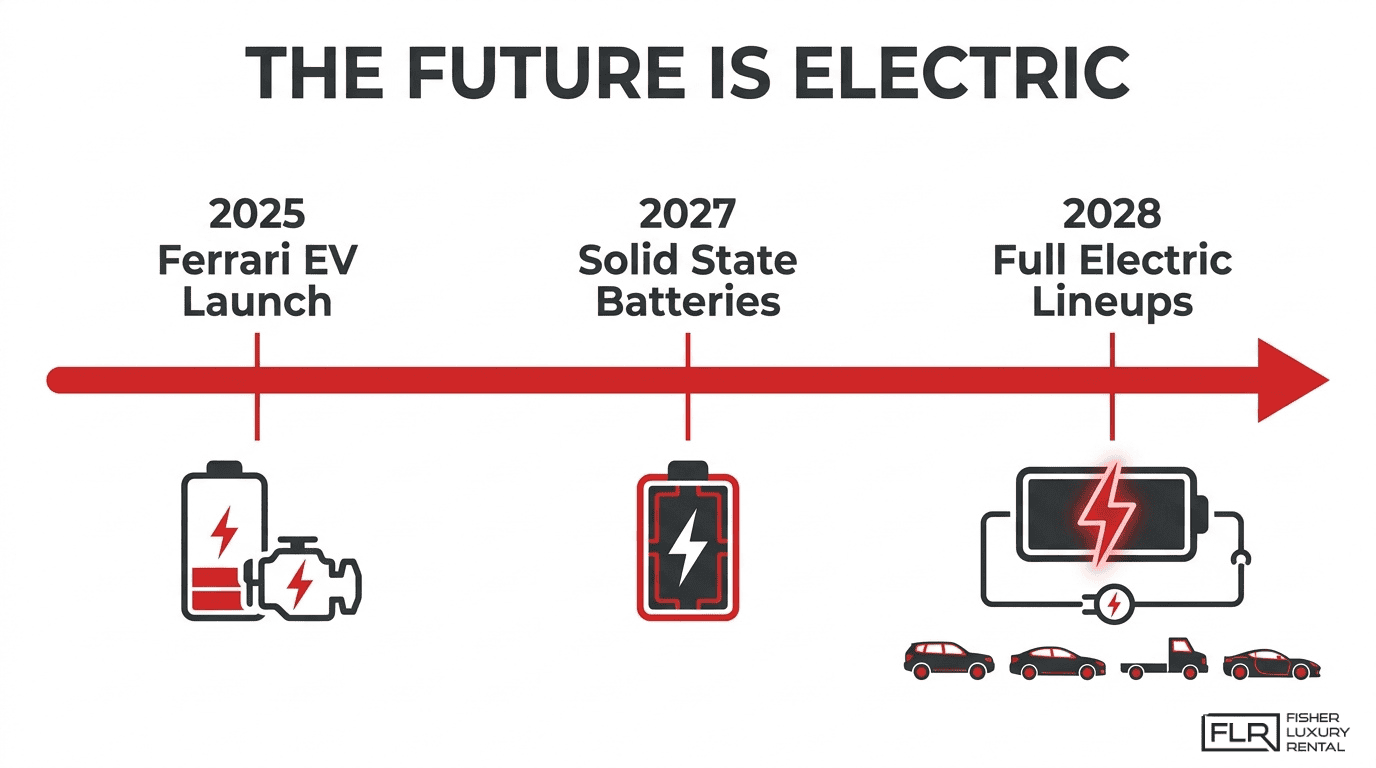
Battery advances will change hybrid supercar design by enabling faster charging, greater energy density, and reduced weight, all of which directly expand performance capability. Toyota plans to introduce first-generation solid-state batteries into production vehicles in the 2027–2028 timeframe, targeting a fast-charging time of approximately 10 minutes, according to Autoweek. For exotic manufacturers, solid-state chemistry matters enormously: smaller, lighter packs allow engineers to redistribute mass for better handling without sacrificing electric range or peak power output. This is arguably the most consequential materials shift the segment has seen since carbon fiber monocoques became standard.
Will Hybrid Powertrains Become Standard Across Exotic Brands?
Hybrid powertrains will become standard across exotic brands, with Ferrari and Lamborghini already publishing firm electrification timelines. Ferrari is scheduled to reveal its first fully electric vehicle on October 9, 2025, at its Maranello headquarters, while Lamborghini’s “Direzione Cor Tauri” roadmap targets its first full-electric model in 2028. Between now and those milestones, plug-in hybrid architecture remains the bridge technology of choice. Given how thoroughly hybrids have already reshaped flagship models from both marques, expecting anything less than full adoption across their lineups is increasingly unrealistic.
How Do Hybrid Exotics Impact Ownership and Maintenance Costs?
Hybrid exotics impact ownership and maintenance costs through higher insurance premiums, strong resale value retention, and reduced fuel expenses compared to pure ICE supercars. The sections below cover insurance rates, depreciation, and routine maintenance considerations.
How Much Does It Cost to Insure a Hybrid Exotic Car?
Insuring a hybrid exotic car costs significantly more than a standard vehicle. According to Insure.com, the average annual insurance premium for a hybrid vehicle in 2025 is estimated at $2,554, approximately $213 per month. For hybrid exotics specifically, premiums climb considerably higher due to replacement part costs, specialized repair networks, and the vehicles’ overall market value. Owners should budget insurance as one of the largest fixed ownership expenses.
Do Hybrid Exotic Cars Hold Their Value Better Than ICE Supercars?
Hybrid exotic cars generally hold their value better than traditional ICE supercars, largely because hybrid powertrains represent current and future-facing technology. Analysis from iSeeCars shows the Ferrari F8 Tributo loses approximately 20.5% of its value over five years. The SF90 Stradale, Ferrari’s flagship hybrid, depreciates at a slower rate by comparison, reflecting strong collector demand for electrified performance models. In this segment, technology currency directly influences resale strength.
What Maintenance Differences Should Hybrid Exotic Owners Expect?
Hybrid exotic owners should expect maintenance differences in braking systems, battery servicing, and powertrain complexity. Regenerative braking reduces brake pad wear meaningfully, lowering routine brake replacement frequency. However, high-voltage battery packs and dual powertrain systems require specialized technicians and manufacturer-certified service centers, which can increase labor costs per visit. Balancing lower consumable costs against higher specialist labor makes total maintenance budgeting more nuanced than with conventional supercars.
How Can You Experience a Hybrid Exotic Car Firsthand?
Experiencing a hybrid exotic car firsthand means getting behind the wheel, not just reading specifications. The H3s below cover how renting lets you compare hybrid power directly and what key takeaways to carry forward.
Can Renting a Luxury Exotic Car Help You Compare Hybrid Power?
Yes, renting a luxury exotic car can help you compare hybrid power by giving you direct, side-by-side seat time across different powertrains without a purchase commitment. Reading about instantaneous electric torque or regenerative braking is one thing; feeling the SF90 Stradale’s 1,000 cv system launch or the McLaren 720S deliver power through a corner is something fundamentally different. Rental access lets enthusiasts evaluate what hybrid integration actually changes in real driving conditions, from throttle response to acoustic character, before forming any opinion that data alone cannot provide. Fisher Luxury Rental offers a fleet that includes the Ferrari 488 Spider and McLaren 720S in Phoenix and Portland, putting high-performance exotics within reach for a single day.
What Are the Key Takeaways About Hybrid Exotic Cars?
The key takeaways about hybrid exotic cars are that performance, efficiency, and future viability converge in a single powertrain architecture. The core lessons from this article are:
- Performance is additive: Hybrid systems deliver instant electric torque alongside combustion power, producing outputs exceeding 1,000 hp in models like the Ferrari SF90 Stradale and Lamborghini Revuelto.
- Efficiency gains are real: Regenerative braking, electric-only driving modes, and optimized fuel mapping reduce consumption without sacrificing capability.
- Major brands are committed: Ferrari, Lamborghini, and McLaren have each embedded hybrid technology into their core model strategies, not as a compromise but as a performance advantage.
- Renting is the fastest path to understanding: Specifications describe a car; driving one reveals it.
Fisher Luxury Rental makes exotic driving accessible in Phoenix and Portland for enthusiasts ready to experience this shift firsthand.