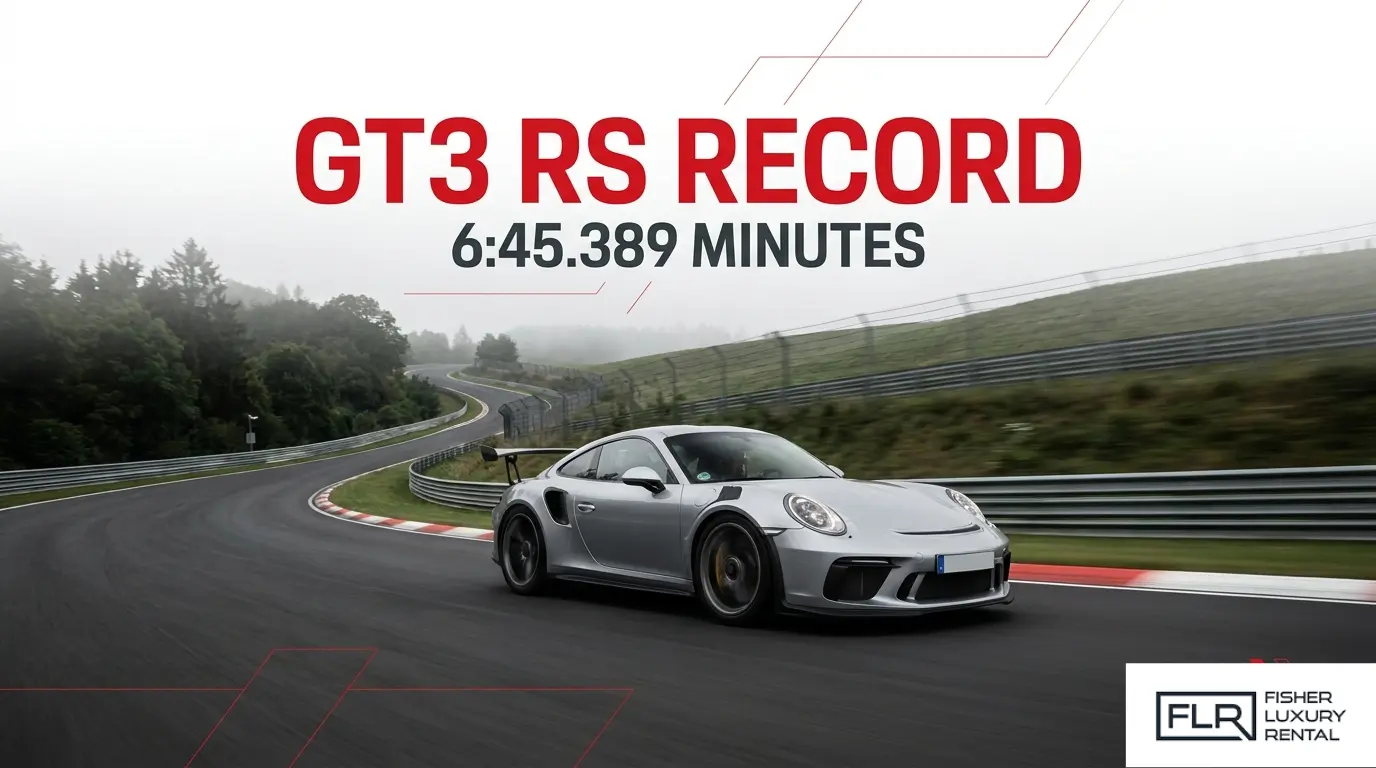
The Porsche 911 GT3 RS Nürburgring lap time record stands at 6:45.389 minutes, set by Jörg Bergmeister in the 992.1 with the Manthey Performance Kit on April 14, 2025. Across generations, the GT3 RS has evolved from a 7:43 benchmark in 2004 to one of the fastest naturally aspirated production cars ever to lap the Nordschleife.
This guide covers the all-time records and their context, how lap times have progressed generation by generation, the drivers behind each benchmark, how the GT3 RS compares to Porsche siblings and non-Porsche rivals, the engineering behind its speed, how conditions and track configurations shape the numbers, and how to experience this performance firsthand.
The all-time records section examines the 992 GT3 RS’s 6:49.328 standard run alongside the 991 generation’s 6:56.4, the first sub-seven-minute lap by a naturally aspirated production car, and places both against competitors including the Mercedes-AMG GT Black Series and GT2 RS Manthey Kit.
The generational progression traces each model from the 996’s 7:43 through the 997, 991, 991.2, and 992 generations, showing how each engineering step delivered measurable lap time reductions.
The performance analysis covers the 992’s 860 kg of downforce at 285 km/h, its DRS system, Formula One-inspired suspension geometry, and 518 hp naturally aspirated flat-six, explaining why the 992 generation made such a large jump from the 991.2.
The conditions and track configuration sections clarify why layout distance, ambient temperature, wind, and driver pedigree all affect how any quoted GT3 RS lap time should be read.
What Is the Fastest Porsche GT3 RS Nürburgring Lap Time Ever Recorded?
The fastest Porsche GT3 RS Nürburgring lap time ever recorded is 6:56.4 minutes, set by Porsche works race driver Kévin Estre in the 991-generation 911 GT3 RS (520 hp) on the 20.6-kilometre Nordschleife, according to the Porsche Newsroom. That result made the GT3 RS the first naturally aspirated production car to break the seven-minute barrier on the circuit.
Context matters when comparing this record to broader Nürburgring benchmarks. The 992 GT3 RS holds a separate time of 6:49.328 minutes on the longer 20.8-kilometre layout, while the Porsche 911 GT2 RS with the Manthey Performance Kit pushed further to 6:43.300 minutes on June 14, 2021, driven by Lars Kern. The Mercedes-AMG GT Black Series holds a certified time of 6:48.047 minutes on the 12.944-mile total track, set by GT3 driver Maro Engel under conditions where some sections were not yet fully dry at 44.6°F ambient temperature.
One factor behind the 992 GT3 RS’s competitiveness is its drag reduction system (DRS), fitted for the first time on a production Porsche, which flattens the wings at the push of a button for lower drag on straights. Understanding how lap configurations differ is also essential: the official Nordschleife lap, standardised in 2019, measures 12.944 miles after the operating company repositioned the start/finish line at the T13 section, adding 761.155 ft versus the older 12.8-mile circuit.
How Have Porsche GT3 RS Nürburgring Lap Times Evolved by Generation?
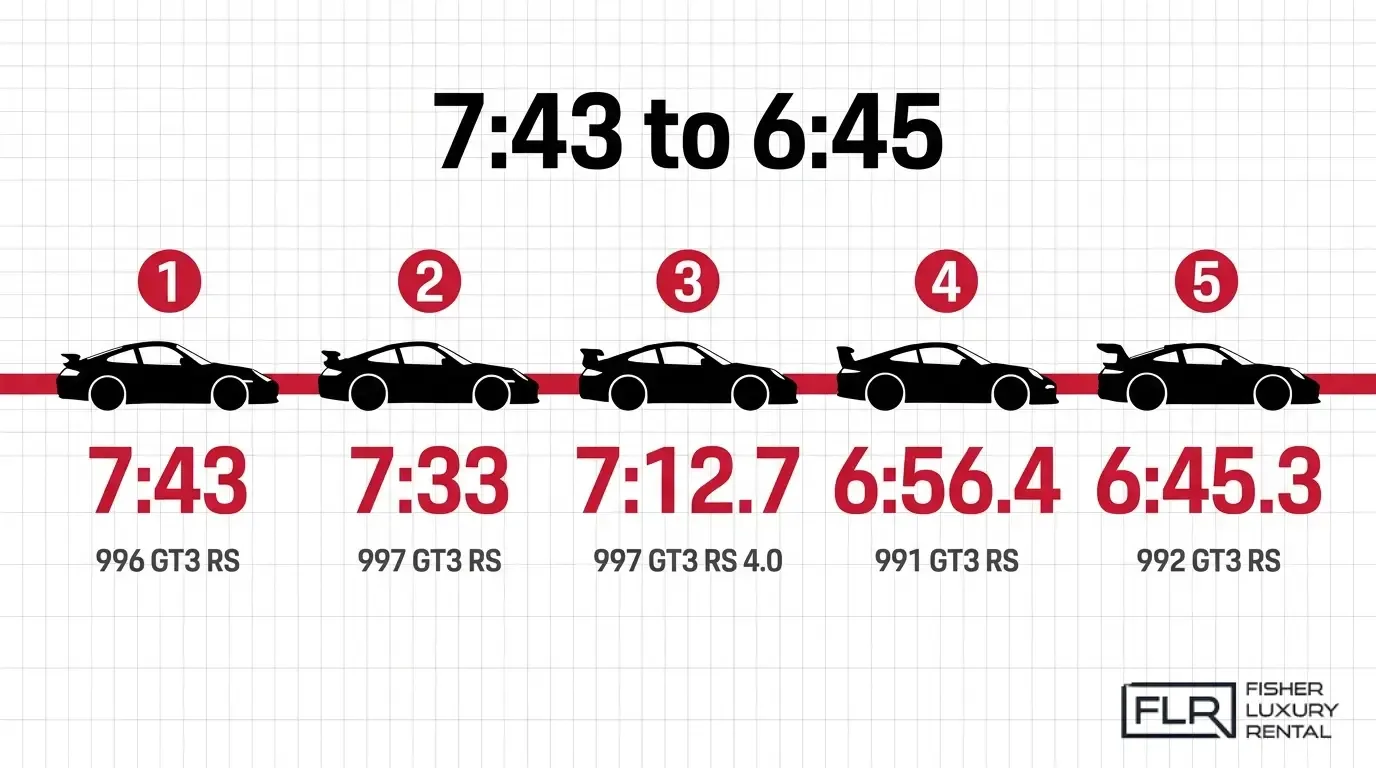
Porsche GT3 RS Nürburgring lap times have evolved from 7:43 in 2004 to 6:45.389 in 2025, a reduction of nearly one minute across five generations. The sections below trace each generation’s recorded time, driver, and lap configuration.
What Was the 996 GT3 RS Nürburgring Lap Time?
The 996 GT3 RS Nürburgring lap time was 7:43, set in October 2004 by Walter Röhrl on the full Nordschleife layout, according to Wikipedia’s official lap time records. As the first GT3 RS to carry a documented Nordschleife benchmark, this time established the baseline that every subsequent generation would work to improve.
What Was the 997 GT3 RS Nürburgring Lap Time?
The 997 GT3 RS Nürburgring lap time was first recorded at 7:48 in 2007 (997.1), driven by Horst von Saurma on the 20,600 m layout. The 997.2 improved that to 7:33 in 2010, and the 997.2 GT3 RS 4.0 pushed further to 7:30 in 2011, with von Saurma driving all three runs.
What Was the 991 GT3 RS Nürburgring Lap Time?
The 991 GT3 RS Nürburgring lap time was 7:28, recorded in 2015 by Christian Gebhardt on the 20,600 m layout. Powered by a naturally aspirated 4.0-liter engine producing 500 PS, this 991.1 pre-facelift result represented a meaningful step forward from the 997 generation’s best time of 7:30.
What Was the 991.2 GT3 RS Nürburgring Lap Time?
The 991.2 GT3 RS Nürburgring lap time was 7:05.41, set on April 18, 2018, by Christian Gebhardt on the 20,600 m layout. The facelift’s 520 PS output shaved over 22 seconds from the 991.1 result, marking the largest single-generation improvement in the GT3 RS’s recorded Nordschleife history.
What Is the 992 GT3 RS Nürburgring Lap Time?
The 992 GT3 RS Nürburgring lap time is 6:49.328, set by Porsche brand ambassador Jörg Bergmeister on the 20.8-kilometre Nordschleife, according to the Porsche Newsroom. With the Manthey Performance Kit fitted, the 992.1 lowered that benchmark further to 6:45.389 on April 14, 2025, also driven by Bergmeister on the 20,832 m layout.
Who Set the Official Porsche GT3 RS Nürburgring Lap Records?
The official Porsche GT3 RS Nürburgring lap records were set by a small group of factory-affiliated drivers across multiple generations, each selected for their precision and racing pedigree. The drivers behind these benchmark times include Jörg Bergmeister, Kévin Estre, Christian Gebhardt, Horst von Saurma, and Walter Röhrl.
The drivers and their official times are:
- Jörg Bergmeister set the 992 GT3 RS time of 6:49.328 on the 20.8 km Nordschleife, and later improved it to 6:45.389 with the 992.1 Manthey Kit on April 14, 2025, according to the Porsche Newsroom and Wikipedia.
- Kévin Estre, a Porsche works race driver, set the 991 generation record of 6:56.4 on the 20.6 km layout.
- Christian Gebhardt drove the 991.1 to 7:28 in 2015 and the 991.2 to 7:05.41 on April 18, 2018.
- Horst von Saurma recorded times of 7:48 (997.1, 2007), 7:33 (997.2, 2010), and 7:30 (997.2 GT3 RS 4.0, 2011).
- Walter Röhrl set the 996 GT3 RS time of 7:43 in October 2004.
These records reflect a deliberate pattern: Porsche consistently deploys brand ambassadors and works drivers rather than outside testers, ensuring each record represents the car’s genuine engineering ceiling. Bergmeister’s 2025 Manthey Kit result demonstrates that the platform still has headroom when factory-supported upgrades enter the equation.
How Does the GT3 RS Compare to Other Porsche Models at the Nürburgring?
The GT3 RS sits above the standard GT3 in Porsche’s track hierarchy but below the twin-turbocharged GT2 RS. The sections below compare the GT3 RS directly against the GT3, GT2 RS, and 911 Turbo S on the Nordschleife.
How Does the GT3 RS Compare to the GT3 at the Nürburgring?
The GT3 RS compares to the GT3 at the Nürburgring with a substantial performance advantage, built on aerodynamics and weight reduction. The 992 GT3 RS produces 860 kg of total downforce at 285 km/h, three times the figure of a standard 911 GT3, according to Porsche Newsroom. Consistent use of carbon fibre reinforced plastic (CFRP) holds the GT3 RS unladen weight to just 1,450 kg, per Porsche International. That combination of extreme downforce and low mass translates directly into faster cornering speeds and quicker lap times than the GT3 can achieve.
How Does the GT3 RS Compare to the GT2 RS at the Nürburgring?
The GT3 RS compares to the GT2 RS at the Nürburgring as the slower but naturally aspirated alternative. The GT2 RS fitted with the Manthey Performance Kit recorded 6:43.300 minutes on the 20.8-kilometre Nordschleife on June 14, 2021, driven by Lars Kern, according to Porsche Newsroom. The 992 GT3 RS posted 6:49.328 minutes over the same layout, placing it roughly six seconds behind. The GT2 RS gains its edge through turbocharged power; the GT3 RS counters with a purer, higher-revving driving character that many enthusiasts regard as the more engaging experience.
How Does the GT3 RS Compare to the 911 Turbo S at the Nürburgring?
The GT3 RS compares to the 911 Turbo S at the Nürburgring as the dedicated track weapon versus an all-round performance car. The Turbo S prioritises everyday usability alongside straight-line speed, while the GT3 RS sacrifices comfort for maximum cornering capability through its motorsport-derived aerodynamics, CFRP construction, and DRS system. On a technical circuit like the Nordschleife, the GT3 RS’s downforce advantage and lower weight give it a meaningful edge in high-speed sections, where driver Jörg Bergmeister noted it performs at a level usually reserved for top-class racing cars.
What Makes the Porsche GT3 RS So Fast Around the Nürburgring?
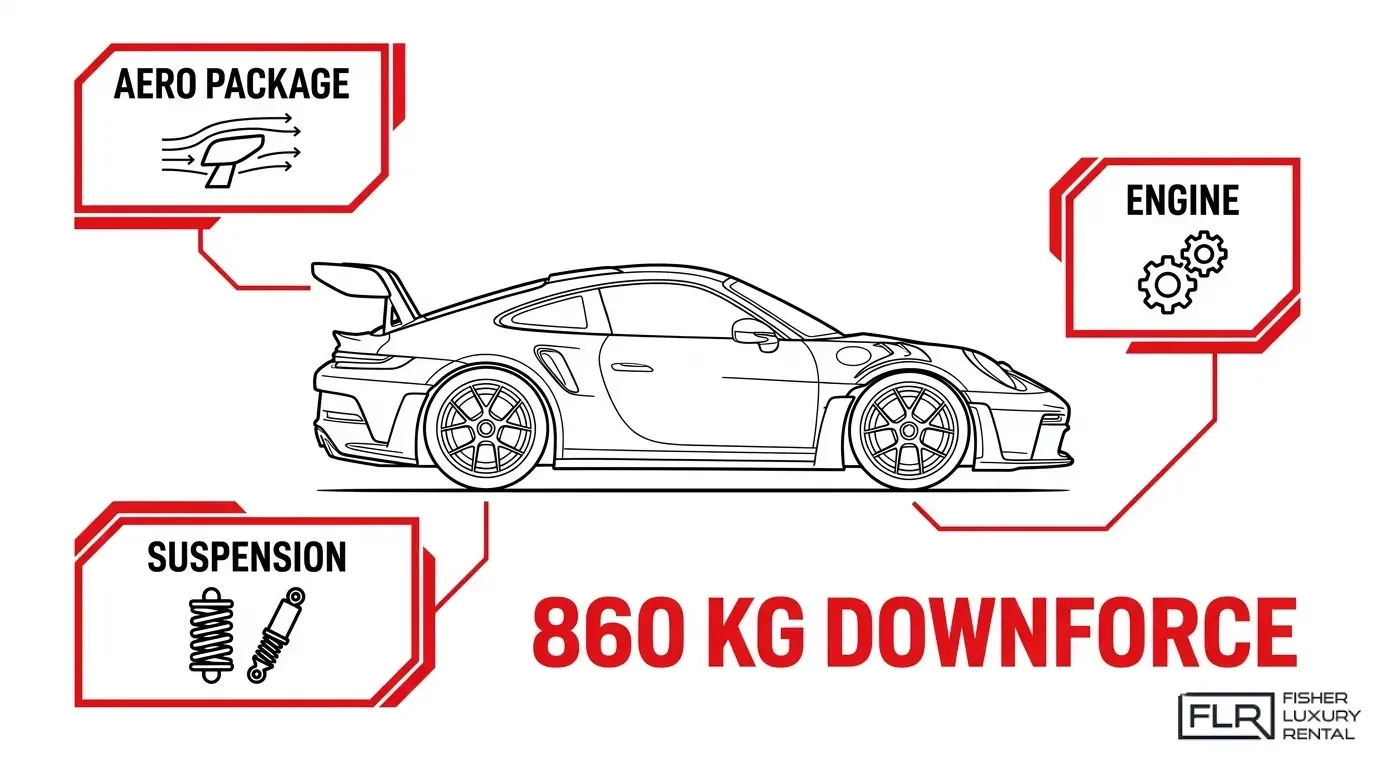
The GT3 RS is fast around the Nürburgring because of three deeply integrated performance systems: a race-derived aerodynamic package, a track-tuned suspension, and a high-revving naturally aspirated engine paired with a short-ratio PDK gearbox.
How Does the GT3 RS Aerodynamic Package Improve Lap Times?
The GT3 RS aerodynamic package improves lap times by generating massive downforce that keeps the car planted at high speed. According to Porsche Newsroom, the 992 GT3 RS produces 860 kilograms of total downforce at 285 km/h, three times the figure of a standard 911 GT3. A drag reduction system (DRS), fitted to a production Porsche for the first time on the GT3 RS, flattens the wings at the push of a button to reduce drag on straights. Jörg Bergmeister confirmed the real-world effect, stating: “In the fast sections in particular, the 911 GT3 RS is in a league of its own. Here it’s on a level usually reserved for top-class racing cars.” For a circuit like the Nürburgring, where confidence at speed is everything, this downforce-to-drag balance is arguably the GT3 RS’s single greatest competitive weapon.
How Does the GT3 RS Suspension Setup Handle the Nürburgring?
The GT3 RS suspension setup handles the Nürburgring by combining Formula One-inspired geometry with adaptive rear-axle steering. Reprofiled front wishbones and tie rod ends generate 40 kg of aerodynamic downforce directly at the suspension, a technique uncommon on road cars. Spring rates are only 50% stiffer than those on the standard 992 GT3, because thicker anti-roll bars manage lateral roll instead of relying solely on spring stiffness. At low speeds, rear wheels steer opposite to the fronts to sharpen turn-in; above 50 mph, they steer in the same direction to add high-speed stability. This combination keeps the car settled through the Nürburgring’s relentless elevation changes and blind crests.
How Does the GT3 RS Engine and Gearbox Contribute to Its Speed?
The GT3 RS engine and gearbox contribute to its speed through a 4.0-liter naturally aspirated flat-six producing 518 hp, paired with a seven-speed PDK transmission geared shorter than the standard 911 GT3. New camshaft profiles and a motorsport-derived single-throttle intake system sharpen throttle response across the rev range. The PDK’s shorter overall ratio keeps the engine in its power band through the Nürburgring’s rapid sequence of corners, without the hesitation of a turbocharged unit under lift-throttle. For a track that punishes delayed power delivery, a high-revving naturally aspirated engine with instant response is a genuine advantage over forced-induction alternatives. For drivers who want to experience this kind of high-performance engineering outside a racetrack setting, Fisher Luxury Rental offers exotic and luxury car rentals across Phoenix, AZ and Portland, OR — putting serious performance machines within reach for enthusiasts at any level.
How Does the GT3 RS Stack Up Against Non-Porsche Rivals at the Nürburgring?
The GT3 RS stacks up exceptionally well against non-Porsche rivals at the Nürburgring, matching or beating some of the most powerful exotic cars in the world. The comparisons below cover three key competitors: the Mercedes-AMG GT Black Series, the Lamborghini Aventador SVJ, and the Dodge Viper ACR.
How Does the GT3 RS Compare to the Mercedes-AMG GT Black Series?
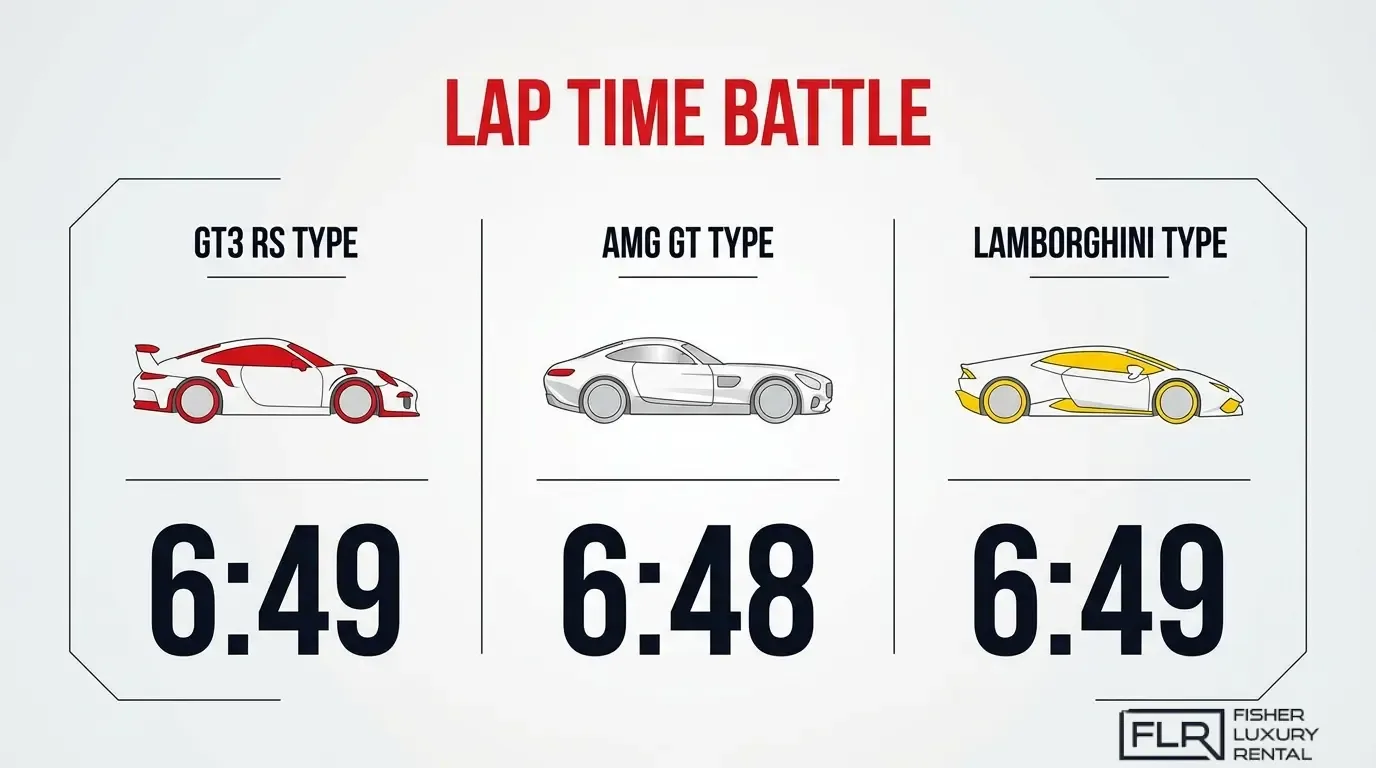
The GT3 RS compares closely to the Mercedes-AMG GT Black Series at the Nürburgring, with the result depending on specification. The standard 992 GT3 RS posted 6:49.328, while the Mercedes-AMG GT Black Series recorded an officially notarized time of 6:48.047 on the same 20.8-kilometre layout, driven by GT3 driver Maro Engel. That is a gap of just 1.28 seconds. With the Manthey Performance Kit, however, the GT3 RS reclaimed the edge at 6:45.389. Given that the GT3 RS achieves this with a naturally aspirated engine against the AMG’s turbocharged V8, it is a remarkable demonstration of what aerodynamic efficiency can accomplish.
How Does the GT3 RS Compare to the Lamborghini Aventador SVJ?
The GT3 RS compares favorably against the Lamborghini Aventador SVJ LP770-4, which set a lap time of 6:49.42 on the 20,832 m Nordschleife layout on July 26, 2018, driven by Marco Mapelli. The standard 992 GT3 RS matched it almost exactly at 6:49.328, despite producing significantly less power than the Aventador SVJ’s 770 hp. The GT3 RS’s 860 kg of downforce at 285 km/h, generated without a monstrous V12, makes this comparison a strong argument for precision engineering over raw horsepower.
How Does the GT3 RS Compare to the Dodge Viper ACR?
The GT3 RS is substantially faster than the Dodge Viper ACR at the Nürburgring. The 2017 Dodge Viper ACR recorded a lap time of 7:01.3 on the 20,600 m layout, while the 992 GT3 RS completed the same circuit in 6:49.328. That gap of over 12 seconds is decisive. The Viper ACR was built specifically as an extreme track weapon, making the GT3 RS’s margin of victory all the more telling about the 992 generation’s engineering leap.
What Conditions Affect Porsche GT3 RS Nürburgring Lap Times?
The conditions that affect Porsche GT3 RS Nürburgring lap times include weather, asphalt temperature, wind, and track configuration. Even factory-timed runs are subject to these variables, which can meaningfully shift recorded results.
How Do Weather and Track Temperature Affect GT3 RS Lap Times?
Weather and track temperature directly affect GT3 RS lap times by altering tire grip, downforce effectiveness, and mechanical grip. Cooler asphalt reduces tire operating temperature, limiting peak grip levels. According to Porsche Newsroom, Andreas Preuninger, Director of GT Cars, acknowledged that the 992 GT3 RS’s 6:49.328 lap was set “with a strong headwind on the long straight of the Döttinger Höhe and cool asphalt temperatures,” noting conditions were far from ideal. Even at the official record level, ambient temperature and wind resistance demonstrably cost lap time.
How Does Track Layout and Measurement Affect Lap Time Comparisons?
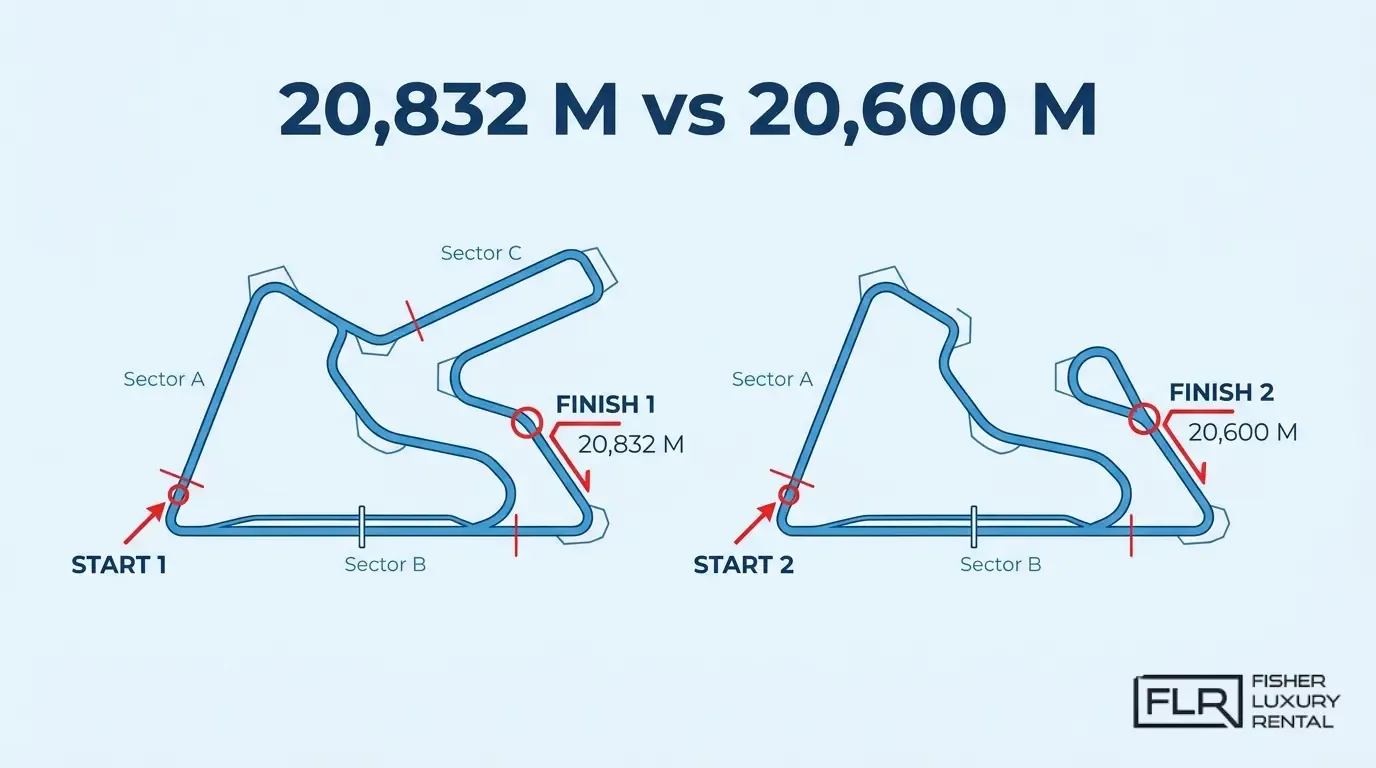
Track layout and measurement significantly affect lap time comparisons across different GT3 RS generations. Most historical laps were completed on the 20,600 m configuration, while the current official Nordschleife layout measures 20,832 m. Comparing a 7:28 set by the 991.1 on the shorter layout directly against the 992’s 6:49.328 on the longer configuration understates the newer car’s advantage. Standardized measurement is essential for accurate generational benchmarking.
Does Driver Skill Influence Official GT3 RS Nürburgring Results?
Driver skill influences official GT3 RS Nürburgring results considerably. Factory lap records use professional works drivers, such as Jörg Bergmeister and Kévin Estre, whose racecraft extracts the maximum from the car’s aerodynamic and mechanical package. A privateer driver in the same 992 GT3 RS would record a substantially slower time under identical conditions. The car’s capability sets the ceiling; the driver determines how close to that ceiling the lap time lands.
With conditions, layout, and driver all proven to shift recorded times, understanding these variables is essential context for reading any GT3 RS lap time figure.
What Is the Difference Between Nordschleife and Bridge-to-Gantry Lap Times for the GT3 RS?
The difference between Nordschleife and Bridge-to-Gantry lap times for the GT3 RS is primarily a matter of measured distance and timing reference points. The full Nordschleife layout runs 20,832 m, while most recorded laps use the 20,600 m configuration, omitting roughly 200 metres for safety reasons. Bridge-to-Gantry times cover a shorter, standardized segment and are not directly comparable to full-circuit Nordschleife times.
This distinction matters when evaluating how the GT3 RS compares to rivals. According to Wikipedia, the Lamborghini Aventador SVJ LP770-4 set its 6:49.42 on the 20,832 m layout, while the Dodge Viper ACR recorded 7:01.3 on the 20,600 m configuration. Comparing those two times as equals would be misleading, since the longer layout adds measurable seconds. The same applies to GT3 RS benchmark laps: always verify which layout a quoted time uses before drawing performance conclusions.
How Can You Experience Porsche GT3 RS Performance Firsthand?
You can experience Porsche GT3 RS performance firsthand by renting an exotic Porsche through a premium rental service. The section below covers the key takeaways from GT3 RS Nürburgring lap time data.
Can Renting an Exotic Porsche from Fisher Luxury Rental Deliver the GT3 RS Thrill?
Renting an exotic Porsche from a premium rental service can deliver a thrilling high-performance driving experience for enthusiasts who want direct seat time in a capable machine. The 911 GT3 RS uses a 4.0-liter naturally aspirated engine producing 518 hp, with camshaft profiles and a single-throttle intake system derived directly from motorsport, according to the Porsche Newsroom. Andreas Preuninger, Director of GT cars, captured the car’s demanding character plainly: “Considering the far from ideal conditions, with a strong headwind on the long straight of the Döttinger Höhe and cool asphalt temperatures, we are satisfied with this time.” Fisher Luxury Rental offers exotic and luxury car rentals, giving enthusiasts the opportunity to experience high-performance vehicles firsthand.
What Are the Key Takeaways About Porsche GT3 RS Nürburgring Lap Times and Top Records?
The key takeaways about Porsche GT3 RS Nürburgring lap times are that the platform has shed nearly 63 seconds from its 2004 benchmark across seven generations, reaching a current best of 6:45.389 with the Manthey Kit. According to Wikipedia’s Nordschleife lap time records, the progression spans from Walter Röhrl’s 7:43 in the 996 (2004) to Jörg Bergmeister’s 6:45.389 in the 992.1 Manthey Kit (April 14, 2025), with the standard 992 completing the 20.8 km Nordschleife in 6:49.328. The full generation-by-generation record is:
| Generation | Year | Driver | Lap Time | Layout |
| 996 | 2004 | Walter Röhrl | 7:43 | Full layout |
| 997.1 | 2007 | Horst von Saurma | 7:48 | 20,600 m |
| 997.2 | 2010 | Horst von Saurma | 7:33 | 20,600 m |
| 997.2 4.0 | 2011 | Horst von Saurma | 7:30 | 20,600 m |
| 991.1 | 2015 | Christian Gebhardt | 7:28 | 20,600 m |
| 991.2 | 2018 | Christian Gebhardt | 7:05.41 | 20,600 m |
| 992 | 2022 | Jörg Bergmeister | 6:49.328 | 20,832 m |
| 992.1 Manthey Kit | 2025 | Jörg Bergmeister | 6:45.389 | 20,832 m |
The 992 generation’s 860 kg of downforce at 285 km/h, three times that of the standard GT3, is the single biggest factor explaining the gap between the 991.2 and 992 lap times. Each generation’s improvement reflects a deliberate engineering step rather than incremental tuning, making the GT3 RS one of the most measurable development stories in production-car motorsport. Fisher Luxury Rental, serving Phoenix and Portland, offers enthusiasts a way to get behind the wheel of exotic and luxury vehicles — translating that engineering story into a personal driving experience.