Ferrari dashboard design is the progressive engineering of the driver’s command center, shaped by over seven decades of motorsport-derived innovation and purposeful ergonomic refinement.
This guide covers the origins of the hand-crafted cockpit, the instrumentation shifts across each defining decade, the arrival of F1-inspired steering wheel controls, the materials and craftsmanship defining Ferrari interiors, and how digital integration has transformed the modern cabin.
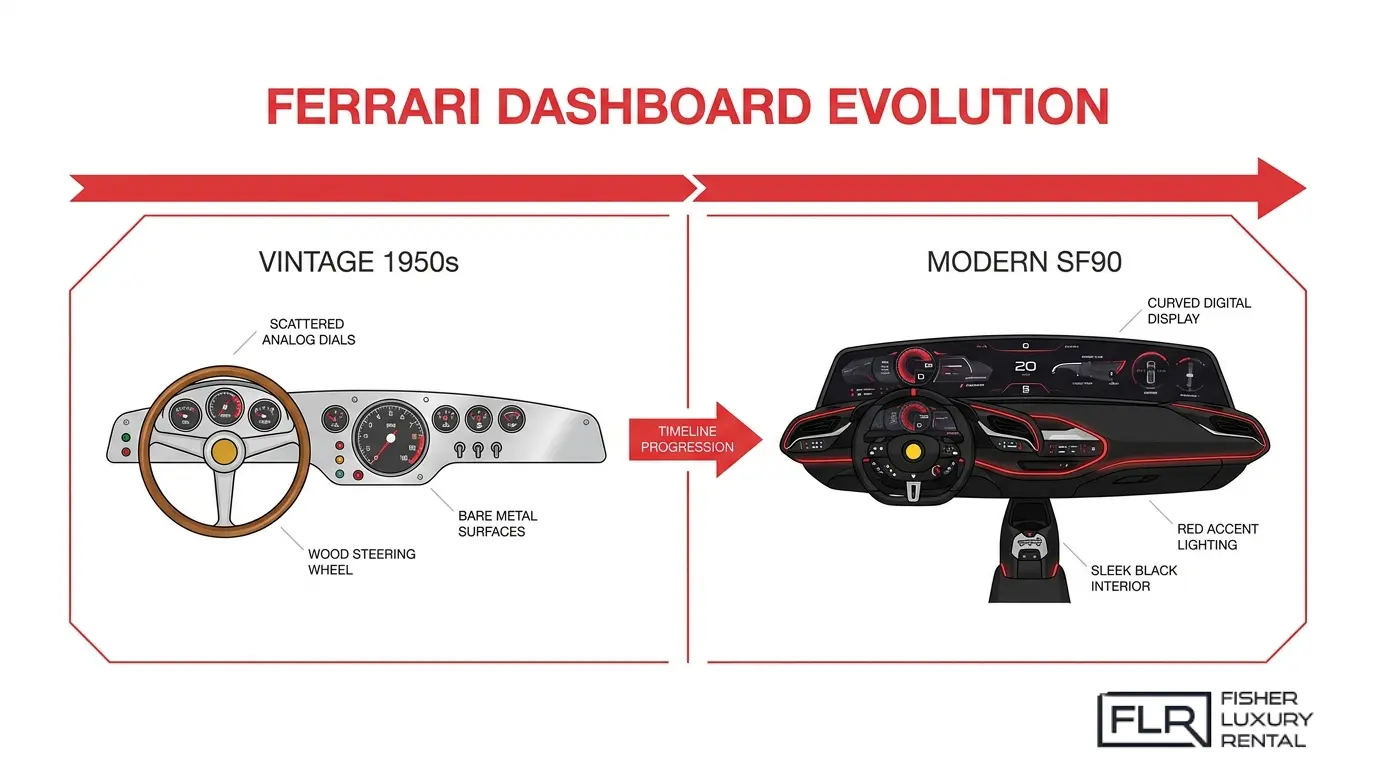
Early Ferrari dashboards were stripped racing tools, with scattered Veglia-supplied dials and wood-rimmed wheels built entirely around function over comfort. Instrument layouts became progressively more consolidated through the 1960s and 1970s, with the Daytona grouping all eight gauges into a single driver-facing binnacle and the 250 GT Lusso relocating the main dials into a central double cowl.
The 1980s introduced ergonomic clarity at driver eye-level, while the 1990s brought paddle-shift transmission and LCD technology directly from the track to the road. The 2000s deepened the Formula 1 connection through the Enzo’s wheel-mounted controls and the F430’s manettino dial, a single rotary switch replacing multiple buttons for dynamic settings.
Ferrari’s steering wheel-mounted control philosophy reflects how F1 engineering translates to road use, placing gear selection, drive modes, and secondary controls within reach without redirecting driver attention. Carbon fiber and hand-stitched leather define the material balance across these interiors, pairing structural performance with tactile refinement.
Modern Ferraris, from the SF90 Stradale’s 16-inch curved HD display to the 296 GTB’s unified digital binnacle, represent the fullest expression of an “eyes on the road, hands on the wheel” doctrine built across eight decades of deliberate cockpit evolution.
What Did Early Ferrari Dashboards Look Like in the 1940s and 1950s?
Early Ferrari dashboards were raw, functional, and deeply shaped by racing. The sections below cover hand-crafted instrumentation, the materials defining these cockpits, and how motorsport directly drove layout decisions.
How Did Hand-Crafted Instrumentation Define the First Ferraris?
Hand-crafted instrumentation defined the first Ferraris through stripped-down cockpits built entirely around driver utility. Every dial, switch, and gauge was positioned for racing function rather than comfort or aesthetics. The Ferrari 125 S, the first car to bear the Ferrari name in 1947, was powered by a V12 engine designed by Gioacchino Colombo, establishing the performance-first philosophy that would shape every interior decision that followed. These early cabins had no padding, no noise insulation, and no decorative elements; the dashboard was simply a mounting surface for the instruments a driver needed to survive a race.
What Materials Were Used in Vintage Ferrari Dashboard Design?
The materials used in vintage Ferrari dashboard design included bare metal, wood, leather, and analog dial assemblies sourced from specialist suppliers. Instrument faces were mechanical and exposed, contributing to the raw aesthetic. According to Ferrari S.p.A., the main instruments of the 250 series were supplied by Ferrari’s partner Veglia, with supplementary dials spread right across the dashboard. Wood appeared prominently in steering wheels and trim, while leather covered seats and grips. These material choices were practical rather than luxurious: lightweight, available, and suited to the workshop-built nature of early production.

How Did Racing Heritage Influence Early Ferrari Cockpit Layouts?
Racing heritage influenced early Ferrari cockpit layouts by making instrument placement a matter of survival, not style. According to Ferrari S.p.A., the 1950s 166 MM Barchetta featured a large centrally mounted dial containing three smaller inset dials monitoring temperatures and fuel level, flanked on either side by a rev counter and speedometer, with a huge three-spoke wood-rimmed wheel dominating the interior. This layout kept critical data within the driver’s direct sightline at speed. The 250 GTO took this philosophy further: its minimalist interior had no speedometer, no carpeting, and no headliner, with ventilation supplied through exterior air inlets. Every omission was intentional, a weight-saving decision that reflected the car’s sole purpose on the track. These early cockpits set a template Ferrari would refine for decades.
How Did Ferrari Dashboard Design Change During the 1960s and 1970s?
Ferrari dashboard design changed during the 1960s and 1970s through a progressive consolidation of instrumentation, moving from scattered dial layouts toward unified driver-focused binnacles. The following sections cover the 250 GTO’s racing-pure cockpit, the Daytona’s gauge cluster revolution, and the earliest ergonomic shifts.
What Role Did the Ferrari 250 GTO Dashboard Play in Design History?
The Ferrari 250 GTO dashboard played a defining role in establishing the brand’s racing-first cockpit philosophy. Its minimalist interior reflected pure competition intent: no speedometer, cloth-upholstered seats, no carpeting, no headliner, with ventilation drawn through exterior air inlets. Instruments from Ferrari’s partner Veglia were spread across the dashboard, prioritizing function over comfort. This stripped approach proved that a Ferrari cockpit could communicate everything a driver needed without excess. The 250 GTO’s uncompromising layout became a reference point against which later, more refined designs were measured.
How Did the Daytona and Dino Reshape Ferrari Gauge Clusters?
The Daytona and Dino reshaped Ferrari gauge clusters by consolidating scattered instruments into a single, driver-oriented binnacle. According to Ferrari S.p.A., the 1968 365 GTB4 Daytona arranged all eight instruments in a single binnacle ahead of the driver, with ventilation handled via vertical sliders and seats featuring contrast-coloured inserts. This was a decisive break from earlier layouts where dials spread across the full dashboard width. Centralizing the gauges reduced driver eye-travel and established a layout logic that influenced Ferrari’s cockpit thinking for decades.
When Did Ferrari Start Prioritizing Driver Ergonomics?
Ferrari started prioritizing driver ergonomics with the 1980 308 GTS Quattrovalvole, which positioned every instrument at the driver’s eye level. This marked a deliberate shift: rather than distributing controls for aesthetic symmetry, Ferrari began designing the cockpit around the driver’s sightlines and reach. That philosophy, once introduced, became a foundational principle carried forward into every subsequent generation.
What Innovations Appeared in Ferrari Dashboards During the 1980s?
The innovations that appeared in Ferrari dashboards during the 1980s centered on two priorities: driver ergonomics and purposeful minimalism. The following sections cover how the Testarossa redefined the dashboard philosophy and which electronic instruments entered the Ferrari cockpit during this era.
How Did the Ferrari Testarossa Introduce a New Dashboard Philosophy?
The Ferrari Testarossa introduced a dashboard philosophy built around driver focus and ergonomic clarity. This shift reflected a broader 1980s commitment at Maranello to position controls and instruments at driver’s eye level rather than scattering them across the cabin. According to Ferrari S.p.A., the 1980 308 GTS Quattrovalvole had already established this direction by positioning everything at the driver’s eye level as Ferrari began prioritizing driver ergonomics. The Testarossa extended that principle into a wider, more deliberately architected interior, pairing a clean instrument cluster with a cockpit oriented toward the driver’s sightline. This philosophy represented a decisive break from the more scattered, symmetrical dash layouts of prior decades.
What Electronic Instruments First Appeared in 1980s Ferraris?
The electronic instruments that first appeared in 1980s Ferraris included early digital readouts and electronically monitored gauges replacing purely mechanical dials. The decade also marked the arrival of simplified, stripped-down cockpit architecture in performance variants. The F40, Ferrari’s landmark late-1980s supercar, featured a simple grey dashboard expanse with perforated vinyl roof headlining and no interior door handles, relying instead on a length of cord to open doors, according to Ferrari S.p.A. That deliberate removal of excess reflected Ferrari’s belief that weight reduction and function outranked luxury electronics. In this era, electronic instrumentation served performance rather than comfort, a philosophy that would only expand in the decades ahead.
How Did Ferrari Dashboards Transition to Digital in the 1990s?
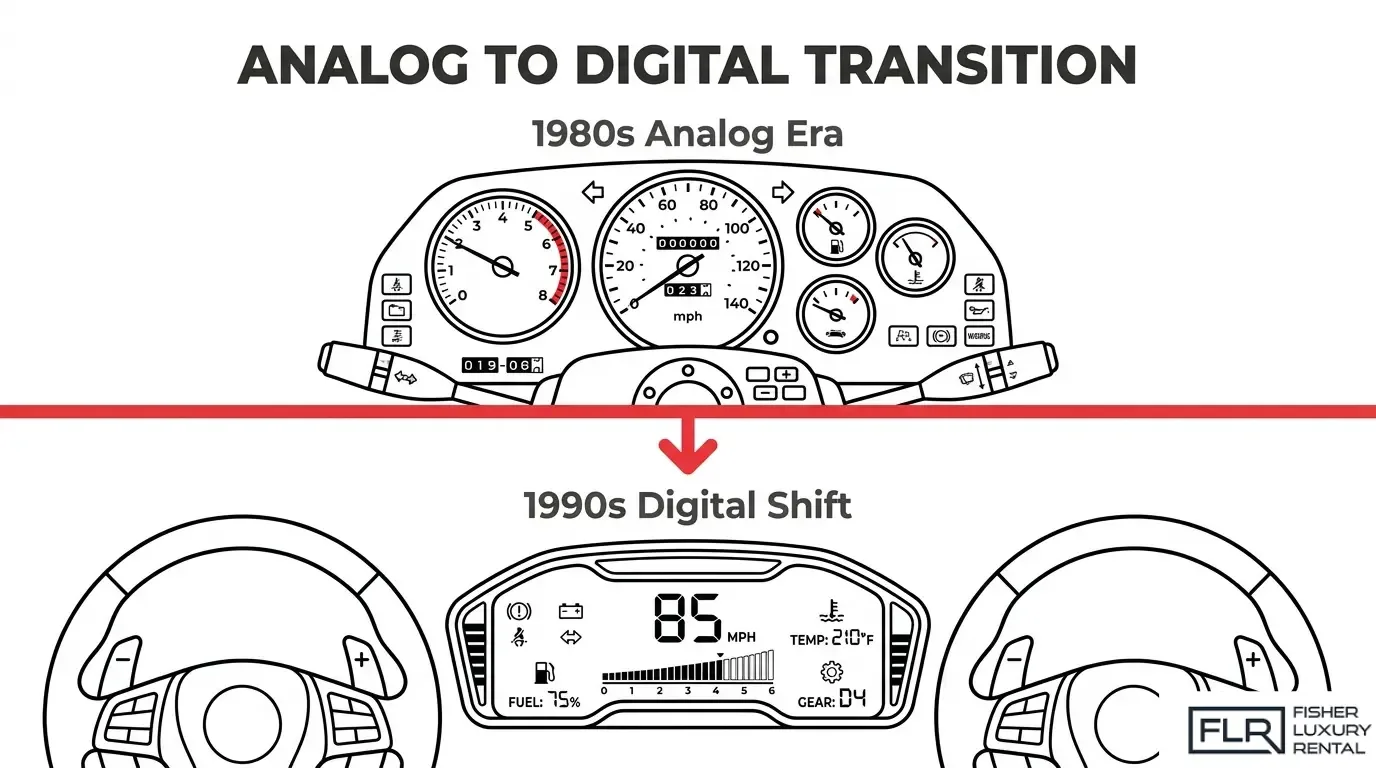
Ferrari dashboards transitioned to digital in the 1990s through two landmark shifts: paddle-shift transmission controls and the introduction of LCD display technology. The sections below cover how the F355 modernized the cockpit and what LCD screens changed about gauge design.
How Did the Ferrari F355 Modernize the Cockpit Experience?
The Ferrari F355 modernized the cockpit experience by introducing paddleshift and semi-automatic transmission technology directly transferred from racing to road use. According to Ferrari S.p.A., the paddleshift system arrived with the 1997 update of the F355, alongside the addition of airbags as a critical safety innovation. Together, these changes transformed driver interaction from a mechanical process to an electronics-driven one, placing gear control at the driver’s fingertips without leaving the wheel. This was arguably the most consequential single update to a Ferrari cabin in the decade, bridging the gap between analog heritage and digital performance driving.
What Was the Impact of LCD Screens on Ferrari Gauge Design?
The impact of LCD screens on Ferrari gauge design was a gradual shift from analog dial clusters toward driver-configurable digital readouts. LCD displays allowed engineers to consolidate multiple instrument functions into a single surface, reducing cockpit clutter while increasing the volume of real-time data available to the driver. The F50, which succeeded the F40, maintained a clean carbon fibre panel philosophy, preserving visual simplicity even as electronics advanced beneath the surface. LCD integration set the foundation for the fully digital binnacles that would define Ferrari interiors in the decades that followed.
What Technology Defines Ferrari Dashboards From 2000 to 2010?
The technology defining Ferrari dashboards from 2000 to 2010 centers on direct F1 technology transfer, beginning with the Enzo’s steering wheel-integrated controls and culminating in the manettino dial introduced on the F430. The H3s below cover the Enzo’s F1-inspired layout, the manettino’s function, and the 599 GTB’s digital advances.
How Did the Ferrari Enzo Pioneer the F1-Inspired Dashboard?
The Ferrari Enzo pioneered the F1-inspired dashboard by placing vehicle controls directly on the steering wheel rather than on the center console. According to Ferrari, the 2002 Enzo was the first production Ferrari to deeply embed Formula 1 design philosophy: indicators sat at thumb detentes, while three smaller buttons on either side of the boss controlled the LCD dash display, front ride height, damper settings, traction control, and reverse gear selection. Individual buttons governed each function, rather than a single consolidated switch. This layout established the conceptual foundation that the manettino would later refine into one rotary control.
What Is the Manettino Dial and How Did It Change Driver Controls?
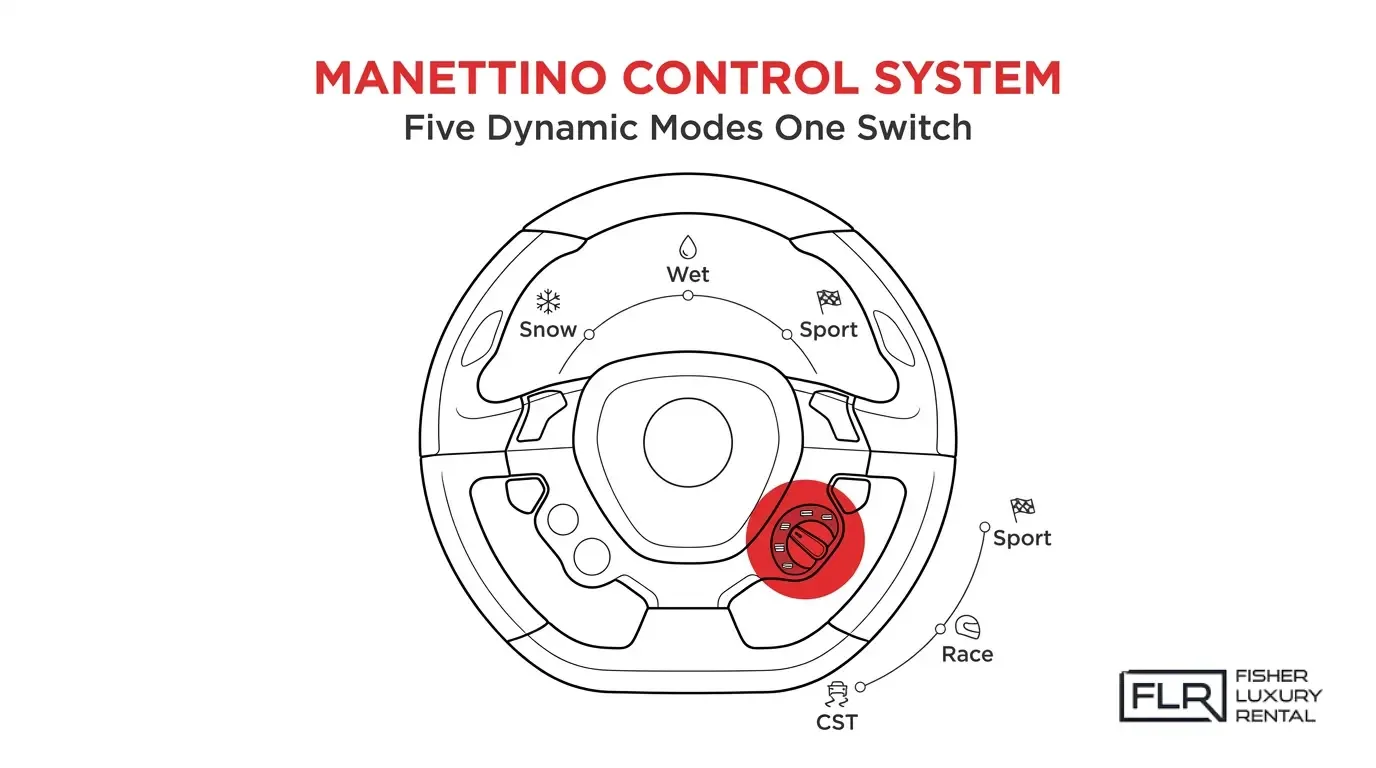
The manettino dial is a rotary switch on the steering wheel, first designed by Frank Stephenson and introduced on the Ferrari F430 in 2004. According to Wikipedia, it allows quick adjustment of suspension settings, traction control, electronic differential, and gearbox shift speed through a single anodised switch with five dynamic settings, ranging from snow/ice protection to Sport, Race, and CST modes. Previously, each function required a separate button. Consolidating all dynamic parameters into one control was a genuinely transformative ergonomic decision, keeping the driver’s focus on the road rather than scattered across the dash.
How Did the Ferrari 599 GTB Advance Digital Instrumentation?
The Ferrari 599 GTB advanced digital instrumentation by building on the F430’s electronic architecture, incorporating more integrated digital displays and refining the driver-focused cockpit philosophy established earlier in the decade. The 599 continued Ferrari’s momentum toward centralizing critical readouts within the driver’s natural sightline, bridging the analog-dominant designs of prior V12 grand tourers and the fully digital clusters that would follow in the 2010s.
How Have Modern Ferrari Dashboards Evolved Since 2010?
Modern Ferrari dashboards have evolved from analog-dominant layouts into fully integrated digital cockpits. The sections below cover three defining developments: the LaFerrari’s milestone design, the SF90 Stradale’s digital cluster, and the 16-inch curved display in the 296 GTB.
What Makes the Ferrari LaFerrari Dashboard a Technological Milestone?
The Ferrari LaFerrari dashboard marks a technological milestone because it bridges the analog-to-digital transition while deepening the car’s connection to Formula 1 principles. Its cockpit prioritized driver focus by consolidating controls within reach of the wheel, anticipating the fully digital direction Ferrari would take in subsequent models. The LaFerrari established the ergonomic and functional blueprint that the SF90 Stradale and 296 GTB would later refine into a completely screen-based interface.
How Does the SF90 Stradale Use a Fully Digital Instrument Cluster?
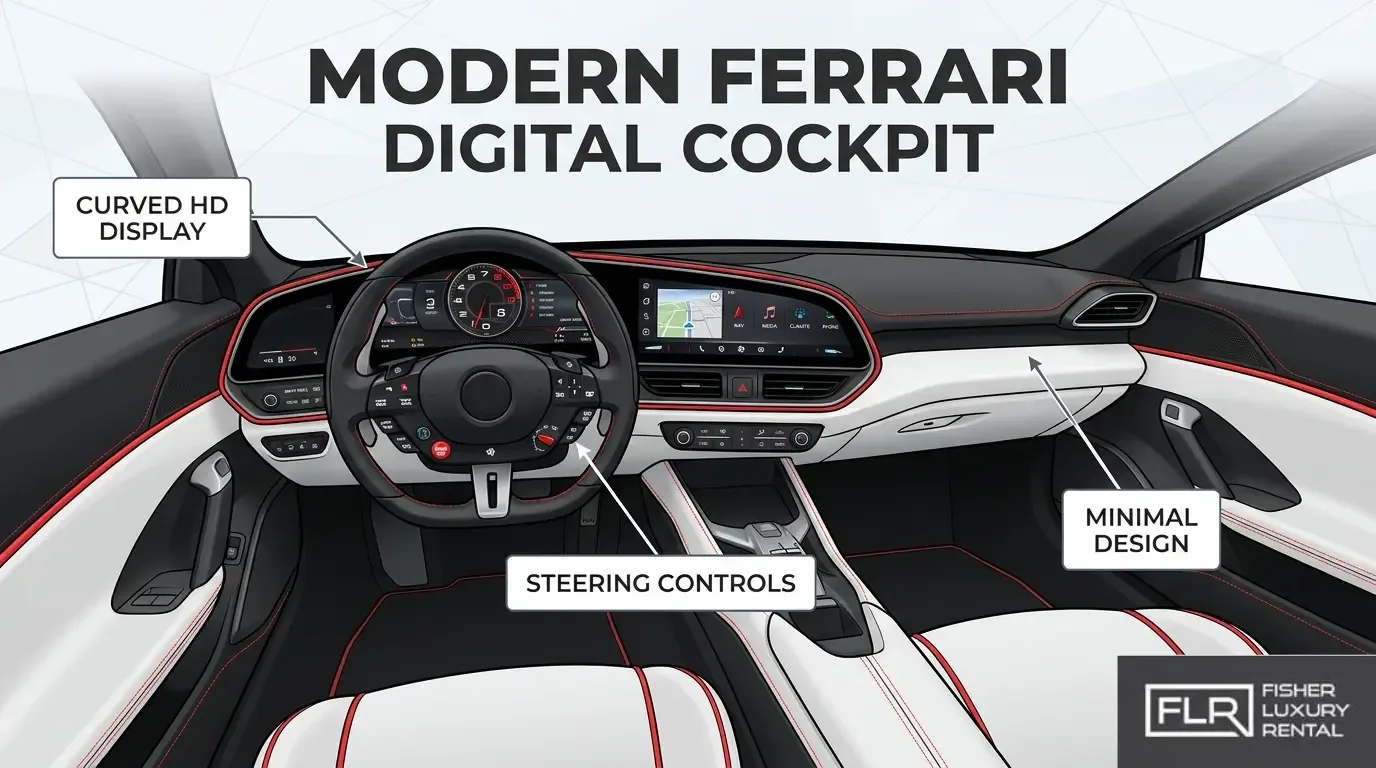
The SF90 Stradale uses a fully digital instrument cluster built around a single 16-inch HD screen that curves toward the driver, making it the first Ferrari to feature this technology. For enthusiasts who want to encounter this level of cockpit engineering in person, exotic rental companies like Fisher Luxury Rental provide access to modern top-trim vehicles where these technologies can be experienced on the road rather than studied on a page. According to Ferrari S.p.A., this binnacle combines the instrument panel, rev counter, infotainment display, and navigation system into one interface, with capacitive buttons on the steering wheel controlling secondary functions. The result is a cockpit governed entirely by the “eyes on the road, hands on the wheel” philosophy. This approach represents the most complete expression of Ferrari’s human-machine interface thinking to date.
What Role Does the 16-Inch Curved Display Play in the Ferrari 296?
The 16-inch curved display in the Ferrari 296 GTB serves as the central hub for all driver information, consolidating the instrument panel, rev counter, infotainment, and navigation into a single screen ahead of the driver. This architecture follows the ergonomic groundwork laid by the 2009 458 Italia, which first placed audio and sat nav displays flanking a centrally mounted rev counter, accessed via satellite pods beside the wheel. The 296 builds on that layout by eliminating separate pods entirely in favor of one unified digital surface. For enthusiasts who want to experience this cockpit evolution firsthand, sitting behind a modern Ferrari remains the most direct way to understand how far the interface has come.
What Is Ferrari’s Iconic Steering Wheel-Mounted Control Layout?
Ferrari’s iconic steering wheel-mounted control layout is a driver-centric system that consolidates dynamic controls, gear selection, and secondary functions directly on the wheel. The two H3s below explore how Formula 1 technology shaped this philosophy and why centralization became Ferrari’s defining cockpit principle.
How Did Formula 1 Technology Influence Ferrari Road Car Controls?
Formula 1 technology influenced Ferrari road car controls by establishing the steering wheel as a command center rather than a simple directional input. According to Ferrari S.p.A., the steering wheel on a modern Formula 1 car is an advanced computer, offering control over engine maps, brake balance set-ups, lap time deltas, and much more, directly inspiring Ferrari’s road car approach. The F430’s manettino translated this philosophy into a practical road interface: a small anodised switch on the lower right-hand side of the wheel tapping five distinct dynamic settings, including damper stiffness and semi-automated gearbox shift times, with dedicated symbols for snow/ice, wet roads, Sport, Race, and CST modes. This transfer of motorsport logic into everyday driving is what separates Ferrari’s cockpit engineering from conventional luxury car design.
Why Did Ferrari Move Key Functions Onto the Steering Wheel?
Ferrari moved key functions onto the steering wheel to keep driver attention forward and reduce reaction time during dynamic driving. The exposed metal gear gate was a Ferrari tradition maintained through production models until steering column-mounted paddle shifters replaced it in the 2000s, signaling a deliberate shift toward wheel-centralized control. The F430’s 2004 introduction of the electronically controlled, hydraulically actuated E-Diff, monitoring steering angle, yaw, and individual wheel speeds, made consolidated wheel controls a functional necessity rather than a styling choice. Today, Ferrari’s steering wheel carries gearshift paddles, indicator buttons, wiper controls, headlight controls, and the drive mode manettino, with tactility remaining a key design principle throughout.
What Materials and Craftsmanship Define Ferrari Interior Quality?
Ferrari interior quality is defined by a combination of advanced lightweight materials and meticulous hand-finishing techniques. The two key areas covered below are carbon fiber dashboard construction and hand-stitched leather trim.
How Does Ferrari Use Carbon Fiber in Dashboard Construction?
Ferrari uses carbon fiber in dashboard construction as a structural and aesthetic material, chosen for its exceptional strength-to-weight ratio. According to Ferrari S.p.A., the F50 featured a simple but beautiful carbon fiber panel stretching the full width of the cockpit, establishing the material as a signature element of Ferrari’s interior philosophy. Carbon fiber also signals the cabin’s racing DNA, reinforcing the visual and tactile connection between road cars and Ferrari’s motorsport heritage. For drivers, the result is a dashboard that feels purposeful rather than decorative.
What Role Does Hand-Stitched Leather Play in Ferrari Cabins?
Hand-stitched leather plays a central role in Ferrari cabins by adding tactile refinement to an otherwise performance-focused environment. Leather covers key contact surfaces including seats, steering wheel wraps, door panels, and console trims, with stitching applied by hand to ensure precision and consistency. This craftsmanship tradition balances the raw, technical presence of carbon fiber and aluminum with warmth and luxury. The contrast between exposed structural materials and finely finished leather is one of the most distinctive qualities of any Ferrari interior.
How Does Ferrari Integrate Infotainment Without Compromising Design?
Ferrari integrates infotainment by consolidating all controls onto the steering wheel and a driver-facing digital display, keeping the visual architecture clean while preserving full functionality. The sections below cover the steering wheel control philosophy and the evolution of the digital cockpit layout.
How Did Formula 1 Technology Influence Ferrari Road Car Controls?
Formula 1 technology influenced Ferrari road car controls by establishing the steering wheel as the primary command center for the driver. According to Ferrari S.p.A., the modern F1 steering wheel functions as an advanced computer, governing engine maps, brake balance, and lap time deltas, and this philosophy directly shaped how Ferrari engineered road car interfaces. The F430’s manettino, positioned as a small anodised lozenge on the lower right of the wheel, accessed five dynamic settings covering damper stiffness, gearbox shift times, and electronic safeguards ranging from snow/ice to Sport, Race, and CST modes. Translating that level of control to a single tactile switch, without burdening the dashboard with additional buttons, is one of Ferrari’s most elegant design solutions.
Why Did Ferrari Move Key Functions Onto the Steering Wheel?
Ferrari moved key functions onto the steering wheel to keep the driver’s eyes on the road and hands in a safe position at all times. On contemporary Ferrari models, gearshift paddles, indicator buttons, wiper controls, headlight controls, and the drive mode manettino all reside on the steering wheel, with tactility remaining a core design principle. The F430’s 2004 introduction of the E-Diff, monitoring steering angle, yaw, and individual wheel speeds, demonstrated that integrating complex electronics into a single wheel-mounted switch was both practical and performance-enhancing. This approach eliminates the need for a cluttered center console while maintaining every critical driver input within reach.
How Does Ferrari’s 16-Inch Digital Display Serve Infotainment Without Cluttering the Cockpit?
Ferrari’s 16-inch digital display serves infotainment by consolidating the instrument panel, rev counter, navigation, and audio into one curved screen oriented directly toward the driver. The SF90 Stradale was the first Ferrari to feature this single 16-inch digital HD curved cluster, and subsequent models including the 296 GTB and Roma adopted the same ‘eyes on the road, hands on the wheel’ philosophy. Capacitive buttons on the steering wheel handle secondary functions, so the display itself remains a passive information surface rather than an interactive touchscreen requiring the driver to look away. This architecture proves that digital integration and minimalist cockpit design are not opposing forces, but complementary ones when the interface is engineered around the driver rather than the technology.
How Does the Ferrari Dashboard Compare to Other Exotic Car Brands?
The Ferrari dashboard compares to other exotic car brands through its racing-derived philosophy, steering wheel-mounted control consolidation, and driver-first ergonomic hierarchy, setting it apart from competitors that prioritize cabin technology or interior opulence over pure driving focus.
What Can You Experience Behind a Ferrari Dashboard Today?
Ferrari’s decades of cockpit innovation culminate in what drivers encounter today: a seamlessly integrated command center where every control serves the driver’s instincts. The following sections cover how Fisher Luxury Rental makes this experience accessible and what the key lessons from Ferrari’s dashboard evolution reveal.
Can Renting an Exotic Car from Fisher Luxury Rental Let You Experience Ferrari Innovation Firsthand?
Yes, renting an exotic car from Fisher Luxury Rental can let you experience Ferrari innovation firsthand. Fisher Luxury Rental offers access to top-trim exotic vehicles in Phoenix, AZ and Portland, OR, placing decades of Ferrari engineering within reach of driving enthusiasts.
Ferrari’s modern cockpit, with its 16-inch curved HD display, steering wheel-mounted manettino, and capacitive controls, represents nearly 80 years of purposeful evolution. Sitting behind that dashboard is not simply driving a car; it is engaging with every F1-derived insight Ferrari has translated from the track to the road. Fisher Luxury Rental is built around a passion for cars and the memorable experiences that come with putting exceptional vehicles in the hands of enthusiasts.
What Are the Key Takeaways About Ferrari Dashboard Evolution?
The key takeaways about Ferrari dashboard evolution are that every era introduced a deliberate, driver-focused advancement, building toward today’s fully integrated digital cockpit.
The most actionable conclusions from this history include:
- Function always led form. From the 166 MM Barchetta’s centrally mounted dial cluster to the SF90 Stradale’s curved 16-inch HD screen, Ferrari prioritized driver information access above aesthetics.
- Racing directly drove road car design. The manettino, paddle shifters, and steering wheel-mounted controls all originated in Formula 1 before reaching production cars.
- Ergonomics evolved continuously. Each decade refined driver eye-line, control placement, and tactile feedback, culminating in the “eyes on the road, hands on the wheel” philosophy seen in the 296 GTB and Roma.
- Materials reflected performance priorities. Stripped cockpits in the F40 gave way to precision carbon fiber and digital binnacles as technology matured.
Understanding this evolution makes time behind a modern Ferrari dashboard far richer, transforming every control interaction into a connection with that legacy. Fisher Luxury Rental, serving Phoenix, Scottsdale, Portland, and Vancouver, offers top-trim exotic vehicles that put exactly this kind of cockpit evolution within reach for enthusiasts who want to experience it firsthand.