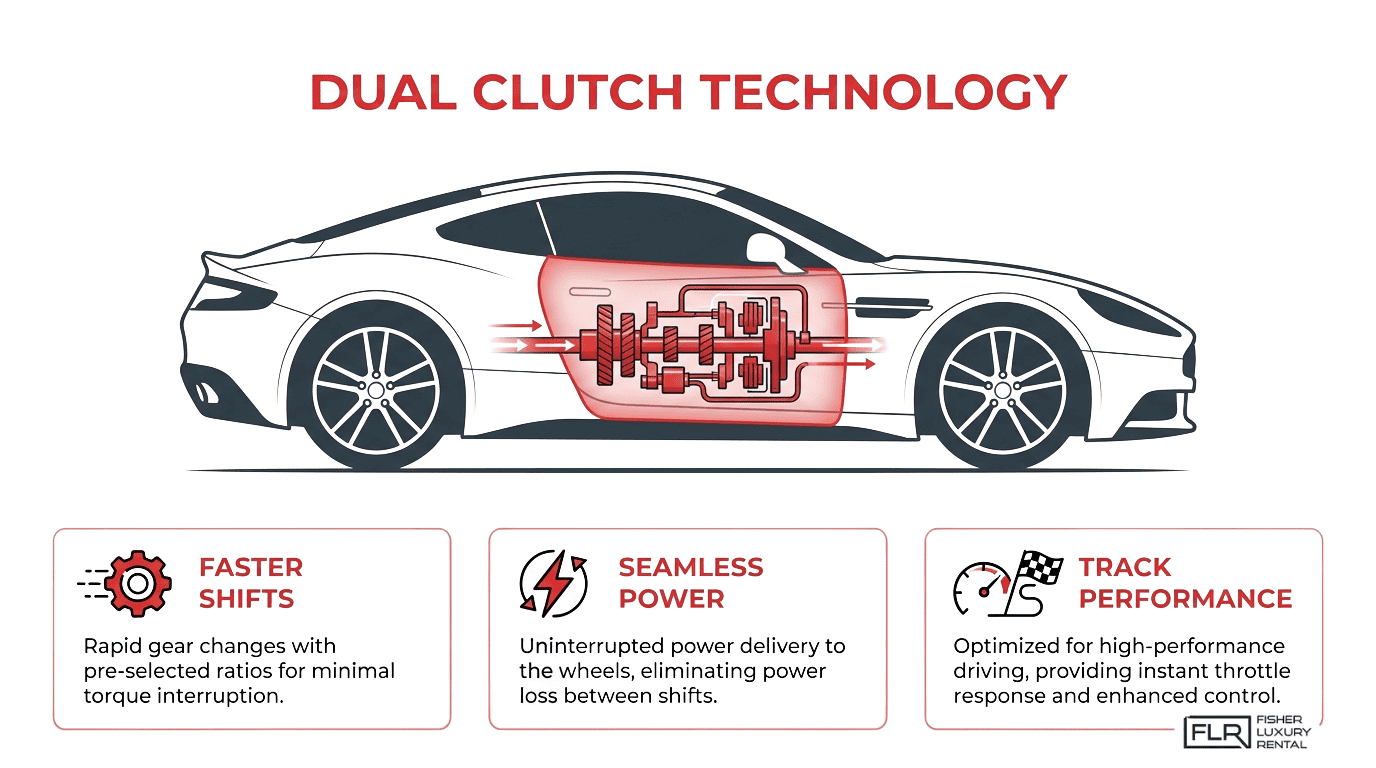
A dual-clutch transmission (DCT) is an automated manual transmission that uses two separate clutch packs, one controlling odd gears and one controlling even gears, to pre-select the next ratio and execute shifts without interrupting power delivery. It combines the mechanical directness of a manual with the speed and automation of a purpose-built performance gearbox.
This guide covers how a DCT works at a mechanical level, how it compares to other transmission types, why exotic manufacturers prefer it, which specific cars use it, what it feels like to drive, its real advantages and drawbacks, how to maintain one, whether it is replacing the manual in supercars, and how to experience a DCT exotic firsthand.
The mechanical section explains the two clutch packs, concentric input shafts, mechatronic control unit, and hydraulic actuation system that make millisecond gear changes possible.
When measured against traditional automatics, manuals, single-clutch systems, and torque converters, the DCT consistently delivers faster shifts and more efficient power transfer, with concrete performance data across Porsche, Ferrari, and Lamborghini platforms supporting that conclusion.
The brand coverage spans Ferrari, Lamborghini, McLaren, Porsche, Bugatti, Koenigsegg, and Audi, with specific models, gear counts, and power ratings for each.
The driving experience, advantages, and drawbacks sections cover what a DCT feels like across track, city, and paddle-input conditions, alongside real maintenance costs from Ferrari and Lamborghini service data.
The guide closes with how Fisher Luxury Rental lets you experience a DCT exotic directly, without ownership costs or service commitments.
How Does a Dual-Clutch Transmission Work?
A dual-clutch transmission works by using two separate clutch packs operating simultaneously to pre-select gears and execute shifts without interrupting power. The sections below cover how the two clutches divide gear duties, how gear pre-selection works, and what actually happens during a millisecond-fast shift.
What Role Do the Two Clutches Play Simultaneously?
The two clutches in a DCT play distinct, complementary roles: one clutch controls odd-numbered gears (1st, 3rd, 5th) while the other controls even-numbered gears (2nd, 4th, 6th). While one clutch is engaged and delivering power, the other is already holding the next gear on standby. This split-shaft architecture eliminates the power interruption that occurs in both manual and single-clutch transmissions, making the handoff between gears nearly seamless at any engine speed.
How Does a DCT Pre-Select the Next Gear?
A DCT pre-selects the next gear by engaging its second clutch pack around the anticipated gear before the shift is commanded. According to Transmission Digest, a gerotor-type fluid pump on the innermost shaft delivers pressurized fluid to actuate both clutch packs, lubricate components, and position the selected gear simultaneously. One shaft drives even-numbered gears; the other drives odd-numbered gears. The transmission’s control module monitors speed and throttle position to determine which gear to stage, so the next ratio is always ready before the driver needs it.
What Happens During a Gear Change in Milliseconds?
A gear change in a DCT happens by releasing the active clutch while instantly engaging the pre-loaded second clutch, transferring drive torque with no gap in power delivery. According to Ferrari via Design News, clutch fill time on shifts dropped from 300 milliseconds in the Ferrari 488 Pista to 200 ms in the SF90 Stradale, achieved partly because the SF90’s 8DCL900 uses clutch packs 20 percent smaller in diameter. That speed advantage is not incidental: shorter fill times mean less energy wasted and faster net acceleration, which is exactly why exotic manufacturers invest heavily in clutch pack engineering rather than simply tuning software.
What Are the Main Components of a Dual-Clutch Transmission?
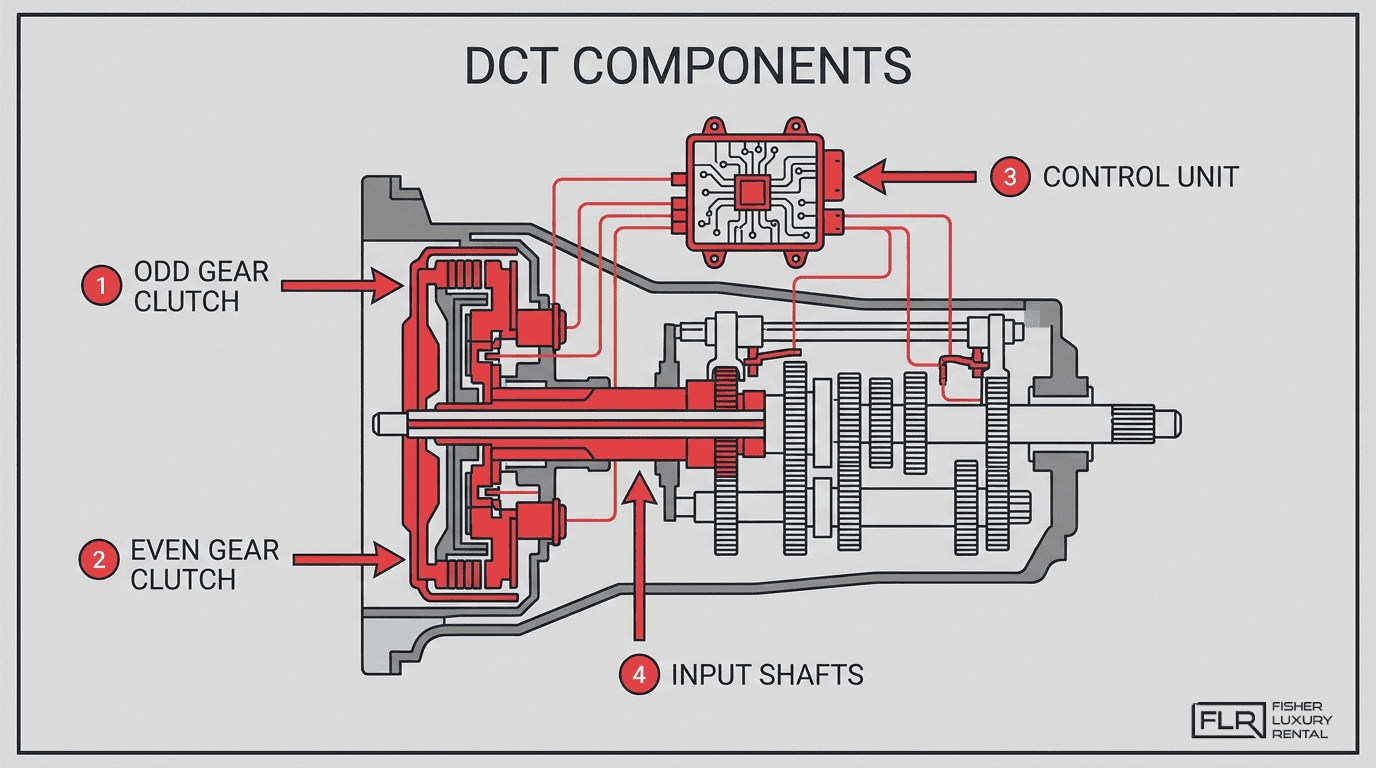
The main components of a dual-clutch transmission are two clutch packs, concentric input shafts, a mechatronic control unit, and a hydraulic actuation system. Each component handles a distinct role in enabling the DCT’s signature seamless, uninterrupted gear changes.
Odd-Gear Clutch Pack
The odd-gear clutch pack manages gears 1, 3, 5, and 7, engaging power delivery through the transmission’s inner input shaft. While one clutch pack is actively transferring engine torque, the other is simultaneously pre-selecting the next gear, which is the mechanical basis for the DCT’s near-zero interruption during upshifts and downshifts. This pre-selection architecture is what separates DCTs from every other transmission type in performance applications.
Even-Gear Clutch Pack
The even-gear clutch pack controls gears 2, 4, 6, and 8 through the outer concentric shaft. It operates in a synchronized handoff with the odd-gear pack, so power transfer between gears is continuous rather than interrupted. The two clutch packs alternate engagement in rapid succession, with neither pack ever fully idle during active driving.
Mechatronic Control Unit
The mechatronic control unit is the DCT’s electronic brain, coordinating clutch engagement, gear selection, and hydraulic pressure in real time. According to Transmission Digest, fluid distribution is managed through an electro-hydraulic valve body paired with hall-effect sensors: BorgWarner calls this assembly the DualTronic control module, while Volkswagen refers to its equivalent unit as the Direct Shift Gearbox Mechatronics. This integration of electronics and hydraulics into a single module is why modern DCTs can execute gear changes with millisecond precision.
Concentric Input Shafts
The concentric input shafts are two coaxial shafts nested inside one another, with each shaft driven by its respective clutch pack. The inner shaft handles odd gears while the outer shaft handles even gears. This coaxial arrangement keeps the transmission compact, a critical packaging advantage in mid-engine exotic platforms where space is tightly constrained.
Hydraulic Actuation System
The hydraulic actuation system supplies pressurized fluid to engage the clutch packs, lubricate internal components, and execute gear shifts. The innermost shaft drives a gerotor-type fluid pump that generates this hydraulic pressure continuously during operation. Without consistent hydraulic pressure, the DCT cannot complete the rapid clutch-swap that defines its performance advantage over conventional automatics.
How Is a DCT Different From Other Transmission Types?
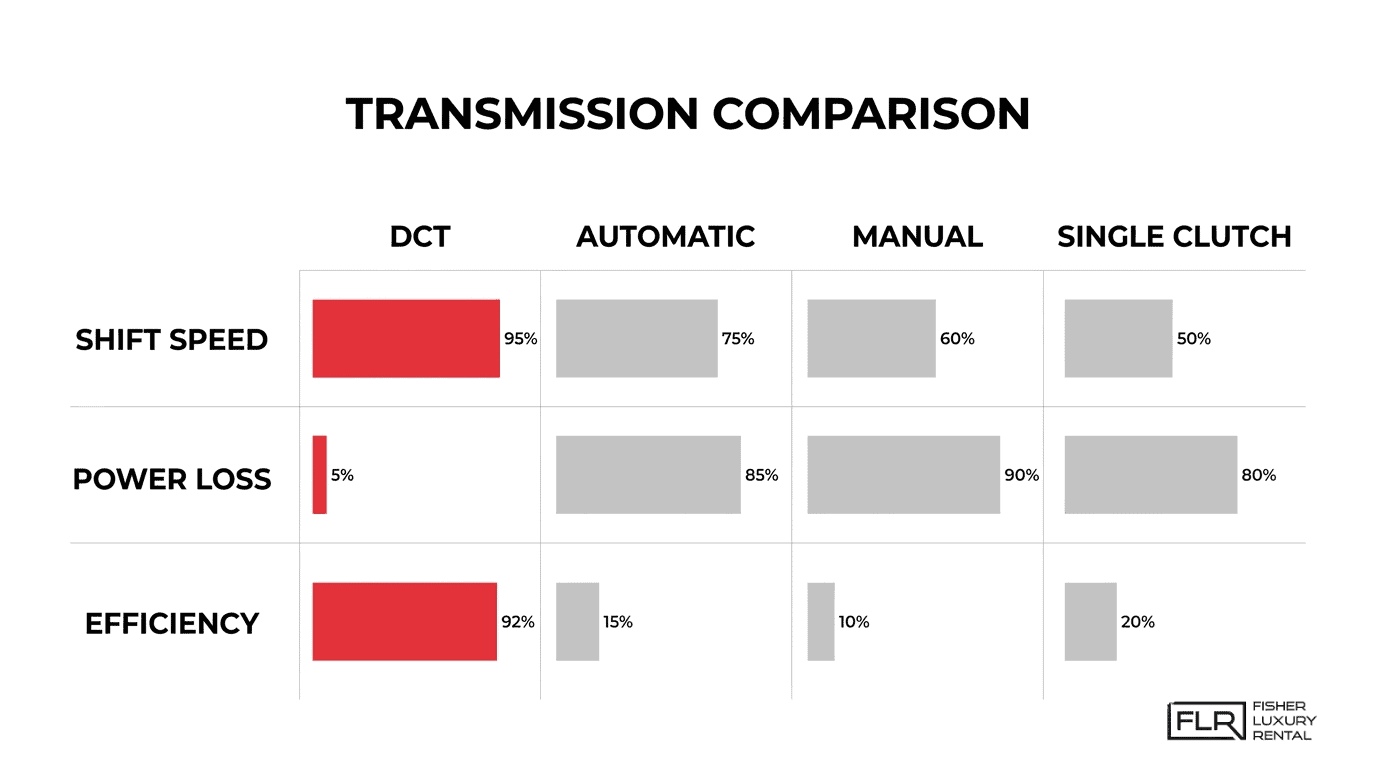
A DCT differs from other transmission types by combining the automation of a traditional automatic with the mechanical directness of a manual, delivering faster shifts than either. The comparisons below cover traditional automatics, manual gearboxes, single-clutch automated manuals, and torque converters.
How Does a DCT Compare to a Traditional Automatic?
A DCT compares to a traditional automatic by replacing a single fluid coupling with two mechanical clutch packs, eliminating the energy losses inherent in a hydraulic torque converter. Traditional automatics use a torque converter to transfer engine power through fluid, which absorbs energy and introduces shift lag. A DCT engages gears mechanically and pre-selects the next ratio while the current one is still active, producing faster, more direct power delivery. This mechanical advantage makes DCTs the preferred choice for exotic car engineers who need both efficiency and performance in one unit.
How Does a DCT Compare to a Manual Transmission?
A DCT compares to a manual transmission by delivering the same mechanical gear engagement but with faster, automated execution and no power interruption between shifts. According to Porsche, the PDK-equipped 718 Cayman accelerates from 0 to 100 km/h in 4.9 seconds versus 5.1 seconds for the six-speed manual, with combined fuel economy of 8.6 L/100 km compared to 9.1 L/100 km for the manual. CO₂ emissions also drop from 208 g/km to 197 g/km with PDK. While the manual preserves driver engagement, the DCT objectively outperforms it on every measurable metric that matters in a supercar context.
How Does a DCT Compare to a Single-Clutch Automated Manual?
A DCT compares to a single-clutch automated manual (AMT) by eliminating the torque interruption that makes AMTs feel jerky during gear changes. A single-clutch AMT uses one clutch and executes shifts sequentially: it disengages, changes gear, then re-engages, creating a brief but noticeable power gap. A DCT holds one clutch engaged while the second clutch pre-loads the next gear, so the handoff is seamless. This makes DCTs far more refined at low speeds and far more competitive on track, which is precisely why AMTs have largely disappeared from modern exotic cars.
How Does a DCT Compare to a Torque Converter in Supercars?
A DCT compares to a torque converter automatic by offering superior shift speed and mechanical efficiency, though modern torque converters have closed much of the gap. Torque converters use fluid coupling that multiplies torque at low speeds, giving smooth, effortless launches suited to grand tourers and luxury vehicles. A DCT connects engine to gearbox mechanically, reducing parasitic losses and enabling gear changes measured in milliseconds. For supercars where every fraction of a second matters, this mechanical directness is decisive. The global DCT market is projected to grow from USD 22.42 billion in 2026 to USD 36.00 billion by 2033, reflecting how broadly the industry has accepted this conclusion.
Why Do Exotic Car Manufacturers Prefer Dual-Clutch Transmissions?
Exotic car manufacturers prefer dual-clutch transmissions because DCTs deliver the performance, efficiency, and engineering precision that define the supercar segment. The reasons span faster acceleration, higher torque capacity, reduced weight, and seamless power delivery.
How Does a DCT Improve Acceleration and Lap Times?
A DCT improves acceleration and lap times by eliminating the power interruption that occurs during gear changes in conventional transmissions. With one clutch always pre-engaged on the next gear, shifts execute without any measurable torque drop. The performance advantage is concrete: according to Magna, the 8DCL900 transmission developed for the Ferrari SF90 Stradale boosted torque capacity by 20 percent over the previous 7-speed unit in the Ferrari 488 Pista, increasing from 553 lb-ft to 664 lb-ft. For manufacturers building cars where tenths of a second define competitiveness, that engineering margin is decisive. DCTs are, in practice, the fastest-shifting solution available at production scale.
How Does a DCT Enhance Fuel Efficiency Over Manuals?
A DCT enhances fuel efficiency by managing gear selection and clutch engagement more precisely than a human driver can. Because shifts are electronically optimized, the engine operates closer to its ideal power band at all times, reducing unnecessary fuel burn. This efficiency gain matters to exotic manufacturers facing tightening emissions regulations, making DCTs as commercially practical as they are performance-oriented.
How Does a DCT Deliver Seamless Power Delivery?
A DCT delivers seamless power delivery by keeping torque flow continuous through every gear change. Rather than a brief interruption at each shift, the driver experiences unbroken linear acceleration. According to Jörg Gindele, Senior Director Engineering at Magna Powertrain, the DCT developed for the Ferrari SF90 Stradale “sets a new benchmark for super sport applications” and delivers outstanding performance “in urban traffic as well as on racetracks.” That dual capability, from city driving to circuit work, is precisely why exotic manufacturers treat DCTs as the default transmission architecture for high-performance vehicles.
Which Exotic Cars Use a Dual-Clutch Transmission?
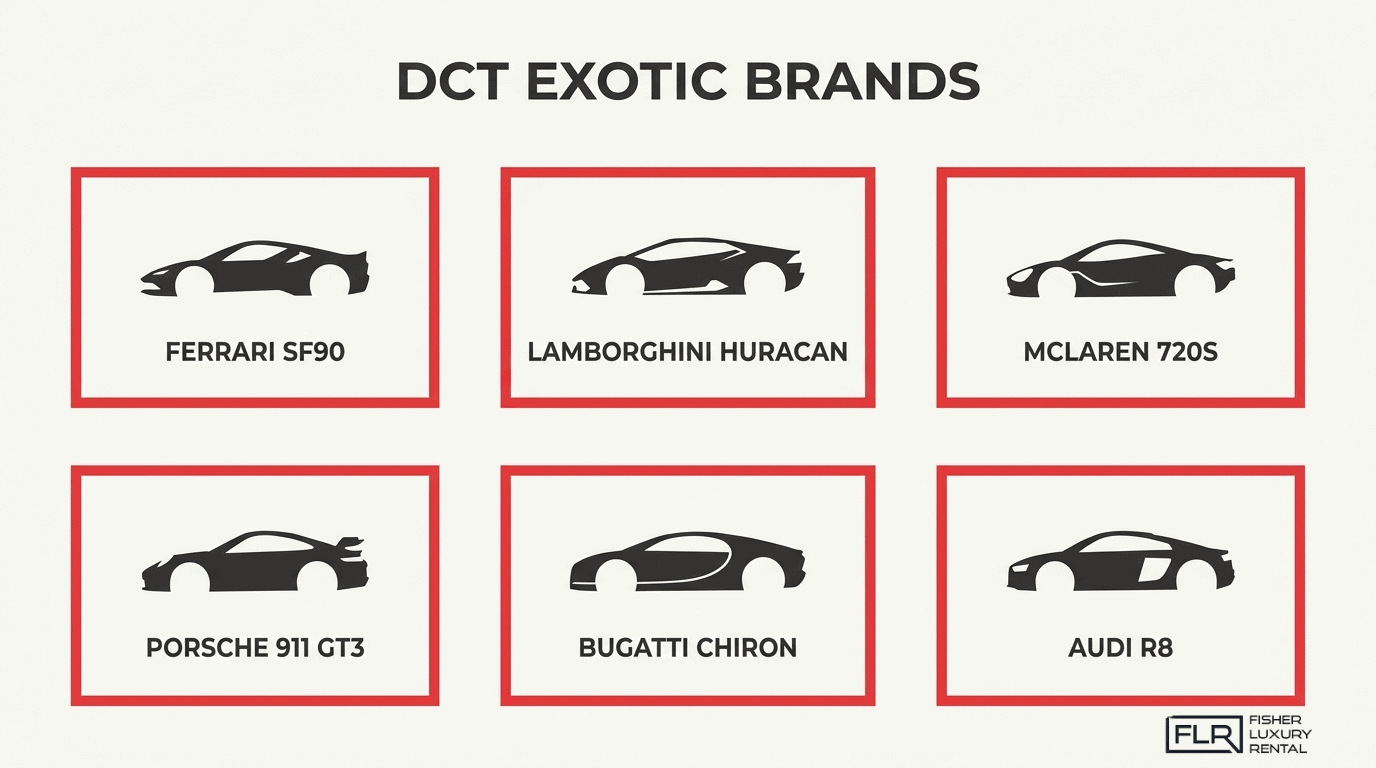
Several leading exotic car brands use dual-clutch transmissions, including Ferrari, Lamborghini, McLaren, Porsche, Bugatti, Koenigsegg, and Audi. Each brand applies its own DCT variant, with differences in gear count, clutch design, and power handling capacity.
Which Ferrari Models Feature a DCT?
Ferrari models featuring a DCT include the SF90 Stradale, which uses an 8-speed dual-clutch transmission developed by Magna. The SF90 Stradale pairs this gearbox with three electric motors and a V-8, producing 986 horsepower and launching to 60 mph in 2.1 seconds. According to Magna, the transmission provides improved torque and shifting while also reducing weight and CO₂ emissions.
Which Lamborghini Models Feature a DCT?
Lamborghini models featuring a DCT include the Huracán, which uses the 7-speed “Lamborghini Doppia Frizione” (LDF) dual-clutch transmission paired with an all-wheel drive system. The LDF delivers power from the Huracán’s ten-cylinder engine directly to the road with minimal interruption, making it one of the most driver-focused DCT implementations in the segment.
Which McLaren Models Feature a DCT?
McLaren models featuring a DCT include the 720S and the Artura. The 720S uses a seven-speed dual-clutch transmission paired with McLaren’s Brake Steer system, which replicates a limited-slip differential effect. The Artura features an 8-speed SSG (Seamless Shift Gearbox) dual-clutch transmission, supporting 671 horsepower and 531 lb-ft of torque from its twin-turbocharged hybrid V6.
Which Porsche Models Feature a DCT?
Porsche models featuring a DCT include the 911 GT3 and the 718 Cayman, both equipped with the PDK (Porsche Doppelkupplung) system. The 911 GT3 was the first in the 911 lineup to receive a 7-speed PDK as standard, featuring short ratios designed exclusively for that model. Porsche began PDK development in the 1980s specifically to make its race cars more competitive through faster gear changes.
Which Other Exotic Brands Use a DCT?
Other exotic brands using a DCT include Bugatti, Koenigsegg, and Audi. The Bugatti Chiron uses a Ricardo-manufactured seven-speed DCT capable of handling over 1,500 hp and 1,600 Nm. Koenigsegg equips the Jesko with its in-house 9-speed Light Speed Transmission (LST), engineered for near-instantaneous gear shifts. The 2017 Audi R8 uses a seven-speed S tronic dual-clutch transmission that shifts in as little as 120 ms, enabling the R8 V10 Coupe to produce 562 horsepower.
What Does a DCT Feel Like When Driving an Exotic Car?
A DCT delivers a driving experience that shifts character depending on the mode selected. The sections below cover how it performs under hard acceleration, how it behaves in daily traffic, and how it responds to direct paddle input.
How Does a DCT Perform in Sport or Track Mode?
A DCT performs in sport or track mode by holding gears longer, tightening shift windows, and delivering rapid, sharp power changes that keep the engine in its peak power band. The sensation is more mechanical and immediate than any torque converter automatic, with each upshift landing like a physical event rather than a smooth fade.
According to Jörg Gindele, Senior Director Engineering at Magna Powertrain, the dual-clutch transmission developed for the Ferrari SF90 Stradale “sets a new benchmark for super sport applications” and “comes with all attributes necessary for outstanding driving performance in urban traffic as well as on racetracks.” On a track, that translates to a transmission that never feels like the weak link between driver and road.
How Does a DCT Perform in Comfort or City Driving?
A DCT performs in comfort or city driving by softening shift timing, allowing the transmission to coast and creep like a conventional automatic. Most exotic cars equipped with a DCT include a dedicated comfort or auto mode that makes low-speed traffic manageable without the lurching common in older single-clutch systems. The result is a car that can be genuinely relaxed to drive on a commute, which is a real functional advantage for cars used daily or on long road trips.
How Does a DCT Respond to Paddle Shifter Inputs?
A DCT responds to paddle shifter inputs by executing the gear change almost instantaneously, as the next gear is already pre-selected and waiting on the standby clutch. The driver pulls a paddle and the transition happens without a meaningful delay, making manual shifts feel direct and connected. This responsiveness makes paddle shifters genuinely useful in an exotic car, rather than a cosmetic feature, giving drivers precise gear control without lifting a hand from the wheel.
What Are the Advantages of a DCT in Exotic Cars?
The advantages of a DCT in exotic cars include faster acceleration, improved fuel efficiency, and uninterrupted power delivery. The H3 sections below cover how each benefit performs in real-world and track conditions.
How Does a DCT Improve Acceleration and Lap Times?
A DCT improves acceleration and lap times by eliminating the power interruption that occurs during gear changes in a manual or traditional automatic. Because the next gear is pre-engaged on the second clutch shaft, the handoff between gears takes milliseconds rather than the fraction of a second lost in other systems. According to MotorTrend, the PDK-equipped 2018 Porsche 911 GT3 hit 60 mph in 3.1 seconds, while the six-speed manual version required 3.5 seconds. That 0.4-second gap compounds over a full lap, making DCTs a measurable competitive advantage on track.
How Does a DCT Enhance Fuel Efficiency Over Manuals?
A DCT enhances fuel efficiency over manuals by optimizing clutch engagement timing and reducing drivetrain slip. Because the transmission pre-selects gears electronically, it executes shifts at the precise rpm point for maximum efficiency, without the variation introduced by a human clutch foot. Porsche reports that the PDK-equipped 718 Cayman returns 8.6 L/100 km combined, compared to 9.1 L/100 km for the manual, with CO2 emissions of 197 g/km versus 208 g/km. In high-performance applications, those gains matter both for range and emissions compliance.
How Does a DCT Deliver Seamless Power Delivery?
A DCT delivers seamless power delivery by keeping engine torque continuously connected to the drivetrain through overlapping clutch engagement. The outgoing clutch releases as the incoming clutch engages, producing a shift the driver feels as a firm, unbroken surge rather than a momentary lurch. This is evident in the Ferrari SF90 Stradale, which MotorTrend describes as delivering “endless, linear thrust.” Similarly, the Lamborghini Huracán routes its V10 output through the 7-speed Lamborghini Doppia Frizione DCT and all-wheel drive system for complete traction control across the powerband. According to Magna’s Tom Rucker, the DCT developed with Ferrari “leveraged industry-leading transmission expertise to deliver a state-of-the-art” result befitting a supercar benchmark.
What Are the Drawbacks of a Dual-Clutch Transmission?
The drawbacks of a dual-clutch transmission include low-speed jerkiness, high maintenance costs, and a reduced sense of driver engagement compared to a true manual gearbox. Each of these limitations matters differently depending on how and where you drive.
Can a DCT Feel Jerky at Low Speeds?
Yes, a DCT can feel jerky at low speeds, particularly in stop-and-go traffic or during slow parking maneuvers. Unlike a traditional automatic with a torque converter, a DCT uses mechanical clutch packs that can hesitate or shudder when modulating between gears at crawling speeds. The transmission software is optimized for performance driving, not slow urban creep, which is where the behavior becomes most noticeable. Most drivers find that once speeds increase, the jerkiness disappears entirely.
Are Dual-Clutch Transmissions Expensive to Maintain?
DCT maintenance costs are genuinely high, especially on exotic cars. Clutch service at dealerships represents the steepest expense: a Ferrari dealer has quoted $8,000 to replace a clutch, while fluid changes on a Lamborghini Huracán run between $800 and $1,500, with spark plug replacements and clutch inspections reaching up to $6,000. These costs reflect the mechanical complexity of dual wet clutch assemblies that operate under extreme heat and load.
Is a DCT Less Engaging Than a True Manual Gearbox?
A DCT is less engaging than a true manual gearbox for drivers who value the tactile process of clutching and shifting. A manual requires the driver to physically manage clutch bite, gear selection, and throttle blipping, which many enthusiasts consider an irreplaceable part of the driving experience. A DCT automates all of that. Paddle shifters offer some control, but the mechanical connection between driver input and gear change is fundamentally different. For lap times, DCTs win; for driver involvement, the manual still has a devoted following.
How Do You Maintain a Dual-Clutch Transmission in an Exotic Car?
Maintaining a dual-clutch transmission in an exotic car requires scheduled fluid changes, clutch inspections, and software updates specific to the transmission system. The costs and intervals vary by brand, but all DCT-equipped exotics demand specialist attention.
What Fluid Changes Does a DCT Require?
DCT fluid changes require specialized transmission fluid replaced at manufacturer-specified intervals, typically every 30,000 to 40,000 miles depending on the brand and usage intensity. The fluid serves three critical functions: actuating the clutch packs, lubricating internal components, and cooling the system under high thermal loads. Skipping fluid services accelerates clutch wear and can compromise the mechatronic control unit’s hydraulic accuracy. According to Lambo Charlotte, fluid changes for a Lamborghini Huracán alone can cost between $800 and $1,500, reflecting how specialized DCT service truly is.
How Much Does DCT Clutch Maintenance Cost?
DCT clutch maintenance costs are significantly higher than those of conventional transmissions, particularly for exotic cars. Clutch wear accumulates faster in stop-and-go traffic than on open roads, making driving habits a direct cost variable. The following figures illustrate the real expense of clutch-related service:
- Lamborghini Huracán spark plug replacements and clutch inspections can cost up to $6,000.
- Ferrari dealer quotes for full clutch replacement reach approximately $8,000.
- Aftermarket clutch assemblies average around $2,500, though installation labor adds substantial cost.
For exotic car owners, budgeting for clutch service is not optional. It is one of the most consequential maintenance decisions affecting both performance and long-term reliability.
What Are the Best Practices for Preserving a DCT?
The best practices for preserving a DCT focus on minimizing clutch slip, avoiding excessive heat buildup, and following manufacturer service schedules. Practical habits that extend DCT longevity include:
- Avoiding prolonged creeping in traffic, which generates heat and clutch wear.
- Allowing the transmission to warm up before aggressive driving.
- Using the correct manufacturer-approved transmission fluid exclusively.
- Scheduling clutch inspections at or before the recommended service interval.
- Having software calibrations checked at authorized dealers after high-mileage track use.
With proper service habits in place, a DCT in an exotic car can deliver consistent, high-performance shifting across its full service life.
Is the Dual-Clutch Transmission Replacing the Manual in Supercars?
The dual-clutch transmission is largely replacing the manual in supercars, driven by measurable performance advantages and growing market adoption. The data and on-track numbers make a compelling case, though the manual has not disappeared entirely.
According to MotorTrend testing of the 2018 Porsche 911 GT3, the PDK-equipped car hit 60 mph in 3.1 seconds and completed the quarter mile in 11.2 seconds at 126.6 mph, while the six-speed manual trailed at 3.5 seconds to 60 and an 11.5-second quarter mile at 125.2 mph. The gap is real, but narrower than most enthusiasts expect.
The broader market reflects this shift. The dual-clutch transmission market is projected to grow from USD 22.42 billion in 2026 to USD 36.00 billion by 2033, according to Coherent Market Insights. Automakers are responding to that trajectory by making DCTs standard across flagship models.
That said, the manual remains available in a handful of supercars precisely because driver engagement still carries commercial value. For buyers prioritizing lap times and consistency, the DCT is the clear choice. For those prioritizing feel, the manual survives as a deliberate option rather than the default.
How Can You Experience a Dual-Clutch Exotic Car Firsthand?
You can experience a dual-clutch exotic car firsthand by renting one through Fisher Luxury Rental, which offers DCT-equipped vehicles like the McLaren 720S, Ferrari 488 Spider, and Porsche 911 Carrera S. The sections below cover renting from Fisher Luxury Rental and key DCT takeaways.
Can Renting an Exotic Car From Fisher Luxury Rental Let You Experience a DCT?
Yes, renting an exotic car from Fisher Luxury Rental lets you experience a DCT without ownership costs or maintenance commitments. Fisher Luxury Rental’s fleet includes DCT-equipped vehicles such as the McLaren 720S, Ferrari 488 Spider, Lamborghini Huracán Spyder, Audi R8 Spyder, and Porsche 911 Carrera S, available in Phoenix, AZ and Portland, OR. According to MotorTrend, racing driver Randy Pobst described the PDK-equipped 2018 Porsche 911 GT3 as “an otherworldly kind of perfection” and “incredibly enjoyable.” Renting is, in my view, the smartest way for most drivers to genuinely understand what a dual-clutch transmission delivers before ever considering ownership.
What Are the Key Takeaways About Dual-Clutch Transmissions in Exotic Cars?
The key takeaways about dual-clutch transmissions in exotic cars are that DCTs deliver faster shifts, better acceleration, and improved efficiency compared to traditional automatics and manual gearboxes. The most important conclusions from this guide include:
- DCTs use two separate clutches to pre-select the next gear, eliminating power interruption during shifts.
- Brands like Ferrari, Lamborghini, McLaren, Porsche, and Bugatti rely on DCTs as their primary performance transmission.
- DCTs outperform manuals in acceleration and fuel economy, though they can feel abrupt at low speeds.
- Maintenance costs are significant, making rental a practical way to enjoy the technology without ownership risk.
- Fisher Luxury Rental offers immediate access to DCT-equipped exotics in Phoenix and Portland.