
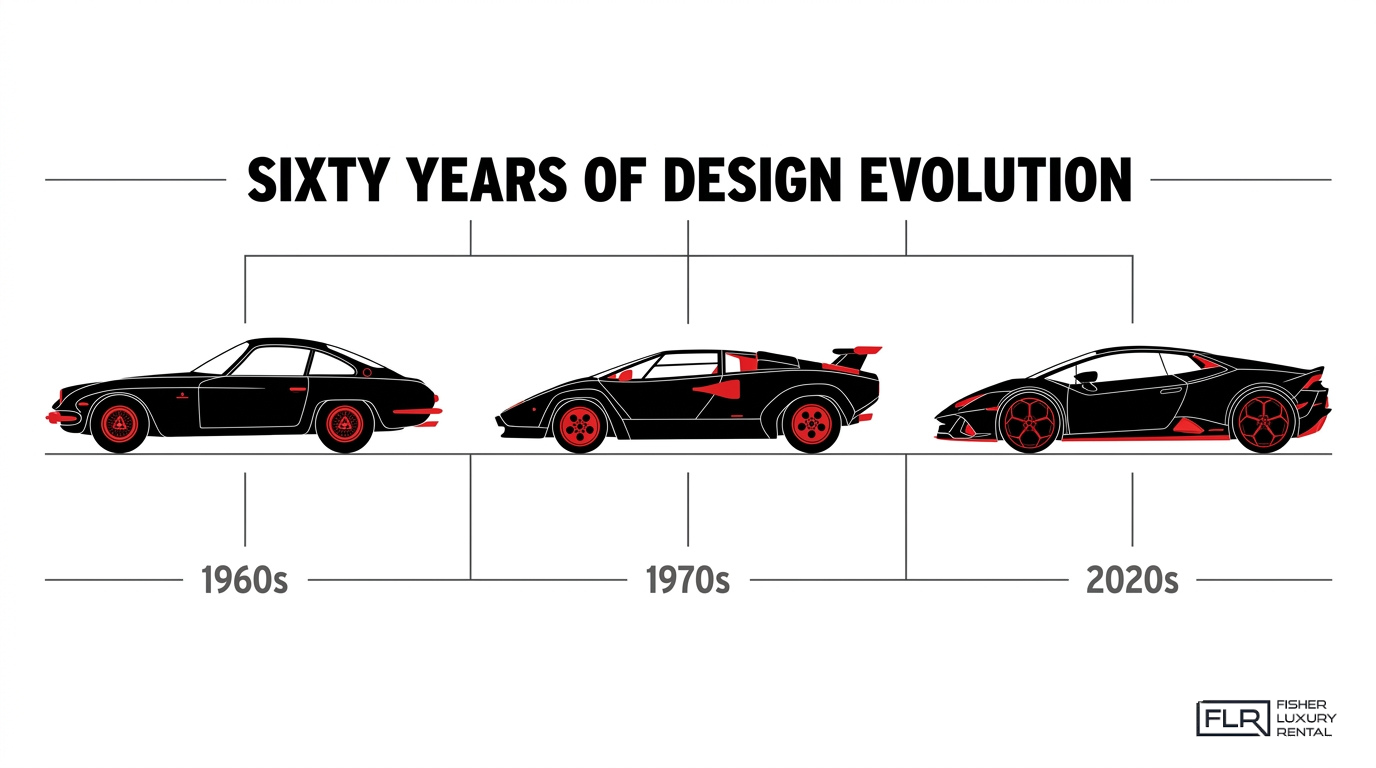
Lamborghini design evolution is the story of a single founding principle, clean Italian intent, transformed across six decades into one of the most recognizable visual languages in automotive history. From Ferruccio Lamborghini’s demand for an uncluttered silhouette in 1963 to the 1,015 CV hybrid powertrain of the 2023 Revuelto, every model reflects a disciplined commitment to angular aggression, geometric precision, and driver-focused drama.
This guide covers the 1960s founding philosophy, the designers who shaped each era, the landmark models that redefined supercar aesthetics, the recurring visual codes carried across every generation, and where electrification is taking Lamborghini’s design next.
The 1960s roots trace from the restrained grand touring elegance of the 350 GT to the Miura’s revolutionary mid-engine silhouette, with Ferruccio Lamborghini’s insistence on simplicity setting the standard every successor would either honor or deliberately break.
The designers behind the brand, from Marcello Gandini’s wedge revolution at Bertone to Mitja Borkert’s in-house philosophy today, each left a measurable mark on how Lamborghini looks, moves, and communicates intent.
Landmark models from the Countach through the Aventador and into the current Huracán, Revuelto, and Urus generation show how ownership changes, new materials, and hybrid architecture shaped the exterior lines and cockpit experience that make each car immediately identifiable.
The signature elements binding every generation together, hexagonal motifs, Y-shaped lighting, angular body lines, low and wide proportions, and fighter jet cockpits, explain why a Lamborghini from any decade is unmistakable at a glance.
What Defined Lamborghini’s Original Design Philosophy in the 1960s?
Lamborghini’s original design philosophy in the 1960s was built on two principles: a clean, uncluttered silhouette and a driver-focused performance aesthetic rooted in Italian craftsmanship. The sections below cover how the 350 GT, the Miura, and Ferruccio Lamborghini’s founding vision each shaped this language.
How Did the 350 GT Establish Lamborghini’s Early Styling Language?
The 350 GT established Lamborghini’s early styling language through a classic Italian grand touring form: a long bonnet, compact cabin, and restrained surface detail. Carrozzeria Touring of Milan executed the production design after Franco Scaglione’s 350 GTV concept introduced the original uncluttered silhouette that Ferruccio Lamborghini demanded. Where Ferrari leaned into drama, Lamborghini’s first production car prioritized elegance and mechanical refinement. That restraint was intentional, setting a foundation sophisticated enough to anchor every radical departure that followed.
What Role Did the Miura Play in Creating the Mid-Engine Supercar Silhouette?
The Miura played a defining role in creating the mid-engine supercar silhouette by placing the V12 transversely behind the driver, a layout borrowed directly from motorsport. According to Automobili Lamborghini, this architecture fundamentally changed automotive weight distribution and established the proportional template every supercar would later follow. Marcello Gandini, then Head of Design at Carrozzeria Bertone, finalized the Miura’s body in early 1966, producing a low, wide form that made the mid-engine layout visually inevitable rather than merely mechanical.
How Did Ferruccio Lamborghini’s Vision Influence Initial Design Choices?
Ferruccio Lamborghini’s vision influenced initial design choices by demanding simplicity and mechanical excellence over theatrical styling. The 350 GTV concept, designed by Franco Scaglione, reflected his insistence on a clean, uncluttered silhouette rather than ornamental complexity. That founding discipline explains why later ownership changes registered so clearly: Chrysler’s influence on the Diablo produced noticeably rounder proportions compared to Gandini’s original sharp-edged replacement proposal for the Countach, a departure that devoted Lamborghini followers still debate today.
Which Designers Shaped Lamborghini’s Most Iconic Eras?
Several key designers shaped Lamborghini’s most iconic eras, from Marcello Gandini’s revolutionary wedge forms to Mitja Borkert’s in-house design philosophy. The H3s below profile each designer’s distinct contribution to the brand’s visual identity.
Marcello Gandini
Marcello Gandini is the designer most responsible for Lamborghini’s defining visual language, serving as Head of Design at Carrozzeria Bertone during the brand’s most transformative period. He finalized the Miura’s body in 1966 and later conceived the Countach’s radical wedge silhouette. According to Lamborghini, the Countach’s iconic scissor doors were his functional solution to the car’s poor rear visibility, allowing drivers to lean out of the cabin while reversing. Few designers have shaped a brand’s identity as completely as Gandini did across two consecutive landmark models.
Bertone
Bertone is the Milan-based coachbuilder that served as Lamborghini’s primary design partner throughout the 1960s, 1970s, and 1980s. The studio produced the bodywork for the Miura, Countach, and Espada, giving each a dramatic visual coherence rooted in Bertone’s commitment to bold proportion and sculptural surface tension.
Giorgetto Giugiaro
Giorgetto Giugiaro is a designer whose Lamborghini contribution arrived later, most notably with the 1995 Calà concept, which explored a softer, more curvaceous design direction than the sharp-edged models that defined the brand’s earlier decades.
Walter de Silva
Walter de Silva is the designer who guided Lamborghini’s modernization phase in the early 2000s, developing the visual framework that produced the 2006 Miura Concept and the highly expressive 2013 Egoista one-off.
Mitja Borkert
Mitja Borkert is Lamborghini’s current Design Director, holding the role since 2016. He insists that design must remain in-house, stating that “design is the number one reason customers buy a Lamborghini.” Borkert’s leadership safeguards the brand’s creative independence while extending its geometric design language into hybrid and SUV models.
How Did the Countach Redefine Supercar Design in the 1970s?
The Countach redefined supercar design by replacing the organic curves of 1960s Italian coachbuilding with an extreme wedge silhouette, scissor doors, and a visual aggression that no production car had previously attempted. The sections below cover the wedge shape’s impact, the origin of scissor doors, and the Countach’s aerodynamic approach.
What Made the Countach’s Wedge Shape So Revolutionary?
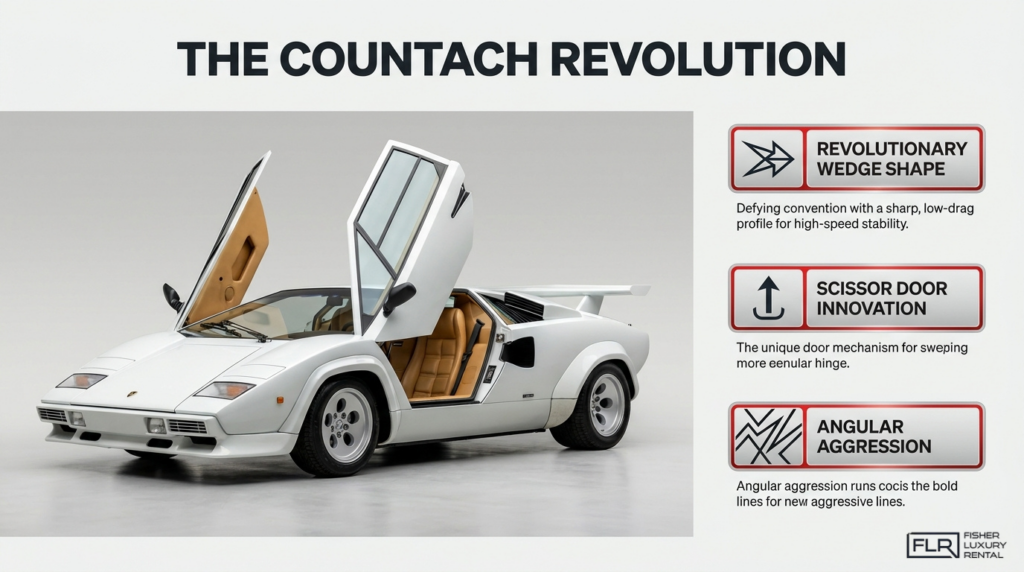
The Countach’s wedge shape was revolutionary because it replaced every conventional automotive proportion with a dramatically low, angular, surface-forward silhouette that looked more like a concept study than a road car. Marcello Gandini conceived the LP500 prototype in 1971, and its impact was immediate: the design was so visually shocking that spectators at the Geneva Motor Show reportedly exclaimed “Countach,” a Piedmontese dialect word for astonishment, and the name stuck. No production supercar before it had committed so fully to a knife-edged, ground-hugging form. The wedge shape set a visual template that competitors spent the next two decades chasing.
How Did the Scissor Doors Become a Lamborghini Signature?
The scissor doors became a Lamborghini signature through functional necessity before they became a stylistic icon. According to Lamborghini, Marcello Gandini engineered the vertically rotating doors specifically so drivers could lean out to see behind the car while reversing, compensating for the Countach’s severely limited rear visibility. The gesture was so theatrical that it became inseparable from the brand’s identity across every flagship model that followed. Notably, the European Union Intellectual Property Office rejected Lamborghini’s attempt to trademark the scissor door motion, ruling that the movement is a functional feature rather than a protectable brand identifier.
What Aerodynamic Innovations Did the Countach Introduce?
The aerodynamic innovations the Countach introduced were primarily visual rather than scientifically optimized, which is precisely what makes the model’s legacy so interesting. Its Cd of 0.42 is comparable to an early Volkswagen Beetle, revealing that the design prioritized drama over downforce efficiency. Lamborghini introduced the large rear wing as a retrofit option to generate additional downforce, yet independent testing showed it actually increased drag and reduced top speed. The Countach’s real aerodynamic contribution was cultural: it proved that a production supercar could treat aero elements as bold visual statements, a philosophy that influenced how every subsequent supercar was marketed and perceived.
How Did Lamborghini’s Design Language Evolve Through the 1980s and 1990s?
Lamborghini’s design language in the 1980s and 1990s was shaped by two forces: shifting ownership and the transition from angular excess to a more refined aggression. The following sections cover the Jalpa’s styling approach, the Diablo’s design compromises, and how corporate ownership changes redirected the brand’s aesthetic identity.
How Did the Jalpa Blend Grand Touring With Angular Styling?
The Jalpa blended grand touring with angular styling by inheriting the sharp, wedge-influenced geometry of the Countach era while scaling it into a smaller, more accessible V8-powered package. Where Lamborghini’s earlier grand touring roots, traced back to the 350 GT’s long bonnet and refined cabin proportions, emphasized comfort alongside drama, the Jalpa pushed those lines into more aggressive territory. Its low roofline, pronounced wheel arches, and flat surfaces reflected the angular Italian design sensibility that defined the decade. Ultimately, the Jalpa was discontinued under Chrysler’s ownership as the company redirected resources toward the Diablo.
What Design Shifts Appeared in the Diablo Era?
The design shifts in the Diablo era centered on a softening of Lamborghini’s previously razor-sharp aesthetic. Marcello Gandini had originally proposed a more extreme, hard-edged successor to the Countach, but Chrysler, which acquired Lamborghini in 1987 and invested $50 million in the brand, intervened. According to Automobili Lamborghini, Chrysler’s influence resulted in more rounded proportions replacing Gandini’s original sharp-edged proposal. The outcome was a car that retained supercar drama but introduced smoother surfacing, wider body haunches, and a more sculpted silhouette. This represented a genuine inflection point: Lamborghini’s design shifted from pure geometric provocation toward a blend of aggression and visual flow.
How Did Ownership Changes Affect Lamborghini’s Styling Direction?
Ownership changes affected Lamborghini’s styling direction significantly across this period, pulling the brand between American commercial priorities and later German engineering discipline. Chrysler’s ownership pushed toward broader market appeal, smoothing Gandini’s harder vision for the Diablo. Then, according to Hagerty, Audi’s acquisition in 1998 introduced manufacturing discipline and technical rigor that enabled the subsequent development of the Murciélago. Audi’s influence prioritized build quality and structural refinement alongside design, giving Lamborghini the production foundation needed to evolve its aesthetic consistently rather than reactively.
What Design Breakthroughs Defined the Murciélago and Gallardo Era?
The Murciélago and Gallardo era produced two landmark breakthroughs: the Murciélago refined Lamborghini’s aggressive flagship identity for modern production standards, while the Gallardo introduced a more compact, approachable design that brought the brand to its widest audience. Together, they cemented Lamborghini’s visual language for the 2000s.
How Did the Murciélago Modernize Lamborghini’s Flagship Aesthetic?
The Murciélago modernized Lamborghini’s flagship aesthetic by evolving the angular, low-slung proportions of the Diablo era into sharper, more precise geometry suited to Audi’s post-1998 manufacturing standards. Its wide haunches, dramatic air intakes, and scissor doors preserved continuity with the Countach and Diablo lineage while introducing cleaner, more purposeful surfacing. The result was a supercar that felt simultaneously familiar and technologically advanced, striking the balance every flagship demands.
What Made the Gallardo’s Design Accessible Yet Unmistakably Lamborghini?
The Gallardo’s design is accessible yet unmistakably Lamborghini because it scaled down the brand’s wedge proportions and angular body lines into a smaller, more manageable form without softening the visual aggression. According to Lamborghini’s Centro Stile, design coherence across the model range requires each car to share core DNA regardless of size or segment. Sharp crease lines, a low roofline, and assertive front fascia gave the Gallardo instant brand recognition. With 14,022 units produced between 2003 and 2013, it became Lamborghini’s highest-production model, proving that accessible design and iconic styling are not mutually exclusive.
How Does the Aventador Represent Peak Lamborghini Design Language?
The Aventador represents peak Lamborghini design language by unifying sharp geometric exterior lines, a fighter jet-inspired cockpit, and extreme limited editions into a single cohesive vision. The sections below cover its exterior principles, interior philosophy, and the special variants that pushed that vision furthest.
What Geometric Principles Drive the Aventador’s Exterior Lines?
The geometric principles driving the Aventador’s exterior lines are rooted in sharp angular surfaces, aggressive creases, and deliberately complex polygonal bodywork. Every panel intersects at acute angles, creating a silhouette that reads as kinetic even at a standstill. Low, wide proportions amplify the visual tension, while deep air intakes and pronounced wheel arches reinforce the car’s predatory stance. In practice, this is one of the most disciplined executions of Lamborghini’s angular design vocabulary: no surface is passive, and every crease serves both an aerodynamic and a visual function.
How Did the Aventador’s Interior Design Match Its Aggressive Exterior?
The Aventador’s interior design matches its aggressive exterior through a cockpit architecture inspired directly by modern aeronautics and fighter jets. The most striking detail is the start button positioned beneath a red flip cover, mimicking a missile launch trigger. Instrument clusters, carbon fiber trim, and angled switchgear reinforce the aircraft analogy throughout the cabin. According to Automobili Lamborghini, the entire interior experience is designed to place the driver in the mindset of a combat pilot, making the emotional intensity of the exterior feel consistent the moment you sit inside.
What Limited Editions Pushed Aventador Styling to Extremes?
The limited editions that pushed Aventador styling to extremes include variants engineered specifically to test the boundaries of the platform’s visual and material possibilities. The Sesto Elemento, produced in 2011 to 2012 in just 20 units, exemplified this approach: according to LamboCars, it prioritized extreme lightness through comprehensive carbon fiber construction, reducing every non-essential element to its structural minimum. Other bespoke one-offs followed a similar logic, stripping the design to its most aggressive geometric core while experimenting with exposed materials and radical aerodynamic bodywork.
With its exterior geometry, cockpit drama, and extreme limited variants, the Aventador stands as the fullest realization of Lamborghini’s angular design philosophy before the brand’s pivot to electrification.
What Current Design Cues Define Modern Lamborghini Models Like the Huracán and Revuelto?
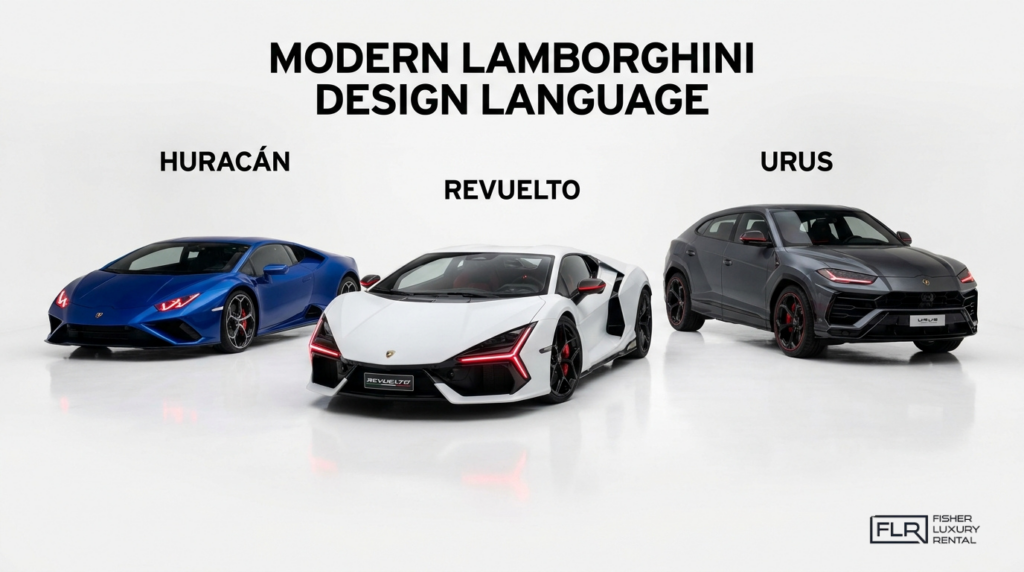
Modern Lamborghini design cues include sharp angular surfaces, Y-shaped lighting signatures, hexagonal geometry, and aerodynamically integrated bodywork. The Huracán, Revuelto, and Urus each express these cues differently while maintaining unmistakable brand identity.
How Does Huracán’s Design Balance Aggression With Elegance?
The Huracán’s design balances aggression with elegance through tightly sculpted body panels, low-slung proportions, and integrated aerodynamic elements that serve both visual and functional roles. Angular air intakes and sharp crease lines create visual tension, while smooth surface transitions prevent the design from feeling chaotic. Hexagonal motifs appear throughout the cabin and exterior, reinforcing brand consistency without sacrificing refinement. The result is a car that looks purposeful at a standstill and cohesive at speed, making it one of the most visually resolved Lamborghinis ever produced.
What New Design Elements Does the Revuelto Introduce for the Hybrid Era?
The Revuelto introduces design elements for the hybrid era that visually communicate electrification while preserving Lamborghini’s aggressive DNA. Launched in 2023, the Revuelto is Lamborghini’s first High Performance Electrified Vehicle (HPEV), combining a new V12 engine with three electric motors for a total of 1,015 CV, according to Automobili Lamborghini. New aerodynamic surfaces manage increased thermal demands from the hybrid powertrain, while updated lighting and bodywork signal a technological step forward. The design avoids the softening seen on many electrified rivals, proving that hybrid performance and radical styling are not mutually exclusive.
How Does the Urus Translate Lamborghini DNA Into an SUV Form?
The Urus translates Lamborghini DNA into an SUV form by applying the brand’s signature hexagonal motifs and Y-shaped lighting elements to a high-riding utility body. According to Automobili Lamborghini, these cues directly connect the Urus to the supercar lineage despite its fundamentally different proportions. Wide fender flares, a sharply raked roofline, and aggressive front fascia maintain the visual weight and authority expected of the brand. With Automobili Lamborghini reaching a turnover of €3.20 billion in 2025, the Urus has clearly proven that design-led SUVs can anchor a brand’s commercial success without diluting its identity.
What Are the Signature Styling Elements Found Across All Lamborghini Generations?
The signature styling elements found across all Lamborghini generations are a set of recurring visual codes that have defined the brand since Ferruccio Lamborghini set out to build a “perfect car” to rival Ferrari. These elements span five key design areas: hexagonal geometry, angular body lines, low and wide proportions, Y-shaped lighting, and fighter jet cockpit interiors.

Hexagonal Geometric Motifs
Hexagonal geometric motifs are one of Lamborghini’s most consistent design signatures, appearing on grilles, air intakes, interior surfaces, and wheel designs across every generation. The hexagon functions as a visual fingerprint, immediately communicating the brand without a single badge. Lamborghini’s Y-shaped light graphic and hexagonal geometry draw direct inspiration from 1960s Italian architecture and industrial design, giving the motif deep historical roots rather than arbitrary styling. Even the Urus SUV carries these geometric elements, proving the hexagon’s adaptability beyond low-slung supercar bodies. No other automaker deploys this shape so consistently across such a diverse lineup.
Sharp Angular Body Lines
Sharp angular body lines are a defining Lamborghini characteristic, originating with the radical wedge silhouette Marcello Gandini introduced through the Countach in 1971. Every surface crease, edge, and panel fold is intentional. Where competitors often smooth bodywork into flowing curves, Lamborghini uses tension: intersecting planes that create visual aggression at every angle. This approach generates surface drama without added ornamentation, letting the geometry do the work. The Aventador and Revuelto both continue this tradition, with multi-faceted bodywork that shifts dramatically in appearance depending on lighting conditions and viewing angle.
Low and Wide Proportions
Low and wide proportions are a structural signature of Lamborghini design, inherited from the Miura’s mid-engine architecture and reinforced through every flagship since. The low roofline, broad stance, and wide rear haunches communicate performance before the engine turns over. This proportion strategy is non-negotiable for the brand: stretching the wheelbase to lower the center of gravity visually anchors the car to the road while maximizing perceived power. Even the Urus, which must accommodate practical SUV packaging, maintains a notably wider and more aggressive stance compared to mainstream luxury SUVs, preserving the brand’s visual DNA in an entirely different vehicle category.
Y-Shaped Lighting Signatures
Y-shaped lighting signatures are a modern Lamborghini brand identifier, appearing across the Huracán, Aventador, Revuelto, and Urus model lines. The Y-shape translates into both daytime running lights and tail light clusters, ensuring instant recognition at any hour. According to Automobili Lamborghini, this lighting graphic is rooted in the same 1960s Italian architecture and industrial design heritage that inspired the hexagonal geometry. The decision to apply identical lighting language across supercar and SUV body styles reinforces brand cohesion and makes each new model unmistakably Lamborghini before any other styling element is registered.
Fighter Jet-Inspired Cockpit Design
Fighter jet-inspired cockpit design is a persistent interior philosophy at Lamborghini, placing the driver within a control environment built around performance ritual. The Lamborghini Aventador’s interior exemplifies this most directly: its start button sits beneath a red flip cover replicating a missile launch trigger, a deliberate reference to military aeronautics that turns ignition into an event. Low-slung seating, narrow visibility channels, angular instrument housings, and upward-scissoring doors all reinforce the pilot-in-command sensation. This interior language is not merely aesthetic; it psychologically prepares the driver for the performance the powertrain delivers, making the cockpit as much a part of the Lamborghini experience as the exterior silhouette.
How Will Lamborghini’s Design Evolve in the Electric and Hybrid Future?
Lamborghini’s design will evolve by preserving its aggressive visual identity while integrating electrified powertrains and new proportional formats. The sections below examine the Lanzador concept and the broader shift toward hybrid and electric architecture.
What Does the Lanzador Concept Reveal About Lamborghini’s Electric Design Direction?
The Lanzador concept reveals that Lamborghini’s electric design direction prioritizes dramatic presence over minimalist EV conventions. Unveiled in 2023, the Lanzador previews the brand’s first all-electric model, scheduled for production in 2029, delivering over 1,341 horsepower in a 2+2 GT layout, according to Car and Driver. Rather than softening lines to signal efficiency, the concept maintains sharp geometric surfaces, a wide aggressive stance, and the signature Y-shaped lighting graphic. This approach signals that electrification will not dilute Lamborghini’s visual aggression. In practice, this makes the Lanzador one of the clearest statements any legacy supercar brand has made: that EV architecture can reinforce, rather than compromise, a performance identity built over six decades.
How Can You Experience Lamborghini’s Iconic Design Firsthand?
You can experience Lamborghini’s iconic design firsthand by renting one and driving it yourself. The sections below cover how Fisher Luxury Rental makes that possible and recap the key design milestones explored throughout this article.
Does Renting a Lamborghini From Fisher Luxury Rental Let You Feel Decades of Design Heritage?
Renting a Lamborghini from Fisher Luxury Rental does let you feel decades of design heritage through direct, hands-on experience behind the wheel. Every exterior angle, scissor door, and fighter jet-inspired cockpit tells a story spanning more than 60 years of Italian design mastery. The Lamborghini Gallardo alone, the brand’s best-selling model with 14,022 units produced between 2003 and 2013, represents the moment Lamborghini made its radical design language accessible to a wider audience. Fisher Luxury Rental offers the Lamborghini Huracán Spyder Convertible, a direct descendant of that Gallardo legacy, starting at $1,099 per day in Phoenix and Portland. No photograph or museum exhibit replicates the sensation of those angular body lines, hexagonal motifs, and V10 soundtrack surrounding you in motion.

What Are the Key Takeaways About Lamborghini’s Design Evolution We Covered?
The key takeaways about Lamborghini’s design evolution center on a consistent thread: radical intent executed with Italian precision across every era. From Ferruccio Lamborghini’s clean 1960s silhouettes to Marcello Gandini’s wedge-shaped Countach revolution, each decade introduced a design breakthrough that competitors then spent years absorbing. The Murciélago and Gallardo era democratized that aggression, the Aventador elevated it to geometric art, and the Revuelto carries it into the hybrid age without softening a single line. Three principles have survived every ownership change and technology shift:
- Angular, low-slung proportions signal performance before the engine starts.
- Y-shaped lighting and hexagonal geometry create instant brand recognition across all models.
- The driver-focused cockpit, inspired by fighter jet aesthetics, makes every seat feel like a pilot’s station.
Understanding this lineage transforms a Lamborghini rental from a thrill into something richer: a moving lesson in automotive design history.