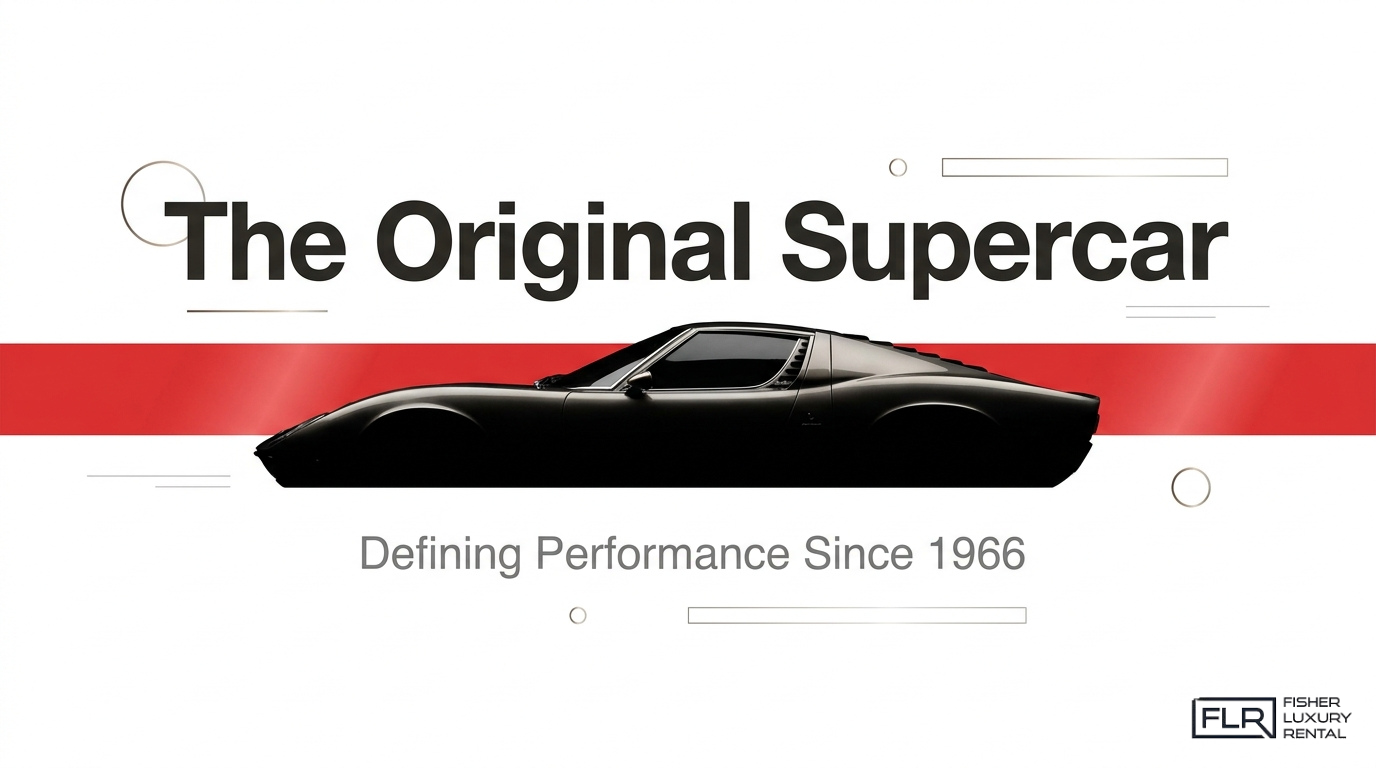
The Lamborghini Miura is the car that defined what a supercar is: a mid-engine, V12-powered road machine combining race-derived engineering, radical Italian design, and performance that no production rival had matched when it debuted in 1966.
This article covers the Miura’s rebellious origins, its design revolution, the evolution across its three production variants, its performance legacy, its role as the original supercar, its influence on every Lamborghini that followed, and its standing in today’s collector market.
The Miura was born from a personal grievance. Ferruccio Lamborghini’s frustration with Ferrari, and his engineers’ secret project built against his own wishes, produced one of the most consequential road cars ever made.
Its design changed everything. A 25-year-old Marcello Gandini, working at Bertone, introduced the transverse mid-engine layout that became the universal blueprint for high-performance sports cars, wrapped in bodywork that still reads as a design standard more than five decades later.
Across 764 examples spanning the P400, P400 S, and P400 SV, each variant raised the performance ceiling, from the S’s 168 mph to the SV’s claimed 180 mph. The one-off Jota pushed the platform beyond what Lamborghini ever chose to sell.
The Miura’s influence carried directly into the Countach, the Aventador, and every Lamborghini since, making it the founding document of the brand’s entire engineering identity.
Today, Miura values range from $1.5 million for a P400 to more than $6.6 million for an exceptional SV, confirming that the market’s conviction in its significance has never wavered.
Why Was the Lamborghini Miura Created?
The Lamborghini Miura was created out of frustration, rebellion, and engineering ambition. This section covers the personal grievance that sparked Ferruccio Lamborghini’s rivalry with Ferrari, the young engineers who secretly built the project, and the 1966 Geneva Motor Show debut that changed automotive history.
What Problem Did Ferruccio Lamborghini Want to Solve?
The problem Ferruccio Lamborghini wanted to solve was a deeply personal one. Ferruccio Lamborghini, a successful tractor manufacturer, was unhappy with his Ferrari because he believed the car’s clutch broke too easily. When he reportedly brought his complaint directly to Enzo Ferrari, Ferrari dismissed him, insisting a tractor maker had no business telling him how to build cars. That rebuff became the catalyst for an entirely new manufacturer. Ironically, the Miura itself was conceived against Ferruccio’s own wishes: his engineering team designed it in their spare time, as he preferred powerful but sedate grand touring cars over the race-derived machines produced by rival Ferrari.
Who Were the Young Engineers Behind the Miura Project?
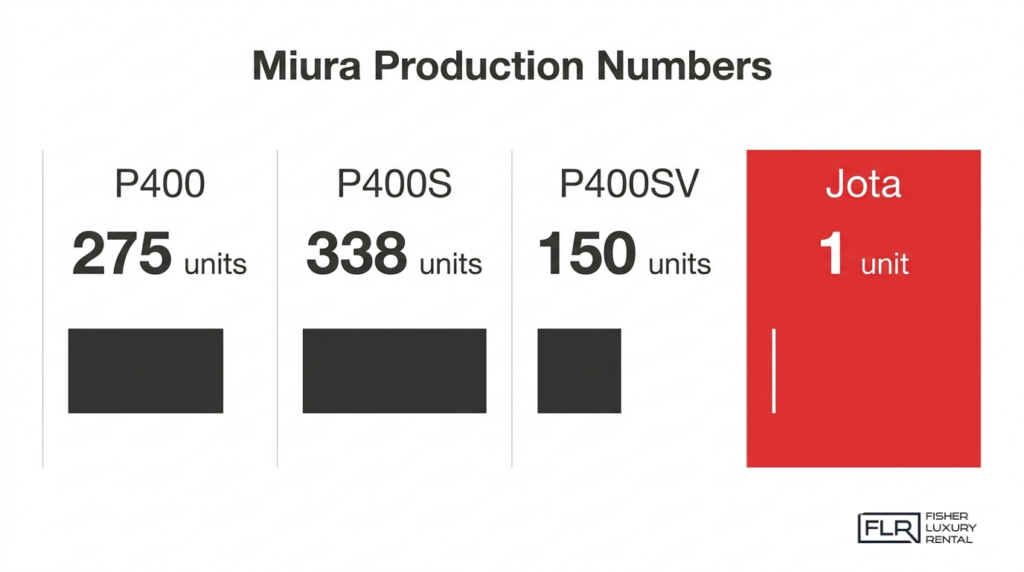
The young engineers behind the Miura project were Gian Paolo Dallara, Paolo Stanzani, and New Zealand test driver Bob Wallace. Starting in 1964, the trio developed the concept for a new super sports car in their spare time, building a performance-calibrated prototype chassis after hours without their employer’s approval. Their ambition produced a car that ultimately spanned three variants plus one unique prototype: a total of 764 Miuras were built, comprising 275 P400 models, 338 P400S models, 150 P400SV models, and 1 Jota. The P400 S alone produced 370 horsepower from its 3.9-liter V12, reaching a top speed of 168 mph. For a project born in secret, its engineering legacy proved extraordinary.
How Did the 1966 Geneva Motor Show Launch Change Everything?
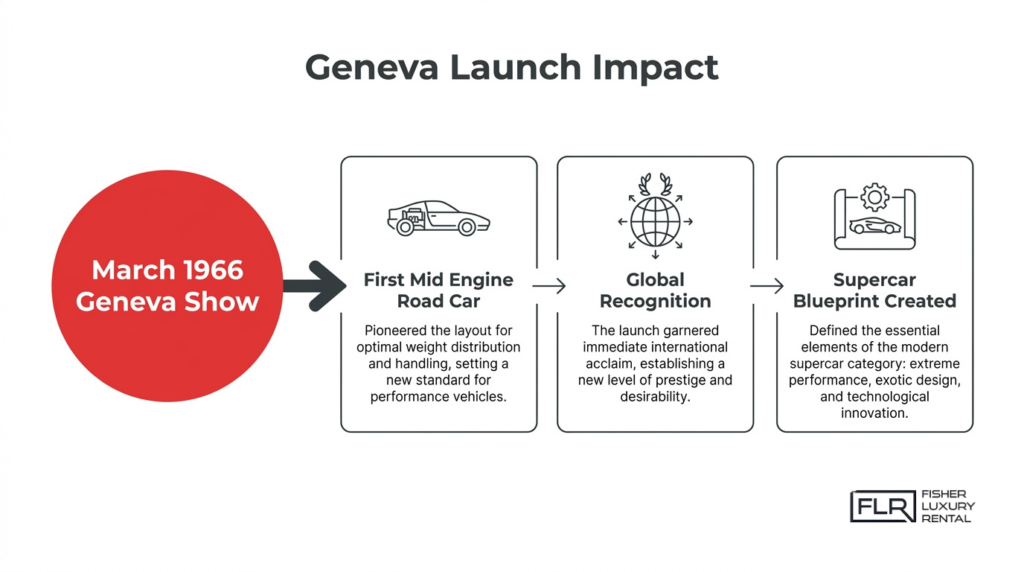
The 1966 Geneva Motor Show launch changed everything by placing the Miura in front of a global audience that had never seen anything like it. When the Miura was presented on March 10, 1966, it captured the imagination of the world. According to MotorTrend, the car designed by Marcello Gandini for Bertone introduced a mid-engine layout that would become the standard for all high-performance sports cars. Before the Miura, mid-engine placement belonged almost exclusively to racing machines. After Geneva, it became the defining architecture of the modern supercar. No single motor show debut in the postwar era more permanently reshaped what the industry considered possible for a road-going automobile.
What Made the Lamborghini Miura’s Design Revolutionary?
The Lamborghini Miura’s design was revolutionary because it combined a mid-engine layout, a transverse V12, and dramatic Italian bodywork into a single cohesive form. The sections below cover Gandini’s styling choices, the mid-engine breakthrough, and the engine’s structural role.
How Did Marcello Gandini Shape the Miura’s Bodywork?
Marcello Gandini shaped the Miura’s bodywork by delivering sweeping, low-slung lines that no production car had expressed before. According to MotorTrend, Bertone, a design firm with no ties to Ferrari or Maserati, led the project with 25-year-old Gandini at the helm. The large windshield swept back dramatically, and the roofline trailed down over the mid-mounted V12 toward the car’s wide hips, creating a visual tension between aggression and elegance. Gandini’s influence proved so formative that his next project for Bertone, the Countach, reportedly drew gasps of disbelief in the same Turin studio. Few designers have defined a brand’s DNA with a debut so completely.
Why Was the Mid-Engine Layout So Groundbreaking?
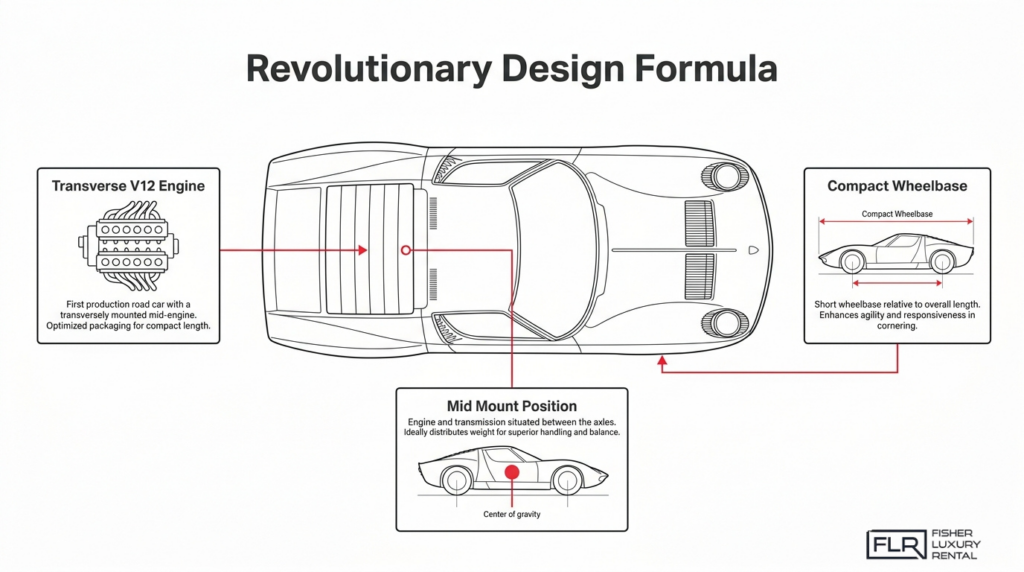
The mid-engine layout was groundbreaking because it placed the heaviest mechanical component behind the driver, dramatically lowering the car’s center of gravity and improving handling balance. Before the Miura, high-performance road cars typically used front-engine configurations. By relocating the V12 to the center, Lamborghini achieved a weight distribution that GT cars of that era could not match. This layout, once reserved for racing prototypes, became the blueprint for every serious supercar that followed.
What Role Did the Transverse V12 Engine Play in the Design?
The transverse V12 engine played a structural and aesthetic role by sitting sideways across the chassis, keeping the overall wheelbase compact while freeing the bodywork to flow uninterrupted. Mounting the engine transversely allowed Gandini to keep the rear bodywork low and tightly sculpted, reinforcing the car’s dramatically horizontal silhouette. This engineering choice also concentrated mass centrally, reinforcing the handling benefits of the mid-engine position. Without the transverse orientation, the Miura’s signature proportions would have been impossible to achieve.
How Did the Lamborghini Miura Evolve Through Its Versions?
The Lamborghini Miura evolved through three increasingly refined production variants, the P400, P400 S, and P400 SV, plus one legendary one-off prototype. Together, these versions trace a continuous arc from radical debut to mechanical maturity, with each iteration addressing real-world feedback while raising the performance ceiling.
What Defined the Original Miura P400?
The original Miura P400 defined an entirely new template for what a road car could be: a mid-engine, V12 machine produced for road use rather than the racetrack. Lamborghini built 275 P400 examples, establishing the Miura’s foundational architecture that every subsequent variant would refine. The P400 introduced the transverse engine placement and low-slung body that made the Miura instantly iconic. From this starting point, the Miura lineage grew into one of the most consequential model families in automotive history, influencing Lamborghini descendants from the Countach to the Aventador.
How Did the P400 S Improve on the Original?
The P400 S improved on the original Miura through meaningful mechanical and comfort upgrades that made the car more capable and livable. Lamborghini produced 338 P400 S examples, making it the most-built Miura variant. The S received a 3.9-liter V12 producing 370 horsepower, enabling a top speed of 168 mph, according to performance data from Apex Automotor. Interior refinements accompanied the power increase, broadening the Miura’s appeal beyond pure performance driving without diluting its character.
What Made the P400 SV the Ultimate Miura?
The P400 SV is the ultimate Miura because it delivered the sharpest performance and most resolved engineering of any production variant. With a sprint to 60 mph in just 5.8 seconds and a claimed top speed of 180 mph, the SV represented a significant leap over its predecessors, according to MotorTrend. Lamborghini produced only 150 SV examples, making it the rarest production Miura. That scarcity, combined with its performance credentials, is why the SV commands the highest collector valuations of all Miura variants today.
Why Is the Miura Jota Considered a Legendary One-Off?
The Miura Jota is considered a legendary one-off because only one original was ever built, constructed by test driver Bob Wallace around chassis #5084 as an extreme performance experiment. The Jota was never a production vehicle; it was Wallace’s personal development car, pushing Miura architecture to its absolute limit. According to Supercars.net, no other original Jota exists. Its singular status means it occupies a category beyond any Miura variant, a prototype that defined what the platform could theoretically become rather than what Lamborghini chose to sell.
What Were the Lamborghini Miura’s Performance Specs?
The Lamborghini Miura’s performance specs placed it among the fastest road cars of the 1960s and early 1970s, combining V12 power with a mid-engine layout no production rival had matched. The sections below cover engine output, top speed, and competitive benchmarks.
How Fast Could the Miura V12 Engine Propel the Car?
The Miura V12 engine propelled the car with impressive force across all three production variants. The P400 S used a 3.9-liter V12 producing 370 horsepower, enabling a top speed of 168 mph. The final SV variant pushed that further, with the same displacement tuned to deliver sharper throttle response and improved power delivery. For a road car of the late 1960s, these figures were extraordinary, and the transverse mid-engine placement kept weight central for handling that matched the straight-line numbers.
What Top Speed Did the Miura Achieve in Its Era?
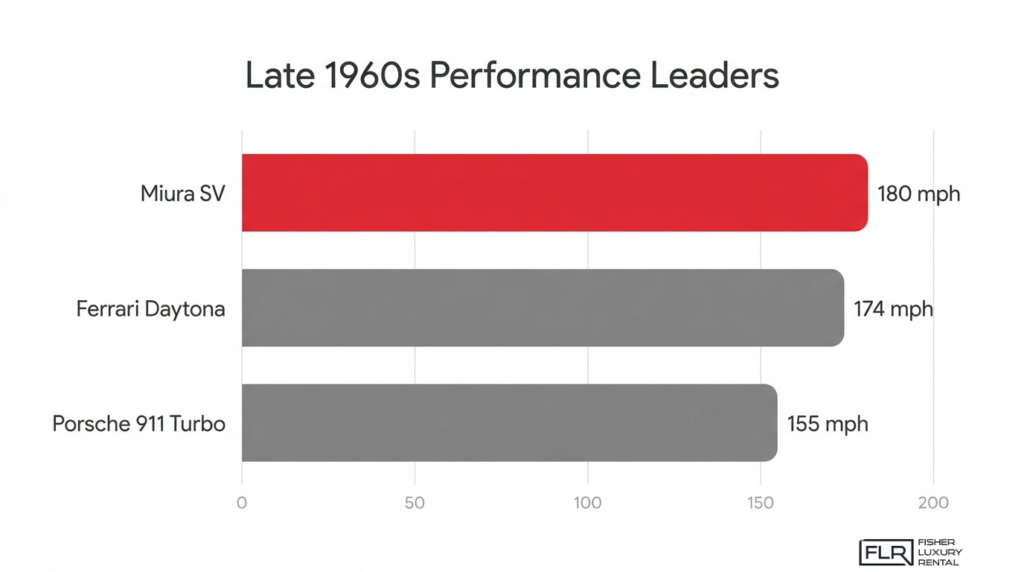
The top speed the Miura achieved in its era reached 180 mph in its most developed form. According to MotorTrend, by 1971 the Miura SV sprinted from 0 to 60 mph in just 5.8 seconds, with a claimed top speed of 180 mph. Those figures made it one of the fastest production cars on earth at the time, a benchmark few contemporaries could credibly challenge.
How Did the Miura Compare to Contemporary Rivals?
The Miura compared favorably to contemporary rivals, outclassing virtually every production car available when it debuted. The Ferrari 365 GTB/4 Daytona, its most credible opponent, used a front-engine layout that felt conventional beside the Miura’s mid-engine architecture. Visually and dynamically, the Miura set a standard the Daytona could not match on equal terms. In an era when 150 mph was considered exceptional for a road car, the SV’s 180 mph capability put the Miura in a class of its own.
Why Is the Lamborghini Miura Considered the First Supercar?
The Lamborghini Miura is considered the first supercar because it combined a mid-mounted transverse V12 engine, race-derived engineering, and radical low-slung styling in a road-legal package that no production car had achieved before. According to Hagerty, the Miura came to embody the “supercar” as we know it.
The three qualities that define this classification are:
- Racing technology on public roads: Gian Paolo Dallara, Paolo Stanzani, and Bob Wallace engineered the Miura with motorsport-derived mechanical principles, starting in 1964, making it genuinely performance-calibrated rather than merely powerful.
- Groundbreaking mid-engine layout: Marcello Gandini’s design for Bertone placed the engine behind the driver, establishing the layout that every subsequent supercar would follow.
- Unprecedented performance: The model’s combination of speed, handling, and visual drama set a benchmark no contemporary rival could match.
The Miura did not simply raise the performance bar; it invented the category entirely. No car before it integrated all three of these attributes in a road-going production vehicle, which is precisely why automotive historians treat 1966 as the supercar’s true origin point.
How Did the Miura Influence Lamborghini’s Future Models?
The Miura influenced Lamborghini’s future models by establishing the mid-engine supercar template that every successor followed. From the Countach to the Aventador, each generation built directly on the performance philosophy and design DNA the Miura introduced.
How Did the Miura Shape the Countach’s DNA?
The Miura shaped the Countach’s DNA by passing on Marcello Gandini’s radical design language and the mid-engine architecture. According to Classic & Sports Car, the Piedmontese expletive “Countach” echoed through Bertone’s Turin studio as Gandini’s Miura replacement took shape, signaling a deliberate creative continuation rather than a clean break. The Countach retained the transverse mid-engine configuration and the same commitment to dramatic, wedge-driven aesthetics that the Miura pioneered.
How Did the Miura’s Legacy Carry Through to the Aventador?
The Miura’s legacy carried through to the Aventador by embedding a consistent performance standard across every intervening model. LamboCARS notes that from the groundbreaking Miura to the advanced Aventador, each model has set new standards for performance and redefined what a supercar can be. The Miura’s core formula, a high-revving V12 mounted behind the driver in a sculpted low-slung body, remained Lamborghini’s competitive identity for over five decades. That continuity is arguably the strongest evidence of how completely the Miura defined the brand’s engineering direction.
What Is the Lamborghini Miura Worth Today?
The Lamborghini Miura’s value today reflects its status as the original supercar, with prices varying significantly across the P400, P400 S, and P400 SV variants based on originality, condition, and auction history.
How Much Does a Miura P400 Sell for at Auction?
Miura P400 auction prices typically range from $1.5 million to $2.5 million for well-documented, numbers-matching examples. According to Hagerty Valuation Tools, the most recent auction sale of a 1972 Lamborghini Miura P400 SV achieved $6,605,000 through Broad Arrow Auctions on March 7, 2026, demonstrating the ceiling that exceptional SV variants can reach. The P400, as the original and least powerful variant, commands the lowest prices within the Miura family, though its historical significance as the founding model sustains strong collector demand.
How Much Does a Miura P400 S Command?
The Miura P400 S commands prices in the range of $1.5 million to $2.5 million at auction, reflecting its upgraded 370-horsepower V12 and improved refinement over the base P400. A 1969 Lamborghini Miura S sold for $1,875,000 at RM Sotheby’s in Miami on February 27, 2026. The P400 S represents the best value entry point into Miura ownership for serious collectors, as it delivers meaningful performance gains without the scarcity premium attached to SV examples.
What Are Miura SV Examples Valued At?
Miura SV examples are valued at the top of the Miura market, routinely exceeding $2 million and reaching well above $6 million for exceptional specimens. According to Gooding and Company, a 1971 Lamborghini P400 SV sold for $869,000, illustrating that condition and provenance drive enormous price variance even within the same variant. Classic.com reports the average Lamborghini Miura price across all variants at $2,170,605. With only 150 SV models ever produced, scarcity alone ensures these remain among the most sought-after postwar collectibles at any major auction.
Why Does the Miura’s Legacy Still Resonate with Car Enthusiasts?
The Miura’s legacy resonates with car enthusiasts because it represents the singular moment when automotive engineering, Italian design, and raw performance converged to define an entirely new category of car. No section of this article captures that better than examining what the Miura continues to mean to collectors, designers, and drivers today.
The Miura came to embody the “supercar” as we know it, according to Hagerty, combining racing technology, groundbreaking design, and unprecedented performance in a single road-legal package. That combination has never lost its power to captivate.
Several factors sustain the Miura’s enduring appeal:
- Cultural permanence: An orange Miura opened The Italian Job (1969), cementing its status as a symbol of speed, style, and European glamour in popular imagination.
- Design that still leads: Marcello Gandini’s bodywork, penned at just 25 years old, remains a reference point for supercar aesthetics more than five decades later.
- Technical founding myth: The mid-engine transverse V12 layout the Miura introduced became the universal blueprint for every high-performance sports car that followed.
- Collector market validation: The most recent auction sale of a 1972 Miura P400 SV reached $6,605,000 in March 2026 through Broad Arrow Auctions, confirming the market’s sustained conviction in its significance.
- Lineage: From the Miura to the Aventador, each successor Lamborghini model has carried forward the performance standards and visual drama the Miura first established.
The Miura is not merely historic; it is the benchmark against which every supercar since has been measured, and that standard shows no sign of diminishing.
How Can You Experience Lamborghini’s Legacy Firsthand?
You can experience Lamborghini’s legacy firsthand by getting behind the wheel of a modern exotic. The H3s below cover renting from Fisher Luxury Rental and the key takeaways from the Miura’s history.
Can Renting an Exotic Lamborghini from Fisher Luxury Rental Capture the Miura’s Spirit?
Yes, renting an exotic Lamborghini from Fisher Luxury Rental can capture the Miura’s spirit. The Lamborghini Huracan Spyder Convertible carries forward the same mid-engine philosophy and visceral V10 performance that made the Miura legendary in 1966. Fisher Luxury Rental offers the Huracan Spyder at $1,099 per day, with top-trim vehicles available in Phoenix, AZ, and Portland, OR. Driving one connects you directly to the lineage Ferruccio Lamborghini’s engineers built against all odds. For any enthusiast who cannot own a piece of supercar history, this is the most practical way to feel it.
What Are the Key Takeaways About the Lamborghini Miura’s History and Enduring Legacy?
The key takeaways about the Lamborghini Miura’s history and enduring legacy are that it permanently redefined what a road car could be. According to Curated, the Miura is a milestone in the history of classic road cars, combining racing technology, groundbreaking design, and unprecedented performance into a single machine. It introduced the mid-engine supercar template, inspired every Lamborghini that followed, and still commands millions at auction today. The Miura’s story proves that the boldest ideas, even those pursued against a founder’s wishes, shape entire industries.