The Lamborghini Miura is the world’s first true supercar, a mid-engine, purpose-built road car that redefined what high-performance vehicles could be when it debuted in 1966. Built by engineers Gian Paolo Dallara, Paolo Stanzani, and Bob Wallace, and styled by Marcello Gandini at Bertone, it combined radical architecture with street-legal performance so extreme that the media coined a new word to describe it: supercar.
This guide covers the Miura’s origins and production history, its variants and model-year differences, the revolutionary design and engineering behind it, its role as the supercar category’s founding document, its lasting influence on modern exotics, and what examples sell for at auction today.
The Miura’s creation story begins with three engineers who built the concept on their own time, inspired by motorsport’s mid-engine race cars, and ends with Ferruccio Lamborghini placing 764 units into production across three distinct series between 1966 and 1973.
Each variant, from the original P400 to the definitive P400 SV, introduced meaningful mechanical and aesthetic refinements, with the SV correcting the shared engine-transmission lubrication system that had been the original’s most scrutinized technical compromise.
Gandini’s body, completed in weeks, introduced the mid-engine silhouette that every serious supercar has followed since, while the transverse 3.9L V12 at its core grew from 350 CV to 385 CV across the production run and seeded the engineering DNA carried by every Lamborghini V12 flagship through the Aventador.
Today, Miura values range from $1,000,000 to well beyond $4,900,000 for record SV examples, reflecting scarcity, historical significance, and a collector market that shows no sign of cooling.
What Is the History Behind the Lamborghini Miura?
The history behind the Lamborghini Miura begins in 1964, when three young engineers defied their employer to build a car that would rewrite automotive convention. The sections below cover the creators, the inspiration, the landmark 1966 Geneva debut, and the model’s evolution across seven years of production.
Who Created the Lamborghini Miura and Why?
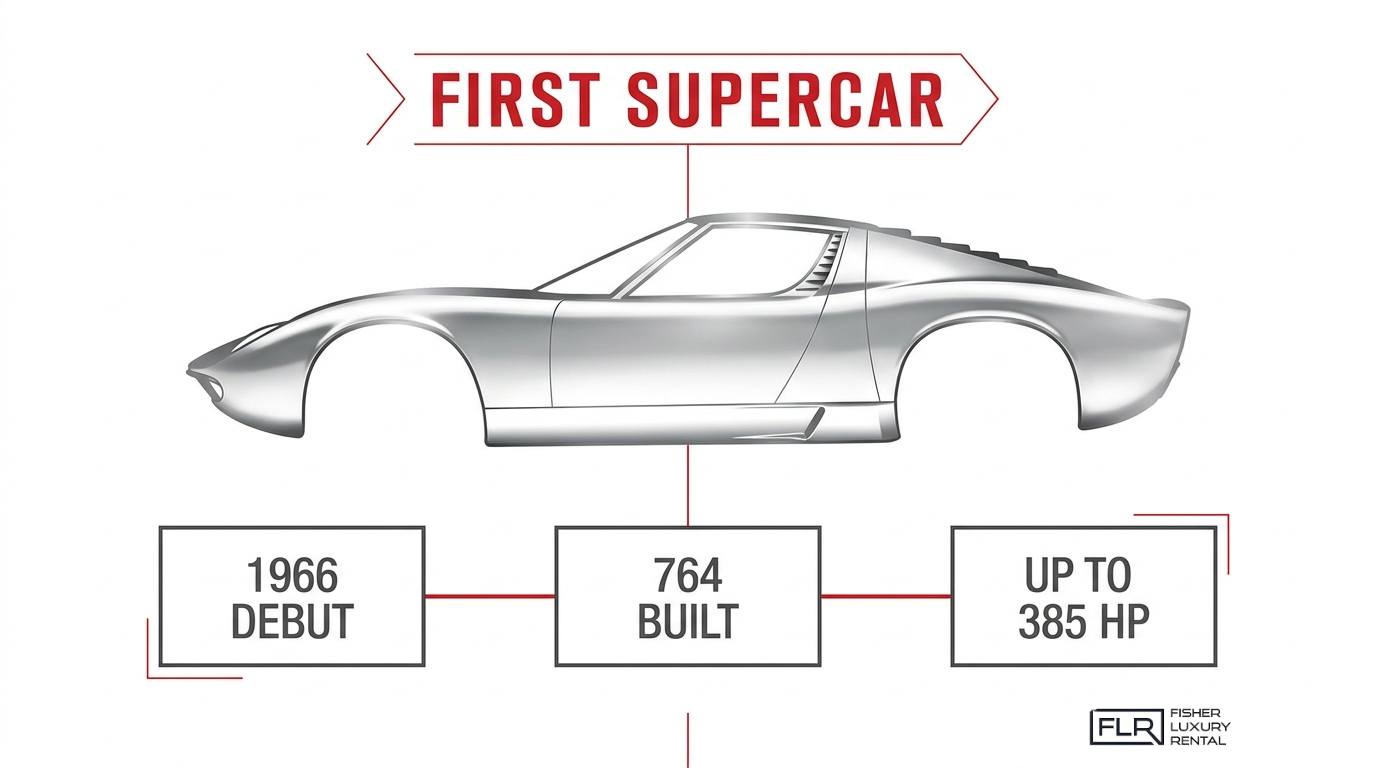
The Lamborghini Miura was created by engineers Gian Paolo Dallara, Paolo Stanzani, and test driver Bob Wallace, who developed the concept largely on their own time, driven by a shared ambition to build a mid-engine road car inspired by motorsport. Ferruccio Lamborghini himself sought to produce something more powerful and radical than his first GT, the 350 GT, guided by brand values of “innovation without compromise.” According to Automobili Lamborghini, between 1966 and 1973 the company produced 764 Miura units: 265 of the original P400, 338 of the P400 S, and 150 of the P400 SV. Designer Marcello Gandini captured the team’s ethos simply: “To make exceptional things, you must have complete freedom.”
What Inspired the Miura’s Development at Lamborghini?
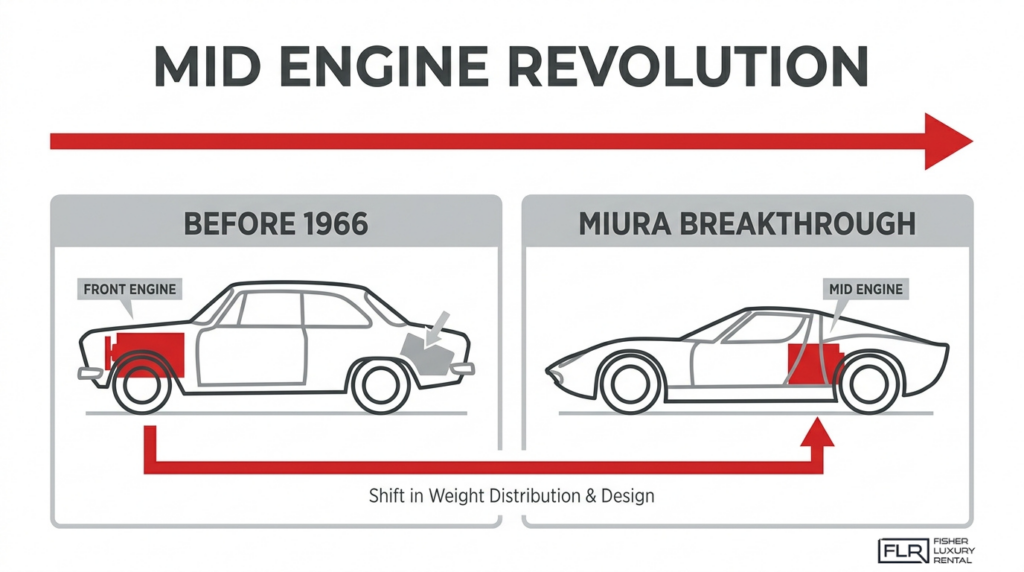
The inspiration behind the Miura’s development at Lamborghini was contemporary motorsport, specifically the mid-engine race cars dominating circuits in the early 1960s. Dallara, Stanzani, and Wallace observed that placing the engine behind the driver dramatically improved weight distribution and handling. Ferruccio Lamborghini’s broader ambition was to establish a brand identity built on “courage over convention,” pushing his engineering team to challenge every assumption held by rival GT manufacturers. The Miura was also the first Lamborghini production model named after a famous Spanish fighting bull breed, that of Don Eduardo Miura Fernández, cementing the brand’s enduring bull-naming tradition.
How Did the Miura Debut at the 1966 Geneva Motor Show?
The Miura debuted at the 1966 Geneva Motor Show on March 10, when the Lamborghini Miura P400 appeared on the Bertone stand finished in orange, its radical mid-engine layout contradicting every GT convention of the era. The bare chassis, known as Project L105, had first appeared publicly at the 1965 Turin Motor Show, but Geneva revealed the complete, clothed car for the first time. According to Automobili Lamborghini, the reception was so overwhelming that orders were placed immediately, surprising both Ferruccio Lamborghini and Nuccio Bertone. The P400 posted a top speed of 280 km/h (174 mph) and 0-to-100 km/h acceleration of 6.7 seconds, making it the fastest production car in the world at that moment.
How Did the Miura Evolve Through Its Production Years?
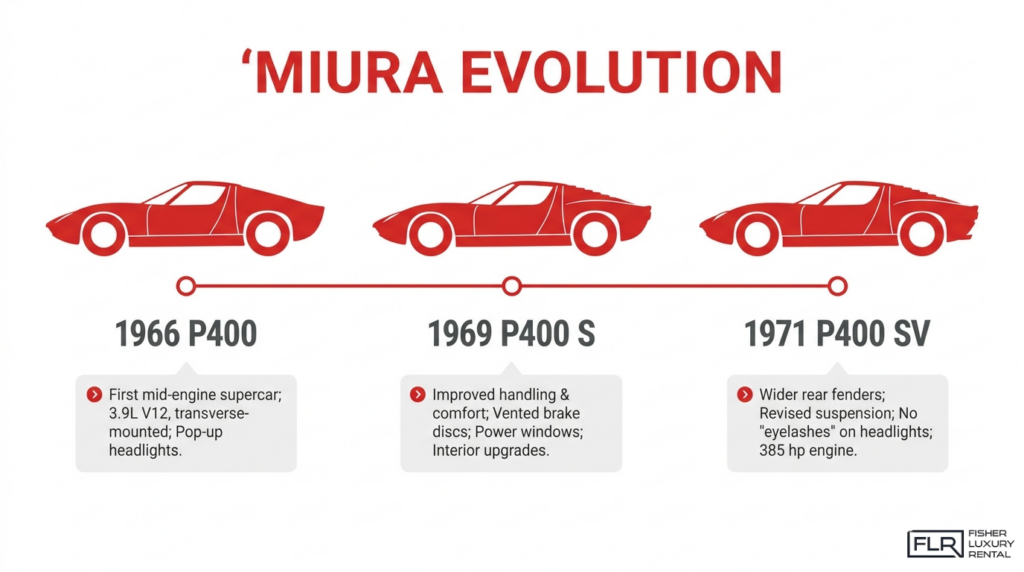
The Miura evolved through three distinct production series across its seven-year lifespan. The P400 S, launched in 1969, brought improved interior quality and revised rear suspension. The 1971 P400 SV (Super Veloce) went further, adding flared rear fenders for 15-inch wheels, removing the signature “eyelash” headlight surrounds, reinforcing the chassis, and crucially separating the shared engine-transmission-differential lubrication system that had been a technical compromise of the original. According to MotorTrend, the SV represented the most comprehensively resolved version of the platform. Beyond these series, Bob Wallace developed the one-off Miura Jota to FIA Appendix J regulations, which later inspired several factory-built SVJ models for select clients.
What Are the Lamborghini Miura Variants and Model Years?
The Lamborghini Miura variants are the P400, P400 S, P400 SV, and the experimental Jota and SVJ. Each successive model introduced mechanical and aesthetic refinements, with production spanning 1966 to 1973.
Miura P400 (1966–1969)
The Miura P400 is the original variant, produced from 1966 to 1969 and representing the foundation of the Miura lineage. A defining engineering characteristic of this model was its shared housing and lubrication system for the engine, transmission, and differential, a space-saving but technically challenging arrangement that Lamborghini later revised. Though innovative, this shared sump design created oiling inconsistencies under hard cornering, an issue engineers addressed in subsequent variants.
Miura P400 S (1968–1971)
The Miura P400 S is the second variant, launched in 1969 with improved interior quality and revised rear suspension over the original P400. Its collectibility today reflects these refinements: Gooding & Company recorded a record sale for a P400 S at $2,590,000 during the 2026 Amelia Island and Miami auction events.
Miura P400 SV (1971–1973)
The Miura P400 SV (Super Veloce) is the definitive production variant, introduced in 1971 and distinguished by flared rear fenders accommodating 15-inch wheels, the removal of the signature “eyelash” headlight trim, and a reinforced chassis. Crucially, the SV separated the engine and transmission lubrication systems, correcting the original P400’s shared sump design.
Miura Jota and SVJ
The Miura Jota is a one-off experimental prototype developed by Bob Wallace to FIA Appendix J regulations. It was never intended for production, but demand from select clients prompted Lamborghini to build several factory-constructed SVJ models, making these the rarest and most sought-after Miura variants in existence today.
What Makes the Lamborghini Miura’s Design Revolutionary?
The Lamborghini Miura’s design is revolutionary because it combined a mid-engine layout, sculpted bodywork, and purpose-built street performance into a single cohesive package that no production car had achieved before. The following sections cover who designed the body, why the mid-engine placement changed everything, and the signature details that define its visual identity.
Who Designed the Lamborghini Miura’s Body?
The Lamborghini Miura’s body was designed by Marcello Gandini at Carrozzeria Bertone, working in close collaboration with the engineers who built the car’s chassis. Gandini took over the project after Giorgio Giugiaro departed Bertone, bringing a fresh, aggressive sensibility to the commission.
What Role Did Marcello Gandini Play in the Miura’s Styling?
Marcello Gandini served as Head of Design at Carrozzeria Bertone and finalized the Miura’s body in early January 1966, completing the prototype in just a few weeks with a team of 30 employees. That pace was remarkable for a design with such lasting consequence. Gandini himself captured the ethos of the project plainly: “To make exceptional things, you must have complete freedom.” The result earned cultural permanence well beyond the showroom; the Miura appeared in the 1969 film “The Italian Job,” with Rossano Brazzi driving on the Gran San Bernardo road, cementing its status as a global icon.
Why Is the Miura’s Mid-Engine Layout Considered Groundbreaking?
The Miura’s mid-engine layout is considered groundbreaking because it moved the heavy V12 behind the driver and ahead of the rear axle, lowering the center of gravity and enabling a silhouette no front-engine car could match. At launch, the Ferrari 275 GTB/4 competed in the same price bracket, yet its front-engine architecture was widely described as “dated” against the Miura’s low-slung, modern stance. This shift in packaging philosophy redefined what a high-performance road car could look and handle like, and every serious supercar built since has followed the same principle.
What Are the Signature Design Elements of the Miura?
The signature design elements of the Miura include its wide hip flares, forward-hinged clamshell front and rear body sections, eyelash-trimmed headlights, and a near-horizontal windscreen that flows uninterrupted into the roofline. Critically, unlike the Ford GT40, which was a racing car adapted for street use, the Miura was designed from the outset as a road car and never received factory racing support. That singular focus on the street allowed Gandini to prioritize visual drama and occupant experience over aerodynamic function, producing proportions that remain genuinely influential today. The Miura’s design is, in many ways, proof that the most enduring automotive shapes come from creative freedom rather than competitive mandate.
What Are the Lamborghini Miura’s Engine and Performance Specs?
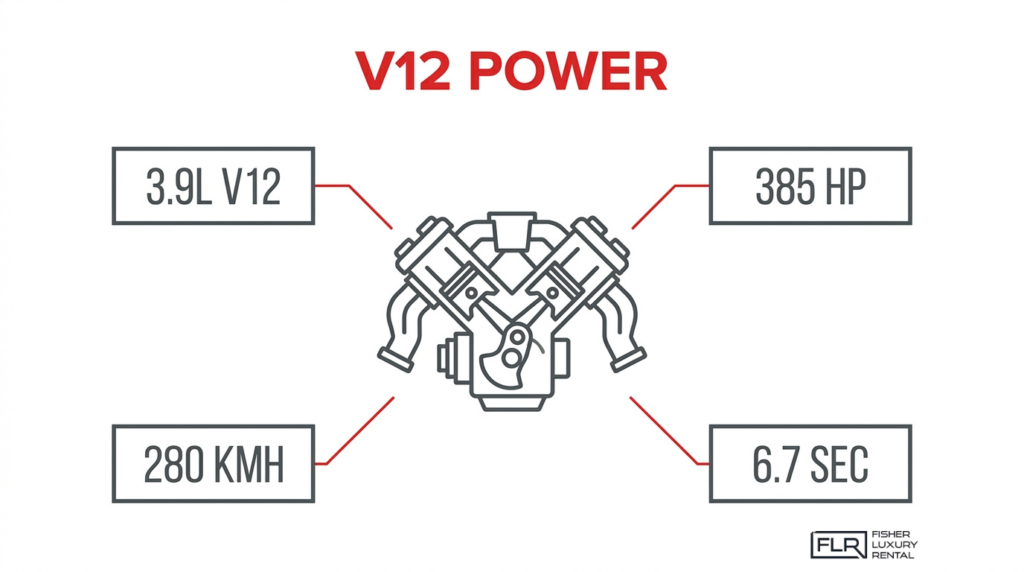
The Lamborghini Miura’s engine and performance specs center on a 3.9L transverse V12 producing up to 385 CV, with a top speed of 280 km/h. The following sections cover the engine architecture, speed credentials, and the transverse configuration that made it legendary.
What Engine Powers the Lamborghini Miura?
The engine powering the Lamborghini Miura is a 3929cc, 60-degree V12 mounted transversely behind the driver. According to Automobili Lamborghini, it features four camshafts and four Weber 40 IDL 3L carburetors. Output progressed across variants: 350 CV at 7,000 rpm in the P400, 370 CV in the P400 S, and 385 CV at 7,850 rpm in the final P400 SV. This engine established a mid-engined V12 DNA that directly shaped every Lamborghini flagship that followed, from the Countach through to the Aventador.
How Fast Is the Lamborghini Miura’s Top Speed?
The Lamborghini Miura’s top speed is 280 km/h (174 mph), paired with a 0 to 100 km/h time of 6.7 seconds. At its 1966 debut, these figures made it the fastest production car in the world. For context, no road car had combined a mid-engine layout with this level of straight-line performance before the Miura arrived.
How Does the Miura’s Transverse V12 Configuration Work?
The Miura’s transverse V12 configuration works by mounting the engine perpendicular to the car’s centerline, positioning mass low and central for optimal balance. The original P400 shared a common housing for the engine, transmission, and differential, a compact but technically demanding solution. Lamborghini later separated these systems in the P400 SV to address lubrication challenges. This engineering trade-off is often underestimated: the shared-sump design was both a packaging breakthrough and the Miura’s most scrutinized technical compromise.
Why Is the Lamborghini Miura Considered the First Supercar?
The Lamborghini Miura is considered the first supercar because it was the first production road car to combine a mid-engine layout with extreme performance and purpose-built design. The sections below cover what defined the category before 1966, how the Miura rewrote the formula, and which rivals it faced.
What Defined a Supercar Before the Miura Existed?
A supercar before the Miura existed was defined by front-engine Grand Tourers, a configuration that prioritized comfort and speed over dynamic architecture. According to Automobili Lamborghini, before 1966 no production road car had placed a high-revving engine behind the driver, a layout that would prove foundational to every supercar that followed.
The term “supercar” itself was first applied by the media specifically to describe the Miura, whose revolutionary architecture and performance seemed “surreal” for a street vehicle in 1966. Stephan Winkelmann, President and CEO of Automobili Lamborghini, stated that the Miura “defined the very concept of the supercar.” That verdict is difficult to dispute: the Miura did not fit into an existing category, so the automotive world had to invent one.
How Did the Miura Change the Supercar Formula Forever?
The Miura changed the supercar formula by establishing mid-engine placement, extreme power output, and radical low-slung styling as the non-negotiable pillars of the genre. Every core attribute modern enthusiasts associate with a supercar, including a central engine, aggressive proportions, and road-legal performance that rivals purpose-built racers, originates with the Miura’s blueprint. Prior to 1966, no manufacturer had delivered all three in a single production vehicle.
Which Cars Did the Miura Compete Against in the Late 1960s?
The cars the Miura competed against in the late 1960s included the Ferrari 275 GTB/4 and the Ford GT40, two very different benchmarks. The Ferrari matched the Miura closely on price at launch, but its front-engine layout was widely considered dated against the Miura’s low-slung mid-engine architecture. The Ford GT40, by contrast, was a pure race car adapted for road use and was never designed as a street vehicle from the outset the way the Miura was. The Miura occupied a unique position: more radical than the Ferrari yet genuinely road-focused in a way the GT40 was not. The experimental Miura Jota, a one-off prototype built by Bob Wallace to FIA Appendix J regulations, later pushed the competition further by inspiring several factory-built SVJ models for select clients.
How Did the Lamborghini Miura Influence Future Supercars?
The Miura’s influence on future supercars operates on two levels: the design philosophy it embedded within Lamborghini and the mid-engine template it handed to the entire industry. The sections below cover how the Miura shaped Lamborghini’s creative identity and which modern machines carry its DNA.
How Did the Miura Shape Lamborghini’s Design Philosophy?
The Miura shaped Lamborghini’s design philosophy by establishing bold, visionary, mid-engined architecture as the brand’s permanent creative foundation. According to Automobili Lamborghini, that DNA directly influenced every subsequent V12 flagship, including the Countach, Diablo, Murciélago, and Aventador. Each model inherited the Miura’s core commitment: a transverse or longitudinal mid-engine layout paired with dramatic, sculptural bodywork that prioritizes visual aggression alongside performance. Lamborghini has never returned to a front-engine grand tourer layout for its flagship, making the Miura’s architectural choice the defining strategic decision in the brand’s history. In that sense, the Miura did not just inspire successors; it constrained Lamborghini’s future in the best possible way.
Which Modern Supercars Trace Their Lineage to the Miura?
Modern supercars that trace their lineage to the Miura include the Lamborghini Countach, Diablo, Murciélago, Aventador, and virtually every mid-engine exotic that followed from competing manufacturers. Lamborghini CEO Stephan Winkelmann stated that the Miura “changed the course of automotive history” and “defined the very concept of the supercar,” a claim supported by the fact that the mid-engine road car layout the Miura pioneered became the universal formula for high-performance vehicles after 1966. Ferrari, McLaren, and Porsche all adopted variations of this architecture in their subsequent flagship models. The Miura’s real legacy is not any single successor but the blueprint itself, one that the entire supercar segment still follows today.
What Is the Lamborghini Miura Worth Today?
The Lamborghini Miura is worth between $1,000,000 and $3,000,000 at auction, with exceptional SV examples pushing well beyond that range. The following sections cover current auction results and the key factors driving the Miura’s collector value.
How Much Does a Lamborghini Miura Sell for at Auction?
A Lamborghini Miura sells for between $1,000,000 and $3,000,000 at auction, though rare SV variants have shattered that ceiling. In June 2024, a 1972 Miura P400 SV from the Dare to Dream Collection set a new world record for the model at $4,900,000 at RM Sotheby’s Toronto. More recently, a 1969 Miura P400 S sold for $1,875,000 at the RM Sotheby’s Miami auction in February 2026. Variant, condition, and documented history remain the three factors that separate a $1.5 million result from a $4.9 million one.
Why Has the Miura Become One of the Most Valuable Classics?
The Miura has become one of the most valuable classics because scarcity, historical significance, and cultural status converge in a single automobile. Only 764 units were produced across all variants between 1966 and 1973, with just 150 SV models ever built. Its status as the acknowledged first true supercar makes it a foundational artifact of automotive history, not merely a fast car. According to a 2021 IMSA report, the Miura’s median value in excellent condition reached $1.2 million, representing a 167% increase over the 2011–2016 period. Few collector cars can claim that trajectory alongside genuine historical importance.
How Can You Experience Lamborghini Performance Today?
Owning a Miura remains a dream for most enthusiasts, but the spirit of Lamborghini performance is within reach today. The H3s below cover renting a Lamborghini from Fisher Luxury Rental and key takeaways from the Miura’s legacy.
Can You Rent a Lamborghini from Fisher Luxury Rental?
Yes, you can rent a Lamborghini from Fisher Luxury Rental. Fisher Luxury Rental offers the Lamborghini Huracan Spyder Convertible from $1,099 per day, providing a direct connection to the mid-engine, high-performance DNA the Miura established in 1966. The demand for these experiences is growing rapidly. According to Fortune Business Insights, the global luxury car rental market was valued at USD 52.82 billion in 2025 and is projected to reach USD 125.98 billion by 2033. Fisher Luxury Rental serves Phoenix, Scottsdale, Portland, and Vancouver, offering top-trim exotic vehicles and exceptional service for drivers who want a genuinely memorable experience.

What Are the Key Takeaways About the Lamborghini Miura?
The key takeaways about the Lamborghini Miura are that it redefined automotive history by introducing the mid-engine supercar layout, establishing a template every exotic manufacturer still follows today.
- The Miura was engineered by Dallara, Stanzani, and Wallace, then styled by Marcello Gandini in weeks.
- Its transversely mounted 3.9L V12 produced up to 385 CV in the final SV variant.
- Lamborghini produced 764 units across three series between 1966 and 1973.
- Record auction prices now exceed $4.9 million for pristine SV examples.
- Its direct design and engineering DNA flows through every Lamborghini V12 flagship since.
For enthusiasts who cannot acquire a Miura, driving a modern Lamborghini remains the closest way to honor its legacy.