If you’re researching exotic car depreciation rates, you’re likely considering purchasing a supercar or trying to understand the true cost of owning one of these automotive masterpieces. We understand that beyond the initial purchase price, depreciation represents the single largest expense in exotic car ownership, and knowing these rates can mean the difference between a sound investment and a financial disaster.
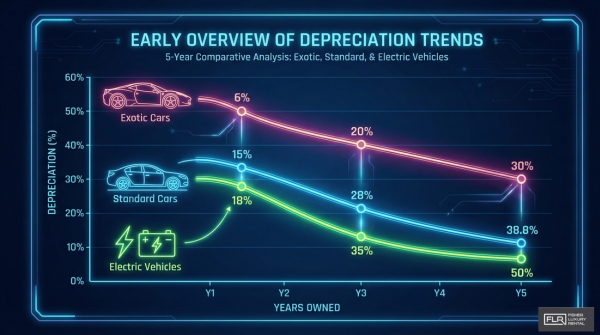
Exotic car depreciation is the reduction in value that high-performance luxury vehicles experience over time, typically measured as a percentage of the original purchase price. Unlike standard vehicles that lose 38.8% of their value over five years, exotic cars follow unique depreciation patterns influenced by brand prestige, production volumes, and market demand. While most supercars depreciate about 6% after one year and 20% after three years, certain models from Ferrari and Porsche can actually appreciate in value, especially limited-production vehicles with fewer than 500 units made.
TL;DR Summary: We’ll explore how exotic cars depreciate differently from standard vehicles, with Ferrari showing the lowest depreciation rates and McLaren historically experiencing the steepest drops. You’ll discover the main factors affecting depreciation including initial purchase price markups, mileage (with exotic cars typically driven 12,000-15,000 miles annually), maintenance costs ranging from $1,500-$10,000 yearly, and production volumes. We’ll examine typical depreciation curves showing how most exotics lose 20% in three years but can appreciate after 15-25 years, and provide strategies to minimize losses including optimal ownership periods of 18 months to 4 years and seasonal buying patterns. You’ll learn why some exotic cars appreciate instead of depreciate, how depreciation affects insurance costs (typically 1.5-2% of vehicle value annually), and whether these vehicles can become investments. Finally, we’ll help you evaluate depreciation when making purchase decisions with insights from professional dealers and key takeaways about brand-specific depreciation patterns.
Quick Tip: Time your exotic car purchase during winter months (January-February) when demand is lowest and sellers are most motivated – this seasonal strategy alone can save you tens of thousands in initial depreciation by avoiding dealer markups and speculative pricing.
How Do Exotic Car Depreciation Rates Compare to Standard Vehicle Depreciation?
Exotic car depreciation rates significantly outperform standard vehicle depreciation across all timeframes. Supercars depreciate approximately 6% after one year and 20% after three years, while standard cars lose 38.8% of their value over five years according to 2024 data. Electric vehicles perform worst among standard cars, losing approximately 50% of their value.
Italian brands like Ferrari and Lamborghini demonstrate superior value retention compared to German and British counterparts. Ferrari models consistently show the lowest depreciation rates, while Porsche maintains strong performance with the 911 achieving just 19.5% depreciation over five years—the lowest among sports cars. British brands including Aston Martin and McLaren experience 20-25% depreciation over three years.
The following section explores factors driving these depreciation differences and identifies which brands perform best and worst in value retention.
What Factors Influence the Differences in Depreciation Rates Between Exotic and Standard Cars?
The differences in depreciation rates between exotic and standard cars stem from supply constraints and market dynamics unique to luxury vehicles. Supply represents the single biggest factor affecting supercar values, with limited production runs of 500 units or less often leading to appreciation rather than depreciation.
Production exclusivity creates fundamental value protection for exotic cars. High-profile launches where cars sell over list price can damage residual values short-term, but scarcity typically restores value over time. Exotic cars with 12,000-15,000 miles annually are considered normal usage, while standard cars face steeper depreciation with similar mileage.
Specialized features significantly alter future valuations for exotic vehicles. Paint to Sample (PTS) finishes and rare factory options create unique value propositions absent in standard cars. Ferrari Classiche Certification impacts certified model values positively. Detailed documentation and excellent condition prove critical for appreciation in the exotic market, requirements less stringent for standard vehicles.
Which Exotic Car Brands Experience the Fastest and Slowest Depreciation?
Ferrari experiences the slowest depreciation among major exotic car brands, with the 488 GTB losing only 16% of its purchase price within the first three years. Porsche demonstrates consistent value retention, particularly GT models which maintain exceptional strength in secondary markets.
Lamborghini shows moderate depreciation with special editions holding value well. The Huracán depreciates 48% over five years while the Aventador experiences 31% value loss over the same period. Italian brands consistently outperform their German and British competitors in value retention.
| Exotic Car Brand | Model Evaluated | Depreciation Timeframe | Total Value Loss | Value Retention Category |
| Ferrari | 488 GTB | 3 years | 16% | Best |
| Porsche | 911 Overall | 5 years | 19.5% | Best |
| Lamborghini | Aventador | 5 years | 31% | Moderate |
| Lamborghini | Huracán | 5 years | 48% | Moderate |
| Aston Martin | Vantage | 5 years | 49% | High |
| McLaren | 650S | 6 years | 45% | High |
| McLaren | 570S | 5 years | 30% | Improving |
| McLaren | Artura | 1 year | 21.2% | Recent |
McLaren historically experiences the steepest depreciation but shows signs of market stabilization. The brand’s newer models like the 570S demonstrate improved value retention at 30% over five years compared to older models. The recent Artura faces 21.2% depreciation with a €45,800 loss in one year, reflecting typical new model market adjustments.
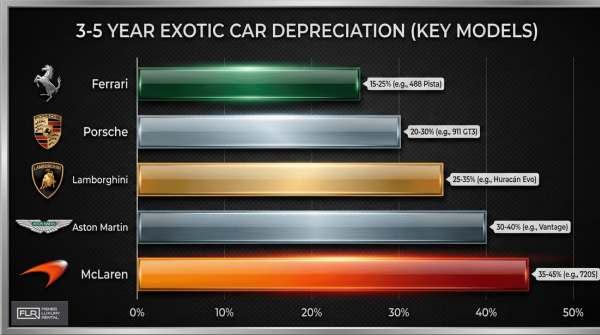
This analysis reveals clear brand hierarchies in depreciation performance, with Ferrari leading value retention and McLaren working to stabilize after historical volatility. Understanding these patterns helps buyers make informed decisions about timing and brand selection for optimal value preservation.
What Main Factors Affect Depreciation Rates for Exotic Cars?
The main factors affecting exotic car depreciation rates are initial purchase price, mileage accumulation, maintenance condition, production volume, and broader economic trends. These variables interact to create the complex valuation patterns that distinguish exotic cars from standard vehicles. Understanding these factors helps buyers and sellers make informed decisions about timing and investment strategies.
How Does Initial Purchase Price Impact Exotic Car Depreciation?
Initial purchase price impacts exotic car depreciation because cars bought above MSRP face steeper value drops when market speculation ends. Dealer markups and speculative pricing create artificial price floors that collapse during market corrections. High option costs reduce investment appeal for newer models compared to well-equipped used alternatives.
Market data shows dramatic depreciation from inflated starting prices. The Ferrari SF90 Stradale dropped from $750,000 in 2021 to approximately $350,000 currently, representing $400,000 depreciation over four years. Another SF90 Stradale owner recorded a $763,295 loss over three years on a $485,000 sale. Conversely, strategic timing can yield profits—a 2021 Porsche 992 Turbo S purchased at $235,000 sold for $289,000 after four months during peak demand.
The McLaren 650S Spider demonstrates typical depreciation cycles: €136,000 in May 2020, peaking at €164,000 in 2022, then declining to €135,000 by March 2024.
How Important Is Mileage in Determining an Exotic Car’s Depreciation Rate?
Mileage determines exotic car depreciation rates because lower mileage commands premium pricing while high-mileage examples lose value exponentially. Exotic cars with 12,000-15,000 miles annually represent normal usage patterns, though collectors prefer significantly lower mileage. Low-mileage samples command well over half a million at auctions for desirable models.
Specific depreciation rates per mile vary by model and brand:
- Ferrari 488 Spider (2016): $3,043 depreciation per 1,000 miles with 18,600 miles total
- Aston Martin Vantage (2019): $4,804 depreciation per 1,000 miles
- Ferrari 488 GTB (2018): $6,400 depreciation per 1,000 miles
These rates demonstrate how mileage directly impacts resale values, with some models losing more than $6 per mile driven.
In What Ways Do Maintenance and Condition Influence Exotic Car Value?
Maintenance and condition influence exotic car value because proper care preserves mechanical integrity and supports future appreciation potential. Detailed documentation and excellent conditions prove critical for maintaining value in the exotic car market. Ferrari Classiche Certification positively impacts values for eligible models by providing factory authentication.
Annual maintenance costs vary significantly by brand:
| Exotic Brand | Service Scope | Estimated Annual Maintenance Cost | Cost Data Source |
| Ferrari | Average | $1,500–$2,000 | Industry data |
| Ferrari | Annual service | $2,800 | Service records |
| Ferrari | F430 average | $5,000 | Maintenance data |
| McLaren | Routine | $2,500–$3,500 | Service data |
| McLaren | With repairs | $5,000+ | Owner reports |
| Lamborghini | Huracán basic | $5,000–$10,000 | Service data |
Well-maintained examples with complete service histories command premium prices compared to neglected vehicles regardless of mileage.
How Do Model Year and Production Volume Impact Depreciation?
Model year and production volume impact depreciation because limited production runs of 500 units or less often appreciate in value while high-volume models depreciate predictably. Manufacturers deliberately control production numbers to maintain exclusivity and support residual values. Rarity drives collector demand decades after initial production ends.
Historical production data reveals clear patterns:
- Lamborghini Miura: 763 made (1966-1972), 167% appreciation from 2011-2016
- Ferrari F50: fewer than 350 made, rarer than F40
- Ferrari F40: 1,315 made from initially planned 400 units
- Lamborghini Countach: under 2,000 total production
- Lamborghini Gallardo: 14,000+ made, reducing collectibility
McLaren produces fewer cars annually than Ferrari or Lamborghini, influencing scarcity perception. Ferrari caps production at lower volumes than competitors, while Lamborghini achieved record 2023 sales exceeding 10,000 units, potentially affecting future collectibility.
How Do Economic Trends and Market Demand Affect Exotic Car Depreciation?
Economic trends and market demand affect exotic car depreciation through wealth concentration, market growth patterns, and regional purchasing power. Global supercar markets show consistent expansion with the market growing from $35.2 billion in 2024 to projected $52.3 billion by 2030, representing 6.8% compound annual growth. The secondary market grows 1.5 times faster than new sales at 5-8% versus 5-6% annually.
Regional market data demonstrates varying demand patterns. The US luxury car market projects growth from $110 billion in 2025 to $180-215 billion by 2035. UK luxury car prices increased 30% from January 2021 to September 2025. China’s supercar market reached $3,167.72 million in 2025 with 10.0% projected compound annual growth.
Tariffs and taxes increase manufacturing costs, affecting desirability and pricing structures. Global wealth concentration at the top end continues supporting market growth, ensuring sustained demand for limited-production exotic vehicles.
This analysis of depreciation factors prepares buyers to evaluate specific models and timing strategies for optimal value retention.
What Are the Typical Depreciation Curves for Different Types of Exotic Cars?
Exotic car depreciation patterns vary significantly based on brand, model exclusivity, and market timing. Understanding these curves helps buyers make informed decisions about purchase timing and expected value retention.
The following sections examine first-year depreciation rates, stabilization points, and how classic exotic cars differ from modern models. This analysis reveals optimal ownership windows and investment potential across different exotic car categories.
How Quickly Do New Exotic Cars Depreciate in the First Five Years?
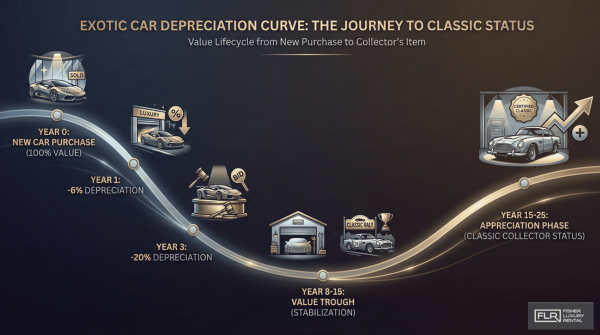
New exotic cars typically depreciate 6% after one year and 20% after three years across all supercars. However, depreciation rates vary dramatically by brand and model exclusivity.
Ferrari models show the strongest value retention among exotic brands. The Ferrari 488 Pista Coupe appreciates 6% in year one, then declines approximately 7% by year three. In contrast, the Ferrari SF90 Stradale experiences 30% depreciation after three years despite its hybrid technology and performance credentials.
Porsche exotic models demonstrate mixed results depending on initial pricing. The 911 GT2 RS suffers a 12% decline in the first year due to over-list pricing from dealers, while other GT models maintain stronger values.
British brands face steeper depreciation curves. Aston Martin vehicles retain only 62% of their original price after one year. Both Aston Martin and McLaren models depreciate 20-25% over three years, significantly higher than Italian counterparts.
Lamborghini maintains moderate depreciation, holding around 60% of value after three years. This positions the brand between Ferrari’s strong retention and British brands’ steeper declines.
For comparison, standard vehicles average 38.8% depreciation over five years as of 2024 data, making exotic cars relatively competitive in value retention despite their higher purchase prices.
At What Point Does Depreciation Slow Down or Stabilize for Exotic Cars?
Exotic car depreciation slows significantly between 18 months to 4 years after purchase, creating an optimal ownership window for minimizing losses. The value trough typically occurs 8-15 years after production when initial depreciation ends but collector interest hasn’t emerged.
Current market stabilization varies by brand and model generation. McLaren markets stabilized in mid-2023 after the pandemic boom/bust cycle, with models like the 650S, 675LT, 570S, 600LT, and 12C showing bottoming trends. The 992 GT3 prices similarly stabilized after initial decline from over-list pricing.
Older generation Porsches demonstrate strong performance in established markets. The 996 and 997 generations perform well in the German market, indicating appreciation phase activation for models reaching 15-20 years of age.
The stabilization period creates opportunities for buyers seeking maximum value and sellers timing exits. Models entering years 8-15 often represent the best value propositions before appreciation triggers activate.
Regional variations affect stabilization timing, with established European markets often leading appreciation trends that spread to other regions over 1-2 years.
Do Classic or Collector Exotic Cars Depreciate Differently?
Classic exotic cars follow appreciation curves rather than depreciation after reaching collector status 15-25 years post-production. Nostalgia triggers and rarity drive substantial value increases for surviving examples.
Ferrari classics demonstrate exceptional appreciation rates. The F50 achieved a 60% value increase in one year, reaching an average sale price of $5.3 million. The F40 appreciated from approximately $1 million five years ago to over $2 million currently, representing 100% value growth.
Lamborghini classics show similar patterns with the Miura appreciating 167% from $367,000 in 2011 to $1.2 million in 2021. The Countach increased from mid-$700,000 in 2014 to over $1.2 million currently.
Collector market trends indicate seven of the top 10 collector sales will be post-1990 vehicles, showing appreciation expanding to newer generations. The average model year of vehicles selling for $1 million or more shifted from 1972 in 2020 to 1984 in 2025, demonstrating the moving appreciation window.
The 15-25 year appreciation trigger occurs when nostalgia combines with rarity as examples are lost to accidents or poor maintenance, creating scarcity that drives collector interest and substantial price increases.
How Can Buyers and Owners Minimize Depreciation Losses on Exotic Cars?
Buyers and owners can minimize depreciation losses on exotic cars through strategic maintenance practices, optimal timing decisions, and careful financing choices. The most effective strategies focus on preserving condition, timing market cycles, and understanding total ownership costs rather than just purchase price.
Understanding these depreciation mitigation strategies becomes crucial given that exotic cars typically lose 6% of their value in the first year and 20% after three years. However, proper execution of these approaches can significantly reduce losses and, in some cases, lead to value appreciation. The following sections detail the specific practices that protect exotic car investments most effectively.
What Maintenance and Storage Practices Help Protect Exotic Car Value?
Maintenance and storage practices that help protect exotic car value include budgeting $5,000+ annually for unexpected repairs, keeping detailed documentation, and storing vehicles in climate-controlled environments. These practices directly impact resale value because exotic car buyers prioritize condition and provenance above most other factors.
Essential Maintenance and Storage Practices:
- Budget $5,000+ annually for unexpected repairs on exotic cars
- Keep detailed documentation of all maintenance and repairs
- Store vehicles in climate-controlled environments
- Follow manufacturer-recommended service intervals strictly
- Use Ferrari Classiche Certification for eligible models
- Maintain low mileage when possible (low mileage samples command premiums)
Nearly one-third of UK supercars are registered off-road specifically for storage purposes, demonstrating how seriously collectors prioritize preservation. Climate-controlled storage prevents paint degradation, interior cracking, and mechanical issues that can cost tens of thousands in restoration later. Documentation becomes especially critical because exotic car buyers often pay premiums for complete service records that prove proper care.
This foundation of proper maintenance and storage creates the optimal conditions for strategic timing decisions about when to buy or sell.
How Does Timing Car Sales or Purchases Affect Depreciation Outcomes?
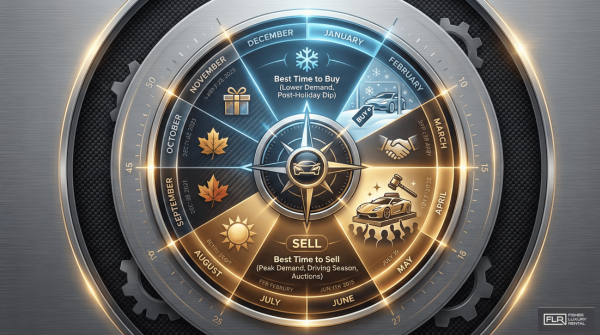
Timing car sales or purchases affects depreciation outcomes because seasonal demand patterns create predictable price variations of 10-20% throughout the year. Winter months (January-February) offer the best buying opportunities with lowest demand and motivated sellers, while spring and early summer provide optimal selling conditions for maximum value.
Strategic Timing Windows:
- Winter (January-February): Best for deals; lowest demand, motivated sellers
- Spring/Early Summer: Best seasons to sell for maximum value
- Fall: Underrated window; year-end dealer targets, good trade-in deals
- Optimal ownership period: 18 months to 4 years for minimizing depreciation
Research shows first-time exotic car owners average 13 months before moving to their second car, while experienced buyers (fifth vehicle ownership) move after just 8 months on average. This pattern suggests that understanding personal ownership cycles helps optimize timing decisions. Auction timing also sets benchmarks for private sales, making it essential to monitor major auction results when planning transactions.
The 18-month to 4-year ownership window allows owners to avoid the steepest initial depreciation while exiting before longer-term value erosion accelerates.
These timing strategies work in conjunction with financing decisions that can further reduce depreciation exposure.
Should Owners Consider Leasing to Mitigate Depreciation Risks?
Owners should consider leasing to mitigate depreciation risks because high residual values translate to lower overall ownership costs and eliminate depreciation uncertainty. An IEEE study achieved 5% mean absolute percentage error in residual value predictions, making lease calculations increasingly accurate for exotic cars.
Leasing Market Dynamics:
| Leasing & Depreciation Metric | Measured Value | Data Source |
| Mean prediction accuracy | 5% error rate | IEEE study |
| Average depreciation cost | $14,716 per segment | Ownership analysis |
| ICE vehicle financing | 85% of luxury vehicles | Industry data |
| Target buyer income | £50k–£150k, age 35–49 | Financing demographics |
Leasing becomes particularly attractive for buyers in the £50k-£150k income range (age 35-49) who represent the core luxury vehicle financing demographic. The fact that 85% of luxury vehicles financed are ICE vehicles rather than EVs suggests that traditional exotic cars maintain stronger residual value predictability, making lease terms more favorable.
However, leasing works best for buyers who want to experience multiple exotic cars rather than long-term collectors seeking appreciation potential. The decision depends on individual goals: minimizing costs versus building a collection for potential future gains.
These comprehensive strategies—from meticulous maintenance to strategic timing to smart financing—create the framework for minimizing exotic car depreciation losses while maximizing ownership enjoyment.
What Are the Most Frequently Asked Questions About Exotic Car Depreciation Rates?
Exotic car depreciation raises unique questions that differ fundamentally from standard vehicle ownership concerns. Understanding these frequently asked questions helps potential buyers and current owners make informed decisions about their investments.
The following sections address the most common inquiries about exotic car value retention, insurance implications, and investment potential. These answers provide practical guidance for navigating the complex exotic car market.
Why Do Some Exotic Cars Appreciate Instead of Depreciate?
Some exotic cars are appreciated because limited production creates artificial scarcity that drives collector demand. Models with production runs of 500 units or less typically appreciate over time, as surviving examples become increasingly rare.
Unique specifications significantly impact future valuations. “1 of 1” factory options and rare Paint to Sample finishes command substantial premiums at resale. Rare factory colors such as yellow, blue, and silver consistently outperform common red examples in auction results.
Market timing plays a crucial role in appreciation patterns. Nostalgia kicks in 15-25 years after production, when original buyers develop emotional attachments to models from their youth. Current market trends favor “milestone” models representing the pinnacle of internal combustion engineering, as electrification drives collector interest toward analog supercars with naturally aspirated engines and manual gearboxes.
How Do Depreciation Rates Affect Insurance and Financing Costs?
Depreciation rates directly influence insurance premiums through agreed value policies that reflect current market worth. Average yearly exotic car insurance ranges from $5,000-$20,000, typically calculating at 1.5-2% of the car’s agreed insured value.
Specific examples demonstrate this correlation:
- 2021 Lamborghini Aventador: approximately $5,889 annually
- 2021 Ferrari 488 GTB: approximately $5,782 annually
- Average Ferrari insurance: $5,377 annually
Owners with daily driver vehicles receive 10-15% premium discounts, as insurers view exotic cars as secondary vehicles with lower risk exposure. Financing costs average $4,077 per segment in total ownership expenses, with depreciation representing the largest component of these calculations.
Is It Ever Possible for an Exotic Car to Become an Investment?
Exotic cars can become exceptional investments when specific conditions align, particularly for ultra-rare examples with documented provenance. Recent auction results demonstrate this potential: Ferrari F50 models have sold for $9.245 million (Ralph Lauren’s yellow example), while a 1993 Ferrari F40 LM achieved $11 million at the 2025 Monterey Auction, setting a world record.
The 1995 McLaren F1 exemplifies ultimate appreciation, with Gooding & Company selling one for $20.465 million in 2021. Historical data shows the Lamborghini Miura achieved 167% appreciation between 2011-2016, driven by its limited production of only 763 units.
The classic car market represents a €45 billion annual transaction volume with approximately 10% growth per annum since 2000. Models with production runs under 500 units consistently appreciate in value, and nearly 50% of classic car transactions occur off-market through private sales and specialized dealers.
These examples illustrate how exotic car ownership intersects with broader investment strategies when buyers focus on the rarest, most historically significant models.
How Should You Evaluate Exotic Car Depreciation When Considering a Purchase or Sale?
Evaluating exotic car depreciation requires professional expertise and comprehensive market analysis to make informed purchase or sale decisions. Professional dealers and specialized services provide critical data insights that individual buyers cannot access independently.
The following sections examine professional depreciation analysis services and summarize the essential depreciation principles covered throughout this guide.
Can a Professional Exotic Car Dealer Help With Depreciation Analysis and Decision-Making?
Professional exotic car dealers provide sophisticated depreciation analysis through proprietary data and market expertise. Hagerty analyzed 24,000+ data points from UK and US markets to establish comprehensive depreciation models for exotic vehicles. An IEEE/Ferrari study achieved 5% mean absolute percentage error in residual value predictions, demonstrating the accuracy of professional analysis tools.
Specialized services offer multi-factor depreciation analysis:
- Vincentric measures 8 cost factors including depreciation, fees, financing, fuel, and insurance
- OctoClassic provides Porsche and McLaren market analysis with pricing trend forecasts
- Limited Spec Miami offers exotic car buying/selling services with integrated depreciation analysis
- JBR Capital provides tailored finance solutions with proprietary lending data insights
- duPont REGISTRY leverages 40+ years of luxury automotive marketplace history for valuation guidance
Professional dealers access real-time market data, auction results, and transaction histories that enable precise depreciation forecasting for specific makes, models, and configurations.
What Are the Key Takeaways About Exotic Car Depreciation Rates We Covered?
The essential depreciation principles for exotic car ownership center on brand performance, timing strategies, and ownership costs. Ferrari depreciates least among major brands, while McLaren historically depreciates most, though recent market stabilization shows improvement across British manufacturers.
Core Depreciation Facts:
- All supercars depreciate approximately 6% in year one and 20% after three years
- Limited production under 500 units often leads to appreciation rather than depreciation
- The optimal ownership period spans 18 months to 4 years for minimizing losses
- Winter months offer the best buying opportunities, while spring/summer maximize selling prices
Ongoing Ownership Costs:
- Annual maintenance costs range $1,500-$10,000 depending on brand and model
- Insurance typically costs 1.5-2% of vehicle value annually
- Appreciation triggers typically activate 15-25 years after production when nostalgia and scarcity drive collector demand
Understanding these fundamentals enables buyers and sellers to time transactions strategically and select vehicles with the strongest depreciation resistance for their ownership goals.