The first supercar ever made is a title most widely given to the 1966 Lamborghini Miura, the car that combined a mid-engine layout, exotic styling, and record-breaking performance into a single production vehicle. The Mercedes-Benz 300SL of 1954 also holds a strong claim due to its pioneering fuel injection and racing pedigree, making this debate one of automotive history’s most enduring.
We cover the origins of high-performance sports cars, the criteria that define a true supercar, the landmark vehicle that earned the title, the evolution it sparked across subsequent decades, and how that legacy connects to modern luxury driving experiences.
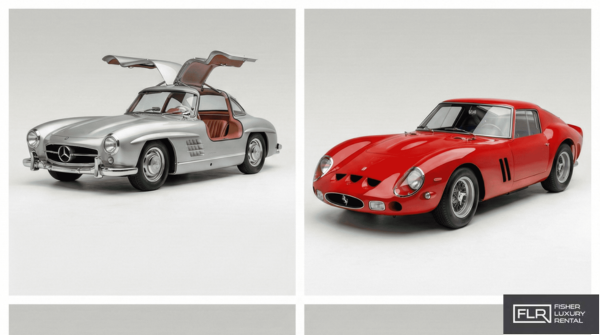
Post-war innovation from manufacturers like Mercedes-Benz, Ferrari, and Jaguar produced the sports cars that laid the supercar’s foundation. The 300SL introduced direct fuel injection to production cars, while the Ferrari 250 GTO brought V12 racing power to the road with only 36 units built.
A true supercar demands more than raw speed. Performance, design, and technological innovation must converge in a single vehicle, and how we weigh those criteria determines whether the 300SL or the Miura claims the crown.
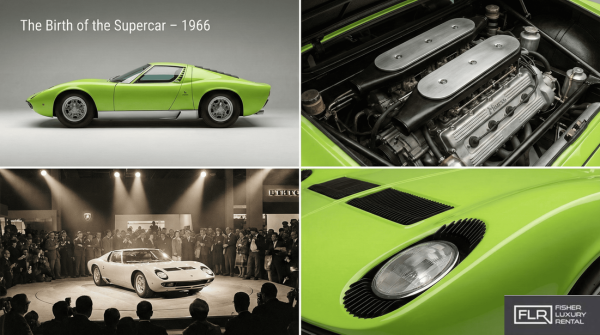
The Lamborghini Miura debuted at the 1966 Geneva Motor Show with a transverse mid-mounted 4.0-liter V12 producing 350 horsepower. Its 174-mph top speed made it the fastest production car in the world, and Marcello Gandini’s bodywork defined what a supercar should look like.
The Miura ignited a supercar arms race that produced the Countach, the Ferrari F40, and the McLaren F1, then accelerated into the hypercar era with the Bugatti Veyron and today’s electric machines like the Rimac Nevera.
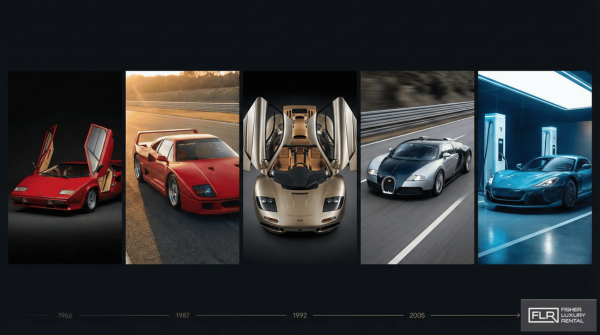
These vehicles represent more than engineering milestones; they carry a driving experience rooted in decades of relentless innovation that we can still access today.
How Did the Concept of the Supercar Emerge in Automotive History?
The concept of the supercar emerged through a series of groundbreaking sports cars in the 1950s and 1960s, followed by technological leaps that redefined what a road car could achieve. Below, we explore the early influences and the key innovations that shaped this iconic category.
Which Early Sports Cars Influenced the Supercar Era?
The early sports cars that influenced the supercar era include the Mercedes-Benz 300SL, the Ferrari 250 GTO, the Jaguar E-Type, and the AC Cobra. Each pushed the boundaries of performance and design during the post-war period, laying the foundation for what would become the modern supercar.
The Mercedes-Benz 300SL stands out as a particularly strong precursor. Its direct fuel injection system, a first for a production car, was a significant performance enhancer that set it apart from contemporaries. Combined with a space-frame chassis and iconic gullwing doors, the 300SL was a road car born from a successful racing program, a characteristic that would become a hallmark of many future supercars.
| Model | Engine | Horsepower | Top Speed | Production Years |
| Mercedes-Benz 300SL | 3.0L Inline-6 | 215 hp | 160 mph | 1954–1957 |
| Ferrari 250 GTO | 3.0L V12 | 300 hp | 174 mph | 1962–1964 |
| Jaguar E-Type | 3.8L Inline-6 | 265 hp | 150 mph | 1961–1975 |
| AC Cobra | 4.2L V8 | 260 hp | 160 mph | 1962–1967 |
These machines collectively set the stage for the Lamborghini Miura, whose creation began as a clandestine project by engineers Giampaolo Dallara, Paolo Stanzani, and Bob Wallace, working in their spare time against the initial wishes of Ferruccio Lamborghini himself. For anyone fascinated by the engineering ambition of this era, the technological breakthroughs that followed proved even more transformative.
What Technological Advancements Defined the First Supercars?
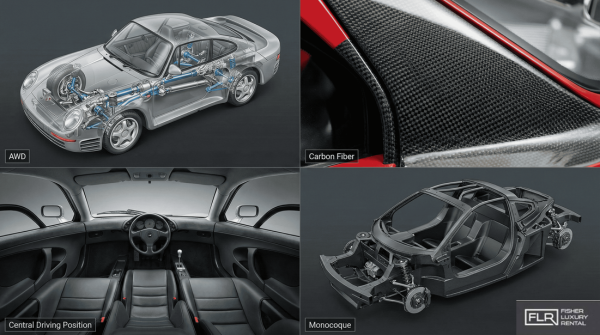
The technological advancements that defined the first supercars were the transverse mid-engine layout, all-wheel drive systems, carbon fiber construction, and centralized driving positions. These innovations transformed high-performance cars from fast grand tourers into purpose-built machines with race-derived engineering.
According to MotorTrend, the Porsche 959 and Ferrari F40 introduced all-wheel drive and carbon fiber to the supercar world during the 1980s and 1990s, while the McLaren F1 redefined the hypercar concept with its central driving position and 240-mph top speed. Each generation built directly on the mid-engine template established in the 1960s, proving that the earliest supercars created a technological blueprint the industry still follows today.
What Criteria Must a Car Meet to Be Considered a True Supercar?
A true supercar must meet criteria spanning three pillars: exceptional performance, striking design, and meaningful technical innovation. The following subsections explore how these factors define supercar status and how those definitions have shifted across decades.
How Do Performance, Design, and Innovation Factor into Supercar Status?
Performance, design, and innovation factor into supercar status as the three inseparable pillars that elevate a vehicle beyond ordinary sports cars. Raw speed alone has never been enough. The Ferrari 250 GTO, with only 36 units produced between 1962 and 1964, combined a 3.0-liter V12 producing 300 horsepower, a top speed of 174 mph, and extreme rarity into a package that many consider an early supercar candidate.
Design carries equal weight. Ferruccio Lamborghini himself declared of the Miura, “I like this one. It’ll earn us legendary status.” That conviction proved justified; Marcello Gandini’s work on both the Miura and the wedge-shaped Lamborghini Countach, which debuted with scissor doors and a 5.0-liter V12 producing 455 horsepower, essentially invented the visual language every supercar still follows.
Innovation ties these elements together. Without a genuine engineering breakthrough, even beautiful, fast cars remain sports cars rather than supercars.
How Have Perceptions of Supercars Changed Over Time?
Perceptions of supercars have changed from viewing them primarily as race-bred road machines to recognizing them as complete statements of engineering art and cultural status. In the 1950s, a car like the Mercedes-Benz 300SL earned admiration mainly for its direct fuel injection and racing pedigree. By the mid-1960s, the Lamborghini Miura shifted the conversation; a supercar now needed a mid-engine layout, dramatic styling, and an emotional presence that transcended mere lap times.
The supercar arms race that followed the Miura accelerated this evolution further, producing increasingly ambitious machines from multiple manufacturers. Today, exclusivity, brand heritage, and technological storytelling matter as much as horsepower figures. For most enthusiasts, the definition continues to expand, but the core expectation remains: a true supercar should feel extraordinary the moment you see it, not just when you read its spec sheet.
With these criteria established, the next question becomes which specific car first met them all.
Which Car Is Recognized as the First True Supercar?
The car recognized as the first true supercar is the Lamborghini Miura. Its transverse mid-engine layout, 4.0-liter V12 producing 350 horsepower, and 174 mph top speed made it the fastest production car of its era. The sections below explore its specs alongside a key predecessor and its lasting influence.
What Are the Key Features and Performance Specs of This Landmark Vehicle?
The key features and performance specs of this landmark vehicle center on two groundbreaking cars. The Lamborghini Miura introduced the transverse mid-engine layout to production cars, mounting its 4.0-liter V12 sideways behind the cockpit. This centralized the car’s mass and delivered 350 horsepower, a 174 mph top speed, and a 0-60 mph time of 6.7 seconds.
Before the Miura, the Mercedes-Benz 300SL set an earlier benchmark. Introduced in 1954 as a road-going version of the W194 racing car, the 300SL featured the first production direct fuel injection system, developed by Bosch. According to MotorTrend, “We could point to the 1954 W198 Mercedes-Benz 300 SL, also called the Gullwing, as the world’s first supercar.” Its 3.0-liter inline-six produced 215 horsepower and reached 160 mph, while iconic gullwing doors and a space-frame chassis distinguished it as a technological marvel. With 1,400 coupes built between 1954 and 1957, the 300SL proved that high performance and commercial viability could coexist.
How Did This Car Influence Future High-Performance Automobiles?
This car influenced future high-performance automobiles by establishing the mid-engine, rear-drive layout as the supercar blueprint. Before the Miura, mid-engine configurations existed only in purpose-built race cars. By proving this layout worked brilliantly on public roads, Lamborghini created a template that nearly every supercar manufacturer would follow for decades.
Fisher Luxury Rental’s fleet reflects this lineage, offering vehicles like the Ferrari 488 Spider and McLaren 720S that carry forward the mid-engine, high-performance blueprint established by those pioneering machines.
Understanding this lineage transforms how enthusiasts appreciate today’s high-performance machines.
How Did the First Supercar Inspire the Evolution of High-Performance Cars?
The first supercar inspired the evolution of high-performance cars by establishing a blueprint that every successor followed. From refined Miura variants to the supercar arms race of subsequent decades, this influence shaped the entire genre.
What Automotive Milestones Followed Its Introduction?
The Lamborghini Miura’s introduction at the 1966 Geneva Motor Show triggered a paradigm shift in how manufacturers approached high-performance road cars. Its mid-engine layout, V12 power, and exotic styling became the defining characteristics that every competitor sought to match or exceed. According to Lamborghini’s own historical records, the Miura is widely considered the birth of the modern supercar, and its influence was so profound that it is often credited with coining the term “supercar” itself. This single model ignited a fierce competition among manufacturers, each striving to create the next ultimate driving machine. The resulting “supercar arms race” produced some of the most celebrated automobiles in history.
Which Iconic Models Continued the Supercar Legacy in Subsequent Decades?
The iconic models that continued the supercar legacy include refined Miura variants, the Lamborghini Countach, and a wave of 1980s and 1990s innovators. Lamborghini itself evolved the Miura through the P400S in 1968, producing 370 horsepower, and the P400SV in 1971, delivering 385 horsepower. The SV, meaning “Super Veloce” (Super Fast), represented the ultimate Miura expression with a wider rear track and more aggressive design. Beyond performance, the Miura’s cultural reach extended to film, most notably the opening scene of the 1969 The Italian Job. Today, enthusiasts can experience this evolution firsthand through Fisher Luxury Rental’s carefully curated collection in Phoenix and Portland, where vehicles like the Lamborghini Huracan Spyder maintain the exotic design and visceral performance that defined the supercar category from its inception. For anyone passionate about experiencing the machines that carry this lineage forward, few things compare to getting behind the wheel yourself.
How Is the Legacy of the First Supercar Reflected in Modern Luxury Car Rentals?
The legacy of the first supercar is reflected in modern luxury car rentals through the same principles that defined the genre: exotic mid-engine design, visceral performance, and visual drama. Below, we explore how renting from Fisher Luxury Rental connects you to this heritage and summarize the key origins we covered.
How Does Renting a High-Performance Car from Fisher Luxury Rental Let You Experience Automotive History?
Renting a high-performance car from Fisher Luxury Rental lets you experience automotive history by placing you behind the wheel of vehicles that carry forward the engineering DNA pioneered by the Lamborghini Miura. The mid-engine layout, V12 lineage, and striking aesthetics that defined the first supercar live on in today’s exotic fleet. Fisher Luxury Rental offers models like the Lamborghini Huracan Spyder, Ferrari 488 Spider, and McLaren 720S, each a direct descendant of that revolutionary era. As RM Sotheby’s notes, the Miura “set the standard for future generations.” Every supercar rental today exists because that standard was set. For most enthusiasts, driving one of these machines is the closest way to feel the legacy firsthand.
What Are the Key Takeaways About The First Supercar Ever Made: Origins of High-Performance Cars We Covered?
The key takeaways about the first supercar ever made: origins of high-performance cars are:
- The Mercedes-Benz 300SL introduced groundbreaking technology like direct fuel injection, making it a strong early contender for the first supercar title.
- The Lamborghini Miura’s transverse mid-engine layout revolutionized road car design and is widely credited with defining the supercar category.
- Supercar evolution progressed through the Countach, Ferrari F40, McLaren F1, and into modern hypercars like the Bugatti Veyron and Rimac Nevera.
- Performance, exotic styling, and engineering innovation remain the three pillars that separate supercars from conventional sports cars.
Understanding these origins makes the experience of driving a modern exotic from Fisher Luxury Rental far more meaningful.