

If you’re preparing to get behind the wheel of a supercar—whether it’s your dream Ferrari, a rented Lamborghini, or any other high-performance machine—you’re likely experiencing a mix of excitement and apprehension. We understand that driving a vehicle with 500+ horsepower and the capability to exceed 200 mph requires more than just enthusiasm; it demands respect, preparation, and knowledge. You’re in the right place to learn the essential safety considerations that will help you enjoy this extraordinary experience while minimizing risks.
Driving a supercar safely is the practice of operating high-performance vehicles with proper preparation, specialized techniques, and awareness of their unique capabilities and limitations. These exotic machines differ fundamentally from regular cars in their power-to-weight ratios, braking systems, handling characteristics, and driver assistance technologies, requiring specific knowledge and skills to operate safely on public roads.
TL;DR Summary:
• Before driving, ensure you have proper documentation including standard driver’s license, adequate insurance coverage ($100,000+ liability minimum), and complete pre-drive inspections of tires, brakes, and vehicle systems
• Master supercar-specific driving techniques including progressive acceleration, threshold braking (Ferrari 488 GTB stops 9% shorter than predecessors), proper cornering with counter-steering, and maintaining safe following distances with AEB systems
• Avoid common mistakes like overconfidence (ESC reduces fatal crashes by 50%), distracted driving, and illegal street racing which carries penalties up to 90 days jail and $1,000 fines
• Adapt to weather conditions carefully—77% of weather-related crashes occur in wet conditions where hydroplaning risk increases exponentially with speed
• Utilize modern safety features including Electronic Stability Control, carbon fiber safety cells with aerospace-grade materials, and manufacturer-specific systems like McLaren’s Proactive Chassis Control
• When renting from companies like Fisher Luxury Rental, discuss all vehicle features, understand insurance limitations (credit cards often exclude exotics), and follow comprehensive safety procedures with security deposits ranging $5,000-$20,000
Quick Universal Tip: Always look where you want to go, not at what you’re trying to avoid—professional race car driver Randy Pobst calls this the foundational principle of car control that applies whether you’re driving at 30 mph or 130 mph.
How Should You Prepare Before Driving a Supercar?
Proper preparation before driving a supercar involves securing correct documentation, conducting thorough pre-drive inspections, and developing the mental focus required for high-performance vehicle operation. Fisher Luxury Rental emphasizes comprehensive preparation to ensure safe and enjoyable supercar experiences.
What Documents and Qualifications Are Needed to Drive a Supercar?
No special license is required to operate a supercar on public roads—a standard driver’s license is sufficient. However, rental companies impose specific insurance and documentation requirements that extend beyond basic licensing.
Fisher Luxury Rental requires minimum liability coverage of $100,000 per person, $300,000 per accident, and $100,000 for property damage. Security deposits range from $5,000 to $20,000 depending on vehicle value. Many standard insurance policies have limitations on exotic vehicle coverage, and credit card rental insurance often excludes supercars entirely.
Essential documentation includes:
- Valid driver’s license with clean driving record
- Proof of minimum insurance coverage
- Security deposit availability
- Age verification meeting rental company minimums
Understanding insurance gaps protects renters from unexpected financial exposure during their supercar experience.
What Pre-Drive Inspections Should You Perform on a Supercar?
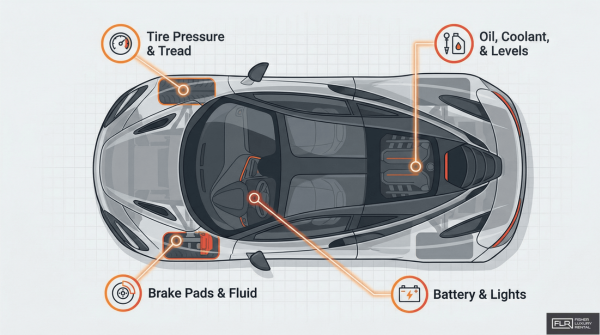
Pre-drive inspections identify existing damage and verify vehicle safety systems before operation. Fisher Luxury Rental conducts thorough pre-rental vehicle inspections and documents any existing damage to protect both renter and vehicle.
Ultra-high performance (UHP) tires are standard on most supercars and should be inspected for wet and dry condition performance. These specialized tires require specific attention to tread depth, pressure, and visible damage. Rental companies provide detailed explanation of vehicle features and operation before allowing drivers to depart.
Key inspection areas include:
- Tire condition and pressure verification
- Brake system functionality check
- Fluid level confirmation
- Electronic system status review
- Exterior damage documentation
Proper pre-drive inspection prevents mechanical issues and establishes baseline vehicle conditions for rental protection.
How Can You Mentally Prepare for Handling a High-Performance Vehicle?
Mental preparation involves understanding vehicle dynamics, developing proper visual techniques, and building confidence through education. Professional race car driver Randy Pobst emphasizes: “Look where you want to go” as the foundational principle of car control.
Ferrari’s Corso Pilota offers a multi-tiered curriculum with Sport, Advanced, Evolution, and Challenge levels for drivers seeking structured high-performance education. Leading automotive engineers from Aston Martin, Lotus, and Ferrari highlight linearity—predictable and consistent response to driver inputs—as key to great handling.
Mental preparation strategies include:
- Visual focus training on intended path
- Understanding vehicle response characteristics
- Developing smooth input techniques
- Building confidence through gradual exposure
This preparation phase establishes the foundation for safe supercar operation and maximizes driving enjoyment while minimizing risk factors. The next section covers specific driving techniques that translate preparation into safe vehicle control.
What Driving Techniques Help Ensure Safety in a Supercar?
Driving techniques for supercars require specialized knowledge due to their extreme performance capabilities. Supercars accelerate faster, brake harder, and corner more aggressively than regular vehicles, demanding heightened awareness and refined control inputs. Mastering acceleration, braking, cornering, and following distance techniques prevents accidents and maximizes safety. This section covers essential handling differences, proper cornering methods, and safe following distances for high-performance driving.
How Does Acceleration and Braking Differ in Supercars Versus Regular Cars?
Acceleration and braking in supercars differ dramatically from regular cars through exponentially increased performance capabilities and specialized braking systems. McLaren 720S brings the car from 100 km/h (62 mph) to a halt in just 29 meters (95 feet), while Ferrari 488 GTB’s Brembo Extreme Design braking system provides 9% shorter stopping distance than its predecessor.
Supercar acceleration delivers instant, overwhelming power that requires gradual throttle application and smooth inputs. Professional race car driver Randy Pobst advises: “There is no such thing as powering out of trouble. If you are not sure where you are going, why would you wanna go there faster?” Carbon ceramic brakes generate extreme heat and require different pedal pressure compared to standard steel brakes.
Key acceleration and braking differences:
- Throttle response occurs instantaneously with minimal lag
- Brake pedal travel is shorter but requires more precise modulation
- Heat buildup affects brake performance during repeated hard stops
- Traction control systems intervene more aggressively at high power levels
What Is the Proper Way to Handle Corners and Turns in a Supercar?
The proper way to handle corners and turns in a supercar involves precise steering inputs, visual focus, and immediate corrective actions when grip limits are exceeded. Counter-steer promptly by steering into the direction of a slide to correct the car’s orientation, while easing off both accelerator and brake to allow tires to regain grip.
Cornering technique prioritizes smooth, progressive inputs over aggressive maneuvers. Maintain visual focus on the intended path, not the obstacle you’re trying to avoid, as your hands naturally steer toward your visual target. Once a slide is corrected, quickly return steering to neutral position to avoid snap-back in the opposite direction.
Essential cornering techniques:
- Enter corners at sustainable speeds rather than relying on braking mid-turn
- Apply throttle gradually through corner exit to prevent wheelspin
- Keep steering inputs smooth and progressive to maintain tire contact
- Use racing line principles: outside-inside-outside for maximum cornering speed
How Can You Maintain Safe Following Distances at High Speeds?
Safe following distances at high speeds require extended spacing and modern safety technologies to compensate for increased stopping distances and reaction times. Autonomous Emergency Braking (AEB) systems reduce front-to-rear crashes by up to 52% in newer models by using radar and cameras to scan the road ahead and automatically apply brakes if drivers don’t take corrective action.
Following distance increases exponentially with speed due to physics principles and human reaction limitations. At highway speeds, maintain at least a three-second gap between vehicles, expanding to four or five seconds in supercars due to their weight distribution and braking characteristics.
Modern supercars integrate adaptive cruise control and collision warning systems that maintain predetermined following distances automatically. These systems provide audio and visual alerts when vehicles ahead slow suddenly, giving drivers additional reaction time for emergency braking situations.
This comprehensive approach to supercar driving techniques emphasizes smooth control inputs, visual awareness, and technology integration to maximize safety during high-performance driving experiences.
What Common Mistakes Should Supercar Drivers Avoid?
Common mistakes supercar drivers should avoid include overconfidence in electronic systems, distracted or impaired driving, and aggressive maneuvers that exceed safety limits. These errors become amplified in high-performance vehicles due to their exceptional power and speed capabilities. Understanding these pitfalls helps drivers maintain control and avoid dangerous situations that could result in accidents or legal consequences.
How Can Overconfidence Lead to Accidents in Supercars?
Overconfidence leads to accidents in supercars when drivers rely too heavily on electronic safety systems or exceed their skill level with the vehicle’s capabilities. According to IIHS studies, Electronic Stability Control (ESC) reduces the risk of fatal single-vehicle crashes by about half, while reducing fatal single-vehicle rollovers by 75% for SUVs and 72% for cars. However, these systems have limits and cannot compensate for extreme driver error or physics-defying maneuvers.
Drivers often develop false confidence after experiencing a supercar’s advanced safety features during normal driving conditions. This leads to progressively riskier behavior as they push boundaries, mistakenly believing the car’s technology will always save them. ESC and other systems work best as safety nets, not as enablers for reckless driving.
What Are the Dangers of Distracted or Impaired Driving With Supercars?
The dangers of distracted or impaired driving with supercars include significantly reduced reaction times when controlling vehicles capable of extreme acceleration and high speeds. NHTSA estimates that ESC saved over 4,100 lives between 2010 and 2014, demonstrating how even small improvements in driver attention and system response can prevent fatalities. Pedestrian AEB systems reduce frontal crashes with non-motorists by 9%, but these systems require alert drivers to function optimally.
Supercars amplify the consequences of impaired judgment due to their performance capabilities. A moment of distraction that might result in a minor fender-bender in a regular car can become a catastrophic high-speed collision in a supercar. The combination of reduced reaction times and extreme vehicle performance creates exponentially higher risks.
Why Should Aggressive Maneuvers or Reckless Behavior Be Avoided?
Aggressive maneuvers or reckless behavior should be avoided because they carry severe legal penalties and physical risks that increase dramatically in high-performance vehicles. A first-time street racing offense in California results in up to 90 days jail, $1,000 fine, and six-month license suspension. Street racing resulting in injury or death can lead to lengthy prison sentences, and street racing is illegal in all jurisdictions with strict penalties.
Beyond legal consequences, aggressive driving in supercars often exceeds the limits of physics and driver skill. The exceptional power and speed capabilities of these vehicles mean that small errors in judgment can result in loss of control at speeds where accidents become fatal. Professional racing environments provide the proper safety equipment and controlled conditions that public roads lack.
The combination of overconfidence, distraction, and aggressive behavior creates a dangerous triangle that has led to numerous preventable accidents, making disciplined driving essential for supercar safety.
How Do Weather and Road Conditions Impact Supercar Safety?
Weather conditions dramatically affect supercar performance and safety, requiring specialized driving techniques and heightened awareness. Supercars with their high-performance tires and advanced powertrains present unique challenges in adverse conditions that differ significantly from conventional vehicles. Understanding these environmental factors helps drivers maintain control and avoid dangerous situations. The following sections examine specific weather scenarios, tire considerations, and road surface challenges that supercar drivers must navigate.
What Precautions Should You Take When Driving a Supercar in Rain or Wet Conditions?
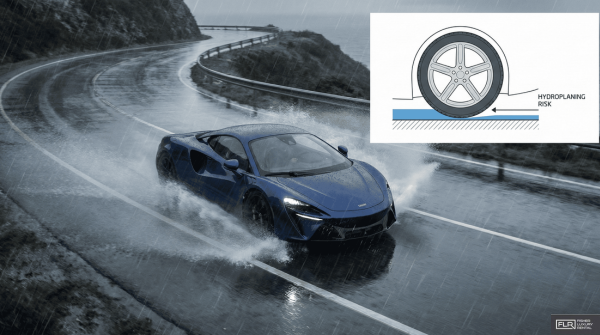
Rain and wet conditions require immediate speed reduction and increased following distances when driving supercars. According to the Federal Highway Administration, over 77% of weather-related crashes occur in rainy or wet conditions. A 2025 tire hydroplaning study reveals that hydroplaning risk increases significantly with both water depth and vehicle speed.
Hydroplaning occurs when water builds between tires and road surface, causing complete loss of traction and steering control. Supercars are particularly susceptible due to their wide, low-profile tires and substantial power delivery. Key wet-weather precautions include:
• Reduce speed by 30-50% compared to dry conditions
• Increase following distance to 6-8 seconds minimum
• Avoid sudden acceleration, braking, or steering inputs
• Use smooth, gradual movements for all controls
• Turn off traction control if stuck to allow wheel spin for traction
Fisher Luxury Rental recommends postponing drives during heavy rain or standing water conditions to ensure both vehicle and driver safety.
How Do Temperature and Tire Conditions Affect Supercar Handling?
Temperature changes significantly impact supercar tire performance and overall handling characteristics. Ultra-high performance (UHP) tires standard on supercars are designed for maximum traction in both wet and dry conditions but require specific temperature ranges for optimal grip. High-quality tires designed for wet-weather performance are crucial for mitigating hydroplaning risks.
Cold temperatures below 45°F reduce tire grip substantially, while excessive heat above 200°F can cause tire degradation and potential failure. Tire pressure increases approximately 2 PSI for every 20°F temperature rise, affecting handling precision. Proper tire maintenance includes:
• Check tire pressure weekly, adjusting for temperature changes
• Inspect tread depth regularly (minimum 4/32″ for wet conditions)
• Allow tires to warm up gradually before aggressive driving
• Monitor tire temperature during extended high-performance driving
Temperature affects not only tires but also suspension components, brake fluid viscosity, and engine oil performance in supercars.
What Should You Consider When Driving on Unfamiliar Roads or Surfaces?
Unfamiliar roads present hidden dangers that require conservative driving approaches and reliance on modern safety systems. The McLaren 720S features Proactive Chassis Control System II that anticipates the road ahead and adjusts suspension accordingly, but driver vigilance remains paramount. Adjusting driving speed to match road conditions helps maintain control in unexpected situations.
Surface variations like gravel, oil, painted lines, and manhole covers create sudden traction changes that can destabilize supercars quickly. Construction zones, debris, and varying pavement conditions require constant attention. Safe practices for unfamiliar terrain include:
• Reduce speed by 20-30% on unknown roads
• Study the road surface ahead continuously
• Test braking and steering response gently in safe areas
• Use GPS systems with real-time traffic and road condition updates
• Plan routes in advance to avoid challenging areas
Understanding local traffic patterns, speed enforcement, and road maintenance schedules helps prevent dangerous encounters while maximizing the supercar driving experience safely.
What Safety Features Are Found in Modern Supercars?
Modern supercars integrate advanced safety systems that work together to protect drivers while maximizing performance potential. These vehicles combine traditional passive safety elements with cutting-edge electronic aids and performance-focused components designed for both track and street use.
How Do Electronic Stability Control and Traction Systems Enhance Supercar Safety?
Electronic Stability Control (ESC) continuously monitors vehicle trajectory and compares it to driver’s steering input to prevent accidents. ESC selectively applies brakes to individual wheels to correct skids or spins when the system detects loss of control.
The Ferrari 488 GTB incorporates a sophisticated Vehicle Stability Control system that earned high EuroNCAP and NHTSA crash test ratings. The Lamborghini Huracán features the ANIMA (Adaptive Network Intelligence Management) system, which allows drivers to adjust vehicle behavior across different driving modes. The Huracán includes a full suite of ESC, ABS, and traction control systems working in coordination.
According to IIHS studies, Electronic Stability Control reduces the risk of fatal single-vehicle crashes by about half, with fatal single-vehicle rollovers reduced by 75% for SUVs and 72% for cars equipped with ESC.
What Role Do Tires and Brakes Play in Supercar Safety?
Tires and brakes form the critical connection between driver input and vehicle response in high-performance situations. Ultra-high performance (UHP) tires are standard on most supercars and provide maximum traction in both wet and dry conditions.
The McLaren 720S features carbon ceramic brakes that deliver exceptional stopping power, bringing the vehicle from 100 km/h to a complete stop in just 29 meters. Brembo Extreme Design braking systems are standard in high-performance vehicles like the Ferrari 488 GTB, providing 9% shorter stopping distances than previous generations.
How Important Are Crash Structures and Airbags in Supercars?
Crash structures in modern supercars utilize advanced materials that exceed traditional automotive safety standards. Koenigsegg utilizes carbon fiber reinforced polymer (CFRP) and aerospace-grade aluminum honeycomb for their monocoque safety cell construction.
Carbon honeycomb tub structures withstand immense impact forces to protect occupants during collisions. The tensile strength of carbon fiber materials far exceeds traditional automotive steel, providing superior protection while maintaining the lightweight construction essential for supercar performance.

These safety advances demonstrate how modern supercars balance extreme performance with comprehensive protection systems, preparing readers to understand how rental companies like Fisher Luxury Rental implement additional safety protocols for their high-performance fleet.
How Can You Stay Safe When Driving a Rented Supercar?
Staying safe when driving a rented supercar requires careful preparation, appropriate insurance coverage, and strict adherence to safety protocols. Rental supercars demand heightened awareness due to their exceptional performance capabilities and high replacement costs.
What Should You Discuss With Your Rental Provider Before Driving Off?
You should discuss the vehicle’s specific features, controls, and operating procedures with your rental provider before departure. Fisher Luxury Rental provides detailed explanations of vehicle features and operation before every rental to ensure driver familiarity. Key discussion points include:
- Electronic stability systems and their operation modes
- Braking system characteristics and stopping distances
- Acceleration patterns and throttle sensitivity
- Emergency procedures and safety features
Rental companies conduct thorough pre-rental vehicle inspections with documentation of existing damage to protect both parties. This inspection process typically covers exterior panels, interior components, tire condition, and all operational systems.
What Insurance Options Should You Consider for Supercar Rentals?
You should evaluate specialized insurance options since supercar insurance premiums are significantly higher than standard vehicles due to high repair costs and theft risk. Standard automotive coverage often proves inadequate for exotic vehicles.
Key insurance considerations include:
- Standard policies: Many have limitations on exotic vehicle coverage
- Credit card protection: Often excludes exotic vehicles entirely
- Supplemental coverage: May be required through rental company
- Liability minimums: Fisher Luxury Rental requires $100,000 per person, $300,000 per accident, and $100,000 property damage
Security deposits range from $5,000 to $20,000 depending on vehicle value, reflecting the substantial financial exposure involved.
How Can You Protect Yourself and the Car During Your Rental Experience?
You can protect yourself and the vehicle by following all rental company safety procedures designed for safe and enjoyable experiences. Understanding vehicle capabilities and limitations before driving prevents dangerous overconfidence.
Essential protection strategies include:
- Respecting performance limits until familiar with the vehicle
- Avoiding aggressive maneuvers in unfamiliar cars
- Using progressive throttle inputs to gauge acceleration response
- Maintaining conservative speeds until comfortable with handling characteristics
The combination of proper preparation, adequate insurance, and cautious initial driving creates the foundation for safe supercar rental experiences.
How Can Fisher Luxury Rental Help You Drive a Supercar Safely?
Fisher Luxury Rental helps clients drive supercars safely through comprehensive pre-rental procedures, thorough safety guidance, and strict insurance requirements designed to protect both drivers and vehicles.
What Safety Guidance Does Fisher Luxury Rental Provide to Supercar Renters?
Fisher Luxury Rental provides comprehensive safety guidance through detailed pre-rental inspections and thorough operational briefings. The company conducts complete vehicle inspections before each rental, documenting any existing damage to establish clear baselines for vehicle condition.
Fisher requires substantial financial protection including minimum liability coverage of $100,000 per person, $300,000 per accident, and $100,000 for property damage. Security deposits range from $5,000 to $20,000 based on vehicle value, ensuring clients understand the financial responsibility of handling high-performance vehicles.
Every renter receives detailed explanations of vehicle features and operation before departure. This guidance covers:
- Supercar-specific controls and electronic systems
- Performance characteristics unique to each vehicle model
- Proper handling techniques for high-performance capabilities
- Emergency procedures and safety protocols
This thorough preparation ensures clients understand their vehicle’s capabilities and limitations before experiencing supercar performance on public roads.
What Are the Key Takeaways About Safety Tips for Driving a Supercar We Covered?
The key takeaways about supercar safety encompass preparation, technique, and responsibility across multiple driving scenarios. Essential preparation includes obtaining proper insurance coverage, understanding vehicle-specific features through professional guidance, and conducting thorough pre-drive inspections of tires and safety systems.
Critical driving techniques include maintaining visual focus on intended paths rather than obstacles, using gentle inputs for acceleration and braking to avoid overwhelming traction systems, and applying counter-steering promptly during slides while easing off throttle and brake inputs. Electronic Stability Control systems reduce fatal single-vehicle crashes by approximately 50%, but drivers must understand these systems’ limitations and avoid overconfidence.
Weather conditions require heightened caution, as over 77% of weather-related crashes occur in rainy conditions where hydroplaning risks increase significantly with speed and water depth. Modern supercars feature advanced safety systems like autonomous emergency braking and proactive chassis control, but these technologies supplement rather than replace careful driving practices.
Professional rental companies like Fisher Luxury Rental provide essential safety frameworks through comprehensive inspections, detailed operational briefings, and appropriate insurance requirements that protect both drivers and vehicles during high-performance experiences.