Whether you’re a driving enthusiast searching for your next track weapon or dreaming about the ultimate canyon carver, you’ve come to the right place. We understand that handling performance can make or break the exotic car experience – it’s what transforms a powerful machine into a true driver’s car. In the world of exotic automobiles, exceptional handling is the difference between merely fast and truly exhilarating.
Exceptional exotic car handling is the precise combination of suspension technology, aerodynamics, weight distribution, and electronic systems working in harmony to deliver maximum cornering speed, driver feedback, and control at the limit.
TL;DR Summary: This comprehensive guide reveals how exotic car manufacturers engineer superior handling through magnetorheological dampers, active aerodynamics generating up to 1,000 kg of downforce, and sophisticated electronic control systems. We examine what makes each brand unique – from Ferrari’s Dynamic Enhancer to Porsche’s record-breaking Nürburgring performance. You’ll discover which specific models deliver the best handling, including the Lamborghini Huracán STO’s class-leading 1.16 g lateral acceleration and the McLaren 720S’s revolutionary Proactive Chassis Control II. We also cover essential topics like performance tire selection, driving techniques for optimal cornering, and maintenance requirements to preserve handling excellence. Finally, we’ll show you how to experience these engineering marvels firsthand through Fisher Luxury Rental’s meticulously maintained fleet.
Quick Tip: When evaluating exotic car handling, focus on lateral acceleration (g-force) ratings rather than just horsepower – a car achieving 1.10+ g on the skidpad will dramatically outperform lower-rated vehicles in real-world cornering situations.
The exotic car market has evolved dramatically over the past decade, with manufacturers pushing the boundaries of physics through advanced materials, sophisticated electronics, and race-derived technologies. Today’s supercars deliver handling performance that rivals dedicated race cars while maintaining street-legal status and surprising daily usability. Understanding what separates exceptional handlers from merely fast cars requires examining the intricate engineering that enables these machines to defy conventional automotive limits.
What Makes an Exotic Car’s Handling Stand Out from the Rest?
Exotic car handling distinguishes itself through advanced suspension technology, optimized weight distribution, and precision engineering that delivers exceptional road-holding capabilities. These vehicles achieve lateral acceleration figures exceeding 1.0 g while maintaining driver confidence through sophisticated electronic systems and aerodynamic downforce generation.
The following sections examine how suspension systems, weight optimization, and chassis design work together to create the superior handling characteristics that define today’s exotic supercars.
How Do Suspension Systems Affect Handling in Exotic Cars?
Suspension systems in exotic cars utilize magnetorheological dampers that adjust stiffness in real-time based on driving conditions. Ferrari’s magnetorheological suspension integrates with E-Diff3, F-Trac, and Side-Slip Angle Control system (SSC 6.0) to provide seamless traction management. Lamborghini’s MagneRide 2.0 maintains tire contact with imperfect pavement surfaces through millisecond adjustments.
McLaren’s Proactive Chassis Control II connects left and right dampers with hydraulic hoses, allowing compression on one side to resist extension on the opposite side. This eliminates traditional anti-roll bars while maintaining roll stiffness. The Porsche 911 GT3 RS employs track-oriented PASM with 50% stiffer front springs and 60% stiffer rear springs versus the standard 911.
Advanced suspension components include:
- Double wishbone designs enabling precise wheel control and optimized camber curves
- Carbon fiber anti-roll bars reducing weight while maintaining torsional rigidity
- Aerodynamically designed suspension components generating 40kg of downforce at speed on the GT3 RS
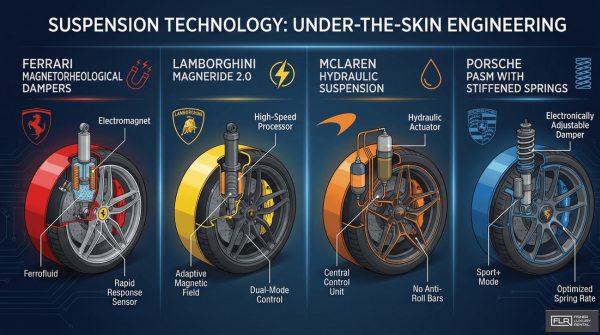
These sophisticated systems deliver the precise control and feedback that separate exotic cars from conventional performance vehicles.
Why Is a Low Center of Gravity Crucial for Precision Handling?
A low center of gravity provides stability and reduces body roll during cornering maneuvers. The Ferrari 488 Pista achieves a dry weight of 1,280 kg (2,822 lbs) with mid-engine placement that optimizes the center of gravity position. McLaren’s 720S weighs 3,161 lbs, making it 157 lbs lighter than the Porsche 911 GT3 through extensive carbon fiber construction.
Weight reduction efforts focus on strategic component placement and material selection. The Lamborghini Huracán STO achieves a 95-pound weight reduction from the standard Huracán Evo, with carbon fiber components comprising over 75% of exterior panels. Removable carbon fiber roof panels on the Huracán STO weigh only 13 lbs (6 kg) each.
Weight-saving technologies include:
- Lithium-ion batteries saving 30 lbs in the Porsche 911 GT3 RS versus standard lead-acid
- Optional carbon fiber wheel rims on the Ferrari 488 Pista reducing unsprung weight
- Magnesium roof panels and carbon fiber body components standard on performance variants
Lower weight and optimized placement create the agility and responsiveness that define exotic car handling characteristics.
How Do Weight Distribution and Chassis Design Influence Handling?
Weight distribution determines how forces transfer through the chassis during acceleration, braking, and cornering. The Ferrari 488 Pista maintains approximately 40/60 front/rear weight distribution with its mid-engine layout, providing balanced handling characteristics. The Porsche 911 GT3 RS has 38.3/61.7 percent front/rear distribution, requiring adjustable anti-roll bars to compensate for the rear-engine configuration.
Chassis construction utilizes advanced materials for optimal strength-to-weight ratios. McLaren’s Carbon Fibre Monocage II chassis provides exceptional rigidity at minimal weight, while the Lamborghini Huracán STO uses hybrid aluminum and carbon fiber construction. The GT3 RS saved 100 of 137 total pounds from the front axle through component deletion and substitution.
Chassis optimization strategies include:
- McLaren 720S eliminating the limited-slip differential to prioritize weight savings
- Magnesium roof panels reducing overhead mass
- Carbon fiber body panels maintaining structural integrity while reducing weight
These engineering approaches create the balanced weight distribution and structural rigidity that enable precise handling at the limits of adhesion.
Which Exotic Car Brands Are Known for Exceptional Handling?
Ferrari, Lamborghini, McLaren, and Porsche dominate exotic car handling excellence through advanced suspension systems, aerodynamic innovations, and precision engineering. These brands achieve lateral acceleration figures exceeding 1.0 g while maintaining driver confidence through sophisticated electronic systems. Their handling superiority stems from racing-derived technologies, lightweight construction, and manufacturer-specific innovations that maximize tire grip and chassis dynamics.
How Does Ferrari Engineer Superior Handling Capabilities?
Ferrari engineers superior handling through the world’s first Ferrari Dynamic Enhancer (FDE) system that adjusts brake pressure at individual calipers for controlled traction management. The Side-Slip Angle Control system (SSC 6.0) integrates E-Diff3, F-Trac, and magnetorheological suspension for seamless power delivery through corners.
Performance metrics demonstrate Ferrari’s handling prowess:
- 488 Pista achieves 1.10 g lateral acceleration on skidpad testing
- Sustains 1.5-1.7 g in flat corners at Nürburgring Nordschleife
- Completed Nordschleife lap in 7:00.03 minutes
Aerodynamic enhancements provide 20% increased downforce compared to 488 GTB through F1-inspired technology. The S-Duct front design and double-link rear wing derive from the 488 GTE race car, while underbody vortex generators and rear diffuser incorporate proven racing technology for maximum grip.
Ferrari’s handling innovations prepare drivers for Lamborghini’s equally impressive but distinctly different approach to cornering excellence.
What Handling Innovations Set Lamborghini Apart?
Lamborghini sets itself apart through MagneRide 2.0 magnetorheological adaptive dampers that adjust suspension characteristics in milliseconds based on road conditions. The seamless rear steering system provides up to 3 degrees of lock, dramatically improving agility during direction changes and enhancing cornering precision.
The Huracán STO achieves the highest 1.16 g lateral acceleration among tested supercars, supported by Bridgestone Potenza Race tires developed specifically for the STO that delivered the fastest 2:35.39 lap time at Nardo among competitors. Aerodynamic optimization provides a 53% downforce increase over the Huracán Performante model.
Additional handling technologies include:
- Brembo CCM-R carbon-ceramic brakes for linear response and consistent performance
- Torque vectoring system that integrates with rear steering for optimal cornering
- Pioggia (rain) mode that optimizes all systems for wet conditions
Lamborghini’s comprehensive approach to handling excellence contrasts with McLaren’s unique hydraulic suspension philosophy.
In What Ways Do McLaren Models Excel in Handling?
McLaren models excel through Proactive Chassis Control II that eliminates traditional anti-roll bars using hydraulic interconnection between dampers. This system allows engineers to increase roll stiffness without compromising vertical compliance, delivering both comfort and performance simultaneously.
The 720S achieves 1.09-1.10 g lateral acceleration on the skidpad while providing exceptional steering feedback through electrohydraulically assisted steering that delivers a constant stream of information to the driver. Performance figures include 0-60 mph in 2.7-2.8 seconds with quarter-mile times of 10.2 seconds.
McLaren’s engineering advantages include:
- Active rear wing functioning as both downforce generator and airbrake
- Open differential with electronic control reducing weight versus limited-slip designs
- Carbon Fibre Monocage II providing exceptional chassis rigidity at minimal weight
McLaren’s hydraulic innovation bridges the gap to Porsche’s aerodynamically-focused handling philosophy.
What Do Porsche Supercars Contribute to World-Class Handling?
Porsche supercars contribute world-class handling through the 911 GT3 RS, which achieves a 6:56.4 Nürburgring lap time—the fastest among tested road cars. Porsche Active Aerodynamics (PAA) generates 860 kg of downforce at 285 km/h, with the GT3 RS being the first production Porsche equipped with a Drag Reduction System (DRS) from motorsport.
Track performance demonstrates Porsche’s handling superiority, with the GT3 RS lap time only 3.67 seconds slower than the GT3 Cup race car at Road America. The optional Manthey Racing kit increases downforce to over 1,000 kg at 285 km/h for ultimate track performance.
Engineering innovations include:
- Track-oriented PASM providing real-time damping adjustments
- Carbon fiber reinforced plastic anti-roll bars reducing weight while maintaining stiffness
- Aerodynamically designed wishbones generating additional downforce
These four brands represent the pinnacle of exotic car handling, each offering distinct approaches to maximizing cornering performance and driver engagement.
How Do Performance Tires and Wheels Improve Exotic Car Handling?
Performance tires and wheels dramatically improve exotic car handling through advanced compound chemistry, optimized contact patches, and weight reduction strategies. Modern performance tires generate lateral forces exceeding 1.1g while specialized wheel materials reduce unsprung weight by up to 40%.
Why Does Tire Compound Choice Matter for Cornering Ability?
Tire compound choice matters for cornering ability because chemical composition directly affects the friction coefficient between rubber and asphalt. Performance compounds achieve peak lateral force at approximately 6 degrees slip angle through optimized molecular structures.
Cornering stiffness measures force generated per degree of slip angle (N/°), with performance tires maintaining grip through controlled molecular deformation. The Bridgestone Potenza Race achieves the shortest braking distance at 32.3 meters (100-0 km/h) through specialized silica compounds. Temperature affects adhesion by increasing conformance to road surface irregularities, with chemical reactions between tire rubber and asphalt optimizing at specific temperature ranges.
Key Performance Tire Technologies:
- Michelin Pilot Sport Cup 2 uses bi-compound technology with endurance racing compound in outer tread
- Treadwear ratings of 140-240 UTQG for track-focused compounds
- Wider tires reduce contact pressure per element, increasing coefficient of friction
These compound innovations create the foundation for exotic cars’ exceptional cornering capabilities, enabling sustained lateral forces that separate supercars from conventional vehicles.
How Do Wheel Sizes and Materials Impact Handling Response?
Wheel sizes and materials impact handling response by reducing unsprung weight and improving suspension dynamics. Larger diameter wheels accommodate bigger brake rotors while advanced materials like carbon fiber cut rotational mass by significant margins.
Optional 20″ carbon fiber wheel rims on Ferrari 488 Pista reduce unsprung weight compared to aluminum alternatives. Porsche offers magnesium wheels with Weissach package for weight reduction, while carbon fiber ‘aerodisc’ wheel covers on Manthey kit reduce air resistance. Reduced unsprung weight improves suspension response and road following by allowing dampers to maintain tire contact over surface irregularities.
| Material | Weight Reduction | Application | Benefit |
| Carbon Fiber | 30-40% | Ferrari 488 Pista | Unsprung weight reduction |
| Magnesium | 20-25% | Porsche Weissach | Rotational mass decrease |
| Forged Aluminum | 15-20% | Standard performance | Cost-effective weight savings |
Tire sizes range from 275/35-20 front to 335/30-21 rear on GT3 RS, with larger diameter wheels providing structural benefits for high-performance braking systems while maintaining optimal sidewall stiffness for precise handling response.
What Role Does Advanced Technology Play in Exotic Car Handling?
Advanced technology transforms exotic car handling through sophisticated electronic systems, adaptive suspension, and active aerodynamics that work together to maximize grip, stability, and driver control. Modern supercars integrate multiple advanced technologies to create handling capabilities that exceed what was possible just a decade ago.
How Do Traction and Stability Control Systems Enhance Handling?
Traction and stability control systems enhance handling by precisely managing power delivery and preventing loss of control during aggressive driving. Ferrari’s Side-Slip Angle Control (SSC 6.0) manages controlled oversteer for faster lap times by allowing the car to maintain optimal slip angles through corners. This system represents a paradigm shift from traditional stability control that simply cuts power when slip is detected.
Lamborghini’s stability control operates differently in Trofeo mode, acting as an aid rather than a restrictive guardrail. The Ferrari Dynamic Enhancer manages loss of traction smoothly between all four corners through individual brake pressure adjustments. McLaren’s Variable Drift Control allows progressive levels of slip angle, giving drivers precise control over how much the car slides.
These systems work through:
- Electronic differential control that optimizes torque distribution during cornering
- Brake-based torque vectoring that improves turn-in response
- Porsche Stability Management integration with all chassis systems for coordinated control
The result is handling that allows skilled drivers to operate closer to the limits while providing safety nets that prevent dangerous situations.
What Impact Do Adaptive Suspension and Active Aero Have on Driving Dynamics?
Adaptive suspension and active aerodynamics dramatically improve driving dynamics by continuously optimizing the car’s setup for current conditions and driver inputs. Porsche Active Aerodynamics continuously adjusts downforce based on all vehicle data, creating optimal grip levels for every driving situation.
McLaren’s hydraulic rear wing deploys automatically or manually for downforce and braking assistance. Lamborghini STO’s three-position adjustable wing provides 450 kg of downforce at 174 mph, while the GT3 RS DRS system reduces drag on straights while maintaining corner downforce for maximum efficiency.
Advanced suspension technologies include:
- Manthey Racing semi-active coilover suspension using seven acceleration sensors
- Ferrari 488 Pista’s adaptive dampers that integrate with traction and stability systems
- Active suspension systems that maintain optimal ride height for aerodynamic efficiency
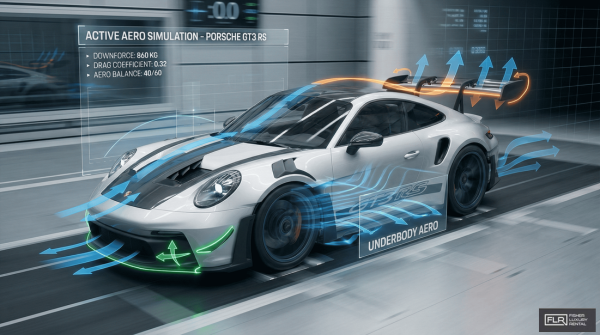
These technologies work together to create handling that adapts in real-time to track conditions, driving style, and performance demands. The combination of adaptive suspension and active aerodynamics allows exotic cars to achieve handling characteristics that remain optimal across widely varying speeds and driving conditions, setting them apart from conventional sports cars.
Which Exotic Car Models Are Regularly Rated as the Best for Handling?
Four exotic car models consistently dominate handling performance ratings: the Ferrari 488 Pista, Porsche 911 GT3 RS, McLaren 720S, and Lamborghini Huracán STO. These supercars achieve lateral acceleration exceeding 1.08 g while delivering exceptional steering feedback and cornering precision through advanced suspension systems and aerodynamic engineering.
What Makes the Ferrari 488 Pista Renowned for Its Handling?
The Ferrari 488 Pista achieves 1.10 g lateral acceleration through its Ferrari Dynamic Enhancer system and F1-inspired aerodynamics. The Pista’s handling dominance stems from precise engineering that delivers controlled performance at the limit.
Key Performance Metrics:
- Nordschleife lap time: 7:00.03 minutes sustaining 1.5-1.7 g in flat corners
- 0-60 mph acceleration: 2.85 seconds with quarter-mile in 10.1 seconds at 144 mph
- Braking distance: 70-0 mph in 141 feet with carbon-ceramic brakes
- Weight reduction: 198 pounds lighter than 488 GTB improves agility
The Ferrari Dynamic Enhancer enables controlled slides with smooth traction management between all four corners. Light steering provides exceptional feedback and clarity for precise control inputs. A 20% downforce increase over the 488 GTB through F1-inspired aerodynamics enhances high-speed stability without compromising agility.
How Does the Porsche 911 GT3 RS Achieve Precise Control?
The Porsche 911 GT3 RS records a 6:56.4 Nürburgring lap time as the fastest tested production car. This precision control results from track-oriented suspension tuning and advanced aerodynamic systems that generate massive downforce.
Performance Specifications:
- Downforce generation: 860 kg standard, over 1,000 kg with Manthey kit
- Track comparison: Only 3.67 seconds slower than GT3 Cup race car at Road America
- Lateral acceleration: 1.08-1.24 g depending on model year
- Spring rates: 50% stiffer front, 60% rear versus standard 911
The steering provides constant feedback with precise communication over road undulations. Carbon fiber anti-roll bars and aerodynamic wishbones reduce weight while maintaining structural rigidity. The DRS system enables higher straight-line speeds without sacrificing corner grip through intelligent aerodynamic management.
What Handling Features Distinguish the McLaren 720S?
The McLaren 720S features Proactive Chassis Control II that provides Mercedes S-Class ride quality with supercar handling precision. This system achieves 1.09-1.10 g lateral acceleration through innovative hydraulic suspension technology.
Distinctive Technologies:
- Weight advantage: 3,161 lbs curb weight (157 lbs lighter than GT3) enhances agility
- Acceleration: 0-60 mph in 2.7 seconds, quarter-mile in 10.2 seconds
- Steering feedback: Electrohydraulic system provides constant feedback stream
- Aerodynamics: Active rear wing functions as downforce generator and airbrake
Hydraulic damper interconnection increases roll stiffness without compromising vertical compliance over road imperfections. The system eliminates traditional limited-slip differential to prioritize weight savings while maintaining precise control through electronic management.
Why Is the Lamborghini Huracán STO Celebrated for Road and Track Grip?
The Lamborghini Huracán STO achieves the highest lateral acceleration at 1.16 g average on skidpad testing. This exceptional grip comes from advanced tire technology and sophisticated chassis control systems optimized for both road and track performance.
| Vehicle System | Technical Specification | Resulting Performance Advantage |
| Lateral Acceleration | 1.16 g average | Highest among tested supercars |
| Tire Performance | Bridgestone Potenza Race | Fastest Nardo lap at 2:35.39 |
| Suspension | MagneRide 2.0 | Maintains tire contact on imperfect surfaces |
| Rear Steering | Up to 3 degrees | Improves agility and stability |
g in 95 feet. The STO generates 53% more downforce than the Huracán Performante through aerodynamic optimization. Brembo CCM-R brakes deliver perfectly linear response with figure-eight completion in 22.3 seconds at 0.99 average g.
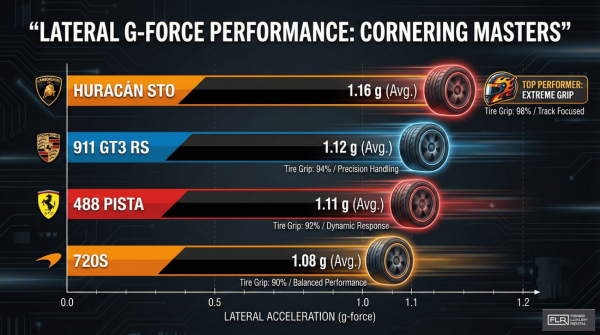
These four models represent the pinnacle of exotic car handling through different engineering philosophies—Ferrari’s dynamic enhancement, Porsche’s track precision, McLaren’s adaptive comfort, and Lamborghini’s ultimate grip—each offering distinct advantages for drivers seeking world-class handling performance.
How Can Drivers Optimize Handling in an Exotic Car?
Drivers optimize handling in exotic cars through proper technique, consistent maintenance, and strategic upgrades that maximize the vehicle’s performance potential. These supercars demand precise inputs and careful attention to maintain their exceptional capabilities.
The following sections detail specific driving techniques, maintenance requirements, and upgrade options that transform good drivers into exceptional ones behind the wheel of high-performance exotic cars.
What Driving Techniques Improve Cornering and Control?
Proper driving techniques improve cornering and control by maximizing tire adhesion and maintaining optimal weight transfer throughout each corner. Professional drivers use eight fundamental techniques to extract maximum performance from exotic cars:
- Trail braking maximizes tire friction circle utilization through corners by gradually releasing brake pressure during turn-in
- Slip angle management maintains angles near 6 degrees for peak lateral force generation according to tire physics
- Steering feedback interpretation identifies grip limits through palm pressure and wheel resistance changes
- Progressive throttle application prevents overwhelming rear tires on corner exit, especially in rear-engine models
- Smooth steering inputs maintain optimal weight transfer without upsetting chassis balance
- Visual targeting involves looking through corners to natural apex and exit points for consistent lines
- Straight-line braking occurs before turn-in for maximum deceleration without compromising corner entry
- Friction circle management balances throttle and steering to keep the car at the edge of available grip
These techniques work together to help drivers approach the performance limits safely while maintaining control in high-speed situations.
How Does Regular Maintenance Affect Long-Term Handling Performance?
Regular maintenance affects long-term handling performance by preserving critical system tolerances and preventing performance degradation over time. Exotic car manufacturers specify strict maintenance intervals that differ significantly from standard vehicles due to higher performance demands.
Essential maintenance schedules include annual Ferrari service requirements regardless of mileage, Porsche GT3 RS oil changes every 3,000 miles for track use versus 12,000 street miles, and Lamborghini brake fluid replacement every 2 years for consistent pedal feel. Additional critical maintenance includes tire pressure optimization for flat contact patches, suspension alignment checks for proper camber and toe settings, carbon-ceramic brake bedding procedures, spark plug replacement every 2 years, and coolant changes to prevent overheating during sustained high-performance driving.
Neglecting these intervals results in reduced handling precision, inconsistent brake feel, and potential component failures that compromise both performance and safety during spirited driving.
Which Upgrades Make the Most Noticeable Difference in Handling?
Upgrades that make the most noticeable difference in handling focus on aerodynamics, tires, and suspension components that directly affect grip and control. The most effective modifications transform how exotic cars respond to driver inputs and perform at the limit.
High-impact upgrades include the Manthey Racing kit for GT3 RS that increases downforce by 16% to over 1,000 kg, semi-slick tires like Bridgestone Potenza Race that reduce lap times by 2+ seconds, and coilover suspension with 30% stiffer front springs for transformed corner response. Supporting modifications include steel-sheathed brake lines for more direct pedal feel, carbon fiber wheels that reduce unsprung weight, track-specific brake pads that reduce fade while increasing precision, adjustable anti-roll bars for track-specific tuning, and carbon fiber aero components including splitters, diffusers, and wings.
These upgrades work synergistically to enhance feedback, increase grip limits, and provide more precise control that experienced drivers can feel immediately on track and spirited road driving.
How Can You Experience Exotic Cars with the Best Handling at Fisher Luxury Rental?
Fisher Luxury Rental provides access to the world’s most advanced handling-focused exotic cars, allowing drivers to experience magnetorheological suspension, active aerodynamics, and precision engineering firsthand. Our fleet features meticulously maintained vehicles from Ferrari, Lamborghini, McLaren, and Porsche, each equipped with manufacturer-specific handling technologies that deliver track-proven performance on public roads.
What Exotic Car Models with Superior Handling Does Fisher Luxury Rental Offer?
Fisher Luxury Rental offers eight exotic car models with superior handling capabilities. These include the Ferrari 488 Spider with magnetorheological suspension achieving 1.10 g cornering capability, the Lamborghini Huracán Spyder Convertible featuring MagneRide 2.0 adaptive dampers that adjust in milliseconds, and the McLaren 720S with Proactive Chassis Control II hydraulic suspension eliminating traditional anti-roll bars.
Additional handling champions in our fleet include:
- Porsche 911 Carrera S with rear-engine dynamics and precision steering feedback
- Ferrari California T Convertible combining luxury comfort with sports car handling precision
- Corvette C8 Z06 featuring mid-engine layout and track-focused suspension tuning
All vehicles maintain manufacturer specifications for optimal handling performance through our certified maintenance program. We stock only top-trim models, ensuring maximum performance features including carbon-ceramic brakes, adaptive suspension systems, and advanced traction control remain fully operational.
What Are the Key Takeaways About Exotic Cars With the Best Handling We Covered?
The key takeaways about exotic cars with the best handling center on measurable performance achievements and technological innovations. The Porsche 911 GT3 RS holds the fastest Nürburgring lap at 6:56.4 among tested road cars, while the Lamborghini Huracán STO achieves the highest lateral acceleration at 1.16 g on skidpad testing.
Ferrari’s 488 Pista introduces the world’s first Dynamic Enhancer system enabling controlled slides unique to the brand, and McLaren’s 720S Proactive Chassis Control II eliminates the need for anti-roll bars through hydraulic interconnection. Magnetorheological dampers provide real-time suspension adjustment across all premium brands, while active aerodynamics generate 860-1,000+ kg downforce on track-focused models.
The most significant handling improvements come from semi-slick tires and carbon fiber components, with Bridgestone Potenza Race tires reducing lap times by 2+ seconds and carbon fiber wheels decreasing unsprung weight for improved suspension response. Fisher Luxury Rental makes these handling champions accessible in Phoenix, Portland, and Vancouver markets, delivering professional-grade exotic car experiences with comprehensive support and maintenance backing.