When you’re considering an exotic car with a V12 engine, whether for purchase or rental, you’re likely wondering about the real-world reliability of these magnificent powerplants. We understand the concerns about maintaining these engineering marvels and want to provide you with comprehensive insights based on actual data and owner experiences. You’ve come to the right place for an authoritative analysis of V12 engine reliability compared to their smaller counterparts.
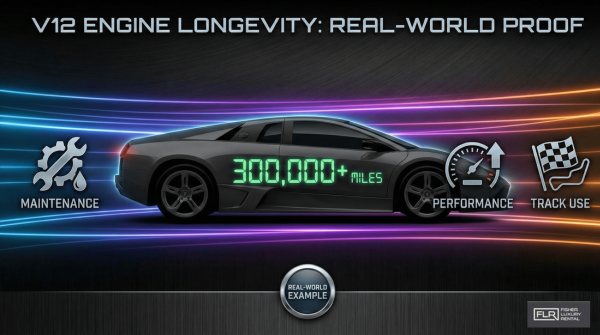
An exotic car V12 engine is a twelve-cylinder internal combustion engine arranged in a V configuration, typically found in high-performance supercars from manufacturers like Ferrari, Lamborghini, and Aston Martin. These engines can achieve remarkable longevity of 200,000-300,000 kilometers without major surgery when properly maintained, as demonstrated by real-world examples like Simon George’s 300,000+ mile Lamborghini Murciélago.
TL;DR Summary
• Maintenance practices significantly impact V12 longevity: Meticulous care enables engines to exceed 200,000-300,000 km, with annual costs ranging from $1,500-$10,000+ depending on usage
• Driving habits directly affect reliability: Track use increases wear dramatically, while normal driving extends engine life considerably
• Manufacturer design determines lifespan: Modern V12s benefit from advanced materials and electronic management systems
• Common issues include oil leaks and cooling problems: Multiple gaskets and high heat generation create more potential failure points than simpler engines
• Electronic systems add complexity: Modern V12s require specialized diagnostic equipment and trained technicians
• Regular wear differs significantly: V12s have 12 cylinders creating more wear points, with maintenance costs 3-10x higher than standard vehicles
• Modern V12s show improved reliability: Electronic control units, hybrid systems, and predictive maintenance enhance longevity
• Vintage V12s require specialized care: Parts availability and experienced technicians are crucial for older models
• Maintenance costs are substantial: Annual preventive maintenance starts at $10,000, with specific services like oil changes costing $800-$2,000
• Specialized technicians are essential: ASE certification plus manufacturer training required, with some repairs needing factory-specific tools
• Performance driving increases maintenance needs: Track use can require 10x more frequent component replacement
• Climate significantly impacts reliability: Phoenix heat reduces component life by 40%, requiring enhanced cooling protocols
• High-mileage capability is proven: Multiple documented cases exceed 300,000 miles with proper care
• Preventive maintenance prevents catastrophic failures: Following manufacturer intervals and using quality parts ensures longevity
• Fisher Luxury Rental provides maintained V12 access: Experience these engines without ownership concerns through our meticulously maintained fleet
Quick Tip: Always warm up your V12 engine gently before aggressive driving – cold starts followed by immediate high RPM operation significantly increase wear and can lead to premature component failure.
As we explore the intricate world of V12 reliability throughout this article, you’ll discover how proper maintenance transforms these complex engines from potential headaches into surprisingly durable powerplants that can outlast many conventional engines when given appropriate care.
What Factors Most Influence the Reliability of V12 Engines in Exotic Cars?
V12 engine reliability in exotic cars depends primarily on three critical factors: maintenance practices, driving habits, and manufacturer design quality. These factors interact to determine whether a V12 engine reaches 300,000 miles like Simon George’s 2004 Lamborghini Murciélago or suffers catastrophic failure like a Ferrari 365 GTC from over-revving. Understanding these influences helps owners and enthusiasts make informed decisions about V12 ownership and care. The following sections examine how maintenance schedules, driving behavior, and engineering choices shape long-term V12 reliability.
How Do Maintenance Practices Impact V12 Engine Longevity?
Maintenance practices directly determine V12 engine lifespan, with meticulous care enabling Ferraris to exceed 100,000 miles and reach expected lifespans of 200,000-300,000 km without major surgery. Simon George’s 2004 Lamborghini Murciélago achieved over 300,000 miles through consistent maintenance throughout ownership, demonstrating the impact of proper care.
Ferrari supports reliability through a 7-year free maintenance program, while average yearly Ferrari maintenance costs range $1,500-$2,000. Lamborghini Huracán and Aventador models require service every 9,000 miles or 12 months, with minor services at 10,000-mile intervals covering oil, filters, and basic inspection. Major services occur at 20,000-mile intervals for comprehensive system checks.
Professional maintenance standards include multi-point inspections before and after every rental, as implemented by Fisher Luxury Rental. Preventive maintenance for exotic V12s starts at approximately $10,000 annually, with oil change intervals every 5,000-7,000 miles for most models and BMW/Porsche extending to 10,000 miles. Engine tuning requirements occur every 30,000-50,000 miles depending on the specific model.
Regular maintenance scheduling prevents the costly repairs that result from neglect and ensures V12 engines reach their full potential lifespan.
What Role Do Driving Habits Play in V12 Engine Reliability?
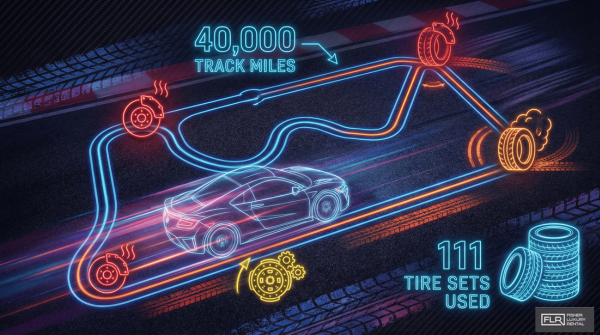
Driving habits significantly impact V12 reliability, with aggressive use accelerating wear and requiring enhanced maintenance protocols. Simon George’s Murciélago accumulated approximately 40,000 track miles out of 300,000+ total miles, resulting in 10 clutch replacements due to track use intensity.
Catastrophic failures occur from improper driving, such as the Ferrari 365 GTC failure caused by over-revving or rod fatigue from being over-extended. Performance driving requires enhanced cooling system maintenance with monthly coolant changes and pressure checks to handle increased thermal stress.
Carbon deposits accumulate more quickly in high-performance V12 engines during aggressive driving, with direct fuel injection V12s like Ferrari’s F154 (since 2013) requiring carbon blasting using walnut shells. High-performance driving increases oil consumption to factory specifications of approximately 1 liter per 1,000 miles for pre-LP Lamborghini engines.
The evidence shows that while V12 engines can handle performance driving, this usage pattern demands more frequent maintenance and component replacement to maintain reliability.
How Does Manufacturer Design Affect the Lifespan of V12 Engines?
Manufacturer design choices fundamentally determine V12 longevity through engineering approaches and material selections. Lamborghini has used only 2 major V12 designs in 60 years, demonstrating a proven engineering approach that prioritizes reliability through refinement rather than frequent redesign.
Advanced materials improve durability, with Aston Martin’s Cosworth RA V12 using higher-grade aluminum for cylinder heads compared to Ford Duratec V6 engines. Ferrari V12 engines feature precision-engineered components with factory gaskets lasting 60,000+ miles when properly maintained, while modern aluminum liners expand and contract in harmony with engine blocks during heat cycles, reducing thermal stress.
Electronic systems enhance V12 performance through variable valve timing and lift systems that optimize engine breathing across operating conditions. Electronic Control Units (ECUs) provide precise management of fuel injection, ignition timing, and valve control, with the Lamborghini Revuelto V12 producing 127 CV/liter specific power and 9,500 rpm redline capability.
However, V12 complexity creates reliability challenges, including multiple gaskets and seals that create more potential leak points than simpler engines, complex ignition systems with 12 cylinders that increase misfire probability, and significant heat generation requiring advanced cooling systems with high-performance radiators.
These design factors explain why proper maintenance and driving habits become even more critical for V12 reliability compared to simpler engine configurations.
What Are the Most Common Reliability Issues Found in Exotic V12 Engines?
Exotic V12 engines experience distinct reliability challenges due to their complex 12-cylinder architecture and high-performance demands. Unlike conventional engines, V12s contain twice as many moving components, sophisticated cooling systems, and advanced electronics that require specialized maintenance protocols.
What Types of Mechanical Failures Are Typical in V12 Engines?
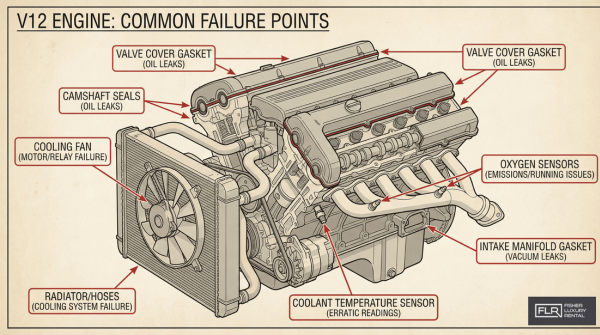
Mechanical failures in V12 engines occur across multiple critical systems due to their complex design. Oil leaks from valve cover gaskets, oil pan gaskets, and camshaft seals rank among the most frequent issues requiring immediate attention.
Catastrophic engine failures, while rare, create devastating damage when they occur. In a documented Ferrari 365 GTC failure, two connecting rods broke completely, creating holes in both the engine block and oil pan. Additional bent rods required full replacement, demonstrating how over-revving or rod fatigue can destroy an entire engine assembly.
Carbon buildup accumulates on intake valves and combustion chambers in high-performance V12s, particularly those with direct fuel injection systems. Direct fuel injection V12s like the Ferrari F154 engine since 2013 require specialized carbon blasting using walnut shells to remove stubborn deposits.
Common V12 cooling system failures include:
- Radiator component breakdowns
- Water pump mechanical failures
- Thermostat malfunctions
- Cooling fan electrical issues
Cooling system inadequacy leads directly to engine overheating and potential catastrophic damage requiring complete rebuilds. V12 rebuild parts typically cost $12,000-$15,000 with 120-180 labor hours required for complete restoration.
Transmission troubles manifest as rough shifting, slipping, and delayed gear engagement, with advanced automatic transmissions particularly expensive to repair when paired with V12 powertrains.
How Frequent Are Electronic or Sensor Issues in Modern V12s?
Electronic and sensor issues plague modern V12s due to their complex array of electronic components managing everything from fuel injection to hybrid integration. Modern V12s use sophisticated ECUs for precise fuel injection and ignition timing control across all 12 cylinders simultaneously.
Electronic malfunctions manifest as ignition system problems, sensor failures, and electrical shorts resulting in poor engine performance, starting difficulties, and persistent dashboard warning lights. Ferrari vehicles are particularly famous for electrical gremlins requiring hours to diagnose seemingly simple loose connections.
Diagnostic requirements for modern V12 electronics include:
- Dealer-level code scanners for OBD2 port access
- Specialized diagnostic equipment for troubleshooting
- Skilled technicians trained on specific manufacturer systems
- Multiple driving modes requiring complex electronic integration
Hybrid V12 systems add additional complexity through battery management systems covered by separate 60-month warranties. Inverter modules and electric power management modules create multiple failure points requiring specialized training to diagnose and repair properly.
Electronic issues require immediate professional attention since incorrect diagnosis can lead to more expensive component failures throughout the interconnected systems.
How Does Regular Wear and Tear Differ for V12s Versus Smaller Engines?
V12 engines create significantly more wear points than smaller engines due to their 12 cylinders moving in precise harmony, requiring specialized maintenance approaches and dramatically higher costs. Simon George’s Murciélago required 111 sets of Pirelli tires over 300,000 miles, demonstrating the accelerated wear patterns typical in exotic V12 applications.
V12 maintenance cost comparisons reveal dramatic differences:
| Maintenance Service | V12 Exotic Vehicle Cost | Typical Standard Vehicle Cost |
| Oil Change (Ferrari F430) | $500 | $67–96 (Toyota) |
| Oil Change (Ferrari F355) | $1,100 | $67–96 (Toyota) |
| Belt Replacement | $4,000 (every 15,000 miles) | $200–400 |
| Clutch Replacement | $6,500 (Ferrari F-1) | $1,200–2,000 |
| Spark Plugs | $3,000 (Ferrari V12) | $100–300 |
Carbon ceramic disc brakes on V12 cars cost $3,000 for replacement compared to $300-800 for standard brake systems. Low-profile tires on exotic V12s require special care to prevent premature wear and damage, with tire rotation, alignment, and balancing required every 5,000-8,000 miles.
Brake inspection intervals occur every 1-2 years due to sophisticated brake technology that operates under extreme performance conditions, creating accelerated wear patterns unique to high-performance V12 applications.
These mechanical, electronic, and wear pattern challenges demonstrate why V12 engines require specialized knowledge and significantly higher maintenance budgets compared to conventional powertrains, making professional maintenance essential for long-term reliability.
How Does the Reliability of Older V12 Exotic Cars Compare to Newer Models?
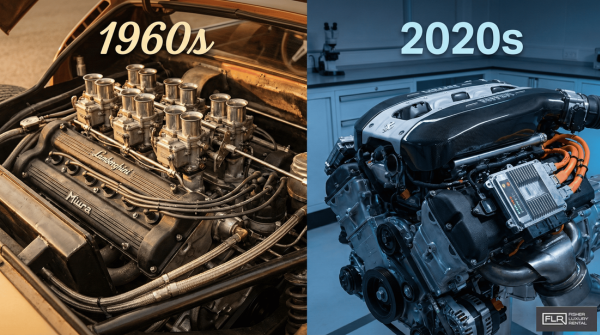
Older V12 exotic cars show significantly lower reliability than newer models due to technological advances and improved engineering. Modern V12 engines benefit from electronic management systems, direct fuel injection, and hybrid powertrains that dramatically enhance performance and dependability compared to vintage alternatives.
The evolution spans decades of engineering improvements. Early models like the 1966 Lamborghini 350 GT produced 320 CV with twin overhead cams but lacked sophisticated management systems. Contemporary examples demonstrate this progression—Lamborghini has refined only 2 major V12 designs over 60 years, proving their commitment to proven engineering approaches while continuously improving reliability.
Modern advances address historical weaknesses while vintage models require specialized restoration expertise. The following sections examine specific technological improvements, vintage reliability challenges, and parts availability impacts on older V12 maintenance.
What Advances Have Improved V12 Engine Reliability Over Time?
Electronic Control Units enable better fuel economy and reduced emissions without sacrificing power in modern V12 engines. These sophisticated systems manage fuel injection, ignition timing, and valve control with precision impossible in vintage mechanical systems.
Key technological improvements include:
- Direct fuel injection technology controlled by advanced electronics enhances V12 capabilities
- Variable valve timing systems optimize engine breathing across all operating conditions
- Modern aluminum liner materials reduce thermal stress through harmonious expansion with engine block
- AI-assisted engine management systems and predictive maintenance capabilities in development
Hybrid powertrains represent the latest evolution. The Lamborghini Revuelto combines 825 PS V12 with 187 hp electric motors for 1,015 CV total output. Ferrari’s SF90 hybrid system includes eDrive mode for pure electric operation up to 15 miles, demonstrating how electric assistance improves both efficiency and performance.
Digital integration enhances maintenance capabilities. Digital instrument clusters provide real-time performance data for early issue detection, while telematics systems enable predictive maintenance scheduling based on actual usage patterns. Manufacturer-specific diagnostic tools for Ferrari, Lamborghini, McLaren, and Porsche improve troubleshooting accuracy and repair efficiency.
Are Vintage V12 Engines More Prone to Breakdowns?
Vintage V12 engines are significantly more prone to breakdowns than modern equivalents due to mechanical limitations and aging components. Early designs suffered from fundamental engineering challenges that modern technology has largely eliminated.
Historical examples demonstrate these vulnerabilities:
- Early Miura models had fire risk from fuel system with four triple-barrel carburetors
- The 1974 Countach commonly experiences oil leaks requiring engine-out restoration
- A Ferrari 365 GTC with 60,000+ miles suffered catastrophic failure despite factory gaskets
The 1971 Miura SV improved reliability by separating motor oil and transmission oil systems, showing how manufacturers addressed early design flaws. However, vintage V12s lack modern electronic management systems for optimal performance and require more frequent carburetor tuning compared to modern fuel injection.
Age-related failures compound mechanical issues. Parts like pumps and electronics may fail due to age despite good maintenance, while the 1990 Diablo introduced four-wheel drive improving traction but adding complexity. Despite these challenges, Ferrari Chat Forum members report V12s can exceed 500,000 miles with proper care, demonstrating that meticulous maintenance can overcome inherent design limitations.
How Do Repair and Replacement Parts Availability Affect Older V12 Reliability?
Parts availability directly impacts the economic viability of maintaining older V12 reliability, with specialized components often requiring manufacturer-direct sourcing. Ferrari-specific sockets are available only through Ferrari for transmission and timing belt work, while all repair components for Ferrari 365 GTC must be sourced directly from Ferrari.
Professional service networks provide varying support levels:
- OEM dealerships provide factory-certified repairs with 24-48 hour response time
- Specialized repair shops offer 12-24 hour response for McLaren, Bentley, Aston Martin
- Certified Pre-Owned Lamborghinis receive at least 12 months warranty coverage
Restoration costs reflect parts complexity and labor intensity. DIY Jaguar V12 rebuild parts cost $1,000+ depending on extent of work, while Ferrari V12 rebuilds require 120-180 labor hours from specialized technicians. Numbers-matching blocks are preserved through expert aluminum welding and fabrication, with Zyglo penetrant inspection required for crack detection in vintage aluminum blocks.
Parts availability ultimately determines whether catastrophic failures can be economically repaired, making thorough pre-purchase inspections essential for vintage V12 ownership. This economic reality makes professional rental services an attractive alternative for experiencing V12 performance without ownership complications.
What Are the Typical Maintenance Costs for Keeping an Exotic V12 Engine Reliable?
Typical maintenance costs for keeping an exotic V12 engine reliable range from $1,500 to $10,000+ annually depending on the manufacturer, usage patterns, and service requirements. These sophisticated powerplants require specialized care that significantly exceeds conventional vehicle maintenance expenses.
What Routine Services Are Required for V12 Engines?
V12 engines require comprehensive routine services including oil changes, filter replacements, fluid monitoring, and multi-system inspections. Lamborghini mandates service intervals every 9,000 miles or 12 months for Huracán and Aventador models, while Ferrari provides a 7-year free maintenance program covering routine services. Aston Martin requires oil and filter changes every 10,000 miles or 12 months with comprehensive services every 30,000 miles.
Essential routine services include:
- Multi-point inspections covering engine performance, tire condition, brake functionality, and fluid levels
- Engine oil examination for leaks at every service interval
- Air filter and fuel filter replacements at specified intervals
- Coolant system flushes, required more frequently in extreme climates
- Transmission fluid changes for advanced automatic transmissions
- Battery performance checks during seasonal changes
How Much Does Preventive Maintenance for V12 Engines Typically Cost?
Preventive maintenance for V12 engines typically costs $3,000-$8,500 annually according to CarBuzz data on supercar maintenance. Ferrari owners average $1,500-$2,000 yearly with warranty programs, while Lamborghini Huracán maintenance spans $15,000-$25,000 over five years ($3,000-$5,000 annually). Ferrari’s 7-year maintenance program costs $19,600 total ($2,800 annually).
Specific service costs demonstrate the premium nature of V12 maintenance:
| Exotic Vehicle | Maintenance Service Type | Service Cost | Cost Data Source |
| Lamborghini Murciélago | Oil Change | $2,000 | Industry Data |
| Ferrari F350 Modena | Oil Change | $800 | Service Records |
| Bentley | 10-Year Maintenance | $36,522 ($3,652 annually) | CarBuzz |
| Porsche | 10-Year Maintenance | $22,075 | Comparative Data |
Exotic car maintenance starts at approximately $10,000 annually, contrasting sharply with Toyota’s $5,996 ten-year average.
Are Specialized Technicians Necessary for Exotic V12 Engine Care?
Specialized technicians are absolutely necessary for exotic V12 engine care due to complex systems requiring manufacturer-specific training and certification. ASE Certification requires 2 years on-the-job training plus recertification every 5 years, with many luxury OEMs requiring ASE Certification before manufacturer training begins. Luxury vehicle technicians need 4+ years experience for OE certification.
Non-domestic OEM certification requires in-person training in Europe or Asia, including significant investment in international travel lasting a week or more. Ferrari offers an Apprenticeship Programme providing Vehicle Damage Panel Technician Level 3 certification, while Porsche’s Technology Apprenticeship Program includes 23 weeks of instructor-led training.
Specialized diagnostic tools are essential, including dealer-level code scanners, multimeters, exhaust gas testers, and Ferrari-specific sockets available only through the manufacturer. I-CAR Gold Certification is required by some Hi-Line OEMs for center certification, ensuring technicians meet the exacting standards these sophisticated V12 engines demand.
This section establishes the foundation for understanding V12 maintenance costs, preparing readers for the subsequent discussion of how these engines perform under high-stress conditions and extended driving scenarios.
How Do V12 Engines Perform Under High-Stress Conditions and Extended Driving?
V12 engines demonstrate remarkable resilience under extreme conditions, though performance driving and environmental factors significantly impact maintenance requirements. Real-world data from high-mileage exotic cars reveals both the potential and limitations of V12 reliability under stress.
How Does Performance Driving Impact V12 Engine Reliability?
Performance driving accelerates wear on V12 engines, with track use requiring extensive maintenance protocols. Simon George’s Murciélago accumulated 40,000 track miles requiring 10 clutch replacements over its 300,000-mile lifetime. High-RPM operation increases carbon buildup on intake valves, necessitating specialized walnut shell blasting service for direct injection V12s. Over-revving poses catastrophic risks, as demonstrated by connecting rod failures that can destroy engine blocks and oil pans.
Track conditions demand enhanced cooling systems to prevent overheating. High-performance radiators, oil coolers, and high-speed cooling fans become essential for maintaining proper operating temperatures during aggressive driving. Monthly radiator deep cleaning and coolant pressure checks prevent thermal damage under track stress.
Performance driving creates accelerated component wear throughout the vehicle. George’s Murciélago consumed 111 tire sets over 300,000 miles, demonstrating the comprehensive impact of high-stress driving on all vehicle systems.
What Is the Effect of Climate and Environmental Factors on V12 Longevity?
Extreme climates pose significant challenges for V12 engine reliability, with Phoenix temperatures exceeding 100°F for over 100 days annually. Heat above 115°F creates overheating risks requiring enhanced cooling protocols. Daily temperature fluctuations affect tire pressure by 1 PSI per 10-degree change, demanding constant monitoring.
Hot climates accelerate component degradation across multiple systems:
- Battery life reduces from 5 years to 3 years in Phoenix conditions
- Monthly coolant changes become necessary versus standard annual intervals
- Accelerated fluid replacement schedules for engine oil, transmission fluid, and brake fluid
- Ceramic paint coatings applied bi-annually to block 99% UV radiation
- Interior UV films require annual replacement to prevent leather deterioration
Climate-controlled storage at stable 75°F temperatures proves essential for preservation. Hydrophobic treatments applied quarterly protect against dust storms and environmental contaminants in desert climates.
Can Exotic V12 Engines Handle Long-Term High Mileage?
V12 engines demonstrate exceptional longevity potential when properly maintained, with documented cases reaching extraordinary mileage figures. Simon George’s Lamborghini Murciélago exceeded 300,000 miles as both daily driver and track car, requiring only one engine replacement over its lifetime. Ferrari models consistently achieve high-mileage milestones, including a 308 reaching 200,000 miles at Sonoma Raceway in 2014 and an F355 documented at 200,000 miles.
Modern exotic V12s show impressive durability across manufacturers:
| V12 Engine Platform | Verified Mileage Achieved | Durability and Maintenance Notes |
| Lamborghini Murciélago V12 | 300,000+ miles | Original chassis/gearbox survived |
| Ferrari 308 V12 | 200,000 miles | Reached milestone at race track |
| Ferrari F355 V12 | 200,000 miles | April documentation |
| Jaguar V12 | 500,000+ miles | With proper maintenance |
Factory specifications accommodate normal wear, with pre-LP Lamborghini engines allowing 1 liter oil consumption per 1,000 miles. Lamborghini Huracán owners report trouble-free operation reaching 50,000, 80,000, and 100,000+ miles with proper care.
High-mileage success requires comprehensive maintenance protocols and component replacement schedules. While the original Murciélago chassis and gearbox casing survived 300,000+ miles, all other components required multiple replacements during extended use, demonstrating the importance of proactive maintenance for achieving exceptional longevity.
How Can Owners Maximize the Reliability of Their Exotic V12 Engines?
Owners can maximize the reliability of their exotic V12 engines through preventative maintenance, strict adherence to manufacturer service intervals, and careful consideration of modifications. Following manufacturer-recommended maintenance schedules enables V12 engines to reach 200,000-300,000 km without major surgery, while proper preventative care and OEM parts usage prevents costly failures. The following strategies focus on fuel system care, cooling system maintenance, and professional service protocols essential for V12 longevity.
What Preventative Steps Can Be Taken to Avoid Major Repairs?
Preventative steps to avoid major V12 repairs center on fuel system cleanliness, cooling system maintenance, and environmental protection measures. These steps address the most common failure points before they escalate into expensive repairs.
Fuel System Maintenance:
- Use high-quality fuel to prevent carbon buildup in combustion chambers
- Perform regular fuel system cleaning to remove carbon deposits that accumulate in high-performance V12 engines
Cooling System Care:
- Maintain proper coolant levels with 50/50 antifreeze mixture
- Check antifreeze levels in radiator during seasonal changes when temperature fluctuations affect cooling efficiency
Environmental Protection:
- Store vehicles in climate-controlled environment at stable 75°F temperature
- Apply ceramic coatings every 6 months to protect paint from UV radiation and heat damage
- Install hydrophobic treatments on paint and glass to repel contaminants
Battery and Tire Management:
- Monitor battery performance with special tests every 30 days in hot climates where heat reduces battery life from 5 years to 3 years
- Rotate tires every 5,000-8,000 miles to prevent uneven wear on low-profile exotic car tires
These preventative measures protect V12 engines from common environmental and operational stresses while maintaining optimal performance conditions.
How Important Are Manufacturer Service Intervals for V12 Reliability?
Manufacturer service intervals are critical for V12 reliability, with strict adherence required to maintain warranty coverage and achieve optimal engine longevity. Following manufacturer schedules enables engines to reach 200,000-300,000 km without major surgery, while ignoring intervals voids warranty coverage for mechanical and electrical failures.
Warranty Requirements:
- Ferrari warranty requires proper maintenance to maintain validity
- Lamborghini service required every 9,000 miles or 12 months to preserve warranty on Huracán and Aventador models
- OEM parts required during scheduled maintenance to maintain warranty coverage
Extended Coverage Programs:
- Ferrari Premium Maintenance Program available from third year up to 16th year
- Lamborghini Urus offers 3 or 5 year maintenance packages covering scheduled services
Documentation and Tracking:
- Digital service logs provide permanent maintenance history for resale value
- Automated maintenance scheduling through fleet management software prevents missed services
Engineering Precision:
- Manufacturer intervals account for specific engineering tolerances of 1mm or less in V12 components
- These precise tolerances require exact maintenance timing to prevent component degradation
Manufacturer service intervals represent decades of engineering data optimized for V12 engine longevity and performance consistency.
Can Aftermarket Modifications Affect V12 Engine Dependability?
Aftermarket modifications can significantly affect V12 engine dependability by altering engineered tolerances, voiding warranties, and requiring complex system recalibrations. Non-OEM components may compromise the precise engineering that enables V12 engines to operate reliably at high performance levels.
Warranty and Tolerance Considerations:
- Aftermarket parts may void manufacturer warranty on new vehicles
- Non-OEM components can affect precise tolerances required for V12 operation with engineering specifications of 1mm or less
- Modified exhaust systems may alter back pressure affecting engine performance and longevity
Electronic System Impact:
- Aftermarket ECU tuning can exceed factory safety margins for components
- Modifications require recalibration of multiple ADAS systems in modern V12s
- Non-standard wheels and tires affect suspension geometry and handling characteristics
Professional Installation Requirements:
- Fisher Luxury Rental uses only genuine OEM parts for all repairs to maintain reliability
- Professional installation by certified technicians essential for any modifications
- Titanium aftermarket components in Assetto Fiorano package improve performance when properly engineered by manufacturers
Beneficial Modifications:
- Larger sump installations possible during rebuilds for improved oil capacity
- Factory-approved performance packages maintain reliability while enhancing performance
This section demonstrates that V12 reliability maximization requires comprehensive attention to preventative maintenance, strict service interval adherence, and careful modification decisions that preserve engineered tolerances.
How Should You Approach Exotic Car V12 Engine Reliability with Fisher Luxury Rental?
Approaching exotic car V12 engine reliability with Fisher Luxury Rental means accessing professionally maintained high-performance vehicles without the ownership burden of $10,000+ annual maintenance costs. Fisher Luxury Rental’s comprehensive approach addresses the critical reliability challenges that V12 engines present through specialized servicing, genuine parts, and professional oversight that ensures optimal performance.
This section examines how rental services provide access to reliable V12 performance and summarizes the key reliability insights covered throughout our analysis. Fisher Luxury Rental’s established protocols and the broader V12 reliability landscape offer valuable perspectives for enthusiasts considering exotic car experiences.
Can Renting from Fisher Luxury Rental Help You Experience Reliable Exotic V12 Performance?
Renting from Fisher Luxury Rental provides access to reliable exotic V12 performance through professional maintenance protocols and specialized oversight that individual owners often struggle to match. Fisher Luxury Rental established operations in 2022 with a parent company providing customer service since the mid-1990s, bringing decades of automotive experience to exotic car management.
The fleet includes Ferrari California T Convertible and Ferrari 488 Spider with V12 heritage, representing proven platforms with established reliability records. Multi-point inspections performed before and after every rental ensure consistent reliability standards that protect both vehicle condition and customer experience.
Key reliability advantages include:
- Specialized servicing by expert technicians trained specifically on high-performance vehicles
- Exclusive use of genuine OEM parts maintaining factory specifications and reliability standards
- Digital service logs tracking complete maintenance history for every vehicle in the fleet
- Emergency roadside assistance with 30-minute response time for any performance issues
- Partnerships with certified luxury service centers providing immediate professional support
- Comprehensive insurance coverage exceeding Arizona state requirements for complete protection
White glove delivery service ensures vehicles arrive in perfect condition, while careful fleet purchasing guarantees highest grade quality vehicles. This approach eliminates customer concerns about complex V12 maintenance while providing access to properly maintained exotic performance.
What Are the Key Takeaways About Exotic Car V12 Engine Reliability We Covered?
The key takeaways about exotic car V12 engine reliability demonstrate that proper maintenance enables exceptional longevity while rental services provide access without ownership complexity. V12 engines can exceed 300,000 miles with meticulous maintenance, as proven by real-world examples like Simon George’s Lamborghini Murciélago that accumulated over 300,000 miles through daily driving and track use.
Annual maintenance costs range from $1,500 to $10,000+ depending on usage patterns and specific models, with Ferrari’s 7-year maintenance program averaging $2,800 annually while comprehensive exotic car maintenance typically starts at $10,000 onwards. Common reliability issues include oil leaks from multiple gasket points, cooling system failures under extreme conditions, and electronic malfunctions requiring specialized diagnostic equipment.
Modern V12s benefit from advanced Electronic Control Units providing precise fuel injection and ignition timing control, hybrid systems combining V12 power with electric efficiency, and predictive maintenance technology enabling proactive service scheduling. Proper maintenance following manufacturer intervals remains essential for longevity, with Lamborghini requiring service every 9,000 miles and Ferrari offering structured maintenance programs.
Essential reliability factors include:
- Specialized technicians with factory training required for proper V12 service and diagnostics
- Climate factors significantly impacting reliability, particularly in extreme heat requiring enhanced cooling protocols
- Preventive maintenance and quality parts usage preventing catastrophic failures and preserving performance
- Fisher Luxury Rental providing access to maintained V12 performance without ownership concerns
- Rental experiences allowing exotic V12 engine enjoyment with professional maintenance and comprehensive support
This contextual understanding prepares enthusiasts to make informed decisions about exotic V12 experiences, whether through ownership or professional rental services that eliminate maintenance complexity while preserving performance access.