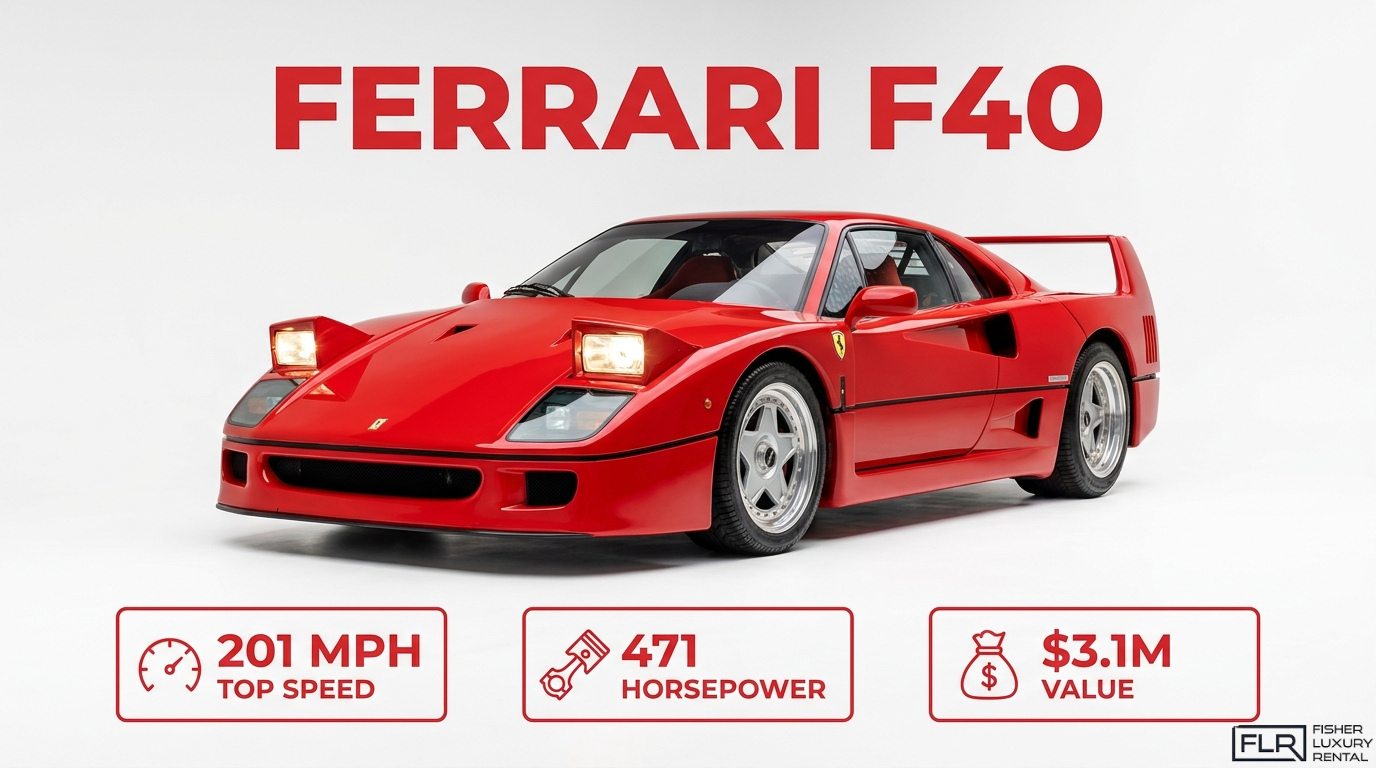
The Ferrari F40 is a mid-engine, twin-turbocharged V8 supercar built between 1987 and 1992 as Ferrari’s 40th anniversary car and Enzo Ferrari’s final personally approved project. Conceived as a road-legal race car rather than a grand tourer, it became the first production car to break the 200 mph barrier.
This guide covers the F40’s origins and engineering heritage, its full technical specifications, what makes its design and construction unique, how it compares to its era’s greatest rivals, what it’s worth in 2026, the variants produced, and what buyers and enthusiasts need to know before engaging with one.
The F40 was created in just 13 months under Enzo Ferrari’s direct mandate, with Chief Engineer Nicola Materazzi building on the 288 GTO Evoluzione’s chassis and engine to meet an 11-month deadline. That race-derived foundation is what separates it from every anniversary Ferrari before it.
Its 2.9-liter twin-turbocharged V8 produces 471 hp, propels the car to 60 mph in 3.8 seconds, and achieves 201 mph, all from a car weighing approximately 2,425 lbs thanks to 11 composite panels woven from carbon fiber, Kevlar, and Nomex.
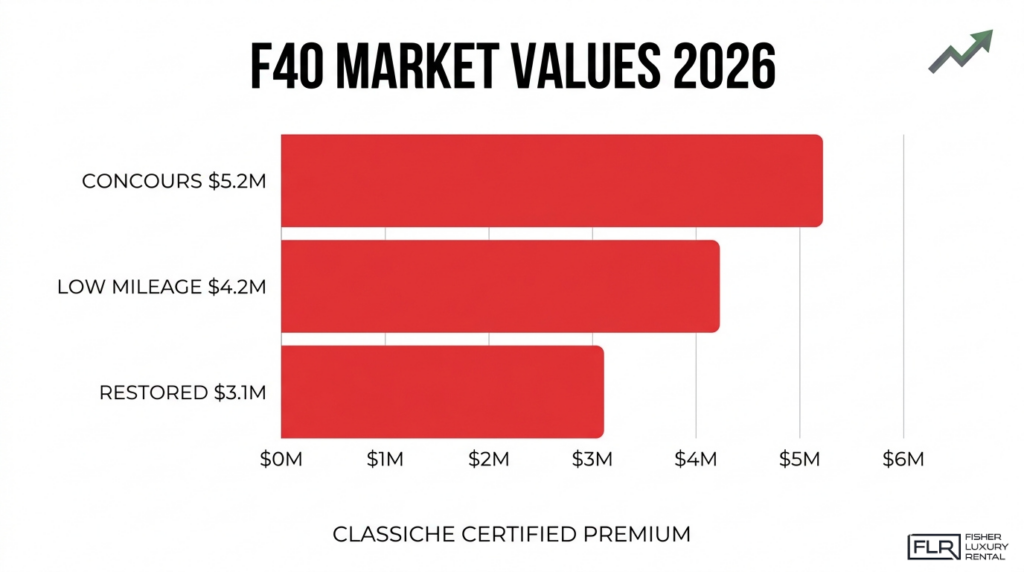
In 2026, standard road cars are valued between $3.1 million and $5.2 million, with European “non-cat, non-adjust” examples commanding a premium and the F40 LM auction record reaching $11,005,000. Ferrari Classiche certification and provenance are the dominant value drivers.
For enthusiasts who want to experience Ferrari’s competition DNA without the ownership cost, exotic rental access remains the most practical entry point available today.
Why Was the Ferrari F40 Created?
The Ferrari F40 was created to celebrate Ferrari’s 40th anniversary and embody Enzo Ferrari’s personal vision for the ultimate road car. The following sections cover Enzo’s direct role in the project, the 1987 launch milestone, and how the F40 differed from Ferrari’s earlier anniversary models.
What Role Did Enzo Ferrari Play in the F40’s Development?
Enzo Ferrari played a direct, hands-on role in the F40’s development, personally setting the performance mandate and timeline. He requested that the car be completed within 11 months, a constraint that shaped every engineering decision. Chief Engineer Nicola Materazzi met that demand by using the 288 GTO Evoluzione’s experimental chassis and engine as the technical foundation, allowing the team to build on proven hardware rather than starting from scratch. This pragmatic approach, born from Enzo’s urgency, is precisely what gives the F40 its race-derived character. Without his direct intervention, the car would likely have emerged as a more conventional grand tourer.

What Was Ferrari Celebrating With the F40’s Launch in 1987?
The Ferrari F40’s launch in 1987 marked Ferrari’s 40th anniversary as an automaker. Enzo Ferrari revealed the car at a press event on July 21, 1987, where he stated: “I expressed my wish to the engineers: build a car to be the best in the world. And now the car is here.” The project began on June 10, 1986, meaning the entire development spanned just 13 months, an extraordinary timeline for a supercar of this complexity.
How Did the F40 Differ From Ferrari’s Previous Anniversary Models?
The F40 differed from Ferrari’s previous anniversary models by rejecting the grand tourer formula entirely. Unlike the 250 GT and 275 GTB, which were front-engined V12 grand tourers built for comfort and elegance, the F40 was a mid-engine, twin-turbocharged V8 engineered as a road-legal race car. Its creation was an explicit response to the perception that Ferraris had become too plush and comfortable, prioritizing raw mechanical performance over refinement. That distinction makes the F40 the most uncompromising milestone car Ferrari has ever built.
What Is the History of the Ferrari F40?
The history of the Ferrari F40 spans a focused five-year production run rooted in racing heritage and anniversary ambition. The following sections cover its developmental lineage from the 288 GTO Evoluzione, its production timeline, total units built, and why Ferrari ultimately exceeded its original volume target.
How Did the F40 Evolve From the 288 GTO Evoluzione?
The F40 evolved from the 288 GTO Evoluzione, a Group B racing prototype that was never campaigned after the category was cancelled in 1986. Rather than abandon the work, Chief Engineer Nicola Materazzi used the Evoluzione’s experimental chassis and engine as the direct technical foundation for the F40. This decision allowed Ferrari to complete the project within the strict timeline Enzo Ferrari had requested, preserving competition-grade engineering in a road-legal package.
What Happened During the F40’s Production Run From 1987 to 1992?
The F40’s production run lasted from 1987 to 1992, beginning with its public debut on July 21, 1987, as Ferrari’s 40th anniversary centerpiece. Throughout this period, the car was built using composite bodywork and twin-turbocharged V8 technology derived from motorsport. Unlike contemporary Ferraris trending toward comfort, the F40 was positioned as a raw, road-legal race car, a deliberate philosophical reset under Enzo Ferrari’s direct instruction.
How Many Ferrari F40s Were Produced?
Ferrari F40 total production reached 1,311 units, with some sources citing 1,315, between 1987 and 1992. Unlike the front-engined V12 grand tourers that preceded it, such as the 250 GT and 275 GTB, the F40 was a mid-engine twin-turbocharged V8 conceived specifically to counter Ferraris becoming “too plush and comfortable.”
Why Did Ferrari Extend Production Beyond the Original 400 Units?
Ferrari extended F40 production beyond the original 400-unit plan to satisfy overwhelming global demand, ultimately building 1,311 units across the full run. According to Hagerty, 213 of those units were built specifically for the United States market, featuring rubber bumper strips and modified engine tuning to meet EPA and DOT regulations. This market-specific adaptation reflects how broadly demand materialized beyond Ferrari’s initial expectations. The U.S. specification changes also explain why European “non-cat, non-adjust” examples are often considered mechanically purer by collectors today.
What Are the Key Specifications of the Ferrari F40?
The key specifications of the Ferrari F40 cover its 2.9-liter twin-turbocharged V8 engine, 478 PS output, 201 mph top speed, 3.8-second 0-60 time, 1,100 kg curb weight, and 5-speed manual transmission. Each sub-section below details one core specification.
What Engine Powers the Ferrari F40?
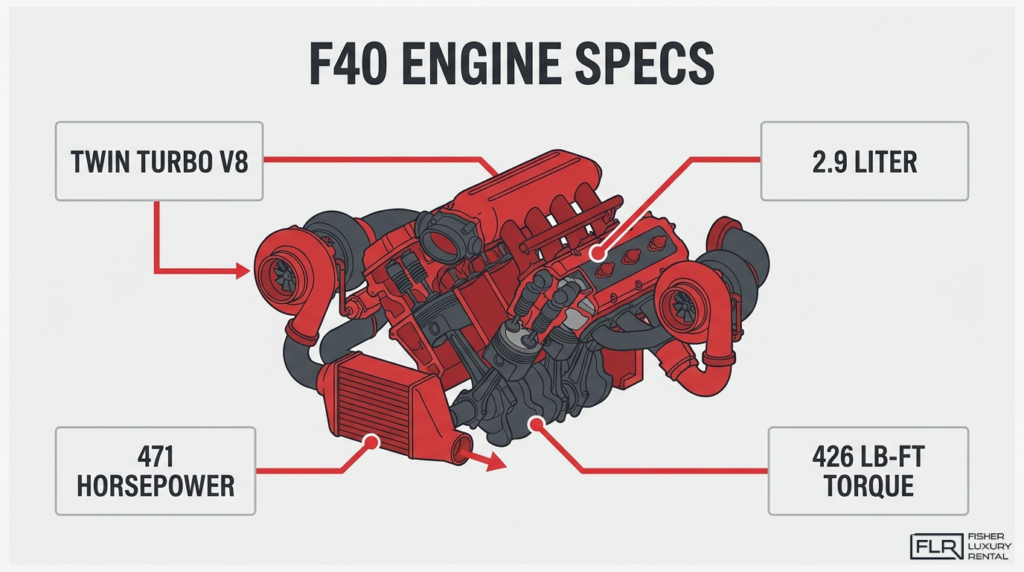
The engine powering the Ferrari F40 is a 2,936 cc (2.9-liter) 90-degree V8 with twin IHI turbochargers. Mounted mid-rear, it produces 478 PS (471 hp) and 426 lb-ft of torque. Ferrari Classiche certification, the “Red Book,” authenticates matching numbers for the engine, gearbox, and chassis, directly impacting resale value. According to collector specialist Andrew Goldberg, “The F40 represented a turning point in the evolution of performance engineering… its lightweight composite construction and exposed mechanical character created a car that felt inseparable from Ferrari’s competition heritage.”
How Much Horsepower Does the Ferrari F40 Produce?
The Ferrari F40 produces 478 PS (471 hp) at peak output. That figure comes from the twin-turbocharged 2.9-liter V8 paired with 426 lb-ft of torque, giving the car a power-to-weight ratio that remained unmatched among road cars of its era. For a road-legal vehicle with no electronic aids, that output is exceptional even by modern standards.
What Is the Ferrari F40’s Top Speed?
The Ferrari F40’s top speed is a factory-claimed 201 mph (324 km/h), making it the first production car to break the 200 mph barrier. According to Sotheby’s, this milestone cemented the F40’s status as the fastest road car in the world at the time of its 1987 launch.
How Fast Does the Ferrari F40 Accelerate From 0 to 60 MPH?
The Ferrari F40 accelerates from 0 to 60 mph in 3.8 seconds. Combined with its 201 mph top speed, this acceleration figure confirmed the F40 as a genuine benchmark for production car performance in the late 1980s. Few road cars of that generation came close to matching both metrics simultaneously.
What Is the Curb Weight of the Ferrari F40?
The curb weight of the Ferrari F40 is approximately 1,100 kg (2,425 lbs) for European “non-cat, non-adjust” versions. Ferrari achieved this through extensive use of Kevlar, carbon fiber, and Nomex composites throughout the body and structure. For context, Michelotto’s 19 F40 LM competition cars reduced this figure further still, with engines uprated to approximately 760 hp.
What Transmission Does the Ferrari F40 Use?
The transmission the Ferrari F40 uses is a 5-speed manual gearbox, driving the rear wheels. There are no paddle shifters, no sequential automation, and no electronic intervention between driver and drivetrain. That deliberate mechanical simplicity is central to the F40’s identity as a driver-focused machine rather than a technologically mediated one.
What Makes the Ferrari F40’s Design and Construction Unique?
The Ferrari F40’s design combines lightweight composite materials, functional aerodynamics, and a deliberately stripped-down mechanical philosophy. The sections below cover why Ferrari chose carbon fiber and Kevlar, which aerodynamic features define the body, and why the F40 intentionally excludes driver aids like power steering and ABS.
Why Did Ferrari Use Kevlar and Carbon Fiber in the F40?
Ferrari used Kevlar and carbon fiber in the F40 to achieve an extreme power-to-weight ratio that no conventional steel or aluminum construction could match. The F40’s bodywork consists of 11 panels made from a weave of carbon fiber, Kevlar, and Nomex, bonded with epoxy resin to provide structural rigidity while minimizing weight. According to DK Engineering, this composite construction helped bring the European curb weight to approximately 1,100 kg (2,425 lbs). Nomex added fire resistance alongside structural benefit, a direct carryover from Formula 1 construction methods of that era.
What Aerodynamic Features Define the F40’s Body?
The aerodynamic features that define the F40’s body are functional rather than decorative, shaped entirely around downforce and high-speed stability. A large rear wing generates rear downforce at speed, while a flat underbody and front splitter manage airflow beneath the car. The rear diffuser channels air efficiently away from the undertray. Ventilation louvers behind the front wheels reduce lift, and the sloping fastback roofline minimizes drag. Every surface serves a performance purpose, with no stylistic additions that compromise airflow.
Why Does the Ferrari F40 Lack Power Steering and ABS?
The Ferrari F40 lacks power steering and ABS because Ferrari deliberately omitted these systems to preserve a direct mechanical connection between the driver and the road. According to Autoevolution, Ferrari excluded power steering, power brakes, and ABS to reflect the car’s philosophy as a pure performance machine with no electronic buffer between driver input and vehicle response. This was a conscious design choice, not a cost-cutting measure. In an era when rivals were adding electronic complexity, the F40’s rawness was its defining competitive statement, and it remains the most viscerally engaging aspect of driving one today.
How Does the Ferrari F40 Compare to Other Supercars of Its Era?
The Ferrari F40 compares favorably against its era’s greatest rivals by prioritizing raw performance and minimal weight over technological complexity. The sections below examine its two most significant competitors: the Porsche 959 and the Lamborghini Countach.
How Does the F40 Compare to the Porsche 959?
The F40 compares to the Porsche 959 as a philosophically opposite machine built for the same era. According to the Porsche Club of America, the 959 was a “laboratory for the future,” featuring advanced all-wheel drive and electronic suspension, while the F40 was a Spartan road-legal race car with no electronic driver aids whatsoever. Where Porsche pursued technological sophistication, Ferrari pursued mechanical purity. For drivers who want total, unfiltered engagement, the F40’s approach remains the more compelling choice.
How Does the F40 Compare to the Lamborghini Countach?
The F40 compares to the Lamborghini Countach as a function-first design against a theater-first icon. While the Countach delivered a brutal naturally aspirated V12 and theatrical wedge styling, the F40 prioritized functional aerodynamics and lightweight composite construction derived directly from Formula 1 technology. The Countach commands a room; the F40 commands a lap record. Both are era-defining supercars, but they represent fundamentally different answers to the question of what a supercar should be.
What Is the Ferrari F40 Worth in 2026?
The Ferrari F40’s market value in 2026 spans a wide range depending on specification, provenance, and certification status. The sections below cover average pricing, historical price trends, key value drivers, and the US versus European market premium.
What Is the Average Market Value of a Ferrari F40 in 2026?
The average market value of a Ferrari F40 in 2026 ranges from $3.1 million for restored examples to over $5.2 million for historically significant, low-mileage “non-cat, non-adjust” cars, according to current market data. Ferrari Classiche certification, matching numbers, and documented service history push valuations toward the upper end of that range.
Younger collectors are driving sustained demand. According to CNBC’s 2025 reporting, the collector car market continues to show strong momentum for “analog” supercars like the F40, fueled by buyers seeking visceral, unassisted driving experiences in an increasingly digital era. This generational demand shift shows no sign of reversing, making the F40 one of the most defensible stores of value in the collector car market today.
How Have Ferrari F40 Prices Changed Over the Past Decade?
Ferrari F40 prices have appreciated significantly over the past decade, rising from the $400,000–$700,000 range in the mid-2010s to multi-million dollar transactions by the early 2020s. The August 2025 sale of a 1993 Ferrari F40 LM by Michelotto for $11,005,000 at RM Sotheby’s set a new benchmark for the most expensive F40 variant ever sold at auction.
Standard road cars followed a parallel upward trajectory. Low-mileage, single-owner examples with clean provenance led that appreciation, while restored or high-mileage cars lagged the market. The pace of appreciation has been most dramatic since 2020, coinciding with the documented ownership shift toward younger, high-net-worth collectors.
What Factors Increase a Ferrari F40’s Value?
Several key factors increase a Ferrari F40’s value above the market average:
- Ferrari Classiche “Red Book” certification: Authenticates matching engine, gearbox, and chassis numbers, directly increasing resale value.
- “Non-cat, non-adjust” European specification: Lighter weight and perceived mechanical purity command a premium over US-spec cars.
- Low, documented mileage: Unrestored, original-condition cars with verifiable service histories attract the strongest bids.
- Single ownership history: Fewer owners reduces provenance risk, a major concern for six-figure-plus transactions.
- Original paint and interior: Unmodified presentation preserves collectibility and avoids authentication complications.
- Auction-house provenance: Cars with documented major sale history carry additional market credibility.
Ferrari Classiche certification is arguably the single most impactful factor. Without it, even a low-mileage car faces significant buyer skepticism at this price level.
What Is the Price Difference Between US and European Market F40s?
The price difference between US and European market F40s favors European-spec cars, with “non-cat, non-adjust” examples commanding a clear premium over US-spec counterparts due to their lighter curb weight and perceived mechanical purity. US-spec cars carry rubber bumper strips and modified engine tuning required to meet EPA and DOT regulations, both of which collectors view as deviations from the car’s original intent.
However, quantifying the exact differential remains one of the more frequently unaddressed questions in the F40 market. When both a US-spec and a European-spec car share similar low mileage and Classiche certification, the precise price gap is difficult to isolate from other provenance variables. Buyers evaluating cross-market purchases should treat spec as one factor within a broader due diligence process, not a fixed premium formula.
What Are the Different Ferrari F40 Variants?
The Ferrari F40 variants include the standard production road car, the F40 LM, the F40 GTE, and the F40 Competizione. Each version served a distinct purpose, from street use to full endurance racing competition.
Ferrari F40 Standard Production
The Ferrari F40 standard production car is the road-going version built between 1987 and 1992, totaling 1,311 units. Ferrari originally planned only 400 examples, but overwhelming global demand extended the run. Of those produced, 213 units were built specifically for the U.S. market, featuring rubber bumper strips and revised engine tuning to satisfy EPA and DOT regulations. European-spec cars, known as “non-cat, non-adjust” versions, are considered mechanically purer and remain more desirable among collectors today.
Ferrari F40 LM
The Ferrari F40 LM is a factory-sanctioned competition variant prepared by Michelotto Automobili for endurance racing, including Le Mans. Michelotto built 19 F40 LM cars in total, each featuring uprated engines producing approximately 760 hp alongside a significantly reduced curb weight versus the road car. According to RM Sotheby’s, a 1993 F40 LM sold for $11,005,000 in August 2025, making it the most expensive F40 variant ever sold at auction. The F40 LM represents the pinnacle of the model’s competition lineage.
Ferrari F40 GTE
The Ferrari F40 GTE is an evolution of the LM specification, developed in the early 1990s to comply with updated GT endurance racing regulations. Michelotto again handled the conversion work, refining aerodynamics, upgrading the sequential gearbox, and modifying the engine management system. The GTE competed in series including the BPR Global GT Series and served as a bridge between the raw LM spec and more structured GT racing classes of the mid-1990s.
Ferrari F40 Competizione
The Ferrari F40 Competizione is an umbrella designation covering F40s prepared by Michelotto to various competition specifications beyond standard road trim. These cars were converted from existing road cars at customer request and could be configured to LM or GTE levels depending on the racing series targeted. Unlike the LM, which was purpose-built from the outset, Competizione cars began as production units and were subsequently modified, making their specifications variable and their provenance individually important to buyers.
What Should Buyers Know Before Purchasing a Ferrari F40?
Buyers should know that purchasing a Ferrari F40 requires thorough due diligence across maintenance history, provenance verification, and ongoing ownership costs. The sections below cover the most critical issues: common mechanical concerns, authentication standards, and annual maintenance expenses.
What Are Common Maintenance Issues With the Ferrari F40?
Common maintenance issues with the Ferrari F40 include fuel system degradation, turbocharger wear, and composite bodywork fragility. The most serious concern is the internal rubber fuel bladders, which degrade over time and present a genuine fire hazard. These bladders require replacement every 10 years at an estimated cost of $12,000 to $15,000, according to FerrariChat ownership discussions. Turbo seals, cooling system hoses, and the wiring harness are also known wear items given the car’s age. Buyers should budget for these proactively, as neglected examples can carry significant deferred maintenance costs that far exceed the price differential between a well-maintained and a distressed car.
How Do You Authenticate a Genuine Ferrari F40?
Authenticating a genuine Ferrari F40 requires Ferrari Classiche certification, commonly known as the “Red Book.” This program verifies matching numbers for the engine, gearbox, and chassis, and its presence significantly impacts resale value. Beyond Classiche, buyers should commission an independent pre-purchase inspection from a marque specialist familiar with F40-specific build sheets and factory documentation. Confirm the car’s production record against the total run of approximately 1,311 units, and verify whether it is a U.S.-spec car with rubber bumper strips or a European “non-cat, non-adjust” example, as each has distinct documentation.
What Does It Cost to Maintain a Ferrari F40 Annually?
Annual Ferrari F40 maintenance costs vary considerably depending on usage and the car’s service history, but owners consistently report four- to five-figure annual expenses even for low-mileage examples. Routine items include annual servicing, fluid replacement, tire replacement, and belt inspections. Major scheduled work, such as fuel bladder replacement, can add $12,000 to $15,000 in any given year. Storage, specialist labor rates, and insurance on a vehicle valued between $3.1 million and $5.2 million add further to the total. Prospective buyers should treat maintenance budgeting as essential as the purchase price itself.
How Can You Experience a Ferrari Without Buying One?
Experiencing a Ferrari without buying one is possible through exotic car rental companies that offer factory-spec supercars by the day. The H3s below cover Fisher Luxury Rental’s Ferrari offerings and the key takeaways from this article.
Can Fisher Luxury Rental Help You Drive an Exotic Ferrari?
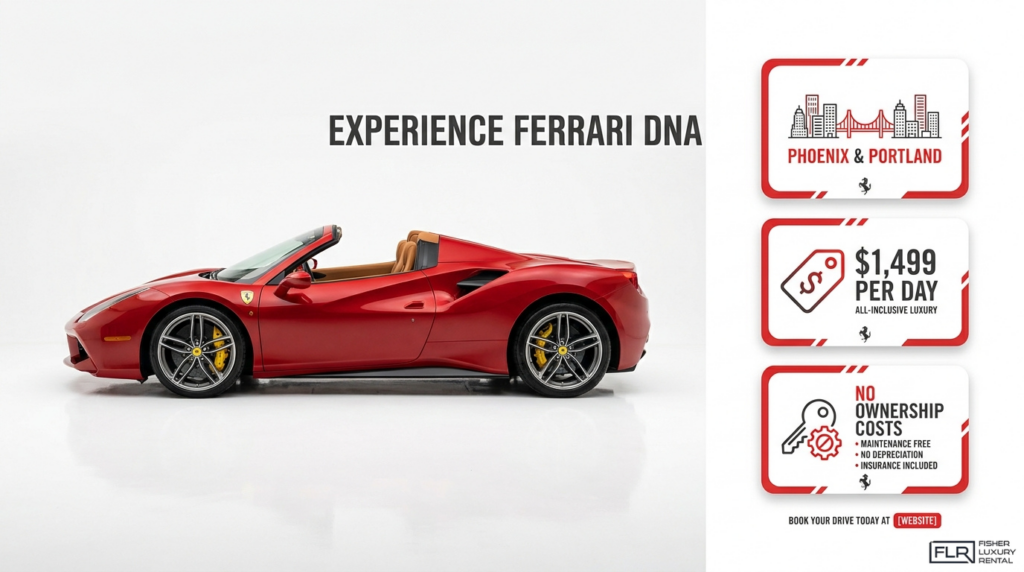
Yes, Fisher Luxury Rental can help you drive an exotic Ferrari through its rental fleet, which includes the Ferrari California T Convertible and the Ferrari 488 Spider. Based in Phoenix, AZ and Portland, OR, Fisher Luxury Rental offers top-trim vehicles with no compromises on specification or condition. The Ferrari 488 Spider, available at $1,499 per day, delivers a mid-engine twin-turbocharged experience that shares the same performance DNA as the legendary F40. For enthusiasts who want to feel a Ferrari’s raw, visceral character without the $3 million-plus ownership price tag, rental access is the most practical entry point available today.
What Are the Key Takeaways About the Ferrari F40’s History, Specs, and Market Value in 2026?
The key takeaways about the Ferrari F40’s history, specs, and market value in 2026 are:
- Origin: Ferrari developed the F40 in just 13 months to celebrate the company’s 40th anniversary in 1987, making it Enzo Ferrari’s final approved project.
- Engineering: The F40 uses a 2.9L twin-turbocharged V8 producing 471 hp, achieving a 201 mph top speed and 0–60 mph in 3.8 seconds.
- Construction: Bodywork consists of 11 Kevlar, carbon fiber, and Nomex composite panels, keeping curb weight at approximately 2,425 lbs.
- Production: Ferrari built 1,311 units between 1987 and 1992, including 213 U.S.-spec cars.
- Market value: According to RM Sotheby’s, standard road-going F40s are valued between $3.1 million and $5.2 million in 2026, with the F40 LM auction record reaching $11,005,000.
- Variants: The range includes the standard road car, the F40 LM, the GTE, and the Competizione competition builds.
- Ownership: Ferrari Classiche certification and European “non-cat, non-adjust” specification are the two strongest drivers of premium valuation.
The F40 remains the clearest expression of Ferrari’s competition-bred philosophy, and rental access through Fisher Luxury Rental offers the closest attainable experience for drivers who want to understand that legacy firsthand.