The Ferrari F40 is a mid-engine, rear-wheel-drive supercar created through a precise collaboration between chief engineer Nicola Materazzi and Pininfarina’s design studio, commissioned personally by Enzo Ferrari to mark 40 years of Ferrari road car production.
This guide covers the designers and engineers behind the F40, the vision that drove its creation, the design philosophy that shaped every surface, its technical innovations, and the cultural legacy it carries today.
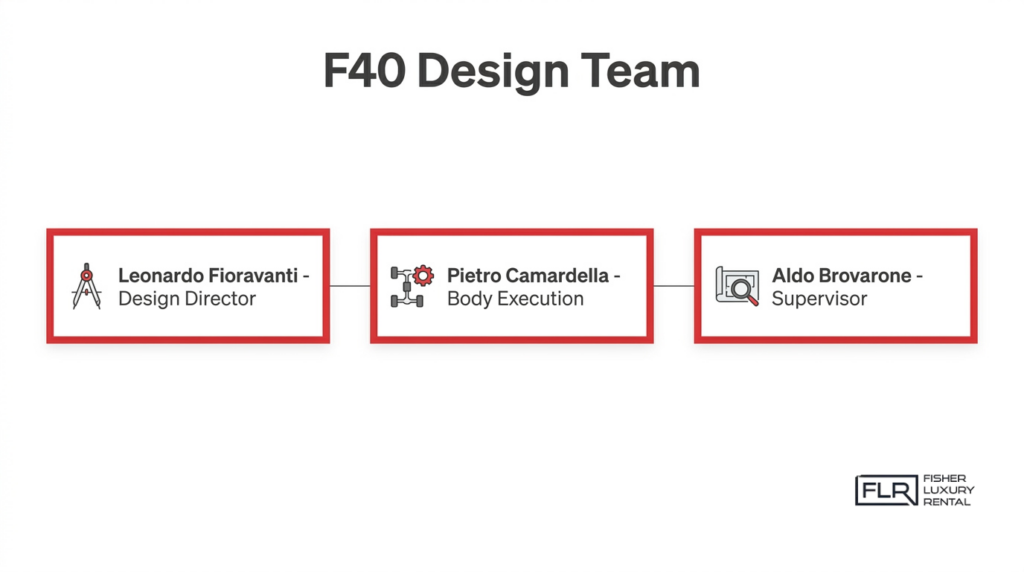
Pininfarina’s Leonardo Fioravanti led the exterior design direction, with Pietro Camardella executing the body under Aldo Brovarone’s supervision. Their angular geometry and aerodynamic intent produced one of the most recognizable silhouettes in automotive history.
Nicola Materazzi, known as the “father of the Ferrari F40,” built the car’s mechanical foundation on the 288 GTO Evoluzione prototype, bringing the project from concept to production in just 11 months. Enzo Ferrari’s brief demanded a pure driver’s machine stripped of all comfort, and that directive shaped every decision from the composite bodywork to the twin-turbocharged V8.
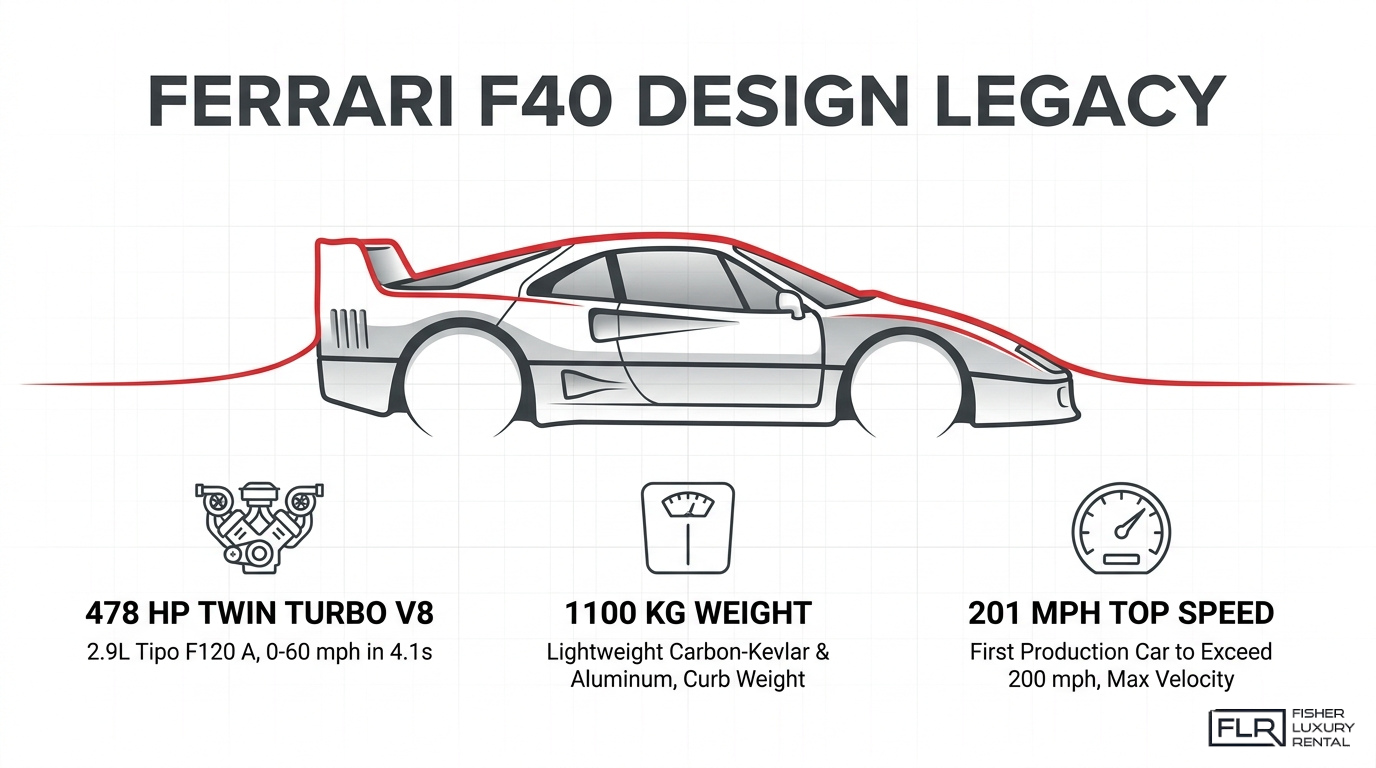
The F40’s design philosophy placed function above luxury absolutely, using Kevlar and carbon fiber panels, eliminating ABS and power steering, and applying paint so thinly that the weave beneath remained visible. Those choices produced a 1,100 kg car capable of 201 mph.
Its influence carried directly into the F50, Enzo, and LaFerrari lineage, reshaped industry expectations for road-legal supercars, and built a collector market where examples now regularly sell above $3.5 million, with competition variants exceeding $11 million at auction.
Who Was the Lead Designer of the Ferrari F40?
The Ferrari F40’s design was a collaborative effort between Pininfarina’s studio team and Ferrari’s engineering leadership. The following sections cover Pininfarina’s exterior role, Leonardo Fioravanti’s creative influence, and Aldo Brovarone’s supervisory contribution.
What Role Did Pininfarina Play in the F40’s Exterior Design?
Pininfarina played the central role in shaping the F40’s exterior, with Pietro Camardella executing the body design under the supervision of Aldo Brovarone. Leonardo Fioravanti of Pininfarina, a long-time Ferrari collaborator, led the overall design direction and worked closely with Camardella throughout the process. According to Classic Driver, Fioravanti credited Brovarone specifically, noting that for the F40, “Aldo Brovarone placed at right angles, made it famous.” The result was one of the most aerodynamically aggressive silhouettes ever worn by a road car.
How Did Leonardo Fioravanti Influence the F40’s Shape?
Leonardo Fioravanti’s influence on the F40’s shape came from a design philosophy that treated form and function as inseparable. The designer behind the Daytona, the 308, and the F40 once stated: “A Ferrari must be both art and science, otherwise it is just a machine.” That principle is visible in every surface of the F40, where bodywork follows airflow rather than aesthetic convention. Fioravanti’s oversight ensured the car’s lines served performance, not decoration.
Who Was Aldo Brovarone and What Did He Contribute?
Aldo Brovarone was the Pininfarina supervisor who oversaw Pietro Camardella’s execution of the F40’s body design. His directional decisions, particularly the angular geometry he imposed on the car’s proportions, gave the F40 its distinctively aggressive stance. Fioravanti’s attribution to Brovarone for making the F40 “famous” through those right-angle design choices underscores how much the car’s visual identity owed to his guidance. Brovarone’s contribution is often underestimated, but his structural decisions shaped the icon as much as any single sketch.
Who Were the Key Engineers Behind the Ferrari F40?
The key engineers behind the Ferrari F40 include chief engineer Nicola Materazzi, whose mechanical expertise shaped the car’s structure, and the 288 GTO Evoluzione development team, whose prototype work made production possible.
What Was Nicola Materazzi’s Role as Chief Engineer?
Nicola Materazzi’s role as chief engineer was to lead the full mechanical development of the Ferrari F40. The Ferrari F40 (Type F120) is a mid-engine, rear-wheel drive sports car engineered by Materazzi, with styling handled by Pininfarina. Known as the “father of the Ferrari F40,” Materazzi passed away in 2022 aged 83, leaving behind one of the most celebrated engineering legacies in automotive history. His ability to balance extreme performance with a buildable road car architecture is what makes the F40’s creation genuinely remarkable.
How Did the 288 GTO Evoluzione Team Shape the F40 Project?
The 288 GTO Evoluzione team shaped the F40 project by providing the mechanical foundation the car was built upon. According to the Audrain Automobile Museum, Materazzi convinced Enzo Ferrari and Ferrari management to use the 288 Evoluzione as a prototype for a production road car, and in just 11 months, the F40 progressed from concept to a full production model. That compressed timeline reflects the depth of engineering groundwork the Evoluzione team had already completed, making the F40’s development far more focused than a clean-sheet program would have allowed.
Why Did Enzo Ferrari Commission the F40?
Enzo Ferrari commissioned the F40 to mark 40 years of Ferrari road car production, presenting it as a personal statement before his death in August 1988. The sections below cover his original vision for the car and how the 288 GTO program directly shaped its development.
What Was Enzo Ferrari’s Vision for His Final Car?
Enzo Ferrari’s vision for his final car was to build the most extreme road-legal Ferrari ever made: a pure driver’s machine stripped of comfort in favor of performance. The F40 was the last car unveiled to the public in Enzo Ferrari’s presence, according to Ferrari S.p.A., making it an intensely personal legacy project. He wanted owners to experience the car exactly as a racing driver would, with no electronic aids softening the connection between driver and machine. That philosophy shaped every decision that followed, from the composite bodywork to the twin-turbocharged engine.
How Did the Ferrari 288 GTO Lead to the F40’s Development?
The Ferrari 288 GTO led directly to the F40’s development by providing both its mechanical foundation and its competitive ambition. When the Group B racing series was cancelled, Ferrari was left with a highly developed 288 GTO Evoluzione prototype and nowhere to race it. Nicola Materazzi recognized the platform’s potential and convinced Enzo Ferrari to transform it into a road car. The resulting F40 retained the twin-turbocharged V8 architecture, producing 478 hp at 7,000 rpm and 577 Nm of torque at 4,000 rpm, per Ferrari’s official technical data. Without the 288 GTO program, the F40’s engineering brief would never have existed in its final form.
What Design Philosophy Guided the Ferrari F40’s Creation?
The design philosophy that guided the Ferrari F40’s creation was a strict commitment to performance over comfort, where every element served a functional purpose. The three H3s below cover the prioritization of function over luxury, aerodynamic intent, and the central role of lightweight materials.
Why Did the Designers Prioritize Function Over Luxury?
The designers prioritized function over luxury because Enzo Ferrari’s brief demanded a pure driver’s car with no concessions to comfort. The F40 was devoid of anything not directly involved in the driving experience, including no ABS, no power steering, and no traction control. Carpets, door handles, and sound insulation were eliminated entirely. In an era when rival manufacturers were adding electronic aids, this philosophy was a deliberate statement. Stripping a car to its essentials is not a shortcut; it is the hardest design discipline to execute well.
How Did Aerodynamics Shape the F40’s Iconic Body Lines?
Aerodynamics shaped the F40’s iconic body lines by dictating every major surface, from the aggressive front splitter to the prominent rear wing. The low-slung nose channels airflow beneath the car to generate downforce, while the large rear spoiler stabilizes the vehicle at high speeds. Functional NACA ducts feed cooling air directly to the engine and brakes rather than serving as decorative trim. Leonardo Fioravanti’s principle that a Ferrari must be “both art and science” is embodied here: every curve had an aerodynamic justification, yet the result is unmistakably beautiful.
Why Were Lightweight Materials Central to the Design Brief?
Lightweight materials were central to the design brief because reducing mass was the most direct path to performance gains. The F40 was the first Ferrari production car to use mainly composite materials for its body panels, which totalled only eleven pieces due to large single-unit front and rear sections, according to Ferrari’s official technical data. The dry weight reached just 1,100 kg, an extraordinary figure for a 478 hp road car. Ferrari applied paint so thinly that the Kevlar weave remained visible beneath the surface, making weight savings a visible, tactile design choice rather than an invisible engineering detail.
What Technical Innovations Did the F40 Introduce?
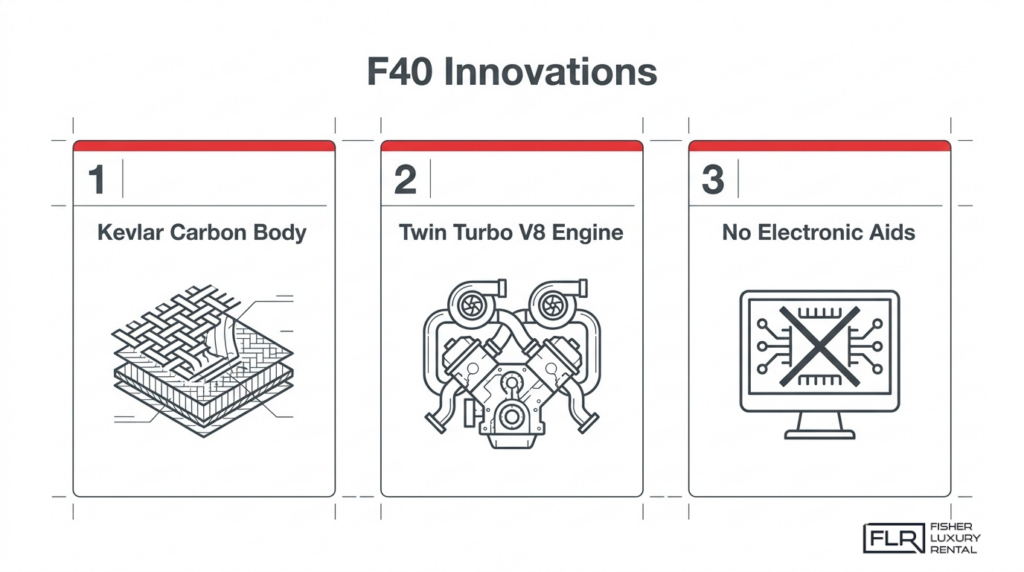
The F40 introduced three defining technical innovations: a composite Kevlar and carbon fiber body, a twin-turbocharged V8 engine, and a deliberately stripped-out driver interface with no electronic aids. Each sub-section below covers one of these breakthroughs in detail.
How Did the Kevlar and Carbon Fiber Body Break New Ground?
The Kevlar and carbon fiber body broke new ground by making the F40 the first Ferrari production car to use composite materials for its body panels. According to Ferrari’s official technical documentation, those panels totaled only eleven pieces, enabled by large single-unit front and rear sections. Ferrari applied such a thin coat of paint that the Kevlar weave remains visible through the finish, a deliberate choice that kept the dry weight to just 1,100 kg. That combination of structural composites and radical weight discipline set a new benchmark for road-legal supercars.
What Made the Twin-Turbocharged V8 Revolutionary?
The twin-turbocharged V8 was revolutionary because it paired forced induction with a mid-engine, rear-wheel-drive layout to produce 478 hp at 7,000 rpm and 577 Nm of torque at 4,000 rpm from a 2,936 cc displacement. The engine used twin IHI turbochargers, a setup adapted directly from Ferrari’s motorsport program. That power output, delivered through such a compact and lightweight platform, produced a claimed top speed of 324 km/h (201 mph) and a 0-to-100 km/h time of 4.1 seconds. For a road-legal car in 1987, those figures were genuinely unprecedented.
Why Was the F40’s Lack of ABS and Power Steering Intentional?
The F40’s lack of ABS, power steering, and traction control was intentional because the car was designed to contain only what directly served the driving experience. According to the Audrain Automobile Museum, the F40 was devoid of anything not directly involved in that experience. Every excluded system saved weight and preserved unfiltered mechanical feedback between driver and car. This philosophy was the design team’s clearest statement: the F40 was built to be driven by a skilled pilot, not managed by electronics.
How Did the Ferrari F40 Influence Future Supercar Design?
The Ferrari F40 redefined what a road-legal supercar could be, establishing benchmarks that modern high-performance cars still reference. The following sections cover its direct lineage within Ferrari’s model lineup and its broader impact on industry expectations.
What Modern Ferraris Trace Their Lineage to the F40?
Modern Ferraris that trace their lineage to the F40 include the F50, Enzo, LaFerrari, and SF90 Stradale, each carrying forward the F40’s core philosophy: extreme performance through minimal mass and maximum mechanical engagement. The F40’s use of composite body panels, a mid-mounted twin-turbocharged V8, and a stripped cabin set the structural and philosophical template for every flagship Ferrari that followed. Its 1,100 kg dry weight demonstrated that reducing mass was the most direct path to performance, a principle Ferrari’s engineers have continued prioritizing decades later.
How Did the F40 Change Expectations for Road-Legal Supercars?
The F40 changed expectations for road-legal supercars by proving that a street-legal car could deliver genuine motorsport performance without electronic driver aids, luxury appointments, or comfort concessions. Before the F40, the assumption was that road cars required compromise. Producing 478 hp from a 2,936 cc twin-turbocharged V8 while weighing just 1,100 kg, it reached 201 mph and hit 100 km/h in 4.1 seconds on public roads. Its absence of ABS, power steering, and traction control signaled that driver skill, not technology, was the intended interface. That philosophy reshaped how rival manufacturers approached the supercar segment entirely.
What Is the Ferrari F40’s Cultural Legacy Today?
The Ferrari F40’s cultural legacy is one of the most enduring in automotive history, built on a combination of raw performance, emotional design, and irreplaceable historical significance. The sections below examine why collectors regard it as the definitive Ferrari and how auction results reflect its growing market value.
Why Do Collectors Consider the F40 the Most Iconic Ferrari?
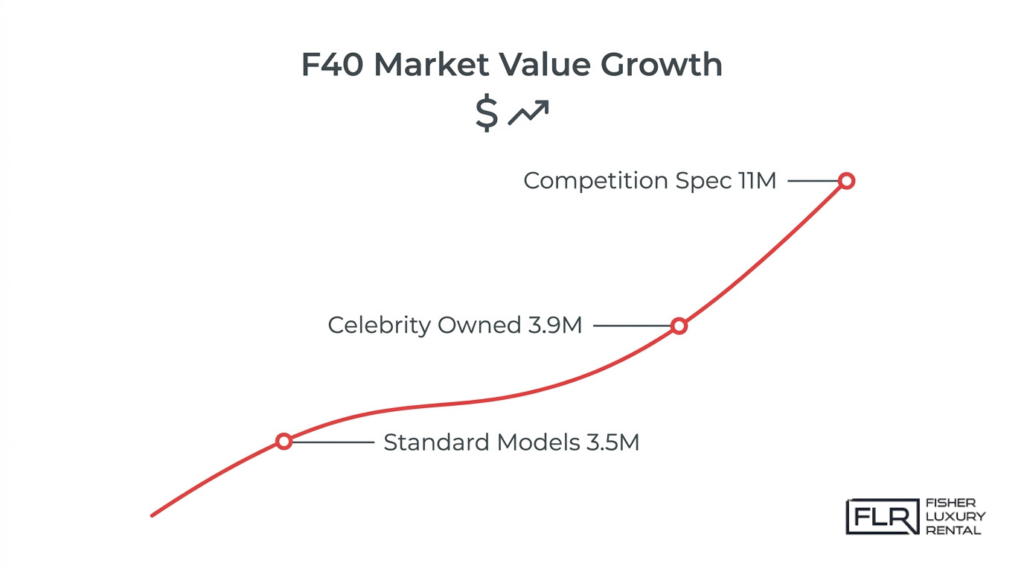
Collectors consider the F40 the most iconic Ferrari because it represents the last car personally unveiled by Enzo Ferrari before his death in August 1988, making every example a direct connection to the marque’s founding spirit. Its uncompromising driver focus, composite construction, and twin-turbocharged performance created a benchmark no subsequent road car could emotionally replicate. According to Sotheby’s, a 1993 Ferrari F40 LM by Michelotto sold for $11,005,000 in August 2025, confirming that the market treats competition-specification examples as irreplaceable artifacts rather than appreciating cars.
How Has the F40’s Value Evolved in the Classic Car Market?
The F40’s value in the classic car market has evolved from a celebrated production supercar into a multi-million-dollar collectible with consistently rising auction results. Standard road examples now regularly achieve prices between $3.5 million and $3.9 million at major auctions, while provenance and specification drive premiums well beyond that baseline. A 1990 example delivered to four-time Formula 1 World Champion Alain Prost sold for $3,886,250 in December 2025, illustrating how celebrity ownership amplifies an already exceptional market position. This sustained appreciation reflects a broader collector consensus: the F40 is not simply vintage machinery but a cultural document of what Ferrari, Enzo, and the supercar era stood for.
How Can You Experience the Ferrari F40’s Design Legacy Today?
The Ferrari F40’s design legacy lives on through museum collections, auction houses, and rental fleets offering modern Ferraris that carry its bloodline. The sections below cover how Fisher Luxury Rental connects enthusiasts to that heritage and what key facts to remember about the F40’s creators.
Can You Rent a Ferrari from Fisher Luxury Rental to Feel That Supercar Heritage?
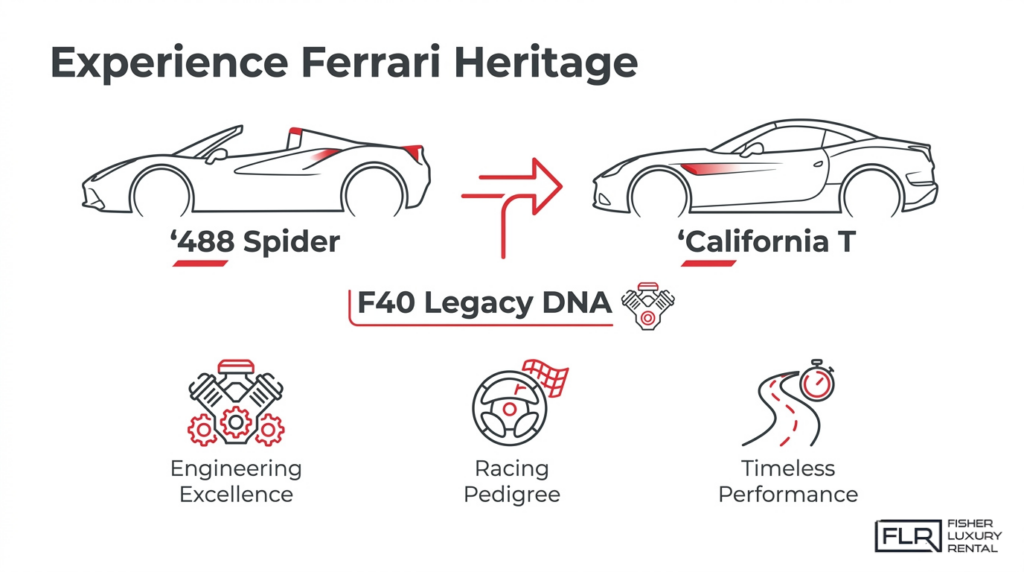
Yes, you can rent a Ferrari from Fisher Luxury Rental to feel that supercar heritage firsthand. Fisher Luxury Rental offers the Ferrari 488 Spider and Ferrari California T Convertible, both direct descendants of the engineering and design philosophy that made the F40 legendary.
The F40 hit 324 km/h (201 mph) and reached 100 km/h in 4.1 seconds, setting the benchmark every modern Ferrari is measured against. Its paint was applied so thinly that the Kevlar weaves beneath remained visible through the finish, according to the Audrain Auto Museum. That obsession with weight, performance, and purpose defines every Ferrari built since. Driving a modern Ferrari rental brings you closer to that legacy than any photograph or documentary ever could.
What Are the Key Takeaways About Who Designed the Ferrari F40?
The key takeaways about who designed the Ferrari F40 are that it was a collaboration between engineer Nicola Materazzi and Pininfarina’s design team, led by Leonardo Fioravanti with Pietro Camardella executing the body under Aldo Brovarone’s supervision. Enzo Ferrari personally commissioned the car to celebrate 40 years of the brand. Only 1,311 units were ever produced, making each one a piece of automotive history. The F40’s stripped-back philosophy, composite body, and twin-turbocharged V8 redefined what a road-legal supercar could be.