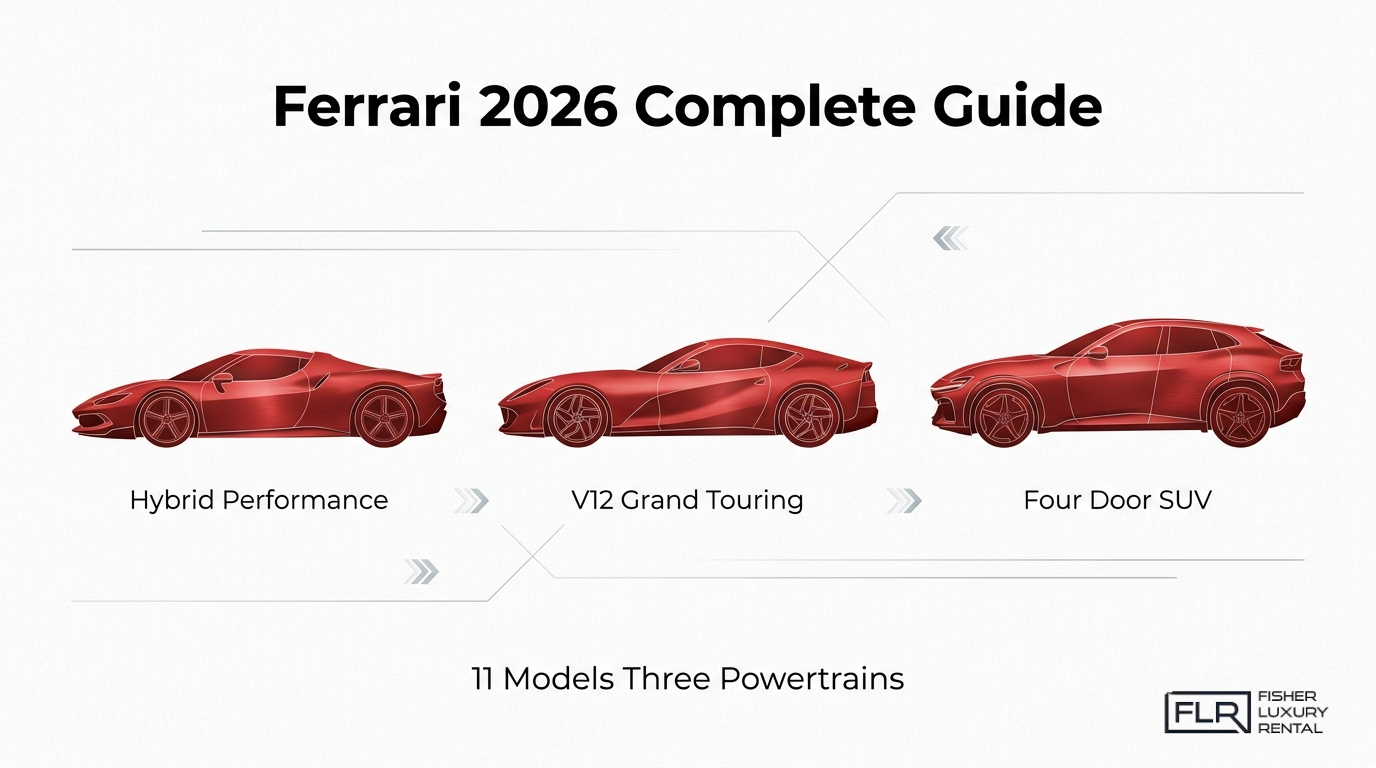
The 2026 Ferrari model lineup is the most technically diverse range in the brand’s history, spanning plug-in hybrid mid-engine sports cars, naturally aspirated V12 grand tourers, a four-door SUV, limited-edition special series builds, and the brand’s first fully electric model.
This guide covers the full production lineup and engine layout categories, the hybrid and electric strategy shaping Ferrari’s direction, how V6 and V12 philosophies compare, limited-edition and special series models, pricing across every tier, performance specifications by powertrain, daily driving suitability, how the 2026 range differs from previous years, and how to experience these cars through rental.
The 2026 production lineup spans eleven models across three powertrain types, ranging from the $274,965 Roma Spider to the $3,735,000 F80 hypercar, each with distinct engine configurations and performance outputs.
Engine layout divides the lineup into mid-engine performance cars and front-engine grand tourers, with placement determining handling character, cabin space, and intended use as much as output figures do.
Ferrari’s hybrid strategy now spans four PHEV models producing between 819 and 1,184 horsepower, while the Ferrari Luce, set to premiere on May 25, 2026, marks the brand’s first fully electric production car.
The V6 hybrid and V12 naturally aspirated lineups reach identical peak outputs through opposite means: battery-assisted torque fill versus high-revving mechanical drama, a distinction that defines buyer preference more than raw numbers alone.
Limited-edition models including the Daytona SP3, SP-8, and KC23 represent Ferrari’s Special Projects program at its most extreme, with the Daytona SP3 setting a record as the most valuable new car ever sold at auction.
Pricing, performance tiers, daily usability, lineup evolution, and rental access through Fisher Luxury Rental are covered in full across the sections below.
What Are the Current Ferrari Production Models Available in 2026?
The current Ferrari production models available in 2026 span three powertrain types: naturally aspirated V12, turbocharged V8, and plug-in hybrid V6 configurations. The sections below detail each model’s engine, output, and starting price.
Ferrari 296 GTB
The Ferrari 296 GTB is a mid-engine plug-in hybrid sports car that uses a 120° V6 engine paired with a PHEV system to deliver a combined 819 horsepower (830 cv), according to Ferrari of Fort Lauderdale. Starting at $338,250, it represents Ferrari’s entry point into electrified performance coupes. For buyers who want hybrid power without the full commitment of a flagship price, the 296 GTB is one of the most technically sophisticated values in the current lineup.
Ferrari 296 GTS
The Ferrari 296 GTS is the open-top Spider variant of the 296 GTB, sharing the same 120° V6 hybrid powertrain and 819 hp combined output. According to Car and Driver, the 296 GTS starts at $367,189. The $28,939 premium over the coupe buys a retractable hardtop and the same electrified driving experience in an open-air package.
Ferrari SF90 Stradale
The Ferrari SF90 Stradale is Ferrari’s most powerful series-production V8 hybrid, combining a 4.0-liter twin-turbo 90-degree V8 rated at 769 hp with three electric motors that add 217 hp for a total system output of 986 hp, according to Ferrari Lake Forest. It is Ferrari’s highest-output non-hypercar model in the 2026 lineup, sitting just below the F80 in the hierarchy.
Ferrari SF90 Spider
The Ferrari SF90 Spider is the convertible version of the SF90 Stradale, retaining the same 986 hp hybrid powertrain. It shares the SF90 platform’s all-wheel-drive architecture and electric front axle, delivering identical performance with a retractable hardtop roof. For drivers who want maximum V8 hybrid power alongside open-air driving, the SF90 Spider is the definitive choice.
Ferrari Roma
The Ferrari Roma is a front-engine grand tourer powered by a 3.9-liter twin-turbo V8 producing 612 horsepower and 561 lb-ft of torque, per The Car Guide. It is positioned as Ferrari’s most elegant and understated 2026 production model, targeting buyers who prioritize refined GT character over track-focused dynamics.
Ferrari Roma Spider
The Ferrari Roma Spider is the convertible variant of the Roma coupe, sharing the same 3.9-liter twin-turbo V8 with 612 hp and 561 lb-ft of torque. According to CarGurus, the Roma Spider starts at $274,965 MSRP. Its combination of grand touring comfort, open-air driving, and sub-$300,000 pricing makes it one of the more accessible Ferraris in the current range.
Ferrari 812 Competizione
The Ferrari 812 Competizione is a limited-production, track-focused evolution of the 812 Superfast, featuring a naturally aspirated V12 developed from Ferrari’s front-engine GT platform. It represents Ferrari’s highest-output naturally aspirated V12 configuration in the series-production coupe format, and production allocations have been fully distributed through authorized dealers.
Ferrari 812 Competizione A
The Ferrari 812 Competizione A is the open-top Aperta version of the 812 Competizione, retaining the naturally aspirated V12 drivetrain in a roadster body. Like the coupe variant, units have been allocated and are no longer available through new retail channels. Both Competizione models are considered collector-grade acquisitions given their limited build numbers.
Ferrari Purosangue
The Ferrari Purosangue is Ferrari’s first four-door, four-seat production model, equipped with a naturally aspirated V-12 producing 715 hp and 528 lb-ft of torque, with 80% of that torque accessible at just 2,100 rpm, according to Ferrari Silicon Valley. It starts at $428,636 in the United States. Ferrari has also introduced a “Handling Speciale” configuration featuring revised shift strategies for more dynamic performance at mid-to-high engine speeds.
Ferrari F80
The Ferrari F80 is Ferrari’s current hypercar flagship, powered by a mid-mounted 3.0-liter twin-turbo V6 paired with three electric motors producing a combined 1,184 horsepower and capable of reaching 62 mph in 2.15 seconds, according to Ferrari S.p.A. Priced at approximately $3,735,000 and limited to 799 units, all production has been spoken for. Automotive journalist Drew Dorian of Car and Driver describes the F80 as pushing “the boundaries of style, performance, and technology in just the way that a Ferrari flagship should.”
Ferrari 12Cilindri
The Ferrari 12Cilindri is a front-engine grand tourer powered by a naturally aspirated 6.5-liter V-12 producing 819 horsepower at 9,250 rpm and 500 lb-ft of torque at 7,250 rpm, according to Car and Driver. The coupe starts at $465,994. David Gluckman of Car and Driver notes that “the 12Cilindri eschews electrification, instead marrying its old-school V-12 with Ferrari’s latest chassis tech” — making it the purist’s choice in a lineup moving steadily toward hybridization.
Ferrari 12Cilindri Spider
The Ferrari 12Cilindri Spider is the open-top variant of the 12Cilindri, sharing the same naturally aspirated 6.5-liter V-12 with 819 hp and 9,250 rpm redline. According to Car and Driver, the Spider starts at $512,394, a $46,400 premium over the coupe. For buyers seeking the full acoustic experience of a naturally aspirated V12 without a roof, the 12Cilindri Spider is the definitive 2026 offering in that segment.
What Are the Ferrari Model Categories by Engine Layout?
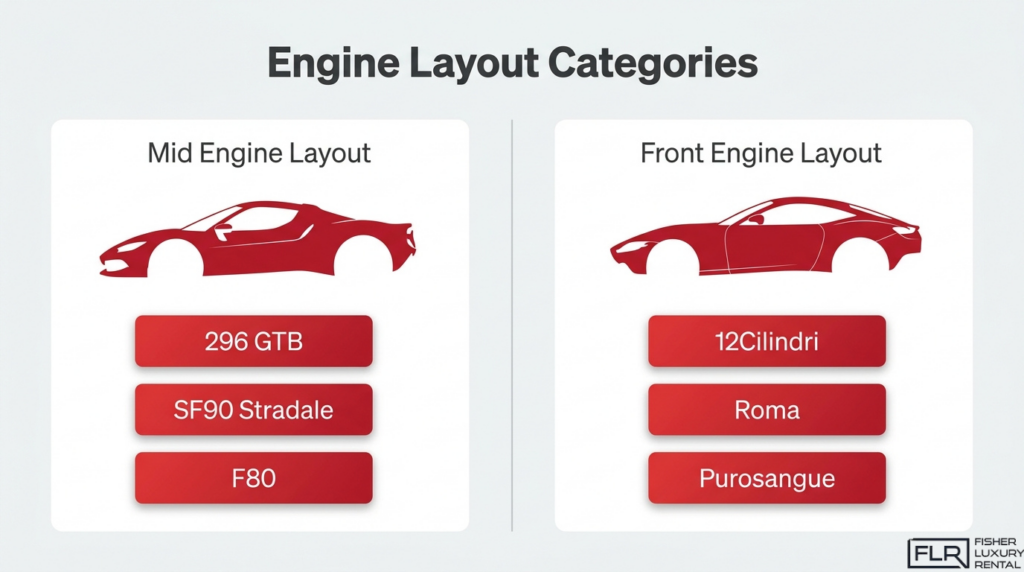
Ferrari model categories by engine layout fall into two primary groups: mid-engine and front-engine configurations. The sections below identify which current production models belong to each layout and explain what that placement means for performance.
Which Ferrari Models Have Mid-Engine Configurations?
The Ferrari models with mid-engine configurations are the 296 GTB, 296 GTS, SF90 Stradale, SF90 Spider, 849 Testarossa, and F80. Placing the engine behind the driver and ahead of the rear axle concentrates mass at the center of the car, improving handling balance and cornering precision. This layout dominates Ferrari’s performance-oriented lineup because it allows engineers to maximize grip and responsiveness. According to MotorTrend, the 849 Testarossa pairs its mid-mounted 4.0L twin-turbo V-8 with three electric motors for a combined output of 1,050 cv, illustrating how Ferrari uses this configuration to amplify hybrid performance. The F80 follows the same principle, mounting its V-6 hybrid system centrally to support all-wheel-drive capability.
Which Ferrari Models Have Front-Engine Configurations?
The Ferrari models with front-engine configurations are the 12Cilindri, 12Cilindri Spider, Roma, Roma Spider, Amalfi, and Purosangue. In this layout, the engine sits ahead of the passenger compartment, enabling a longer wheelbase and a more accommodating cabin without sacrificing structural rigidity. Ferrari uses front-engine placement specifically for its grand touring and SUV models, where comfort, refinement, and everyday usability take priority alongside outright speed. According to Car and Driver, the 12Cilindri’s naturally aspirated 6.5-liter V-12 produces 819 horsepower, proving that front-engine Ferraris sacrifice nothing in raw power. For buyers who want extended journeys without compromise, the front-engine lineup is often the more practical choice.
What Are the Hybrid and Electric Ferrari Models in 2026?
The hybrid and electric Ferrari models in 2026 span two categories: plug-in hybrid production cars and a forthcoming fully electric debut. The sections below cover which models use PHEV powertrains and what Ferrari’s first EV represents for the brand.
Which Ferrari Models Use Plug-In Hybrid Powertrains?
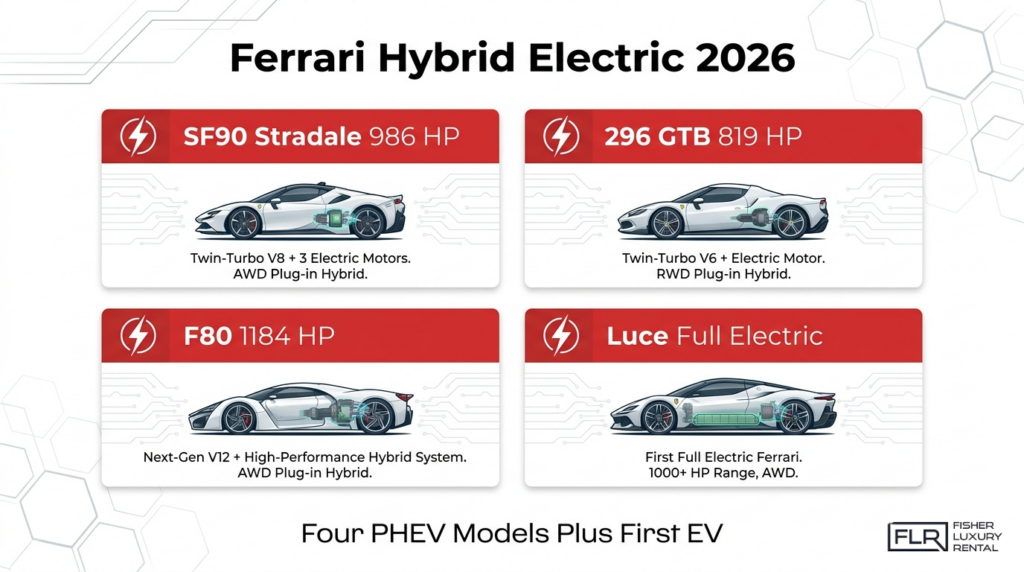
The Ferrari models that use plug-in hybrid powertrains are the 296 GTB, 296 GTS, SF90 Stradale, SF90 Spider, 849 Testarossa, and F80. Each pairs an internal combustion engine with one or more electric motors for increased output and all-wheel-drive capability.
- 296 GTB / 296 GTS: A 120° V6 engine combined with a PHEV system delivers 819 hp combined (830 cv), with the GTB starting at $338,250 and the GTS at $367,189.
- SF90 Stradale / SF90 Spider: A 4.0L twin-turbo V8 rated at 769 hp pairs with three electric motors adding 217 hp for a total of 986 hp.
- 849 Testarossa: A 4.0L twin-turbo V8 producing 818 hp is supplemented by three electric motors for a total of 1,050 cv, with prices starting at $565,685.
- F80: A 3.0-liter twin-turbo V6 combined with an electric front axle and rear MGU-K delivers a combined 1,184 hp, reaching 62 mph in 2.15 seconds.
Ferrari’s PHEV strategy is the most performance-focused in production car history. No other automaker currently fields four PHEV models spanning this horsepower range within a single lineup.
What Is Ferrari’s First Fully Electric Model?
Ferrari’s first fully electric model is the Ferrari Luce, scheduled for its world premiere in Rome on May 25, 2026, with order books opening immediately after the reveal. Ferrari CEO Benedetto Vigna has stated that the driving engagement of an electric Ferrari will match that of a thermal Ferrari, underscoring the brand’s commitment to preserving its identity through the transition.
Ferrari has also revised its 2030 electrification target to a 20% electric vehicle mix, down from a previous 40% goal, while maintaining a 40% share for traditional internal combustion engines. The Luce’s arrival marks the most significant strategic shift in the brand’s history without abandoning its core character.
How Does Ferrari’s V6 Lineup Compare to Its V12 Lineup?
Ferrari’s V6 and V12 lineups represent two distinct engineering philosophies: electrified mid-engine performance versus naturally aspirated front-engine grandeur. The V6 models prioritize hybrid efficiency and raw acceleration, while the V12 models deliver high-revving, analog drama at higher price points.
V6 vs. V12: Engine Philosophy
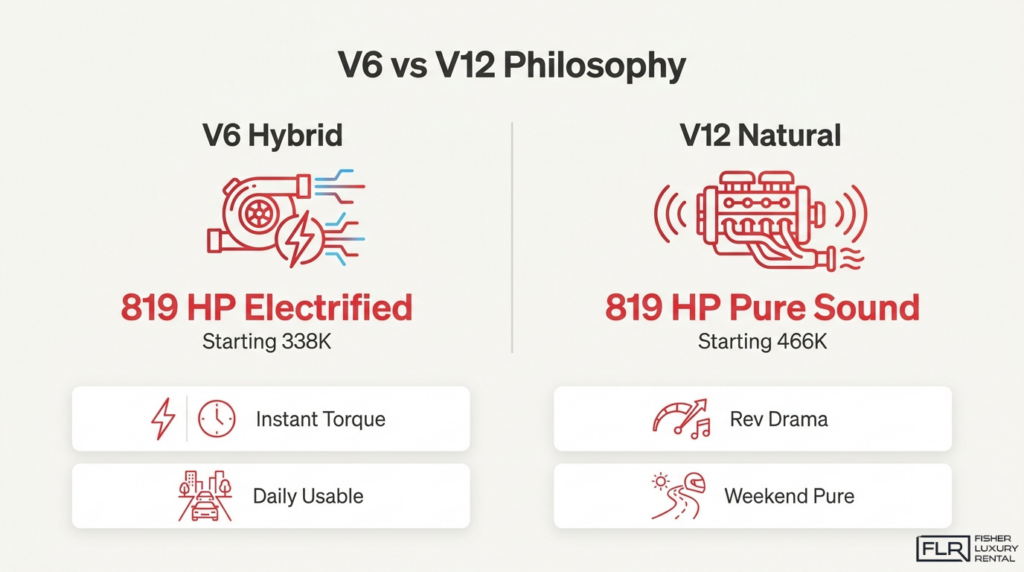
Ferrari’s V6 lineup uses turbocharged, plug-in hybrid powertrains, while its V12 lineup relies on large-displacement, naturally aspirated engines. The 296 GTB pairs a 120-degree V6 with a PHEV system for a combined 819 horsepower, achieving supercar performance in a mid-engine package. By contrast, according to Car and Driver, the 12Cilindri’s 6.5-liter V-12 produces 819 hp at a stratospheric 9,250 rpm without any electrification, delivering a fundamentally different — and intensely acoustic — driving character.
V6 vs. V12: Performance and Price
Ferrari’s V6 models start lower in price and produce comparable peak power to V12 models through hybrid assistance. The 296 GTB starts at $338,250, while the 12Cilindri coupe starts at $465,994. Both engines reach 819 horsepower through completely different means: one through battery-assisted torque fill, the other through mechanical revs alone. For drivers who value analog purity over electrified efficiency, the V12’s naturally aspirated character remains irreplaceable.
V6 vs. V12: Accessibility and Character
Ferrari’s V6 models offer broader daily usability thanks to hybrid torque delivery at lower rpm, while V12 models reward drivers who push to the top of the rev range. The V6’s turbocharged architecture delivers immediate response across a wider power band, making it more forgiving in varied driving conditions. The V12, however, represents Ferrari’s most emotionally pure expression, built for buyers who prioritize sensation over practicality. For those choosing between the two, engine preference ultimately defines the decision more than performance numbers alone.
What Are Ferrari’s Limited-Edition and Special Series Models?
Ferrari’s limited-edition and special series models are one-off or ultra-low-volume builds commissioned through Ferrari’s Special Projects program, each representing the pinnacle of bespoke craftsmanship. The following H3s cover three notable examples: the Daytona SP3, the SP-8, and the KC23.
Ferrari Daytona SP3
The Ferrari Daytona SP3 is a limited-series hypercar celebrating Ferrari’s endurance racing heritage with an open-cockpit, mid-engine design. Its collector status was cemented when a “Tailor Made” Daytona SP3 sold for $26,000,000 at the RM Sotheby’s Monterey auction in August 2025, setting a record as the most valuable new car ever sold at auction. For serious collectors, the Daytona SP3 represents not just a driving machine but a financial asset whose value is shaped entirely by exclusivity and Ferrari’s Tailor Made personalization program.
Ferrari SP-8
The Ferrari SP-8 is a one-off roadster based on the F8 Spider, built through Ferrari’s Special Projects division for a single private client. According to Conceptcarz, the SP-8 features a 3.9-liter twin-turbo V8 engine producing 710 BHP at 8000 RPM. Its open-top, barchetta-inspired bodywork distinguishes it visually from the donor F8 Spider while retaining the same high-performance mechanical foundation.
Ferrari KC23
The Ferrari KC23 is a one-off track car designed exclusively for non-competitive track use, built on the 488 GT3 Evo 2020 chassis and engine, according to Ferrari Magazine. Its carbon-fiber bodywork and aerodynamic package are purpose-engineered for circuit driving without any racing homologation requirement. The KC23 exemplifies Ferrari’s ability to merge motorsport engineering with private commission artistry for clients seeking pure track experience.
How Much Do Ferrari Models Cost in 2026?
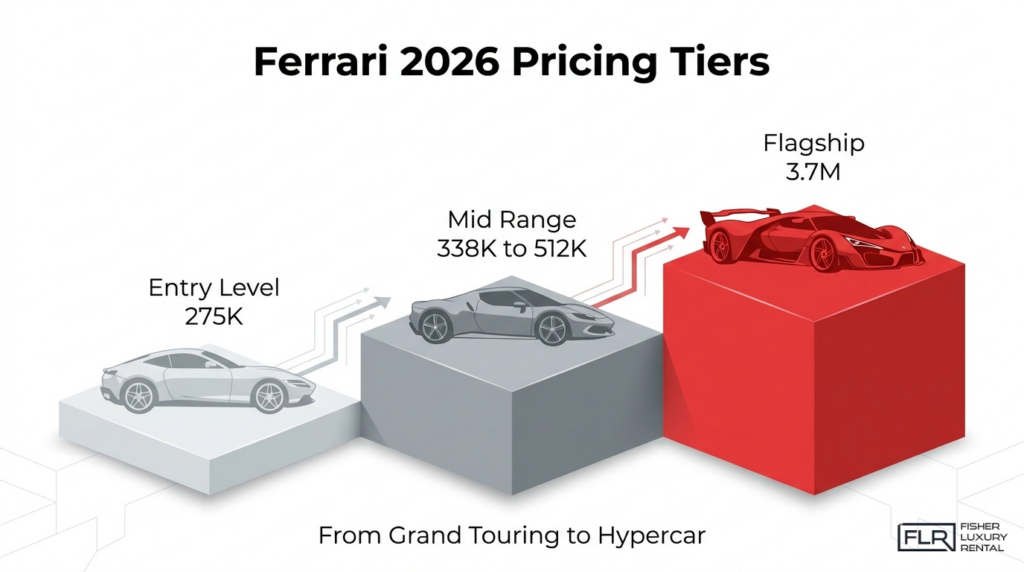
Ferrari model prices in 2026 span from roughly $275,000 for entry-level grand tourers to over $3.7 million for limited-edition hypercars. The sections below cover entry-level, mid-range, and flagship pricing in detail.
What Is the Starting Price for Entry-Level Ferrari Models?
The starting price for entry-level Ferrari models in 2026 is approximately $275,000. According to MotorTrend, the Ferrari Amalfi carries an expected starting price of around $275,000, making it the most accessible point of entry into the current lineup. The Roma Spider sits at a similar level, with an MSRP starting at $274,965 per CarGurus. For buyers seeking a Ferrari experience without crossing into mid-six-figure territory, these two models represent the floor of the 2026 range.
What Do Mid-Range Ferrari Models Cost?
Mid-range Ferrari models cost between roughly $338,000 and $465,000. The key price points in this tier are:
- Ferrari 296 GTB: Starting at $338,250
- Ferrari 296 GTS: Starting at $367,189
- Ferrari Purosangue: Starting at $428,636
- Ferrari 12Cilindri coupe: Starting at $465,994
- Ferrari 12Cilindri Spider: Starting at $512,394
According to Car and Driver, these figures reflect base MSRP before options or Tailor Made personalization, which can add substantially to the final cost. This tier offers the widest variety of powertrains, from V6 hybrids to naturally aspirated V12s, giving buyers genuine choice across driving characteristics.
What Do Flagship and Limited-Edition Ferraris Cost?
Flagship and limited-edition Ferrari models cost between $565,685 and $3,735,000. The 849 Testarossa coupe starts at $565,685, with its Spider variant at $611,685, per Road and Track. At the extreme end, the F80 carries a starting MSRP of approximately $3,735,000, with production capped at 799 units, all already allocated, per Car and Driver. These prices reflect not just performance credentials but the near-impossibility of acquisition, which is precisely what positions Ferrari at the top of the collector and investment market.
What Performance Specs Define Each Ferrari Model Tier?
Ferrari’s 2026 performance tiers are defined by engine configuration: V6 hybrid, V8 hybrid, and naturally aspirated V12. The H3s below detail the specific horsepower outputs for each tier.
How Much Horsepower Do Ferrari V6 Hybrid Models Produce?
Ferrari V6 hybrid models produce between 819 and 1,184 horsepower depending on the variant. The 296 GTB pairs a 120-degree V6 with a plug-in hybrid system to deliver 819 combined horsepower, according to Ferrari of Fort Lauderdale. At the top of the V6 tier, the F80 uses a 3.0-liter twin-turbo V6 with three electric motors to generate 1,184 horsepower, reaching 62 mph in just 2.15 seconds. The power gap between the 296 GTB and the F80 is striking and reflects how aggressively Ferrari has scaled hybrid technology within a single engine family.
How Much Horsepower Do Ferrari V8 Hybrid Models Produce?
Ferrari V8 hybrid models produce between 612 and 1,050 combined horsepower across the lineup. The key outputs by model are:
- Ferrari Roma / Roma Spider: 612 hp from a 3.9-liter twin-turbo V8 (non-hybrid)
- Ferrari SF90 Stradale: 986 hp total, combining a 769 hp twin-turbo V8 with three electric motors producing an additional 217 hp
- Ferrari 849 Testarossa: 1,050 cv total, pairing an 818 hp 4.0-liter twin-turbo V8 with three electric motors
According to Ferrari Lake Forest, the SF90 Stradale’s V8 alone produces 769 hp before hybrid assistance. The 849 Testarossa represents the most powerful V8-based production Ferrari currently available.
How Much Horsepower Do Ferrari V12 Models Produce?
Ferrari V12 models produce between 715 and 819 horsepower, all drawn from naturally aspirated engines without hybrid assistance. The two current V12 production models are:
- Ferrari Purosangue: 715 hp from a naturally aspirated V12, with 80% of torque available at 2,100 rpm
- Ferrari 12Cilindri: 819 hp at 9,250 rpm from a 6.5-liter naturally aspirated V12
According to Car and Driver, the 12Cilindri “eschews electrification, instead marrying its old-school V-12 with Ferrari’s latest chassis tech.” The V12 tier delivers the highest-revving, most acoustically pure Ferrari experience available, which makes it the preferred choice for purists regardless of peak horsepower comparisons with hybrid models.
Which Ferrari Models Are Best for Daily Driving?
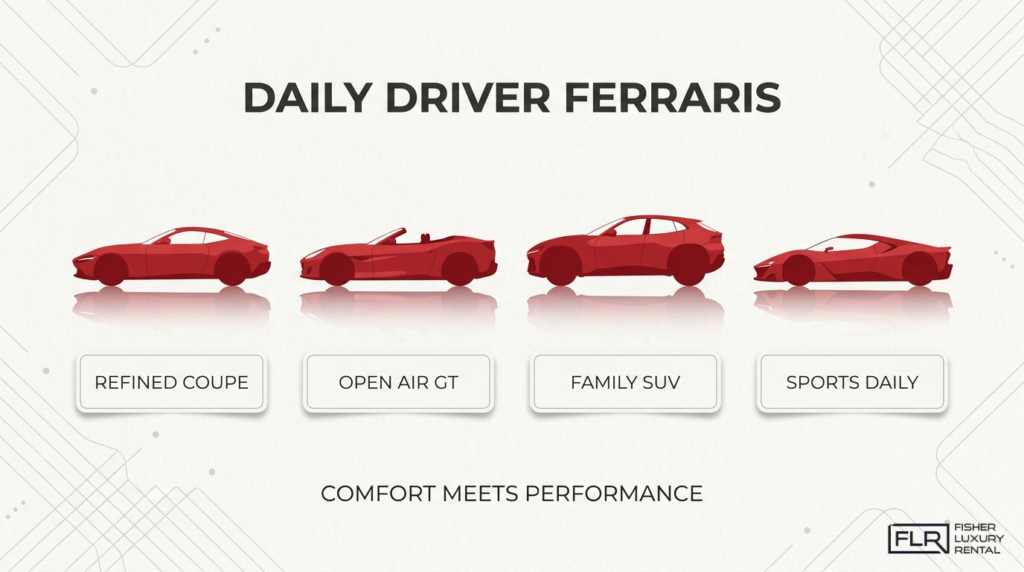
The Ferrari models best for daily driving prioritize comfort, usability, and accessible power over outright track performance. The Roma, Purosangue, and Amalfi stand out as the strongest candidates, each offering distinct advantages depending on driving style and passenger needs.
Ferrari Roma
The Ferrari Roma is the best daily driver in Ferrari’s coupe lineup for buyers who prioritize a refined, elegant experience. Its 3.9-liter twin-turbo V8 produces 612 horsepower, delivering strong performance without the harsh ride of a track-focused car. The Roma’s grand touring character, composed suspension tuning, and well-appointed interior make extended drives genuinely comfortable rather than fatiguing.
Ferrari Roma Spider
The Ferrari Roma Spider is the convertible variant of the Roma, sharing the same 612-horsepower twin-turbo V8 and grand touring DNA. It adds open-air driving to the Roma’s everyday usability, making it particularly well-suited to warmer climates. For drivers who want a Ferrari capable of weekend road trips and daily commutes alike, the Roma Spider represents an exceptionally balanced choice.
Ferrari Purosangue
The Ferrari Purosangue is Ferrari’s four-door, four-seat SUV and the most practical model in the 2026 lineup for daily use. Equipped with a naturally aspirated V-12 producing 715 hp and 528 lb-ft of torque, with 80% of torque available at just 2100 rpm, it delivers effortless low-speed pull in city traffic. The available “Handling Speciale” configuration adds sporting dynamics without sacrificing ride quality, making it the most versatile Ferrari for drivers with families or frequent passengers.
Ferrari Amalfi
The Ferrari Amalfi is a rear-wheel-drive model powered by a 3.9-liter V8, positioned as Ferrari’s direct competitor to the Porsche 911 in the everyday sports car segment. According to Driving.ca, it carries a 36-month unlimited mileage comprehensive and powertrain warranty, a significant practical advantage for buyers using it as a primary vehicle. Among Ferrari’s 2026 lineup, the Amalfi arguably offers the most complete ownership proposition: accessible performance, daily comfort, and genuine long-term peace of mind.
How Does Ferrari’s 2026 Lineup Compare to Previous Years?
Ferrari’s 2026 lineup represents the most expansive and technically diverse range in the brand’s history, introducing new nameplates, revived heritage names, and the first fully electric model alongside continued V8 and V12 offerings.
New Models Entering the 2026 Lineup
The new models entering the 2026 Ferrari lineup include the 849 Testarossa, the Amalfi, and the Ferrari Luce. The 849 Testarossa revives one of Ferrari’s most celebrated nameplates with a modern 4.0L twin-turbo V8 and three electric motors producing 1050 cv. The Amalfi replaces the Roma as Ferrari’s entry-level grand tourer, starting at approximately $275,000. The Luce marks Ferrari’s first foray into fully electric motoring, with its world première scheduled for May 25, 2026.
Models Continuing From Previous Years
The models continuing from previous years include the SF90 Stradale, 296 GTB, 12Cilindri, Purosangue, and the Roma. These carry-over models have received refinements rather than full redesigns. The 296 Speciale, revealed in 2025, introduced a 19.8-pound lighter engine and increased electric motor output from 165 to 178 horsepower, according to Car and Driver, showing Ferrari’s commitment to continuous performance improvement rather than static model cycles.
How the Powertrain Mix Has Shifted
The powertrain mix has shifted significantly in 2026, with hybrid architectures now spanning multiple tiers. Ferrari has revised its 2030 electrification target to a 20% electric vehicle mix, down from the original 40% goal, while maintaining 40% for traditional internal combustion engines. The 2026 lineup reflects this recalibration: V12 naturals remain in the 12Cilindri and Purosangue, while PHEVs anchor the performance and supercar tiers.
How Can You Experience Ferrari Models Without Ownership?
You can experience Ferrari models without ownership through luxury car rental services that provide access to these vehicles for daily or short-term use. This section covers how Fisher Luxury Rental makes that possible, followed by key takeaways from the full 2026 Ferrari lineup.
Can You Rent a Ferrari Through Fisher Luxury Rental?
Yes, you can rent a Ferrari through Fisher Luxury Rental, with options including the Ferrari California T Convertible starting at $599 per day and the Ferrari 488 Spider at $1,499 per day. Fisher Luxury Rental serves Phoenix, Scottsdale, Portland, and Vancouver, offering top-trim exotic vehicles maintained to a premium standard. For context, daily Ferrari rental rates in major U.S. cities typically range from $900 to $3,000 according to Premier Auto Miami, making Fisher Luxury Rental a competitive option for first-time exotic car drivers and enthusiasts alike. Renting is, in many ways, the most practical path to experiencing a Ferrari without the six-figure purchase commitment or multi-year waitlist that defines ownership today.
What Are the Key Takeaways About the Full Ferrari Lineup in 2026?
The key takeaways about the full Ferrari lineup in 2026 are that the brand spans a wider range of powertrains, body styles, and price points than any previous year, while maintaining strict production discipline. Ferrari’s order book already extends toward the end of 2027, confirming that ownership remains out of reach for most enthusiasts regardless of budget. For those who want the driving experience without the wait or the cost, rental services like Fisher Luxury Rental offer an immediate and memorable alternative.