
The Ferrari logo is a heraldic shield featuring a black prancing horse on a canary yellow background, paired with the Italian tricolor stripes and the “S.F.” inscription for Scuderia Ferrari. Every element carries a specific historical or geographic meaning rooted in early 20th-century Italy.
This article covers the military origins of the horse symbol, what each logo element represents, how the badge has evolved across nearly a century, its place within Italian heraldry, its comparison to the Porsche crest, and how the Prancing Horse became one of the world’s most valuable luxury symbols.
The symbol begins with Francesco Baracca, Italy’s top WWI fighter ace, who painted a modified version of his cavalry regiment’s prancing horse onto his aircraft fuselage. His mother transferred that emblem to Enzo Ferrari in 1923 with a single instruction: put it on your cars for good luck.
Each element of the resulting logo was chosen deliberately. The horse stayed black, the yellow came from Modena’s civic color, the tricolor declared Italian identity, and “S.F.” anchored the racing team’s name to the badge.
The logo’s design has shifted incrementally from its 1929 debut through a 2002 refinement to a 2026 Formula 1 rebrand, while its core visual identity has remained intact. That continuity reflects the deeper story: a heraldic tradition stretching from a 1692 cavalry regiment through a fallen war hero to one of the most legally protected and financially valued brand marks on earth.
Who Was the Pilot Behind the Ferrari Prancing Horse Symbol?
The pilot behind the Ferrari Prancing Horse symbol is Francesco Baracca, Italy’s greatest World War I fighter ace. The following sections cover his aviation career, the heraldic origins of his horse emblem, and how his family transferred the symbol to Enzo Ferrari.
What Role Did Francesco Baracca Play in Italian Aviation?
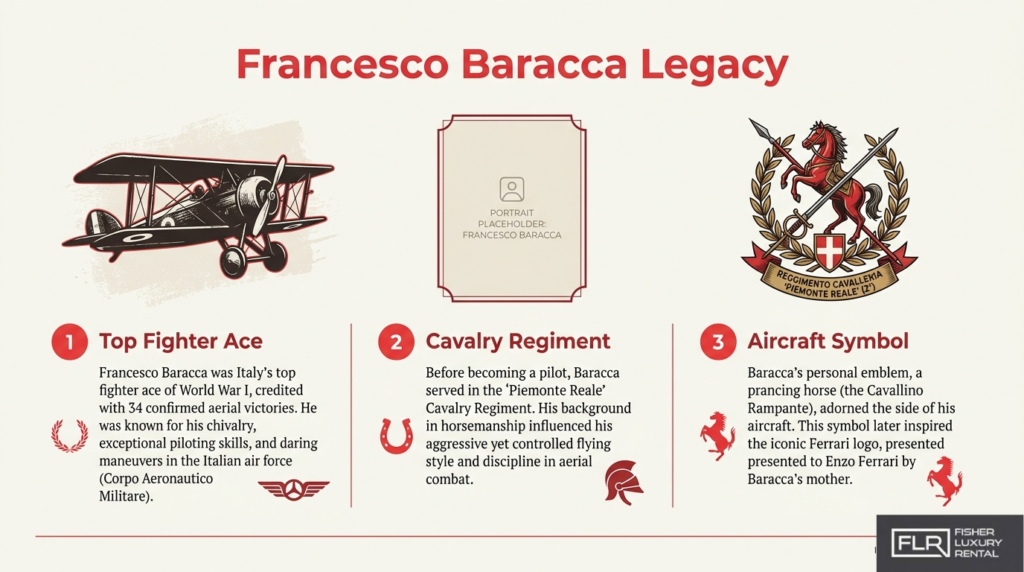
Francesco Baracca was Italy’s top fighter ace of World War I, credited with 34 confirmed aerial victories before being shot down and killed on June 19, 1918, during the Battle of the Piave River. According to the Encyclopedia 1914-1918 Online, he began his military career in 1910 as a cavalry officer in the prestigious 2nd “Piemonte Reale” Cavalry Regiment, garrisoned in Rome, before earning his pilot’s license in Reims, France, in July 1912. His cavalry roots would later prove inseparable from his identity as an aviator. Baracca’s record made him a national hero whose legacy outlasted his life by more than a century.
How Did Baracca’s Family Crest Feature the Prancing Horse?
Baracca’s family crest featured the prancing horse through its connection to the “Piemonte Reale” cavalry regiment. Founded in 1692, the regiment displays a silver prancing horse on a red background in its coat of arms. Baracca modified the horse to black for better visibility on his aircraft’s canvas, personalizing a heraldic tradition that stretched back more than two centuries. This deliberate adaptation transformed a regimental emblem into a personal mark of identity carried into combat.
How Did Countess Paolina Baracca Introduce the Symbol to Enzo Ferrari?
Countess Paolina Baracca introduced the symbol to Enzo Ferrari at a direct, personal meeting on June 17, 1923, after Ferrari won the Savio Circuit in Ravenna. The Countess told him: “Ferrari, put my son’s prancing horse on your cars. It will bring you luck.” This single exchange transferred a fallen war hero’s emblem to the racing world, giving it a new life on four wheels rather than aircraft fuselage.
Why Did Enzo Ferrari Adopt the Prancing Horse as His Emblem?
Enzo Ferrari adopted the Prancing Horse after a personal encounter with the family of Italy’s greatest WWI flying ace. The sections below cover his connection to Italian racing culture and what the symbol meant to him personally.
What Was Enzo Ferrari’s Connection to Italian Racing Culture?
Enzo Ferrari’s connection to Italian racing culture was forged through competition, not engineering. Before founding Scuderia Ferrari in 1929 to manage Alfa Romeo’s racing activities, Ferrari was himself a racing driver, competing on circuits across Italy during the early 1920s. It was this life on the track that placed him at the Savio Circuit in Ravenna on June 17, 1923, where a chance post-race meeting with Count Enrico and Countess Paolina Baracca set everything in motion. Racing was Ferrari’s identity, and the emblem he eventually chose reflected that world: military, competitive, and distinctly Italian.
What Did the Prancing Horse Represent to Enzo Ferrari Personally?
The Prancing Horse represented both tribute and territorial pride to Enzo Ferrari personally. After Countess Paolina Baracca urged him to use her late son’s emblem for good luck, Ferrari made one deliberate change: he placed the black horse on a canary yellow background, the civic color of Modena, his hometown. According to Ferrari Magazine, his own words confirmed this: “The horse was and will always be black; I added the canary yellow background, the colour of the city of Modena.” The full shield also incorporated the “S.F.” inscription for Scuderia Ferrari and the Italian national colors at the top. The emblem first appeared on Scuderia Ferrari’s cars at the Spa 24 Hours on July 9, 1932. For Ferrari, the symbol fused personal loyalty, regional identity, and competitive ambition into a single image that has endured for nearly a century.
What Does Each Element of the Ferrari Logo Mean?
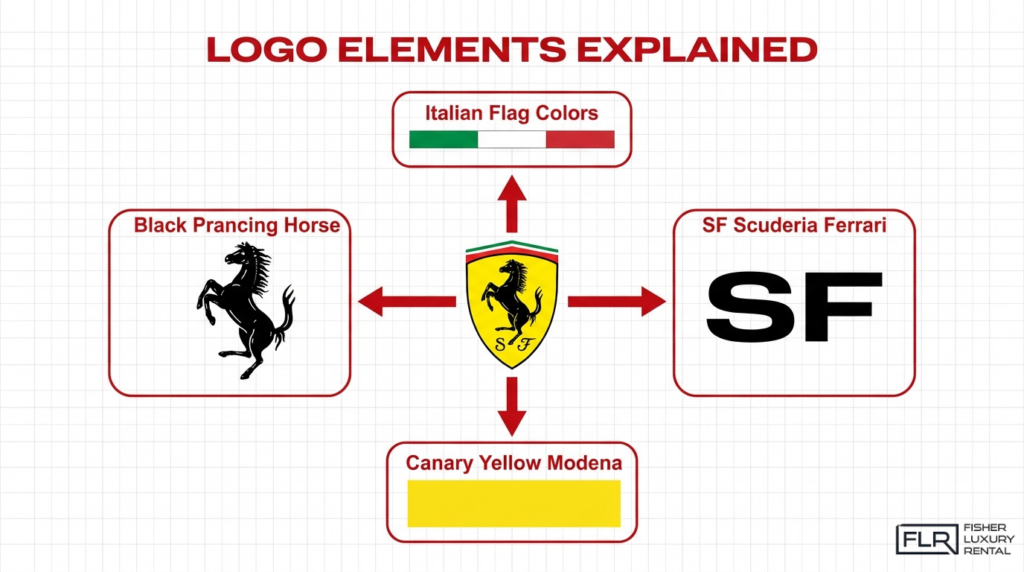
The Ferrari logo contains four distinct elements, each carrying its own historical or geographic meaning: the black prancing horse, the canary yellow background, the green-white-red stripes, and the “S.F.” inscription.
What Does the Black Prancing Horse Symbolize?
The black prancing horse symbolizes courage, speed, and the legacy of WWI ace Francesco Baracca, who painted the emblem on his aircraft fuselage. Baracca originally modified the horse from his cavalry regiment’s silver version to black for visibility on canvas. When Countess Paolina Baracca gifted the symbol to Enzo Ferrari in 1923, it carried the weight of a fallen hero’s identity into motorsport. Few brand symbols carry that depth of human story, which is precisely why the prancing horse remains one of the most recognized icons in the world.
Why Is the Ferrari Logo Background Yellow?
The Ferrari logo background is yellow because it represents the civic color of Modena, Enzo Ferrari’s hometown. According to Ferrari Magazine, Enzo stated directly: “The horse was and will always be black; I added the canary yellow background, the colour of the city of Modena.” The modern logo, finalized in 2002, preserves this canary yellow while updating the overall design for contemporary aesthetics. Ferrari’s 2026 Formula 1 logo introduced a “Rosso Scuderia” scheme with new white and black accents, but the core shield retains its iconic yellow for road cars.
What Do the Green White and Red Stripes Represent?
The green, white, and red stripes represent the Italian national flag. Positioned at the top of the shield, these three colors anchor the Ferrari brand firmly to its Italian identity and heritage. The stripes serve as a constant declaration of origin, connecting every Ferrari vehicle to Italy’s culture, craftsmanship, and national pride.
What Does the S F Inscription Stand For?
The “S.F.” inscription stands for Scuderia Ferrari, the racing division Enzo Ferrari founded in 1929. According to Goodwood Road and Racing, the full logo combines this inscription with the prancing horse, yellow background, and Italian tricolor into a unified heraldic shield. Together, these elements tell one cohesive story: a racing team born from Italian pride, personal grief, and competitive ambition.
How Has the Ferrari Logo Evolved Over the Decades?
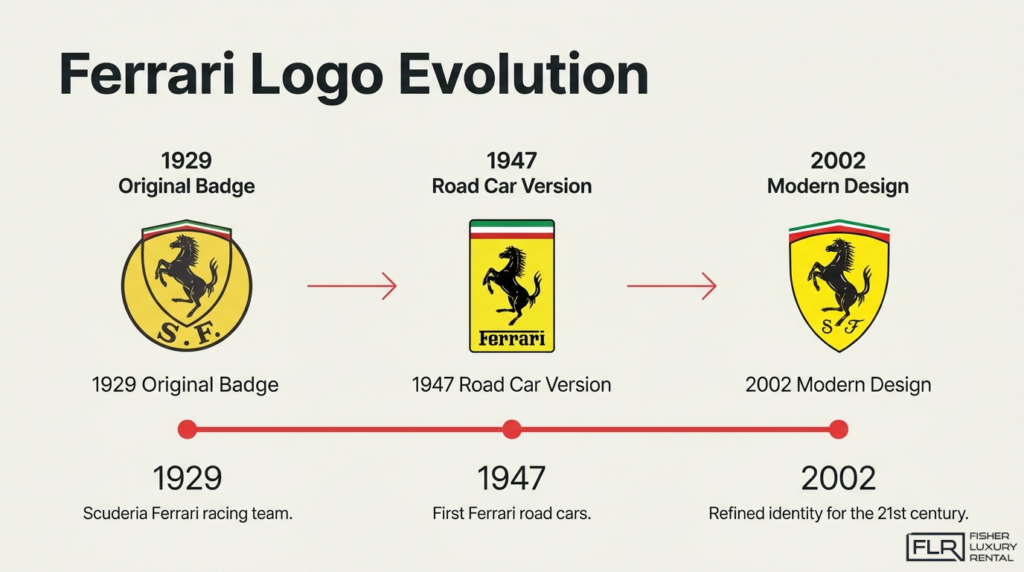
The Ferrari logo has changed incrementally across three distinct eras: its origins as a racing team badge, its transition to road car branding, and its refinement into the modern emblem used today.
What Did the Original 1929 Scuderia Ferrari Badge Look Like?
The original 1929 Scuderia Ferrari badge featured a shield shape carrying the black prancing horse on a yellow background, paired with the Italian national colors. According to Designbro, Ferrari refined this shield in 1931 by straightening the curved lines at the top, producing a cleaner, more angular silhouette. A significant milestone came in 1947, when the 125 S became the first car to carry the brand’s official badge as an independent manufacturer, marking Ferrari’s formal separation from Alfa Romeo.
How Did the Logo Change When Ferrari Became a Road Car Maker?
The logo’s transition to road car use brought greater standardization, anchoring the Prancing Horse shield as a unified identity across both racing and production vehicles. The core elements, the black horse, yellow background, and “S.F.” inscription, remained consistent, signaling brand continuity rather than reinvention. Ferrari’s commitment to protecting this identity is illustrated by active legal enforcement: in 2025, Ferrari pursued a trademark case in the Malaysian High Court against energy drink maker Sunrise-Mark over the horse-themed “WEE POWER” logo, a case Ferrari ultimately lost.
What Does the Modern Ferrari Logo Look Like Today?
The modern Ferrari logo is the refined shield design finalized in 2002, preserving the black prancing horse, canary yellow background, green-white-red tricolor stripes, and “S.F.” lettering from earlier versions. Most recently, Ferrari unveiled a 2026 Formula 1 team logo in January 2026, introducing a “Rosso Scuderia” color scheme with new white and black accents tied to Hewlett-Packard title sponsorship, showing that while the core badge endures, Ferrari continues adapting its visual identity for new competitive contexts.
What Is the Connection Between the Prancing Horse and Italian Heraldry?
The connection between the Prancing Horse and Italian heraldry runs through centuries of military tradition, cavalry symbolism, and regional civic identity. This section examines the regiment coat of arms that inspired Baracca’s emblem and the 1930 memorial artwork that directly shaped Ferrari’s modern logo.
The “Piemonte Reale” cavalry regiment, founded in 1692, features a silver prancing horse on a red background in its coat of arms. Baracca, who served in that regiment before becoming a pilot, modified the horse to black for better visibility on his aircraft’s canvas. The connection is direct: a 17th-century military heraldic tradition became the seed of one of the world’s most recognized automotive symbols.
A 1930 memorial brochure for Baracca, featuring a coat of arms designed by artist Gino Croari, shows a prancing horse with its tail pointing upward, a design variation identical to the modern Ferrari logo. This single archival document is, in my view, the most underappreciated evidence in the entire Ferrari origin story: it proves the tail-up posture was deliberate heraldic convention, not an arbitrary design choice by Enzo Ferrari.
The Emilia-Romagna region also contributed directly through Modena’s civic color, canary yellow, which Enzo Ferrari himself added as the shield’s background. Italian heraldry is present in every element of the badge: regimental arms, memorial iconography, and municipal color.
How Does the Ferrari Emblem Compare to Other Prancing Horse Logos?
The Ferrari emblem and the Porsche crest share a striking visual coincidence: both feature a prancing horse. The sections below explain why two competing automakers landed on the same symbol and what separates Ferrari’s horse from its German counterpart.
Why Do Ferrari and Porsche Both Feature a Horse on Their Crests?
Ferrari and Porsche both feature a horse on their crests for entirely separate historical reasons. Ferrari’s prancing horse traces directly to WWI ace Francesco Baracca’s aircraft emblem, while Porsche’s horse derives from the official coat of arms of Stuttgart, Germany, the city where Porsche is headquartered. According to Yahoo Autos, the parallel is a historical coincidence rather than any shared lineage between the two brands.
What Distinguishes the Ferrari Horse from the Stuttgart City Seal?
The Ferrari horse is distinguished from the Stuttgart city seal by its origin and the mythology surrounding it. Stuttgart’s seal depicts a horse standing on a red background as a civic heraldic symbol. A popular theory suggests Baracca may have first encountered the Stuttgart horse after shooting down a German pilot whose aircraft bore that city seal, though official records attribute his adoption of the emblem solely to his cavalry background in the “Piemonte Reale” regiment. The two horses share a visual resemblance but carry entirely different histories, making their parallel use across Ferrari and Porsche one of motorsport’s most debated coincidences.
Why Has the Prancing Horse Become a Global Symbol of Luxury?
The Prancing Horse has become a global symbol of luxury because it unites a century of wartime heroism, Italian cultural identity, and unbroken racing excellence into a single, instantly recognizable mark. The sections below explore the brand valuation, trademark enforcement, and cultural weight that sustain its status.
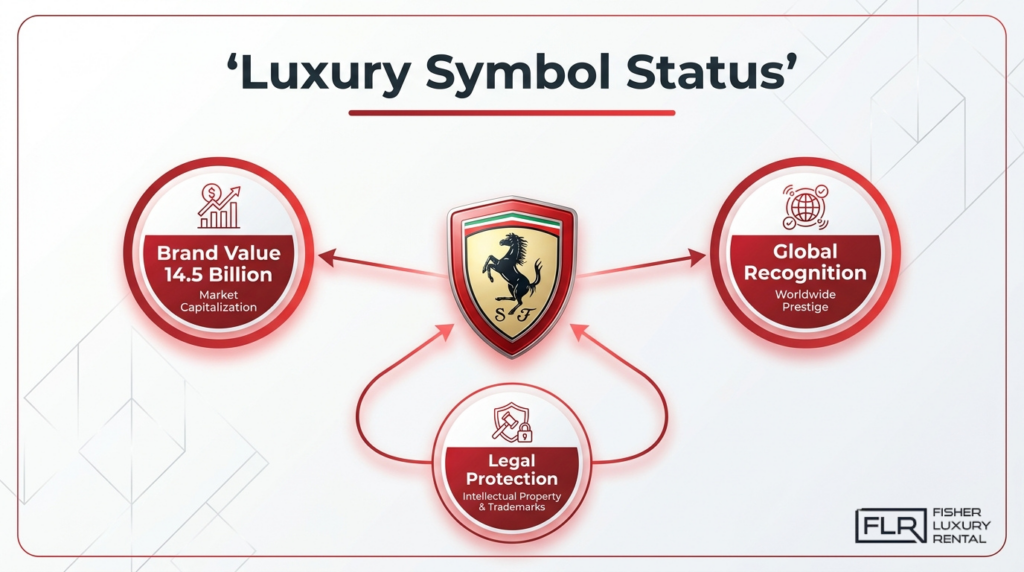
How Did Ferrari’s Brand Value Reach $14.5 Billion?
Ferrari’s brand value reached $14.5 billion after rising 39% in 2025, according to the Kantar BrandZ report, ranking it among the world’s most valuable luxury brands. That figure reflects more than vehicle sales. The Prancing Horse commands premium perception across fashion, motorsport, and popular culture simultaneously, making it one of the rare symbols that transcends any single industry. Few logos carry that breadth of cultural authority, and that breadth is precisely what separates Ferrari from every other automotive brand.
Why Does the Prancing Horse Carry Legal and Cultural Weight?
The Prancing Horse carries legal and cultural weight because Ferrari actively defends the trademark across industries far beyond automotive retail. Legal enforcement extends to fashion, as illustrated when designer Philipp Plein was required to seek consent before displaying the logo on social media. Ferrari also contested a horse-themed logo used by Malaysian energy drink maker Sunrise-Mark, though it lost that particular case in the Malaysian High Court in 2025. The volume of legal challenges alone signals how broadly the symbol is recognized and coveted.
What Cultural Factors Have Sustained the Symbol’s Global Prestige?
The cultural factors that have sustained the Prancing Horse’s global prestige are its layered origins: a fallen war hero, an Italian city’s civic color, and decades of Formula 1 dominance. The symbol connects modern buyers to Francesco Baracca’s courage, Modena’s regional pride, and Enzo Ferrari’s competitive obsession. That depth of narrative is impossible to manufacture or replicate. Ferrari’s 2026 Formula 1 rebrand, featuring a “Rosso Scuderia” livery with new accents for HP title sponsorship, shows the brand continues evolving while keeping the horse at its center, a deliberate signal that legacy and innovation coexist under the same emblem.
How Can You Experience the Ferrari Prancing Horse Firsthand?
You can experience the Ferrari Prancing Horse firsthand by renting one of the brand’s iconic models. The sections below cover what a Ferrari rental delivers and the key historical takeaways that make that experience meaningful.
Can Renting a Ferrari from Fisher Luxury Rental Bring the Logo’s Legacy to Life?
Yes, renting a Ferrari from Fisher Luxury Rental can bring the logo’s legacy to life in a way no museum visit replicates. Every detail of the car, from the Prancing Horse badge on the hood to the engine note, carries a century of heritage. Fisher Luxury Rental offers the Ferrari California T Convertible starting at $599 per day and the Ferrari 488 Spider at $1,499 per day, giving drivers access to top-trim models in Phoenix, AZ and Portland, OR. According to the 2025 Kantar BrandZ report, Ferrari’s brand value rose 39% to $14.5 billion, confirming that sitting behind that prancing horse emblem means something far beyond transportation. Few driving experiences place you this close to living history.
What Are the Key Takeaways About the Ferrari Logo and Prancing Horse History?
The key takeaways about the Ferrari logo and Prancing Horse history are rooted in military honor, personal legacy, and deliberate design. The symbol traces directly to WWI ace Francesco Baracca, whose prancing horse emblem was drawn from his cavalry regiment and painted on his fighter aircraft. A 1930 memorial brochure for Baracca, featuring artwork by artist Gino Croari, shows a prancing horse with its tail pointing upward, a design identical to the modern Ferrari logo. The trademark carries real legal weight: fashion designer Philipp Plein was required to seek consent before displaying the logo on social media. Looking ahead, Ferrari announced its first full-electric sports car, the “Ferrari Luce,” on February 9, 2026, signaling that the Prancing Horse will carry this legacy into an entirely new era.